Announcement

Collapse
No announcement yet.

Vladimir Putin saves the world?

Collapse
X
 
  • Filter
  • Time
  • Show
Clear All
new posts

  • EXCLUSIVE - BRICS emerging nations close to launching bank; to start lending in 2016

    BY ALONSO SOTO
    BRASILIA Fri May 30, 2014 4:05am IST


    (Reuters) - The five BRICS nations will likely agree to fund their $100 billion development effort equally, giving them the same rights in a new multilateral bank that could start lending in two years, a senior Brazilian government official told Reuters on Thursday.

    Capitalization of the bank was one of the main sticking points in the sometimes tortuous negotiations among the emerging powers to create a joint lender to finance infrastructure projects in developing nations.

    The new bank would symbolize the growing influence of emerging economies in the global financial architecture long dominated by the United States and Europe through the International Monetary Fund and World Bank.

    Negotiations to create the lender have dragged on for two years, with some members growing weary of China's desire to have a bigger stake in the bank by putting in more capital. But this hurdle is being overcome.

    "The majority wants an equal sharing of the capital and there is no other specific proposal on the table," said the official, who is directly involved in the negotiations. "This is not going to be a problem."

    Leaders of Brazil, Russia, India, China and South Africa are expected to sign a treaty to launch the bank officially when they meet at a BRICS summit in the northern Brazilian city of Fortaleza on July 15.

    The bank, which will have start-up capital of $50 billion, will have to be ratified by the countries' legislatures and could begin lending in two years, said the official, who requested anonymity because he was not authorized to speak publicly.

    Of that start-up capital, the countries will put in a total of $10 billion in cash and $40 billion in guarantees, which will be used to raise capital on international markets.

    The new development bank would help cover growing demand for project financing that has not been fully met by global multilaterals, which for years have been heavily criticized for meddling in the domestic policies of sovereign borrowers.

    "The bank will look into the finances of borrowers, but never intervene in their economic affairs," said the official. "Any country can join the bank with a $100,000 share. The idea is to provide them loans at a lower cost than what they would individually get in markets."

    The BRICS will also decide if the bank will be based in New Delhi, Shanghai, Johannesburg or Moscow. Brazil will not offer headquarters because of upcoming presidential elections that could delay negotiations, the official said.

    Later, the group will have to choose an executive "with experience in the financial sector" to lead the bank in a five-year presidency that will rotate among the founding members.

    In five years the bank's capital should double to $100 billion through capitalization from funding members, debt emissions or contributions from new members. The BRICS will hold a minimum of 55 percent of the bank's shares.


    China, Russia, Brazil, India and South Africa are all saying "f*** you" to the US and creating their own international organizations parallel to the US/Western controlled ones such as the World Bank and IMF.


    With the BRICS working towards weakening the petro-dollar, they are also setting up a rival "World Bank" or "IMF".

    We are witnessing the demise of American/western hegemony in slow motion but in front of our eyes.
    * * * * * * * * * * * * * * * * * * * * * * *

    Comment


    • THE ROVING EYE
      The future visible in St Petersburg
      By Pepe Escobar

      The unipolar model of the world order has failed.
      - Vladimir Putin, St Petersburg, May 22

      In more ways than one, last week heralded the birth of a Eurasian century. Of course, the US$400 billion Russia-China gas deal was clinched only at the last minute in Shanghai, on Wednesday (a complement to the June 2013, 25-year, $270 billion oil deal between Rosneft and China's CNPC.)

      Then, on Thursday, most of the main players were at the St Petersburg International Economic Forum - the Russian answer to Davos. And on Friday, Russian President Vladimir Putin, fresh


      from his Shanghai triumph, addressed the participants and brought the house down.

      It will take time to appraise last week's whirlwind in all its complex implications. Here are some of the St Petersburg highlights, in some detail. Were there fewer Western CEOs in town because the Obama administration pressured them - as part of the "isolate Russia" policy? Not many less; Goldman Sachs and Morgan Stanley may have snubbed it, but Europeans who matter came, saw, talked and pledged to keep doing business.

      And most of all, Asians were ubiquitous. Consider this as yet another chapter of China's counterpunch to US President Barack Obama's Asian tour in April, which was widely described as the "China containment tour". [1]

      On the first day at the St Petersburg forum I attended this crucial session on Russia-China strategic economic partnership. Pay close attention: the roadmap is all there. As Chinese Vice President Li Yuanchao describes it: "We plan to combine the program for the development of Russia's Far East and the strategy for the development of Northeast China into an integrated concept."

      That was just one instance of the fast-emerging Eurasia coalition bound to challenge the "indispensable" exceptionalists to the core. Comparisons to the Sino-Soviet pact are infantile. The putsch in Ukraine - part of Washington's pivot to "contain" Russia - just served to accelerate Russia's pivot to Asia, which sooner or late would become inevitable.

      It all starts in Sichuan
      In St Petersburg, from session to session and in selected conversations, what I saw were some crucial building blocks of the Chinese New Silk Road(s), whose ultimate aim is to unite, via trade and commerce, no less than China, Russia and Germany.

      For Washington, this is beyond anathema. The response has been to peddle a couple of deals which, in thesis, would guarantee American monopoly of two-thirds of global commerce; the Trans-Pacific Partnership (TPP) - which was essentially rebuked by key Asians such as Japan and Malaysia during Obama's trip - and the even more problematic Trans-Atlantic Partnership with the EU, which average Europeans absolutely abhor (see Breaking bad in southern NATOstan, Asia Times Online, April 15, 2014). Both deals are being negotiated in secret and are profitable essentially for US multinational corporations.

      For Asia, China instead proposes a Free Trade Area of Asia-Pacific; after all, it is already the largest trading partner of the 10-member Association of Southeast Asian Nations (ASEAN).

      And for Europe, Beijing proposes an extension of the railway that in only 12 days links Chengdu, the capital of Sichuan, to Lodz in Poland, crossing Kazakhstan, Russia and Belarus. The total deal is the Chongqing-Xinjiang-Europe network, with a final stop in Duisburg, Germany. No wonder this is bound to become the most important commercial route in the world. [2]

      There's more. One day before the clinching of the Russia-China gas deal, President Xi Jinping called for no less than a new Asian security cooperation architecture, including of course Russia and Iran and excluding the US. [3] Somehow echoing Putin, Xi described NATO as a Cold War relic.

      And guess who was at the announcement in Shanghai, apart from the Central Asian "stans": Iraqi Prime Minister Nouri al-Maliki, Afghan President Hamid Karzai and crucially, Iranian President Hassan Rouhani.

      The facts on the ground speak for themselves. China is buying at least half of Iraq's oil production - and is investing heavily in its energy infrastructure. China has invested heavily in Afghanistan's mining industry - especially lithium and cobalt. And obviously both China and Russia keep doing business in Iran. [4]

      So this is what Washington gets for over a decade of wars, incessant bullying, nasty sanctions and trillions of misspent dollars.

      No wonder the most fascinating session I attended in St Petersburg was on the commercial and economic possibilities around the expansion of the Shanghai Cooperation Organization (SCO), whose guest of honor was none other than Li Yuanchao. I was arguably the only Westerner in the room, surrounded by a sea of Chinese and Central Asians.

      The SCO is gearing up to become something way beyond a sort of counterpart to NATO, focusing mostly on terrorism and fighting drug trafficking. It wants to do major business. Iran, India, Pakistan, Afghanistan and Mongolia are observers, and sooner rather than later will be accepted as full members.

      Once again that's Eurasian integration in action. The branching out of the New Silk Road(s) is inevitable; and that spells out, in practice, closer integration with Afghanistan (minerals) and Iran (energy).

      The new Crimea boom
      St Petersburg also made it clear how China wants to finance an array of projects in Crimea, whose waters, by the way, boasting untold, still unexplored, energy wealth, are now Russian property. Projects include a crucial bridge across the Kerch Strait to connect Crimea to mainland Russia; expansion of Crimean ports; solar power plants; and even manufacturing special economic zones (SEZs). Moscow could not but interpret it as Beijing's endorsement of the annexation of Crimea.

      As for Ukraine, it might as well, as Putin remarked in St Petersburg, pay its bills. [5] And as for the European Union, at least outgoing president of the European Commission Jose Manuel Barroso understood the obvious: antagonizing Russia is not exactly a winning strategy.

      Dmitry Trenin, director of the Carnegie Moscow Center, has been one of those informed few advising the West about it, to no avail: "Russia and China are likely to cooperate even more closely ... Such an outcome would certainly benefit China, but it will give Russia a chance to withstand US geopolitical pressure, compensate for the EU's coming energy re-orientation, develop Siberia and the Far East, and link itself to the Asia-Pacific region." [6]

      On the (silk) road again
      The now symbiotic China-Russia strategic alliance - with the possibility of extending towards Iran [7] - is the fundamental fact on the ground in the young 21st century. It will extrapolate across the BRICS, the Shanghai Cooperation Organization, the Collective Security Treaty Organization and the Non-Aligned Movement.

      Of course the usual shills will keep peddling that the only possible future is one led by a "benign" empire. [8] As if billions of people across the real world - even informed Atlanticists - would be gullible enough to buy it. Still, unipolarity may be dead, but the world, sadly, is encumbered with its corpse. The corpse, according to the new Obama doctrine, is now "empowering partners".

      To paraphrase Dylan ("I left Rome and landed in Brussels"), I left St Petersburg and landed in Rome, to follow yet another episode in the slow decadence of Europe - the parliamentary elections. But before that, I was fortunate to experience an aesthetic illumination. I visited a virtually deserted Institute of Oriental Manuscripts of the Russian Academy of Sciences, where two dedicated, extremely knowledgeable researchers gave me a private tour of some pieces belonging to arguably the most outstanding collection of Asian manuscripts on the planet. As a serial Silk Road traveler fanatic, I had heard about many of those documents, but I had never actually seen them. So there I was, on the banks of the Neva, a kid in a (historical) candy store, immersed in all those marvels from Dunhuang to Mongolia, in Vedic or Sanskrit, dreaming of Silk Roads past and future. I could stay there forever.

      Comment


      • America’s Declining Influence in the Middle East

        After 9/11, America unleashed their campaign to completely change the political landscape of the Middle East. Under the pretext of fighting terrorism and protecting the US national security, George W Bush and Barack Obama presided over military campaign and covert operations in Afghanistan, Iraq, Libya, Syria, and Iran and also looked to influence the outcome of the Arab Spring in their favour. However, analysing the current situation in the Middle East, one can say with some confidence that the American policy over the last 13 years completely backfired and has played a role in declining American influence and power in the region.

        Iraq and Afghanistan failure

        Apart from the obvious human costs (the Lancet journal in 2006 published an estimate of 654,965 excess Iraqi deaths related to the war), there has been a monumental financial cost (Congressional Research Service estimates that the US spent almost $802bn on funding the war by 2011). The failure of these military campaigns is so obvious that even the American mainstream media propaganda was unable to convince the American people of the worthiness of these wars. On Iraq, Americans by 52%-37% say the United States mostly failed to achieve its goals. On Afghanistan, Americans by a nearly identical 52%-38% say the U.S. has mostly failed to achieve its goals.

        Afghanistan is hardly a functioning state and will require enormous amount of aid that the taxpayer will have to pay in order to prop up basic governing conditions. Furthermore, there is a high chance that the Taliban will slowly make its come back once the American troops pull out. In addition, Iraq is now closer politically to Iran than ever before, due to the Shia majority. Ultimately, the United States not only failed dismally in their self-destructive mission to coerce these two countries through force, but it has actually pushed them further away from the American orbit of influence.

        Syria and Iran

        Despite the best efforts of the American hawks to remove Syrian President Assad from power through sponsoring and financing foreign fighters that have unleashed their radical jihadist attitude on the Syrian people, Assad will likely remain the President of Syria for the foreseeable future. The Syrian “opposition” have proven to be incapable of forming a legitimate body and have committed enough atrocities to ensure that the majority of Syrian people are supportive of Assad. Thanks to Russia’s positive intervention to prevent the US from attacking Syria, in exchange for the destruction of Syria’s chemical weapons, the Middle Eastern country has been spared the fate suffered by Iraq. Though the brutal civil war in Syria is likely to continue, the country is in a better shape than it would have been if American hawks prevailed in convincing Obama to attack Syria.

        Iran, meanwhile, has built closer ties with Russia and China. It was announced recently that Russian President Vladimir Putin and Iranian President Hassan Rouhani agreed that Moscow would build two additional nuclear power plants for Tehran and construct new facilities next to Iran’s power plant in the city of Bushehr. The Ukrainian crisis makes both Russia and the Islamic Republic much closer due to the convergence of interests and geopolitical objectives between Putin and Iranian Supreme Leader Ayatollah Ali Khamenei in resisting Western hegemony in the Middle East. Secondly, both Russia and Iran are attempting to establish themselves as key and influential geopolitical and strategic players in the region. The consolidation of Russia’s and Iran’s strategic depth in the area is combined with their shared objective of withstanding the Western powers.

        Egypt

        Recent results of the Presidential elections in Egypt declared Abdel Fattah el-Sisi as the winner. He has made it a priority to move away from American influence and build stronger ties with other global powers. El-Sisi personally told Putin that he is ready for close cooperation with Russia on bilateral issues and on the international agenda. The two leaders agreed to maintain active contacts and exchange visits at the top level. Both Russia and Egypt have put particular effort into intensifying their military-to-military contacts. Russia and Egypt have also agreed to conduct joint counterterrorism exercises involving Russian paratroopers.

        United States is losing its influence in the Middle East

        The above analysis illustrates that American foreign policy in the Middle East has not only been a failure, but actually accelerated the inevitable decline of U.S. power and influence in the region. America’s only real allies that remain are the Gulf States and Israel, though these are quickly losing their legitimacy due to their appalling human rights record. The other main actors in the Middle East, such as Iran, Egypt and Syria no longer feel the need to be coerced by America. The failures of the Iraq and Afghanistan wars, coupled with the inability of America to influence the outcome in Syria, has resulted in many Arab countries choosing to ally themselves with other powers such as Russia. This outcome is to be welcomed, as American influence in the Middle East has not been a positive one for the region. The United States looked to squeeze the region dry of its resources, while propping up unelected dictators or carrying out illegal military interventions when it suited their interests. American influence was never about promoting democracy and security in the region, but further enhancing American grip on its hegemony. Fortunately, the tide has turned against America and it will not be long till Washington loses much of its support in the Middle East.


        Alexander Clackson is the founder of Global Political Insight, a political media and research organisation. He has a Master’s degree in International Relations. Alexander works as a political consultant and frequently contributes to think-tank and media outlets.

        After 9/11, America unleashed their campaign to completely change the political landscape of the Middle East. Under the pretext of fighting terrorism and protecting the US national security, George W Bush and Barack Obama presided over military campaign and covert operations in Afghanistan, Iraq, Libya, Syria, and Iran and also looked to influence the outcome …
        * * * * * * * * * * * * * * * * * * * * * * *

        Comment


        • Brazil builds nuclear submarine to patrol offshore oil

          By: afp on: 04.06.2014


          Brazil is building five submarines to patrol its massive coast, including one powered by an atomic reactor that would put it in the small club of countries with a nuclear sub.


          RIO DE JANEIRO: Brazil is building five submarines to patrol its massive coast, including one powered by an atomic reactor that would put it in the small club of countries with a nuclear sub.

          The South American giant is in the process of exploring major oil fields off its shores that could make it one of the world's top petroleum exporters.

          The new submarines aim to protect that resource, said the navy official coordinating the US$10-billion project, Gilberto Max Roffe Hirshfeld.

          "The nuclear-propelled submarine is one of the weapons with the greatest power of dissuasion," he told AFP.

          "Brazil has riches in its waters. It's our responsibility to have strong armed forces. Not to make war, but to avoid war. So that no one tries to take away our riches."

          The new submarines, which will replace Brazil's aging fleet of five conventional subs, are being built at a sprawling 540,000-square-metre complex in Itaguai, just south of Rio de Janeiro.

          The project is a joint venture between the navy, Brazilian construction firm Odebrecht and French state defense firm DCNS.

          Brazil and France signed a deal for the project in 2008 under which DCNS is providing building materials and training while Brazil builds up its own submarine industry.

          Brazil is developing the nuclear reactor and enriched uranium itself.

          The first submarine, a conventional sub called SBR1, is 45-percent complete and scheduled to launch in 2017. The second is in the early stages of construction and is due to launch in 2019.

          Work on the nuclear sub, SNBR, is supposed to start in 2017, with a launch target of 2025, the year the project wraps up.

          Workers are assembling the submarines in a massive 38-metre-tall hangar, putting together the giant sheets of steel that will form the hulls.

          When complete, the nuclear submarine will measure 100 metres long and weigh 6,000 tonnes. Its conventional cousins will be slightly smaller, at 75 metres and 2,000 tonnes.

          Currently the only countries to design and build their own nuclear submarines are the permanent members of the United Nations Security Council — Britain, China, France, Russia and the United States — plus India, which has completed one and is in the process of building more.

          Unlike conventional submarines, which run on electric or diesel engines and have to resurface every 12 to 24 hours to refuel, nuclear submarines run on atomic power and can stay immersed indefinitely.

          They can also be outfitted to launch nuclear warheads — though under Brazil's constitution and the Nuclear Non-Proliferation Treaty, the country is barred from developing atomic weapons.

          Its five new submarines will be equipped with conventional torpedos.

          Brazil's navy says the conventional submarines will patrol ports and other strategic points along the country's 8,500-kilometre coast.

          The SNBR will patrol farther away, around the country's "pre-salt" deepwater oil reserves — estimated at up to 35 billion barrels — and the so-called Blue Amazon, a biodiverse area off the coast with minerals including gold, manganese and limestone.

          According to the Stockholm International Peace Research Institute, Brazil had one of the world's 15 largest defense budgets in 2013, at US$31.5 billion.

          - AFP/de


          We’re sorry. The page you are looking for appears to have moved or does not exist. Check the URL or try using our search function at the top right. Alternatively, you might want to check out these top stories:


          - Brazil is the leader of South America. A strong Brazil = A strong South America = A weaker USA.

          A weaker USA = a more peaceful world.
          * * * * * * * * * * * * * * * * * * * * * * *

          Comment


          • How Russia arms America’s southern neighbors

            Russia is now the largest weapons dealer to governments in Latin America.


            Russia's antisubmarine ship Moscow at the port of La Guaira outside Caracas, Venezuela in August 2013.

            RIO DE JANEIRO, Brazil — Russia's push into Ukraine has put many on edge. But less known is that Russia is also strengthening its military links south of the Rio Grande and re-establishing itself as a power in the region.

            Vladimir Putin has been strengthening military links here, and Russia is now the largest arms dealer to governments in Latin America, surpassing the United States. Russia has even floated the possibility of building new military bases in Cuba, Venezuela and Nicaragua, and putting its warships permanently in the Caribbean.

            In the midst of the Ukraine crisis, Russia’s top diplomat Sergei Lavrov recently visited Cuba, Peru, Chile, and Nicaragua, where he announced that Russia would also pour money into the new Central American canal project.


            Arms selling is a free market, and if Russian companies can offer cheaper and better guns than US or British ones, they have the competitive edge.

            Many of this region’s leftist governments are also more suspicious of US military power, which has historically sided with dictatorships across South America, even as it challenges Cuba.

            However, the influx of Russian planes and missiles has ruffled some feathers.

            Costa Rica’s outgoing foreign minister said the arms build-up in neighboring Nicaragua made him “fear trouble.”

            A continued presence of US military bases in countries such as Colombia and Honduras and in Guantanamo Bay also raises the specter of a return to the superpower standoff that ruptured the region during the Cold War.


            Brazil


            Latin America’s largest country held meetings on new arms sales from Russian companies during a visit by Russian Defense Minister Sergei Shoigu in October, and further developments on the deals emerged in March.

            Among the weapons on the table are the Pantsir-S, a missile air defense system that can take on targets flying at low altitudes, and the Igla, a portable surface-to-air missile. Russia is also trying to sell its Sukhoi-35 fighter jets to the South American giant.

            Estimates put the contracts in the multibillion-dollar range.

            Brazil’s left-leaning government has been a heavy critic of the US NSA spying program, while being largely friendly to international business interests.


            Venezuela


            Vladimir Putin and Nicolas Maduro. #172160376 / gettyimages.com
            The late Hugo Chavez became renowned for his opposition to the United States while he courted countries from Iran to Russia. His replacement, Nicolas Maduro, has carried on the tradition.

            Under Chavez, Venezuela bought some $5 billion worth of military hardware from Russia, including fighter planes, helicopters and assault rifles.

            Chavez also stirred the pot by allowing Russian warships, including the nuclear-powered cruiser Peter the Great (below), near its Caribbean coast.


            Then in February, Defense Minister Shoigu revealed he was in talks to build bases in Venezuela, Cuba and Nicaragua for Russian warships.

            “The talks are underway, and we are close to signing the relevant documents,” Shoigu told reporters in Moscow.

            However, while the announcement raised shockwaves, very few details have emerged.


            Cuba


            Throughout the late 20th century, the Castro government based its defense system — and its economy — on help from the Soviets.

            While most of this support evaporated with the Soviet Union’s collapse in 1991, Russia has revived the relationship in recent years.

            In 2011, the allies revealed new contracts for Cuba to make Russian guns and bullets, including an assembly line for 7.62-mm rounds used in Kalashnikovs at the Comandante Ernesto Che Guevara factory.

            However, a new base and potential presence of Soviet warships would up the ante considerably.


            Nicaragua


            The Sandinista government also received some help from the Soviet Union back in the 1980s, to fight the wrath of the US-backed Contras in one of the most notorious Cold War battlegrounds.

            While the re-elected President Daniel Ortega has abandoned many of his socialist leanings of old, he has reinvigorated this relationship with Moscow.

            Speaking to his army in April, Ortega announced new support from the Russian Federation.

            “It’s just as important now to defend our right, the right that we Nicaraguans have to arm ourselves, to strengthen ourselves militarily; we have to modernize the army to provide these services,” Ortega said, according to the Nicaragua Dispatch. “It’s just that simple.”

            Among the support, Russia has promised helicopters and Tiger urban assault vehicles for the war on drug gangs.

            However, Nicaraguan officials themselves have raised questions about the announcement of the Russian base, which could be against Nicaragua’s constitution.

            There have also been significant Russian arms sales to Bolivia and Peru, and discussion of new deals with Chile and Argentina. The United States has particularly strong links to armies in Mexico, Colombia and Honduras, which it supports in antidrug efforts.


            1. Russia is spreading its influence including military influence to south America.

            Brazil is the leader of South America and its friendship with Russia weakens the US in that region.


            2. China is spreading its influence in Africa and has been doing so for a long time, though France still retains huge influence/control of west and north Africa.

            The US has taken control of Libya via the overthrow of Qaddafi.


            3. India is upset with America and slapped it hard over the Khobragade affair (Khobragade is an Indian diplomat stripped naked by the Americans and searched).


            4. In Europe the American attempt to push key western European states to sanction gas-rich Russia has failed.


            Step by step American power is decreasing all over the world.

            It is still (unfortunately) the world's no.1 power but won't be the world's "hyperpower" in the next 10 years.

            There are even questions about the possible future disintegration of the US especially with the rise of Latino and black populations with white Americans being 2/3 of the US now (but totally dominating media, politics, education etc) but non-whites being the majority of new born babies.
            * * * * * * * * * * * * * * * * * * * * * * *

            Comment


            • **** CHINA SENDS ITS NAVY TO THE ARABIAN GULF, TO THE STRATEGIC STRAITS OF HORMUZ ****

              - Enter the Dragon!

              Official: Chinese Flotilla's Presence in Hormuzgan Waters Sign of Iran-China Alliance


              TEHRAN (FNA)- A senior provincial official hailed the satisfactory cooperation between the Iranian and Chinese navies as a sign of growing solidarity between the two nations.
              "The presence of a Chinese navy flotilla in Iran's Southern port of Bandar Abbas is indicative of solidarity between the two nations and armies," Hormuzgan Governor General Jassem Jadari said in a meeting with the commanders and crew members of the Chinese navy flotilla in Bandar Abbas on Sunday.

              He noted that Iran and China have closely cooperated in combat against pirates in the high seas in recent years, and said, "Hormuzgan province is of particular importance due to its strategic status and its location near the Strait of Hormuz and also the presence of flotillas of different countries in there."
              The commander of the Chinese flotilla, for his part, said that his warships berthed at Bandar Abbas at the end of their mission for protecting trade ships against pirate attacks in a move to consolidate the friendly ties between the Chinese and Iranian nations and navies.
              A detachment of China's fleet of warships docked in Iran's territorial waters in Bandar Abbas on Saturday.
              It is the first time that a Chinese flotilla has sailed and berthed in Iran's territorial waters.
              An Iranian flotilla was in the Sea of China last year to deliver Iran's message of peace and friendship to the Chinese.
              In May, 2013, the Iranian warships docked in Zhangjiagang after a 13,000-kilometer voyage in 40 days as part of their mission to convey Iran's message of peace and friendship to the East Asian states.
              Iranian Navy Commander Rear Admiral Habibollah Sayyari said then that presence in the Indian and Pacific oceans and the China Sea, patrolling Southeast Asia's strategic Strait of Malacca, crossing the Equator, docking at China's port city of Zhangjiagang port and identifying 370 surface and subsurface vessel units were among the important tasks carried out by the fleet.
              The visit by the Chinese Navy ships also came a few days after the timely presence and action of the Iranian Navy's 31st Flotilla thwarted an attack by eight pirate speed boats, equipped with various light and semi-heavy weapons, on a Chinese container-carrier ship in the waters of the Gulf of Aden, and forced the pirates to flee the scene.
              The Chinese ship was traveling en route from Singapore to Jeddah, Saudi Arabia, before it came under pirates' attack.
              The Chinese ship continued its voyage after it was rescued by the Iranian Navy.
              The 31st Fleet of the Iranian Navy, comprised of Bayandor destroyer and Bandar Abbas logistic warship, was dispatched to the Gulf of Aden and the high seas late July to protect the country's cargo ships and oil tankers against pirates.
              The fleet of warships has escorted 670 military and cargo ships by now and has identified and traced trans-regional vessels and aircraft.
              Iran's 30th flotilla of warships ended its mission in the Gulf of Aden and the Indian Ocean and returned home in July.
              The Iranian Navy has been conducting anti-piracy patrols in the Gulf of Aden since November 2008, when Somali raiders hijacked the Iranian-chartered cargo ship, MV Delight, off the coast of Yemen.
              According to UN Security Council resolutions, different countries can send their warships to the Gulf of Aden and coastal waters of Somalia against the pirates and even with prior notice to Somali government enter the territorial waters of that country in pursuit of Somali sea pirates.
              The Gulf of Aden - which links the Indian Ocean with the Suez Canal and the Mediterranean Sea - is an important energy corridor, particularly because Persian Gulf oil is shipped to the West via the Suez Canal.

              http://english.farsnews.com/newstext...13930630001341


              1. Nuclear power China is now expanding its global military power projection and sending its forces to the strategic middle east.

              - The Dragon is stretching its wings and muscling in to an area long dominated by the US navy.


              Chinese navy at Bandar Abbas, Iran 20th September.

              2. The naval presence of the world's largest country and nuclear power China helps states in the international community such as Russia, India, Brazil and others deter American aggression in the region.


              Members of China's powerful armed forces which have come in to confrontation with an aggressive America which harasses China close to its borders and has alarmed the international community with its illegal invasions of Iraq, Afghanistan and other countries and destabilization of countries using pseudo-"Islamic" terrorists.
              * * * * * * * * * * * * * * * * * * * * * * *

              Comment


              • UPDATE:

                RUSSIA HAS ESSENTIALLY WON THE WAR IN UKRAINE BY HELPING LOCAL PRO-DEMOCRACY FORCES IN DONETSK AND LUGHANSK REPEL AN ATTACK FROM KIEV REGIME FORCES.

                - The American installed Junta in Kiev has tried to impose its control in eastern Ukraine and failed to do so with forces in Donetsk and Luhansk organizing a popular rebellion against the American-backed Kiev regime.

                Kiev regime forces have been hammered so badly that the radical right wing regime in Kiev last week called for a deal to give autonomy to the Donetsk Republic, a sign of their weakeness and desperation to regain control of the Donetsk and Luhansk regions.

                Pro-Russian forces now control these eastern regions of Ukraine and either keep them as de facto independent states allied to Russia just as Abkhazia or south Ossettia, or keep them as part of a weakened but confederal Ukraine where pro-Russian citizens enjoy significant power commensurate to their size and maintain a pro-Russian Ukraine.

                It is the east of Ukraine which is rich and has industry and other important economic sectors, and not the west.


                - The dragon, China, is spreading its wings in south America, which the US for decades said was its own sphere of influence.

                The dragon is to give $7.5 billion to Argentina and also help build another nuclear plant in the country.

                http://uk.reuters.com/article/2014/0...0PT2N220140719


                The dragon is also giving $18 billion to Venezuela.

                Merida, 22nd July 2014 (Venezuelanalysis.com) – Venezuela has signed 38 agreements worth US$18 billion with China, signaling a deepening of the two countries’ relations.
                http://venezuelanalysis.com/news/10800


                The dragon is talking of investing $20 billion in India.

                China has committed investments worth $20 billion in India over the next five years, Mr Modi said. "I invited Chinese investment in infrastructure and manufacturing sectors. I am glad two Chinese industrial parks will be built in India," the Prime Minister said. "The five-year economic and trade development plan is an important step."
                http://www.ndtv.com/article/cheat-sh...sarovar-594230


                There is also talk of giving $9 billion to Bangladesh.


                This is in addition to many other things which the dragon is doing all over the world.

                The dragon is carrying out deft moves, running rings around the American "eagle", and working with Vladimir Putin's Russia to slowly but surely bring the American eagle down.

                China is speaking of investing $100 billion with Russia.


                SOCHI, September 19. /ITAR-TASS/.

                Russia and China are discussing over 30 joint projects worth over $100 billion with the frames of the mutual economic cooperation, Kirill Dmitriev, the CEO of the Russian Direct Investment Fund, said on Friday.

                “We have set up an intergovernmental Russian-Chinese commission and recently discussed over 30 projects worth over $100 billion,” Dmitriev said
                http://en.itar-tass.com/russia/750313


                This is all in addition to China

                - working on the SCO to weaken the US.

                - working on the BRICS and its financial institutions to weaken the US.

                - Responding robustly to US harassment of China's coastline and adjacent maritime territory.


                The dragon is weakening US influence all over the globe whilst the US goes bankrupt, fighting wars in the middle east and elsewhere.
                * * * * * * * * * * * * * * * * * * * * * * *

                Comment


                • UPDATE:

                  - China has sent a submarine to the Gulf of Aden.

                  http://news.usni.org/2014/09/30/chin...acy-operations


                  A Chinese Song attack submarine. One is now in the gulf of Aden.


                  - The Syrian military has warned Turkey of all out war if the Erdogan regime attacks Syria.

                  On a social media webpage connected to the Syrian army, a warning was issued to the Erdogan regime and images of a Syrian missile were displayed.

                  Yet again, if the Syrian high command gave orders, we will not hesitate to unleash our hell on whoever dares to enter Syria.

                  The Turkish government clearly declared war on Syria by putting in their priorities attacking the Syrian command. ...This will not be tolerated.

                  The Syrian military is on high alert and awaits orders. We will act based on what our command think is in the best interests of Syria.

                  You don't stick a needle in the eye of the tiger and expect the tiger not to react.

                  Picture of a domestically made Tishreen Guided missile during 2012 exercises.

                  https://www.facebook.com/syrianmilitary


                  * * * * * * * * * * * * * * * * * * * * * * *

                  Comment


                  • Let's make du'a that all this fighting, killing and suffering in the middle east ends.

                    Innocent people are suffering.
                    * * * * * * * * * * * * * * * * * * * * * * *

                    Comment


                    • UPDATE:

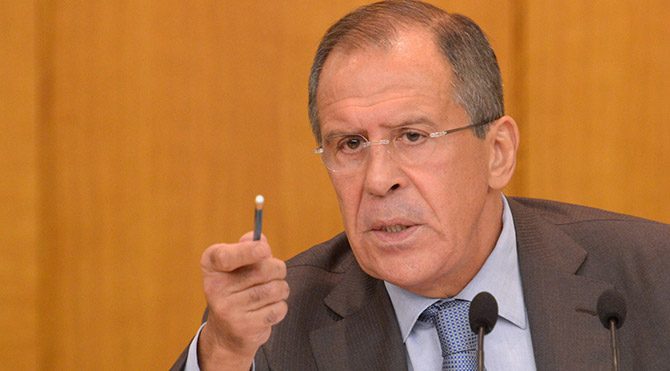
                      Russia has warned Turkey not to invade Syria.


                      Russian federation foreign minister Lavrov, has issued a warning to the Erdogan regime in Turkey not to think of attacking Syria. Russian military planes regularly fly right next to the Turkish coast which in military terms is considered a form of "harrasment" or breathing down someone's necks. This forms a general policy by Moscow to make the Ankara regime understand that Russia is monitoring Turkey and will not tolerate any attack on Syria. Iran too may also go to war with Turkey if it attacks Syria.

                      - Syria is now militarily a province of Russia in the sense that it is under the Russian nuclear umbrella and any attack on Syria by America would be considered akin to an attack on Moscow.

                      In other words it could unleash nuclear war.

                      - Russia has also warned the American regime that Syrian air space is de facto under Russian protection and the Russian federation will retaliate against any American action against Syria's airspace:


                      - If Erdogan decides to attack Syria, the Syrian and Iranian intelligence agencies have their assets in Turkey, including amongst the Alevi community and the heavily Alevi Turkish left, as well as the PKK.

                      There are millions of Kurds and Alevis in Turkey. There are already riots and clashes all over Turkey due to the Kobane crisis.


                      - The Syrian government controls the capital and is mopping up rebel groups on the outskirts of Damascus. It controls the 3rd city, Homs and the 4th city Hama and the west of the country next to the sea whereas the rebels have control of relatively unimportant towns or desert areas.

                      - Syrian government forces captured an area near Damascus recently called Dakhanieh:

                      The capture follows a string of victories for regime forces in the area around Damascus, where they have retaken several rebel strongholds in recent months.


                      However the war has taken a huge toll on the country.


                      Syrian government minister, Kinda Al-Shammat who has called for special protection for women and children.


                      It is quite likely that the Russian air force is in a state of high alert and getting ready to carry out sorties even if it is just patrols of the Turkish coast as a warning to the Erdogan regime.


                      Russian Air Force.


                      Erdogan, his regime has threatened carrying out an illegal invasion of a UN member state, Syria, and has been warned by Russia.
                      * * * * * * * * * * * * * * * * * * * * * * *

                      Comment


                      • Turkish army soldier with ISIL fighters.

                        The Erdogan regime has destabilized Syria by hosting, training and allowing the free movement of militants in to Syria, however it at the same time denies it does these things.


                        Members of the CHP with pro-Kurdish slogans in support with the Kurds of Kobane.

                        - The CHP was the party founded by dictator "Ataturk" and is a very paradoxical organization containing both hardcore secular Turkish racists who hate Kurds and also hardcore secular Islamophobic Kurds with sympathies with the PKK.

                        - However the CHP enjoys heavy support from Turkey's Alevis and there are suspicions that Iranian (and Syrian) intelligence have links with the CHP and other Alevi (leftist) and pro-PKK groups in the country.

                        - The banner above also has the letters "X" and "W" which are illegal in Turkey due to being letters in the Kurdish alphabet but not Turkish one, this is an open rejection of and an affront to tradition Turkish racial supremacism or Kemalism.


                        Kurdish female fighter ready for combat


                        YPG Kurdish fighters have liberated five villages from ISIL.


                        YPG Kurdish fighters (left) have allied with FSA forces (right) to deal with the ISIL terrorist threat.


                        Kurds in Turkey have started rioting over what is happening in southern Kurdistan, Rojava.


                        Kurds burn statue of dictator, "Ataturk" in eastern Turkey.


                        AKP offices attacked by Kurds.


                        Amidst the riots in Turkey's east as well as clashes in western Turkey including a clash in a university in Istanbul, the Erdogan regime is openly talking of an illegal invasion of Syria which is de facto under the Russian nuclear umbrella. The Americans would be crazy to order their puppet Erdogan to try and invade Syria in the midst of all this instability.
                        Last edited by Bengal_Tiger; 10-09-2014, 08:17 PM.
                        * * * * * * * * * * * * * * * * * * * * * * *

                        Comment


                        • **** Du'a for Kurdistan *****

                          Oh Allah please protect our Muslim brothers and sisters in Kurdistan from the evils of Arab, Farsi and Turkish nationalism and racism. Oh Allah it is said the Kemalist army destroyed 3,000 Kurdish villages, made 2-3 million Kurds homeless refugees, tortured Kurds, killed them, made them eat human excrement. The evil Baathists in Iraq it is said also destroyed 3,000 Kurdish villages.

                          Oh Allah please protect the nation of Salahudeen, of Said Nursi, of many great Islamic ulama (scholars), awliya (saints) from the evil of the USA and its allies.

                          Oh Allah please bring peace to the blessed land of the two rivers, Al-Bilad ar-Rafadayn, Al 'Iraq. Oh Allah please destroy this abomination called "ISIL".

                          Oh Allah please protect Kurdistan, please protect Rojava, northern Kurdistan, Iranian-occupied Kurdistan. Oh Allah please protect the innocent men, women and children there from the evil of the Kemalists, Baathists, Khomeneists, Wahabis and other criminals.

                          Oh Allah please bring peace to Kurdistan. Oh Allah please end the suffering of our Muslim brothers and sisters in Kurdistan.

                          Oh Allah please shower blessings and mercy and prayers upon your noble messenger, the seal of the prophets, the envoy of the king of kings, the emissary of the master of the universe, Muhammad solAllahu 'alaihi wa sallam and his noble family and companions and all the other messengers and his ummah.


                          Ameen, thumma ameen.
                          Last edited by Bengal_Tiger; 10-09-2014, 08:33 PM.
                          * * * * * * * * * * * * * * * * * * * * * * *

                          Comment


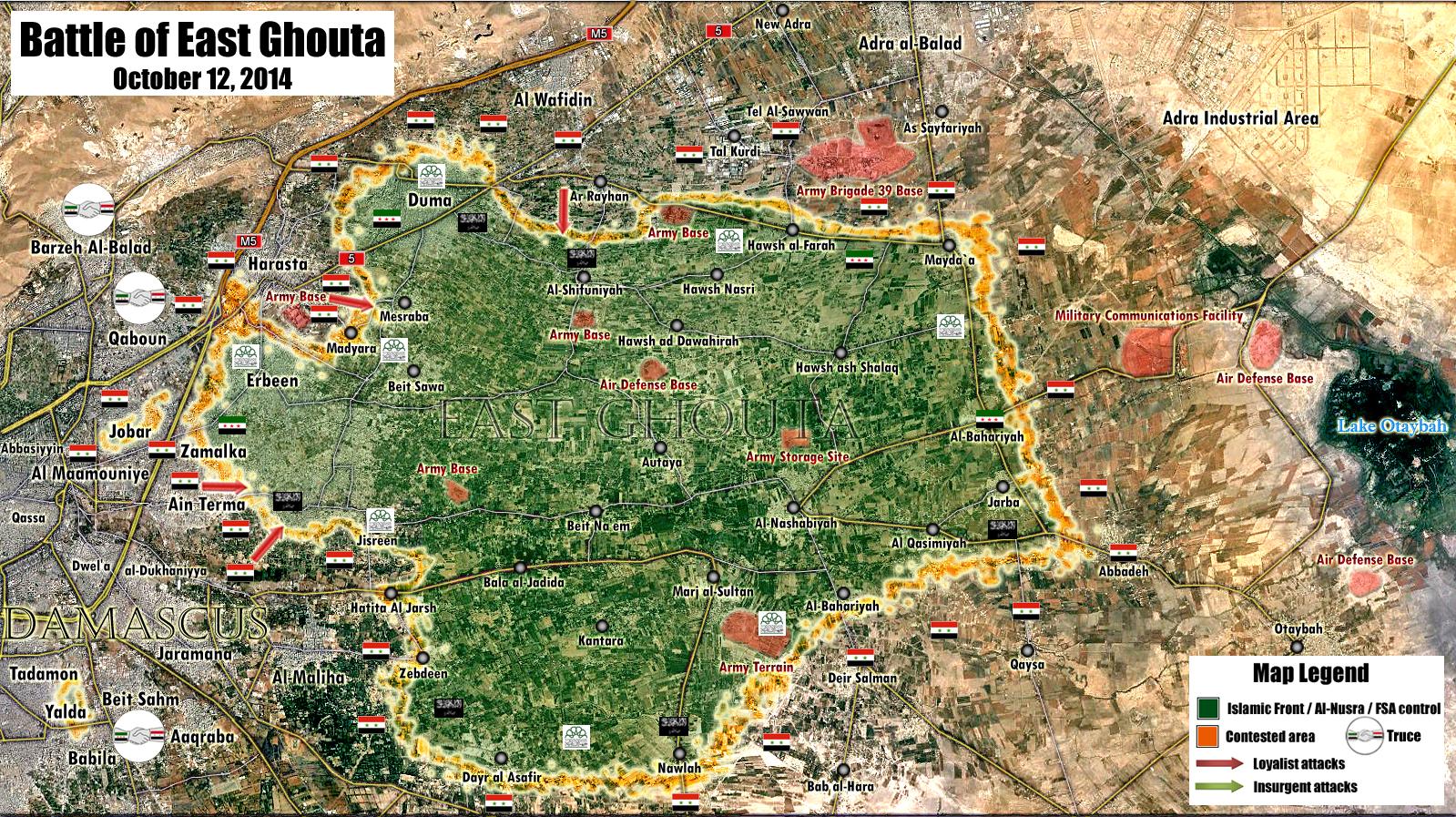
                          • Syrian government forces are closing on in rebels east of Damascus. Territory has been captured.


                            Once Damascus is fully under control and the large concentration of rebel fighters based in east Ghouta are neutralized, the Syrian government will be able to deploy more manpower and resources on to securing the rest of the country.

                            Remember this is a government that a year or two ago was perceived as one that was about to collapse and the discussion was what the post-Assad Syria would look like.
                            * * * * * * * * * * * * * * * * * * * * * * *

                            Comment


                            • Iran Warns Turkey against Desire to Intervene in Syria


                              Iran has warned Turkey against a possible military intervention in Syria as the so-called ISIL terrorist group close in on the Syrian town of Kobani near the Arab country’s border with Turkey.Abdollahian

                              Iran's Deputy Foreign Minister for Arab and African affairs Hossein Amir-Abdollahian said on Thursday that Tehran and Turkey are in consultation over the situation in the Kurdish city, noting that the Islamic Republic has warned Turkey against ground operations in Syria.

                              He added that negotiations over the situation in Syria are going on with Tehran and Ankara trying to find a solution to the crisis in Kobani.

                              “During our preliminary consultations with Turkey, we have found out that this country does not seek escalation of crisis in the region and we hope it would play a positive role in this regard,” the Iranian deputy foreign minister added.

                              The Iranian diplomat stated that Iran and Turkey are in dialogue over Syria and Iran believes that Turkey can play an effective role in facilitating the return of displaced Syrians to their homeland.

                              Explaining about Iran's solution for the ongoing crisis in Kobani, Amir-Abdollahian said, “Regional talks are underway over this issue and we hope a serious measure is taken in this regard.”

                              “The Islamic Republic of Iran will take any necessary action to help the Kurds in Kobani in line with its support for the Syrian government in its fight against terrorism,” added Amir-Abdollahian.


                              - Iran has warned the Turkish regime of Erdogan not to think about invading Syria.

                              A Turkish invasion of Syria would lead to the mobilization of the Iranian army and war with Turkey.
                              * * * * * * * * * * * * * * * * * * * * * * *

                              Comment


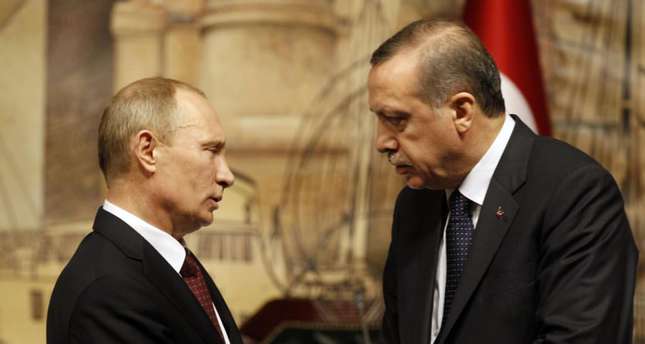
                              • Putin speaks to Erdogan on the phone.

                                Turkey's President Recep Tayyip Erdoğan and Russia's President Vladimir Putin have discussed the recent crisis in the region over a phone call on...


                                Officially it is said it was a discussion including ISIL in Syria. However most likely it was Putin warning Erdogan not to mess around in Syria or there would be consequences.

                                This would be a follow up to the warning to Turkey issued by Russian foreign minister, Lavrov a few days ago.


                                * * * * * * * * * * * * * * * * * * * * * * *

                                Comment

                                Working...
                                X