Announcement

Collapse
No announcement yet.

Vladimir Putin saves the world?

Collapse
X
 
  • Filter
  • Time
  • Show
Clear All
new posts

  • #76
    Transnistria seeks to join Russian Federation

    VOLTAIRE NETWORK | 24 MARCH 2014


    Foreign minister of Transnistria.

    NATO supreme commander in Europe, General Philip Breedlove, warned Russia against any attempt to "annex" Transnistria.

    The Foreign Affairs Minister of the Transnistrian Moldovan Republic, the very glamorous Nina Shtanski (photo), welcomed the outcome of Crimea’s referendum on self-determination and recalled that on 17 September 2006, in an analogous vote, 97.2% of Transnistrians had come out in favor of becoming part of the Russian Federation.

    The President of Transnistria’s Parliament, Mikhail Burla, wrote to his Russian counterpart asking him to pass a law on the accession of Transnistria to the Russian Federation emulating, what has been done for Crimea.

    The President of Moldova, Nicolae Timofti, asked the European Union to speed up the signing of an association agreement so as to have a lock on Transnistria’s legal attachment to his country.

    The President of the Transnistrian Moldovan Republic, Yevgeny Shevchuk, went to Moscow to discuss the situation of his country’s Russian-speaking population following Kiev’s closure of the Ukrainian border.

    Moldova declared its independence on 19 August 1990. Just as, at the time of the USSR, Crimea was administratively attached to Ukraine, Transnistria was attached to Moldova, from which it declared independence one week later, on 1 September. However, Moldova was admitted to the UN, but not Transnistria, which has existed for 24 years as an unrecognized state. In June 1992, NATO tried unsuccessfully to resolve this issue through force, killing more than a thousand people, but had to back off due to the resistance of the population [1]. Since then, the country’s security has been provided by a contingent of Russian peacekeepers.


    * The new regime in Kiev is carrying out a siege/blockade of ethnic Russians and others in Transnistria. This is worse than sanctions.

    Food, medical supplies and other things need to be able to reach Transnistria.
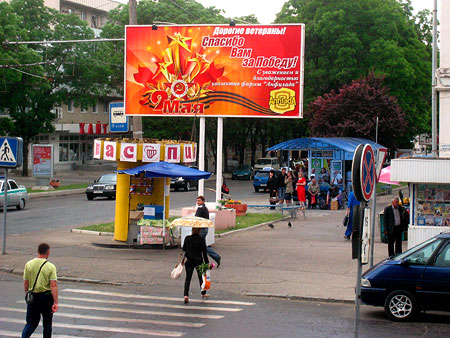


    Transnistria, now under siege by the Kiev regime.


    A picture of a wedding in Transnistria. Normal civilian life is now being affected by the siege of the country by the Kiev regime.


    Children in Transnistria, the country is now under Ukranian siege and the Transnistrians have pleaded to Russia for support.


    Russian president, Vladimir Putin is being urged to provide assistance to the besieged region of Transnistria.
    * * * * * * * * * * * * * * * * * * * * * * *

    Comment


    • #77
      Russia Could Cut Off Critical Supply Line to Afghanistan


      Could also disrupt U.S. plans to establish drone bases


      BY: Adam Kredo
      March 26, 2014 3:50 pm

      Russia’s ongoing standoff with the United States could move Moscow to disrupt critical supply lines to Afghanistan and interfere with U.S. plans to establish drone bases in Central Asia, according to regional experts.

      A trade pipeline known as the Northern Distribution Network (NDN)—which runs through Russia, several Russian-allied nations, and down to Afghanistan—has carried 52 percent of all supplies to coalition forces in the war torn country, many of which are bound for U.S. forces.

      The United States will need to rely heavily on this network as it winds down its military presence in Afghanistan, raising concerns that Russia could disrupt the shipping line, according to Boris Zilberman, deputy director of congressional relations for the Foundation for Defense of Democracies (FDD).

      “Much of the network relies on rail and truck transportation through Russia,” according to a recent brief by Zilberman. This leaves Russian President Vladimir Putin with the ability to significantly disrupt the supply line as a means to interfere with the U.S. drawdown.

      “Putin has not indicated that he would throw a wrench into the resupplying of U.S. forces in Afghanistan, but as the United States and Russia recalibrate their relations, contingency plans for maintaining U.S. national security interests in Central and Southeast Asia should be expedited,” Zilberman told the Washington Free Beacon.

      The NDN has facilitated the shipment of more than 2 million tons of equipment via Baltic ports since 2009, according to the policy brief.

      “With the U.S. winding down its military presence in Afghanistan, it will still need this distribution network the rest of the year,” Zilberman wrote. “Ultimately, some supplies will also need to be shipped back through these same routes.”

      While Putin has generally supported U.S. efforts in Afghanistan, the NDN gives him a great amount of leverage over the U.S. war effort.

      Zilberman warned that “as the situation between the West and Russia escalates, Putin may recalibrate” his support of the supply line. “Should he deprive the U.S. of the NDN, he could challenge U.S. national security interests in Southeast Asia through the end of 2014.”

      The United States could be forced to seek alternate shipping routes through Georgia and Azerbaijan, according to military leaders.

      Putin could also interfere with U.S. plans to build new drone bases in Central Asian countries, many of which are allied with Moscow.

      The Obama administration has sought to establish these bases as a means to combat al Qaeda in Pakistan. This could be one of the few methods to combat these terrorist forces if Afghanistan decides to force a full withdraw of U.S. forces from the country.

      Without cooperation from these Central Asian countries, the United States could experience a security gap in the region and lose its ability to adequately monitor al Qaeda.

      * * * * * * * * * * * * * * * * * * * * * * *

      Comment


      • #78
        US sets Europe and Russia at war

        Fri Mar 28, 2014 1:7PM GMT


        By Finian Cunningham

        When US President Barack Obama embarked on his European tour this week there was the usual sycophantic Western media image of the American leader as a benefactor. Obama, so the story went, was coming to unite and support Europe in the face of Russian aggression in Ukraine.

        With tiresome florid speechifying, Obama claimed that the US and Europe have together historically built up institutions of international law and democracy and that the "allies" would now stand together against Russian "brute behavior" just as they had done during the Cold War against the Soviet Union.

        The facts are the opposite. The US has sought to divide Europe from Russia and sow conflict in Eurasia ever since the end of the Second World War nearly 70 years ago. That is a continuum to the present day. The main objective for Washington is to prevent Europe developing closer relations with Russia. Central to the problem, from the US point of view, is to curb Europe and Russia becoming strategic energy partners.

        This is what the current crisis over Ukraine is really about. Washington took the lead in inciting regime change in Kiev at the end of last year. And it is Washington that is taking the lead in rushing through Congress-approved finance and IMF loans to shore up the unelected anti-Russian junta in Kiev.

        Russian security measures in Crimea and on its borders with Ukraine have subsequently led to the worst diplomatic crisis between European capitals and Moscow since the end of the Cold War more than 20 years ago.

        In this current crisis it is Washington that has been the most strident in calling for punitive sanctions against the Russian government of President Vladimir Putin.

        As the Washington Post reported this week: "President Obama attempted Wednesday to rouse Europe to confront Russia's military seizure of Crimea, framing the West's dispute with Russian President Vladimir Putin as a clash of ideologies lingering from the Cold War."

        The American media have also gone into a frenzy of demonizing Putin as a mad dictator, while it is US military forces under the NATO flag that have mobilized on the Western borders of Russia. All in all, the US propensity is to incite tensions.

        Admittedly, some European politicians, such as Britain's David Cameron and France's Francois Hollande, appear to have gone along gung-ho with the US adversarial agenda towards Moscow. But there again several other European states, including Italy, Austria, Holland, Belgium and Finland, have sought to de-escalate tensions. Most notable is Germany, Europe's largest economy.

        German Chancellor Angela Merkel this week pointedly rejected the imposition of economic sanctions on Russia in spite of much American pressure to do so.
        If we strip off Obama's schmaltz and pseudo-history rhetoric, it is patent that the US stands to gain most from conflict between Europe and Russia - just as it always has done in past decades.

        While Obama was this week endorsing "unity" between the US and Europe and "isolation" for Russia, he was also pushing for two major American interests - under the guise of American benevolence of course.

        Those two interests are, firstly, the long-term replacement of Russian energy supplies with American exports of natural gas. The renewed US fossil fuel industry is a leitmotif of recent years in an attempt to boost the stagnant American economy. America needs to find export markets for its projected natural gas production. Currently, Russia supplies some 30-40 per cent of Europe's fuel consumption. The US wants this lucrative chunk of the global energy market.


        The second major strategic interest from stoking conflict with Russia is to give Washington a continuing military, and therefore political, role in the affairs of Europe as the lead NATO power. That's not new, to be sure, but such a role always needs renewing.

        Already this week the Baltic states of Lithuania and Latvia are reportedly doubling their military spending on the back of US-instigated Ukrainian and Russian tensions, which no doubt will entail sales of US-made F-15 and F-16 fighter jets, as well as missile systems and warships.

        Historically, the Cold War conflict in Europe was not a natural tendency. The US fomented the hostility with the Soviet Union, which included originating the threat of nuclear weapons and the covert arming of Nazi saboteurs behind Soviet lines in the aftermath of WWII. The Soviets responded by imposing the Iron Curtain across Eastern Europe, which the US planners gladly welcomed for the strategic reasons of justifying American militarism in Europe and thwarting Eurasian relations.

        Despite this hostile backdrop, however, relations between Moscow and the rest of Europe managed to grow cordially. This was especially as a result of the wise West German leadership under chancellors Willy Brandt and Helmudt Schmidt, who developed an "Ostpolitik" policy of outreach towards the Soviet Union - to the disapproval of Washington and its trusty British minions.

        Over the two decades since the Cold War that strategic energy relationship between Europe and Russia has continued to grow. Other trade relations have also prospered. Today, bilateral trade between Europe and Russia is about ten times the volume between the US and Russia.

        Germany is the lynchpin in this strategic relationship between Europe and Russia. More than 6,000 German businesses have invested in long-term partnerships with its giant neighbor to the East, with a total bilateral trade of some $100 billion. Millions of jobs on either side bind these two countries together in a mutual dependence. And what is good for Germany is good for the rest of Europe. This is precisely what the US wants to sabotage for its own selfish strategic interests.

        It is significant that one of the early casualties in the commercial relation between Europe and Russia over the latest Ukraine tensions is the South Stream natural gas project. This pipeline is planned to transport gas from Russia into southern Europe and to become operational by the end of 2015. The route would complement existing Russian supply lines through the North Stream, from Russia directly to Germany, and through the existing network of Gazprom pipes via Ukraine.

        However, business press reports this week say that the South Stream gas route is now in danger of falling through because the Russian owner of one of the companies involved, Gennady Timchenko, of Stroitransgaz, is on the sanctions list drawn up by Washington last week. Interestingly, Timchenko is not included in a similar sanctions list against Russian individuals drawn up by European Union. That selective targeting of the South Stream gas project by Washington is indicative of the ulterior strategic purpose.

        As Christof Lehmann, editor of nsnbc international, points out if Europe and Russia were to develop a long-term strategic trade and energy partnership that would then spell the rapid demise US global hegemony. A closer working relationship between Europe and Moscow would greatly undermine the role of the US dollar as a reserve currency and it would obviate the need for Washington's military presence on the European continent and the relentless expansion of NATO eastwards around Russia.

        Says Lehmann: "The development of ties between Europe and Russia would leave the US politically, culturally and economically isolated within no more than 25 years. It would also mean that Washington would become increasingly isolated in terms of its militarist and strategic encirclement of Russia and China. The dollar would collapse earlier than that."

        In other words, in order for US hegemony to survive Washington needs conflict to persist and to be continually stoked between Europe and Russia. Despicably, that divisive American logic is a dangerous warpath that puts millions of lives at risk from a possible nuclear conflagration.

        What Europe needs is real political leadership instead of the American "yes puppets" we see in the pathetic shape of Cameron and Hollande.

        Europe needs to wake up to how it has been and continues to be played for a fool and a stooge by Washington, where potentially good neighborly relations with Russia are abused to the point of war.

        A cheeky admission of that divisive American influence was let slip by Obama during one of his European speeches this week when he told an admiring audience in The Hague: "We [the US] have considerable influence on our neighbors. We generally don't need to invade them in order to have a strong co-operative relationship with them."

        Instead of "co-operative relationship" Obama really meant to say "coercive relationship".

        And there's no need for the US to invade in order to coerce when it can just cast a continual specter of conflict and war over everyone.


        1. The US thrives on divide and conquer and operates this tactic against all its rivals.


        2. Realizing the potent nature of militant "Islam", the US sponsors radical "Islamists" to destabilize its enemies e.g. in Chechnya, Xianjiang etc.


        3. Aside from destabilizing Russia and China with radical "Islam", the US has also used the "Islam"-card against Europe e.g. in Bosnia and Kosova.

        The US ensured that war would break out in Bosnia Hercegovina in 1992 by sabotaging a deal which was about to be made by all 3 ethnic groups (Muslims, Serbs and Croats) in Portugal.

        The subsequent war has made Bosnia a hot-spot which could reignite in to war at any time and create problems for Europe including refugee waves, economic destabilization etc.


        4. However in this latest round of US playing rivals against each other they did not use Muslims/Islam but are trying to make the EU and Russia fight (not militarily but politically and economically) each other.

        - The US will replace "evil" Russia as a major gas supplier to Europe.
        - The US will make money by eastern European states buying American weapons to protect themselves from "evil" Russia.


        All the while the US is thousands of miles away separated by the Atlantic ocean watching everything from comfort.


        - The European states are weak militarily. The two strongest states in western Europe militarily are the UK and France, but the UK is downsizing its military and if Scotland separates later this year will be affected militarily.

        Though being under 15% of the UK population, the Scots formed 30% of the army and major nuclear bases are in Scotland and the UK's nuclear missiles are based in submarines (not on land) in the north sea, which would then become of Scotland. However despite all this I suspect some sort of interim deal would be made between England and Scotland on all these things, some sort of partnership if Scotland ever did leave (which may not happen).


        British submarine.


        Aside from the British, the other major military power in western Europe is France. However France by itself does not have the resources to provide the sort of military umbrella and protection eastern European states are looking for, only the US does. Hence the US provoking tensions with Russia plays in to their hands as the scared eastern European states turn to the US.


        The US can play all these games against the relatively weak (militarily) European states but cannot do such things against China, India and others who have a much more different mentality.

        With Russia, China, India, Iran all working against US interests it is only a matter of time before the US loses its position as the world's bully power and no.1 thug.


        The Europeans however are under the de facto lordship and domination of the US, which they are too weak and needy to break.
        * * * * * * * * * * * * * * * * * * * * * * *

        Comment


        • #79
          Bangladesh abstains on Crimea

          Senior Correspondent, bdnews24.com
          Published: 2014-03-30 22:30:13.0 BdST Updated: 2014-03-31 00:11:22.0 BdST

          Bangladesh has abstained from voting in the UN General Assembly against the recent Crimean referendum backed by Moscow.


          The UN voting, intended to declare the referendum results invaiid, was held on Thursday. However, Bangladesh’s foreign ministry had not announced its position right away.

          The abstention came to light on Sunday, when the Russian ambassador in Dhaka, Alexander Nikolaev, at a seminar “thanked” Bangladesh its stance.

          He said he was “thankful and grateful” to Bangladesh for abstaining from voting.


          There were 100 votes in favour of the resolution, 11 against, and 58 abstentions in the 193-nation assembly.

          Two dozen countries did not take part either because they did not show up or because they have not paid their dues, Reuters reported earlier.

          Although the resolution is non-binding, Western diplomats said it sent a strong message about Russia’s lack of broad support on the Crimean issue.

          A Bangladesh foreign ministry official, however, later confirmed the country’s abstention.

          He told bdnews24.com that Bangladesh was keenly observing the situation.
          “Bangladesh’s foreign policy is guided by the principle of friendship with to all, malice towards none,” he maintained.

          The Russian ambassador said the Mar 16 Crimean referendum had fully conformed to democratic procedures and international norms.

          More than 82 percent of the electorate had taken part in it.

          Over 96 percent of those who voted favoured Crimea’s “reunion” with Russia.

          “These numbers speak for themselves,” he said.

          He said he strongly protested the use of the term “annexation”. “Its reunification,” he stressed.

          Replying to a question, he said Russia was not flexing its muscle but “concentrating on its own interest”.

          He said Russia supported a “multi-polar” world, and its engagement with Bangladesh was “comprehensive”.


          বাংলাদেশ ও বিশ্বের ব্রেকিং নিউজ সবার আগে পেতে ভিজিট করুন bdnews24.com. Read trusted, 24/7 live bilingual news, business, and entertainment updates
          * * * * * * * * * * * * * * * * * * * * * * *

          Comment


          • #80
            Russia sets terms for deal on Crimea as 40,000 troops mass on Ukraine border


            Russia's foreign minister tells John Kerry in Paris that Moscow is seeking a federal solution to Ukraine crisis, with greater autonomy for southern and eastern regions
            Simon Tisdall
            The Guardian, Sunday 30 March 2014 15.35 BST

            Russia on Sunday night set out a series of tough conditions for agreeing a diplomatic solution to the crisis over its annexation of Crimea, demanding that the US and its European partners accept its proposal that ethnic Russian regions of eastern and southern Ukraine be given extensive autonomous powers independent of Kiev.

            Emergency talks between Sergei Lavrov, Russia's foreign minister, and John Kerry, the US secretary of state, got under way at the Russian ambassador's residence in Paris after a day in which tensions over Ukraine deepened appreciably. Neither man made any substantive comment before the talks began. Suggesting it might be a long session, Lavrov told reporters: "Good luck and good night."

            The meeting took place against an ominous backdrop of the massing of an estimated 40,000 Russian troops on Ukraine's eastern border and warnings from Nato and the Pentagon that the Russian military activity, ostensibly relating to routine exercises, was abnormal and could be a prelude to an invasion.

            General Philip Breedlove, Nato Supreme Allied Commander Europe and the head of the US military's European Command, was ordered back to his post in Brussels during a visit to Washington after Chuck Hagel, the US defence secretary, pointed to "a lack of transparency" from Russia about the troop movements. Unlike Moscow, Washington has said it will not resort to force to resolve the crisis.

            The US has called on Russia to disarm irregular forces in Crimea, admit international observers and pull its troops back from the eastern border. But speaking to Russian state television before the talks, Lavrov laid out Moscow's own quite different terms for a deal. Primarily, he said, Russia was seeking a federal solution for Ukraine as part of "deep constitutional reform".

            "Frankly speaking, we don't see any other way for the steady development of the Ukrainian state apart from as a federation," he added. Under the Russian plan, which Barack Obama and Vladimir Putin reportedly discussed in a phone call initiated by Moscow on Friday, each region would have control of its economy, taxes, culture, language, education and "external economic and cultural connections with neighbouring countries or regions," Lavrov said.

            "Given the proportion of native Russians [in Ukraine], we propose this and we are sure there is no other way."

            The Russian proposal to radically alter the way Ukraine is governed and administered is certain to arouse strong opposition in Kiev, where it will be viewed by critics of Moscow's intervention in Crimea as a roundabout way of breaking up or partitioning the country.

            In an apparent bid to assuage concerns in Kiev and western capitals about Russian intentions, Lavrov said there were no plans to invade eastern Ukraine.

            Latest US intelligence estimates based on satellite data indicate that Russia has amassed 40,000 troops on the Ukrainian border, including a wide range of special units, elite forces and equipment.

            "We have absolutely no intention of, or interest in, crossing Ukraine's borders," Lavrov said. "We [Russia and the west] are getting closer in our positions."

            He said Moscow's terms for defusing the crisis, the worst between the west and Russia since the end of the cold war, also included a pledge by Kiev's government that Ukraine would not seek to join Nato.

            The eastward expansion of Nato since the collapse of the Soviet Union was one of the main grievances Putin expressed in a speech in Moscow earlier this month when Crimea joined the Russian Federation.

            Lavrov said Russia remained determined to protect the rights of Russian speakers in eastern and southern Ukraine and implied that it reserved the right to take appropriate action if its proposals for a federation and other settlement terms were not accepted.

            Apparently seeking to exploit western unease to achieve long-standing policy aims beyond Ukraine, Putin reportedly told Obama that Moscow also wanted guarantees about the future of the Russian-backed separatist territory of Transnistria in Moldova, on Ukraine's south-west border.

            Putin told Obama the fate of the breakaway region should be solved not by force but by talks in the 5+2 format of Moldova, Transnistria, the Organisation for Security and Cooperation in Europe, Russia and Ukraine, with the EU and US as observers.

            The Kremlin said Putin had suggested "examining possible steps the global community can take to help stabilise the situation" in the region.

            It was unclear what response the US and its EU partners would make to the Russian demands as the Kerry-Lavrov meeting in Paris got under way.

            The Obama administration has insisted Russia withdraw its forces from Crimea, reduce its military build-up on the eastern border, respect the territorial integrity of Ukraine and support national polls due in May to elect a new president and government.

            The US and EU imposed limited sanctions on Russia following the annexation of Crimea. Lavrov said the measures had had little impact. "I don't want to say that sanctions are ridiculous and that we couldn't care less, these are not pleasant things … We find little joy in that, but there are no painful sensations. We have lived through tougher times."

            Lavrov made no mention of the Ukraine elections or any possible withdrawal from Crimea. Many analysts now predict that in any deal, the US and its western allies, and thus Kiev, will be forced to accept the annexation as a fait accompli.

            In another sign of a possible compromise, Lavrov has offered to talk to representatives of Ukraine's interim government under certain conditions. Russia does not recognise the current leadership in Kiev, which it says mounted a "fascist coup" in February to oust Ukraine's elected president, Viktor Yanukovych.

            In other developments, the Tatar assembly meeting in the historic capital of Bakhchisaray voted in favour of seeking "ethnic and territorial autonomy" within Crimea.

            The 300,000-strong minority make up less than 15% of Crimea's population of 2 million and has strongly opposed the Russian annexation. The proposal to seek autonomy was seen as a sign that the group is now ready to accept the new status quo and negotiate their place in it with Russia.

            In Kiev, the presidential election effectively became a two-horse race at the weekend when the boxer-turned-politician Vitali Klitschko pulled out and threw his weight behind the billionaire confectionery oligarch Petro Poroshenko, known as the Chocolate King. He will now face the former prime minister, Yulia Tymoshenko, on 25 May.


            Russian foreign minister and US secretary of state enter talks again as 40,000 Russian troops mass on Ukraine border


            Russia to the US: Make Ukraine a federation/confederation where the pro-Russian south and east are powerful, or we may invade.


            * * * * * * * * * * * * * * * * * * * * * * *

            Comment


            • #81
              Ukraine: pro-Russia activists proclaim independent republic in Donetsk


              theguardian.com, Monday 7 April 2014 13.42 BST


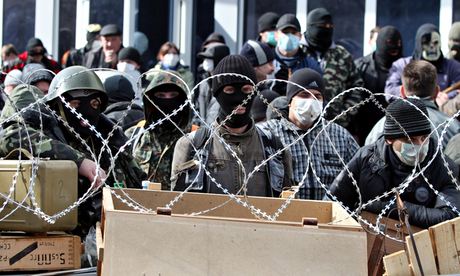
              The announcement, which was posted on YouTube, was delivered by a protest spokesperson outside a building currently occupied by several thousand Russia supporters, some of them armed.

              "Seeking to create a popular, legitimate, sovereign state, I proclaim the creation for the sovereign state of the People's Republic of Donetsk," the spokesperson said to cheers from the gathered crowd.

              The Interfax news agency reported that the self-proclaimed leaders of Donetsk had vowed to hold a referendum on regional sovereignty no later than 11 May. Ukrainian presidential elections have been set for 25 May.

              The regional news website Ostrov said the activists wanted to join the Russian Federation in a similar way to the Crimean peninsula.


              Ukraine's acting president, Olexander Turchynov, said the separatist call in Donetsk and pro-Russian protests in two other cities in the east of the country were evidence of a "second stage" of Russian operations "playing out the Crimean scenario".

              The acting prime minister, Arseny Yatseniuk, told a cabinet meeting in Kiev: "An anti-Ukrainian plan is being put into operation ... under which foreign troops will cross the border and seize the territory of the country."


              Pro-Russian protesters remain in control of security service headquarters in the eastern Ukrainian region of Lugansk. Activists vacated an administration building in Kharkiv on Monday after occupying it overnight.

              On Sunday, a Russian soldier shot dead a Ukrainian naval officer in eastern Crimea, one of the few fatalities reported since Russia took control of the Black Sea peninsula in March.

              The shooting was announced by Ukraine's defence ministry. Russian media said a group of Ukrainian soldiers in the village of Novofedorivka had been drinking and were on their way home when they passed Russian soldiers guarding an entry to the military base where they previously worked, and an argument broke out between the two groups.

              "We confirm the death of a Ukrainian officer in the village of Novofedorivka in Crimea," the ministry's press service told Interfax-Ukraine. According to the news agency, the Russian serviceman shot dead the Ukrainian officer near the hostel where the latter lived.


              Dmytro Tymchuk, director of the Centre for Military and Political Studies, said on Facebook on Monday that Russian junior sergeant Ye S Zaitsevv shot a Ukrainian serviceman – whom he named as Major K of military unit No 1100 – twice in the head at point-blank range.

              He said Captain A Yermolenko, who was sharing a hostel room with the murdered Ukrainian, was beaten and abducted by Russian troops. Tymchuk said Russian servicemen had also taken the body of the Ukrainian major. A criminal investigation has been opened.

              Ukraine's prime minister accused Russia of sowing unrest in his country's eastern provinces as a pretext for dispatching troops across the border.

              Speaking at an emergency cabinet meeting on Monday, Arseniy Yatsenyuk said Russia was behind the seizure of several government buildings in eastern regions, which had led to an increase in secessionist sentiment.

              "The plan is to destabilise the situation, the plan is for foreign troops to cross the border and seize the country's territory, which we will not allow," he said, adding that people engaged in the unrest had Russian accents.

              Yatsenyuk said Russian troops remained stationed within 19 miles (30km) of the frontier.

              Earlier in the day, the interior ministry reported that armed gunmen had occupied a security services building in Luhansk, 15 miles west of the Russian border and scene of frequent protests since Ukraine's pro-Moscow president was ousted in February.

              Police in Luhansk say they had been put on alert and had blocked all entrances to the city.

              A crowd of pro-Russian activists stormed the building on Sunday. Local media reported that demonstrators pelted the building with eggs, and then stones, a smoke grenade and finally a firebomb. The flames were reportedly quickly extinguished. Police said nine people were injured during the assault on the building.

              Eastern Ukraine was the heartland of support for Viktor Yanukovych, the president who fled to Russia in February after months of protests. About half of the region's residents are ethnic Russians, many of whom believe Ukraine's acting authorities are Ukrainian nationalists who will oppress Russians.

              Ukraine's interim authorities deny they are infringing the rights of the ethnic Russian population. Russia has moved large contingents of troops near the Ukrainian border, amid speculation that unrest in eastern Ukraine could be used as a pretext for a Russian incursion.

              Since Crimea held a secession referendum and was annexed by Russia in March, calls for similar votes in Ukraine's east have emerged.


              Will the Kiev regime allow eastern Ukrainians their democratic right to vote for independence or unification with Russia?
              * * * * * * * * * * * * * * * * * * * * * * *

              Comment


              • #82
                A week or two ago....


                Tuesday, March 25, 2014

                Putin calls CFK, praises Argentina's 'double standard' concerns


                President of Argentina spoke by phone to Putin.


                Russia’s Vladimir Putin has called President Cristina Fernández de Kirchner and praised Argentina’s position against the “double standard” of world powers in the resolution of conflicts.

                According to an official statement by the Foreign Ministry, the Russian leader contacted Ms. Kirchner today’s morning, following a previous request for calls by the Russian embassy in Buenos Aires back on Friday.
                Both leaders discussed the situation in Ukraine and Putin was reported to have praised the comments by Fernández de Kirchner last week during an official visit to Paris.
                Holding a press conference along with her French counterpart Francois Hollande, CFK questioned what she called world powers’ “double standard” in the settlement of international disputes. President Kirchner indeed compared the support of world powers to the referendum held by the inhabitants of the Malvinas Islands in 2013 with the rejection of the international community to the vote in Crimea a week ago.

                “Putin highlighted the significance of Argentina’s position that included in the debate the double standard of many countries regarding the United Nations Charter,” the document reads and adds that the “Argentine president ratified our country will continue to promote the pacific resolution of conflicts" and denounce "the inefficiency of sanctions that hinder constructive dialogue.”
                The statement by the Foreign Ministry finally says leaders Putin and Kirchner discussed a joint agenda they had addressed at the G20 summit in St. Petersburg last year, involving key issues such as “energy, military, trade, strategic development and joint activities in the Antarctica”.


                1. Argentina is happy to take revenge against some western countries primarily Britain by supporting Russia on the Ukraine crisis.


                2. Russia and Putin have been supported by China, India, Argentina, Brazil, South Africa and other states.


                The US has imposed some minor sanctions due to Crimea, with Russia ignoring the sanctions and now thinking of going further and taking eastern Ukraine.


                * * * * * * * * * * * * * * * * * * * * * * *

                Comment


                • #83
                  Putin is the man.

                  Comment


                  • #84
                    Originally posted by Toramana View Post
                    Putin is the man.
                    i thought only me spam
                    faye's chauffeur

                    Pashton's girlfriend

                    I'm a Pashtun Princes


                    Comment


                    • #85
                      Crimea and Bangladesh: Behind the Controversy

                      Dhaka’s abstention on the UN resolution on Crimea should not have been a surprise.

                      By Arafat Kabir
                      April 10, 2014


                      Bangladesh’s decision to abstain from a UN resolution on the crisis in Crimea passed largely unnoticed, until the Russian envoy expressed his gratitude in return for Dhaka’s inaction at the United Nations.

                      Bangladesh was among 58 nations that abstained from the recent vote on the Crimea referendum at the UN General Assembly last week. Eleven nations favored the Russian position, while 100 voted to reaffirm Ukraine’s territorial integrity and sovereignty.

                      A grateful Russian ambassador rephrased the West’s “annexation of Crimea” as “reunification” while addressing a seminar held at the Bangladesh Institute of Strategic Studies on Sunday.

                      The next day, U.S. Ambassador Dan Mozena slammed Dhaka’s abstention. “I regret that Bangladesh was not able to join the majority on that important issue,” said Mozena during a press briefing at the American Club.

                      The response from the diplomatic community in Bangladesh was mixed. The Daily Star quoted one anonymous diplomat as saying, “It looks like they’re sitting on the fence, given the recent trend of leaning gradually towards Russia.” Yet some praised Dhaka’s show of independence.

                      Regardless, Bangladesh’s position on the Crimea resolution was hardly surprising.

                      Since its foundation, Bangladesh’s foreign policy has been guided by the principle “friendship to all, malice to none.” This was reflected in Dhaka’s enthusiastic participation in the Non-Aligned Movement (NAM). Even in its more recent history, Bangladesh has been reluctant to take sides when it comes to country-specific resolutions at the UN: it has abstained on resolutions concerning Bosnia, Georgia and Kosovo, for instance. Kosovo’s request for recognition as a sovereign state is still under consideration at Bangladesh’s Foreign Ministry. The Crimea abstention is merely a continuation of a long-term policy.

                      Another major factor is Bangladesh’s historic relations with Russia. The former Soviet Union vetoed—at least twice—U.S.-backed resolutions to intervene in Bangladesh’s war of independence against Pakistan in 1971. History might have been written very differently had that not happened. And Bangladesh remains grateful for Russia’s support.

                      Bilateral relations have strengthened in recent years, with the two nations inking several important deals. Moscow has granted Dhaka a $1 billion loan to purchase Russian military hardware. As part of this, Bangladesh’s armed forces will acquire armored vehicles, infantry weapons, air defense systems, and Mi-17 transport helicopters. In addition, Russia is helping Bangladesh build a 2000 MW nuclear power plant. The plant in Ruppur, which is the first of its kind in Bangladesh, is considered a milestone in tackling Bangladesh’s gargantuan power crisis. Aside from technical assistance, Russia is providing a loan of $500 million to offset the total construction cost of $2 billion.

                      Meanwhile, Russia’s state-owned Gazprom has been awarded contracts for drilling 10 wells in existing gas fields of Bangladesh. Both nations also enjoy healthy trade relations. Estimates put bilateral trade north of $700 million and Dhaka is hoping to boost that by seeking duty-free access to the Russian Federation market.

                      Russia-Bangladesh’s multifaceted cooperation extends into space, too. Moscow is mulling the possibility of helping Bangladesh launch a telecommunications satellite.

                      Given the strength of its ties with Moscow, it was never going to be easy for Dhaka to openly oppose Russia at the UN. At the same time, Sheikh Hasina’s government did not want to again irk Washington or London, especially after the strong reaction from the West in the wake of the January elections, in which Hasina’s party won a landslide victory in poll boycotted by the opposition.

                      At Monday’s briefing, Mozena reiterated that the U.S. position was that Bangladesh should hold fresh elections. In contrast, Russian President Vladimir Putin congratulated Hasina as soon as she took office.

                      So, no, Bangladesh’s position on the Crimea resolution should not have come as a surprise.

                      Arafat Kabir is a Bangladesh based analyst of regional and global affairs. His articles have appeared in outlets including The Wall Street Journal, The National Interest and International Policy Digest. Follow him @ArafatKabirUpol


                      - Bangladesh is a country that prefers to stay out of trouble and stay neutral. They would have abstained on this issue regardless of how good or bad their relations with the US or Russia are. It is simply not their business.

                      I as an individual totally support Putin and Russia on this, in the face of American aggression.
                      * * * * * * * * * * * * * * * * * * * * * * *

                      Comment


                      • #86
                        Ukraine crisis: Violent brawl at Kiev parliament


                        8 April 2014 Last updated at 13:05 BST

                        Tempers flared and punches were thrown in Ukraine's parliament on Tuesday as opposing nationalist and separatist factions traded blows.

                        The punch up was preceded by a heated debate about recent events in several Ukrainian cities, where pro-Russian activists seized government buildings.

                        Tensions remain high between Kiev and Moscow following the recent referendum and annexation of Crimea - a move condemned as illegal by the West and Ukraine.

                        Tempers flared and punches were thrown in Ukraine's parliament on Tuesday as opposing nationalist and separatist factions traded blows.


                        Another fight in the Ukranian parliament, below are pictures from different fights in the parliament in different years.


                        2013:


                        2012:


                        2014:


                        Last edited by Bengal_Tiger; 04-10-2014, 06:04 AM.
                        * * * * * * * * * * * * * * * * * * * * * * *

                        Comment


                        • #87
                          Pro-Russian Ukranians are calling on Russia for help:


                          The Russian army has thousands and thousands of soldiers stationed on the border with Ukraine.


                          * * * * * * * * * * * * * * * * * * * * * * *

                          Comment


                          • #88
                            The annoying of all this Ukraine story is, that its based on some conflict interest of two Christian sects and 2-3 kingdoms hundreds of years ago, and people make themselves still use for empty ideologies.
                            Ա՜խ, ընկել եմ քար ու քարափ,
                            Իմ սրբություն, ե՛տ արի, ե՛տ,

                            Ես ծովակ եմ առանց կարապ,
                            Իմ էություն, ե՛տ արի, ե՛տ:

                            Ես անտառ եմ առանց եղնիկ
                            Իմ վեհություն, ե՛տ արի, ե՛տ:

                            Comment


                            • #89
                              crimea belongs to the muslims anyways.
                              There are people today who think that admitting God’s absolute greatness decreases the value and importance of humans in the creation, as if God and mankind are rivals competing in greatness and power. Meanwhile I feel that whenever our perception of God’s greatness increases, with it we become greater, because we are the creation of a great God.

                              Sayyid Qutb

                              Comment


                              • #90
                                Kiev regime ready for military operation against Ukranian citizens in the east!!!


                                - The Kiev regime has announced that it will send military forces to the east of Ukraine to crush protests by Ukranian citizens in the region, despite the fact that it is through protests themselves that the Kiev regime overthrew the democratically elected government of Ukraine and seized power.


                                - The Kiev regime's threat against its own citizens is similar to the March 1971 operation "searchlight" by the American-backed Pakistani junta of Yahya Khan.


                                Yahya Khan, American-backed military dictator of the then united Pakistan who illegally blocked the then democratically elected leader of Pakistan, Mujibur Rahman from assuming office and launched one of the most brutal military operations of all time.


                                Ukranian citizens of ethnic Russian origin or Russian speaking about to be attacked by American-backed Kiev regime.


                                Ukranian lady holds placard saying "Protect me Russia".


                                Russia must if required send in troops to defend democracy and human rights in eastern Ukraine.


                                Russia must defend democracy in Ukraine and the right of eastern Ukraine to vote for its future.


                                Russia must not allow eastern Ukranians to be killed by the Kiev regime.


                                In 1971 Russia helped the people of the then east Pakistan to liberate themselves from an American-backed Pakistani military regime. A new nation was born called Bangladesh.

                                In 2014, Russia may once again have to help another oppressed people liberate themselves from yet another brutal American-backed regime.
                                * * * * * * * * * * * * * * * * * * * * * * *

                                Comment

                                Working...
                                X