Announcement

Collapse
No announcement yet.

Children brought up with no God are MORE generous and tolerant, study finds

Collapse
X
 
  • Filter
  • Time
  • Show
Clear All
new posts

  • #46
    Originally posted by Damir9000 View Post
    That First quote is not a definition of Atheism. It's an explanation of what Atheism relates to...someone's belief.

    The second quote was the definition of the word "Atheist" from google.

    There is no contradiction. You're just too damn stupid.
    When one types the word 'atheist' into google the definition comes up with "Atheism is not a disbelief in gods or a denial of gods; it is a lack of belief in gods. Older dictionaries define atheism as "a belief that there is no God."

    Which is basically saying we used to say there was no God but now we're not too sure aka confused ****s. infact all over the internet atheists conflict with each other on what the definition of an atheist is. take yourself as an example:

    1) You openly said you don't disbelieve in the existence of God
    2) Then you said word for word "I'm an Atheist"
    3) You then give a definition of what an Atheist is saying "Atheist: a person who disbelieves or lacks belief in the existence of God or God's"

    Now if that ^^ is not going around in circles i don't know what is. like i said be more assertive and maybe we'll take your BS a little more serious. Like the old saying goes "if you can't convince them, confuse them" i think you've opened up a whole new theory with that and applied it to yourself.
    ----------

    *You cannot climb the ladder of success with your hands in your pockets*

    Originally posted by Karachi
    like I said, there was only one reason I pretended to be pathan, for a girl, who was from Afghan forums and also registered here

    Comment


    • #47
      Originally posted by Manzareh View Post
      When one types the word 'atheist' into google the definition comes up with "Atheism is not a disbelief in gods or a denial of gods; it is a lack of belief in gods. Older dictionaries define atheism as "a belief that there is no God."

      Which is basically saying we used to say there was no God but now we're not too sure aka confused ****s. infact all over the internet atheists conflict with each other on what the definition of an atheist is. take yourself as an example:

      1) You openly said you don't disbelieve in the existence of God
      2) Then you said word for word "I'm an Atheist"
      3) You then give a definition of what an Atheist is saying "Atheist: a person who disbelieves or lacks belief in the existence of God or God's"

      Now if that ^^ is not going around in circles i don't know what is. like i said be more assertive and maybe we'll take your BS a little more serious. Like the old saying goes "if you can't convince them, confuse them" i think you've opened up a whole new theory with that and applied it to yourself.

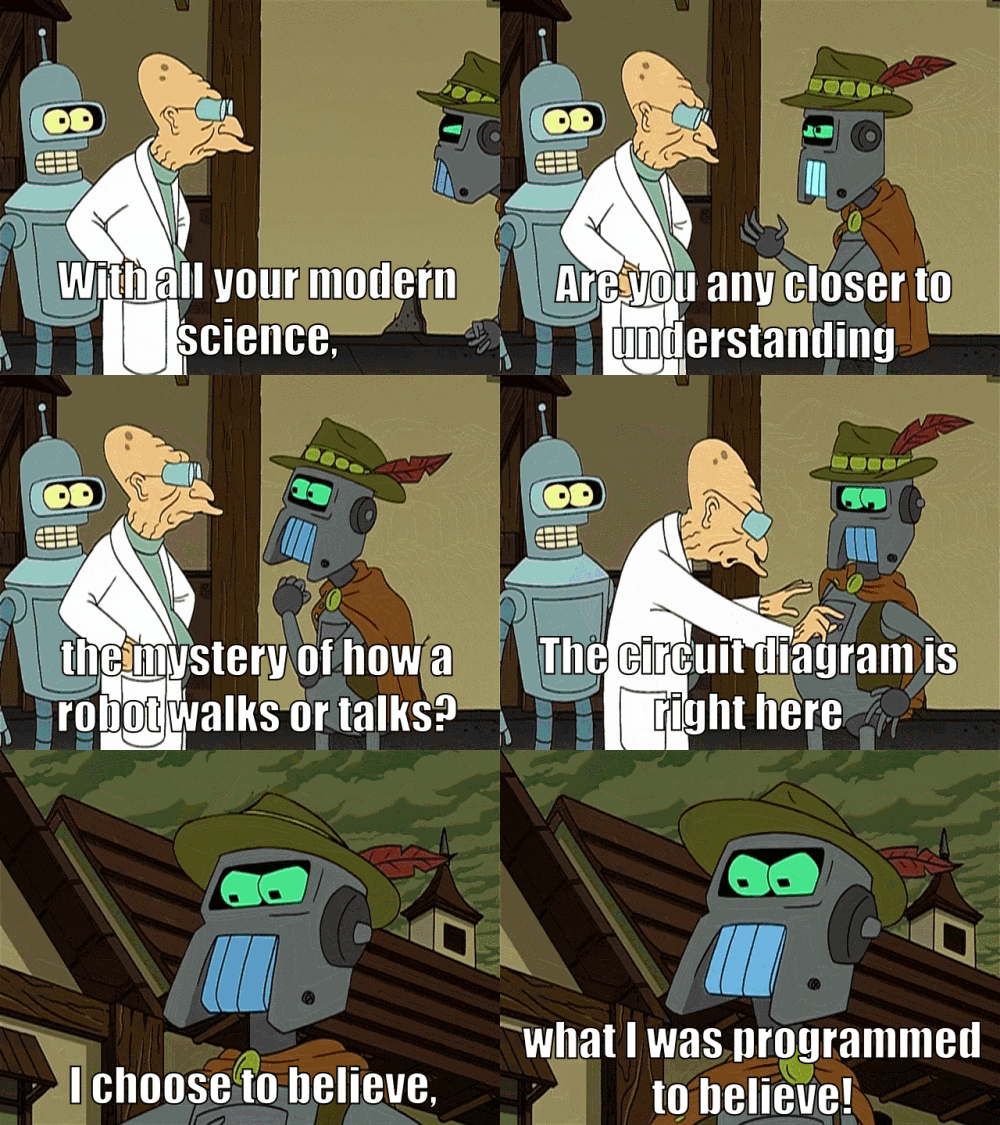
      Here let me make this simple for you.


      I don't believe in Allah, Vishnu, Odin etc...
      I don't have my own personal God either.

      Whether a Creator of the Universe really exists or not, I don't know.
      But I am sure Islam's Allah doesn't exist.

      You're only amusing yourself.


      "False beliefs influence our actions and degrade our character."

      Comment


      • #48
        Originally posted by Manzareh View Post
        When one types the word 'atheist' into google the definition comes up with "Atheism is not a disbelief in gods or a denial of gods; it is a lack of belief in gods. Older dictionaries define atheism as "a belief that there is no God."

        Which is basically saying we used to say there was no God but now we're not too sure aka confused ****s. infact all over the internet atheists conflict with each other on what the definition of an atheist is. take yourself as an example:

        1) You openly said you don't disbelieve in the existence of God
        2) Then you said word for word "I'm an Atheist"
        3) You then give a definition of what an Atheist is saying "Atheist: a person who disbelieves or lacks belief in the existence of God or God's"

        Now if that ^^ is not going around in circles i don't know what is. like i said be more assertive and maybe we'll take your BS a little more serious. Like the old saying goes "if you can't convince them, confuse them" i think you've opened up a whole new theory with that and applied it to yourself.
        Here. Read this retard.


        Atheist vs. Agnostic - What's the Difference?
        Atheists & Agnostics are Different, but Sometimes the Same

        People separated by venn diagram - Atomic Imagery/Photodisc/Getty Images
        Atomic Imagery/Photodisc/Getty Images
        By Austin Cline

        What is an Atheist?

        An atheist is anyone who doesn't happen to believe in any gods, no matter what their reasons or how they approach the question of whether any gods exist.
        This is a very simple concept, but it's also widely misunderstood. For that reason, there are a variety of ways to state this.
        Atheism is: the lack of belief in gods, the absence of belief in gods, disbelief in gods, not believing in gods.

        The most precise definition may be: an atheist is anyone who does not affirm the proposition "at least one god exists."
        Although it may seem convoluted, it has a number of important elements: there is a proposition, it's not a proposition made by atheists, and
        being an atheist requires nothing active or even conscious on the part of the atheist — all that's required is not "affirming" a proposition made by others.

        More: Atheism Basics for Beginners


        What is an Agnostic?

        An agnostic is anyone who doesn't claim to know for that any gods exist or not, no matter what their reasons or how they approach the question of whether any gods exist.

        This is also a simple concept, but it may be as widely misunderstood as atheism is. One major problem is that atheism and agnosticism both deal questions about the existence
        of gods, but whereas atheism involves what a person does or does not believe, agnosticism involves what a person does or does not know. Belief and knowledge are related but nevertheless separate issues.

        There's a simple test to tell if one is an agnostic or not.

        Do you think you know for sure if any gods exist? If so, then you're not an agnostic. Do you think you know for sure that gods do not or even cannot exist? If so, then you're not an agnostic.
        Everyone who can't answer "yes" to one of those questions is a person who may or may not believe in one or more gods, but since they don't also claim to know for sure they are agnostic — an agnostic theist or an agnostic atheist.

        More: Agnosticism Basics for Beginners


        What is an Agnostic Atheist?

        An agnostic atheist has two qualities: they don't happen to believe in any gods and they don't claim to know or sure that no gods can or do exist.

        Not believing that some claim is true while also not claiming to know for sure that it's false is not only easy, it happens in lots and lots of different topics.
        It would be a surprise if it didn't happen when the topic is the existence of gods.

        For some strange reason, though, many people have he mistaken impression that agnosticism and atheism are mutually exclusive. But why?
        There's nothing about "I don't know" which excludes "I don't believe." On the contrary, not only are they compatible but they frequently appear together because not knowing is
        frequently a reason for not believing. It's often a very good idea to not accept some proposition is true unless you have enough evidence that would qualify as knowledge.


        What is an Agnostic Theist?

        An agnostic theist has two qualities: they believe in the existence of at least one god and they don't claim to know for sure that this god or gods definitely exist.
        Believing that some claim is true while also not claiming to know for sure that it's true is not only easy, it happens in lots and lots of different topics. Why shouldn’t it also happen when the topic is the existence of gods?

        Once again, many people have the mistaken impression that agnosticism and theism are mutually exclusive. They are convinced that agnosticism is some sort of "middle way" or "third way"
        between atheism and theism — but why? There's nothing about "I don't know" which logically excludes "I believe." Sometimes it perhaps should because there are some claims that you shouldn't
        believe without sufficient evidence to qualify as knowledge. Being a juror in a murder trial would be a good example.


        Atheist vs. Agnostic: What's the Difference?

        By now, the difference between being an atheist and being an agnostic should be pretty clear and pretty easy to remember. Atheism is about belief, or specifically what you don't believe.
        Agnosticism is about knowledge, or specifically about what you don't know. An atheist doesn't believe in any gods. An agnostic doesn't know if any gods exist or not. These can be the exact same person, but need not be.

        Every agnostic is also either an atheist or a theist because any given belief is either present or not — there is no alternative to those two options.
        An agnostic may be unsure whether atheism or theism is more reasonable. An agnostic may not consider their theism or atheism very important. But regardless, belief that
        the proposition "at least one god is true" is present or not in everyone.

        Atheism vs. Agnosticism
        What's the Difference? Are they Alternatives to Each Other?


        Question:
        If atheism is just disbelief in gods, then what is the difference between that and agnosticism?


        Response:
        Many people who adopt the label of agnostic reject the label of atheist — there is a common perception that agnosticism is a more “reasonable” position while atheism is more “dogmatic,” ultimately indistinguishable from theism except in the details. This is not a valid position to adopt because it misrepresents or misunderstands everything involved: atheism, theism, agnosticism, and the nature of belief itself.

        It also happens to reinforce popular prejudice against atheists.


        Prejudice Against Atheism, Atheists

        Agnostics may sincerely believe it and theists may sincerely reinforce it, but it relies upon more than one misunderstanding about both atheism and agnosticism. These misunderstandings are only exacerbated by continual social pressure and prejudice against atheism and atheists. People who are unafraid of stating that they indeed do not believe in any gods are still despised in many places, whereas “agnostic” is perceived as more respectable.

        Atheists are thought to be closed-minded because they deny the existence of gods, whereas agnostics appear to be open-minded because they do not know for sure.

        This is a mistake because atheists do not necessarily deny any gods and may indeed be an atheist because they do not know for sure — in other words, they may be an agnostic as well.


        Agnostic Atheism & Agnostic Theism

        Once it is understood that atheism is merely the absence of belief in any gods, it becomes evident that agnosticism is not, as many assume, a “third way” between atheism and theism. The presence of a belief in a god and the absence of a belief in a god exhaust all of the possibilities.
        [MENTION=5800]DaZahroJaam.[/MENTION]
        Agnosticism is not about belief in god but about knowledge — it was coined originally to describe the position of a person who could not claim to know for sure if any gods exist or not.

        Thus, it is clear that agnosticism is compatible with both theism and atheism. A person can believe in a god (theism) without claiming to know for sure if that god exists; the result is agnostic theism. On the other hand, a person can disbelieve in gods (atheism) without claiming to know for sure that no gods can or do exist; the result is agnostic atheism.

        It is also worth noting that there is a vicious double standard involved when theists claim that agnosticism is “better” than atheism because it is less dogmatic.

        If atheists are closed-minded because they are not agnostic, then so are theists. On the other hand, if theism can be open-minded then so can atheism.

        In the end, the fact of the matter is a person isn’t faced with the necessity of only being either an atheist or an agnostic. Quite the contrary, not only can a person be both, but it is in fact common for people to be both agnostics and atheists. An agnostic atheist won’t claim to know for sure that nothing warranting the label “god” exists or that such cannot exist, but they also don’t actively believe that such an entity does indeed exist.


        P.S. Allah did exist. Allah was Muhammad's Ego.
        Last edited by Damir9000; 11-27-2015, 03:14 PM.


        "False beliefs influence our actions and degrade our character."

        Comment


        • #49
          Originally posted by Damir9000 View Post
          Here. Read this retard.


          Atheist vs. Agnostic - What's the Difference?
          Atheists & Agnostics are Different, but Sometimes the Same

          People separated by venn diagram - Atomic Imagery/Photodisc/Getty Images
          Atomic Imagery/Photodisc/Getty Images
          By Austin Cline

          What is an Atheist?

          An atheist is anyone who doesn't happen to believe in any gods, no matter what their reasons or how they approach the question of whether any gods exist.
          This is a very simple concept, but it's also widely misunderstood. For that reason, there are a variety of ways to state this.
          Atheism is: the lack of belief in gods, the absence of belief in gods, disbelief in gods, not believing in gods.

          The most precise definition may be: an atheist is anyone who does not affirm the proposition "at least one god exists."
          Although it may seem convoluted, it has a number of important elements: there is a proposition, it's not a proposition made by atheists, and
          being an atheist requires nothing active or even conscious on the part of the atheist — all that's required is not "affirming" a proposition made by others.

          More: Atheism Basics for Beginners


          What is an Agnostic?

          An agnostic is anyone who doesn't claim to know for that any gods exist or not, no matter what their reasons or how they approach the question of whether any gods exist.

          This is also a simple concept, but it may be as widely misunderstood as atheism is. One major problem is that atheism and agnosticism both deal questions about the existence
          of gods, but whereas atheism involves what a person does or does not believe, agnosticism involves what a person does or does not know. Belief and knowledge are related but nevertheless separate issues.

          There's a simple test to tell if one is an agnostic or not.

          Do you think you know for sure if any gods exist? If so, then you're not an agnostic. Do you think you know for sure that gods do not or even cannot exist? If so, then you're not an agnostic.
          Everyone who can't answer "yes" to one of those questions is a person who may or may not believe in one or more gods, but since they don't also claim to know for sure they are agnostic — an agnostic theist or an agnostic atheist.

          More: Agnosticism Basics for Beginners


          What is an Agnostic Atheist?

          An agnostic atheist has two qualities: they don't happen to believe in any gods and they don't claim to know or sure that no gods can or do exist.

          Not believing that some claim is true while also not claiming to know for sure that it's false is not only easy, it happens in lots and lots of different topics.
          It would be a surprise if it didn't happen when the topic is the existence of gods.

          For some strange reason, though, many people have he mistaken impression that agnosticism and atheism are mutually exclusive. But why?
          There's nothing about "I don't know" which excludes "I don't believe." On the contrary, not only are they compatible but they frequently appear together because not knowing is
          frequently a reason for not believing. It's often a very good idea to not accept some proposition is true unless you have enough evidence that would qualify as knowledge.


          What is an Agnostic Theist?

          An agnostic theist has two qualities: they believe in the existence of at least one god and they don't claim to know for sure that this god or gods definitely exist.
          Believing that some claim is true while also not claiming to know for sure that it's true is not only easy, it happens in lots and lots of different topics. Why shouldn’t it also happen when the topic is the existence of gods?

          Once again, many people have the mistaken impression that agnosticism and theism are mutually exclusive. They are convinced that agnosticism is some sort of "middle way" or "third way"
          between atheism and theism — but why? There's nothing about "I don't know" which logically excludes "I believe." Sometimes it perhaps should because there are some claims that you shouldn't
          believe without sufficient evidence to qualify as knowledge. Being a juror in a murder trial would be a good example.


          Atheist vs. Agnostic: What's the Difference?

          By now, the difference between being an atheist and being an agnostic should be pretty clear and pretty easy to remember. Atheism is about belief, or specifically what you don't believe.
          Agnosticism is about knowledge, or specifically about what you don't know. An atheist doesn't believe in any gods. An agnostic doesn't know if any gods exist or not. These can be the exact same person, but need not be.

          Every agnostic is also either an atheist or a theist because any given belief is either present or not — there is no alternative to those two options.
          An agnostic may be unsure whether atheism or theism is more reasonable. An agnostic may not consider their theism or atheism very important. But regardless, belief that
          the proposition "at least one god is true" is present or not in everyone.

          Atheism vs. Agnosticism
          What's the Difference? Are they Alternatives to Each Other?


          Question:
          If atheism is just disbelief in gods, then what is the difference between that and agnosticism?


          Response:
          Many people who adopt the label of agnostic reject the label of atheist — there is a common perception that agnosticism is a more “reasonable” position while atheism is more “dogmatic,” ultimately indistinguishable from theism except in the details. This is not a valid position to adopt because it misrepresents or misunderstands everything involved: atheism, theism, agnosticism, and the nature of belief itself.

          It also happens to reinforce popular prejudice against atheists.


          Prejudice Against Atheism, Atheists

          Agnostics may sincerely believe it and theists may sincerely reinforce it, but it relies upon more than one misunderstanding about both atheism and agnosticism. These misunderstandings are only exacerbated by continual social pressure and prejudice against atheism and atheists. People who are unafraid of stating that they indeed do not believe in any gods are still despised in many places, whereas “agnostic” is perceived as more respectable.

          Atheists are thought to be closed-minded because they deny the existence of gods, whereas agnostics appear to be open-minded because they do not know for sure.

          This is a mistake because atheists do not necessarily deny any gods and may indeed be an atheist because they do not know for sure — in other words, they may be an agnostic as well.


          Agnostic Atheism & Agnostic Theism

          Once it is understood that atheism is merely the absence of belief in any gods, it becomes evident that agnosticism is not, as many assume, a “third way” between atheism and theism. The presence of a belief in a god and the absence of a belief in a god exhaust all of the possibilities.
          [MENTION=5800]DaZahroJaam.[/MENTION]
          Agnosticism is not about belief in god but about knowledge — it was coined originally to describe the position of a person who could not claim to know for sure if any gods exist or not.

          Thus, it is clear that agnosticism is compatible with both theism and atheism. A person can believe in a god (theism) without claiming to know for sure if that god exists; the result is agnostic theism. On the other hand, a person can disbelieve in gods (atheism) without claiming to know for sure that no gods can or do exist; the result is agnostic atheism.

          It is also worth noting that there is a vicious double standard involved when theists claim that agnosticism is “better” than atheism because it is less dogmatic.

          If atheists are closed-minded because they are not agnostic, then so are theists. On the other hand, if theism can be open-minded then so can atheism.

          In the end, the fact of the matter is a person isn’t faced with the necessity of only being either an atheist or an agnostic. Quite the contrary, not only can a person be both, but it is in fact common for people to be both agnostics and atheists. An agnostic atheist won’t claim to know for sure that nothing warranting the label “god” exists or that such cannot exist, but they also don’t actively believe that such an entity does indeed exist.


          P.S. Allah did exist. Allah was Muhammad's Ego.

          You expect me to read that essay. You don't have the charisma to speak for yourself. Anybody can copy and paste articles they don't even understand themselves. I will read it when I get time, probably never.

          Fact number 1: Previously in recent history, the definition of atheist was dismissing the existence in God.

          Fact number 2: the definition has now changed to considering the existence of God.

          Why? See you keep avoiding that point so fuk you and your philosophies.
          ----------

          *You cannot climb the ladder of success with your hands in your pockets*

          Originally posted by Karachi
          like I said, there was only one reason I pretended to be pathan, for a girl, who was from Afghan forums and also registered here

          Comment


          • #50
            Originally posted by Manzareh View Post
            You expect me to read that essay. You don't have the charisma to speak for yourself. Anybody can copy and paste articles they don't even understand themselves. I will read it when I get time, probably never.

            Fact number 1: Previously in recent history, the definition of atheist was dismissing the existence in God.

            Fact number 2: the definition has now changed to considering the existence of God.

            Why? See you keep avoiding that point so fuk you and your philosophies.
            It is well sectioned. You do not need to read the entirety, only a paragraph.

            But it is very clear now, how much of a retard you are.


            "False beliefs influence our actions and degrade our character."

            Comment

            Working...
            X