If this is your first visit, be sure to
check out the FAQ by clicking the
link above. You may have to register
before you can post: click the register link above to proceed. To start viewing messages,
select the forum that you want to visit from the selection below.
thanks gurji. what are those towers for, amongst the houses?
towers you can see in mountain regions of georgia :svaneti,tusheti,khevi,khevsureti,racha. it's combat towers,they performed defensive function. each surname have their own tower .
The Architecture of Georgia refers to a style of architecture found in Georgia.
Georgian architecture is influenced by a number of architectural styles, including several each for castles, towers, fortifications and churches. The Upper Svaneti fortifications and the castle town of Shatili in Khevsureti are among the finest examples of medieval Georgian castles.
Georgian ecclesiastic art represents one of the most fascinating aspects of Georgian Christian architecture, combining classical dome style with original basilica style. Often known as the "Georgian cross-dome style," this style of architecture developed in Georgia during the 9th century. Before that, most Georgian churches were basilicas. One distinguishing feature of Georgian of Georgian ecclesiastical architecture, one which can be traced back to a high emphasis on individualism in Georgian culture, is reflected in the allocation of space inside the churches. Other examples of Georgian ecclesiastic architecture can be found overseas, in Bulgaria (Bachkovo Monastery built in 1083 by Georgian military commander Grigorii Bakuriani), in Greece (Iviron monastery built by Georgians in 10th century) and in Jerusalem (Monastery of the Cross built by Georgians in 9th century).
The Cathedral of the Dormition, or the Kutaisi Cathedral, more commonly known as Bagrati Cathedral is the 11th-century cathedral church in the city of Kutaisi, the region of Imereti, Georgia. It was built in the early years of the 11th century, during the reign of King Bagrat III due to which it was called "Bagrati" Cathedral, i.e., Bagrat’s cathedral.
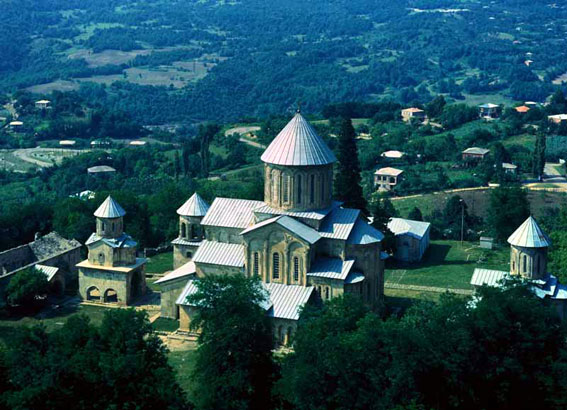
The Monastery of Gelati is a monastic complex near Kutaisi, Imereti, western Georgia. It contains the Church of the Virgin founded by the King of Georgia David the Builder in 1106, and the 13th-century churches of St George and St Nicholas.
The Gelati Monastery for a long time was one of the main cultural and intellectual centers in Georgia. It had an Academy which employed some of the most celebrated Georgian scientists, theologians and philosophers, many of whom had previously been active at various orthodox monasteries abroad or at the Mangan Academy in Constantinople.
Jvari Monastery is a Georgian Orthodox monastery of the 6th century near Mtskheta. The name is translated as the Monastery of the Cross. For another, Jerusalem-located Georgian monastery with the same name, see Monastery of the Cross.
The present building, or “Great Church of Jvari”, was built between 586 and 605 by Erismtavari Stepanoz I. The importance of Jvari complex increased over time and attracted many pilgrims. In the late Middle Ages, the complex was fortified by a stone wall and gate, remnants of which still survive.
Svetitskhoveli Cathedral is a Georgian Orthodox cathedral located in the historical town of Mtskheta, Georgia, 20 km (12 mi) northwest of the nation's capital of Tbilisi.
The cave city of Vardzia (Georgian: ვარძია) is a cave monastery dug into the side of the Erusheli mountain in southern Georgia near Aspindza on the left bank of the Mtkvari River. It was founded by Queen Tamar in 1185.
The monastery was constructed as protection from the Mongols. and consisted of over six thousand apartments in a thirteen story complex. The city included a church, a throne room, and a complex irrigation system watering terraced farmlands. The only access to the complex was through some well hidden tunnels near the Mtkvari river.
An earthquake in Samtskhe destroyed approximately two thirds of the city in 1283, exposing the caves to outside view and collapsing the irrigation system.
The church was reinforced and an externally visible bell tower added during the reign of Beka Jakheli in the thirteenth century.
Persians commanded by Shah Tahmasp I raided the monastery in 1551, capturing all important icons and effectively ending the life of the monastery.
 Tweet




Comment