
 Tweet
Georgia is a sovereign state in the Caucasus region of Eurasia. Located at the crossroads of Western Asia and Eastern Europe, it is bounded to the west by the Black Sea, to the north by Russia, to the south by Turkey and Armenia, and to the southeast by Azerbaijan. The capital of Georgia is Tbilisi. Georgia covers a territory of 69,700 km² and its population is almost 4.7 million.
-
-
The landscape within the nation's boundaries is quite varied. Western Georgia's landscape ranges from low-land marsh-forests, swamps, and temperate rainforests to eternal snows and glaciers, while the eastern part of the country even contains a small segment of semi-arid plains. Forests cover around 40% of Georgia's territory while the alpine/subalpine zone accounts for roughly around 10% of the land.
Much of the natural habitat in the low-lying areas of Western Georgia has disappeared over the last 100 years because of the agricultural development of the land and urbanization. The large majority of the forests that covered the Colchis plain are now virtually non-existent with the exception of the regions that are included in the national parks and reserves (e.g. Lake Paliastomi area). At present, the forest cover generally remains outside of the low-lying areas and is mainly located along the foothills and the mountains. Western Georgia's forests consist mainly of deciduous trees below 600 meters (1,969 ft) above sea level and comprise of species such as oak, hornbeam, beech, elm, ash, and chestnut. Evergreen species such as box may also be found in many areas. Ca. 1000 of all 4000 higher plants of Georgia are endemic in this country. -
The climate of Georgia is extremely diverse, considering the nation's small size. There are two main climatic zones, roughly separating Eastern and Western parts of the country. The Greater Caucasus Mountain Range plays an important role in moderating Georgia's climate and protects the nation from the penetration of colder air masses from the north. The Lesser Caucasus Mountains partially protect the region from the influence of dry and hot air masses from the south as well.
Much of western Georgia lies within the northern periphery of the humid subtropical zone with annual precipitation ranging from 1,000–4,000 mm (39.4–157.5 in). The precipitation tends to be uniformly distributed throughout the year, although the rainfall can be particularly heavy during the Autumn months. The climate of the region varies significantly with elevation and while much of the lowland areas of western Georgia are relatively warm throughout the year, the foothills and mountainous areas (including both the Greater and Lesser Caucasus Mountains) experience cool, wet summers and snowy winters (snow cover often exceeds 2 meters in many regions). Ajaria is the wettest region of the Caucasus, where the Mt. Mtirala rainforest, east of Kobuleti receives around 4,500 mm (177.2 in) of precipitation per year.
Eastern Georgia has a transitional climate from humid subtropical to continental. The region's weather patterns are influenced both by dry, Caspian air masses from the east and humid, Black Sea air masses from the west. The penetration of humid air masses from the Black Sea is often blocked by several mountain ranges (Likhi and Meskheti) that separate the eastern and western parts of the nation. Annual precipitation is considerably less than that of western Georgia and ranges from 400–1,600 mm (15.7–63.0 in).
The wettest periods generally occur during Spring and Autumn while Winter and the Summer months tend to be the driest. Much of eastern Georgia experiences hot summers (especially in the low-lying areas) and relatively cold winters. As in the western parts of the nation, elevation plays an important role in eastern Georgia where climatic conditions above 1,500 metres (4,921 ft) are considerably colder than in the low-lying areas. The regions that lie above 2,000 metres (6,562 ft) frequently experience frost even during the summer months.Comment
-
Georgia is divided into 9 regions, 1 city, and 2 autonomous republics.[3] These in turn are subdivided into 69 districts.
Guria
Imereti
Kakheti
Kvemo Kartli
Mtskheta-Mtianeti
Racha-Lechkhumi and Kvemo Svaneti
Samegrelo-Zemo Svaneti
Samtskhe-Javakheti
Shida KartliComment
-
Like most native Caucasian peoples, the Georgians do not fit into any of the main ethnic categories of Europe or Asia. The Georgian language, the most pervasive of the South Caucasian languages, is neither Indo-European.
Ethnic Georgians form about 84% of Georgia's current population of 4,661,473 (July 2006 est.). Other ethnic groups include Abkhazians, Armenians, Azeris, Belorusians, Bulgarians, Estonians, Germans, Greeks, Jews, Moldovans, Ossetians, Poles, Russians, Turks and Ukrainians. Notably, Georgia's Jewish community is one of the oldest Jewish communities in the world. Georgia also exhibits significant linguistic diversity. Within the Kartvelian family, Georgian, Laz, Megrelian, and Svan are spoken.Comment
-
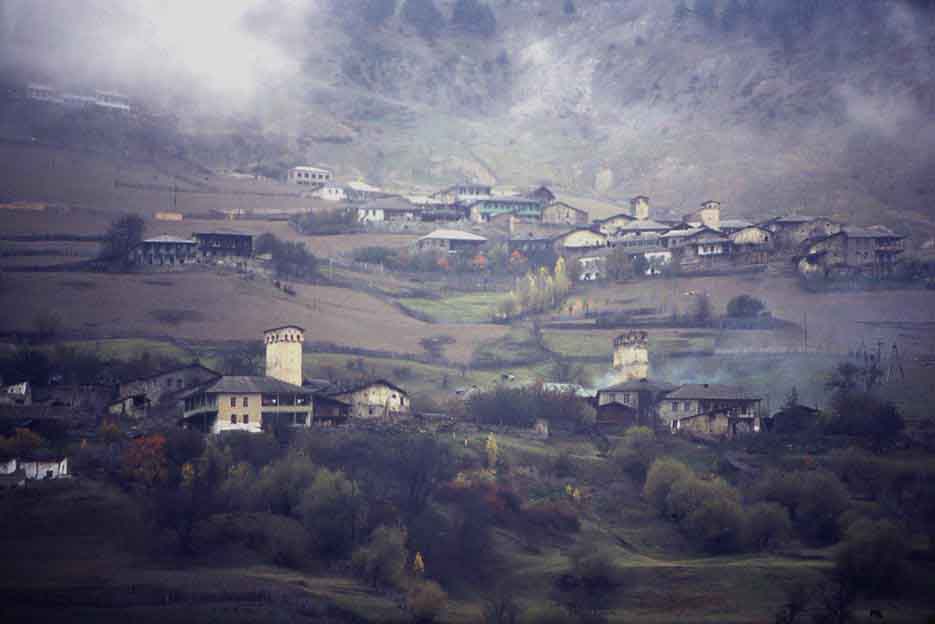
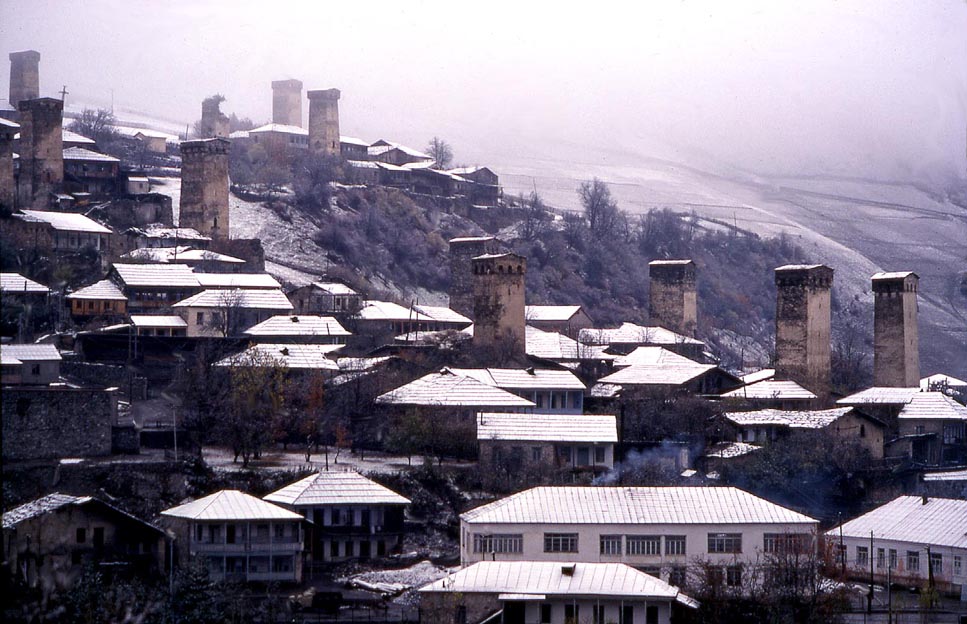
 svaneti
Comment
-

Comment
-

Comment
-
Khevi is a small historical-geographic area in northeastern Georgia.


 Mount Kazbek
Comment
-

Comment
-

Comment
-
Khevsureti is a historical-ethnographic region in eastern Georgia.

Comment
-

Comment
-
Tusheti is a historic region in northeast Georgia.

Comment
-


Comment
Comment