Announcement

Collapse
No announcement yet.

Pashtun genetics?

Collapse
X
 
  • Filter
  • Time
  • Show
Clear All
new posts

  • #46
    Ofcourse the Scythian empire spanned from Eastern Europe to Mongolia, but the statement alludes that the Tocharians were advocates of Buddhism, but in reality they were nomads who had their own Gods, and they certainly weren't Buddhist.

    Another anology might help allude this scenario:

    A Hun spread Islam . When in fact, a descendant of what was a Hun, could have been eventually a Turk, and then a Muslim who spread the faith. To simply say that the Huns spread Islam would be misleading.

    Comment


    • #47
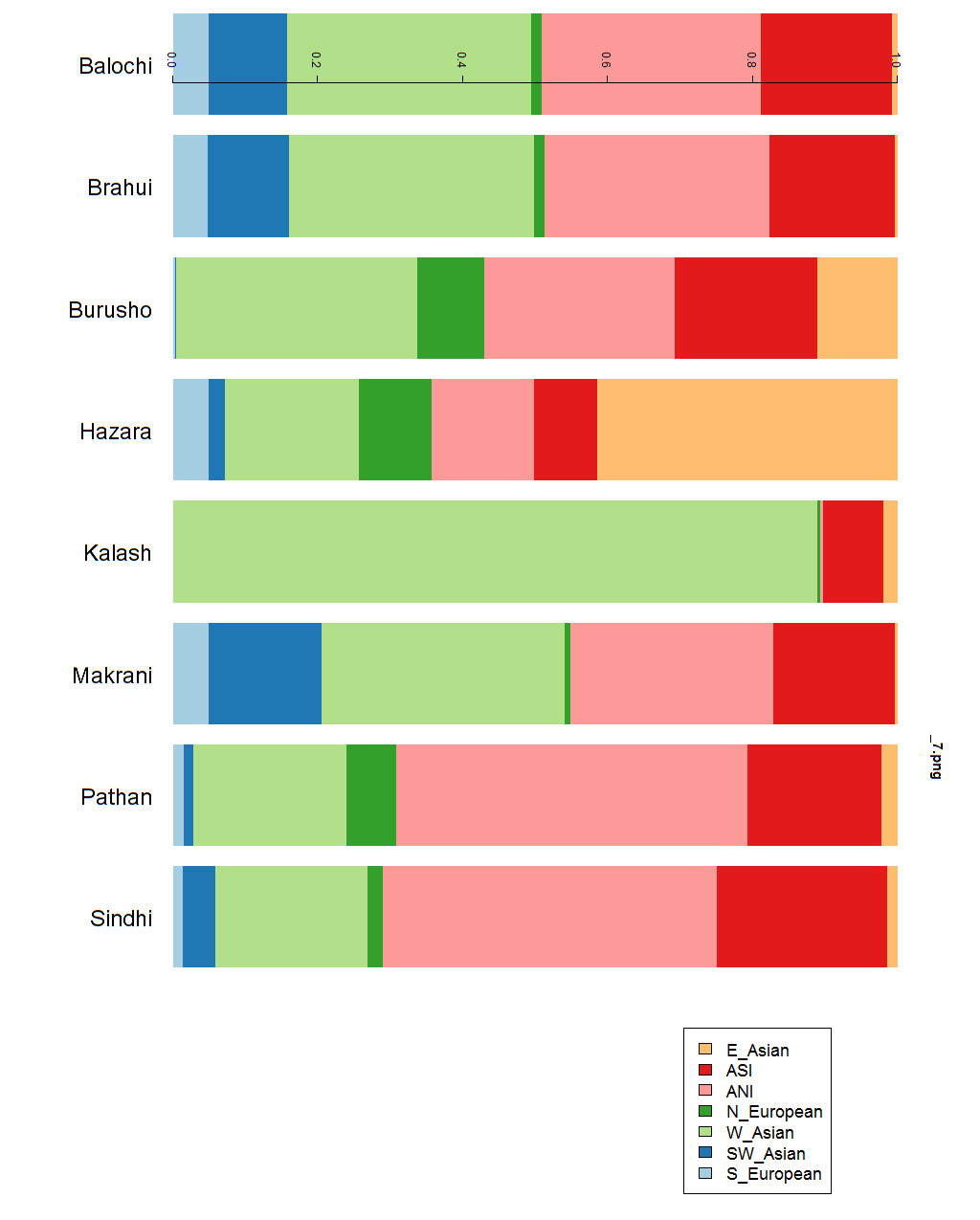
      i would like to share one interesting recent genetic makeup of the pakistani populations:

      This is from the Harrapa ancestory project:

      Comment


      • #48
        Source?

        Comment


        • #49
          its from : Dienekes' Dodecad Ancestry Project

          http://dodecad.blogspot.com/2011/05/...an-groups.html

          Comment


          • #50
            i am surprised by the amount of west asian in all pakistani populations, infact i think the similar kind of graph of indian population from the south india and east india revealed that they have very little to nill west asian in them,

            (west asian) in this sense would be iran, iraq, syria, turkey.

            ANI is (ancestoral north indians)

            ASI is (ancestoral south indians)

            Pashtuns/Sindhis seem to have the highest ANI, ANI are basically west eurasians that migrated to south asia from around the caspian sea area
            Last edited by Karachi; 06-16-2011, 11:38 PM.

            Comment


            • #51
              So this study used the 15 "pathans" from Pakistan again? That's not really anything new. It's just a composite of other, older studies.

              Comment


              • #52
                ^ yeah the number is small but one thing we know from these testings is that (pakistanis) are very mixed. I am sure if this sort of testing was done on afghans (pashtuns, Tajiks) they will even show more (west asian) in them.

                I was talking to a person on DNA forum.com and he said the reason these populations are showing west asian dna, despite being in south asia is that some time around 3000-4000 years ago, their was a mass movement of people towards the indus valley from what is now (kurdistan).

                I dont know how correct he is but this might explain the (west asian) percentages in these people.

                But there was another guy who said the movement of people might be much older, possibly around 10,000 years ago

                Comment


                • #53
                  also i think (afghans) if tested will show more ANI, ANI seems to be related to the movements of indo-aryans from central asia in to south asia

                  Comment


                  • #54
                    new very recent studies of afghan dna: its seems R1A1 dominates afghanistan: http://dna-forums.org/index.php?/top...13#entry261513

                    ^ i think they are still breaking down the results

                    Comment


                    • #55
                      Originally posted by Karachi View Post
                      ^ yeah the number is small but one thing we know from these testings is that (pakistanis) are very mixed. I am sure if this sort of testing was done on afghans (pashtuns, Tajiks) they will even show more (west asian) in them.

                      I was talking to a person on DNA forum.com and he said the reason these populations are showing west asian dna, despite being in south asia is that some time around 3000-4000 years ago, their was a mass movement of people towards the indus valley from what is now (kurdistan).

                      I dont know how correct he is but this might explain the (west asian) percentages in these people.

                      But there was another guy who said the movement of people might be much older, possibly around 10,000 years ago
                      Hello Karachi

                      Proto-Indo-European is believed to have a Kurgan or Anatolian (Black Sea region) urheimat and it's not a coincidence, that Indo-European speakers tend to have Caucasoid, Western Eurasia ancestry. Nor for example, that the early Indo-European, pantheist religions where influenced by Semitic, Babylonian, Assyrian, and Hurrian sources.

                      R1a has a far wider Eurasian distribution than R1b. Which is seemingly a Anatolian/West Asian R1 branch. As J2, G and R1b are all associated with the spread of Neolithic farmers from the Northern fertile crescent and Anatolia/Northern Mesopotamia.

                      In Europe R1a1 is associated with the bronze age, Corded Ware culture and it has been present in Europe for at least 4600 years. However R1a1 and I2b* where largerly displaced by R1b in Western Europe during the iron age.

                      Y-chromosomes and mtDNA from Eulau (Corded Ware Culture, Germany)
                      Dienekes' Anthropology Blog: Y-chromosomes and mtDNA from Eulau (Corded Ware Culture, Germany)


                      A Predominantly Neolithic Origin for European Paternal Lineages

                      The relative contributions to modern European populations of Paleolithic hunter-gatherers and Neolithic farmers from the Near East have been intensely debated. Haplogroup R1b1b2 (R-M269) is the commonest European Y-chromosomal lineage, increasing in frequency from east to west, and carried by 110 million European men. Previous studies suggested a Paleolithic origin, but here we show that the geographical distribution of its microsatellite diversity is best explained by spread from a single source in the Near East via Anatolia during the Neolithic. Taken with evidence on the origins of other haplogroups, this indicates that most European Y chromosomes originate in the Neolithic expansion. This reinterpretation makes Europe a prime example of how technological and cultural change is linked with the expansion of a Y-chromosomal lineage, and the contrast of this pattern with that shown by maternally inherited mitochondrial DNA suggests a unique role for males in the transition.

                      PLoS Biology: A Predominantly Neolithic Origin for European Paternal Lineages
                      [url=http://www.youtube.com/watch?v=gLflrGStfaY]Afghan Loghari dance- Homayoun Sakhi, Salar Nader & Mariam - YouTube[/url]

                      Comment


                      • #56
                        I found this thread a little late but since it hasnt been posted here yet Ill post, here is the only legitimate looking study Ive found so far. This is a sample of 96 Pakistani Pashtuns, Ill list the main haplogroups, see figure 1 for the below figures
                        http://www.ncbi.nlm.nih.gov/pmc/arti...tool=pmcentrez

                        R1a: 44.8%
                        R1b: 4.2%
                        E1b1: 2.1% (apparently this is the Greek marker)
                        J: 6.3%
                        G: 11.5%
                        L: 12.5%

                        Update on Midnight Suns tally (mine was R1a1 too)

                        4 R1a1
                        2 J2

                        Comment


                        • #57
                          Originally posted by Scythian View Post
                          I found this thread a little late but since it hasnt been posted here yet Ill post, here is the only legitimate looking study Ive found so far. This is a sample of 96 Pakistani Pashtuns, Ill list the main haplogroups, see figure 1 for the below figures
                          http://www.ncbi.nlm.nih.gov/pmc/arti...tool=pmcentrez

                          R1a: 44.8%
                          R1b: 4.2%
                          E1b1: 2.1% (apparently this is the Greek marker)
                          J: 6.3%
                          G: 11.5%
                          L: 12.5%

                          Update on Midnight Suns tally (mine was R1a1 too)

                          4 R1a1
                          2 J2
                          The mtDNA data is more important, as 75% of the genetic make up of humans is female. ie. XY-XX

                          Tajikis have 60% R1a and Pashtunistan, R1a distribution likely vary's.

                          R1a is a Western Central Asian, Haplogroup and people like the Tocharians where predominantly R1a. So it almost certainly has a far earlier, eastly distribution than R1b, J and G.

                          Haplogroup G has Middle Eastern origins and is very common in the Caucasus and Anatolia. The silk road had northern tributaries and I'd be very suspicious of these routes into the region.

                          Hazara have around 30% R1b1b1-M73 and Mongol C3-M217(xC3c-M48), giving rise to speculation, that they are some kind of Turkic remnant. Intrestingly the Banjara in Rajasthan (Indian gypsies) also seemingly have 30% R1b. However R1b seemingly isn't very widespread in Southern Asia.
                          [url=http://www.youtube.com/watch?v=gLflrGStfaY]Afghan Loghari dance- Homayoun Sakhi, Salar Nader & Mariam - YouTube[/url]

                          Comment


                          • #58
                            R1a1a seems to have orginated from the triangle area of southern tajikistan, eastern afghanitan, northern pakistan and kashmir

                            Comment


                            • #59
                              Asalamolalikum,

                              Guys i just wanted you guys to know that there is a Afghan-Pakistan DNA project that was started by brother Mohammed Khan to gather the DNA of those who are from this region. It is a growing group on FTDNA and i would request you guys DNA checked and join or if not just have a look at it.

                              Family Tree DNA - Afghan-Pakistani DNA Project

                              Comment


                              • #60
                                Originally posted by Karachi View Post
                                R1a1a seems to have orginated from the triangle area of southern tajikistan, eastern afghanitan, northern pakistan and kashmir
                                I would not necessarily place R1a origins in Pakistan. As Haplogroup R has Western Central Asian origins. Pakistanis are closer to South Asians, than Pashtuns and Tajiks who are seemingly somewhat more Western Asian.
                                [url=http://www.youtube.com/watch?v=gLflrGStfaY]Afghan Loghari dance- Homayoun Sakhi, Salar Nader & Mariam - YouTube[/url]

                                Comment

                                Working...
                                X