Announcement

Collapse
No announcement yet.

Roman Pashto or Arabic Pashto

Collapse
X
 
  • Filter
  • Time
  • Show
Clear All
new posts

  • #46
    Here. See below. English vowels on phonetic diagram.
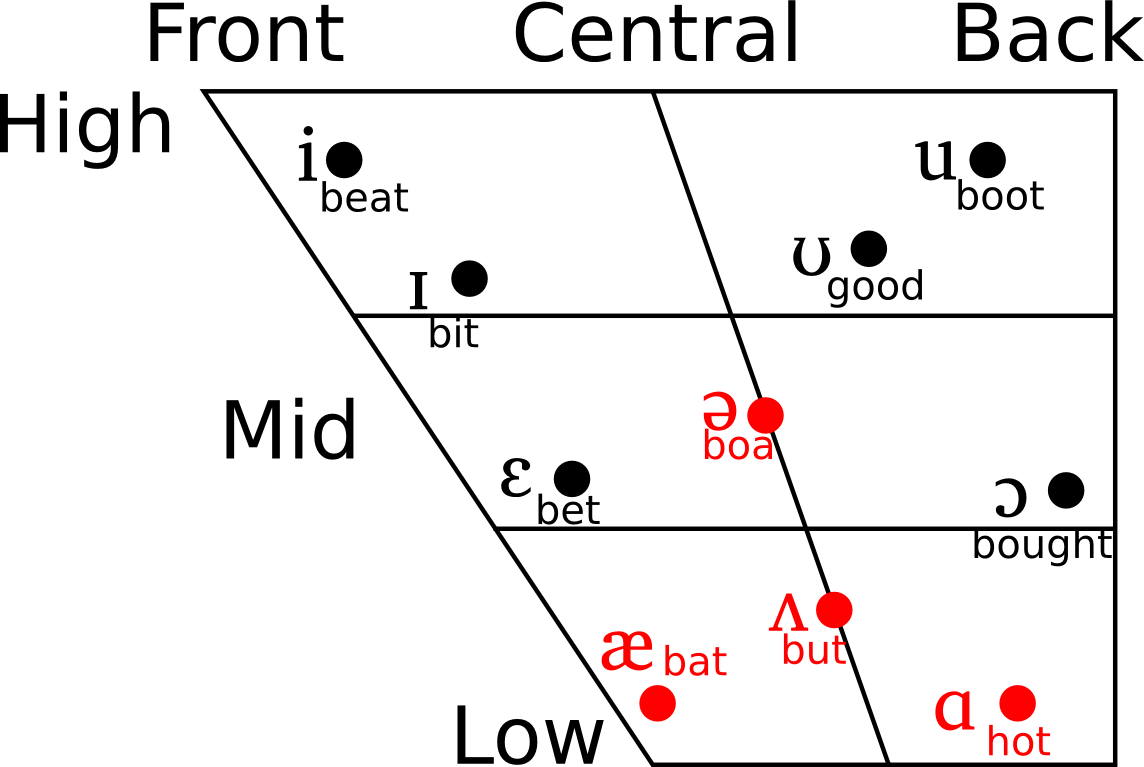


    We don't have the hot, but, bet, boot in Pashto not at least in the northern hard dialect spoken in Peshawar Valley, Swat, and Nangarhar-Kunar Valley.

    The sound bat is as in spae(dog), narrae(thin), sarhae(man) but short and not as aspired as in English.

    The sound bought is exactly the same as in Pashto moor(mother), koor(house), throor (aunt), and soor (riding).

    The sound good (or took) is exactly the same as in Pashto lur(daughter), sur(red), and buth (idol). In Pashto, Persian, Arabic, Urdu etc. it is the "paish" sound

    The sound bit is exactly the same as in thir(backbone), and siz (thing). In Pashto, Persian, Arabic, Urdu etc. it is the "zair" sound.

    The sound Beat is as in meegi (ants), baileegi (separating from), etc. In Pashto, it is like zair but longer and more frontal, closed, and un-rounded (you don't round your lips).

    The sound boa is exactly as in las(ten), kas(person), zar(quick, soon), etc. In Pashto, it is zwarakai or zabar sound.

    Father (not shown on the diagram) is as in kar(work), las (hand), kal(year), etc. It is Alif sound in Pashto, Persian, Urdu, etc.

    Finally, the sound found in Pashto but not in English is the one in thair(past, last), naigh (straight), gair(surrounded), etc.
    Last edited by Toramana; 05-02-2015, 10:39 AM.

    Comment


    • #47
      See how hard Roman alphabet is. You guys are already disagreeing. Its gonna taake a whole encyclopedia for you guys to actually write down the rules and still you will disagree and be confused just like professors are presently confused on English spelling and pronunciation of words.

      Comment


      • #48
        Originally posted by Azad Pashtunistan View Post
        The top is Roman Pashto, the bottom is the IPA. If you don't know which letter makes which sound, then tell me and I'll post Pashto's Arabic script equivalent.

        Consonants:

        Bb Cc Čč Dd Ḍḍ Gg Ǧǧ Hh Jj J̌ǰ Kk Ll Mm Nn Ṇṇ Pp Rr Ṛṛ Ss Šš Ṣṣ Tt Ṭṭ Ww Xx Yy Zz Žž Ẓẓ

        b ts tʃ d̪ ɖ g ɣ h dz dʒ k l m n ɲ p r ɽ s ʃ ʂ t̪ ʈ w x j z ʒ ʐ


        Vowels:

        Aa Āā Ee Ēē Ii Īī Oo Uu Yy

        a ɑ ə e ɪ i ɵ u ɨ

        The letter <y> makes two sounds. If used in the middle or beginning of a word, it makes the [j] sound but if used as the last letter of the word it makes the [ɨ] sound. The reason I didn't choose separate letters for the two different sounds is because there are no instances in Pashto where [j] is used at the end or where [ɨ] is used in the beginning/middle.


        This looks more complicated than Arabic and very sloppy.

        Comment


        • #49
          Arabic script is much more Intuitive than Roman script for Pashto. Roman has too many variants.

          Comment


          • #50
            Originally posted by Toramana View Post
            I disagree.

            The sounds in "a - xar (donkey) - خر" and "e - sterga (eye) - سترګه", which is the so-called "shwa" (in Pashto zabar or zwarakai) is the same sound. Similarly, "ē - zmarē (lion) - زمری" and "ī - ṣowankī (teacher) - ښونکي" (half-closed front vowel same as in English "man" but a bit shorter) is the same sound.
            The <a> in xar and the <e> in sterga are distinct sounds. In the IPA, they are represented by [a] and [ə] respectively. The diacritic mark used to make the [a] sound is called the zwar (zabar in Urdu), which is basically the slanted line that is put on top of a letter. And the diacritic mark used to represent the [ə] is called the zwarakay, which is a straight line that is put on top of the letter. A word in Pashto that uses both those sounds is the word for boy, /halək/. Notice how the first vowel is pronounced slightly differently than the second vowel. In English, the letter <u> in burp makes the [ə] sound and the letter <u> in understand makes the [a] sound. Both are unique sounds and both are present in Pashto and English, but not in Urdu.

            The Similarly, "ē - zmarē (lion) - زمری" and "ī - ṣowankī (teacher) - ښونکي" are completely different. The <ī> is used to represent the sound in dirty and the <ē> is used to represent the sound in man.

            Comment


            • #51
              Originally posted by Toramana View Post
              Here. See below. English vowels on phonetic diagram.


              We don't have the hot, but, bet, boot in Pashto not at least in the northern hard dialect spoken in Peshawar Valley, Swat, and Nangarhar-Kunar Valley.

              The sound bat is as in spae(dog), narrae(thin), sarhae(man) but short and not as aspired as in English.

              The sound bought is exactly the same as in Pashto moor(mother), koor(house), throor (aunt), and soor (riding).

              The sound good (or took) is exactly the same as in Pashto lur(daughter), sur(red), and buth (idol). In Pashto, Persian, Arabic, Urdu etc. it is the "paish" sound

              The sound bit is exactly the same as in thir(backbone), and siz (thing). In Pashto, Persian, Arabic, Urdu etc. it is the "zair" sound.

              The sound Beat is as in meegi (ants), baileegi (separating from), etc. In Pashto, it is like zair but longer and more frontal, closed, and un-rounded (you don't round your lips).

              The sound boa is exactly as in las(ten), kas(person), zar(quick, soon), etc. In Pashto, it is zwarakai or zabar sound.

              Father (not shown on the diagram) is as in kar(work), las (hand), kal(year), etc. It is Alif sound in Pashto, Persian, Urdu, etc.

              Finally, the sound found in Pashto but not in English is the one in thair(past, last), naigh (straight), gair(surrounded), etc.
              In the picture you showed, we have the following sounds:

              a ɑ ə e ɪ i ɵ u ɨ

              Actually to be 100% accurate, [ɑ] isn't present in Pashto. [aː] would be the proper sound, but they sound very similar. Don't know why I posted it earlier.

              The vowel in "bought" and "father" aren't present in Pashto. The sound in mor (mother) is represented by [ɵ] in Pashto and "kar" is [aː].
              The one in "bought" and father are [ɑ].

              We don't have [æ]. The sound in bat isn't present in Pashto. The sound in "spae" (dog) is represented by [e].

              The vowel in "tsiz" (thing) is not present in English. Its basically a shorter version of the elongated creep in English. The Pashto one is [i] and the English one is [iː].

              The vowel in good I don't think is present in Pashto.
              The one in lur (daughter) is a shorter version of the elongated English cool represented by [u] in Pashto and [uː] in English.

              The vowel in beat is an elongated version of [i] used for /ʂʉwaŋki/ (ṣowankī - teacher). The one for "meegi" is not present in English except for the word "eww", but that's it.

              The vowel in "boa" is the same as the one in "sterga" (/stərga/) and not "xar". The one in xar is the same as the English "cull".

              Btw, I use the North American accent. If you speak with a non-North American accent, then a few of those might be different for you. The IPA I follow is for American pronunciations. Let me know if you're British or something and I'll see if I can explain it again then.

              Comment


              • #52
                Originally posted by Brown Skinned Savage View Post
                This looks more complicated than Arabic and very sloppy.
                Its not more complicated. You're just used to the very simple looking 24 letter English alphabet. If I wrote فلانتم (made up word), you wouldn't know if it was supposed to be pronounced fulantim, fulantum, falantim, etc. With the Roman script, it is pronounced EXACTLY like how its written. It just looks complicated. Most of the words make similar sounds and the alphabet is very easy to memorize once you know the sounds. If we use all of the sounds in English, then it amounts to over 30 letters. This Pashto Roman one has 38 letters and most of them are extremely similar. In contrast, the Arabic Pashto alphabet has over 40 letters, so the reason why this looks sloppy is because you aren't used to it.

                Example:
                [n] and [ɳ] are both sounds present in Pashto.

                Nn Ṇṇ are the Roman equivalent whereas the Arabic equivalents are ن and ڼ.

                Comment


                • #53
                  Originally posted by Azad Pashtunistan View Post
                  Its not more complicated. You're just used to the very simple looking 24 letter English alphabet. If I wrote فلانتم (made up word), you wouldn't know if it was supposed to be pronounced fulantim, fulantum, falantim, etc. With the Roman script, it is pronounced EXACTLY like how its written. It just looks complicated. Most of the words make similar sounds and the alphabet is very easy to memorize once you know the sounds. If we use all of the sounds in English, then it amounts to over 30 letters. This Pashto Roman one has 38 letters and most of them are extremely similar. In contrast, the Arabic Pashto alphabet has over 40 letters, so the reason why this looks sloppy is because you aren't used to it.

                  Example:
                  [n] and [ɳ] are both sounds present in Pashto.

                  Nn Ṇṇ are the Roman equivalent whereas the Arabic equivalents are ن and ڼ.
                  Yes I would, because I'd be adapted to the colloquial voweling. Native speakers don't usually have hard time with voweling. Plus the lack of overt vowels except when special marks are placed allows for different dialects to communicate more effectively because they have a standard spelling and can fill in the vowels themselves.

                  Furthermore Pashto does not have many vowelings except when it comes to borrowed words from other languages.

                  also you'll need more letters to make ONE sound than using Arabic script according to Roman script. That makes it a bit clumsy.


                  This paper gives a good detailed analysis about Pashto voweling From what i says here it doesn't seem the adoption of a Roman script officially would give any advantage.

                  Comment


                  • #54
                    Originally posted by Azad Pashtunistan View Post
                    In the picture you showed, we have the following sounds:

                    a ɑ ə e ɪ i ɵ u ɨ

                    Actually to be 100% accurate, [ɑ] isn't present in Pashto. [aː] would be the proper sound, but they sound very similar. Don't know why I posted it earlier.

                    The vowel in "bought" and "father" aren't present in Pashto. The sound in mor (mother) is represented by [ɵ] in Pashto and "kar" is [aː].
                    The one in "bought" and father are [ɑ].

                    We don't have [æ]. The sound in bat isn't present in Pashto. The sound in "spae" (dog) is represented by [e].

                    The vowel in "tsiz" (thing) is not present in English. Its basically a shorter version of the elongated creep in English. The Pashto one is [i] and the English one is [iː].

                    The vowel in good I don't think is present in Pashto.
                    The one in lur (daughter) is a shorter version of the elongated English cool represented by [u] in Pashto and [uː] in English.

                    The vowel in beat is an elongated version of [i] used for /ʂʉwaŋki/ (ṣowankī - teacher). The one for "meegi" is not present in English except for the word "eww", but that's it.

                    The vowel in "boa" is the same as the one in "sterga" (/stərga/) and not "xar". The one in xar is the same as the English "cull".

                    Btw, I use the North American accent. If you speak with a non-North American accent, then a few of those might be different for you. The IPA I follow is for American pronunciations. Let me know if you're British or something and I'll see if I can explain it again then.
                    Zwana, I am talking of British received pronunciation and classical IPA symbols not north American pronunciation and symbols (which are weird). The symbols are given in the image below (for English).


                    In North American English, "ou" in bought is replaced with the sound of "a" in father but in British English "ou" (in bought) is uttered in exactly the same way as "oo" in Pashto moor(mother), "khoor"(sister), koor(house/home), shoor(noise), etc.

                    Likewise, daughter, caught, brought is pronounced the same way as "oo" in Pashto "moor", "khoor", etc. There is no difference between the two sounds phonetically speaking.

                    Similarly, "a" in all, small, tall, ball is the same sound as "oo" in Pashto moor (according to rules of phonology for British English, "a" preceding "l" i.e., dark l is pronounced "oo").

                    In the IPA chart above , the Pashto "oo" in moor(mother) and English "ou" in bought has the 4th phonetic symbol in the list of long vowels. As can be seen, the symbol is a "c" but oriented towards the left and with a colon ":" to the right.

                    On the shwa the 5th symbol in the list of short vowels (an "e" turned upside down) it is exactly Pashto, Urdu, Arabic, Persian zabar. No difference or very little difference whatsoever.

                    As for the other sounds I stick to my guns and insist that what I say is right.

                    Last edited by Toramana; 05-03-2015, 05:12 PM.

                    Comment

                    Working...
                    X