
 Tweet
Tweet
Here. See below. English vowels on phonetic diagram.
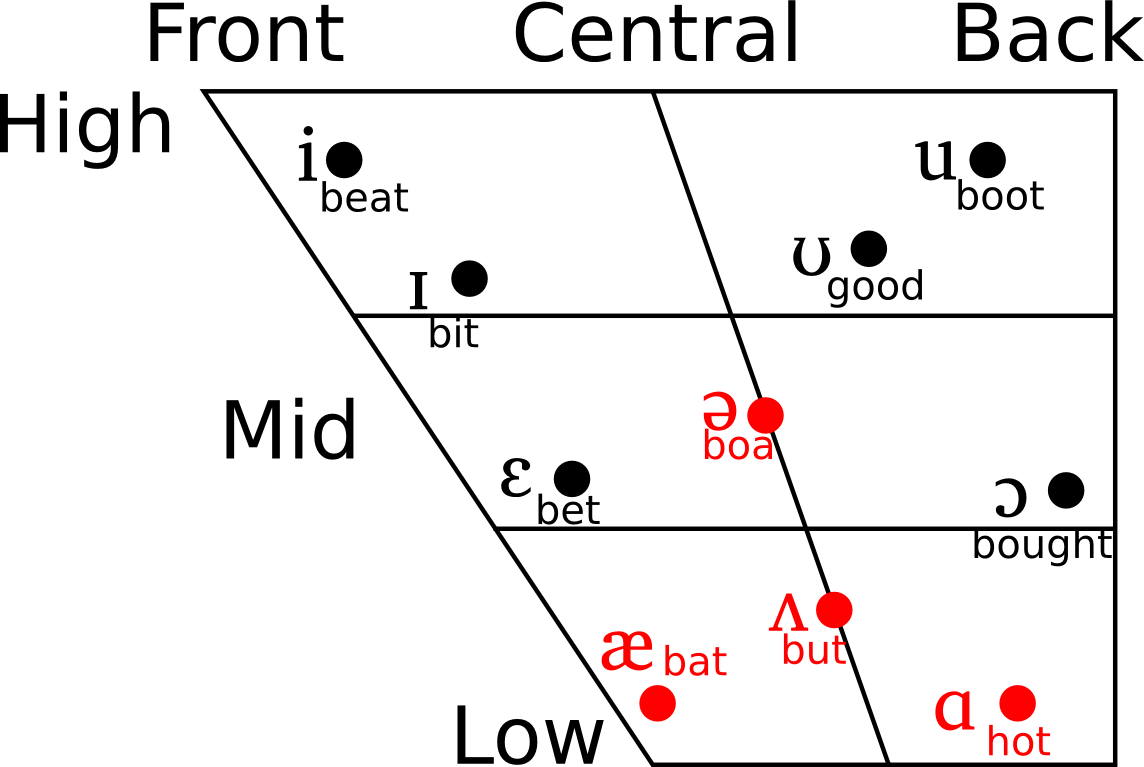
We don't have the hot, but, bet, boot in Pashto not at least in the northern hard dialect spoken in Peshawar Valley, Swat, and Nangarhar-Kunar Valley.
The sound bat is as in spae(dog), narrae(thin), sarhae(man) but short and not as aspired as in English.
The sound bought is exactly the same as in Pashto moor(mother), koor(house), throor (aunt), and soor (riding).
The sound good (or took) is exactly the same as in Pashto lur(daughter), sur(red), and buth (idol). In Pashto, Persian, Arabic, Urdu etc. it is the "paish" sound
The sound bit is exactly the same as in thir(backbone), and siz (thing). In Pashto, Persian, Arabic, Urdu etc. it is the "zair" sound.
The sound Beat is as in meegi (ants), baileegi (separating from), etc. In Pashto, it is like zair but longer and more frontal, closed, and un-rounded (you don't round your lips).
The sound boa is exactly as in las(ten), kas(person), zar(quick, soon), etc. In Pashto, it is zwarakai or zabar sound.
Father (not shown on the diagram) is as in kar(work), las (hand), kal(year), etc. It is Alif sound in Pashto, Persian, Urdu, etc.
Finally, the sound found in Pashto but not in English is the one in thair(past, last), naigh (straight), gair(surrounded), etc.
We don't have the hot, but, bet, boot in Pashto not at least in the northern hard dialect spoken in Peshawar Valley, Swat, and Nangarhar-Kunar Valley.
The sound bat is as in spae(dog), narrae(thin), sarhae(man) but short and not as aspired as in English.
The sound bought is exactly the same as in Pashto moor(mother), koor(house), throor (aunt), and soor (riding).
The sound good (or took) is exactly the same as in Pashto lur(daughter), sur(red), and buth (idol). In Pashto, Persian, Arabic, Urdu etc. it is the "paish" sound
The sound bit is exactly the same as in thir(backbone), and siz (thing). In Pashto, Persian, Arabic, Urdu etc. it is the "zair" sound.
The sound Beat is as in meegi (ants), baileegi (separating from), etc. In Pashto, it is like zair but longer and more frontal, closed, and un-rounded (you don't round your lips).
The sound boa is exactly as in las(ten), kas(person), zar(quick, soon), etc. In Pashto, it is zwarakai or zabar sound.
Father (not shown on the diagram) is as in kar(work), las (hand), kal(year), etc. It is Alif sound in Pashto, Persian, Urdu, etc.
Finally, the sound found in Pashto but not in English is the one in thair(past, last), naigh (straight), gair(surrounded), etc.


Comment