Announcement

Collapse
No announcement yet.

Punjabi/Pakistan and Turk Brotherhood?

Collapse
X
 
  • Filter
  • Time
  • Show
Clear All
new posts

  • Punjabi/Pakistan and Turk Brotherhood?

    Recently, the Punjabi politicians Nawaz Sharif, Shahbaz Sharif, and the current Punjabi general have tried to convey to Turks and Erdogan in their interactions as if they are their true Muslim brothers.

    The poor Turks who have poor knowledge of Pakistan's ethnic geography and Muslim Indian history don't know that this is far from truth; rather the contrary is true.

    Turks may argue that Arabs by siding with British betrayed them in the World War I and the Ottomons but one can absolve or pardon Arabs on the ground that they, i.e., Arabs actually had some grievances against Ottomon rule over Arabs. One cannot simply call them traitors and plain mercenaries.

    It would be a good lesson for Turks to know that the group that had really committed an offence against them and a betrayal were Indian Muslims most importantly Punjabis. In the Gallipolli and later confrontation between Turks and the allied forces, the mainstay of British military force comprised of Punjabi Muslims which was just a mercenary force fighting for money and reward and approval of the British masters. This force was mainly been recruited for British by the Mushaikh and feudal of the Punjab.

    Iqbal Sialkoti was also a part of the recruitment campaign. That is why after the War, he was awarded with the title of Sir. He was a lazy person and a typical Punjabi constantly looking for favour from British and using his Islamist poetry for popularity in Muslims of South Asia.

    The one group that had showed loyalty to Turks was Pashtuns. Pashtuns in World War I and the war of Gallipoli had refused to fight against Turks and therefore had been punished by the British.

    After the War, one British general had stated that,

    "Punjabis were steadfast like a rock whereas a big question mark hangs over the Pathan".

    British Raj military history records that after the War British Raj authorities had reduced the number of Pashtuns to mere 4000 as a punishment. The proportion of Punjabi Musalmans (PMs) on the other hand had been increased manifolds.
    Last edited by Toramana; 04-04-2015, 10:36 PM.

  • #2
    Modern Turkey worships Pakistan.


    1. Many complain about the relationship that America has with Israel, however there are large sections of American society and the media which criticize Israel and presidents also argue with it at times.

    However Turkey will never criticize Pakistan.

    Pakistan can kill Pakistani civilians.

    It will never be criticized.

    Why?


    2. From a young age Turks are taught to revere and worship Pakistan as their eternal ally and brother.

    Many ignorant Turks even believe that in the 1920s, "Pakistan", helped Turkey.

    However there was no Pakistan back then.

    The Indian Muslim support for Turkey/Ottomans came mainly from Uttar Pradesh, Bengal and other areas.

    The modern day Pakistan which is a de facto greater Punjab had no major support for the Ottomans but instead supplied soldiers who killed Muslim Turks in both Anatolia and Mecca.


    3. A few years ago there was a poll in Turkey and Turks said Pakistan was their no.1 ally in the world.

    Yes, even more than Azerbaijan, Turkic countries or others.


    This is all because of the constant brainwashing drummed in to Turks about Pakistan as the "eternal friend" of Turkey.


    4. Geo-politically it is a bit different.

    It is Arab states who have helped Pakistan with Kashmir more e.g. Arab fighters and the Turks have never militarily helped the Pakistanis, nor have Turkish volunteers (e.g. greywolves) gone to Kashmir.


    Pakistan and Turkey have a conflict of interests in Afghanistan, with Pakistan supporting the Taliban and Turkey supporting the opponents of the Taliban including Uzbek Turk, Dostum.

    Turkey and Iran's role in Afghanistan is very important in supporting the Afghan government from falling to the pro-Pakistan Taliban thus frustrating a major policy goal of the rulers of Pakistan, the Punjabi generals of Rawalpindi.


    5. Aside from that the Erdogan regime has taken Pakistano-philia to an all together new level with Erdogan supporters attacking the Bangladeshi embassy in Ankara a while back.

    This was due to their support of a Bangladeshi militant who was supported by Pakistan, Qader Molla.


    Qader Molla, the pro-Pakistan militant for whom Pakistan-loving Turks attacked the Bangladesh embassy in Ankara.
    * * * * * * * * * * * * * * * * * * * * * * *

    Comment


    • #3
      Bengal-Tiger, British Raj also distrusted Bengalis just as they distrusted Pashtuns because Pashtuns had fought against them. There were two reasons for that.

      (1) The British had come via sea and saw the sea as the exit route from India. Therefore, they considered the recruitment of Bengalis in large number in Raj army and the development of Bangali's military capacity as a threat and risk to keeping the sea-route safe and open.

      (2) During the 1857 rebellion, the Bengal lancers had mutinied.

      On the contrary, Punjabis were considered more wholesome and subservient which was a character Punjabis had developed due to the very feudal social structure in Punjab. In fact, Punjabi mushaikh and feudal were the main tool of the British in suppressing the 1857 mutiny.
      Last edited by Toramana; 04-04-2015, 11:17 PM.

      Comment


      • #4
        I can understand Bengali tiger frustration. Muslim bengali were first in line to cry about separate country because 99% of them were slaves working on hindu master lands
        Best post in PF history
        [I]
        ''Today the ideology of Pakistaniat within Pakistanis is so strong that even if world war 3 is fought within Pakistan boundries,Pakistan will survive.'' [/I]Da Bannu Mazdigar

        Comment


        • #5
          Originally posted by Toramana View Post
          Bengal-Tiger, British Raj also distrusted Bengalis just as they distrusted Pashtuns because Pashtuns had fought against them. There were two reasons for that.

          (1) The British had come via sea and saw the sea as the exit route from India. Therefore, they considered the recruitment of Bengalis in large number in Raj army and the development of Bangali's military capacity as a threat and risk to keeping the sea-route safe and open.

          (2) During the 1857 rebellion, the Bengal lancers had mutinied.
          They were not bengalis but bihari rajputs in bengal regiment
          Best post in PF history
          [I]
          ''Today the ideology of Pakistaniat within Pakistanis is so strong that even if world war 3 is fought within Pakistan boundries,Pakistan will survive.'' [/I]Da Bannu Mazdigar

          Comment


          • #6
            I hope someone tells Turk scholars about the ethnic composition of the military of the British Raj era and the role of various groups in the British military campaign against the Ottomans.

            I have requested a friend to write about it in Turkish newspapers.

            Comment


            • #7
              Originally posted by Toramana View Post
              I hope someone tells Turk scholars about the ethnic composition of the military of the British Raj era and the role of various groups in the British military campaign against the Ottomans.

              I have requested a friend to write about it in Turkish newspapers.
              1. Toramana Lala,

              I think your friend should point out that Pakistan like any other country in the world be it Bangladesh, Turkey, USA or Mongolia is a country with imperfections and that Turks should adopt a realistic attitude towards it.

              Of course they should have friendship with Pakistan (I am not advocating enemity) but they should not have blind unquestioning worship of it and turn a blind eye to its atrocities in east Pakistan, Balochistan, FATA and now violation of human rights by the mass expulsion/ethnic cleansing of Afghans in Pakistan.

              Rather than having a childish immature infatuation with Pakistan they should have a mature adult balanced approach.


              2. I don't know how possible it will be for him/her to write such an article as Turks are a very "fundamentalist" type of people i.e. they stick rigidly to any belief they adopt be it Islam or secular Kemalist nationalism.

              They have Pakistan-worship deeply rooted in them and many will not be interested in removing it, even if they know they are wrong.

              But anyway good luck to him/her.

              Any single act counts.

              A balanced Turkish approach to Pakistan will help her with understanding things better and relations with Afghanistan, Bangladesh and India.


              3. Bengal overall was the most rebellious region in south Asia against Britain.

              I won't give details as I don't want to derail this thread which is about Turkey's infatuation with Pakistan, but am happy to do so in another thread.
              * * * * * * * * * * * * * * * * * * * * * * *

              Comment


              • #8
                Originally posted by Bengal_Tiger View Post
                1. Toramana Lala,

                I think your friend should point out that Pakistan like any other country in the world be it Bangladesh, Turkey, USA or Mongolia is a country with imperfections and that Turks should adopt a realistic attitude towards it.

                Of course they should have friendship with Pakistan (I am not advocating enemity) but they should not have blind unquestioning worship of it and turn a blind eye to its atrocities in east Pakistan, Balochistan, FATA and now violation of human rights by the mass expulsion/ethnic cleansing of Afghans in Pakistan.

                Rather than having a childish immature infatuation with Pakistan they should have a mature adult balanced approach.


                2. I don't know how possible it will be for him/her to write such an article as Turks are a very "fundamentalist" type of people i.e. they stick rigidly to any belief they adopt be it Islam or secular Kemalist nationalism.

                They have Pakistan-worship deeply rooted in them and many will not be interested in removing it, even if they know they are wrong.

                But anyway good luck to him/her.

                Any single act counts.

                A balanced Turkish approach to Pakistan will help her with understanding things better and relations with Afghanistan, Bangladesh and India.


                3. Bengal overall was the most rebellious region in south Asia against Britain.

                I won't give details as I don't want to derail this thread which is about Turkey's infatuation with Pakistan, but am happy to do so in another thread.
                I hope you don't mistake british bengal regiment/army with actual bengalis in it
                Best post in PF history
                [I]
                ''Today the ideology of Pakistaniat within Pakistanis is so strong that even if world war 3 is fought within Pakistan boundries,Pakistan will survive.'' [/I]Da Bannu Mazdigar

                Comment


                • #9
                  When Pashtun Soldiers refused to fight against Ottomans

                  The Pathans were not eager to fight Ottoman Turkey, this was evident among the Pathan personnel in the 20th infantry when the unit was destined for Mesopotamia in late 1914. In fact on 19 November and 26 November 1914, some Kamber Khel Afridis deserted to the Ottoman Turks. Arthur Barret cabled to GHQ India that this unit be sent from Mesopotamia to India. John Nixon was also against the North-West Frontier Pathans and Afghans against Ottoman Turkey. On 12 April, during the Turkish attack at Shaiba, the Bajauri and Bunerwal Pathans deserted from the unit.[1]

                  The members of Pathan tribes from NWFP voiced strong objections to the war with Turks on the religious grounds. Abstentions and desertions among Pathans in the initial stages of campaigns exceeded those among all other martial classes [2]. In early 1915, two Pathan units refused even to embark for service in Mesopotamia, with members of one unit opening fire on their officers.[3]

                  Omissi has observed : "From early 1915 , letters written by Pathan Sepoys show that they are willing to consider absconding"[4] .By march, major general Arther Barret, the original commander of 6th indian division in Mesopotamia, had twice requested the replacement of four companies of Pathans which he didn't trust. The authorities in India refused on the grounds that they could not depend on muslim troops to fight on North-West Frontier (Pakhtunkhwa) either, and therefore couldn't spare non-Muslim units for service overseas.[5]

                  On 23rd October , 2 Pathan soldiers shot 2 sentries and deserted to the Ottomans. Faced with growing desertion rate , Townshend decided to send an entire Battalion composed largely of Pathans back to Basra. [6]. In February 1915, the Pathans who advanced up to the Tigris with the relief force, refused to fight the ottomans, consequently, in late February, all trans-indus Pathans were removed from the force and sent back downriver.[7]

                  In 1914 there were nearly 5000 Trans-Indus Pathans in the Indian Army, of whom about half were Afridis. By June 1916 over 600 Afridis had deserted to Turks. In November 1915 all recruitment of Trans-Indus Pathans was stopped.[8]. Philip Mason well summed up the loyalty assessment of the Indian Army by saying that "A faint question mark hung over the Pathans throughput the war but the Punjabi Muslims were steady as a rock"

                  15th Lancers

                  The 15th Lancers was a cavalry regiment of the British Indian Army which existed from 1858 to 1921. The regiment was one of the single class regiments, with all troops being recruited from the Multani Pathan community. In 1915, 15th lancers were detached from the Lahore Division and sent to the Middle East. On landing at Basra from Europe, 429 soldiers of 15th lancers refused to fight fellow Muslims, i.e. the Turks, in the Holy Land of Islam.[9]

                  The incident of 15 Lancers Pathan rebellion is mentioned in one of the volumes of the British official history of Operations in Mesopotamia .This 15 Lancer was an Alizai dominated unit and was one of the very few units of Indian Cavalry to have an 'Honorary Native Commandant' Nawab Abdullah Khan who was the Head of the Alizai clan of Dera Ismail Khan Pathans (Refers-Page- 153-The Armies of India-Major G.F Macmunn- Adam and Charles Black- London 1911).[10]


                  Mir Mast Afridi

                  A forgotten hero in Pakistan is Jemadar Mir Mast Afridi from the 58th Frontier Force (Vaughan's Rifles). Mir Mast was an Afridi Pathan from tribal areas of modern Pakistan. In 1914 his unit was shipped to France as part of the Indian Infantry Corps, which played a major role in stopping the German advance in France in 1914 in Ypres Sector . Mir Mast Afridi seems to have been a far more politically aware and resolute man as compared to many Muslims educated at MAO College Lahore, Aligarh or at many prestigious British universities and Legal Inns! Mir Mast decided that he must not fight the Britisher's war and crossed over to the German lines on a rainy night in March 1915 along with 14 other Afridi Tribal Pathan. Mir Mast was awarded one of the highest German gallantry award Iron Cross by the German Kaiser Willhelm II . The British in order to equalize the insult awarded Mir Mast's real brother Mir Dast Afridi (from 55th FF Coke's Rifles) a Victoria Cross in April 1915.

                  Mir Mast was sent to Turkey by the Germans, to meet with the Mufti, and by late in the war was back in Afghanistan apparently trying to discourage his Muslim countrymen from joining up to fight for the Raj.The Turko-German mission failed in 1915 to gain the support of the Afghan government. However, the Mission members succeeded in establishing a centre for the anti-British activities in Bagh (Tirah), in the tribal belt. In June 1916 two Turkish emissaries arrived Tirah; one was Khired Bey, a staff colonel of the Turkish army and the other Mohammad Abid (alias Abidin), an Arab, a former employee of the Turks as a drill' instructor at Kabul. Mir Mast accompanied the Turko-German Mission. He was already busy in propaganda against the British in Tirah, he had already prepared ground for the mission.

                  On their arrival in Tirah, the emissaries were welcomed by Mast. They delivered anti-British speeches and unfurled a flag, a blessed and sent by the Turkish Sultan. By the middle of 1916 a large number of the Pashtoon soldiers, mainly deserters from the British Indian army had swelled the ranks of the Turkish emissaries. They started recruitment of the locals as well.. By July 1916, the total number of the Afridi recruits was reported to have reached about four hundreds.. They were posted in three different places and and drilled every day by Mir Mast Khan under the supervision of Kharid Bay, a Turkish Colonel.The Turks also wrote letters to the neighbouring tribes, and in the month of August some Turkish emissaries visited the Mohmand areas where Hajji Sahib was busy in waging war against the British.

                  As a result of the growing popularity of the Sultan's army in Tirah, Sir George Roos-Keppel, then Chief Commissioner NWFP, found the tribes being virtually divided into two camps: anti-British and pro-British. The former consisted of deserters and discharged soldiers from the Indian army and other pro-Afghan elements, while the latter was composed mainly of Maliks and elders who were in favour of maintaining friendly relations with the British in lieu of their allowances and other emoluments from the British Indian government. Roos Keppel believed that the Turkish agents were responsible for creating the troubles in the tribal belt, but he could not ask the Government to take any stern action against them lest he feared aggravation in the already tense situation.

                  The tribes who were supporting the Turkish emissaries inflicted losses on those who were accused of supporting the British. In retaliation, other tribes also organized themselves under the leadership of Khan Bahadur Zaman Khan Kuki Khel and attacked and burnt the village in which the two Turkish emissaries and their Afghan followers were living in Tirah. This action of the Afridis made them unpopular among the people. The British rewarded the tribes by sanctioning a bonus of one year's allowances.[12]


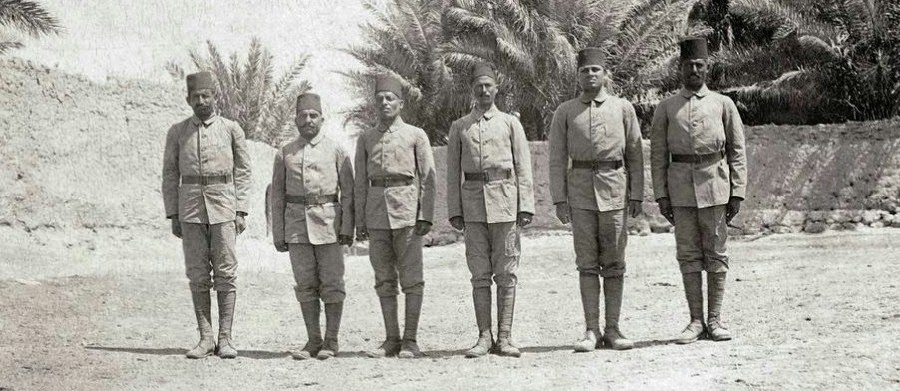
                  From left to right they are Mir Mast Afridi, Itbargul, Mohabad Khan, the cook Seyed Ahmed and the two volunteers that had arrived from America, Abdur Rahman Khan and Abdul Subhan Khan. They wear simple khaki uniforms with red fezzes. The Afghan Mission was a collective of Indian, German and Ottoman military and diplomatic personnel sent to Kabul to try to convince Emir Habibullah of Afghanistan to join the Central Powers and rise up in a Jihad against the British in India. These six pathans were recruited to protect the mission.


                  References

                  1.The Army in British India: From Colonial Warfare to Total War 1857 - 1947 by Kaushik Roy, p-86
                  2. Telegram from Viceroy, 3 February 1915, Edmund Barrow Papers, MSS EUR E420/10, IOR
                  3. Omissi (ed.), "Indian voices", p-14-5.
                  4. Omissi, "the sepoy and the Raj", p-120.
                  5. Telegram from Viceroy, dated 11 march 1915, Telegram from Viceroy , dated 3 March 1915, Edmund Barrow Papers, MSS EUR E420/10. IOR.
                  6. Townshend. "My campaign", p-226
                  7. War record of 27th Punjabis, 1916, Lt.Colonel H.S Vernon Papers, MSS EUR D744. IOR.
                  8. Michael S. Neiberg, World War I, p-481
                  9. Izzat: historical records and iconography of Indian cavalry regiments, 1750-2007 - Ashok Nath
                  10. http://www.defencejournal.com/oct99/letter.htm
                  11. http://www.defencejournal.com/2001/may/forgotten.htm
                  12. Perceptions: Journal of International Affairs, Volume 12, Issue 4. p-40
                  [URL="http://historyofpashtuns.blogspot.com.au/2014/07/afghan-sikh-wars.html"][SIZE=5][COLOR=Green]History of Pashtuns[/COLOR][/SIZE][/URL]

                  Comment


                  • #10
                    commendable [MENTION=1234]Smarty[/MENTION], do you have an account of the relation of Ottoman and Afghan Barakzai dynasty? when Ottoman turks were helping emirate of Afghanistan and Possible uprising in Pushtun belt against British india

                    Comment


                    • #11
                      Originally posted by marwat View Post
                      commendable @Smarty, do you have an account of the relation of Ottoman and Afghan Barakzai dynasty? when Ottoman turks were helping emirate of Afghanistan and Possible uprising in Pushtun belt against British india
                      I do not have it, but read this relevant piece of article for your interest http://s400910952.websitehome.co.uk/...%20mission.htm
                      [URL="http://historyofpashtuns.blogspot.com.au/2014/07/afghan-sikh-wars.html"][SIZE=5][COLOR=Green]History of Pashtuns[/COLOR][/SIZE][/URL]

                      Comment


                      • #12
                        So Smutty sorry smarty urf Goofy sorry Loofy, that means Punjabis are not very idealistic sort to stand for relationships, associations, or values and can serve any power depending on who offers better money or status or importance.

                        Although the Pathan knew his family back home will be in danger and he will lose career not to mention also his understanding that he might be punished for the act, yet he went ahead with his decision.

                        There lays the difference.

                        In my opinion, Sikh Punjabis make a better human being and hero than the Musalman Punjabi. Remeber Baghat Singh and many others yet in Punjabi Muslims you cannot find a single instance someone has stood for something ideal and moralistic.
                        Last edited by Toramana; 04-06-2015, 07:56 PM.

                        Comment


                        • #13
                          Originally posted by Toramana View Post
                          So Smutty sorry smarty urf Goofy sorry Loofy, that means Punjabis are not very idealistic sort to stand for relationships, associations, or values and can serve any power depending on who offers better money or status or importance.

                          Although the Pathan knew his family back home will be in danger and he will lose career not to mention also his understanding that he might be punished for the act, yet he went ahead with his decision.

                          There lays the difference.

                          In my opinion, Sikh Punjabis make a better human being and hero than the Musalman Punjabi. Remeber Baghat Singh and many others yet in Punjabi Muslims you cannot find a single instance someone has stood for something ideal and moralistic.
                          Troray, let me introduce you to a very interesting punjabi musalman character of 18th century,

                          Dina Arain: the master ‘double game’ player
                          [URL="http://historyofpashtuns.blogspot.com.au/2014/07/afghan-sikh-wars.html"][SIZE=5][COLOR=Green]History of Pashtuns[/COLOR][/SIZE][/URL]

                          Comment


                          • #14
                            [MENTION=1201]Toramana[/MENTION]

                            I think your friend should also let the Turks know about the role of Jinnah in the Khilafah movement.

                            So this lie that Turks are brainwashed from when they are little kids that "Pakistan is our eternal friend as they helped us in our war of independence" is nonsense.

                            As the founder of Pakistan himself was opposed to the pro-Turkish Khilafah movement.

                            * * * * * * * * * * * * * * * * * * * * * * *

                            Comment


                            • #15
                              Originally posted by Bengal_Tiger View Post
                              [MENTION=1201]Toramana[/MENTION]

                              I think your friend should also let the Turks know about the role of Jinnah in the Khilafah movement.

                              So this lie that Turks are brainwashed from when they are little kids that "Pakistan is our eternal friend as they helped us in our war of independence" is nonsense.

                              As the founder of Pakistan himself was opposed to the pro-Turkish Khilafah movement.
                              not all turks are ottomanists, only ottomanists yearn for usmania caliphate, and it is not fully a lie. many Urdu-speaking musalmans of bar-e-sagheer, supported the khilafa movement, only punjab/pukhtun soldiers and some elites from muslim league stoppped support for it or turn against it.

                              Jinnah was an admirer of Kemal Ataturk, both belong to minority muslim sects & followed a secular lifestyle; Jinnah & Ataturk had mutual respect for eachother.

                              so even if ottomanists may not be pleased wid jinnah, the Kemalists def are.
                              "I bow to no one, except ALLAH. I dont bow to punjabay, do not bow to kabulay and afghanay, do not bow to faujay and mullay, do not bow to asfandyarwalay and petty khanays...i am traitor to all of them." - Smartay

                              Comment

                              Working...
                              X