

 Tweet
Originally posted by Not an idiot
View Post
-
Than why Ibn Sina or Maulana or Sanai, Jami, Ansari etc are called as ''Afghans'' while beeing ''non-Afghans'' (non-Pashtuns)? You can´t change the facts. That´s reality in today´s world and you can do nothing to change it. Just live with it and accept it. You like it or not. By not accepting Hazaras, Tajiks, Uzbeks etc not as Afghans you give them the right to form with large parts of Afghanistan their own nations or unite with the neighbouring countries. Have you seen what kind of maps Hazaras, Tajiks and Nuristani´s have created on facebook? If those are not Afgahns Afghanistan get devided and every part will go to it´s regional inhabitants. Do you want that?Last edited by Guest; 05-24-2011, 04:29 PM. -
Provide the quotes for one, of all of their claims. I wanna see what they wrote, if they wrote it.Originally posted by Albani_Rahmat_Kabulzada View PostComment
-
Go and open Ghobar´s book that was many times censured and rewritten. Go and read Kohzad´s books. Afghanland.com that site is a forerunner and there are many other sites on the net who claim on them as Afghans. Just type on google and look for famous ancient Afgahns. I guess, the owner of the site is even here on this forum registered.Originally posted by Not an idiot View Post
Let´s look what they write. '' Ibn Sina Avicenna a world famous afghan physician, philosopher, and scientist'' http://www.afghanland.com/history/biographies.html
Comment
-
Don't provide me with the books, provide the darn quotes when those people said those quotes.
Ibn Sina was an Uzbek BTWComment
-
Can you prove that? Uzbeks came to Central Asia in 1500. Barakzai Pashtuns are originally Uzbeks. Ibn Sina lived 500 years before of Uzbek arrival. Why are Ghaznavids called as Afghans? Why is Nauroz called as Afghan celebration? Pashtuns don´t have Nauroz. Btw, where is the difference between quoting a book or any internet site? At the end they are claimed have beeing Afghans.Originally posted by Not an idiot View Post
Ibn Sina´s background
http://books.google.com/books?id=p9e...ethnic&f=false
Uzbeks claim on him because he lived in the region. That´s the new nationalism of historyless countries like Uzbekistan which are 80 years old. That´s Pan-Turkism propagandaLast edited by Guest; 05-24-2011, 04:49 PM.Comment
-
Don't change the topic, provide the quotes of your claim? Don't divert the subject like you always do.Originally posted by Albani_Rahmat_Kabulzada View Post
Ibn Sina was born in modern day Uzbekistan. Your sources say he was Persian, where's the Afghan source?
Where's your evidence that Barakzai were originally Uzbeks, didn't you say they were originally Tajiks/Persians
That is only thing your good at, making a bs claim and then wait for someone else to respond, and then you make morembs claims without providing the sources.Last edited by کیش; 05-24-2011, 04:48 PM.Comment
-
Go and look by yourself on the net and read books from Afghanistan. It´s not my duty to provide you anything. Afghanland.com is such a site. No matter where Ibn Sina was born. He was not a Turk (then, Turks were slaves and soldiers, the only occupations they had). Samarqand, Bukhara all the regions were dominated by Tajiks. Persian was the native language and dominant. The claims he was an Uzbek is based on modern Uzbek nationalism. After Soviet´s break-down the new independant states created a lot of stupid claims and myths. Why don´t you provide only one source where it is attested that Ibn Sina was an Uzbek? You can´t and you will not able to find one. Btw, I never said Barakzais are Tajiks or Persians. They are just tajikified Pashtuns of original Uzbek origin. You people turn words to other meanings. But please provide your claim if you can otherwise your words are not trustfully because they are taken from Nick´s mouth, possibly your teacher. Your hate for Darizubans is obvious. You are just jealous on them while they even invite you to their houses. Provide the sources above as wrong. Please, go onOriginally posted by Not an idiot View PostComment
-
Are you only here to denigrate Pashtuns?
Don't make bull**** claims, and ask me to look up the sources of your claims.
Am not you, I do not go out of my way to denigrate a group of people. I actually can also speak Dari, so your wrong again.
Barackzai's are Tajiikfied Uzbeks who are Pashtuns but confused about their identity? That doesn't make sense.Comment
-
For a man who says his father is a Kabuli, you do seem to love Persians/ and Tajikistani. I wonder if that's another bull**** claim you made.Comment
-
Don´t change the issue. Please provide your sources. Yes, I am Kabuli ... my father is a Kabuli and my mother is from Chaharasiab. That still make me Kabuli. As Kabuli i love my Pashtun brothers as much as I love my Tajik, Hazara, Nuristani and Uzbek brothers and even those living in the neighbouring countries. We are all one people just devided by boundaries and politics.Comment
-
This guy is one of those people on Tajikam.comComment
-
I don´t know what you are talking brother. I get a bit confuse. I repeat again myself. Just open books or visit only Afghanland.com. That´s a good site because this site is actually made exclusively for Pashtuns. Nick, your teacher and brother also claim many of those Tajiks as Afghans and even as Pashtuns. You have your proof alive. You just change the issue because you cannot provide only one source that would back your pity claim on Ibn Sina. Please, provide also that I insulted you or my mother´s background. You just turn my words or just don´t understand it.Originally posted by Not an idiot
I do not know Parsistani. The admin can make an account comparison. Dear brothers, dear sisters, that´s how Afghanistan looks like. Our own home is destroyed because we can not live together as human-beeings and one nationals. Very sad
Nick
03-11-2007, 06:31 PM
:thumbup1: The Afghan Samanid Empire
The Samanids (875-999) (in Dari: Saman-i-han) were an Afghan dynasty in Eastern Iran, and Central Asia named after its founder Saman Khodh-i-Balkhi from Afghan Samandi tribe who rised from Balkh. It was among the first native Afghan dynasties in the Muslim world, who were non-Arabs. Samanids are considered the beginning of the Afghan nation. And the main spreaders of Sunni sact. Their rule lasted for 102 years and 10 days, and their territory encompassed of Mashad (Iran), Kandahar, Kabul, Samarkand, Takharistan, and Balkh.
To further legitimate the dynasty, the Samanids claimed to be descendants of the Samandi/Samandizia tribe and once an Avestian Bactrian speakers of Takharistan.They revived the Afghan culture and gave a birth to a new language called Dari. Dari is a mixture of Avestian (Pashtu), Palavi (western Iranian) and Quranic (Arabic). Their capitals were Balkh, Herat, Ghowr and Baghlan at one point Mashad (IRAN) and Samarkand (Russia) the other lasting contribution besides Language of the Samanids to the history of Islamic art is the pottery known as Samanid Epigraphic Ware. Plates, bowls, and pitchers fired in a white slip and decorated only with calligraphy, often elegantly and rhythmically written. The Arabic phrases are generally more or less generic well wishes, or admonitions to good table manners. However, it is difficult to say that Dari was the dominant language in all spheres of life in the Samanid Empire.
Most of the theological and philosophical works were still written in Arabic, which was the academic language in the Islamic world. Even the Afghan and Iranian scholars, who were mentioned bellow mostly wrote in Arabic, and there also was developed Arabic literature in the Samanids period. On the other hand there were many other local eastern Iranian languages like Sakai (A Bakhtrian branch) Bakhtarian/Pakhtrian (Pashtu), Palavi (Old language of Pars/Farsi). In addition to that, Arabic was the language of religious practice for the Muslims. So that was one of main reason why Arabic writing was used.
As time past Samanid went far from Khorashan border into Iranian land, and past the Dari language which once was forgotten duo to Arab influnce. Since the language shared many words with Iranian language of Palavi, Iranian adapt the new language and named it Parsi (After their Palavi). By the end of Afghan Gaznavide Empire, Parsi became the first language of "Persians". But For Afghans it remain to be Dari until now. Many westerners think that Dari was born out of Persian, the fact is Persian is just bilingual of Dari. Dari is the real language where Arabic, Avestian and Palavi mixture takes place.
From the mid-10th century, Samanid power was gradually undermined, was losing power amongs, its people economically by the interruption of outsiders and politically by a struggle with a confederation of disaffected nobles. The Samanids became under pressure from the rising Altic/Turkish powers in Central Asia who came from the north. And Arabs from the west. Nuh II (976-997), to retain at least nominal control, he confirmed Sebüktigin, a former Turkish slave, who was bought by Afghans from Iranians made him as semi-independent ruler of Balkh and appointed his son Mahmud governor of Ghazni knowing that his power was geting attacked from the north, and the power should be past to the once who can unite the people.
The Turkish Karakhanids, who then occupied the greater part of Transoxania. Soon the Karakhanids allied with Arabs/Iranians to deposed the Samanid Mansur II, taking possession of Afghanistan. The last Samanid, Ismail II, after a five-year struggle against the Qarakhanids from the north, was assassinated in 1005. Thats when Mahmud of Ghazni steped in, to take power before Turks, and Arabs, continued with the Afghan culture and made Dari the world class language. And made Afghanistan, the central
Islamic civilization.
Afghan Poets/Artists during Samanids:
Shahidi Balkhi,
Abushukuri Balkhi
Pbiai Balkhi,
Ahmadi Daqiqi
Abu Ali ibn Sina
Non-Afghans Poets/Artists
Abdulqasim Firdausi
Abubakr Muhammad Narshakh
Al-Khwarazmi
The slave Al-Turk Abu Dulaf
Al-Maqdisi
Samanid kings:
Samanid Amirs
Saman Khoda (819 - 864)
Nasr I (864 - 892)
Ismail I (892 - 907)
Ahmad II (907 - 914)
Nasr II (914 - 943)
Hamid Nuh I (943 - 954)
Abdül-Malik I (954 - 961)
Mansur I (961 - 976)
Nuh II (976 - 997)
Mansur II (997 - 999)
Just two examples. Why ANA means Afghan National Army and not Tajik or Hazaraa or Pashtun Ntaional Army? Why you call Wahid Kazimi an Afghan and not a Tajik. Why is Mozhdha called as Afghan artist and not as a Tajik artist from Afghanistan? Why you call Ghaznavids as Afghans or Safarids of Iran? Why Farian of Samanagan as Afghan while all these people were Tajiks?... You see, because no matter which ethnicity these people have, their are national Afghans or lived in that region. Pathans are Pakistanis. The same system that works in Pakistan, works also in Afghanistan.As far as nationality goes, Rumi is either Khwarezemi or Afghan. Ethnically you can call him Persian or Tajik. But that is it. There really isnt much to debate, just like there isnt a debate over whether or not Shakespeare is English or Irish. If someone said Shakespeare was Irish or Scottish he would be laughed out of the room. If its not ok for an Irishman to claim Shakespeare why is it ok for an Iranian to claim Rumi?Last edited by Guest; 05-24-2011, 06:43 PM.Comment
-
Greetings,
I don't think you have noticed, or perhaps you haven't read your posts carefully, but it appears to me as if you are a Tajik supremacist/chauvinist who is merely looking for a reason to defame Pashtuns/Afghans, and their heritage. You have made a few outrageous posts, and some of your subliminal posts are just way too obvious.
You said;
Absolutely.Originally posted by Albani_Rahmat_Kabulzada View Post
Pathan is what Indians calls Pashtuns. If an Indian meets me, he calls me a Pathan. I usually politely correct them, but Afghanistan has had enemies of all ethnic groups. Dr.Abdullah claims he is Pashtun. In fact, usually when he visits Kandahar he takes great pride in his Kandahari roots. An indian might call him a Pathan, and some think he is an enemy of Afghanistan. So there you go, I've named one supposed enemy.Originally posted by Albani_Rahmat_Kabulzada View Post
The term Afghan which is an alternative for the Pashtuns is still our historic identity. In fact, it's quite obvious that Pashtun and Afghan are synonymous. I have tons of sources to prove it's historic correlation, but aside from that have you heard of Pashto? If yes, Pashto, the national language of Afghanistan, is also referred to as Afghani. Many dictionaries when they are Pashto - x language are mostly named as Afghani - x language. A quick Google search on Afghani solidifies my claim.That´s also a reason why the term Afghan has lost it´s original meaning with Afghan.
Whilst it's certainly commendable to see such education Parsiwaans, the aforementioned made me cheese[:D]. I respect Dari, German, French and all languages in the world. One thing I don't respect is nonsense, especially when it's spewed with such a condescending attitude. My friend, when someone hears the word Afghan, whether you like it or not, it screams Pashto and Pashtuns. Nearly every aspect of Afghan history revolves around Pashtuns. From it's founder, to it's current ruler, from Abdul Hai Habibi to Ahmad Shah Baba Abdali from Sher Shah Suri to Khan Abdul Ghaffar Khan. I respect Uzbek history, Tajik history and Parsiwaans in general but expect a rebuttal when you try to hide our history under the rugs. Every Afghan child in Kabul, Tajik or Mazar knows Pashto or a few words in Pashto, if not an entire paragraph in Pashto. Why? Because the national anthem is in Pashto. In schools, they sing the national anthem in Pashto. In boxing matches, every time in Afghan fights, the anthem is in Pashto. Ever heard of Loya Jirga? Masharano Jirga? Da Afghanistan Bank? Da Afghanistan barq? Military rankings? My God, I can go on with the influence of Pashto in your day to day affairs. Unlike you, I don't deny the influence of Arabic/Dari in the life of regular Afghans either. To be fair, it's a two way street. It's sad to see you claim you want Afghan unity, yet all you are doing is utilizing the rhetoric coined by the enemies of Afghanistan to further divide the nation. On the flip side, attend any Afghan wedding or event, without the Attan the event is not complete :-). That however, does not mean we are ethnocentric. We Pashtuns have embraced every ethnic group, but we are tired of non-Pashtuns dictating our future, and telling us that the nation that we founded has nothing to do with the south. My friend, are you telling me provinces like Kandahar, Helmand don't hold weight? You can run, but you can't hide. There are Pashtuns in Panjshir who have embraced Dari, but there are thousands of Tajiks in Kandahar who speak, read and write in Pashto. They can't even speak Dari. Go ahead, deny that claim as well.Today, everyone in the world cognate the term Afghan with Dari, Maulana, Ibn Sina, the countries food, national sport...which represent mainly the northern and north-eastern part of the country, all the urban and historical places.
In fact, the currency bills that all Tajiks used are in Pashto! Want proof? wait a few hours, and I will post currency bills of Afghanistan that might make your jaws drop. :-) Oh, and it sort of shows that Pashto is fundamental in life of Tajiks, if not, they can't read Afghan currency bills. And if they can't read Pashto, a Tajik will be a horrible businessman for obvious reasons[not knowing which currency is which can be pretty distasteful]. As you can now evidently see, knowing Pashto or English in Afghanistan is extremely important. The bills have Pashto written all over them, and there are some important messages. Not knowing what they say can be pretty terrifying. Let me guess, "Pinzos Afghani, "Da Afghanistan bank" is Dari as well? :-). What's interesting is the ball is in your court. No one here spoke against Dari, or denied the influence of Urdu, Dari, English and French. Even the French have influenced Dari and Pashto.
The list can go on, but the country you live, the identity[Afghan] that you take pride in, was all developed by a young Pashtun of Kandahar. Guess who! Please don't tell me that Tajiks were referred to as Afghans, that would be hilarious. Tajiks are our brothers, and I can vouch for PF that most of them do not try to hide from the facts. The identity that Afghan, of which you are a staunch supporter, was an alternative word for guess who? Today, the revenue records of Pashtunkhwa Pashtuns, and in their domicile, Pashtuns of Pakistan are referred to as Afghan. What I find is intriguing is the fact that you claim you are from Kabul, if you are from Kabul, Pashtun influence is all over the place. From Pashtunistan square, to all those 'minas'. Most of those streets and neighborhoods are named after spera Pashtuns.About which achievements are you talking? Can you bring on example? Seriously, you are confused and have read to much fantasy books or listened to much fake propaganda's about Pashtuns this and that.
Nonsense. Alexander the Great witnessed hell when he entered Arachosia[now known as Kandahar]In fact, check out what he had to say about Pashtuns,haha .... bring one prove. Pashtuns did not exist then. In fact, the hardest fights where Alexander nearly had been killed was in Herat, Kapisa and Samarkand (3times and), regions that are still populated by the descandants of those anicnet people today known as Tajiks. All other regions were no problems for him. Even the Indian tribes were defeated by him easily with his Sogdian-Persian-Bactrian footsoldiers who became the most loyal soldiers of his entire troup. http://www.livius.org/aj-al/alexander/alexander12.html .
" I am involved in the land of a lion like and brave people, where every foot of the ground is like a wall of steel, confronting my soldiers. You have brought only one Alexander into this world, but Everyone in this land can be called an Alexander. "
So again, he certainly must have fought in the North as well, but don't try to hide our history. It's intellectually dishonest of you.
Yup, and it was our Tajik brothers who drove the British out 3 times. It was our Tajik brothers who drove the soviets out. And it's our Tajik brothers who lit fire in Isfahan. Notice the trend brother, you claim you are all for Afghan unity but your ethnocentric posts beg to differ.There was no power who had not ruled Pashtuns. From Alexander, Darius to British and you still claim beeing never defeated?
Pashtuns, Tajiks and Australians all bleed red. Don't try to associate propaganda with my people. Personally, I have no problems with Tajiks, Germans, Dutch or Americans. The same goes for the world languages. I, however, do have a problem with those who have malicious intentions.Even Adobe Photoshop can't change me.
A line[Durrand line] of hatred that raised a wall between the two brothers -Hamid Karzai
For generations, the Hindus of India prayed for deliverance from "the venom of the cobra, the teeth of the tiger and the vengeance of the Afghan."
The men of Kábul and Khilj also went home; and whenever they were questioned about the Musulmáns of the Kohistán (the mountains), and how matters stood there, they said, "Don't call it Kohistán, but Afghánistán; for there is nothing there but Afgháns and disturbances." Thus it is clear that for this reason the people of the country call their home in their own language Afghánistán, and themselves Afgháns. The people of India call them Patán; but the reason for this is not known. But it occurs to me, that when, under the rule of Muhammadan sovereigns, Musulmáns first came to the city of Patná, and dwelt there, the people of India (for that reason) called them Patáns—but God knows!
-Ferishta, 1560–1620Comment
-
Hi brothers, Kabulzada is a nice guy and has his own views. Kindly, don't target one or other ethinc group while arguing with him. I also have disagreement with him because what he thinks would not lead to a stable regional order (which is in interests of all) but still discussion with him should be based on detached reasoning.Comment
-
Originally posted by Albani_Rahmat_Kabulzada View Post
You are a joke, give proof that more afghans died after the soviet withdrawal than during the soviet occupation. Dont make thing up, Give proof or shut the hell up.
You are embarrassing your Tajik roots when you cling onto the "Afghan" as though Tajik alone means nothing, the more you post the more you are convincing people that Tajiks truly are under achievers. I told you don't cling to our achievements. Make your own.
The Whole World knows us. Ask the Americans if they fear you Tajiks or do they fear the Afghans, Ask the Soviets if they fear you Tajiks or do the fear the Afghans, ask the British, The Moghuls. No one knows you and if they do, they know you as a submissive people who will do the bidding of others. Why is it that the Tajiks from the north and the Indic people from the South always try to cling to "Afghan." 100 million Indians claim to have Afghan ancestory. This alone speaks volume into what we have accomplished.
There are many sources(greek, Chinese, Indian, Arabs, Turks, Russians, European) that proves and knows us as Afghan not you or the Indians:
Pashtun people - Wikipedia, the free encyclopedia
A variety of ancient groups with eponyms similar to Pukhtun have been hypothesized as possible ancestors of modern Pashtuns. The RigvedaPaktha inhabiting eastern Afghanistan and academics have proposed their connection with today's Pakhtun people.[13][14] Furthermore, the Greek historian HerodotusPactyans living in the same area (Achaemenid's Arachosia Satrapy) as early as the 1st millennium BC.[15] It is believed that these may have been the ancient ancestors of Pashtuns.[13] (1700–1100 BC) mentions a tribe called mentioned a people called
Some of modern-day Pashtun tribes have also been identified living in ancient Gandhara (i.e. Alexander's historians mentioned "Aspasii" in 330 BC and that may refer to today's Afridis).[48] Herodotus has mentioned the same Afridi tribe as "Apridai" over a century earlier.[49] Strabo, who lived between 64 BC and 24 CE, explains that the tribes inhabiting the lands west of the Indus River were part of Ariana and to their east was India.[13]
In the Middle Ages until the advent of modern Afghanistan in the 18th century and the division of Pashtun territory by the 1893 Durand Line, Pashtuns were often referred to as ethnic "Afghans". The earliest mention of the name Afghan (Abgân) is by Shapur I of the Sassanid Empire during the 3rd century CE,[16][17][50] which is later recorded in the 6th century CE in the form of "Avagānā" by the Indian astronomer Varāha Mihira in his Brihat-samhita.[18] It was used to refer to a common legendary ancestor known as "Afghana", grandson of King Saul of Israel.[12][42][51] Hiven Tsiang, a Chinese pilgrim, visiting the Afghanistan area several times between 630 to 644 CE also speaks about them.[16][52] In ShahnamehAwgaan.[16] Ancestors of many of today's Turkic-speaking Afghans settled in the Hindu Kush area and began to assimilate much of the culture and language of the Pashtun tribes already present there.[53] Among these were the Khalaj people which are known today as Ghilzai.[54] According to several scholars such as V. Minorsky, the name "Afghan" is documented several times in the 982 CE Hudud-al-Alam.[50] 1-110 and 1-116, it is written as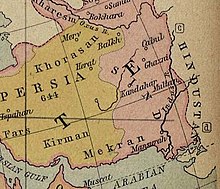

Names of territories during the Islamic Caliphate of the 7th century and onward.

Kelaut-I-Ghiljie, a small village-town in Afghanistan.
The village of Saul was probably located near Gardez, Afghanistan. Hudud ul-'alam also speaks of a king in Ninhar (Nangarhar), who had Muslim, Afghan and Hindu wives.[44] Al-Biruni wrote about Afghans in the 11th century as various tribes living in the western mountains of India and extending to the region of Sind, which would be the Sulaiman MountainsKhorasan and Hindustan. It was reported that between 1039 and 1040 CE Mas'ud I of the Ghaznavid Empire sent his son to subdue a group of rebel Afghans near Ghazni. An army of Arabs, Afghans, Khiljis and others was assembled by Arslan Shah Ghaznavid in 1119 CE. Another army of Afghans and Khiljis was assembled by Bahram Shah Ghaznavid in 1153 CE. Muhammad of Ghor, ruler of the Ghorids, also had Afghans in his army along with others.[55] A famous Moroccan travelling scholar, Ibn Battuta, visiting Afghanistan following the era of the Khilji dynasty in early 1300s gives his description of the Afghans. area betweenWe travelled on to Kabul, formerly a vast town, the site of which is now occupied by a village inhabited by a tribe called Afghans. They hold mountains and defiles and possess considerable strength, and are mostly highwaymen. Their principle mountain is called Kuh Sulayman. It is told that the prophet Sulayman [Solomon] ascended this mountain and having looked out over India, which was then covered with darkness, returned without entering it.[56]Muhammad Qasim Hindu Shah (Ferishta), writes about Afghans and their country called Afghanistan in the 16th century.
—Ibn Battuta, 1333
The men of Kábul and Khilj also went home; and whenever they were ques*tioned about the Musulmáns of the Kohistán (the mountains), and how matters stood there, they said, "Don't call it Kohistán, but Afghánistán; for there is nothing there but Afgháns and dis*turbances." Thus it is clear that for this reason the people of the country call their home in their own language Afghánistán, and themselves Afgháns. The people of India call them Patán; but the reason for this is not known. But it occurs to me, that when, under the rule of Muhammadan sovereigns, Musulmáns first came to the city of Patná, and dwelt there, the people of India (for that reason) called them Patáns—but God knows![57]One historical account connects the ethnic Afghans or Pashtuns to a possible Ancient Egyptian past but this lacks supporting evidence.
—Ferishta, 1560-1620
I have read in the Mutla-ul-Anwar, a work written by a respectable author, and which I procured at Burhanpur, a town of Khandesh in the Deccan, that the Afghans are Copts of the race of the Pharaohs; and that when the prophet Moses got the better of that infidel who was overwhelmed in the Red Sea, many of the Copts became converts to the Jewish faith; but others, stubborn and self-willed, refusing to embrace the true faith, leaving their country, came to India, and eventually settled in the Sulimany mountains, where they bore the name of Afghans.[19]On the contrary, although this too is unsubstantiated, Afghan historians have maintained that Pashtuns are linked to the ancient Israelites.
—Ferishta, 1560-1620
The Afghan historians proceed to relate that the children of Israel, both in Ghore and in Arabia, preserved their knowledge of the unity of God and the purity of their religious belief, and that on the appearance of the last and greatest of the prophets (Mohammed) the Afghans of Ghore listened to the invitation of their Arabian brethren, the chief of whom was Khauled (or Caled), son of Waleed, so famous for his conquest of Syria, and marched to the aid of the true faith, under the command of Kyse, afterwards surnamed Abdoolresheed.[58][edit] Oral traditions
—Mohan Lal, 1846

Amir Sher Ali Khan with Prince Abdullah Jan and the Afghan Sardars in 1869.
Some anthropologists lend credence to the oral traditions of the Pashtun tribes themselves. For example, according to the Encyclopaedia of Islam, the theory of Pashtun descent from Israelites is traced to Maghzan-e-Afghani who compiled a history for Khan-e-Jehan Lodhi in the reign of Mughal Emperor Jehangir in the 17th century.[49]
Another book that corresponds with Pashtun historical records, Taaqati-Nasiri, states that in the 7th century BC a people called the Bani IsraelGhor region of Afghanistan and migrated later to the southeast areas. These references to Bani Israel agree with the commonly held view by Pashtuns that when the twelve tribes of Israel were dispersed (see Israel and Judah and Ten Lost Tribes), the tribe of Joseph, among other Hebrew tribes, settled in the region.[59] This oral tradition is widespread among the Pashtuns. There have been many legends over the centuries of descent from the Ten Lost Tribes after groups converted to Christianity and Islam. Hence the tribal name Yusufzai in Pashto translates to the "son of Joseph". A similar story is told by the 16th century Persian historian, Ferishta.[19] settled in the
One conflicting issue in the belief that the Pashtuns descend from the Israelites is that the Ten Lost Tribes were exiled by the ruler of Assyria, while Maghzan-e-Afghani says they were permitted by the ruler to go east to Afghanistan.[citation needed] This inconsistency can be explained by the fact that Persia acquired the lands of the ancient Assyrian Empire when it conquered the Empire of the Medes and Chaldean Babylonia, which had conquered Assyria decades earlier. But no ancient author mentions such a transfer of Israelites further east, or no ancient extra-Biblical texts refer to the Ten Lost Tribes at all.
Other Pashtun tribes claim descent from Arabs, including some even claiming to be descendants of the Islamic prophet Muhammad (referred to as Sayyids).[60] Some groups from Peshawar and Kandahar claim to be descended from Ancient Greeks that arrived with Alexander the Great.[61]
[edit] Anthropology

Caucasian race includes Pashtun (Afghan), seen on the right bottom row.
Physically and racially, the Pashtuns are classified as Caucasians[12] of the Mediterranean variant.[62] Their Pashto language is classified under the Eastern Iranian sub-branch of the Iranian branch of the Indo-Europeanfamily of languages.[63]
Comment


Comment