Announcement

Collapse
No announcement yet.

Rally against reconciliation/compromise with Taliban

Collapse
X
 
  • Filter
  • Time
  • Show
Clear All
new posts

  • Rally against reconciliation/compromise with Taliban

    By ALISSA J. RUBIN

    Published: May 5, 2011


    KABUL, Afghanistan — More than 10,000 people gathered Thursday in Kabul to oppose reconciliation with the Taliban and the involvement of Pakistan in any peace deal, warning that it would be a betrayal of the Afghan people’s long fight against extremism.

    The meeting, organized by a former intelligence director, Amrullah Saleh, and attended as well by Abdullah Abdullah, a former presidential candidate, was a frontal attack on the current government’s policies, and speakers denounced both Al Qaeda and the Taliban. The organizers promised that if they were not listened to, they would “go to the streets and protest.”

    Under the name “a gathering for justice,” the meeting was attended overwhelmingly by Afghans from the north and particularly from Panjshir Province, the home of the Afghan icon Ahmed Shah Massoud, who was killed by suicide bombers backed by Al Qaeda two days before the Sept. 11, 2001, attacks. Panjshir is also the home province of Mr. Saleh and Mr. Abdullah.

    Both men have long experienced friction with President Hamid Karzai: Mr. Karzai forced out Mr. Saleh, and Mr. Abdullah withdrew from a runoff election against Mr. Karzai in 2009 because, he said, the voting would be rigged. “The Taliban and Al Qaeda are terrorists,” said Mr. Saleh, as he looked out across the crowd, many of them young people. “They have destroyed our lands and houses, dishonored our wives and families.”
    Then Mr. Saleh addressed Mr. Karzai: “You call them your brothers, this is oppression — to this nation; they are not our brothers,” he said in a criticism of Mr. Karzai’s frequent reference to the Taliban not as enemies or terrorists but as “upset brothers” or “angry brothers.”

    The meeting struck a strongly nationalist tone and seemed aimed at generating the kind of grass-roots movement that has swept the Middle East. It was advertised on Facebook, radio and television stations, as well as in local newspapers.

    Banners in Dari, one of the official Afghan languages, around the edge of the large tents were critical of the government: “The international community should not support Karzai for deals with the Taliban;” “Don’t step on our national interest by making deals with the Taliban;” “Every government organ is screaming with corruption, let’s root it out.”

    The meeting was held in the parking lot of one of Kabul’s many immense wedding halls, and the manager, who asked that his name not be used, said that his staff had set out more than 10,000 chairs. Almost every one was filled, and overflow crowds gathered outside to listen to the speeches over loudspeakers.

    The dominance of northerners at the gathering raised the issues of the growing tension over the prospect of a peace deal with the Taliban and the very different outlooks of the predominantly non-Pashtun north of Afghanistan and the overwhelmingly Pashtun south.

    “As you know, one tribe, one circle has governed Afghanistan,” said Rasullah Paya, 22, a Kabul University student, referring to the Pashtuns, the ethnic group of Mr. Karzai. “From now on we don’t want one circle, one tribe, one nation, to run the government,” said Mr. Paya, who is from the Hazara ethnic group and is originally from Parwan Province, which is also in the north.

    In fact, the government’s senior figures come from all ethnic groups, but perhaps because there is general frustration with day-to-day corruption and inefficiency, people feel deeply disenfranchised.

    Others were even blunter. Abu Bakr, 32, from Panjshir Province, said, “We came today to participate in this gathering, to express our hatred of the Taliban and of the High Peace Council.”

    The peace council, with more than 60 members, picked by Mr. Karzai, has been involved in reaching out to the Taliban and other insurgent groups to persuade them to lay down their weapons and join the government.

    Mr. Saleh worked for Mr. Karzai until last June when insurgents attacked a peace jirga held in Kabul with rockets. In the wake of the attack, Mr. Karzai forced both Mr. Saleh and the interior minister at the time, Hanif Atmar, to offer their resignations because they had not pre-empted the attack. While Mr. Saleh is a Tajik, Mr. Atmar is a Pashtun, and they have criticized the government’s failure to root out corruption and to take a tough stand against the Taliban.

    Underlying the reason for the gathering and on the minds of many in attendance was Mr. Karzai’s recent meeting with senior Pakistani officials at which the two countries’ leaders pledged to work together to bring peace to the region. However, in private the Pakistanis pushed for changes in Afghan policies, urging the country to draw closer to China and implicitly distance itself from the United States.

    After the meeting, several local newspapers released what they said were lists of Pakistan’s demands to Afghanistan. While some of the demands were completely fabricated, others appeared to have been mentioned at the meeting, and the overall lack of transparency, coupled with the recent revelation that Osama bin Laden was living near a Pakistani military compound, has exacerbated people’s suspicions of Pakistan.

  • #2
    Very good and interesting read...thanks for it.

    Comment


    • #3
      Afghans protest against Taliban peace deal

      Thousands attend anti-Taliban rally in Kabul as Osama bin Laden's death prompts talk of an end to the 10-year conflict

      <LI class=byline sizcache="5" sizset="58">Jon Boone in Kabul <LI class=publication sizcache="5" sizset="59">guardian.co.uk, Thursday 5 May 2011 14.33 BST <LI class=history sizcache="5" sizset="60">Article history
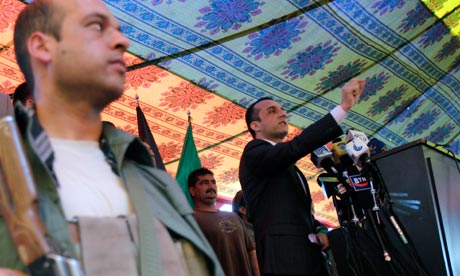
      The Afghan former spy chief Amrullah Saleh, right, addresses an anti-Taliban rally in Kabul. Photograph: Kamran Jebreili/AP

      Thousands of Afghans have attended a heated rally in Kabul decrying peace talks with the Taliban in a show of strength by those opposing any return to power of the hardline movement.

      Crowds carrying green flags and wearing ribbons of the newly established National Movement gathered under a vast series of tented canopies in the capital days after the event was called on Monday – the same day that news broke that Osama bin Laden had been killed by US special forces in Pakistan.

      The killing of the man who was sheltered by the Taliban regime in the 1990s has prompted heady speculation that an "end game" to the 10-year conflict could now be at hand, with the Afghan government under President Hamid Karzai and the Taliban-led insurgency striking a deal.

      But "deal making" were dirty words to the crowd gathered at the rally in Kabul on Thursday morning. Banners lining the tent said "We didn't vote for Karzai to make deals," and "Don't sacrifice justice for dealing."

      Speeches were interrupted several times by chants from the crowd of "Death to the Taliban. Death to the suicide bombers. Death to the Punjabis" – a reference to the demonstrators' view that the Taliban is under the control of Pakistan's spy service.

      The event was organised by Amrullah Saleh, the country's former spy chief and outspoken critic of Karzai's efforts to reach out to the Taliban.

      Saleh, a burly and comparatively young man who earned the respect of the CIA during his sometimes brutal leadership of Afghanistan's intelligence service, received a rapturous reception from the flag-waving crowd when he marched into the tent with a phalanx of bodyguards.

      Speaking to a crowd that organisers claimed, not unreasonably, was about 15,000 strong, Saleh said he had "for years" warned that al-Qaida and the Taliban were being protected in Pakistan, something that had been "proved" by the killing of Bin Laden in a Pakistani garrison town this week.

      Saleh said efforts to reach out to the Taliban ignored what he claimed was the vast majority of people who oppose the insurgents. And he expressed anger at Karzai's description of the Taliban as disaffected "brothers".

      "They are not my brother, they are not your brother – those are our enemies," he told the cheering crowd.

      Since being sacked by Karzai last year, Saleh has been developing a political profile for himself, travelling the northern regions of the country to warn people of Karzai's peace plans and recruit people to his cause.

      But Thursday's event, held outside a gaudy wedding hall on one of the city's busiest roads, appeared to be a deliberate effort by the party to burst on to the national scene as a force to be reckoned with.

      Unusually for a political rally in Afghanistan, the master of ceremonies was a woman, who welcomed the crowds and introduced the speakers.

      It appeared part of an effort to highlight the Taliban's harsh treatment of women, who during the Taliban government were restricted from education, employment and even venturing out of their homes without a male relative.

      Although aides to Saleh said he had been planning the event for the past two weeks, his rapid mobilisation of so many people since Monday highlighted one of the main pitfalls on the road to a possible negotiated peace with the Taliban – that it would not be accepted by many Afghans, particularly those who are not Pashtuns, the country's largest ethnic group.

      Some have even warned that a rapid peace deal could rekindle civil war in the country, particularly as the strongest opposition to a Taliban return to power comes from within the ranks of the Northern Alliance, the old coalition of largely non-Pashtun communities from the north of the country who fought bitterly against the Taliban takeover of the country in the 1990s.

      Saleh himself was an aide to Ahmed Shah Massoud, the leader of the Northern Alliance who was assassinated days before 9/11 on the orders of Bin Laden.

      Although Saleh described the anti-Taliban movement as a non-tribal group covering the whole nation, at the rally on Thursday the audience appeared to be disproportionately made up of northerners, with a heavy representation of burly men from Panjshir, a valley north of Kabul that resisted the Taliban, who were assisting with security and crowd control.

      Western diplomats have long warned that any political arrangement to bring the conflict to a close must not be, in the words of one, "a Pashtun-to-Pashtun stitch-up". But there is little sign that Karzai has succeeded in getting national buy-in for his peace plans.

      Last year the Afghan president hosted a national "peace jirga" designed to win a national mandate for pursuing peace plans. Unfortunately the event, which was boycotted by most of the leading non-Pashtun warlords and civil war leaders, was criticised by some for being unrepresentative.

      Comment


      • #4
        Originally posted by Timbaktu
        What do you think about this Comrade?
        spay dai.

        Comment


        • #5
          Comrade,
          Can you tell me more about Amrullah Saleh? Share the intelligence brother.
          Even Adobe Photoshop can't change me.

          A line[Durrand line] of hatred that raised a wall between the two brothers -Hamid Karzai

          For generations, the Hindus of India prayed for deliverance from "the venom of the cobra, the teeth of the tiger and the vengeance of the Afghan."


          The men of Kábul and Khilj also went home; and whenever they were questioned about the Musulmáns of the Kohistán (the mountains), and how matters stood there, they said, "Don't call it Kohistán, but Afghánistán; for there is nothing there but Afgháns and disturbances." Thus it is clear that for this reason the people of the country call their home in their own language Afghánistán, and themselves Afgháns. The people of India call them Patán; but the reason for this is not known. But it occurs to me, that when, under the rule of Muhammadan sovereigns, Musulmáns first came to the city of Patná, and dwelt there, the people of India (for that reason) called them Patáns—but God knows!

          -Ferishta, 1560–1620

          Comment


          • #6
            Afghans Rally Against Compromising With Taliban

            by Quil Lawrence

            May 6, 2011
            There is no clear sign yet that the death of Osama bin Laden has changed U.S. policy in Afghanistan. There is also no sign it has had any effect on the Taliban movement, which so far has been strangely silent about the death of its one-time ally and benefactor.

            But that's not stopping fevered speculation in Afghanistan about how bin Laden's killing this week might help or hurt efforts to negotiate with the Taliban.

            The policy of both the Obama administration and Afghan President Hamid Karzai has been to encourage peace talks with any Afghan insurgent who denounces al-Qaida, puts down weapons and accepts the Afghan constitution. The death of bin Laden this week may take al-Qaida out of the equation, and some voices are suggesting it makes a peace deal — and an American drawdown — more imminent.

            That doesn't go down well with the group of about 2,000 people who gathered Thursday near the Uroonus hotel in North Kabul.

            "We are here to show our protest against the negotiation with Taliban. We want peace, but it's very clear, we want peace with dignity," said Mateen Beg, a Kabul resident. He says he came out to protest Karzai's frequent peace overtures to the Taliban and to Pakistan, which he says was complicit with bin Laden.

            "We have gathered together to let the world to know that we're glad that Osama bin Laden is dead. We have been a victim of what he has done, and he has misused Islam," Beg said. "We're glad and the world should know that."

            Among the prominent speakers was Amrullah Saleh, Karzai's former intelligence chief who left the government last summer — many say because his anti-Pakistan positions began to clash with Karzai's desire for Pakistan's help with a peace process.

            Saleh entered the rally jogging among a phalanx of body guards, like a boxer or a political candidate.

            "The government wants to capitulate, but we won't let that happen," he told the crowd. He went on to criticize the way Karzai often refers to the Taliban as "brothers."

            "If you're negotiating with your enemy, that's fine," Saleh said, "but don't pretend they're your brothers."

            The crowd loved it, but it's fair to say the group represented Karzai's political opposition — the speakers included Abdullah Abdullah, who ran against Karzai in 2009.

            Abdullah sought to tar Karzai with some of the anger at Pakistan for apparently sheltering al-Qaida and Taliban leaders.

            "President Karzai has been begging for help from a country that every day is destroying our country," Abduallah said.

            The gathering issued a resolution demanding reforms from the Afghan government, and hinted at Egypt-style street protests. But it's hard to tell if bin Laden's death in Pakistan has truly galvanized Afghans or just given ammunition to Karzai's critics.

            Comment


            • #7
              Got a couple questions with all these articles:
              1. Do the people know the Intelligence Chief for example? I mean in America, we know our state senators and representatives because they represent us in government.
              2. What exactly are the views of Pashtuns on "Taliban." I mean the word, the people and the ideologies of "the Taliban."

              Comment


              • #8
                i don't know who this person is and what his agenda is, but i know for a fact that there are many who oppose this reconciliation with taliban... mainly the Dari speaking people and of course some pashtoons as well.. the ones who oppose this simply give me one reason... taliban are backed by pakistan and if we have any taliban influence in our country (Afghanistan), they will take any measure to serve their masters (pakistan).

                let's face it... many saw taliban as an enemy when taliban were in power back in mid 90s to 2000. minorities in afghanistan were specially very intimidated by their presence. i am not talking about politicians, rather the common man. now the politicians, knowing this, are taking full of advantage of the situation.

                Under no circumstance, will the minorities accept the taliban as their government, and if any such event occurs in Afghanistan, another episode of civil war is for sure.

                every Afghan citizen wants the government to represent him, and the taliban 'government' didn't represent every afghan... nor did they care about every afghan citizen. they operated in a way, as if they were instructed to alianate minorities in Afghanistan (probably by their masters in Pakistan)
                [B].[/B]

                Comment


                • #9
                  Originally posted by ComradePashtun View Post
                  Speeches were interrupted several times by chants from the crowd of "Death to the Taliban. Death to the suicide bombers. Death to the Punjabis" – a reference to the demonstrators' view that the Taliban is under the control of Pakistan's spy service.
                  Der ala.

                  Comment


                  • #10
                    Originally posted by Timbaktu
                    What's the best way to deal with these people and are they the legitimate voice of non pashtun? guys like abdullah abdullah, fahim, atta, saleh, qanuni, dostum and khalili. are these guys popular in their communities? if you say no then what proof do you have?
                    I say, they are very popular amongst the minorities. i would tell you tht these people are the only hope minorities think they have. that is the sad part. mainstream minorities are not anti-pashtoon, they think that pashtoons are anti-minorities... which is why they side with these criminals... knowing everything about them. like they say "ba wakhtesh khar ra ham adam mama mega".

                    one needs to understand the sentiments of ordinary afghan citizens and particularly the minorities.... majority of them are as uneducated as majority of pashtoons are... and tough times they have no other choice but to stand behind someone they think represents them.
                    [B].[/B]

                    Comment


                    • #11
                      Originally posted by Adamyousafzai
                      So are there some Afghans who view the Taliban as foreigners?
                      many!. i have been to Afghanistan and i have spoken to many people about this. you will find many in Afghanistan who hate the languge "Urdu" and if you ask them the reason they will say because some talib spoke Urdu. many have very bad memories of them as a child and as an adult.

                      in case of afghanistan, where taliban knew that the minorities are a big chunk, their first goal had to be to win the heart of the minorities... not the minority politicians, but the ordinary afghan citizens... rather what they did was try to win their support by instilling fear in them... won't work in a long run

                      at least in major cities and amongst the educated, you will know that the main opinion about taliban is that they are foreigners... Pakistanis. and to many Pakistan is the biggest threat to their nation and their people.
                      [B].[/B]

                      Comment


                      • #12
                        When people are talking about "minorities" here, are they describing the various "tribes" of Afghanistan? I'm confused a bit.

                        Comment


                        • #13
                          The Talibans reach extends throughout Afghanistan because they have brought security and order whereas the leaders of this so-called protest are affiliated with crime and fraud. The increased support for the Taliban is backed by US reports. The reason, all Afghans are against foreign occupation, and those who are not, do not represent any meaningful voice. The Afghan people will reject their call for civil war which is what they are essentially asking.

                          An organized protest like this means nothing.

                          Comment


                          • #14
                            Originally posted by MDresden View Post
                            When people are talking about "minorities" here, are they describing the various "tribes" of Afghanistan? I'm confused a bit.
                            no. tribes exist amongst Pashtoons only. when we are speaking of minorities we are referring to those people in Afghanistan who come from different ethnic background and speak a different language. Afghanistan is land of more than 20 ethnic groups and subgroups and at least more than 10 spoken languages.

                            There are pashtoons (majority), Dari speakers (who mostly people refer to as tajiks) Uzbek, Turkman, Hazara (mogolian) and many other.
                            [B].[/B]

                            Comment


                            • #15
                              Originally posted by ghundal View Post
                              The Talibans reach extends throughout Afghanistan because they have brought security and order whereas the leaders of this so-called protest are affiliated with crime and fraud. The increased support for the Taliban is backed by US reports. The reason, all Afghans are against foreign occupation, and those who are not, do not represent any meaningful voice. The Afghan people will reject their call for civil war which is what they are essentially asking.

                              An organized protest like this means nothing.
                              I'm sorry for being so blunt: but you are wrong...very wrong! The people of Afghansitan gathering on an idea is a very big deal. They have voiced their opnion and their opnion should be heard.

                              Taliban bring security? From who? From the convoys that roll past them resupplying other places or from their own security of ANA/AUP? They already have their own security and I'm sure they know that.

                              The Taliban are knowingly coming from Pakistan and other parts of the world so they themselves are not from Afghanistan.

                              I agree with you though, that the people will reject civil war...they already have their own voice and their own security.

                              Comment

                              Working...
                              X