
 Tweet
so what is fact about evolution?
-
-
Originally posted by Mountain Goat View Post
prove it.
JUST PROVE IT.
that's all I am asking for.
if you can't prove it... then you are just basing it on blind faith. It means evolution is based on faith. It means this is your religion.Comment
-
Does the definition state anything about how the development occurred? No, it doesn't. It simply states that it did.Originally posted by Alchemist
Read it again:
"the development of forms of animal and plant life out of forms significantly different from them"
See, it doesn't explain how.
Comment
-
What? Elaborate.Originally posted by Alchemist View Post
Proposition:Originally posted by Alchemist View Post
FoE; forms of animal and plant life (organisms, if you will) developed out of forms significantly different from them.
Evidence:
1. Living things come from living things. (never observed anything else)
2. Living things are different from each other (e.g. unicellular organisms are different from vertebrates)
3. Some kinds of living things existed on Earth before other kinds (e.g. unicellular organisms existed on Earth billions of years before vertebrates, see fossil record)
Conclusion:
Thus, scientifically, the "other kinds of living things" (e.g. vertebrates) must have come from the "former kinds living things" (e.g. unicellular organisms).
Last edited by طالب; 04-28-2011, 09:36 AM.Comment
-
DONKEYOriginally posted by Mountain Goat View Post
PROCESS = HOW
process
- 8 dictionary results
Hyperspectral Catalog
Cameras and all other components Complete
systems for R&D + process www.MiddletonResearch.com
Apparel Systems Support
Save Time & Money in Apparel Biz.
EDI, Back Office Outsourcing in NYC www.waitexinformationsystems.com
Top 15 Supply Chain Mgmt
2011 Top 15 Supply Chain Management Software Ranked.
Get Free Report Sponsored Results
Business-Software.com/SupplyChain
.shd_hdr1 { width: 100%; }.sep_top1 { position: relative; }.citesourceseperator { border-bottom: 1px solid rgb(228, 228, 228); margin-top: 15px; margin-bottom: 7px; }.sep_top1 table { margin-top: -2px; margin-bottom: -3px; }.results_content ul, .results_content ol { margin-bottom: -3px; }.LImg { background-image: url("http://sp1.dictionary.com/en/i/dictionary/AddThis_v2/sprite_icons.png"); }.Lsentnce { margin-top: 14px; }.moredef { display: none; }a.more, a.more:hover, a.less, a.less:hover { font: 10px arial; height: 18px; padding-left: 26px; color: rgb(64, 137, 224); cursor: pointer; display: block; padding-top: 5px; text-decoration: none; margin-bottom: 6px; margin-top: 5px; }a.more, a.more:active, a.more:hover, a.more:visited { background: url("http://sp1.dictionary.com/en/i/dictionary/more.png") no-repeat scroll 0pt 0pt transparent; }a.less, a.less:active, a.less:hover, a.less:visited { background: url("http://sp1.dictionary.com/en/i/dictionary/close.png") no-repeat scroll 0pt 0pt transparent; } .luna-Ent a.slA:link, .luna-Ent .slANC > a, .lunatext .slD a, .lunatext .spl_unshd a { text-decoration: none; }.lunatext .slT b { color: rgb(64, 137, 224); }.slD a, .slD a:hover, .slD:visited { color: rgb(64, 64, 64); } proc·ess
 /ˈprɒs
 ɛs; especially Brit. ˈproʊsɛs/
 Show Spelled [pros-es; especially Brit. proh-ses] Show IPA noun, plural proc·ess·es /ˈprɒsɛsɪz, ‐əsɪz, ‐əˌsiz or, especially Brit., ˈproʊsɛs‐, ˈproʊsə‐/ Show Spelled[pros-es-iz, ‐uh-siz, ‐uh-seez or, especially Brit., proh-ses‐, proh-suh‐] Show IPA, verb, adjective
–noun 1. a systematic series of actions directed to some end: to devise a process for homogenizing milk.
2. a continuous action, operation, or series of changes taking place in a definite manner: the process of decay.
3. Law . a. the summons, mandate, or writ by which a defendant or thing is brought before court for litigation.
b. the whole course of the proceedings in an action at law.
–verb (used with object) 10. to treat or prepare by some particular process, as in manufacturing.
11. to handle (papers, records, etc.) by systematically organizing them, recording or making notations on them, following up with appropriate action, or the like: to process mail.
12. to require (someone) to answer questionnaires, perform various tasks, and sometimes to undergo physical and aptitude classification examinations before the beginning or termination of a period of service: The army processes all personnel entering or leaving the service.
–verb (used without object) 18. to undergo the activities involved in processing personnel: The recruits expected to process in four days.
–adjective 19. prepared or modified by an artificial process: process cheese.
20. noting, pertaining to, or involving photomechanical or photoengraving methods: a process print.
21. Informal . of or pertaining to hair that has been conked.
Origin:
1275–1325; Middle English proces (noun) (< Old French ) < Latin prōcessus a going forward, equivalent to prō- pro-1 + ced-, variant stem of cēdere to yield ( see cede) + -tus suffix of v. action; see cession
—Related forms pro·ces·su·al /prɒˈsɛʃuəl or, especially Brit., proʊ-/ Show Spelled[pro-sesh-oo-uhl or, especially Brit., proh-] Show IPA, adjective
o·ver·proc·ess, verb (used with object)
pre·proc·ess, verb
re·proc·ess, verb (used with object)
sem·i·proc·essed, adjective
trans·proc·ess, noun
un·proc·essed, adjective
COLLAPSE
—Synonyms
1. operation. Process, procedure, proceeding apply to something that goes on or takes place. A process is a series of progressive and interdependent steps by which an end is attained: a chemical process. Procedure usually implies a formal or set order of doing a thing, a method of conducting affairs: parliamentary procedure. Proceeding (usually pl.) applies to what goes on or takes place on a given occasion or to the records of the occasion: Proceedings of the Royal Academy of Sciences.
—Pronunciation note
The word process, an early 14th century French borrowing, has a regularly formed plural that adds -es to the singular. This plural, as in similar words like recesses and successes, has traditionally been pronounced /-ɪz/ Show Spelled[-iz] Show IPA: /ˈprɒsɛsɪz, ˈproʊsɛs-/[pros-es-iz, proh-ses-] or /ˈprɒsəsɪz, ˈproʊsə-/[pros-uh-siz, proh-suh-]. Recent years have seen the increasing popularity of an /-ˌiz/[-eez] pronunciation for processes, perhaps by mistaken analogy with such plurals as theses and hypotheses, with which it has no connection. This newer pronunciation is common among younger educated speakers.
Dictionary.com Unabridged
Based on the Random House Dictionary, © Random House, Inc. 2011.
#webres { display: block; padding-top: 4px; margin-bottom: -4px; }#Lsntnce { margin: 0pt; padding-top: 3px; }#webres { margin-bottom: -4px; padding-top: 10px; } #macnt, #alM8 { display: block; } .luna-Ent a.slA:link, .luna-Ent .slANC > a, .lunatext .slD a, .lunatext .spl_unshd a { text-decoration: none; }.lunatext .slT b { color: rgb(64, 137, 224); }.slD a, .slD a:hover, .slD:visited { color: rgb(64, 64, 64); } World English Dictionary
process 1 (ˈprəʊsɛs) — n 1. a series of actions that produce a change or development: the process of digestion 2. a method of doing or producing something 3. a forward movement 4. the course of time 5. a. a summons, writ, etc, commanding a person to appear in court b. the whole proceedings in an action at law 6. a natural outgrowth or projection of a part, organ, or organism 7. a distinct subtask of a computer system which can be regarded as proceeding in parallel with other subtasks of the system 8. ( modifier ) relating to the general preparation of a printing forme or plate by the use, at some stage, of photography 9. ( modifier ) denoting a film, film scene, shot, etc, made by techniques that produce unusual optical effects — vb 10. to subject to a routine procedure; handle 11. to treat or prepare by a special method, esp to treat (food) in order to preserve it: to process cheese 12. a. to institute legal proceedings against b. to serve a process on 13. photog a. to develop, rinse, fix, wash, and dry (exposed film, etc) b. to produce final prints or slides from (undeveloped film) 14. computing to perform mathematical and logical operations on (data) according to programmed instructions in order to obtain the required information 15. to prepare (food) using a food processor [C14: from Old French procès, from Latin prōcessus an advancing, from prōcēdere to proceed ]
process 2 (prəˈsɛs) — vb
( intr ) to proceed in or as if in a procession [C19: back formation from procession ]
Collins English Dictionary - Complete & Unabridged 10th Edition
2009 © William Collins Sons & Co. Ltd. 1979, 1986 © HarperCollins
Publishers 1998, 2000, 2003, 2005, 2006, 2007, 2009
Cite This Source
Word Origin & History
process
early 14c., "fact of being carried on" (e.g. in process ), from O.Fr. proces "journey" (13c.), from L. processus "process, advance, progress," from pp. stem of procedere "go forward" (see proceed). Meaning "course or methodof action" is from mid-14c.; sense of "continuous series of actions meant to accomplish some result" (the main modern sense) is from 1620s. Legal sense of "course of action of a suit at law" is attested from early 14c. Verb meaning "prepare by special process" first recorded 1884; processor is 1909; data processor is 1958; word processor is c.1974; food processor is
HOW:
–conjunction 12. the manner or way in which: He couldn't figure out how to solve the problem.
13. about the manner, condition, or way in which: I don't care how you leave your desk when you go. Be careful how you act.
14. in whatever manner or way; however: You can travel how you please.
definition of how
a : in what manner or way b : for what reason : why c : with what meaning : to what effect d : by what name or title
2
: to what degree or extent
3
: in what state or condition <how are you>
4
: at what price <how a score of ewes now — Shakespeare>
go back to english class, goat.Comment
-
Originally posted by Mountain Goat View Post
A syllogism (Greek: συλλογισμός – syllogismos – "conclusion," "inference") or logical appeal is a kind of logical argument in which one proposition (the conclusion) is inferred from two others (the premises) of a certain form, i.e. categorical proposition.
In Prior Analytics, Aristotle defines syllogism as "a discourse in which, certain things having been supposed, something different from the things supposed results of necessity because these things are so." (24b18–20)
Despite this very general definition, he limits himself first to categorical syllogisms[1] (and later to modal syllogisms). The syllogism was at the core of traditional deductive reasoning, where facts are determined by combining existing statements, in contrast to inductive reasoning where facts are determined by repeated observations. The syllogism was superseded by first-order predicate logic following the work of Gottlob Frege, in particular his Begriffsschrift (Concept Script) (1879).
Contents
[hide]
- 1 Basic structure
- 2 Types of syllogism
- 3 Terms in syllogism
- 4 Existential import
- 5 Syllogism in the history of logic
- 6 Everyday syllogistic mistakes
- 7 See also
- 8 Notes
- 9 References
- 10 External links
[edit] Basic structure
A categorical syllogism consists of three parts: the major premise, the minor premise and the conclusion.
Each part is a categorical proposition, and each categorical proposition contains two categorical terms.[2] In Aristotle, each of the premises is in the form "All A are B," "Some A are B", "No A are B" or "Some A are not B", where "A" is one term and "B" is another. "All A are B," and "No A are B" are termed universal propositions; "Some A are B" and "Some A are not B" are termed particular propositions. More modern logicians allow some variation. Each of the premises has one term in common with the conclusion: in a major premise, this is the major term (i.e., the predicate of the conclusion); in a minor premise, it is the minor term (the subject) of the conclusion. For example:
Major premise: All men are mortal.Minor premise: All Greeks are men.Conclusion: All Greeks are mortal. Each of the three distinct terms represents a category. In the above example, "men," "mortal," and "Greeks." "Mortal" is the major term; "Greeks", the minor term. The premises also have one term in common with each other, which is known as the middle term; in this example, "man." Both of the premises are universal, as is the conclusion.
Major premise: All mortals die.Minor premise: Some men are mortals.Conclusion: Some men die. Here, the major term is "die", the minor term is "men," and the middle term is "mortals". The major premise is universal; the minor premise and the conclusion are particular.
A sorites is a form of argument in which a series of incomplete syllogisms is so arranged that the predicate of each premise forms the subject of the next until the subject of the first is joined with the predicate of the last in the conclusion. For example, if one argues that a given number of grains of sand does not make a heap and that an additional grain does not either, then to conclude that no additional amount of sand will make a heap is to construct a sorites argument.
[edit] Types of syllogism
Although there are infinitely many possible syllogisms, there are only a finite number of logically distinct types. We shall classify and enumerate them below. Note that the syllogism above has the abstract form:
Major premise: All M are P.Minor premise: All S are M.Conclusion: All S are P. (Note: M – Middle, S – subject, P – predicate. See below for more detailed explanation.)
The premises and conclusion of a syllogism can be any of four types, which are labeled by letters[3] as follows. The meaning of the letters is given by the table:
code
quantifier
subject
copula
predicate
type
example
a
All
S
are
P
universal affirmatives
All humans are mortal.
e
No
S
are
P
universal negatives
No humans are perfect.
i
Some
S
are
P
particular affirmatives
Some humans are healthy.
o
Some
S
are not
P
particular negatives
Some humans are not clever. (See Square of opposition for a discussion of the logical relationships between these types of propositions.)
In Analytics, Aristotle mostly uses the letters A, B and C as term place holders, rather than giving concrete examples, an innovation at the time. It is traditional to use is rather than are as the copula, hence All A is B rather than All As are Bs. It is traditional and convenient practice to use a, e, i, o as infix operators to enable the categorical statements to be written succinctly thus:
Form Shorthand All A is B AaB No A is B AeB Some A is B AiB Some A is not B AoB This particular syllogistic form is dubbed BARBARA (see below) and can be written neatly as BaC,AaB -> AaC.
The letter S is the subject of the conclusion, P is the predicate of the conclusion, and M is the middle term. The major premise links M with P and the minor premise links M with S. However, the middle term can be either the subject or the predicate of each premise where it appears. The differing positions of the major, minor, and middle terms gives rise to another classification of syllogisms known as the figure. Given that in each case the conclusion is S-P, the four figures are:
Figure 1
Figure 2
Figure 3
Figure 4 Major premise:
M–P
P–M
M–P
P–M Minor premise:
S–M
S–M
M–S
M–S Putting it all together, there are 256 possible types of syllogisms (or 512 if the order of the major and minor premises is changed, although this makes no difference logically). Each premise and the conclusion can be of type A, E, I or O, and the syllogism can be any of the four figures. A syllogism can be described briefly by giving the letters for the premises and conclusion followed by the number for the figure. For example, the syllogism BARBARA above is AAA-1, or "A-A-A in the first figure".
The vast majority of the 256 possible forms of syllogism are invalid (the conclusion does not follow logically from the premises). The table below shows the valid forms. Even some of these are sometimes considered to commit the existential fallacy, meaning they are invalid if they mention an empty category. These controversial patterns are marked in italics.
Figure 1 Figure 2 Figure 3 Figure 4 Barbara Cesare Datisi Calemes Celarent Camestres Disamis Dimatis Darii Festino Ferison Fresison Ferio Baroco Bocardo Calemos Barbari Cesaro Felapton Fesapo Celaront Camestros Darapti Bamalip The letters A, E, I, O have been used since the medieval Schools to form mnemonic names for the forms as follows: 'Barbara' stands for AAA, 'Celarent' for EAE, etc.
Next to each premise and conclusion is a shorthand description of the sentence. So in AAI-3, the premise "All squares are rectangles" becomes "MaP"; the symbols mean that the first term ("square") is the middle term, the second term ("rectangle") is the predicate of the conclusion, and the relationship between the two terms is labeled "a" (All M are P).
The following table shows all syllogisms that are essentially different. The similar syllogisms share actually the same premises, just written in a different way. For example "Some pets are kittens" (SiM in Darii) could also be written as "Some kittens are pets" (MiS is Datisi).
In the Venn diagrams the black areas tell, that there are no elements, and the red areas tell, that there is at least one element.
[edit] Examples
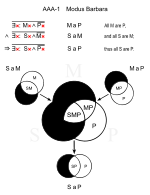

M:man
S:greek P:mortal
[edit] Barbara (AAA-1)
All men are mortal. (MaP) All Greeks are men. (SaM)∴ All Greeks are mortal. (SaP)

M:reptile
S:snake P:fur
[edit] Celarent (EAE-1)
Similar: Cesare (EAE-2)
No reptiles have fur. (MeP) All snakes are reptiles. (SaM)∴ No snakes have fur. (SeP)
[show]Calemes (AEE-4)
M:reptile
S:fur P:snake
Calemes is like Celarent with S and P exchanged.
Similar: Camestres (AEE-2)
All snakes are reptiles. (PaM) No reptiles have fur. (MeS)∴ No fur bearing animal is a snake. (SeP)
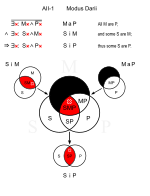
M:rabbit
S:pet P:fur
[edit] Darii (AII-1)
Similar: Datisi (AII-3)
All rabbits have fur. (MaP) Some pets are rabbits. (SiM)∴ Some pets have fur. (SiP)
[show]Dimatis (IAI-4)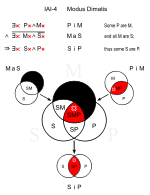
M:rabbit
S:fur P:pet
Dimatis is like Darii with S and P exchanged.
Similar: Disamis (IAI-3)
Some pets are rabbits. (PiM) All rabbits have fur. (MaS)∴ Some fur bearing animals are pets. (SiP)
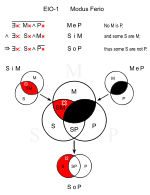
M:homework
S:reading P:fun
[edit] Ferio (EIO-1)
Similar: Festino (EIO-2), Ferison (EIO-3), Fresison (EIO-4)
No homework is fun. (MeP) Some reading is homework. (SiM)∴ Some reading is not fun. (SoP)

M:useful
S:website P:informative
[edit] Baroco (AOO-2)
All informative things are useful things. (PaM) Some websites are not useful things. (SoM)∴ Some websites are not informative. (SoP)

M:cat
S:mammal P:tail
[edit] Bocardo (OAO-3)
Some cats have no tails. (MoP) All cats are mammals. (MaS)∴ Some mammals have no tails. (SoP)

M:man
S:greek P:mortal
[edit] Barbari (AAI-1)
All men are mortal. (MaP) All Greeks are men. (SaM)∴ Some Greeks are mortal. (SiP)
[show]Bamalip (AAI-4)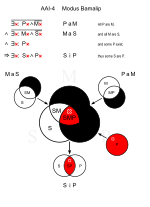
M:man
S:mortal P:greek
Bamalip is like Barbari with S and P exchanged:
All Greeks are men. (PaM) All men are mortal. (MaS)∴ Some mortals are Greek. (SiP)

M:reptile
S:snake P:fur
[edit] Celaront (EAO-1)
Similar: Cesaro (EAO-2)
No reptiles have fur. (MeP) All snakes are reptiles. (SaM)∴ Some snakes have no fur. (SoP)

M:hooves
S:human P:horse
[edit] Camestros (AEO-2)
Similar: Calemos (AEO-4)
All horses have hooves. (PaM) No humans have hooves. (SeM)∴ Some humans are not horses. (SoP)
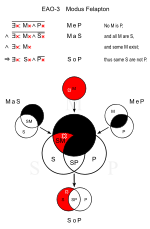
M:flower
S:plant P:animal
[edit] Felapton (EAO-3)
Similar: Fesapo (EAO-4)
No flowers are animals. (MeP) All flowers are plants. (MaS)∴ Some plants are not animals. (SoP)

M:square
S:rhomb P:rectangle
[edit] Darapti (AAI-3)
All squares are rectangles. (MaP) All squares are rhombs. (MaS)∴ Some rhombs are rectangles. (SiP)
[edit] Table of all syllogisms
This table shows all 24 valid syllogisms, represented by Venn diagrams.
(9 of them, on the right side of the table, require that one category must not be empty.)
Syllogisms of the same type are in the same row, and very similar syllogisms are in the same column.
1
Barbara
Celarent

Darii

Ferio

Barbari
Celaront
2

Cesare
Camestres

Festino
Baroco

Cesaro
Camestros
3

Datisi
Disamis
Ferison

Bocardo

Felapton
Darapti
4

Calemes

Dimatis
Fresison

Calemos
Fesapo

Bamalip [edit] Terms in syllogism
We may, with Aristotle, distinguish singular terms such as Socrates and general terms such as Greeks. Aristotle further distinguished (a) terms that could be the subject of predication, and (b) terms that could be predicated of others by the use of the copula (is are). (Such a predication is known as a distributive as opposed to non-distributive as in Greeks are numerous. It is clear that Aristotle's syllogism works only for distributive predication for we cannot reason All Greeks are animals, animals are numerous, therefore All Greeks are numerous.) In Aristotle’s view singular terms were of type (a) and general terms of type (b). Thus Men can be predicated of Socrates but Socrates cannot be predicated of anything. Therefore to enable a term to be interchangeable — that is to be either in the subject or predicate position of a proposition in a syllogism — the terms must be general terms, or categorical terms as they came to be called. Consequently the propositions of a syllogism should be categorical propositions (both terms general) and syllogism employing just categorical terms came to be called categorical syllogisms.
It is clear that nothing would prevent a singular term occurring in a syllogism — so long as it was always in the subject position — however such a syllogism, even if valid, would not be a categorical syllogism. An example of such would be Socrates is a man, All men are mortal, therefore Socrates is mortal. Intuitively this is as valid as All Greeks are men, all men are mortal therefore all Greeks are mortals. To argue that its validity can be explained by the theory of syllogism it would be necessary to show that Socrates is a man is the equivalent of a categorical proposition. It can be argued Socrates is a man is equivalent to All that are identical to Socrates are men, so our non-categorical syllogism can be justified by use of the equivalence above and then citing BARBARA.
[edit] Existential import
If a statement includes a term so that the statement is false if the term has no instances (is not instantiated) then the statement is said to entail existential import with respect to that term. In particular, a universal statement of the form All A is B has existential import with respect to A if All A is B is false if there are no As.
The following problems arise:
(a) In natural language and normal use, which statements of the forms All A is B, No A is B, Some A is B and Some A is not B have existential import and with respect to which terms?(b) In the four forms of categorical statements used in syllogism, which statements of the form AaB, AeB, AiB and AoB have existential import and with respect to which terms?(c) What existential imports must the forms AaB, AeB, AiB and AoB have for the square of opposition be valid?(d) What existential imports must the forms AaB, AeB, AiB and AoB to preserve the validity of the traditionally valid forms of syllogisms?(e) Are the existential imports required to satisfy (d) above such that the normal uses in natural languages of the forms All A is B, No A is B, Some A is B and Some A is not B are intuitively and fairly reflected by the categorical statements of forms
DONKEYComment
-
ev·i·dence ( v

 -d
 ns)n.1. A thing or things helpful in forming a conclusion or judgment: The broken window was evidence that a burglary had taken place. Scientists weigh the evidence for and against a hypothesis.
2. Something indicative; an outward sign: evidence of grief on a mourner's face.
3. Law The documentary or oral statements and the material objects admissible as testimony in a court of law.
tr.v. ev·i·denced, ev·i·denc·ing, ev·i·denc·es 1. To indicate clearly; exemplify or prove.
2. To support by testimony; attest.
Idiom: in evidence1. Plainly visible; to be seen: It was early, and few pedestrians were in evidence on the city streets.
2. Law As legal evidence: submitted the photograph in evidence.
donkeyComment
-
what you providing is not evidence
its called "rationalization"
"I drink alcohol because it helps me coup with the stresses of life"
giving reason ...that is faulty.
donkey.Comment
-
payshe kalay khar beeshee yasin bokhon.
lolComment
-
you should just stop and think
"Why can alchemist defeat my one claim from 50 different directions... but I can only repeat the same mantra over and over...am i brainwashed...maybe I am ignorant...maybe talkorigin is not the quran ..and maybe lorren is not my prophet...maybe i should investigate this issue further and stop making an ass out of my self."Comment
-
An explanation of the process would explain how it happened.Originally posted by Alchemist View Post
Fortunately my definition does not claim to explain the process. It simply acknowledges that, by some process, organisms developed into other organisms. It doesn't claim anything about how it happened, only that they did develop into other organisms.
Quite simply, how it happened is another discussion.
Originally posted by Alchemist View Post
What type of syllogistic fallacy you purport my argument is?Comment
-
-
Absence of visual confirmation of the process does not disprove the FoE as being science:Originally posted by Alchemist
Others reject the notion of evolution outright (without reference to the argument) with the simple claim that it cannot be true because no one has ever seen a complete transformation of one distinct species into another (e.g., fish to reptiles). There may have been all sorts of minor developments of one species into another distinct but closely related species (an established scientific finding), but without such visual experience of a major transformation, so they say, evolution is just a "theory."
Well, of course evolution is a theory, just as atomic structures, black holes, electricity, relativity, DNA, magnetism, and so on are "just theories." But so what? We do not have direct visual evidence of these things with our own eyes (who has ever seen an electron or a molecule or a gene with the naked eye?). What we do observe, often with the aid of very sophisticated machines, are larger events which we explain as effects of those theoretical components. Most scientific theories involve natural elements that we cannot see. Those who seriously believe that this objection carries any weight need to become more familiar with the nature of scientific enquiry and the meaning of a scientific "proof."Comment
-
quite simply evolution is concerened with the process, the how... the whole of science is concerned with the question HOW. what is obvious.
you are sooooo dumb and uneducated that you can sit there with a smirk on your face and tell me that the how is of no consequence to a scientist! EVERY SINGLE book of science deals ONLY with the how! Its about mechanisms...biochemistry... biology...physics ... its only the how...why scientific journal? because it has a methodology section!
Sinec you are trying to divorce evolution from its scientific aspect...you are making it your religion ...and after 50,000 words...everyone that used to believe in evolution are now going to be more caustious because they don't want to be an idiot like you.
You eptimoze what is wrong with evolution. Your weak psychology and flawed argumentation style is what brings shame to most atheists who religiously believe in evolution...but hark on the creationists as being "bible thumbers" ..after copy pasting the whole website of talk origin..ur no different than those bible thumbers.Comment
-
All that is stated in the definition is that organisms developed into organisms. It does not talk about how it happened. Just because I have the word "developed" in the definition it does not automatically mean I would have to explain how they developed.Originally posted by Alchemist
If it had said in the definition: "organisms developed into other organisms by natural selection" then it would be an explanation of how.
But it doesn't. All it states is that we know that by some process, organisms developed into other organisms.
How that process occurred is not stated in the definition and is thus irrelevant to my case for the FoE.Comment


Comment