Announcement

Collapse
No announcement yet.

Evolution, why us?

Collapse
X
 
  • Filter
  • Time
  • Show
Clear All
new posts

  • Evolution, why us?

    I'll be honest I don't know much about evolution...but I have one question if someone that is well versed in the subject can answer...why humans evolved to to an extent to develop such intelligence and sophistication? Where are the fish or reptilian people?

    Does that make sense...? lulz

  • #2
    Evolution attunes you for survival, not necessarily intelligence (though we have evolved in such a way that we prosper through it). We can't survive so easily in the Arctic and Antarctic like the creatures there, we can't run fast enough to catch deer (though we can invent guns now), we can't climb trees like lemurs (some of us can actually....), we can't have the tough hides of elephants (though we can invent Kevlar), we can't be agile and funny like lolcats, etc. A shark needs skills other than self-consciousness to survive. A hippo gets by just fine, thanks to his enormous size.

    A common ancestor of ours broke into lemurs (advanced tree-dwellers) and other primates and ultimately, the latter found themselves in an environment where they were on the ground. Their primate-type hands and feet and their lack of thick hide and claws (which was okay up in the safety of the trees) put them at a disadvantage against the other predators and around that time, a major change occurred because, already keen and intelligent (relatively speaking), they began applying their intelligence instead of going for brute force against highly evolved predators. Therefore, as the fossil evidence suggests, primates began evolving bigger brains by (surprise, surprise) using them. The fossil evidence for this is as undeniable as it is massive. They also gradually began walking upright (again, as the fossil evidence proves) because they were using basic tools now with their hands. Their tails shortened because they didn't need them. This is also evident in the fossil records.

    The next step is where there's a bit of a misconception in your post, Wrayun. We, homosapeans, were not the only ones to have become 'intelligent'. Other social, tool-using and sophisticated advanced apes include neanderthals (some of us have their genes, too), homoerectus (I share most of my genes with this one xD), homohabilis, etc. In the end, our primate species came out on top.

    The fossils show that the further back we go in time (carbonating FTW), the primate fossils we find have smaller brains, they're not upright and they have long tails. When we come forward in time, we find that our ancestors, gradually - one after the other, began walking upright, their skulls were getting larger, their noses got smaller, they lost their tails and became more and more homosapean-like. This happened over hundreds of millions of years. This is clear-cut evidence for evolution.

    How does evolution work? You use one organ, it becomes stronger in the short run and your descendants acquire that trait. At the same time, those with traits preferable for survival (like being smarter, stronger, bulkier, prettier) get to pass on their genes more often than those who are don't have those qualities. Lastly, sometimes, there's an error in our genetic code (a mutation) and in some very few cases, that mutation is positive and that leads to the mutated passing on genes more successfully and that's how over hundreds of thousands of years, those with the mutation become a distinct specie from those that survived without the mutation. Another way is adaptation - six frog of species 'A' crawl to another side of the island or are taken there by a flood. There, their environment is different - they have long green grass there as opposed to dry rocks and there are plenty of birds around. Over the years, those of the descendants of those 6 frogs whose skin color is closer to that of the grass will obviously have a higher chance of not being picked up by the predatory birds. Eventually, they'll get to make more babies and the greener their babies are, the greater will be their possibility to make babies. After many, many years, they will mostly all be green and if they go back to where species A lived and mate with them, they will not be able to produce any offspring because the descendants of those 6 frogs would've become species 'B' by now.

    To conclude, acquiring intelligence is only one way to survive. Whales have survived a lot longer than us by not being half as smart as us, for example. Crocodiles are also a successful species in that regard because they've, with little modification, thrived in their natural habitats. Why would they want to apply their minds like us? They're the kings of their habitats.
    Last edited by Levanaye Zalmaye; 09-24-2010, 06:09 AM.
    "If a nation expects to be ignorant and free, in a state of civilization, it expects what never was and never will be".

    "Knowledge will forever govern ignorance; and a people who mean to be their own governors must arm themselves with the power which knowledge gives".

    Comment


    • #3
      Good read!

      Comment


      • #4
        Originally posted by Levanaye Zalmaye View Post
        How does evolution work? You use one organ, it becomes stronger in the short run and your descendants acquire that trait. At the same time, those with traits preferable for survival (like being smarter, stronger, bulkier, prettier) get to pass on their genes more often than those who are don't have those qualities. Lastly, sometimes, there's an error in our genetic code (a mutation) and in some very few cases, that mutation is positive and that leads to the mutated passing on genes more successfully and that's how over hundreds of thousands of years, those with the mutation become a distinct specie from those that survived without the mutation. Another way is adaptation - six frog of species 'A' crawl to another side of the island or are taken there by a flood. There, their environment is different - they have long green grass there as opposed to dry rocks and there are plenty of birds around. Over the years, those of the descendants of those 6 frogs whose skin color is closer to that of the grass will obviously have a higher chance of not being picked up by the predatory birds. Eventually, they'll get to make more babies and the greener their babies are, the greater will be their possibility to make babies. After many, many years, they will mostly all be green and if they go back to where species A lived and mate with them, they will not be able to produce any offspring because the descendants of those 6 frogs would've become species 'B' by now.

        To conclude, acquiring intelligence is only one way to survive. Whales have survived a lot longer than us by not being half as smart as us, for example. Crocodiles are also a successful species in that regard because they've, with little modification, thrived in their natural habitats. Why would they want to apply their minds like us? They're the kings of their habitats.
        An interesting read. Evolution, if anything is erratic, haphazard, and full of dead ends. Those species that walk/crawl/swim the Earth are the ones that didn't take a path down a dead end.

        When conservationists talk about protecting tiger populations or Virginia Birch trees, are they attempting to interfere with nature? Some species will die out because nature/events have designed it that way - right?

        It begs an ethical dilemma that intrigues me. Like global warming, we tend to point the finger of blame on human activity, but ultimately, beautiful as they are - are tigers and giant pandas (in evolutionary speak), Virgina Birch trees etc. survivors? Are they able to adapt/reproduce fast enough to sustain their own populations?

        There are rights and wrongs. Are human conservationists trying to correct historical human wrongs (i.e. destruction of habitat/over-hunting/exploitation)? Should humans be intervening to conserve giant panda stocks when perhaps nature is suggesting that their time is nigh? Where is the line suggested by survival of a species and the rather cruel twists of evolution, drawn?

        Comment


        • #5
          Brother has asked a very good question. He has said that there are dead ends and the process of evolution is erratic. I agree! *big smile on face* .... More than 99% of all species that ever lived are now extinct! *smile gets bigger as audience claps*

          lol anyway, tor khana, here's another way of looking at it - all living species in their current forms are actually transitory species between what they were and which direction they're going towards. We, all of us, will be the 'missing link' between what was and what will be the next step in human evolution. Tor_Khan, your skeleton will be called Swat Man. A fine specimen indeed it shall be.

          As for us saving pandas, a failing species, there are a lot of people who are divided on this. You can't convince the more ardent ones. I wouldn't want all the pandas to die out either. I want to see more panda diplomacy. More sneezing pandas. More panda babies. Et cetera. In other cases, however, some extinctions can be traced directly to some form of human activity. We're the most vile of creatures. And they dare to call us ashraf-ul-makhluqaat.

          Tor Khan, but global warming can be attributed to human activity. Of course there have been changes in global temperature before but our impact on the environment is pretty overwhelming now, is it not?
          "If a nation expects to be ignorant and free, in a state of civilization, it expects what never was and never will be".

          "Knowledge will forever govern ignorance; and a people who mean to be their own governors must arm themselves with the power which knowledge gives".

          Comment


          • #6
            Thanks LZ for the reply, that was indeed a good read.

            Basically what you are saying is that we have evolved to this level because of our unique circumstances and environment. That brings me to another question, why hasn't all the other primates evolved the same way?

            Comment


            • #7
              Great posts LZ!!! That is a very scientifically valid explanation.If this was your exam, you would have scored 99.9%.For the remaining 0.1%, you must keep evolving =)

              And now I am intrigued to know that why we are still unable to beat Cheetah with our bipedalism or perform echolocation like bats, or make an elephant jump (they can never jump).Shouldn't this make humans less intelligent?As biased animals, we always think we are "brainy" and neglect the intelligence of ants which developed the farming practice before humans!!! To avoid biological blasphemy, I would refrain from using the term intelligence (and also to undermine my intrinsic narcissism) and would adapt to my evolutionarily bestowed complexity. Because my ego got severely bruised the other day when I learnt that I--the intelligent ape---share my pallium with a tiny marine worm (Platynereis dumerilii).Outrageous! A "brainy worm"?

              How could evolution engendered Koalas as the laziest animals and illuminated firefly with the luciferase when the same process formed an intelligent/complex ape which developed technologies and communication skills?For our "extraordinary" intelligence/complexity, we need to take the "ordinary" natural process of Natural Selection into consideration. Where do I as intelligent Homo sapiens fill my niche in the big ecosystem. Perhaps not in Lower Geyser Basin with extremophilic bacteria such as Thermus acquaticus at 80 degree celsius (175 F) or not even with the polar bears and penguins in the North pole (though I would love too!). The major purpose of this life is to get food and survive by being reproductively fit to transfer the genes to next generation. In this complex ecosystem, every animal (including the unicellular prokaryotes) have been evolving defenses to evade predation.The Gaboon viper has the venome against predator--but if it can develop fangs (which it has ) it could have a further selective advantage of piercing deeper into the body of its predator. But wait, its predator is also developing a thick hide to evade the fangs.And what about the fang-less plants? How do they survive in this dangerous world? From thorn to potent toxins of extreme nature, plants also stand tall when it comes to killing its enemy.But where do we stand in this antagonistic race that has been happening in this entire evolutionary time? We have been participating in this antagnonistic arms race since the time our MCRA (most common recent ancestor) diverged into several species but the trick is that we do not witness it in the evolutionary time, we only see it in our own lifetime (the way we can't believe that we outcompeted our cousins/brothers Homo neanderthalensis).In our present framework of thinking, we perceive the diverse phenomena of world by decephering them as causes leading to effects (rubbing stones produced fire) or figuring our how we can detoxifiy the toxins of plants by killing them at higher temperature (use the same fire) and use it as our food, or develop a sharp weapons to kill the animal for a dinner before it has a nice meal on me. Since I learnt this trick, I am going to repeat it and if it gives me the same result I will use the same trick or modify or improve it to utilize the resources.

              In the present post-genomic era, the myriad of studies conducted in the fields of paleontology, anthropology, linguistics, molecular biolgy, genetics and genomics, molecular phylogeny, we suffered massive earthquakes disturbing our biological scala naturae.As the possibility of more aftershocks is inevitable, one thing is true that Homo sapiens do not enjoy the same prestigious spot as the only skulls, containing intelligent brains ever to have populated this earth. Other species like Homo erectus levanaye zalmeye,Homo habils, Homo antecessor,homo hidelbergensis, were quite intelligent when they showed us the art of tool-making and hunting. They also evolved the prototype social intelligence and so we are not that intelligent since we started from the point where others stopped. Yes the only intellligence is that we out-competed them but that still does not give us an exclusive place in the evolutionary tree as the only intelligent animal on the earth.It won't be surprising if the extinct Homo species felt great about their intelligence when they developed lanugage and tools thousands of years ago!

              It would be unfair if we do not give credit to the intricate rewiring of our brains to help us out-compete the other animals and feel great about ourselves as the highly complex primates. With our hundered trillions complex synapses and trillions of nerve cells, how could one believe that all of this happend in one single evolutionay event? This is not a magick of one single mutation or a divine spark which could rewire our brain in such a complex maze together with the release of myriad of neruotrasmitters to make us develop our "cognitive niche" in this ecosystem. As we gather more genomic and chemical data, we are more inclined to think that gradual assimilation of genetic mutations kept evolving our brain including the increase in the number of neurons and the arrangement of loose connections between them. For example, while comparing the brain sizes of human ancestors versus tools complexity, palentologists found that as the brain size increases, the tool complexity also increases. Hence considering the complexity of the tools of modern-day apes it is pretty reasonable to believe that a lot of favorable mutations which took some 6 million years have gone into rewiring the human brain with the simultaneous expansion of its tissue. Again it could be the rewiring of the brains of Homo sapiens comapred to the Homo neanderthalensis which although had the same brain size, became extinct.

              So how smart are sturgeons as electroreceptive chordates compared to humans when the latter can't generate or detect electric fields? Intertwined with social, cultural, and morphological evolution, the development of complex cognitive abilites in Homo sapiens-- spuriously described as intelligence--has unquestionably played a pivotal role in making us the most advanced animals, yet we still do not hold a strict view of human intelligence as a superior case any more since our brains have not stopped evolving. They are evolving constantly albeit at a slower pace (like always) and so are the SNPs (single nucleotide polymorphisms) for several other important metabolic functions. I wish we had a magnetitie in our heads like brids so to that we could have just used our magnetoreception rather than developing fancy technolgies to navigate an unfamiliar territory. But who is more intelligent for unqiue intelligent feature--the former as the progenitor or the latter as the descendent?
              Last edited by PFgulalai; 09-25-2010, 12:03 AM.
              "O Pakhtuns!, Your house has fallen into ruin, let us rebuild it".
              "I want to see my people educated and enlightened. A people with a vision and a strong sense of justice, who can carve out a future for themselves in harmony with nature".

              Comment


              • #8
                Originally posted by tor_khan View Post
                An interesting read. Evolution, if anything is erratic, haphazard, and full of dead ends. Those species that walk/crawl/swim the Earth are the ones that didn't take a path down a dead end ?
                The only haphazard events were the mass extinctions and there have been a total of 5 mass extinction events in the history of the world.In the context of evolution,such haphazrd events cannot explain the natural and gradual process of evolution resulting in most of the "dead ends" in our evolutionary tree.We have two kinds of dead ends--the sudden one (mass extinctions) and the gradual ones (natural selection).The dead ends left by the latter process are more informative for our understading of the origin of organism since they help us in following the step by step process of evolution.The "dead ends" left by the mass extinct forms are not as a result of some "selective force" (as in natural selection) but rather signify an "event" which resulted in the extinction of some species and resultantly reducing species diversity in a biologically nonspecific fashion.They are more useful for being the major factor behind adaptive radiation-linked (rapidly reproducing) lineages.


                Originally posted by tor_khan View Post
                When conservationists talk about protecting tiger populations or Virginia Birch trees, are they attempting to interfere with nature? Some species will die out because nature/events have designed it that way - right?It begs an ethical dilemma that intrigues me. Like global warming, we tend to point the finger of blame on human activity, but ultimately, beautiful as they are - are tigers and giant pandas (in evolutionary speak), Virgina Birch trees etc. survivors? Are they able to adapt/reproduce fast enough to sustain their own populations?
                Another question along the same line....wouldn't it be better to allow the HIV-infected Africans to die an early death and improve the overall human race by not allowing the physically misfit forms? Not really from the scientific viewpoint.

                Natural selection helps the species to adapt to the changing conditions.It is a gradual process which does not occur in a flash of second, but takes thousands of years to produce one reproductively fit population of species. Most of the 70-90% of present-day animals are going to be eradicated from the surface of the earth in the next centuries, not because evolution failed to make them "fit" but because they suffered mass extinction. A group of 9 endangered chimps were found dead in a National Park of African continent and the molecular analysis traced the presence of human-like influenza virus to be the etiological agent. Recently three Dophins were found dead on a certain beach in USA and the blood analysis showed human hepatitis virus. In both cases the transfer of virus from human to the animals resulted in the death of the animals.Could it be because evolution failed to work? Not really. The environmental factor in this case is equal to a nuclear bomb hitting a population of humans and wiping out the entire flora and fauna, including humans. How can natural selection cause thousand random mutation to help us against the external negative stimulus in a matter of few minutes?Yes it can do that if we were as tiny as bacterium of Hydra.But we are not "simple" animals; we are "complex".

                When an organism feels a challenge to its survival, it tries to evolve to combat the challenge.Evolution as a selective force must introduce a favorable mutation to help the oraganism.The impact on the new mutation would be different for the various memebers of the same population.This is because each memeber has different phsyiologic characteristics including the status of health, the availability of food and fit mate to transfer the mutation to the next generation because it is not the parental organism which will reap the benefit of the mutation, rather it wants its progeny to be reproductively fit. This can take hundereds of thousands of years as in case of primates, or could take few minutes as in case of bacteria and viruses. The reason being the enormous size of genetic material of the advanced animals.While it takes 24 hours for one diploid cell of human to divide into two cells, a single bacterium takes 20 min to replicate its genome.There are approximately 3.6 billion basepairs of nucleotides in the DNA of one single human cell!!; on the other hand the DNA size of a typical bacterium such as Escherichia coli runs in few thousands.

                How could pandas and tigers sustain their population when we are throwing nuclear bombs at them? We destoryed their natural habitat, released noxious gases in the air, melted glaciers for them, increased the level of carbon dioxide in the air, polluted the water with arsenic and sulphites, disturbed the usual mating cycles by our aerial navigation and satellite systems, and altered the landscape at an alarming level by draining the wetlands, and logging forests. How will the humans-the intelligent species--themselves in the midst of sixth mass extinction survive?

                Originally posted by tor_khan View Post
                There are rights and wrongs. Are human conservationists trying to correct historical human wrongs (i.e. destruction of habitat/over-hunting/exploitation)? Should humans be intervening to conserve giant panda stocks when perhaps nature is suggesting that their time is nigh? Where is the line suggested by survival of a species and the rather cruel twists of evolution, drawn?
                How does saving the life of endangered species by conservationist qualify as a delibearte disruption in the evolutionary process? Are the marine animals dying on the beaches becoming extinct due to their unfit DNA/RNA?Isn't it due to the acidification of oceans and air which is choking marine animals? A single White Dolphin couple can give birth every three years. It will need hundreds of generations to bring one single mutation to form HCl-resistant genes to surive the acid in water released through the different sources of pollution. Species will have to adapt to the abrupt changes made by humans eventually but that is something we won't be witnessing in our lifetime, although I do see it every day in lower organisms due to their short reproductive cycles.
                Last edited by PFgulalai; 09-25-2010, 02:04 AM.
                "O Pakhtuns!, Your house has fallen into ruin, let us rebuild it".
                "I want to see my people educated and enlightened. A people with a vision and a strong sense of justice, who can carve out a future for themselves in harmony with nature".

                Comment


                • #9
                  ^ You bring many emotional responses to the many ethical questions I ask Gulalai - there's nothing wrong with that - ethics and scientific thought go together.

                  I'm interested though in
                  When an organism feels a challenge to its survival, it tries to evolve to combat the challenge.
                  That would suggest that organisms can consciously adapt to challenges by turning switches on and off. I would perhaps have thought this ability is somewhat rare (e.g. in case of komodo dragons being able to reproduce without mating and clownfish changing gender). In most instances organisms either thrive within a changed environment or decline. In this case survival comes from a mutation that is better 'build' for that environment.

                  I'm a lay person when it comes to science and to be honest, I owe Michael Crichton and Bill Bryson a lot. Michael Crichton's Jurassic Park stories ultimately conclude that dinosaurs had their moment, like the African quagga or the Mauritian dodo, the mammoths, the sabre-tooth cats etc. All fascinating, but of their time. Additionally, Michael Crichton's State of Fear is a novel that is clearly skeptical about the environmental lobby's obsession with global warming etc. Again, he concludes - and this is better explained by Bill Bryons to me - that the earth has periodically heated up and cooled down. In fact generally mild spells in the Earths history (and technically, we are in a mild spell) usually accelerate the oncoming of ice-ages. This needs an explanation, that I won't explore here, but is fascinating to understand none-the-less.

                  Life, is tenacious and I have lots of respect for it - and the need to preserve it - so my tiger/panda example was purely illustrative. Ethically I do believe very much in the preservation of life, but I can't help but to come back to a slight element of fatalism too - somethings will almost certainly happen. Some life forms will not adapt fast enough to survive the next 1000 years.

                  And humans shaping their own environment and in the process destroying the environment for other life forms is another example of how life forms have continually competed with one another.

                  The skies have always been pumped with CO2 - even before humans invented factories. In the late Paleozic when oxygen levels were much higher - thanks to millions of years when plants ruled the earth, gigantic insects such as dragon flies are said to have had 2 feet wingspans. Wild fires in an oxygen rich Earth (up to 33%) will have been much more common - even wet (gigantic) trees are said to have burned easily and thus will have contributed their own "extra" CO2 emissions. The carbon data shows this, apparently.

                  The point I make of course, is that plants conditioned the earth to suit themselves at the time - fast forward humans of today - we are told that we are ruining the earth (and I very much agree with this, actually) but all that is happening on earth is that a dominant life form is conditioning the earth to suit itself. It is not sustainable, and we may suffer as a result of it, but in the grand scheme of the Earth, tectonic plate movement will mean all the litter that we leave behind, all the plastics, all the pollutants we abandon will be taken into the belly of the Earth and re-hashed.

                  We are, let's not forget, made up stardust, earth dust and of other molecular material, left behind by pre-historic plants and animals. We are - at it's most basic - purely scientifically speaking - no more than that.

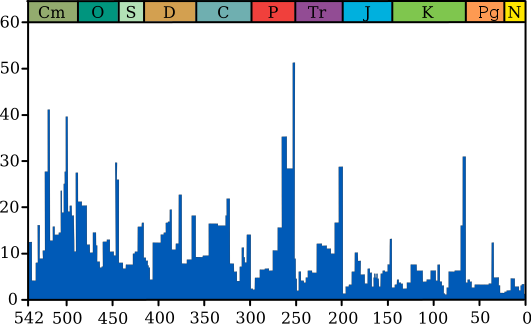
                  Human talk cannot stop as asteroid impact. The earth is supposedly hit by a 1 km asteroid every 500,000 years (half a million years) and a 5 km asteroid every 10 million years. If the Earth is 4.6 billion years old, arguably we've been hit several times over - each hit reportedly has been cataclysmic. Consider the KT event - the asteroid that wiped out the dinosaurs and plunged the earth into a darkness and winter for thousands of years happened 65 million years ago, we are, by all accounts, very much due a hit anytime soon. There's a regular pattern of cataclysm and extinction as the spikes in the graph show:


                  We just need to hurry up and mutate I guess to ensure our continued survival.
                  Last edited by tor_khan; 09-25-2010, 06:10 PM.

                  Comment


                  • #10
                    evolution

                    So I was just thinking here about human evolution. We have evolved a long way over the hundreds of years etc and we are still evolving. These days you hear about people who can use that 1 percent more of their brain then the average human. Where will this evolution take us? Is it going to be anything like the sci-fi movies where you will be able to use your brain to move things etc? Or is it where you will just think on a more advanced level and be able to take in more and put out more at the same time? Is there going to be a point where we will stop evolving? Will our bodies evolve as well?
                    Ka Makh De Rana Hear Sho No Jehan Ba Rana Hear She
                    Ka Nom De Rana Hear Sho No Khpal Zan Ba Rana Her She[

                    Comment


                    • #11
                      hope you are joking

                      Comment


                      • #12
                        ma wail ka bya da haga topic start kru :P:P)
                        .....


                        Comment


                        • #13
                          We will never stop evolving but natural selection is going chaotic as medicine counters the natural death of probably billions of people. People who normally would have plopped dead are given 2nd chances and continued opportunity to spread their genes.

                          Comment


                          • #14
                            i am being serious, evoltuion is not aganst islam
                            Ka Makh De Rana Hear Sho No Jehan Ba Rana Hear She
                            Ka Nom De Rana Hear Sho No Khpal Zan Ba Rana Her She[

                            Comment


                            • #15
                              Originally posted by Midnight_Sun View Post
                              We will never stop evolving but natural selection is going chaotic as medicine counters the natural death of probably billions of people. People who normally would have plopped dead are given 2nd chances and continued opportunity to spread their genes.
                              that will only go upto a point i think, i mean with all this medical advances the human body has been taken away from becoming stronger in the sense to repel illnesses etc like the people who live in the west go back to like afghanistan get ill very quickly there but the people living there do not.
                              Ka Makh De Rana Hear Sho No Jehan Ba Rana Hear She
                              Ka Nom De Rana Hear Sho No Khpal Zan Ba Rana Her She[

                              Comment

                              Working...
                              X