
 Tweet
Tweet
 Pollution in Kabul.
Since I didn't see anything on this and I think its an important issue i'll make a thread with extensive infomation concerning pollution in Kabul (can be applied to other developing cities too like Pekhawar). The infomation obtained from various sources and abit of my own knowledge.
I have highlighted the most important info for you lazy people but I would recommend you read the whole thing.
Pollution in the capital is so bad that the National Environmental Protection Agency (NEPA) and the Health Ministry have advised people to use masks or similar things to protect them.

That's what they do in cities in China such as Hong-Kong where the air pollution is one of the worst.
Bilal Ahmad, a plastic seller in Kabul City, hides his nose and mouth with a mask due to air pollution, he says that he uses mask because it is useful to avoid cold sores and throat diseases.
Frishta, who is a drinkable water seller, says he gets throat ache all the time but since I have used mask, I never felt any diseases or pains.
Tawab Ahmad, a mask seller, says that he sells nearly 30 masks every day to his countrymen and women and he also uses mask himself.
“Anyone can observe that the air in Kabul is highly polluted,” said Chiranjibi Gautam, an expert with the UN Environment Programme (UNEP).
The country imports tens of thousands of second-hand cars every year. They are old and predominantly use low-grade fuel which pollutes the air.
The city's inadequate public transport system does not meet the needs of its estimated 4.5 million inhabitants, pushing more and more people to buy cars.
It is estimated that upto 75% of the city's air pollution is due to transport and world-wide, air pollution causes about two million premature deaths every year.
In Kabul the NEPA and Health Ministry claim that air pollution causes up to 3,000 deaths a year and spreads skin, respiratory and eye diseases, and even cancer.
Also a problem specific to Kabul is that "it is a valley where in winter there is thermal inversion and because of it very low dispersion of pollutants takes place, thus increasing pollution levels”.
The population of Kabul is growing rapidly and it is already overcrowded. In fact I can't remember properly but I think the government is trying to build a 'New Kabul' or something with more houses and stuff to accomodate a million more people or something. Someone will have to confirm that since I read it a while ago. This increase in population is due to people breeding like rabbits and more and more people moving to the city (probably either because of safety reasons (i.e. my family moved there last year because of the heavy fighting in Wardak) or other reasons like jobs etc.
Furthermore the fact that there is very little greenery in the city compared to a few decades ago isn't helping matters. Greenery is needed to absorb the Carbon dioxide (bad for the air) emitted from exhausts, factories, planes etc and they release Oxygen (good for the air). This is especially worse given that trees do this the most and it has been mainly the trees that have dissapeared over all this time (due to bombings and deforestration - people cutting them down for wood or fuel on a large scale).
Over the past two decades the city has lost over 70% of its greenery (trees, plants, grass etc),
Kabul (1980s)


Kabul (now)

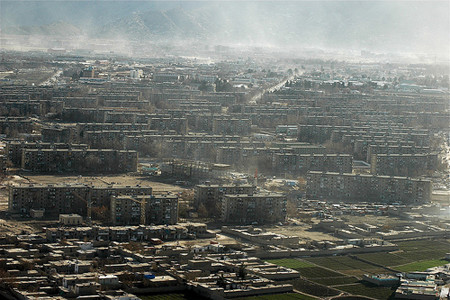
Pollution is worst in the winter months as people burn more firewood to keep warm and use generators more often. Although the use of generators has been falling in recent years due to increased electricity imports from Tajikistan.
Moreover, some brick factories, public baths and small businesses burn old tyres, plastic and combustible waste to run their businesses more cheaply. Toxic pollutants, sulfur oxide, carbon monoxide, nitrogen dioxide and carbon dioxide are emitted, NEPA experts say.
“Poor waste management – both solid and otherwise - is yet another major problem in Kabul which also damages the air quality,” Baheer said.
Then there's the problem of the 'Land Mafia' as officials like to call it:
The government did try something:
As you can see this was not effective at all.
Anyway, all this air pollution results in various health problems as stated here:
Also:
Over the past few years diagnosed cases of cancer, mainly among children, have increased considerably.
Kabul faces numerous environmental problems: a virtually non-existent sewage and sanitation system, burgeoning slums, crumbling infrastructure and rapid population growth. The fledging environmental protection agency will have an uphill struggle in improving air quality.
“We have to act fast and execute a series of projects such as the rehabilitation of forests and promotion of greenery, ban the import and use of substandard fuel, improve waste management... and build and strengthen our own institutional capacity,” NEPA’s deputy director said.
NEPA is looking forward to receiving its first ever assistance from a donor: The US Agency for International Development (USAID) has pledged about US$500,000.
Of course there are more serious probelms affecting the people and this is obviously not a priority at the moment. However something does need to be done because as each day goes by Kabul is becoming filthier and filthier. The people will suffer in the long-term and prevention is far easier then finding a cure.
What are your opinions? What, if anything, can be done to change all of this? Should anything be done now?
I have highlighted the most important info for you lazy people but I would recommend you read the whole thing.
Pollution in the capital is so bad that the National Environmental Protection Agency (NEPA) and the Health Ministry have advised people to use masks or similar things to protect them.
That's what they do in cities in China such as Hong-Kong where the air pollution is one of the worst.
Bilal Ahmad, a plastic seller in Kabul City, hides his nose and mouth with a mask due to air pollution, he says that he uses mask because it is useful to avoid cold sores and throat diseases.
Frishta, who is a drinkable water seller, says he gets throat ache all the time but since I have used mask, I never felt any diseases or pains.
Tawab Ahmad, a mask seller, says that he sells nearly 30 masks every day to his countrymen and women and he also uses mask himself.
“Anyone can observe that the air in Kabul is highly polluted,” said Chiranjibi Gautam, an expert with the UN Environment Programme (UNEP).
The country imports tens of thousands of second-hand cars every year. They are old and predominantly use low-grade fuel which pollutes the air.
The city's inadequate public transport system does not meet the needs of its estimated 4.5 million inhabitants, pushing more and more people to buy cars.
It is estimated that upto 75% of the city's air pollution is due to transport and world-wide, air pollution causes about two million premature deaths every year.
In Kabul the NEPA and Health Ministry claim that air pollution causes up to 3,000 deaths a year and spreads skin, respiratory and eye diseases, and even cancer.
Also a problem specific to Kabul is that "it is a valley where in winter there is thermal inversion and because of it very low dispersion of pollutants takes place, thus increasing pollution levels”.
The population of Kabul is growing rapidly and it is already overcrowded. In fact I can't remember properly but I think the government is trying to build a 'New Kabul' or something with more houses and stuff to accomodate a million more people or something. Someone will have to confirm that since I read it a while ago. This increase in population is due to people breeding like rabbits and more and more people moving to the city (probably either because of safety reasons (i.e. my family moved there last year because of the heavy fighting in Wardak) or other reasons like jobs etc.
Furthermore the fact that there is very little greenery in the city compared to a few decades ago isn't helping matters. Greenery is needed to absorb the Carbon dioxide (bad for the air) emitted from exhausts, factories, planes etc and they release Oxygen (good for the air). This is especially worse given that trees do this the most and it has been mainly the trees that have dissapeared over all this time (due to bombings and deforestration - people cutting them down for wood or fuel on a large scale).
Over the past two decades the city has lost over 70% of its greenery (trees, plants, grass etc),
Kabul (1980s)
Kabul (now)
Pollution is worst in the winter months as people burn more firewood to keep warm and use generators more often. Although the use of generators has been falling in recent years due to increased electricity imports from Tajikistan.
Moreover, some brick factories, public baths and small businesses burn old tyres, plastic and combustible waste to run their businesses more cheaply. Toxic pollutants, sulfur oxide, carbon monoxide, nitrogen dioxide and carbon dioxide are emitted, NEPA experts say.
“Poor waste management – both solid and otherwise - is yet another major problem in Kabul which also damages the air quality,” Baheer said.
Then there's the problem of the 'Land Mafia' as officials like to call it:
Meanwhile, officials accuse what they call a “land mafia” of plundering public land and illegally building houses, with little or no heed to the environment.
“The land mafia has seized green areas and builds houses and commercial buildings in areas which are crucial for environmental protection purposes,” said NEPA’s Yamin.
“The land mafia has seized green areas and builds houses and commercial buildings in areas which are crucial for environmental protection purposes,” said NEPA’s Yamin.
To discourage the use of state-owned vehicles and reduce pollution, the government announced that Thursdays are to be public holidays until March 2011. Afghanistan normally only observes Friday as a day of rest.
Critics, however, say the extra holiday is benefiting no one, as officials tend to use government vehicles for private purposes on days off. “It’s a joke which in fact is damaging the economy more than helping to reduce air pollution because congestion on Thursdays is no better than on other days,” said Kabul resident Ahmad Temor.
The government has not banned the use of government or private vehicles on Thursdays and Fridays, but merely “requested” that people refrain from using their cars “unnecessarily”.
Critics, however, say the extra holiday is benefiting no one, as officials tend to use government vehicles for private purposes on days off. “It’s a joke which in fact is damaging the economy more than helping to reduce air pollution because congestion on Thursdays is no better than on other days,” said Kabul resident Ahmad Temor.
The government has not banned the use of government or private vehicles on Thursdays and Fridays, but merely “requested” that people refrain from using their cars “unnecessarily”.
Anyway, all this air pollution results in various health problems as stated here:
The air pollution can cause or exacerbate a number of serious diseases among inhabitants of an air polluted city. These diseases include Ischemic Heart diseases, stroke, hypertension, and a number of respiratory disease and birth defects. Those who are at highest risk of being affected by air pollution are children, the elderly and patients who already have diabetes, heart disease and respiratory disease. Air pollution can also affect fetus in the mother’s womb. A large study in Los Angeles showed that air pollution due to carbon mono-oxide can increase ventricular septal birth defects. This condition is already high in Afghanistan. Knowing the high concentration of carbon mono oxide in Kabul, it is of great concern to us that birth defects may be on the rise in Kabul. The MoPH will be gathering data on birth defects and other conditions soon.
It has been shown that when air particles of size 2.5 microgram or smaller increase by 10 micrograms per cubic meter air, there is a 6% increase in cardiovascular deaths and an 8% increase in death from lung cancer per year. The mortality from all disease increase by 4%. We know that the average crude mortality in Afghanistan is 17 per 1000 population per year. This means that in the city of Kabul in the absence of air pollutionwe lose about 76500 people. However, if we apply the 4% increase in mortality due to air pollution to the population of Kabul, then an extra 3060 persons may be losing their lives due to air pollution per year. So instead of 76500 people losing their lives, in Kabul we lose 79560 persons.
Kabul faces numerous environmental problems: a virtually non-existent sewage and sanitation system, burgeoning slums, crumbling infrastructure and rapid population growth. The fledging environmental protection agency will have an uphill struggle in improving air quality.
“We have to act fast and execute a series of projects such as the rehabilitation of forests and promotion of greenery, ban the import and use of substandard fuel, improve waste management... and build and strengthen our own institutional capacity,” NEPA’s deputy director said.
NEPA is looking forward to receiving its first ever assistance from a donor: The US Agency for International Development (USAID) has pledged about US$500,000.
Of course there are more serious probelms affecting the people and this is obviously not a priority at the moment. However something does need to be done because as each day goes by Kabul is becoming filthier and filthier. The people will suffer in the long-term and prevention is far easier then finding a cure.
What are your opinions? What, if anything, can be done to change all of this? Should anything be done now?


Comment