Announcement

Collapse
No announcement yet.

Afghanistan Focus

Collapse
X
 
  • Filter
  • Time
  • Show
Clear All
new posts

  • #61
    After 60 years, Sino-Afghan ties set for new era


    Afghanistan looks towards China for economic, security support as it plots a path towards peace


    As neighbors, Afghanistan and China share much of their history and with both countries marking the 60th year of their diplomatic relationship this week, experts believe their partnership is on the verge of entering a new era.

    One of the symbols of the relationship is the Chinese-Pashto dictionary. The 78-year old Chinese linguist Professor Che Hongcai spent 36 years completing it, and was gifted the first copy by Afghan President Ashraf Ghani at a ceremony in Kabul's presidential palace this week.

    Ghani used the event to build on extensive talks held with the Chinese leadership in Beijing in September last year, expressing his hope that Beijing could play a proactive role in the Afghan peace process.

    "Now as China has stepped in, we will be witness to sufficient measures for peace and stability, which is not in the interest of Afghanistan only but of China and the entire region," he said Tuesday after honoring Professor Che with the Sayed Jamaluddin Award -- a prestigious state medal named after a 19th century Islamic scholar who, in the face of colonialism, attempted to forge closer ties between Asian nations.

    China's strategic ties with Afghanistan have historically been limited; lying somewhere in between its close alliance with Pakistan and reserved relations with India.

    Davood Moradian, director of the Afghan Institute for Strategic Studies, believes however, there has been a significant shift in Sino-Afghan ties recently.

    "It seems as if the Chinese government has linked its internal security policy with the stability in Afghanistan," he said, highlighting a perceived potential threat of a spill-over of militancy towards northwestern China’s restive Muslim-majority Xinjiang province.

    For the first time since the arrival of NATO forces in Afghanistan over 13 years ago, Beijing has shown willingness to play its role in bringing the militants to the negotiation table. There have been reports about a Taliban delegation visiting Beijing earlier this month, together with Pakistani officials.

    In the eyes of Moradian, China has always been friendly towards Afghanistan but the latest shift to a more proactive role is a "blessing."

    He warned, however, that the Kabul government must maintain a necessary balance in its ties with Beijing.

    "We have signed a Strategic Bilateral Agreement with the U.S. and are a longstanding ally of India as well, so whatever moves we take we must make sure not to send wrong signals," he said.

    Siddique Patman, President Ghani’s close aide, is less concerned about potential damage to other relationships.

    "The modern world is no longer netted by ideologies, it is linked by mutual interests," he said. Patman noted that the interests of the U.S. and China in Afghanistan do not conflict but instead converge.

    "The U.S. wants Afghanistan not to turn into a base for terrorist attacks on America, while peace and stability is something the Chinese are striving for," he said.

    Patman stressed that Ghani approached Beijing with the clear intention to invite them to strive for mutual and, ultimately, regional economic gains.

    Regarding Pakistan’s influence over the Taliban and its alleged export of terror to Afghanistan, he claimed this could also change for good if Kabul manages to convince Islamabad, through China, that Afghanistan means no harm to Pakistan.

    Beijing and Kabul have been busy exploring new trade routes and chalking out plans to revitalize a more historical one; the ancient Silk Route.

    Afghanistan’s enormous untapped mineral reserves are said to be another reason for Chinese interest. According to the U.S. Geological Survey, the country is said to be sitting on a mineral wealth worth trillions of dollars.

    In 2007, two of China’s state-owned enterprises initiated a $3 billion deal to develop one of Afghanistan’s untapped mineral sites, a 5 million-ton copper deposit roughly 20 miles from Kabul. China has also pledged to provide annual grants of more than $300 million over the next three years.

    "Today Afghanistan and China are not only going to open a new chapter in their cooperation, but to write a whole joint book -- a book on Asia’s reconstruction," the Afghan president told a gathering marking the 60th year of bilateral ties. "Over the next 20 years, Asia will serve as the world’s economic hub, as it had been three centuries ago."


    Kabul, the recent Sino-Afghan celebration meeting.


    Last edited by Bengal_Tiger; 01-25-2015, 07:33 AM.
    * * * * * * * * * * * * * * * * * * * * * * *

    Comment


    • #62
      Germany builds new power grids worth $13m in Samangan

      By KHAAMA PRESS - Sun Feb 01 2015, 3:01 pm


      Afghanistan power grid

      The Construction work of two new power grids worth $13 million and supported by the government of Germany kicked off in northern Samangan province of Afghanistan.

      The two new power grids are being built in the towns of Aybak and Pir Naghchir ties of Samangan which would supply electricity for up to 9,000 households in Aybak and 1,500 households in the town of Pir Naghchir.
      Deputy provincial governor Akhtar Mohammad Khairzada said ““Today we witness a very important moment for the development of Samangan. The power grid will supply more than 100,000 people with electricity.”

      The German Development Commissioner in Afghanistan, Dr. Martin Schuldes, underlined that “In urban, suburban and rural centres, technically reliable access to a transmission and distribution network is essential for steady economic and social development.”

      Once the municipal networks in Aybak and Pir Nagchir are operational, they will be run and maintained by the Samangan business unit of Afghanistan’s power supply company, Da Afghanistan Breshna Sherkat’s (DABS), according to a statement by German Cooperation.
      The statement further added upon completion of the project, households in both municipalities will be able to apply for a connection and get access to electricity from DABS.

      The cost for the construction of the two grids and network investment will amount to AFN 743 million which is equivalent to $13 million and is financed by the German Government through the KfW Development Bank, the statement added.
      The investment is part of Germany’s North Eastern Power System (NEPS) programme to support construction of a modern transmission and distribution infrastructure in the provinces of Balkh, Samangan and Baghlan. The energy sector and with it the improvement of the distribution infrastructure is a priority for Afghan-German Development Cooperation

      According to the German Cooperation, for the city of Aybak the construction measures include the installation of a feeder link from the existing substation into the city, the construction of a medium and low-voltage distribution network and installation of 85 pole-mounted transformers and three transformer substations in the municipal borders. To provide electricity
      for the town of Pir Naghchir, a 40km long 20kV transmission line will be installed from the sub-station in Kholm to Pir Naghchir, as well as 40 transformers and 400 volt city grid distribution line covering as distance of 27 km.

      At the opening ceremony, the deputy provincial governor Akhtar Mohammad Khairzada and Martin Schuldes were joined by the Director of DABS in Samangan, Engineer Mehrabuddin, Dr. Martin Knoll of the KfW Development Bank, Mr. Dirk Drewes from the German engineering firm Fichtner and representatives of the construction company TGEM.

      The Construction work of two new power grids worth $13 million and supported by the government of Germany kicked off in northern Samangan province of
      * * * * * * * * * * * * * * * * * * * * * * *

      Comment


      • #63
        Afghanistan shares optimistic outlook on business situation

        By KHAAMA PRESS - Sat Jan 31 2015, 4:23 pm


        Afghanistan business situationThe Afghanistan Chamber of Commerce and Industries (ACCI) shared an optimistic outlook on business situation in the country which was undermined by controversial presidential election and growing instability.

        ACCI Chief Executive Officer (CEO) Atiqullah Nursrat said there are growing optimisms that the business situation could get better although no considerable changes have been noted in estate of investment and business activities.
        Nusrat was presenting a suvey report by ACCI where 1,209 enterprises and companies were interviewed in five main cities of the country including Kabul, Balkh, Herat, Kandahar and Nangarhar.

        He said the survey report reveals growing optimisms regarding the betterment of business situation in the country where 32 percent of the poll participants have said the situation would get better.

        According to Nusrat the outlook during the six months ahead of fall season was only 0.78 percent which was mainly undermined due to lengthy election process and growing instability.
        He said the negative impact of controversial election could still be felt in the business market as nearly 80 percent of the companies were not operating or were closed in the past six months.
        Nusrat also added that the situation could be further affected as the cabinet is not fully approved by the parliament house and the lawmakers are currently on leave due to winter holidays.
        However, he said ACCI is optimistic that the government of national unity will take certain steps to provide better facilities for the businesses and investors which could help the market to grow and as a result employment opportunities will become available for the labors and workers.
        According to the ACCI report lack of infrastructures and electricity are the main barriers which are creating challenges for the investors in the country.
        He called on the government of national unity to take strict steps specifically on infrastructures and security in a bid to improve situation for investment and business in the country.

        The Afghanistan Chamber of Commerce and Industries (ACCI) shared an optimistic outlook on business situation in the country which was undermined by
        * * * * * * * * * * * * * * * * * * * * * * *

        Comment


        • #64
          Saffron: A Major Source of Income and an Alternative to Poppy

          January 19, 2015


          The cultivation and production of saffron creates numerous job opportunities, especially for women, who perform 80 percent of the processing.

          Rumi Consultancy/World Bank

          Farmers in Herat Province have shown that saffron cultivation could replace poppy production as a lucrative means of income.
          The Government of Afghanistan through initiatives such as the Afghanistan Rural Enterprise Development Program, supported by the World Bank and Afghanistan Rehabilitation Trust Fund, is encouraging farmers and educating them on saffron cultivation and its benefits.
          Saffron cultivation is also providing job opportunities to women since they perform 80 percent of the production activities.
          RELATED
          WORLD BANK
          Project Details
          World Bank in Afghanistan
          EXTERNAL
          Afghanistan Rural Enterprise Development Program
          The Afghanistan Reconstruction Trust Fund (ARTF)
          MULTIMEDIA

          VIDEO
          Afghanistan Rural Enterprise Development Program
          HERAT CITY, Herat Province – “Saffron, the most precious gift of Herat Province!” This note appears on the window of a small kiosk at Herat International Airport garnering the attention of travelers.

          “Whenever I come to Herat, friends ask me to buy them some saffron; demand is high and saffron is expensive so I cannot buy for everyone; I take only for some,” says 30-year-old Nisar Ahmad. He is a resident of Kabul and visits Herat every once in a while and believes that saffron makes the best gift.

          According to the National Union of Saffron Growers (NUSG), Herat Province currently produces more than 90 percent of Afghanistan’s saffron although farmers in 25 other provinces grow it too. More than 6,000 Herati farmers grow saffron and some 18 companies sell and export it abroad. Saffron production reaches 3 tons annually in this province, 60-80 percent of which is exported. NUSG’s data also show saffron cultivation is more prevalent in Ghoryan, Pashtun Zarghoon, Enjil and Gozara compared to other districts in Herat Province.


          Herat Province currently produces more than 90 percent of Afghanistan’s saffron, it is also grown in 25 other provinces.
          Rumi Consultancy/World Bank

          "Saffron can be cultivated in many areas. Economically, if each family had half a jerib or one jerib of land for saffron, we would be saved from poverty "

          Bashir Ahmad Rashidi

          head of the National Union of Saffron Growers of Afghanistan


          In Afghanistan, people use saffron for medicine, in foodstuff and cooking, and as a remedy for many ailments.


          Consumers use saffron for medicine, in foodstuff and cooking, and as a remedy for many ailments. Currently, the price of a kilogram of Afghanistan’s saffron in the global markets is around $2,000. “Saffron can be cultivated in many areas. Economically, if each family had half a jerib or one jerib (half an acre) of land for saffron, we would be saved from poverty”, says Bashir Ahmad Rashidi, head of NUSG and also head of Aryana Saffron Company. His company, started in 2011, is now considered one of the premiere companies in saffron production.

          Saffron production in Afghanistan dates back to more than 100 years. But saffron cultivation was forgotten until some 22 years ago when some Afghans who had been acquainted with saffron cultivation and production in Iran returned and decided to continue the practice in Ghoryan district in Herat Province. This trend, which started with 60 square meters of land, moved so fast that now more than 800 hectares of land in Herat are under saffron cultivation.

          The lucrative harvest of saffron drew the government’s attention, giving rise to the idea that saffron can become a good source of income for rural inhabitants. Thus, the Ministry of Agriculture, Livestock and Irrigation (MAIL) imported 18 tons of saffron from Iran and the pilot cultivation phase started. Four years later, it was clear that the result was better than expected.

          Increasing saffron production, decreasing poppy cultivation

          The Government of Afghanistan and international community have been trying for some years to increase saffron production as well as raise awareness of its benefits. This is aimed at discouraging farmers from poppy cultivation and reducing poppy in the country. According to the United Nations Office for Drug and Crime, Afghanistan is among the top poppy producers in the world.

          Initiatives, such as the Afghanistan Rural Enterprise Development Program (AREDP) that operates within the framework of the Ministry of Rural Rehabilitation and Development (MRRD) and supported by the World Bank and Afghanistan Reconstruction Trust Fund (ARTF), are geared towards expansion of Afghanistan’s licit industries in order to reduce poppy cultivation.

          Started in 2010, AREDP aims to enhance economic mobilization and activities by organizing the rural poor into Savings Groups, Village Savings and Loan Associations, and Enterprise Groups. It works towards strengthening market linkages and value chains for rural enterprises by providing technical support to over 1,345 Enterprise Groups (63 percent female) and 256 Small Medium Enterprises (13 percent female) that have been selected for their potential as key drivers of rural employment and income generation.

          Among other tasks, this program regularly convenes exhibitions and gatherings about cultivation, production, and selling of saffron so that farmers are better educated on the saffron cultivation process. It also enables farmers to travel so that they could learn from the experiences of other countries.

          “We have provided five national exhibitions for 10 saffron enterprises,” says Rahmatullah Quraishi, Executive Director, AREDP. The AREDP have also supported exposure visits to India for about six saffron enterprises of Herat province to enhance their knowledge, technical skills, and market linkages about saffron. The trip cost almost $20,000 to $30,000, Quraishi points out, adding that such trips have proved to be very instrumental in improving saffron production, market linkages, enhancement of skills and knowledge in Herat. Following this exposure visit and technical support from AREDP, there has been an increase of around 90 percent in sales and 20 percent in employment in these enterprises.

          Although saffron production has been off to a good start, saffron producers are hoping to see an increase in demand in foreign and domestic markets. “We have very few contracts through which the farmers can officially export saffron, but it is individually exported to India, Dubai, and Turkey,” says Bashir Ahmad Rashidi. He expects that saffron production in Herat will rise to 4 tons in 2014 and would like to see more attention paid to supplying saffron to domestic markets. “Using saffron has increased in Afghanistan, but has not become part of the culture yet,” he observes.

          More jobs for women

          Cultivation and production of saffron creates numerous job opportunities, especially for women who perform 80 percent of the activities including harvesting, refining, and packaging.

          Beheshta Karimi, a young woman in her twenties, works for Aryana Saffron Company. She is responsible for refining and packaging the produce. In this capacity, she oversees around 10 other women and works alongside them in a small room. Desks are arrayed in the corners of the room and the women calmly carry out their activities behind these desks.

          “We start at 8 in the morning and by 5 in the afternoon, we must prepare one kilogram of saffron ready for packaging,” says Beheshta. She receives a salary of Afghani 7,000 (about $120) and her subordinates receive Afghani 5,000 (about $87) per month. She does not consider her work difficult and says that her colleagues are extremely happy to have this job opportunity.

          * * * * * * * * * * * * * * * * * * * * * * *

          Comment


          • #65
            The Taste of Afghan Honey Proves Irresistible

            January 22, 2015


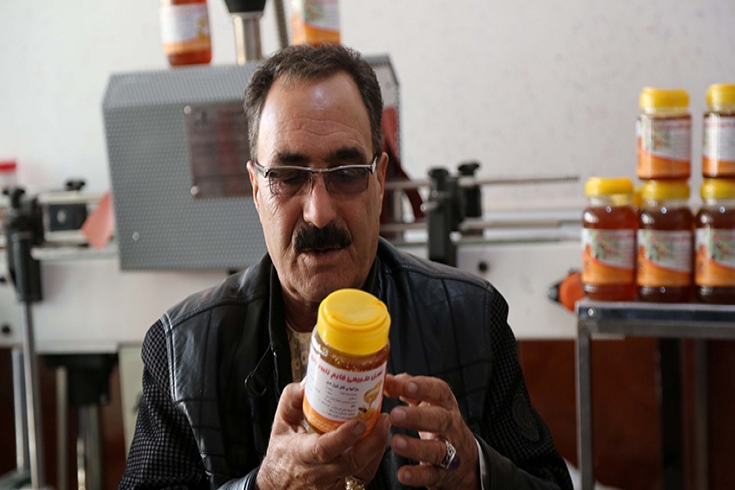
            "Our honey production has exceeded 3,000 kg and we now have 400 beehives," says Bemillah Rahimi, a beekeeping farm owner in Herat.

            High-quality honey from Herat Province is finding demand not only in domestic markets but also abroad in countries such Iran, a major importer of honey.
            Beekeepers in Herat Province are able to meet demand thanks to assistance from the Afghanistan Rural Enterprise Development Program, implemented by the Ministry of Rural Rehabilitation and Development.
            Supported by the World Bank and Afghanistan Reconstruction Trust Fund, the program seeks to provide technical support to small rural enterprises that have been selected for their potential as key drivers of rural employment and income generation.


            Each of those boxes contain a hive that is home to around 10,000 honey bees. “Due to cold weather, we are lowering the number of boxes by merging three bee boxes to two or one box so the bees are closer to each other. This will make the climate inside the boxes warmer,” explains Dr. Bemillah Rahimi, the owner of the apiary and a renowned beekeeper in Herat Province.

            Built in accordance with new construction codes, the apiary and its building, on the outskirts of Herat City, are surrounded by densely yielding grapevines, among which are honey bees sucking on fully ripe Herati grapes that are extremely popular in Afghanistan.


            "The quality of our domestic honey is undisputed. If we maintain the current quality, there will soon be a high demand for our honey outside the country."

            Behzad
            Consumer, Herat City
            Dr. Rahimi started his beekeeping business in 2009 with only 10 hives. He has invested nearly $80,000 in the business, and today he owns two apiaries and also raises bees at home.

            But according to Dr Rahimi, he would not have succeeded without the help of the Afghanistan Rural Enterprise Development Program (AREDP). “Whatever we have is because of AREDP. Our production has crossed the 3,000 kilogram (kg) line and our bee hives total 400,” says Dr. Rahimi, who believes the exposure visits organized by AREDP have benefited their business “more than billions of Afghanis”.

            “As part of its mandate to support rural entrepreneurs, AREDP facilitated exposure visits for us to places like Jalalabad (the capital city of Nangarhar Province), where we met with beekeepers who shared with us their knowhow on bee reproduction, honey harvesting and much more. It was only after returning from this visit that I increased the number of my bee boxes to 100,” says Dr. Rahimi.

            AREDP, implemented by the Ministry of Rural Rehabilitation and Development and supported by the World Bank and Afghanistan Reconstruction Trust Fund, seeks to enhance economic mobilization and activities by organizing the rural poor into Savings Groups, Village Savings & Loan Associations and Enterprise Groups. The project provides technical support to these groups so as to build a financial discipline through savings and internal lending practices, and technical support to enterprises.

            Started in 2010, AREDP works towards strengthening market linkages and value chains for rural enterprises by providing technical support to over 1,345 Enterprise Groups (63 percent female) and 256 Small Medium Enterprises (13 percent female) that have been selected for their potential as key drivers of rural employment and income generation.

            Demand in domestic and export markets

            Honey production in Herat Province occurs twice a year: first in mid-summer and then during early autumn. Beekeepers say they harvest 20 kg of honey, at a minimum, from each beehive. The price of pure honey is just under $20 in local markets in Herat Province.

            According to Dr Rahimi, the quality of the honey produced in Herat Province is such that he receives purchase orders not only domestically but even from other countries including Iran. Given that Iran is a major producer and exporter of honey worldwide, the demand for Afghan honey in Iran is a great achievement in itself, says Dr Rahimi.

            “In Afghanistan we supply honey to different stores in many cities while we also have our own chain stores where we sell honey. Occasionally, we receive orders from Dubai and Turkey as well, not to mention our regular exports to Iran which range between 40 to 50 kg per week,” he remarks.

            It is not only producers but also, more importantly, consumers who are happy with the quality of Afghan honey. Behzad, a young man living in Herat city, says he regularly buys honey for his family of five because he is well informed about its benefits.

            “The quality of our domestic honey is undisputed. It makes you physically fit and is a cure for many illnesses. That is why I try to buy honey from wholesalers or the chain stores owned by the beekeeping farms,” he says. “If we maintain the current quality, there will soon be a high demand for our honey outside the country.”

            Another beneficiary is Nesar Ahmad Mohammadi, 20, who is in charge of honey collection and packaging in an apiary in Herat Province. He is paid around $170 per month for his work. Nesar Ahmad along with his colleagues fill up dozens of honey jars weighing half a kilogram and 1 kg on a daily basis for supply to the market.

            “It takes two to three months from the time honey is harvested from hives until it is marketed. We need to organize our activities carefully so that we always have honey for sale and for daily packaging based on market requirements,” he says.

            * * * * * * * * * * * * * * * * * * * * * * *

            Comment


            • #66
              Hell yeah we gonna be rich mofos soon son!
              "Revenge is a dish best served cold".

              -Old Pashtun proverb


              "My Pashtun Pride i will not hide!"

              Comment


              • #67
                Well-equipped Schools Boost Students’ Learning in Afghanistan

                February 5, 2015


                15 year-old Elaha and her classmates diligently study at the sparkling new library in the Herat Experimental Girls' School.


                Students in Herat Province are enjoying the use of resources such as libraries and computer labs that make lessons more stimulating and help them learn more quickly.
                These resources have been made possible through Quality Enhancement Grants under the Education Quality Improvement Program, which aims to increase equitable access to quality basic education, especially for girls.
                The program is implemented by the Ministry of Education and supported by the World Bank and Afghanistan Reconstruction Trust Fund.


                HERAT CITY, Herat Province – Around 20 little girls are sitting on a carpet making different handmade objects as a young woman continuously guides them through their work. They are in a room, surrounded by shelves holding dozens of paper drawings and a variety of paper and plastic handmade objects. A corner of the room also houses a small library containing mainly children’s storybooks.

                Six-year-old Parisa is busy making a paper cake in the class. She says she enjoys coming to this class. “I like this place. I also like math. We get to practice math here as well using these objects.”

                This is a classroom in Herat Experimental Girls’ School located in Heart city. It is one of the most popular schools in Herat, which has won several awards. The classroom is one of the best-equipped parts of the school, utilized by students from grades 1 to 6.

                Teacher Aalia Osmani, 24, uses different approaches to teach her students, and finds the tools in the classroom helpful. “Suppose their lesson is about a ladder. It is sufficient that I show them what a ladder looks like here and they will get it because they are still so young and rely heavily on their vision compared to other senses,” she explains. “They also learn addition and subtraction here by adding or subtracting the toys. Similarly, they can also practice other subjects here.”


                Students learn about science first hand through practical lessons at their lab class at the Inqelab-e-Islami High School.


                Herat Experimental Girls’ School has been able to offer these resources to their students with the assistance of Quality Enhancement Grants (QEGs) from the Education Quality Improvement Program (EQUIP). It is one of 540 schools in Herat Province that have benefited from QEGs since 2007. The school has received some US$50,000 in grants since then.

                EQUIP is implemented by the Ministry of Education and supported by the World Bank and Afghanistan Reconstruction Trust Fund. EQUIP’s objective is to increase equitable access to quality basic education, especially for girls, through school grants, teacher training, and strengthened institutional capacity with support from communities and private providers.

                To date, based on school improvements plans, QEGs have been distributed to schools that use them for purchase of school supplies, laboratory equipment, and other materials that help strengthen the learning environment. So far, a total of 16,587 schools across Afghanistan have received QEGs (of which 5,045 received a total amount of US$14.3 million as a first generation grant and 11,542 schools received a total amount of US$22.9 million).

                Parents sustain projects

                The biggest achievement of the program, however, is the sustainability of the projects supported by the grants. “The grant mobilized the people and prepared them to help us keep the program running; when this project is over, the parents will assume the role of the funders of this project, thereby ensuring sustainability,” says Abdul Qadeer Salehi, the manager of the program in Herat City.

                Herat Experimental Girls’ School is a good example of this achievement. “In 2012, we received a US$40,000 grant from QEGs to build a two-storey building for the school,” says Basira Basiratkhwah, the school’s principal. “The funds we received were only sufficient for constructing the first floor of the building while students’ parents pledged to contribute to the construction of the second and third floors.”

                The grants have allowed for a tremendous increase in the level of knowledge and awareness amongst students according to Basira, adding that alongside other resources, they have access to computers and Internet too. There are 20 computers with Internet connections at the computer laboratory and 1,000 books in the library. These resources are used by 3,600 students in three shifts.

                “The library and computer lab are so handy for quicker access to information and greater progress in our lessons. In the past we had to go to government libraries or Internet cafes in search of information, which would waste our time immensely,” says Elaha, 15, a student at this school.

                Another school that has greatly benefited from QEGs is Inqelab-e-Islami High School, another popular school in Herat Province. A significant part of the grant went to the building of the 32-room school at the cost of US$225,000. An additional US$8,000 has also been spent on development of a laboratory and a library, and provision of advanced teaching materials for the school.

                “The Inqelab-e-Islami school desperately needed all of this. Whatever we have today is thanks to QEGs,” says Naseer Ahmad Ferotan, the school’s principal.

                * * * * * * * * * * * * * * * * * * * * * * *

                Comment


                • #68
                  Afghanistan, Sweden to sign a long-term strategic accord


                  Hikmat Khalil Karzai, the Deputy Minister of Foreign Affairs during his meeting with Hans Peter Semneby, the Swedish Ambassador in Afghanistan

                  BY MUJIB HAKAMZADA PUBLISHED 2015-02-11


                  Afghanistan and Sweden are planning to sign a long-term strategic partnership agreement that will define Sweden’s future role in Afghanistan, the Ministry of Foreign Affairs said in a statement on Wednesday.

                  The talks on the proposed bilateral accord, according to the statement, took place between Hikmat Khalil Karzai, the Deputy Minister of Foreign Affairs and Hans Peter Semneby, the Swedish Ambassador in Afghanistan.

                  As per the agreement, Sweden will continue to support development projects in the areas of capacity building, education, energy, economic empowerment and employment generation in Afghanistan.

                  During the meeting, Mr. Semneby reaffirmed his country’s commitment to provide 100 million USD on a yearly basis until 2024 as pledged at the Tokyo Economic Conference on Afghanistan in 2012.

                  The envoy said Sweden is committed to work together with the Afghan government in the framework of NATO and international community.

                  “The Swedish government is in favor of the prosperous and stable Afghanistan that is able to stand on its feet,” said Mr. Semneby.

                  Mr. Semneby reaffirmed his country’s commitment to provide 100 million USD on a yearly basis until 2024 as pledged at the Tokyo Economic Conference on Afghanistan in 2012

                  Mr. Karzai, who was recently appointed as the Deputy Minister of Foreign Affairs, thanked Swedish government for their continued support to Afghanistan, particularly in safeguarding human rights, empowering judicial institutions and training Afghan security forces.

                  He said Sweden could play an instrumental role in extraction of mines and investments in mining sector.

                  Both leaders agreed that terrorism is a big challenge and it is important to join hands to facilitate peace in Afghanistan and the region.

                  Since the fall Taliban in 2001, Sweden has been actively engaged in Afghanistan as a member of NATO and international community. It has invested more than 635 million USD in Afghanistan.

                  - See more at: http://www.afghanzariza.com/2015/02/....cLVi2Ehy.dpuf
                  * * * * * * * * * * * * * * * * * * * * * * *

                  Comment


                  • #69
                    Percentage of women police officers in Nangarhar jumps significantly


                    A woman police officer speaking at a workshop in eastern Nangarhar province organized by the Ministry of Interior Affairs with technical support of UNAMA

                    BY ZARIZA CORRESPONDENT PUBLISHED 2015-02-16


                    The percentage of women in Afghan National Police (ANP) in the eastern Nangarhar province has significantly improved following the joint initiative of the Ministry of Interior Affairs and the United Nations.

                    A statement issued by United Nationals Assistance Mission in Afghanistan (UNAMA) on Sunday said a number of police women came together last week to discuss critical issues they face in Nangarhar province.

                    The workshop, organized by the Ministry of Interior Affairs with technical support of UNAMA, was held as part of the program to support Women Police Councils (WPCs), the statement said.

                    The WPCs are designed to build solidarity among women police officers and to encourage more women to choose police work as a vocation.

                    In Nangarhar and other parts of the country, the statement said UNAMA has worked closely with government institutions and women police officers to help them address the challenges they face.

                    The U.S government has pledged 25 million USD to the Ministry of Interior Affairs (MoIA) to train and build capacity of Afghan women police

                    “Currently, out of several thousand police personnel working in Nangarhar, 49 are women,” read the statement, adding that the percentage of women police officers has increased considerably compared to previous years.

                    In December last year, the Ministry of Interior Affairs sent 200 women police officers to Turkey for advanced training. Sediq Sediqi, spokesperson in the Ministry of Interior Affairs, said upon their return from Turkey, they will offer their services in police headquarters across the country.

                    The U.S government has pledged 25 million USD to the Ministry of Interior Affairs (MoIA) to train and build capacity of Afghan women police.

                    The aid money would be spent under the supervision of International Security Assistance Force (ISAF).

                    General Hikmat Shahi, Director of Human Rights and Gender in Ministry of Interior Affairs, says they have devised a plan on how to spend the aid money. He said the Ministry is planning to increase the strength of women police to 10,000 over the next 10 years.

                    Currently there are 2,600 women police in Afghanistan. Lack of adequate facilities and unfavorable work environment prevent women in Afghanistan from joining police force. Abuse of women is also one of the key reasons that dissuade women from joining police ranks.

                    - See more at: http://afghanzariza.com/2015/02/16/p....RwZUOX3m.dpuf


                    [MENTION=17835]Diaphanous[/MENTION]
                    * * * * * * * * * * * * * * * * * * * * * * *

                    Comment


                    • #70
                      Germany building new engineering college in Balkh


                      By KHAAMA PRESS - Mon Feb 16 2015, 4:28 pm

                      Germanermany is building a new engineering college with the cost of 220 million Afghanis (3.4 million Euros) in northern Balkh Province which will have room for 720 students of the faculties of railway construction, plumbing, electricity (electricians), road construction and masonry.
                      The foundation stone of this college was laid to gather by Thomas Silberhorn, the Parliamentary State Secretary in Germany’s Ministry Economic Cooperation and Development and Mohammad Zahir Wahdat, the Deputy Governor of Balkh Province during a ceremony on Sunday.
                      While laying the foundation stone of the college, Thomas Silberhorn talked about the importance of this project

                      He said, “A solid education and vocational training, which is directed towards the needs of the labour market and the needs of the people are the best basis for future generations to contribute to a sustainable development of the country and to generate income for their families.”

                      Mohammad Zahir Wahdat while thanking Germany for the continued assistance said “An investment in education is an investment in Afghanistan’s future. This will help us achieve the greatest goal we can reach: our self-sufficiency.”
                      Government of Germany is funding this project through its Kreditanstalt für Wiederaufbau (KFW) Development Bank.

                      * * * * * * * * * * * * * * * * * * * * * * *

                      Comment


                      • #71
                        China assumes leading role in Afghan reconciliation

                        Abubakar Siddique Published about 3 hours ago


                        China is set to make history by helping prevent neighbouring Afghanistan from sliding into complete chaos after Western forces ended their combat mission in the mountainous nation.

                        A year after economic and security interests prompted China to assume a lead role in Afghanistan's peace process, Beijing appears to be on the cusp of bringing the Kabul government and its Taliban enemies to the negotiating table.

                        Recently, a Chinese foreign minister publically offered to mediate in the stalled Afghan peace negotiations.

                        "We will support the Afghan government in realising reconciliation with various political factions, including the Taliban," Wang Yi told journalists. "China is ready to play a constructive role and will provide the necessary facilitation at any time if required by various parties in Afghanistan."

                        Take a look: China ready to support Kabul-Taliban reconciliation

                        In a significant symbolic step, Wang made these comments during a visit to Pakistan last week.

                        Over the past 13 years, Kabul has consistently blamed Islamabad for supporting the Afghan Taliban by sheltering its leaders and foot soldiers.

                        Author and journalist Ahmed Rashid says the Chinese are reaching out to all the major players involved in the Afghan conflict.

                        "China has a lot going for it," he told RFE/RL Gandhara. "They have come with much greater neutrality. They are respected by all the powers, including the Taliban, for their neutrality."

                        Rashid says that since appointing veteran diplomat Sun Yuxi as its special envoy for Afghanistan in July, Beijing has moved rapidly to secure a regional consensus on Afghan reconciliation.

                        Beijing has set up a trilateral diplomatic forum with Islamabad and Kabul to encourage their cooperation and friendship. China has taken similar initiatives with Iran and India to involve the two countries in trilateral dialogues with Afghanistan.

                        "What they are trying to do is to bring all of those neighbours with them and get them to accept a role for Chinese peacemaking," he said. "Russia will certainly go along with whatever the Chinese propose, as will the Central Asian states."

                        During the past year, Beijing has also reached out to Saudi Arabia and other Gulf states to secure their backing because they are seen as a key funding source for some Afghan insurgents.

                        Chinese diplomats have held meetings with the Afghan Taliban emissaries in the Gulf and inside Pakistan.

                        In January, even the Taliban acknowledged its delegation had visited Beijing late last year, but the insurgents stopped short of accepting a Chinese role. A Taliban statement said it "respects the efforts of all concerned parties in this regard, however, it has not yet decided on a new course of action."

                        Rashid says that in an unprecedented move, China is even pressuring traditional archrivals India and Pakistan to discuss the future of Afghanistan. "Beijing obviously wants to see Afghanistan and Pakistan develop. They do not want to see two failed states on their northwestern border," he said.

                        Beijing has strong reasons to have such fears. In recent years, Beijing has publically aired its concerns about the presence of Muslim Uyghur separatists from the East Turkestan Islamic Movement (ETIM) in Afghanistan and Pakistan. China views their alliance with Islamist militant factions in the two countries as a major security threat and is reportedly worried over their unrest turning into a Chechnya-like fiasco.

                        Beijing blames ETIM for scores of attacks in western China in which hundreds have been killed. Beijing is concerned about increasing violence in the western Uyghur homeland, Xinjiang, which borders Pakistan and Afghanistan.

                        "They want to end the Uyghurs’ training and fighting in Afghanistan and Pakistan and stop the supply of fighters returning to Xinjiang," Rashid said.

                        Marvin Weinbaum, a South Asia specialist at the Middle East Institute, a think tank in Washington, D.C., says that despite Beijing’s strong security interest, it is still not clear how far China will go with its policies.

                        "The test will not be China's willingness to support reconciliation with the Taliban but whether it will work to foster cooperation between Afghanistan and Pakistan while also expanding its role in the Afghan economy," he told Gandhara.

                        Indeed, Beijing has already expressed interest in financing a series of major energy and infrastructure projects to improve cooperation between the two neighbours.

                        In Kabul last week, during the first round of the China-Afghanistan-Pakistan Trilateral Strategic Dialogue, the three countries agreed that Beijing will finance the building of a proposed dam in the eastern Afghan province of Kunar. The 1,500-megawatt hydroelectric project is expected to supply electricity to energy-starved Pakistan and will be jointly managed by the two neighbours.

                        In addition, China is also expected to bankroll the construction of a motorway connecting the northwestern Pakistani city of Peshawar to Kabul. A rail link it agreed to finance will connect Quetta, the capital of southwestern Balochistan Province, to Kandahar in southern Afghanistan.

                        These projects are a recent addition to the billions of dollars China has already invested in infrastructure, mineral extraction and energy resources in Pakistan and Afghanistan.

                        The two neighbours are an important link in Chinese President Xi Jinping's Silk Road Economic Belt initiative. The plan envisions Beijing investing hundreds of billions of dollars in energy and infrastructure projects in neighbouring South and Central Asian countries to connect East Asia with Europe, the Middle East and Africa.

                        Barnett Rubin, a former State Department adviser, says Washington is "fully on board" with the Chinese efforts.

                        Rubin, who advised US diplomats on Afghan reconciliation policies in recent years, says Beijing's role is fundamentally different because, unlike Washington, it is not a party in the Afghan conflict.

                        "China is close to Pakistan and is trusted on this question [of reconciliation] by the Afghan government and the US," he told Gandhara. "China's most important role is creating confidence in Pakistan to facilitate talks with the Afghan Taliban hiding there."

                        Rashid looks to the start of direct negotiations between Kabul and the Taliban in the near future as a sign that China’s efforts are succeeding.

                        "It is really up to the Chinese pressure on Pakistan to allow such a thing to happen," he said. "What the Afghans want most of all from the Pakistanis is access to the Taliban leadership living in Pakistan."

                        Andrew Small, the author of a book on China's close relations with Pakistan, agrees. He says Beijing is making it clear to Islamabad that it should take China's interests in Afghanistan into account.

                        "China's interests there are all about a stable political settlement and ensuring there is no repeat of the [civil war] in the 1990s," he said.


                        - China is leading the way in stabilizing Afghanistan and has been talking to Pakistan, India, Arabs and others to help establish peace in the country.

                        - China - unlike the US - believes in stabilizing countries rather than destabilizing them and creating bloodshed and misery in the way the US does.
                        * * * * * * * * * * * * * * * * * * * * * * *

                        Comment


                        • #72
                          Afghan airlines meet the criteria to fly into EU airspace


                          19 Feb, 2015

                          by Wadsam


                          All state-owned and private airlines of Afghanistan were banned from entering the European Union airspace in 2010 for failing to meet the international safety criteria.

                          In an exclusive interview with Pajhwok Afghan News (PAN), Deputy Head of the Afghanistan Civil Aviation Authority (ACAA) Mahmood Shah Habibi said the conditions for the Afghan airlines to be removed from the blacklist were:

                          Independent civil aviation administration
                          Approval of law on Afghanistan aviation
                          Standardizing Afghan airlines to meet international standards
                          Hiring international operators to run their fleets
                          According to Habibi, the airlines have met these criteria that were previously absent and the developments have been reported to the EU about 10 days ago.

                          The EU authorities have confirmed receipt of the report and are yet to announce their decision about removal of Afghan airlines from their blacklist.

                          Afghanistan currently uses foreign airlines to reach European countries.

                          The ban on Afghan airlines came in 2010 after Afghanistan failed to comply in time with a EU order to update aviation regulations dating back to 1972 and set up a Civil Aviation Authority.

                          Safi, one of the major private airlines in Afghanistan, faced a major blow as a result of the ban, as it offered flies to Frankfurt five times a week.


                          * * * * * * * * * * * * * * * * * * * * * * *

                          Comment


                          • #73
                            63 uplift projects completed in Wardak

                            ByIdrees Noori On Feb 22, 2015 - 18:43


                            MIDAN SHAHR (Pajhwok): As many as 63 development projects have been executed in central Maidan Wardak province, which would help benefit thousands of people, an official said on Sunday.

                            The projects had been implemented at a cost of 176 million afghanis within two years under the stability programme, in charge of the programme, Hazrat Gul Barakzai, told Pajhwok Afghan News.

                            The development schemes included construction of retaining walls, culverts, dames, playgrounds and digging of wells, he said, adding that 38 more projects were underway which will be completed soon.

                            Acting Governor Abdul Hameed Khogyani expressed satisfaction over the development schemes carried out under the “stability” programme. He praised the officials for winning the hearts and minds of locals.

                            MIDAN SHAHR (Pajhwok): As many as 63 development projects have been executed in central Maidan Wardak province, which would help benefit thousands of people,…
                            * * * * * * * * * * * * * * * * * * * * * * *

                            Comment


                            • #74
                              Herat govt presents three-year plan consisting more than 1,000 development projects


                              Khalil Osman, the head of UNAMA’s regional office in Herat, during the the meeting with acting provincial governor of Herat, Aseeluddin Jami

                              BY ZARIZA CORRESPONDENT PUBLISHED 2015-02-22 | 01:00:00 98 Print |

                              The government in western Herat province has presented a three-year plan, consisting of more than 1,000 development projects, to international donors, according to a statement issued by United Nations Assistance Mission in Afghanistan (UNAMA).

                              The 504 million USD plan, developed with the technical assistance of the UNAMA, was presented at a meeting between the officials of UNAMA and the provincial government in Herat on February 11, the statement adds.

                              The ambitious plan details development activities related to security, governance and economy in Herat province.

                              Khalil Osman, the head of UNAMA’s regional office in Herat, who co-chaired the meeting with acting provincial governor Aseeluddin Jami, reiterated the world body’s commitment to support the government and civil society groups in the western province.

                              The ambitious plan details development activities related to security, governance and economy in Herat province

                              At the meeting, representatives from Italy, Iran, Turkmenistan, Pakistan and the United States Agency for International Development (USAID) pledged their support to the plan for 2015 and beyond, said the statement.

                              In addition to providing a forum to discuss donor commitments, the event was designed to strengthen partnerships between the local government and the international community, and to highlight the need for continued assistance to maintain services across the province, the statement added.

                              According to Mr. Osman, the UN agencies implemented 246 development projects in the western part of Afghanistan in 2014.


                              - See more at: http://afghanzariza.com/2015/02/22/h....yOtGVjDU.dpuf


                              *Ghani has recently removed some allegedly corrupt officials in Herat and wants better governance.
                              * * * * * * * * * * * * * * * * * * * * * * *

                              Comment


                              • #75
                                Germany hands over 29 new buildings to provincial government in Baghlan


                                Post

                                BY ZARIZA CORRESPONDENT PUBLISHED 2015-02-24 | 19:29:00 161 Print

                                As part of its stabilization programme for northern Afghanistan (SPNA), Germany handed over 29 newly constructed buildings to local government in Baghlan province on Tuesday, according to a statement issued by German Cooperation with Afghanistan.

                                The project was funded by the German Federal Foreign Office through the KfW Development Bank and implemented by the Aga Khan Development Network, in partnership with ACTED and Mercy Corps.

                                At the official inauguration ceremony, Germany’s Consul General to northern Afghanistan, Dr. Zimmermann handed over new buildings for 21 schools, seven irrigation canals and one road.

                                The projects are located in Pul-e-Khumri city and in the districts of Doshi, Khinjan, Deh Salah, Puli-e- Hesar, Banu and Dan-e-Ghoori. The total cost for all 29 projects amounted to almost AFN 410.5 million, the statement said.

                                Speaking at the opening ceremony, Dr. Zimmermann said Germany intends to make a meaningful and sustainable contribution to development efforts in Afghanistan.

                                “The Afghan government can contribute substantially to the sustainability of these projects by adopting them and taking good care of their future maintenance,” said Dr. Zimmermann.

                                In total, 9,747 boys and 4,402 girls will benefit from the new school buildings, which were constructed according to high standards followed by the Ministry of Education

                                In total, 9,747 boys and 4,402 girls will benefit from the new school buildings, which were constructed according to high standards followed by the Ministry of Education, said the statement.

                                The new road is located in Pul-e-Khumri and offers a much-needed secondary thoroughfare connecting around 10,000 people with the central market. 4,077 households will benefit from the new irrigation canals.

                                All 29 projects, the statement added, were accepted and welcomed on the provincial and district level government, who were active stakeholders in project oversight.

                                Among those who were present on the inauguration ceremony include the Baghlan provincial governor, Heads of various government departments, representatives of Provincial Councils.

                                The construction work on the buildings was carried out by Afghan construction companies between November 2013 and January 2015.

                                “Since 2010, the German government has funded more than 245 small- and medium-size infrastructure projects in 45 districts with over AFN 6.3 billion (€87 million) through the programme, with 50 new infrastructure projects in Baghlan alone,” the statement said.

                                - See more at: http://www.afghanzariza.com/2015/02/....0zB9SoHM.dpuf
                                * * * * * * * * * * * * * * * * * * * * * * *

                                Comment

                                Working...
                                X