Announcement

Collapse
No announcement yet.

Afghanistan Focus

Collapse
X
 
  • Filter
  • Time
  • Show
Clear All
new posts

  • #16
    Afghanistan Needs an Economic Czar

    BY TAMIM ASEY OCTOBER 16, 2014


    China had its Deng Xiaopeng; India, Manmohan Singh; the United Arab Emirates, Sheikh Rashid; Singapore, Lee Kuan Yew; and dozens of others statesmen have unlocked the economic potential of their countries and paved the way for phenomenal economic growth and development in their countries. It is time to reset the economic development agenda for Afghanistan. Afghans can find a sustainable source of economic growth based on natural resources and geographic location in Asia under an economic czar with a vision for the Afghan economy and a program for economic reform in a short time span.

    In the past 13 years, the Afghan economy has had double digit economic growth with an average growth rate of 9.5 percent per year along with a single digit inflation rate. However, since 2013, the GDP growth rate has plummeted from 13.5 percent to 3.2 percent, based on World Bank and IMF estimates. This drastic fall in GDP growth is due to the withdrawal of foreign forces, a prolonged election, fading business confidence, and pervasive corruption within the Afghan government.

    The recipes for building a sustainable Afghan economy ranged from reviving the Silk Road to building a resource-based economy given Afghanistan's vast underground mineral resources. Under President Hamid Karzai, either these models did not work or security priorities overtook the economic development agenda. Furthermore, as Karzai was never interested in an economic development agenda and vision for Afghanistan, economic issues never made it high in his agenda. His assumption was that the international community would continue pouring in millions of dollars in foreign aid, keeping his country afloat and bringing much needed foreign exchange to the economy -- not realizing that, like any form of foreign aid, it won't last long.

    Too many recipes: an inflation of strategies and policies

    With the establishment of the interim administration, led by Hamid Karzai in 2002 -- the then-coordinator of aid for Afghanistan and current president, Ashraf Ghani, formulated the first ever post-Taliban economic development strategy, called the National Development Framework (NDF). The NDF categorized the economic development and poverty reduction priorities of Afghanistan into four pillars and was later presented to donor countries at a Berlin conference as a seven-year plan, called Securing Afghanistan's Future.
    After Ghani's departure as finance minister and with the arrival of a pool of ministers that followed, a plethora of new development strategies were devised for Afghanistan from Afghanistan National Development Strategy (ANDS) to Kabul Conference National Priority Programs (NPPs) to the document presented at the Tokyo Conference II referred to as "Towards a Self-Reliant Afghanistan." Unfortunately, none of these plans were completely implemented. Policy priorities depended on the personal taste and choice of each finance minister officeholder who drew up their own economic development plan for Afghanistan and presented it as Afghanistan's set of economic development priorities at new international donors' conferences.

    The tyranny of experts: too many cooks in the kitchen

    Since 2001, each year, millions of dollars in foreign aid is poured into Afghanistan for technical advisors, consultancy projects, and capacity development programs -- all without much achievement. This has created a revolving door of domestic and foreign consultancy industry where consultants, often highly incompetent, come for short-term consultancies, most of which is highly ineffective. These consultants have produced dozens of documents that do nothing more than lay on shelves in Afghan ministries, gathering dust, with little feasibility to implement and relevance to realities on the ground.

    A framework for the inflow and outflow of consultants should be put in place with clear productivity and competency benchmarks for this shadowy industry in Afghanistan.

    Fiscal policy failure: budget deficit and the Dutch disease

    Afghanistan still lacks a basic fiscal policy framework outlining its short, medium, and long-term expenditure and revenue targets to help adjust the aggregate demand and GDP fluctuations in the economy.
    Fiscal policy is constricted by the Afghan National Budget, estimated to be around $7 billion annually. Afghanistan's operating budget is 40 percent funded by the international community and includes the Development Budget, which is completely dependent on foreign aid.
    But the heavy reliance of the Afghan economy on foreign aid has created some major problems. Dutch disease, where the increase in the development of natural resources brings a decline in the manufacturing sector, and aid addiction, has resulted in few Afghan policymakers bothering to invest time and energy in finding domestic, sustainable sources of revenue and economic of growth.

    Monetary policy, central banking and financial markets: strengthening banking and financial sectors

    The Afghan Central Bank, also known as Da Afghanistan Bank (DAB), is the main regulatory body responsible for the banking and financial sectors of the Afghan economy. It is an efficient institution but lacks the sophistication, capacity, skills, and independence of a modern central bank. Like many central banks, DAB was part of the Ministry of Finance until recently when the new constitution changed its status, transforming it into an independent institution.

    DAB's independence is a new phenomenon and the institution lacked the basic skills and capacity to develop and implement an independent monetary policy, even to this day.

    Furthermore, the collapse of Kabul Bank in 2010 and the spread of contagious and risky assets across the financial and banking system of Afghanistan have destroyed the international credibility and reputation of the Afghan financial and banking institutions.

    The Afghan banking and financial sector was on the verge of being blacklisted because Afghan government failed to pass the international banking association's money laundering and anti-terrorism financing regulations. Fortunately, it was approved at the last minute by the Afghan parliament under intense national and international pressure.
    Building a vibrant financial and banking sector requires a capable, competent, and independent central bank that follows a credible and predictable monetary policy. The governor of DAB has a responsibility to draft, approve, and implement a fresh monetary policy for Afghanistan consistent with the economic realities of the country.

    The blessing of geography: Afghanistan, the land bridge of Asia

    For a long time, Afghanistan's geographic location was a liability, making Afghanistan prey to empires from the east and west or a buffer zone between the former USSR and the United States. Today, this calculus can change with smart and visionary leadership. The three major rising economies of the world are Afghanistan's neighbors: China, India, and Russia. None of these countries will want an insecure and unstable Afghanistan which could potentially hamper their own rate of economic growth.

    Despite the decline of the Silk Road trading routes, even today Afghanistan's ability to act as a cross-regional conduit has never entirely faded from collective perception.

    Upstream water and lithium: Afghanistan's oil

    Afghanistan is a high riparian state in the Central and South Asia region. Except for a water-sharing agreement signed between Afghanistan and Iran in the late 1950s, no treaties exist between Afghanistan and its neighbors on water-sharing rights. Because of the lack of water-sharing agreements, many World Bank and Asia Development Bank small and medium hydropower and irrigation projects are on hold. Afghanistan can seize this opportunity and negotiate water-sharing treaties with its neighbors and either sell its water or ask for other incentives in return.

    There are also four geological belts of high quality Lithium deposits, 60 to 70 percent pure, spread across the country. Geologists and the U.S. Geological Survey (USGS) have termed Afghanistan the Saudi Arabia of Lithium.
    Currently, China has a monopoly in global lithium market, holding over 90 percent of the market share. Afghanistan can partner with the west and exploit this opportunity both to develop a sustainable source of economic growth for Afghanistan but also delivery much needed lithium to international electronics markets.

    Agriculture and irrigation: food security and agriculture development

    Afghanistan has the land, water, and weather to turn into the bread basket for the region. With a good investment climate, Afghanistan would have all the right potential to attract millions of dollars of foreign and domestic investment in its agriculture and food processing industries. Vast swaths of arable land and huge water resources in the north and south of Afghanistan are a beacon of hope for the country.

    The new Afghan president should focus on three priorities: food security, agribusiness development, and standardization of agricultural products for export to regional and international markets. Providing farmers with an agriculture credit through an Agricultural Development Bank and the mechanization of the agriculture sector should be at the top of the agenda for the new Afghan administration.

    Aid versus trade: Afghanistan's comparative advantage

    Today, Afghan business has a diaspora spread all over South and Central Asia, the Middle East, Europe and North America, but the future of the Afghan trade and business sector lies in the South Asia region. Asia, spurred on by Afghanistan's neighbors China and India, is going to be the engine of growth of the world economy. A regionally integrated Afghan economy could get millions of dollars in revenue from transit fees, taxes, oil and gas pipeline revenues, and above all, technology and knowledge transfer.

    Mineral resources: a doubled-edged sword

    The Afghan mineral wealth is estimated to be worth $1 trillion. This estimate only accounts for the 30 percent of the surveyed landscape of Afghanistan -- the remaining 70 percent of the Afghan geography is yet to be explored. The identified fraction of land consists of metals, hydrocarbons, and REEs which could serve as the future backbone of a sustainable Afghan economy.
    Meanwhile the wealth of resources is like a double edged sword. If not carefully managed, Afghanistan could be pushed into a vicious cycle of violence and resource curse like many African countries. How Afghanistan will fair depends on the management and policies of the new Afghan administration.

    The economics of corruption: an economy within economy

    Afghanistan is ranked third from the bottom in the corruption perception index (CPI) by Transparency International, making it one of the most corrupt countries in the world. Corruption is rampant in the usual suspect areas: government contracts, procurement, construction, and the service delivery sectors.

    According to a recent U.N. survey, Afghans have paid almost $4 billion in bribes;the average bribe paid in Afghanistan is estimated to be $160. This is in a country where the per capita income is around $670, meaning almost 20 percent goes to paying bribes to get access to public services.
    Corruption is so rampant and pervasive that it is considered to be its own economy within the Afghan economy. The full extent of the large scale corruption in contracts, procurements, and revenue collection is unaccounted for and could pose a big threat to the long-term peace and stability of Afghanistan. President Ghani, as a former finance minister and World Bank executive, is well aware of these challenges and has demonstrated his will to fight corruption at the highest level possible.

    The institutional challenge: reconciling overlapping mandates

    Afghanistan has numerous financial and economic management institutions, dozens of investment promotion agencies, and numerous economic policymaking institutions, all with overlapping mandates and unclear job descriptions. This has created confusion and dissatisfaction amongst the investors and donors in the country.
    Today, the Ministry of Finance is in quarrels over its policy role and mandate with the Ministry of Economy, the notoriously corrupt Afghanistan Investment Support Agency (AISA), and the Export Promotion Agency of Afghanistan (EPAA). The office of Senior Economic Advisor of Afghanistan has a largely ceremonial role. The Afghanistan Central Bank is ineffective and lacks the critical capacity and skill set to oversee the nascent Afghan banking and financial sectors. Even the newly created High Council of Economic Affairs is inefficient having no proper organizational structure.

    History rarely presents national leaders with the opportunity to rise above their enormous national challenges in order to fundamentally alter the fate of their nations. For Afghanistan, this is the moment for the new leader to reset the economic development agenda for the country.

    In spite of millions of dollars in foreign development aid, the Afghan economy would effectively collapse without international intervention and donor support. Afghanistan needs an economic czar held by a visionary economic giant just like Deng Xiaopeng of China, Manmohan Singh of India, or Lee Kuan Yew of Singapore, who made brave decisions and came up with a vision to build an indigenous and self-reliant economy for their nations. The new Afghan president can do the same by investing in the economic potentials of Afghanistan and tapping into the enormous natural wealth and strategic location of Afghanistan, turning it into capital and wealth for all Afghans and the generations after. This is a historic opportunity for President Ghani and his economic team to fundamentally alter the fate of Afghanistan.


    Tamim Asey is a fellow at Asia Society and a Fulbright scholar at Columbia University pursuing a degree in Economic Policy management. He was also a former Government of Afghanistan official and taught at the American University of Afghanistan (AUAF).

    * * * * * * * * * * * * * * * * * * * * * * *

    Comment


    • #17
      Afghan Social Innovator, Dr. Sakena Yacoobi, to speak at MIIS

      Posted on October 17, 2014 by Katharine Daniels — No Comments ↓
      Dr. Sakena Yacoobi, an award-winning social innovator and Founder and CEO of the Afghan Institute for Learning (AIL), will speak at the Monterey Institute of International Studies in Irvine Auditorium on Wednesday, October 29, at 4pm. Dr. Yacoobi’s visit to the Institute is hosted by the Center for Social Impact Learning (CSIL) in partnership with The WIP.


      Dr. Sakeena Yacoobi. Photograph courtesy of the Center for Social Impact Learning at the Monterey Institute of International Studies.

      Globally, women and girls are not afforded the same educational opportunities as men. One dramatic consequence is lower health outcomes. The WIP is looking forward to Dr. Yacoobi’s talk on the successful innovations she has put forth to improve the education and health of Afghan women and children.

      Dr. Yacoobi founded AIL in 1995 as a way to provide training, education and healthcare to Afghans, with a particular focus on women and children. AIL was the first organization to open Learning Centers for Afghan women – a concept that has been replicated by many organizations across Afghanistan. AIL has become internationally recognized for improving the health and education of Afghan women and children. Under Dr. Yacoobi’s leadership, AIL has helped 12 million Afghans through schools, learning centers, and medical clinics.

      In 2005, Dr. Yacoobi was awarded the Democracy Award from the National Endowment for Democracy. Sakena was among the 1,000 women nominated to jointly receive the 2005 Nobel Peace Prize. In 2013, Dr. Yacoobi won the prestigious Opus Prize, an award that “honors unsung heroes of any faith tradition with a $1 million award for efforts to solve today’s most persistent and pressing global issues, including poverty, illiteracy, hunger, disease, and injustice.”


      Dr. Yacoobi reading to girls in Afghanistan. Photograph courtesy of the Center for Social Impact Learning.

      “I am honored to be the first speaker in CSIL’s Impact Pioneers Speakers Series,” says Dr. Yacoobi. “I really believe that students today, like those at the Monterey Institute, are going to be the ones who make the world a better place, and I look forward to speaking with the MIIS students about my work over the last 20 years, and the situation of the people of Afghanistan.”

      Dr.Yacoobi was born in Herat, Afghanistan and educated in California. She holds a master’s degree in public health from Loma Linda University and a B.S. in biological sciences from the University of the Pacific. Dr. Yacoobi holds honorary doctorates from the University of the Pacific, Loma Linda University, Santa Clara University, the University of St. Joseph and Princeton. She is an emeritus member of the board of directors of the grant-making Global Fund for Women and serves on the board of the Monterey Institute’s Center for Social Impact Learning, as well as New Global Citizens, which connects young people with international NGOs to help solve some of the world’s most pressing issues at a grassroots level. Previously, she was a professor at D’Etre University and a health consultant.

      During her guest lecture, Dr. Yacoobi’s speaking topics will cover the challenges she faced in starting AIL and the current status of women and girls in Afghanistan. The event will mark the launch of CSIL’s Impact Pioneers Speaker Series. Throughout the year, CSIL will host a series of practical and compassionate entrepreneurs and change makers as a way to drive inspiration and thought leadership on social innovation at the Monterey Institute of International Studies. Visit: go.miis.edu/csil

      This event is free and open to the public. For further inquiries, visit go.miis.edu/csil or contact Erina McWilliam-Lopez at 831.647.4645.


      [MENTION=2]Admin Khan[/MENTION]
      * * * * * * * * * * * * * * * * * * * * * * *

      Comment


      • #18
        Ghani to Travel to China With Afghan Business Leaders

        Wednesday, 22 October 2014 19:14
        Last Updated on Wednesday, 22 October 2014 20:47
        Written by Zabhiullah Jahanmal


        President Ashraf Ghani will travel to China next week for a three-day trip with a group of top Afghan business leaders. The visit is intended to start a new chapter in Kabul-Beijing relations, one that the new Afghan government hopes will lead to greater economic and political ties.

        The Presidential Palace has expressed optimism about the trip, which will be Ghani's first trip abroad as president, and will take him to Beijing for a sit-down with his Chinese counterpart, Xi Jinping. In addition, an investment summit will be held in order for Afghan and Chinese businessmen to connect and discuss investment opportunities in Afghanistan.

        "President Ghani will talk with the investors and businessmen of China on his official trip and he will encourage them to invest in Afghanistan, a new gateway for improving economic and political relations will be established and efforts will be made to build a better relationship in this regard," deputy presidential spokesman Fayeq Wahidi said.

        At the moment, China is not a major aid provider in Afghanistan. But according to experts, President Ghani will not only focus on securing a larger amount of aid from Beijing, he will also emphasize opportunities for mutually beneficial business ventures, such as in the natural resource sector in Afghanistan.

        "It is a very good opportunity and President Ghani will try to provide opportunities for investment instead of attracting aid, and the profits from natural resources will increase as China is a country that will invest more in Afghanistan to improve them," economical expert Muhammad Qurban Haqjo said

        The fact that Ghani will be accompanied by a contingent of leaders from the Afghan private sector is a further sign that business investment, rather than just aid, will be a major theme of the trip. "The private sector officials will also go with the president, steps are being taken for the joint meeting of investors to emphasize establishing companies and good opportunities for improving trade between the two countries," said Atiqullah Nasrat, the head of the Afghan Chamber of Commerce and Industries (ACCI).

        China is one of the leading foreign investing countries in the world. In Afghanistan, Chinese companies have already brokered million dollar deals in northern Afghanistan for the Ainak Copper Mine project and a number of oil filled projects.

        But experts, like Haqjo, say that security problems have persistently delayed and derailed the projects, causing Chinese companies to put them on hold or abandon them all together. "The Afghan government should try to resolve the issue of security for these big projects implemented by the Chinese companies and the projects will be completed and more opportunities will be provided for investment in the country," Haqjo said.


        * Afghanistan will also seek to use China's influence over Pakistan to reduce Pakistani support for terrorism against Afghanistan.

        This has been mentioned in other news reports.

        The IRA (Islamic Republic of Afghanistan) is seeking to expand trade with China which is now - in PPP terms - the biggest economy in the world.


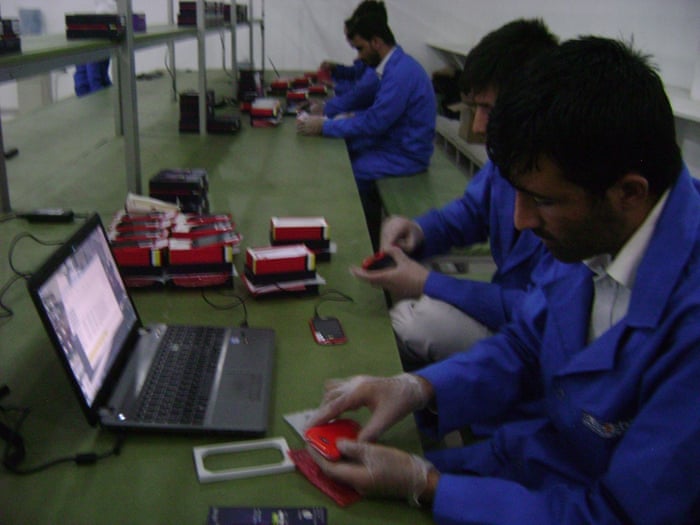
        Employees assemble mobile smart phones at the headquarters of Blue Sonic, a Kabul-based start-up. Afghanistan borders China which is the largest consumer market in the world.


        Blue Sonic, an Afghan IT company.


        Last edited by Bengal_Tiger; 10-22-2014, 03:10 PM.
        * * * * * * * * * * * * * * * * * * * * * * *

        Comment


        • #19
          Solution to Insurgency is Not Military Alone: Daudzai


          Wednesday, 22 October 2014 17:43
          Last Updated on Wednesday, 22 October 2014 17:48
          Written by TOLONnews Online


          Acting Minister of Interior Muhammed Umer Daudzai highlighted Afghanistan's two major transitions this year during his speech at the Munich Security Conference (MSC) Core Group Meeting in New Delhi on October 21.

          "We successfully completed two transitions this year," he said. "The first one was the political transition... For the first time in our history, one elected president transferred authority to another elected president peacefully, and with a lot of dignity...Second, was the transition of security leadership from ISAF to ANSF. We have now assumed almost complete responsibility for security of the country."

          Daudzai emphasized that the contributions and efforts of the international community in Afghanistan have not gone to waste as thousands of people have joined the ANSF ranks to fight against terrorism. He added that the transition has strengthened the morale of the ANSF, as their mantra of "it is our land, and we will defend and secure it" has become even stronger than before.

          "The people of Afghanistan made history this year by their unprecedentedly large turnout in the election," Daudzai added. "They proved that democracy is embraced, and extremism is rejected."

          The interior minister went on to admit that despite the achievements, there are still serious challenges that have yet to be fully addressed, stressing that "Afghanistan is victim of the negative sides of regionalization and globalization."

          "We have not been able to break the Taliban movement and seasonal cycles," he said. "In winter, Taliban cross the Durand Line to their shelters in Pakistan, where they get training and equipment, and come back along with new recruits the following spring. They are accompanied by Pakistani-based extremist militant organizations."

          After explaining the problems, he stressed that "the problem of insurgency does not have a military solution alone," adding that the National Unity Government is an opportunity to work for a "negotiated settlement."

          "We are counting on emerging powers in our neighborhood to come forward and form coalitions for peace in the region...I want to come back to the issue of Afghanistan, and state that our vision is to transform our country from the crossroad of terrorism to the crossroad of gas, electricity and trade of other goods," he said, ending his speech with emphasis on re-definitions of "national interests."

          The MSC Core Group meeting took place in New Delhi on October 21 and 22, in cooperation with the Observer Research Foundation. In addition to Afghan Interior Minister Daudzai, other participants included Indian National Security Advisor Doval, Mexican Foreign Minister Meade, Israel's NSA Cohen and a number of German officials and MPs.


          1. Daudzai and the Afghan government are blaming Pakistan for terrorism in essence.


          2. However in addition to a political solution the GOA (Government of Afghanistan) has also decided to use "emerging powers" in the "neighbourhood" (read China & India) to work towards ending terrorism in the country.

          Afghanistan will urge China to put pressure on Pakistan to reduce/end terrorism in Afghanistan.

          However they will also turn to India for increasing the power of the Afghan military. This will most likely be done through India paying Russia to supply the Afghans with arms as physically India cannot transport arms to Afghanistan as Pakistan would not allow it.
          * * * * * * * * * * * * * * * * * * * * * * *

          Comment


          • #20
            Kabul to send arms request

            SUJAN DUTTA

            New Delhi, Oct. 21: Afghanistan is set to renew a request for arms and military hardware from India as the US draw-down enters its final phase over the next three months.

            But Afghanistan is also using China’s leverage with Pakistan to support itself militarily as nearly 40,000 US and International Security Assistance Force (ISAF) troops exit Afghanistan between now and December.

            Top security officials from India are expected to visit Kabul soon.

            A new government led by President Ashraf Ghani took over in Afghanistan about three weeks ago.

            Afghanistan’s minister of the interior, Mohammed Umer Daudzai, who is set to have informal talks with the Indian establishment during his visit to New Delhi this week, said here on the sidelines of a think-tank conference that investigations into terror attacks on Indian establishments in Afghanistan have found footprints traced to Pakistan.

            “Afghanistan is at the crossroads of terrorists,” he said. “Any investigation into incidents of this sort will lead across the Durand Line,” the minister replied when asked for the inquiries into the attack on the Indian consulate in Herat in May at the time the Modi government took over in Delhi.

            “India is our all-weather friend. Changes in government will not have any, rather it will have a positive impact. We have requested India for assistance in the security sector, in training, and with some equipment that we may need,” he said.

            In April this year, then Afghan President Hamid Karzai had requested the outgoing Manmohan Singh government for 230 types of military equipment, including helicopters and field guns. Daudzai said he expected the request to be heeded “but our list of military demands will be decided by (the Afghan National) army”.

            Daudzai said China was also interested in a stable Afghanistan because of the suspected movements of the East Turkestan Islamic Movement (ETIM).

            Beijing sees the ETIM as a terrorist outfit formed by Uighur militants in western China who are attempting to secede. ETIM militants have been travelling through Afghanistan to other Central Asian countries.

            The Afghan home minister outlined where the interests of China and Afghanistan merge. China “has a leverage with Pakistan” that Kabul wants to use to put pressure on militants crossing the Durand Line — the undemarcated Afghan-Pakistan frontier — and China wants its own eyes and ears for intelligence on militant movements in its western periphery.

            For New Delhi, that is a threat to its interests in Afghanistan that encompass overcoming the distance that Pakistan puts between India and Kabul. At the same time, India is wary of China’s sphere of influence expanding at the cost of its own.

            This jostling reminiscent of the “Great Game” between the British and the Russians in the 19th century is taking place when nearly 40,000 US and ISAF troops have begun leaving Afghanistan. Daudzai said Afghan security forces had begun replacing the international troops.

            The Afghan National Army was expanding from 1,92,000 troops to 2,20,000 troops and needed arms and ammunition to in the fight against the Taliban.


            1. The Afghans want to beef up their army.

            India will help them with this and most likely pay Russia money to give the Afghan National Army (ANA) weaponry.


            2. The Afghans also want to use China to pressurize the Pakistani regime to end support for terrorism.


            This is a dual-approach military & political strategy to combating terrorism.

            In addition to this another point to be aware of is that the very existence, continuation and longevity of the democratically elected national government of Afghanistan is in itself a daily victory against the forces of Pakistani-backed terrorism, and that every day the democratically elected government exists then Afghanistan's HDI levels increase.

            HDI means Human Development Index and countries with high HDI (e.g. high literacy, economic development) are less susceptible to backwards pseudo-Islamic (emphasis on "pseudo") fundamentalism.

            So in addition to the Afghan government's military and political strategies they must be aware that there is also a social factor in this anti-terrorist strategy, with more Afghans being educated, with more Afghan women receiving greater education there is less likelihood that the backwards Pakistani-sponsored Taliban can retake power.
            * * * * * * * * * * * * * * * * * * * * * * *

            Comment


            • #21
              Number of policewomen to reach 10,000 by next year: MoI

              By KHAAMA PRESS - Mon Oct 20 2014, 8:52 pm

              The Ministry of Interior (MoI) said Monday that the ministry is looking to expand the presence of female officers among the Afghan National Police (ANP) forces.

              Deputy minister of policy and strategy, Masoud Ahmad Azizi said necessary steps will be taken to ensure better working environment for the women to serve with the police forces.

              Azizi further added that 2,200 female officers are currently serving with the Afghan National Police (ANP).
              He said the ministry is looking to increase the number to 5,000 by the end of the current Afghan year, while another 5,000 will be recruited by the end of next year.
              Azizi called on the Afghan people, civil society and government to assist the Ministry of Interior (MoI) and insisted that less time has been left to reach to the given target.
              Female police officers are currently engaged in various types of activities, including search operations in the main entry gates of the city.
              Several female police officers are also receiving special military trainings and participate in sophisticated military operations.

              The Ministry of Interior (MoI) said Monday that the ministry is looking to expand the presence of female officers among the Afghan National Police (ANP)


              Afghan policewomen in training. Afghanistan is facing a Pakistani-backed insurgency which seeks to establish backwards pseudo-Islamic laws denigrating the status of women. Afghanistan is seeking support from China, India and others in the international community to tackle this Pakistani-backed insurgency.
              * * * * * * * * * * * * * * * * * * * * * * *

              Comment


              • #22
                Bangladesh supports democratic Afghanistan

                Wed Oct 22, 6:08 pm

                Bangladesh strongly supports Afghanistan government, Bangladesh ambassador in United Nations said.
                Bangladesh ambassador in United Nations said that his country pledged to continue collaboration with Afghanistan government and tries to expand political and economic relations with the Afghan government.
                He noted that his country’s activists and experts are currently activating in several sectors especially in training the Afghan teachers.
                “We always praise a democratic government in Afghanistan and we hope the country’s democracy to continue” he added.
                According to analysts believe, when the developing comprehensive ties, financial and infrastructure investments of the neighboring countries expand that the neighboring countries of Afghanistan to have a real partnership and act in their decisions.
                Bangladesh is among the countries of South Asia and is in the ninth most populous countries in the world.


                1. The above article is from today and from the Afghan website Ariannews.


                2. Bangladesh and Afghanistan have a number of commonalities.

                i - They are both Muslim states.

                ii - They have a Farsi contribution to their culture e.g. words, names etc (Farsi was the language of Muslim Bengal for about 500 years +)

                iii - They both face threats from Pakistani-backed extremists i.e. the Taliban and Jamaat e "Islami" respectively.

                3. Bangladesh rebuilt itself from a horrific war which destroyed the entire country and it can help Afghanistan to do the same.

                4. Bangladesh has the largest NGO in the world BRAC, which is active in Afghanistan particularly in female education.


                21 midwives trained in Afghanistan's Nimroz province through Bangladesh's BRAC organization, the largest NGO in the world.

                Link: http://bracinternational.nl/en/index...in-afghanistan
                * * * * * * * * * * * * * * * * * * * * * * *

                Comment


                • #23
                  China to host international meeting on Afghanistan

                  By KHAAMA PRESS - Sat Oct 25 2014, 1:42 pm

                  By: Mirwais Jalalzai


                  The Fourth Ministerial Conference of the Istanbul Process on Afghanistan will be held in Beijing next week on Oct. 31, sources in the Ministry of Foreign Affairs of China said.

                  From Afghanistan, acting foreign minister Zara Ahmad Moqbil Osmani will lead the afghan delegation.

                  Mr. Osmani and his Chinese counterpart Wang Yi will co-chair the meeting, which will be attended by foreign ministers or senior representatives from Afghanistan’s neighbors and near-neighbor countries.

                  The officials have said Pakistani and Iran foreign ministers will also attend the meeting.

                  The meeting will take place during the new Afghan president Ashraf Ghani Ahmadzai’s state visit to China, due from Oct. 28 to 31.

                  It is Ghani’s first foreign visit since taking office in September.
                  The international meeting hosted by China is of great significance as it is the first time for China to host a major international meeting on Afghanistan and also the first such meeting since the formation of Afghan new government, official sources from China foreign ministry added.

                  The Istanbul Process agreement was reached between China, Russia, Afghanistan and Central Asian countries in 2011, with an aim to present a new vision for regional cooperation for a secure and stable Afghanistan.
                  Istanbul Process is comprised of 14 members, including Afghanistan, China, India, Iran, Kazakhstan, Pakistan, Russia and Turkey and has 28 supporting parties which includes the United States, Britain, the United Nations and the Shanghai Cooperation Organization.
                  Since the fall of the Taliban in 2001, China has been a strong supporter of Afghanistan’s recovery.
                  Since 2010, China has increased its economic aid and investment in Afghanistan, notably with announcement by Metallurgical Corporation Of China(MCC) pledging $3.5 billion to develop Aynak Copper mines.[5] China has the potential to make important contributions to Afghan stability. State-owned Chinese corporations are uniquely risk-tolerant and can help pave the way for future investments. The Chinese also enjoy a more positive relationship with Afghans, making their investments less likely to be targeted for attack by insurgents. These investments can stimulate economic growth that aid money alone cannot.

                  By: Mirwais Jalalzai The Fourth Ministerial Conference of the Istanbul Process on Afghanistan will be held in Beijing next week on Oct. 31, sources in the
                  * * * * * * * * * * * * * * * * * * * * * * *

                  Comment


                  • #24
                    China's Afghanistan policy: Testing the limits of diplomacy

                    24 October 2014 10:09AM

                    In just two months' time, international forces in Afghanistan will hand over security responsibility to local personnel. In preparation for the handover, and the eventual withdrawal of foreign militaries, Beijing has substantially raised its traditionally low-key diplomacy in the country.


                    An Afghan policeman stands guard at the Chinese embassy in Kabul

                    China has pursued dozens of bilateral and multilateral diplomatic mechanisms with Afghanistan and surrounding countries that have focused on the issue of security. As I write in a new Lowy Institute Analysis, diplomacy is one of China's two major policy pillars in Afghanistan (the other is to substantially increase economic engagement).

                    Beijing's key interest in Afghanistan is security. China wants to prevent the spread of terrorism, and in particular terrorist ideology, into the Chinese province of Xinjiang, as well to ensure that Afghanistan does not function as a strong base for Uyghur militancy. Beijing will not commit militarily to Afghanistan, so how will it use diplomacy to prevent new instability spreading to Xinjiang?

                    Beijing will attempt to reduce the security threat in two main ways.

                    1. Stabilise Afghanistan, or prevent further deterioration in the Afghan security environment.

                    2. If 1. fails, limit the spread of new instability regionally and reduce the direct threat to Xinjiang.


                    Beijing's direct influence in stabilising Afghanistan is limited. It will commit huge levels of economic support. Diplomatically it is encouraging surrounding countries to contribute to the reconstruction of Afghanistan. But security will be left to Afghan forces and any residual foreign troops. The US will likely play the role of mediator in Afghanistan if necessary, as happened during the recent electoral deadlock.

                    On point 2, Beijing has more diplomatic options. China maintains contacts with a broad range of actors and groups in Afghanistan, including the Taliban. Since the Karzai Government came to power in 2001, contact with the Taliban has often been via intermediaries. But more recently Beijing has reportedly rebuilt the direct links it had with the Taliban prior to the US invasion in 2001.

                    Beijing seeks guarantees that Afghanistan won't function as a base for Uyghur militant groups. It also wants Chinese investments in Afghanistan protected from Taliban attacks. There are mixed views to how effective this approach will be. Some Chinese sources say the Taliban doesn't want to raise the ire of Beijing because this could complicate the Taliban's relationship with Pakistan, which has close ties to China. Others question the Taliban's commitment to China's requests. Insurgents have attacked Chinese resource projects in Afghanistan on numerous occasions, and in 2012 Reuters quoted a Taliban spokesperson saying it opposed China's largest investment in Afghanistan, a copper mine near Kabul.

                    Beijing has also vastly increased its regional diplomatic footprint. China hopes to achieve a consensus on the Afghan issue among surrounding countries because they are at the front line of containing any new Afghan instability. What this consensus may look like is vague, but could include increasing regional cooperation on issues such as anti-narcotics and counter-terrorism, with practical measures such as intelligence sharing, joint military exercises and judicial or law-enforcement training (some of these already happen bilaterally or through the Shanghai Cooperation Organization).

                    There are clear obstacles. Officials in Central Asian countries are suspected of close links to the drug trade. And there are long running concerns that Pakistan's security and intelligence services help shelter terrorists. Also, many countries in the region have antagonistic relationships with each other.

                    Despite challenges, Beijing's diplomatic approach may suffice to quell the terrorist threat from Afghanistan. The number of Uyghur militants sheltering in Afghanistan (and Pakistan too) in all likelihood remains small, and the capability of external Sunni Uyghur militant groups to launch attacks in China appears limited. It would take a significant capability leap from these groups to be a constant operational threat to China.

                    However, diplomacy, economics or military intervention cannot prevent the spread of terrorist and religious propaganda into Xinjiang. This was consistently identified by Chinese interlocutors in research interviews for my Lowy Institute Analysis as the greatest external threat to Xinjiang's stability.

                    The Chinese Government probably hypes the ideological threat from abroad – as many governments do. Xinjiang's problems are overwhelmingly domestic, stemming from a disenfranchised Uyghur population that chafes under religious repression, economic imbalances and ingrained discrimination. But concerns abound that ideological messages could resonate with this group.

                    The most prominent external Sunni Uyghur militant group, the Turkistan Islamic Party, undeniably encourages violence in Xinjiang and supports Uyghur separatism. Its media output has become more sophisticated in the past few years. Other groups such as the Islamic State and al Qaeda have also expressed ideological support for Uyghurs in Xinjiang, although this doesn't appear to have led to operational support.

                    Chinese analysts understand the limits of diplomacy in regard to Afghan security, but it is seen, along with an economic contribution, as the least-worst policy option. Shi Lan of the Xinjiang Academy for Social Sciences sums it up: 'Dialogue is the best choice we have for solving this issue. Of course, I feel it may be difficult to achieve results with dialogue, but we have to try.'

                    * * * * * * * * * * * * * * * * * * * * * * *

                    Comment


                    • #25
                      Analysts Want Ghani to Seek Out China's Help on Pakistan, Taliban

                      Thursday, 23 October 2014 19:25

                      Last Updated on Thursday, 23 October 2014 20:45

                      Written by Syed Tariq Majidi


                      President Ashraf Ghani should seek out help from China and other countries at the Heart of Asia conference in Beijing next week to pressure Pakistan into being an honest partner for peace with the Taliban, analysts say.

                      On his first trip abroad since taking office, President Ghani will travel to China for the Heart of Asia conference where he is expected to push for stronger economic and security ties between Kabul and Beijing. One of the chief issues experts have encouraged the president and his delegation to focus on is leveraging China, a close ally of Pakistan, for support in the Taliban peace process.

                      Since the signing of the Bilateral Security Agreement (BSA) and Status of Troops Agreement (SOFA), it has been presumed that western nations would continue their commitments to Afghanistan when it comes to the fight against the Taliban. However, in the long term, experts know that any sustainable solution lies in the cooperation of regional countries, particularly fellow muslim ones, and most especially Pakistan.

                      "Afghanistan needs the cooperation of regional and world countries, but unfortunately a number of Islamic countries don't have a clear understanding of the situation in Afghanistan and even show hesitation toward the Afghan government and contracts between Afghanistan and other countries," university lecturer Tahir Hashimi told TOLOnews.

                      Pakistan has long been the subject of suspicion and derision inside Afghanistan in result of the Inter-Service Intelligence (ISI) and military's involvement in supporting the Taliban and its associates for fighting inside Afghanistan. But, now that it has become a major beneficiary of economic ties with China, many hope Kabul can get China to put pressure on Islamabad.

                      "There is no doubt, China is a key ally to Pakistan and could put pressure on Pakistan to honestly contribute in the peace talks," said Mohammad Ismail Qasimyar, the Afghan High Peace Council's advisor for international affairs.
                      Still, others believe that while China has plenty to offer Afghanistan economically, it is the U.S. that is needed in restoring peace. "We can't ignore this issue, it is a fact that China is a key ally to Pakistan, it could support us economically, but western countries, particularly the U.S., can do more for the peace restoration process in the country," political commentator Jawed Kohistani said.

                      * * * * * * * * * * * * * * * * * * * * * * *

                      Comment


                      • #26
                        Originally posted by Bengal_Tiger View Post
                        New Afghan Government? Check. Now Get the Economy Going

                        A long-delayed pipeline to ship gas from Turkmenistan to India could produce $400 million a year for the country.


                        By SAAD MOHSENI

                        Sept. 30, 2014 7:13 p.m. ET

                        On Monday Afghanistan got a new government through a peaceful transition of power. Ashraf Ghani was sworn into office as president while Abdullah Abdullah became chief executive, a post similar to that of prime minister that was created as the result of an agreement between the two rivals. The leadership of the new government must make improvement of the economy its top priority.

                        Pessimists argue that foreign aid, which constitutes the majority of Afghanistan's $20 billion GDP, will decline after 2014—sending the economy, and the country, into a downward spiral. This could happen, but not if the new leadership seizes the initiative. Afghanistan is rich in natural and human resources, with large tracts of arable land and a relatively small population of 30 million. The government can, through short-, medium- and long-term policies, foster a lasting prosperity. These policies include:

                        • Establishing certainty in property rights. According to private estimates, there is some $4 billion in the country's commercial banks that can be lent to enable Afghans to improve their homes, launch small businesses and raise their standard of living. My own rough calculation suggests that there is potentially $40 billion of value in residential buildings in Kabul alone. Unlocking this value will spark a boom in construction and consumer demand.


                        Unfortunately, disputes over land are relatively common in Afghanistan due to conflicting laws, tribal and community customs, and presidential decrees. The uncertainty over property rights is made worse by mortgage laws that need to be clarified and strengthened to spell out the rights of borrowers and lenders. As it is now, banks in many cases are reluctant to lend.

                        Clear title to private property can yield great social benefits and legally empower poor and ordinary citizens—and has done so elsewhere. For example, data cited by the National Endowment for Democracy show that property rights and business reform in Peru resulted in a $2.9 billion increase in the value of urban real-estate assets, nearly $8 billion in additional tax revenue and nearly $200 million in reduced red-tape costs between 1992 and 2007. This turnaround came after Peru reached out to foreign institutions and governments as well as to domestic experts to institute reforms following decades of internal conflict. The Afghanistan Independent Land Authority can do the same.

                        • Encouraging foreign investment, particularly in natural resources. Afghanistan's mineral resources—which include copper, iron ore, gold, silver, aluminum and rare-earth elements—are worth an estimated $900 billion according to the Task Force for Business and Stability Operations, a Pentagon unit tasked with rebuilding Afghanistan's economy.

                        Unfortunately, former President Hamid Karzai viewed international investment and the West with suspicion, which held back development. A new government willing to award contracts to begin a dozen or more mines could help enable the country to meet domestic expenditures from its own revenues.

                        While large-scale mining could take a decade or more to bear fruit, small- to medium-size projects—including the Zarkashan gold and copper mine in Ghazni province—could be up and running within two years, according to geologists. Lithium deposits throughout Afghanistan's evaporite lakes, and cobalt and copper mines in Logar province, would also bring relatively quick returns to the Afghan treasury.

                        In the past, disagreements between mining companies and the Afghan government over the funding of railroads delayed projects such as an $11 billion iron-ore mine in Bamiyan province, the rights to which belong to an Indian steel consortium. No single entity can fund and manage Afghan railroads. Instead, what is needed is a partnership between the government, aid agencies and mining firms.

                        • Modernizing agriculture. Before the Soviet invasion in 1979, Afghanistan produced 10% of the world's raisins. Today intermittent battles with insurgents and logistical hurdles have combined to slow the growth in agriculture, which supports three-quarters of the population. Few proper roads make it difficult for goods to get to market. Afghanistan's rivers flow freely into neighboring lands while shoddy irrigation and storage systems deprive Afghan farmers of adequate water supplies.

                        The new government needs to focus on dam projects while also pursuing peaceful resolutions over water rights with Iran, Pakistan and other neighbors. These neighbors—who have been accused in the past by Afghan officials of interfering in the country's dam projects—ought to realize that a stable, peaceful Afghanistan that works in partnership with them is far more beneficial than a weak state vulnerable to terrorists.

                        Today, Afghanistan too often produces low-margin raw goods with little processing or packaging, such as onions or cotton, for export to nearby markets, while importing more expensive processed versions of those same goods. There is potential for entrepreneurial Afghan farmers and business leaders to offer more profitable, value-added products, including bottled juice, high-quality cashmere and cotton yarn.

                        • Servicing Asia's energy markets. With its location between energy-rich and energy-hungry nations, Afghanistan could become a transportation corridor linking its neighbors in Central Asia and the Middle East with the growing demand in India and Pakistan. For example, the long-delayed Trans-Afghanistan Pipeline, or TAPI, could pipe natural gas from Turkmenistan through Afghanistan into Pakistan and India. Upon completion, ideally by 2017, TAPI could produce $400 million a year in revenues for Afghanistan. The market is certainly there: The Asian Development Bank estimates that South Asia's energy demand will more than double between 2010 and 2020.

                        In recent months China and Bangladesh have reportedly expressed eagerness to join the TAPI project. Once the regional grid is in place, Afghanistan's own substantial natural-gas and oil reserves can be developed for domestic use and export.

                        • Sharpening the work force's skill set. As of 2014, according to GIZ, the German government's aid agency, there were only 250 vocational schools training 90,000 young people in Afghanistan, a country with 20 million people under age 25. This won't do. Afghanistan has begun to formalize its vocational-education sector but needs to do far more to educate more carpenters, mechanics, technicians and other workers needed to build the economy over the next generation.

                        Afghans defied threats from the Taliban and showed enormous courage in voting this spring. Their new leaders should match the people's courage with an unstinting commitment to economic reform. Mr. Ghani and Mr. Abdullah should put aside the rancor and political battles of the past several months and ensure that their unity government speaks with one strong voice, expressing a clear strategic vision for a stable and prosperous Afghanistan that is no longer a haven for extremism. Responsible investments by the international community can help this vision be realized.

                        Mr. Mohseni is the chairman of MOBY Group, Afghanistan's largest media group, with additional holdings in the Middle East and South and Central Asia.


                        *I believe the GOA (Government of Afghanistan) should have a plan B just in case the TAPI pipeline does not materialize, which it hasn't for a long time.

                        The Afghan armed forces are developing their military capabilities and are increasing their abilities to neutralize foreign-backed insurgents and militants destabilizing the country which was evidenced by their ability to hold relatively peaceful nation-wide elections earlier this year which have resulted in a peaceful transition of power (albeit with some political disagreements as to actual percentage of the votes attained by rival candidates).

                        Peace and a terrorist-free Afghanistan is the foundation upon which Afghanistan can utilize its possible $3 trillion worth of mineral resources to catapult itself in to becoming a central Asian tiger economy.

                        Those states who seek to destabilize Afghanistan and keep it weak will ultimately suffer as the law of karma will result in their own demise as we can see.
                        Afghan national army considers pashtuns as foreigners...while afghanistan was originally the land of pashtuns.The nice buildings on kabul are made on innocent deaths of pashtuns...

                        So those other than sincere pashtuns....that seek greed will not get a single gas pipeline project completed for them.Thats not their destiny.Those who ll try ll burn right there inshAllah.If pashtuns cant have it...neither will others.
                        sigpic"When it is said to them: "Make not mischief on the earth," they say: "Why, we only Want to make peace!" (2.11)

                        And when it is said to them (hypocrites): "Believe as the people (followers of Muhammad Peace be upon him , Al-Ansar and Al-Muhajirun) have believed," they say: "Shall we believe as the fools have believed?" Verily, they are the fools, but they know not."(2.13)

                        Comment


                        • #27
                          Can China Save Afghanistan?

                          The 2014 Istanbul Process, hosted by China, is a litmus test of regional support for Kabul in the post-NATO era.

                          shannon-tiezzi
                          By Shannon Tiezzi
                          October 31, 2014

                          As Afghan President Ashraf Ghani wraps up his state visit to China this week, Beijing is preparing to host a bevy of international leaders for the fourth ministerial meeting of the Istanbul Process. With U.S. and NATO forces preparing to withdraw from Afghanistan, the future of the war-torn country may rest in the hands of its neighbors. China, as this year’s host for the Istanbul Process, has a chance to play a major role in pushing for concrete action from the only regional coalition dedicated to Afghan security.

                          The Istanbul Process is a regional cooperation mechanism designed to support “a peaceful and stable Afghanistan.” Its 14 member countries are spread throughout Central and South Asia as well as the Middle East: Afghanistan, Azerbaijan, China, India, Iran, Kazakhstan, Kyrgyzstan, Pakistan, Russia, Saudi Arabia, Tajikistan, Turkey, Turkmenistan, and the United Arab Emirates. This is the first year the annual ministerial conference has been held in China, providing a golden opportunity for Beijing to take the initiative in shaping Afghan security in the post-NATO era. As a senior U.S. State Department official, told Reuters, the Istanbul Process meeting in Beijing is “a real demonstration of China’s commitment to Afghanistan, to its role in the region and one that we greatly welcome.”

                          Chinese Foreign Ministry spokesperson Hua Chunying noted the potential for this year’s meeting in a press briefing last week. “The 4th Ministerial Conference of Istanbul Process on Afghanistan is of great importance as it is the first big international conference on Afghanistan hosted by China, and also the first significant international conference on Afghanistan since the sworn-in [sic] of the new Afghan government,” she said. Hua added, “By hosting this conference, China hopes to showcase the world’s support [for] the peaceful reconstruction in Afghanistan, and build consensus of regional countries on strengthening cooperation on Afghanistan and jointly safeguarding security and stability in Afghanistan and the region.”

                          As my colleague Ankit noted earlier this week, now is the perfect opportunity for China and Afghanistan to elevate their partnership. With the U.S. and NATO largely withdrawing, the new administration in Kabul is looking for new partners to fill the gap. Ghani chose China as the destination for his first state visit since being inaugurated as Afghanistan’s president, a fact that Chinese media have pointed to as evidence of Beijing’s importance to Kabul. Meanwhile, China (and other regional countries) need to step up their contributions to Afghan stability, lest they find a failed state (and haven for militants) on their doorsteps.

                          Andrew Wilder, the vice president at the U.S. Institute of Peace’s Center for South and Central Asia, has more hope for the bilateral aspect of Ghani’s trip than for the Istanbul Process itself. In traveling to China, Ghani wanted “tangible commitments of increased economic and political support” to help fill the gap left by withdrawing U.S. and NATO forces, Wilder told The Diplomat via email. Ghani was rewarded with major new commitments from Beijing – a pledge of 2 billion RMB ($327 million) in aid to Afghanistan through 2017, which will more than double the $250 million China has thus far contributed to Afghanistan since 2001. In addition, China promised to provide personnel training for 3,000 Afghanistan professionals as well as helping develop Afghan agriculture, hydroelectricity, and infrastructure.

                          Odds are that the Istanbul Process itself won’t have such eye-catching results. “To date, the Istanbul Process has resulted in various committees being formed and joint statements being agreed upon, but little in the way of tangible outcomes,” Wilder says. There’s hope that China, thanks to its role as regional heavyweight, can help push for more concrete commitments from regional partners, but the political situation makes that difficult. One of the largest issues will be getting long-time rivals India and Pakistan to agree on a roadmap for Afghan security. “One of President Ghani’s biggest asks of the Chinese will undoubtedly have been for them to use their influence to try to convince the Pakistanis to do whatever they can to bring the Afghan Taliban to the negotiating table,” Wilder comments. But it remains to be seen how far China is willing to go to pressure its longtime “all-weather friend.”

                          Even if the Istanbul Process makes concrete progress, their aid is likely to avoid the area where Afghanistan may need the most help: military assistance, including support for the Afghan National Security Forces (ANSF). Regional partners have been reluctant to provide military support for Kabul; with the U.S. and NATO now withdrawing all but a handful of troops, Afghanistan may struggle to fill the new security void. Beijing is not likely to push for change either, as “China in particular has been reluctant to pick up some of the slack in terms of ANSF support created by the decreasing US/NATO assistance levels,” Wilder says.

                          A Global Times article (republished by People’s Daily) hammers this point home: “However, we can’t say U.S. influence is withdrawing from Afghanistan and that China will overtake its role in Afghanistan… Even when the last U.S. soldier leaves, China will never take on the role played by the U.S. and NATO and act as a powerful meddler.” China has promised to work together with Ghani’s administration to fight against militants, but (as in the case of efforts against Islamic State) Chinese military support is likely to be limited.

                          Beijing argues that, when it comes to Afghan security, it’s unfair to ask China to clean up the mess made by the U.S. “A common perspective [in Beijing] with regards to the U.S. troop presence in Afghanistan was that ‘you broke it – you need to fix it before you leave,’” Wilder notes. “The reality, however, is that U.S. and NATO forces are for the most part leaving, and Afghanistan’s neighbors and other regional actors need to play a more constructive role in helping to stabilize Afghanistan because they will be the ones who pay the heaviest price if it falls apart.”

                          * * * * * * * * * * * * * * * * * * * * * * *

                          Comment


                          • #28
                            *** Visit of the President of the Islamic Republic of Afghanistan (Jamhoori e Islami e Afghanistan) to the People's Republic of China. ***


                            * * * * * * * * * * * * * * * * * * * * * * *

                            Comment


                            • #29
                              AFGHANISTAN SPECIAL FORCES, MORE PICS:


                              [MENTION=223]JAMALUDEEN[/MENTION] [MENTION=4551]hamid954[/MENTION] [MENTION=17579]Loy Afghanistan[/MENTION]
                              * * * * * * * * * * * * * * * * * * * * * * *

                              Comment


                              • #30


                                AFGHAN ARMED FORCES IN PRAYER, DEFENDING A LAND OF MUSLIMS.


                                * * * * * * * * * * * * * * * * * * * * * * *

                                Comment

                                Working...
                                X