Announcement

Collapse
No announcement yet.

Afghanistan Focus

Collapse
X
 
  • Filter
  • Time
  • Show
Clear All
new posts

  • #46
    Viewpoint: Can China bring peace to Afghanistan?


    China is emerging from the shadows to pledge to play a major role in peacemaking in Afghanistan as foreign troops prepare to withdraw at the end of the month, writes guest columnist Ahmed Rashid.

    Beijing's efforts include an invitation for the Taliban to visit China.

    Yet sceptics may well ask whether China, which has never played such a mediating role outside its borders before, can succeed where the US, Nato and Afghanistan's neighbours have so far failed.

    ''For the past 13 years the US and Nato have been playing a major role in Afghanistan and we made a contribution and gave them support - but now with the US leaving, Afghanistan is facing a critical period,'' Ambassador Sun Yuxi, China's special representative for Afghanistan and Pakistan, told the BBC.

    In his first interview to Western media, Ambassador Sun said: ''We are ready to do more, we want to play a bigger role.

    "We would welcome the Taliban in any neutral venue such as in China. We will make negotiations happen but the process must be Afghan-owned and Afghan-led - the agenda must be proposed by President Ashraf Ghani,'' he added.

    Facilitating talks

    President Ghani has already visited Beijing to ask the Chinese to play just such a mediating role and to put pressure on Pakistan, which is a close ally of China, to let the Afghan government meet with Taliban leaders living in Pakistan.

    Islamabad's powerful military, which takes all major foreign policy decisions, has indicated it is willing to consider a peace process once the Afghans come up with one.

    Chinese President Xi Jinping (L) accompanies Afghan President Ashraf Ghani (R) to view an honour guard during a welcoming ceremony outside the Great Hall of The People on 28 October 2014 in Beijing, China.
    Afghan President Ashraf Ghani paid a landmark visit to China in October
    Ambassador Sun said that China had already established several forums for discussion on how to bring in neighbouring states and others to support reconciliation in Afghanistan.

    ''One tripod involves talks between China, Afghanistan and Pakistan, the second is a group of regional countries called 'six plus one', which involves US, Russia, China, India, Pakistan and Iran and the one being Afghanistan. This group has already met twice,'' said Mr Sun.

    Another 'tripod' group that Western diplomats say has held several meetings, but which the Chinese are reluctant to talk about, is China, US and Afghanistan.

    This grouping is seen to be especially vital as the US withdraws from Afghanistan. The Chinese have said they will never deploy troops in Afghanistan, but they are certain to become the major power in the region.

    The US, which is undergoing a strategic shift away from the Pakistan-Afghanistan region, is not averse to a larger Chinese role if it involves keeping the peace and keeping out the militants.

    'Terrorism' threat

    The international forums being sponsored by the Chinese are trying to achieve multiple aims - to support reconciliation in Afghanistan, but to bring countries like India and Pakistan and Iran and Pakistan to the table to iron out their mutual rivalries which have stymied every peace process in Afghanistan since the 1980s.

    The appointment of Sun Yuxi, 63, who has specialised in Afghanistan since 1981 when as a young diplomat he helped provide Chinese arms to the Afghan mujahideen fighting the Soviets, is a strong signal that China is serious.

    Fluent in English, articulate and friendly Mr Sun is clearly equipped with extraordinary powers from his leaders to make things happen.

    ]
    Ambassador Sun Yuxi says any peace talks with the Taliban must be led by the Afghans
    The reasons for this diplomatic outing by China, when it has never helped mediate an international conflict before, is the risks it faces from the south.

    Cheap Afghan opium is flooding China while Uighur Islamic extremists from Xinjiang have been accused of carrying out acts of terrorism. Hundreds of them are based in the badlands of Pakistan and Afghanistan and are supported by the Taliban and al-Qaeda.

    In fact China faces an increasing national security threat if militant groups continue to find sanctuary in Afghanistan and Pakistan.

    ''We support a peace process because we are also victims of terrorism,'' says Mr Sun.

    Rebuilding north-south corridor

    ''Our larger strategy is also economic development - the construction of the Silk Road which includes Pakistan and Afghanistan,'' said Ambassador Sun.

    China is investing billions of dollars in a road and rail transportation network that will stretch from western China to Germany crossing dozens of countries.

    Afghanistan, rich in minerals and oil that China is keen to exploit, is a critical part of that network.


    China wants to build a north-south economic corridor through Pakistan that would carry energy from the Gulf to the Chinese border nearly 2,000 miles in the north.

    China's funding of such mammoth projects could become a huge lure for Pakistan, Afghanistan and the Taliban to come to the peace table.

    Diplomats describe it as a once-in-a-lifetime opportunity to kick-start the two redundant economies of Pakistan and Afghanistan.


    China wants to help rebuild Afghanistan's economy and in turn benefit from its wealth of minerals and oil.

    More than $100bn (£64bn) will be involved in building the Afghan and Pakistani spurs of the Silk Route.

    China wants to exploit the mineral deposits of Afghanistan and is prepared to build a railway from Kabul to Xinjiang in China, while similar mammoth schemes are being prepared for Pakistan.

    But nothing will happen until the numerous wars in the region come to an end. That includes the insurgency in Balochistan, the violence in Karachi and the Taliban insurrections in Pakistan and Afghanistan.

    Much will depend on whether the Pakistan army is prepared to seize the moment and push the Afghan Taliban to the peace table.

    Diplomatic sources say the Chinese have already established their own contacts with the Taliban.

    However, China is unlikely to get itself involved in the nitty-gritty gritty of peace talks between President Ghani and the Taliban.

    It wants to make the introductions, provide a neutral venue and let the two sides get on with it, which is why China is now anxiously waiting for a peace plan from Ashraf Ghani and support from Pakistan's military.


    Guest columnist Ahmed Rashid looks at Beijing's growing role in Afghanistan as foreign combat troops prepare to leave.
    * * * * * * * * * * * * * * * * * * * * * * *

    Comment


    • #47
      Revival of Attan: Afghanistan’s national dance

      By GHANIZADA - Fri Dec 12 2014, 11:29 am


      Banned under the Taliban, the centuries-old Afghan dance known as the Attan is flourishing once again. A traditional dance with its origins buried deep within Afghan history, the Attan was once a Pashtun speciality but is now performed by Afghans of all tribes for various occasions.
      Zabullah Amiri, Attan dancer, says “In the past when the King wanted to announce important news to the people, he would send out drummers, summoning people to gather in town.
      The drummers would bring two types of news, good news and bad news. If the news was good, then the drummers would continue to play and the people would start to dance in celebration. The Attan was also used in the past to invite villagers from one village to a wedding in the neighbouring village.”


      Another Attan dancer Masiul Rahman Popal, says “There is only one Attan but within the Attan there are various styles of performing it. We have variations from the provinces of Kabul, Wardak, Paktia, Khost and Logar in Afghanistan.”
      Amiri says “We do not do the Attan for the sake of money, we would not sell our dance. The Attan is not for sale because it is our tradition. People should dance the Attan at their weddings and to celebrate during holidays. Attan should be treasured and celebrated in the best possible way.”
      “Joining this group, for me, it’s a sign of peace, it’s a sign of unity, it’s a sign of teamwork, it’s a sign of coordination. We really feel proud, each of our team member while we are practising this famous dance, this national dance. Each of us, we really feel proud because it’s a national dance, so we feel proud.


      During the Taliban regime as per everyone know this, music and playing music, these were all prohibited in that era.” says attan dancer Ashmat Rahwan.
      According to Amiri “Attan is not a dance that was created by any one person, it sprung from the heart of the nation. As a result, all Afghans should know how to perform this dance.”
      Popal says “I wanted to revive this old tradition, to bring it back and show the people so that after us it can be passed on to our children. It is important that they do not forget their heritage.”

      Banned under the Taliban, the centuries-old Afghan dance known as the Attan is flourishing once again. A traditional dance with its origins buried deep
      * * * * * * * * * * * * * * * * * * * * * * *

      Comment


      • #48
        Afghanistan's 'Bruce Lee' is an online sensation


        Abbas Alizada, who calls himself the Afghan Bruce Lee, poses for the media.

        Reuters

        From the ruins of a bombed-out palace above Kabul, a young Afghan man bearing a striking resemblance to kung fu legend Bruce Lee is high-kicking his way to Internet fame, aiming to show another side to his war-weary nation.

        Videos and photos of Abbas Alizada, 20, posted on the Facebook page "Bruce Hazara" show him performing back flips and striking Lee's famous poses. They blazed through Afghanistan's small Internet community this week, part of a publicity burst he hopes will catapult him to broader fame.


        The young Afghan man bearing a striking resemblance to kung fu legend Bruce Lee is high-kicking his way to Internet fame.

        "I want to be a champion in my country and a Hollywood star," Alizada said at Kabul's desolate Darulaman palace, where he trains twice a week, swirling nunchakus and sporting a Lee-like bowl haircut.

        At a workout at the palace, adorned with photos of thousands of civilian war victims as part of a protest exhibition, Alizada showed off his wiry physique, doing push-ups on his fingertips and sparring with a partner. Two assistants dabbed his brow and fixed his hair for the cameras.


        Afghan Bruce Lee (R), talks to his father at their house in Kabul

        Alizada is from a poor family of 10 children. His parents could not afford the fees at an academy of Wushu, a Chinese mixed martial art, but the trainer took him under his wing.

        Darulaman palace, built in the 1920s by King Amanullah Khan, was damaged by decades of fighting for control of the capital. It is now a ruin pocked by artillery craters and bullet holes, overlooking an as-yet-unfinished national parliament building.


        Abbas Alizada, who calls himself the Afghan Bruce Lee, poses for the media in front of the destroyed Darul Aman Palace in Kabul

        "The destruction here makes me sad, but it also inspires me," said Alizada, who refused to be filmed in one room where the walls were daubed with graffiti reading "death to Americans".

        He rejects the name Bruce Hazara given to him by friends in recognition of his ethnic heritage, saying he prefers to be known as the Afghan Bruce Lee in a country riven by tribal divides.


        Abbas Alizada, who calls himself the Afghan Bruce Lee, works out during a media event in Kabul

        Questions of national unity are poignant in Afghanistan, where Taliban insurgents are flexing their muscles with near-daily attacks. This year has been the bloodiest of the war, as foreign troops drastically reduce their presence.

        Alizada's recent success on the Internet and at a martial arts tournament in Kabul reflects some of the changes in the country since the US-led intervention toppled the Taliban after the Sept. 11, 2001 attacks.


        Helped by the spread of TV and the Internet, Afghanistan has witnessed a rapid rise in interest in sports under the government that succeeded the hardline Islamists, who had banned television and many sports and martial arts.

        "The only news that comes from Afghanistan is about war ... I am happy that my story is a positive one," Alizada said.

        * * * * * * * * * * * * * * * * * * * * * * *

        Comment


        • #49


          Afghanistan National Army, ready to defend Afghans from terrorists or neighbouring terrorist states.


          * * * * * * * * * * * * * * * * * * * * * * *

          Comment


          • #50


            Pakistani-backed militant captured by Afghan security forces.


            * * * * * * * * * * * * * * * * * * * * * * *

            Comment


            • #51
              Looks great. Their uniform, their physic, style, holding weapons etc awesome, professional, Afghanistan should maintain it. Our prayers and Allah's help is with you. Don't give up.

              Comment


              • #52


                Pakistani-backed militants captured by Afghan security forces.


                Abdul Ghafoor Afghanyar is a bomb squad leader who has defused more than 6,000 bombs including car bombs without sophisticated equipment and has saved 1000s of lives.
                He is native of #Helmand province and is serving in Afghan National Police since four years.

                AFGHANISTAN SECURITY FORCES READY TO DEFEND AFGHANISTAN FROM TERRORISM AND TERRORIST STATES.
                * * * * * * * * * * * * * * * * * * * * * * *

                Comment


                • #53
                  Originally posted by Bengal_Tiger View Post


                  Afghanistan National Army, ready to defend Afghans from terrorists or neighbouring terrorist states.


                  The last photo with man has skull mark on covered mask...clear proof of black water.
                  All uzbek hazara tajiks in uniform...no pashtun.Rather simple pashtuns are taken up from homes during raids and shown in media as terrorists by pakistan then killed.
                  And we ve dari speaking pashtuns praising them.Shame!
                  sigpic"When it is said to them: "Make not mischief on the earth," they say: "Why, we only Want to make peace!" (2.11)

                  And when it is said to them (hypocrites): "Believe as the people (followers of Muhammad Peace be upon him , Al-Ansar and Al-Muhajirun) have believed," they say: "Shall we believe as the fools have believed?" Verily, they are the fools, but they know not."(2.13)

                  Comment


                  • #54
                    Originally posted by Bengal_Tiger View Post
                    Revival of Attan: Afghanistan’s national dance

                    By GHANIZADA - Fri Dec 12 2014, 11:29 am


                    Banned under the Taliban, the centuries-old Afghan dance known as the Attan is flourishing once again. A traditional dance with its origins buried deep within Afghan history, the Attan was once a Pashtun speciality but is now performed by Afghans of all tribes for various occasions.
                    Zabullah Amiri, Attan dancer, says “In the past when the King wanted to announce important news to the people, he would send out drummers, summoning people to gather in town.
                    The drummers would bring two types of news, good news and bad news. If the news was good, then the drummers would continue to play and the people would start to dance in celebration. The Attan was also used in the past to invite villagers from one village to a wedding in the neighbouring village.”


                    Another Attan dancer Masiul Rahman Popal, says “There is only one Attan but within the Attan there are various styles of performing it. We have variations from the provinces of Kabul, Wardak, Paktia, Khost and Logar in Afghanistan.”
                    Amiri says “We do not do the Attan for the sake of money, we would not sell our dance. The Attan is not for sale because it is our tradition. People should dance the Attan at their weddings and to celebrate during holidays. Attan should be treasured and celebrated in the best possible way.”
                    “Joining this group, for me, it’s a sign of peace, it’s a sign of unity, it’s a sign of teamwork, it’s a sign of coordination. We really feel proud, each of our team member while we are practising this famous dance, this national dance. Each of us, we really feel proud because it’s a national dance, so we feel proud.


                    During the Taliban regime as per everyone know this, music and playing music, these were all prohibited in that era.” says attan dancer Ashmat Rahwan.
                    According to Amiri “Attan is not a dance that was created by any one person, it sprung from the heart of the nation. As a result, all Afghans should know how to perform this dance.”
                    Popal says “I wanted to revive this old tradition, to bring it back and show the people so that after us it can be passed on to our children. It is important that they do not forget their heritage.”

                    http://www.khaama.com/revival-of-att...nal-dance-8846
                    High positions are taken by hazara tajiks etc and pashtuns are left for dumtob and arts presentation.
                    sigpic"When it is said to them: "Make not mischief on the earth," they say: "Why, we only Want to make peace!" (2.11)

                    And when it is said to them (hypocrites): "Believe as the people (followers of Muhammad Peace be upon him , Al-Ansar and Al-Muhajirun) have believed," they say: "Shall we believe as the fools have believed?" Verily, they are the fools, but they know not."(2.13)

                    Comment


                    • #55
                      Originally posted by Bengal_Tiger View Post


                      A picture from the New Kabul project in Afghanistan.

                      New Kabul is the name of the new city which is planned to be built outside of Kabul as a modern new city.

                      Construction work of Kabul New City is ready to kick off

                      By GHANIZADA - Wed Dec 24 2014, 9:01 pm

                      The officials in Dehsabz – Barikab City Development Authority (DCDA), Independent Board of Kabul New City Development (KNC) have said the construction of new Kabul city is ready to kick off.
                      Engineer Elham Omar Hotaki, deputy chief of Independent Board of Kabul New City Development (KNC), said they are waiting to receive an approval from the Presidential Palace to start the construction work.
                      He said the DCDA-KNC has signed five agreements with the companies to construct 55,000 residential houses, and the companies are prepared to start their work.

                      According to Eng. Hotaki, the Kabul New City is almost two times bigger than the current city of Kabul, where 600,000 residential houses would be built.
                      Eng. Hotaki further added that the construction of Kabul New City would be completed in two phases and in 15 years period.
                      He said residential houses would be built for 1.5 million in the first phase of the construction work of Kabul New City, while further houses would be built for another 1 million people in the second phase.
                      Eng. Hotaki also added that the construction work of Kabul New City has been estimated to be around $80 billion, where the private sector would have a major role in terms of financing the construction work.
                      The construction design of Kabul New City was completed around 8 years ago where local and international experts contributed in preparing the master plan of the city which would be built in Dehsabz area of Kabul.

                      The officials in Dehsabz - Barikab City Development Authority (DCDA), Independent Board of Kabul New City Development (KNC) have said the construction of


                      [MENTION=5723]Kushan Prince[/MENTION] [MENTION=17579]Loy Afghanistan[/MENTION] [MENTION=8995]DSM0305[/MENTION]
                      * * * * * * * * * * * * * * * * * * * * * * *

                      Comment


                      • #56


                        Afghan designs solar powered vehicle.
                        * * * * * * * * * * * * * * * * * * * * * * *

                        Comment


                        • #57
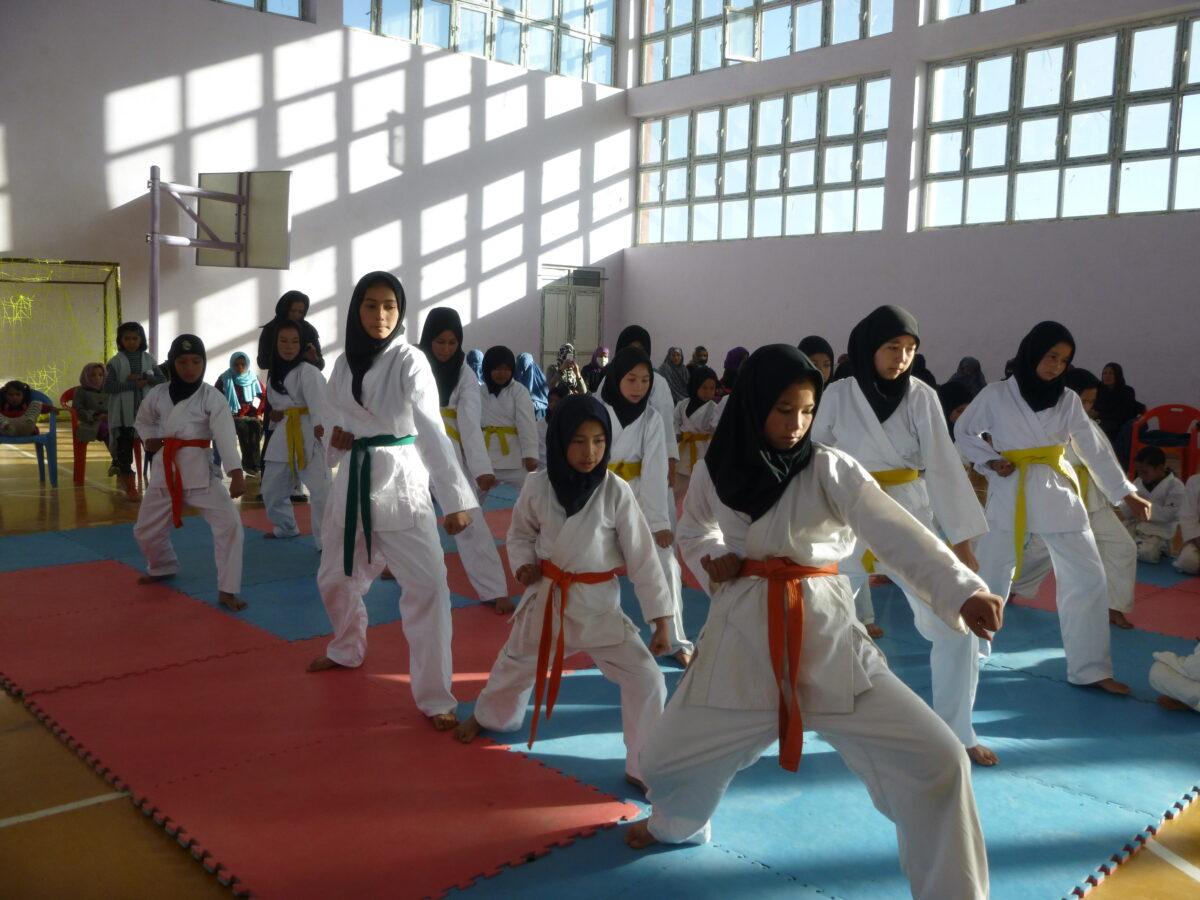
                          Female karate players trained in Ghazni


                          Female karate players trained in Ghazni


                          BySaifullah Maftoon On 19 Dec 2014

                          GHAZNI CITY (Pajhwok): For the first time ever, the Ghazni Olympic Department on Friday awarded 24 women with yellow karate belts on the completion of courses in the southern province.

                          The group of girls was trained in the sport by a female instructor, Zuhra. They demonstrated their expertise and skills at a gymnasium in front of a number of locals.

                          Olympic Director Padshah Khan Azbar said though they were facing a number of challenges to the promotion of women’s sports, some of females exhibited their ability to learn karate.

                          “I am now sure girls, looking at their performance and commitment, will out boys in this strenuous sport,” he added.

                          Zuhra, who trained the group, said female athlete were still facing problems. Girls had no specific ground or facility where they could be trained properly, she noted.

                          “I am confident these girls will embrace success in national competitions,” she remarked, urging the authorities to remove hurdles to women’s sports in the province.

                          Atifa Ahmadi, a karate player, said they were ready to take part in international karate competitions. “The government should provide us a separate ground and facilities.”

                          GHAZNI CITY (Pajhwok): For the first time ever, the Ghazni Olympic Department on Friday awarded 24 women with yellow karate belts on the completion of course…
                          * * * * * * * * * * * * * * * * * * * * * * *

                          Comment


                          • #58
                            New cabinet contains 4 female members

                            By ZABIHULLAH MOOSAKHAIL - Sun Dec 28 2014, 2:28 pm


                            Ashraf-Ghani-Ahmadzai1Afghan president Mohammad Ashraf Ghani has decided that the new cabinet will have four female members.
                            Afghan president’s spokesman Nazifullah Salarzai says president declared this decision in a meeting with female representatives of Herat province.
                            However, the introduction of the cabinet to the House of Representatives is delayed for unknown reasons.
                            The House of Representatives on Saturday decided to send a delegation to ask President Mohammad Ashraf Ghani and Chief Executive Officer Abdullah Abdullah the causes that delays the introduction of the new cabinet to the house.
                            House of Representatives had given one week deadline to the government for the introduction of the cabinet to the House which expired on Saturday.
                            Afghan President Mohammad Ashraf Ghani in his presidential campaigns had said that after reaching the presidential palace in first two months he will have a cabinet.
                            Now it is over three months and the government does not have a cabinet.

                            Afghan president Mohammad Ashraf Ghani has decided that the new cabinet will have four female members. Afghan president’s spokesman Nazifullah Salarzai
                            * * * * * * * * * * * * * * * * * * * * * * *

                            Comment


                            • #59
                              Pioneering 3.75G+ Mobile Broadband Services Launched In Afghanistan

                              By KHAAMA PRESS - Sat Jan 10 2015, 10:57 am

                              Since 2002 Afghanistan’s first mobile operator, the Afghan Wireless Communication Company (AWCC), have delivered wireless and broadband communications systems to residential and business consumers throughout the country. As a result of their pioneering efforts, the AWCC now provide all of Afghanistan’s provinces with comprehensive broadband coverage. In keeping with these groundbreaking technological advances, the AWCC have now launched an innovative 3.75G+ mobile broadband service in Kabul.


                              In recent years the AWCC have completely transformed their radio and core network in Kabul in order establish a viable 3G service for their customers. Consequently, the AWCC are now the only mobile operator in Afghanistan that provide state of the art Dual Carrier-High Speed Packet Access Plus (HSPA+) technology from each of their 3G sites located in Kabul. This next generation of 3G technology facilitates faster data speeds with download data rates of up to 42 Mbps per cell; thereby permitting Kabul residents to access the Internet wirelessly on their mobile phones, computers and other portable electronic devices via the city’s fastest 3G service.
                              As well as introducing this groundbreaking 3.75G+ technology, the AWCC have also implemented state of the art Internet Protocol version 6 (IPv6) within their 3G network. IPv6 is the latest version of the Internet Protocol; a global communications protocol that provides numeric sender and receiver IP addresses for all electronic devices that communicate over the Internet. The implementation of IPv6 is bringing Afghanistan up to the latest international communication standard. Currently, the AWCC are the only telecommunications company in Afghanistan that facilitate an all IPv6 network but it is hoped that rivals will soon follow suit.

                              Speaking about the company’s latest telecommunications developments, AWCC’s Managing Director, Amin Ramin, enthused how;

                              “We have enjoyed the privilege and responsibility of being the industry leader in Afghanistan’s telephony sector for more than a decade, and we are proud to become the first true mobile broadband provider in the country by the globally-accepted definition of the word ‘BROADBAND’… We are delighted to provide these upgraded services to our subscribers in Kabul and, whether it’s through improved internet surfing, online gaming or great video viewing experiences in either SD or HD format, we are sure subscribers will quickly come to understand the true meaning and high speed of 3.75G+ technology and mobile broadband”.

                              Although these advanced telecommunications services are currently only available to the residents of Kabul, the AWCC have announced their plans to introduce these 3.75G+ services in Kandahar in the first quarter of 2015. Furthermore, the AWCC are confident that they will be able to establish this technology throughout all the major cities in Afghanistan in 2015. Given the success of this 3.75G+ network in Kabul and the AWCC’s previous pioneering successes within the telecommunications industry, it is anticipated that all of the provinces in Afghanistan will begin to benefit from a highly advanced, rapid and reliable mobile broadband service in the not too distant future.

                              Since 2002 Afghanistan's first mobile operator, the Afghan Wireless Communication Company (AWCC), have delivered wireless and broadband communications
                              * * * * * * * * * * * * * * * * * * * * * * *

                              Comment


                              • #60
                                In Focus: Amena Hosseini from Afghanistan

                                DW Akademie's project in Afghanistan focuses on strengthening journalism training and media literacy at universities in Mazar-e-Sharif and Kabul. Amena Hosseini is a lecturer who is taking part in the project.


                                Amena Hosseini

                                "We need journalists who can explain things to people and set the record straight," says Amena Hosseini, lecturer at Balkh University

                                Originally from the Afghan city of Herat, 26-year-old Amena Hosseini got a bachelor's degree in TV and radio journalism from Kabul University. Prior to teaching media studies and media history at Balkh University in Mazar-e-Sharif, she worked as a producer and director at various local television stations. The seminars that DW Akademie conducts at journalism departments in Afghanistan aim to provide knowledge and tools lecturers can use to teach journalism theory and practice, and to strengthen journalism training in the country over the long term.


                                DW Akademie seminar for lecturers in Mazar-e-Sharif.

                                Ms. Hosseini, as a participant in the seminars, what have you learned so far that applies to your own work as a lecturer?

                                Amena Hosseini: I've learned just how important good planning and management are for teaching in general, how to be better organized, and how to evaluate teaching sessions on an ongoing basis. The latter is a great help in terms of gauging input and output. I had heard about these methods before, but I'm now learning how to actually use them.


                                Why is it so important to strengthen journalism training in Afghanistan?

                                Journalists here need better training and more education. Besides learning practical skills it’s extremely important that they have a good understanding of journalistic ethics. Many journalists in Afghanistan are unprofessional and the way they work is in fact undermining the field.

                                What is the role of Afghan journalists given the country’s ongoing conflict?

                                The overall situation here continues to deteriorate so it’s absolutely crucial that the information that goes out is more accurate and precise than it currently is. We need journalists who can explain things to people and set the record straight. So in addition to the curriculum and the work they produce themselves, up-and-coming journalists also need training in other areas – in peace journalism, for example.

                                What are you hoping to convey to your journalism students?

                                The most important thing nowadays is that they’re able to prove themselves on the free market. You see, there’s more to journalism studies than just theory – students also need practice. The biggest problem graduates have right now is that they’re not really capable of working in the profession. On paper it might look as if they’re well trained, but the truth is that while they’re studying, students rarely have a chance to work on their practical skills.

                                * * * * * * * * * * * * * * * * * * * * * * *

                                Comment

                                Working...
                                X