Announcement

Collapse
No announcement yet.

Afghanistan Focus

Collapse
X
 
  • Filter
  • Time
  • Show
Clear All
new posts

  • #31
    Rebuilding tech in Afghanistan with open source

    Posted 29 Oct 2014 by
    Maren Abatielos


    opensource.com
    ​
    The Center for International and Intercultural Communication (ZiiK) at the Technical University of Berlin (TU Berlin) has been helping with the reconstruction of academic organizations in Afghanistan since 2002. Under the supervision of the Berlin IT lecturer, Dr. Nazir Peroz, Director of the ZiiK, computer centers have been established at five college locations in Afghanistan.

    Through the project, many students and college employees have been trained in the use of the computers. A new curriculum tailored to the requirements and prerequisites of Afghan students has been developed and Afghan IT students and future lecturers have been trained for Masters degrees in Germany.

    Since its inception in 2000, ZiiK at TU Berlin has been a platform for international and intercultural exchange on information technology. In addition to intensification of the international dialog, one of ZiiK’s main goals is to offer students from developing countries promising perspectives for the future. After the Bonn Conference, the need for reconstruction of Afghanistan's education system was apparent, and the search began in late 2001 for partners to help.

    Dr. Peroz accompanied the German Academic Exchange Service's (DAAD) first fact-finding mission to Kabul in early 2002. The team was sent to evaluate the requirements for the reconstruction of the higher education system. The situation it encountered in the Afghan capital confirmed that after decades of war and tyranny from the Taliban, there was not much left of the academic education system. According to Dr. Peroz, “When we arrived there, Kabul University was made up of just a few run-down buildings. There were a few lone tables and chairs lying around along with a few tattered books. In the whole of the capital’s college there was just a handful of old computers, some of which didn’t even work anymore.”

    Since civil war had erupted in 1978, many well-educated Afghans had already fled the country. Then, after the Taliban seized control in 1996, many schools and colleges were closed down completely.

    From the start it was clear that it would not be enough to just provide new infrastructure, it would also be necessary to familiarize the people with modern electronics so that they were in a position to make use of them. In addition, to ensure that the Afghan facilities were not permanently reliant on foreign aid, it was also important to train specialists who could take care of the operation of the established structures autonomously. “From the beginning, our aim was always to create something that will continue to help Afghanistan in the long term as well—something which opens up perspectives for the future for the nation, and offers the people hope”, explained Peroz. “The IT sector is ideal for achieving these goals because it is indispensable for modern economy on the one hand and requires lower investments in hardware than other branches of trade on the other. The most important asset in IT is expertise and that is what we want to communicate.”


    Masters of Informatics students

    The basis for an education in IT is a functioning IT infrastructure which can be used to train college employees, specialists, and students. One of the first project milestones for the ZiiK was the establishment of a computer center at Kabul University. The IT Center Kabul (ITCK) was launched in March 2003 and has guaranteed the college’s IT capacity ever since. It connects the networked institutes and PC pools with the Internet and provides services such as storage space and mail and web servers. Today, the colleges in Herat, Mazar-i-Sharif, Jalalabad, and Kandahar now also boast their own IT centers.

    When establishing the computer centers, the German-Afghan project employed open source software from the start. Over the years, the ZiiK team and its Afghan partners have tried out several different operating systems, primarily a variety of Linux distributions. The newest computer center, the IT Center Kandahar (ITCQ), was the first to adopt the open source Univention Corporate Server (UCS) from Bremen-based Univention GmbH.


    The arrival of computer hardware for the IT center in Kandahar (ITCQ)

    "It was important for us to find an operating system which put the Afghan staff in a position to perform all the necessary work with as little training as possible and if possible without our support”, said Daniel Tippmann, Project Planner and Coordinator at the ZiiK. “Simple administration of UCS via a central, graphic management surface, lots of integrated tools, simple installation and mounting of additional programs via an integrated App Center are important to the Afghan administrators not as well-versed in the operating system as we are here in Germany."


    New IT center at the University of Herat

    The administrators trained in the summer and winter, and now schools in Berlin can use the web-based UCS management system to administrate their servers, computer workstations, users (rights) as well as different server applications and web services across various platforms. New software can be installed on connected computers from the management console and the App Center via a graphic interface, for example for educational support software.

    "Now we can put our Afghan colleagues on site and are able to resolve everyday problems such as resetting a forgotten password, creating new users, or installing new software much quicker than before,” said Tippmann. “This allows us to reduce our role to emergency support, intervening only if the local staff is no longer able to proceed. And the more experience they gather, the less often that is the case!"


    Dr. Nazir Peroz (Head of the ZiiK) with his planning team for the IT center in Kandahar (ITCQ).

    After six successful months using the new open source corporate server, the decision was made to switch the other IT centers over to the operating system from Germany too. The Bremen-based company provides the requisite licenses free of charge as well as the training documentation. In addition, the ZiiK and Univention run joint workshops to train the Afghan administrators.

    In the more than 12 years since the plea for help with reconstruction went out, over 4,500 college employees and specialists have been trained in the use of computers. Forty-eight Afghans were awarded scholarships and have completed a Master's degree in IT in Berlin and then communicated their knowledge to lecturers in newly established IT courses in their homeland. Around 1,000 IT students have already completed their IT studies at the colleges in Kabul, Herat, Mazar-i-Sharif, Jalalabad, and Kandahar, or are currently enrolled. Many of these graduates have gone on to found their own IT companies. "Every time a company is founded, it is a step towards a stable and better future,” said Peroz. “The country has an incredible amount of catching up to do, and educating the young people is the best way to make up for the missed development of the past 40 years in just a few years."

    Dr. Nazir Peroz (Head of the ZiiK) on rebuilding tech in Afghanistan and a new IT center at the University of Herat.


    [MENTION=2]Admin Khan[/MENTION] [MENTION=5349]Hallo[/MENTION]
    * * * * * * * * * * * * * * * * * * * * * * *

    Comment


    • #32
      Fanged deer spotted in Afghanistan, first sighting in 60 years

      "We hope that conditions will stabilize soon to allow WCS and local partners to better evaluate conservation needs of this species," said Peter Zahler.
      By Brooks Hays | Oct. 31, 2014 at 11:17 PM


      The Siberian musk deer is one of six species similar to the Kashmir variety. (WCS/Maher)

      KABUL, Afghanistan, Oct. 31 (UPI) -- After an absence of more than 60 years, a handful of rare fanged deer have been spotted in Afghanistan -- just in time for Halloween. The sharp-toothed mammal known as the Kashmir musk deer hadn't been seen in the country since 1948.
      But as researchers recently reported in the journal Oryx, a team of field observers with the Wildlife Conservation Society spotted several of the rare specimens -- on multiple occasions -- in the remote alpine fields of northeast Afghanistan, meadows lush with juniper and rhododendron and accented with forested slopes and rugged rock outcrops.

      "Musk Deer are one of Afghanistan's living treasures," lead author of the study, Peter Zahler, said in a recent press release. "This rare species, along with better known wildlife such as snow leopards, are the natural heritage of this struggling nation."

      The sharp white enamel that protrudes from the musk deer's mouth are more tusks than they are fangs -- not used to kill or eat prey, but to impress females and compete with other males during rutting season.

      The Kashmir musk deer, one of seven similar species in Asia, is considered endangered by the International Union for Conservation of Nature. The Dracula-like deer's largest threats are habitat loss and poaching. The species' scent glands are highly prized for their use in perfume, incense, and medicine -- selling for $20,000 per pound on the black market.

      "We hope that conditions will stabilize soon to allow WCS and local partners to better evaluate conservation needs of this species," Zahler added.

      Without improved conservation infrastructure and wildlife initiatives, researchers say the deer is likely to disappear from Afghanistan's Nuristan Province and elsewhere in India and Pakistan.


      Read more: http://www.upi.com/Science_News/2014...#ixzz3IUb3Kndz
      * * * * * * * * * * * * * * * * * * * * * * *

      Comment


      • #33
        The beauty of everyday life in war-torn Afghanistan

        A Turkey-based photographer documents serene moments of normalcy in Kabul By Sarah Eberspacher | November 6, 2014

        News coming out of Afghanistan is rarely good. Headlines are dedicated to the destruction wrought by the ongoing war; images show families sifting through the remnants of another attack. It's easy to forget, then, that beyond the battles, extremists, and politicians, millions of people are just trying to hang on to normalcy.


        Men work at a car wash in the Kart-E Sakhi section of Kabul. | (Monique Jaques)


        Girls practice volleyball drills at the Olympic Stadium women's gym. The girls come three times a week to play each other, as there are no other teams in Afghanistan. | (Monique Jaques)


        Monique Jaques, a 28-year-old photographer living in Turkey, strived to document the everyday moments over the course of a year in Kabul, Afghanistan.

        "I shot this project mostly in 2009 after covering the elections in Afghanistan," Jaques says in an email interview. "At the time, the world's attention was on the war, and I wanted to show the people behind and affected by that war."

        Five years later, the photographs still feel unusual.

        A father-and-son metalworking team labors downtown. The trade is traditionally handed down through families. | (Monique Jaques)


        Businessmen play Snooker at a hall in Haki Yqoob Square. The game is a popular post-work pastime for upper-class Afghanis. | (Monique Jaques)


        Day laborers offer their services outside the Pashto Market. | (Monique Jaques)


        Jaques found her subjects organically, both during shoots for other assignments and from wandering through her foster city.

        "Kabul is a city that's always alive," Jaques says. "Downtown is crowded, so there's always noise and people and animals moving around. Afghanis rarely have electric or gas heating — they rely on burning wood — so during the long winters it always smells of firewood and cold air coming down from the mountains."


        Children enjoy their winter vacation at the Shohadaie Saliheen Cemetery. In Afghanistan, cemeteries are commonly used as recreational sites. | (Monique Jaques)


        Young women visit a shrine near Qargha Lake, outside the city. | (Monique Jaques)


        Families enjoy a visit to Qargha Lake, a man-made body of water offering clean water for swimming and boating. | (Monique Jaques)


        I am sure Kabul has developed since the half a decade that these photos were taken?

        [MENTION=17579]Loy Afghanistan[/MENTION] [MENTION=8995]DSM0305[/MENTION]
        * * * * * * * * * * * * * * * * * * * * * * *

        Comment


        • #34
          The Arbaki can secure Afghanistan better than the US

          When US troops withdraw from Afghanistan, is a 19th century tribal solution the only option?

          Last updated: 05 Nov 2014 07:27

          Prince Ali Seraj is the president of the National Coalition for Dialogue with the Tribes of Afghanistan.


          Afghan members of the Loya Jirga speak before the meeting outside its premises in Kabul [AFP]


          Newly elected Afghan President Ashraf Ghani's move to resurrect the case against Kabul Bank last month was commendable; it demonstrated his resolve to tackle the administrative corruption that has crippled the Kabul government since 2001. Still, for the average Afghan, the case involving the theft of nearly $1bn dollars from the country's first private bank back in 2010 won't make much of a difference.

          According to recent polls, for the vast majority of Afghans, security above all remains the top priority - followed by food, employment, fuel and the price of basic necessities. Without security, none of the other needs can be met.

          US President Barack Obama's plan to withdraw US troops by the end of 2016, has encouraged both Taliban and al-Qaeda fighters to ramp up their activities inside Afghanistan. A case in point is the southeastern province of Helmand, where a number of districts have fallen to Taliban incursions.

          By now it is clear that Afghanistan's security woes cannot be addressed by the Afghan National Army. Unlike the conscript military of yesteryear, when the forces were well equipped with all the necessary hardware, such as tanks, helicopters, jets, armoured personnel vehicles, rockets, etc, today's national army is barely equipped to meet the threat posed by the enemy, widely reported to be supported and financed by neighbouring countries.

          An Afghan solution

          The solution to this major problem lies in restoring the ancient tribal security system - known as Arbaki - to assist the national army in defending the country, especially the borders, against enemy encroachment and infiltration. In recent weeks, there have been reports that the US is studying local power structures with the possible objective of reviving a version of this traditional Afghan model of security.

          Contrary to the beliefs of the international forces, the Arbaki is not a militia force.


          While a militia is made up of individuals from different walks of life, not properly vetted, the members of the Arbaki are tribesmen hailing from well identified villages and specific tribes.

          The efficacy of the Arbaki system is time-tested. Throughout the centuries, the tribes of Afghanistan have sacrificed wealth for freedom. They have always banded together to ward off enemies. It is also a fact that in times of peace, the tribes have bickered among each other. As British writer Rudyard Kipling famously said, when Afghans have no one else to fight, "they fight among themselves".

          Today, as western solutions fail in Afghanistan, a growing number of Afghans are convinced that peace and security can only be achieved through Afghan solutions. Peace can be achieved in Afghanistan, but the tribes must be engaged and empowered to assist the Afghan National Army.

          In keeping with Afghan tradition, a jirga (assembly of elders) must be convened. There, the wisemen must agree to activate the Arbaki.


          If implemented properly, this is the right path to securing the borders of Afghanistan. A time limit must be set for the activities of the Arbaki force. They could operate for six months or until security in the area is achieved, whichever comes last.

          In consultation with the tribes, the government should launch a media campaign to inform the people about this system and show how Taliban rhetoric is politically motivated and designed outside of Afghanistan - and outside of the religion of Islam. The government should make it clear that the expansion of the Taliban is driven by coercion, not popularity.

          Taliban rhetoric

          The Taliban must be challenged on Islam. They must be shown to have violated Islamic principles and the Pashtun honour code, known as Pashtunwali. The government must engender debate and sow doubt.

          The pillar of their rhetoric is that they are engaged in a war against a non-Islamic occupying force; this must be challenged and destroyed. The government must stress that the only invaders are those agitators infiltrating from neighbouring countries, intent on destabilising and destroying Afghanistan. They should also mount a media campaign identifying suicide bombers (mostly non-Afghan nationals) and highlighting the hardship caused to innocent civilians.

          The Taliban must be challenged on Islam. They must be shown to have violated Islamic principles and the Pashtun honour code, known as Pashtunwali. The government must engender debate and sow doubt.


          The government needs solid intelligence on the enemy, but it also needs reliable information on the tribes. Tribal mapping will be important, as it will identify leading personalities and their historical relationships. Afghanistan's past is relevant and it is kept alive by oral traditions.

          The government can use oral histories to reinforce traditional values of loyalty, support right over wrong and expose the Taliban as outsiders.

          Following the Taliban's own example, the government should also make better use of TV, radio and social media. It should show those who are standing on the sidelines the true murderous face of the Taliban.

          A system of border security similar to the Arbaki has already been enacted by the governments of Uzbekistan and Kyrgyzstan to guard their borders.

          Once the government has established a ring of Arbaki security guards around Afghanistan's borders, the National Army and the National Police can maintain security within the nation.

          While the security plan is being put into effect, the government must tackle the shortage of staple products in the country. The staple food among the population is potatoes and onions, both of which are sold to Afghans by Pakistanis at more than 10 times the price.

          In the past, Afghanistan was an agricultural nation. The government can revive this agro-economy by setting up cooperative farms on government lands and resettle Afghan refugees from Pakistan and Iran on these farms. They can assign each family with land and housing, and furnish them with seeds, fertiliser, farming equipment and when needed, expertise to assist those who have been away from farming due to long years of migration.

          This is the proper way for the new government to attack the major problems and show the people that it is serious about tackling issues that will ease their life, liberty and pursuit of happiness.

          Prince Ali Seraj is the president of the National Coalition for Dialogue with the Tribes of Afghanistan.


          [MENTION=1068]gadoonwal[/MENTION] [MENTION=1201]Toramana[/MENTION] [MENTION=17579]Loy Afghanistan[/MENTION]
          * * * * * * * * * * * * * * * * * * * * * * *

          Comment


          • #35
            Afghanistan, China Open New Chapter of Cooperation

            Monday, 10 November 2014 18:24

            Last Updated on Monday, 10 November 2014 19:43

            Written by Shakeela Ibrahimkhail


            Strong efforts are underway by Kabul and Beijing to extend cooperation on trade and fight against terrorism following the recent visit of President Ashraf Ghani to China which is believed to have been a fruitful trip.

            To help determine the framework of cooperation between Kabul and Beijing, Afghanistan's Center of Strategic Studies launched "Seminar on Future Development of Afghanistan-China Relations" on Monday in Kabul.

            "We want to determine the relations between the two countries as the People's Republic of China had been impartial to Afghanistan's issues over the past thirteen years," said Daud Muradian, head of Afghanistan's Center of Strategic Studies. "But from now onwards, China is going to play an important role in Afghanistan and region."

            Stressing the need for extended relations between Kabul and Beijing, the Chinese Ambassador to Kabul, Deng Xijun, said, "The relations between Afghanistan and China are based on the mutual interests of both the countries."

            He added, "Both the countries need long-term peace and stability, that's why, these relations meet vital importance so that we will be able to extend our relations from one generation to another generation."

            Meanwhile, Dr. Rangeen Dadfar Spanta, former National Security Advisor, stated that combating terrorism is impossible without joint efforts of Afghanistan and China as both the countries are facing same threats of terrorism, drugs and other organized crimes.

            "Terrorism cannot be rooted out only with detention and prosecution of few terrorists," Spanta said. "Terrorism hubs need to be eliminated in order to make successful the combat against terrorism."

            Former Afghan intelligence chief, Amrullah Saleh, also praises extended relations with China, believing that China can play an important role in intelligence sharing and military aid to Afghanistan.

            Kabul and Beijing are expected to celebrate their 60th anniversary of their relations in a special ceremony in order to prove their commitments to friendly relations.


            Former Afghan intelligence chief, Amrullah Saleh, also praises extended relations with China, believing that China can play an important role in intelligence sharing and military aid to Afghanistan.
            [MENTION=17582]Al-Afghani[/MENTION]
            * * * * * * * * * * * * * * * * * * * * * * *

            Comment


            • #36
              Originally posted by Bengal_Tiger View Post
              Afghanistan, China Open New Chapter of Cooperation
              More Chinese involvement is very welcome in Afghanistan, since we can be certain that Pakistan will not use their proxies to sabotage this new relationship. However, Afghanistan still is a very low priority for China, whose main "theater of war" is the South China Sea and its many territorial disputes with neighboring countries.

              Comment


              • #37
                Good news from Gran Afghanistan these days. Taliban may not hijack all this!

                Comment


                • #38
                  Meet the skater girls of Afghanistan

                  BY LARISA EPATKO November 12, 2014 at 9:16 AM EST


                  Skateistan youth leader Madina Khsrawy teaches another girl how to skateboard.

                  When Madina Khsrawy was 13, she saw some boys skateboarding and asked them where she could learn.

                  It’s not an unusual pastime — unless you live in Afghanistan, and you’re a girl.

                  They took her to a program called Skateistan, a nonprofit that teaches skateboarding to children in Afghanistan to segue into an education program.

                  Learning to skateboard was hard at first, she said by phone from Kabul. “All sports are hard in the beginning. But I liked it and was interested in it, so I learned it fast.”

                  It’s still a challenge to skateboard outside the Skateistan facility in Kabul. Khsrawy said when she did venture out on the street, “people would look at me and were shocked.” They would ask her why — as a girl — she had a skateboard.

                  At Skateistan, “I feel I am free and I can do sports here, but not on the outside,” Khsrawy said.


                  Skateistan’s founder and executive director Oliver Percovich with possibly the youngest girl skateboarder in Afghanistan.

                  That’s the idea, said Skateistan founder and executive director Oliver Percovich: providing a safe place where girls and boys can interact and learn new skills. The program provides additional education for “street children,” or those who sell items on the street such as chewing gum and cigarettes and don’t get to go to school. The condensed curriculum helps catch them up to their peers.

                  About 1,200 students ages 5-17 attend the Skateistan program per week in Afghanistan’s two sites, in the capital Kabul and the northern city of Mazar-i-Sharif. Skateistan has opened skate parks in two other places: Phnom Penh, Cambodia, and Johannesburg, South Africa, where another 300 students go.


                  Since the PBS NewsHour profiled the group in 2011, Skateistan had branched out into two more countries.
                  About 47 percent of the Skateistan students in Afghanistan are female — quite an undertaking in a country where girls usually don’t play sports, let alone skateboard. The female students require more of Skateistan’s resources, Percovich said, because organizers must pick up and drop off the girls at their homes. The organizers also conduct home visits to ensure their families’ support.

                  “That’s really important in a society where girls going to school is a very special thing, and doing a sport is not the norm at all,” he said. But it’s worth it.

                  “While it’s a lot of effort in terms of logistics, and transport and home visits, the extra attention adds a lot of quality to our programming. I don’t think I would have really started Skateistan if it was just boys skateboarding. The fact that girls were interested in skateboarding when they weren’t doing any other sports made it special.”

                  Percovich started the organization in 2007. “I fell into this work with no background in international development. We were just a ragtag bunch of people who tried very hard to look at what was native and what made sense.”

                  The group pledged to stay in Afghanistan for 10 years and adapted to local needs. Several years later, it turned over the Kabul facility to be run by Afghans, which makes it more sustainable, Percovich said.


                  Boys and girls age 5-17 can participate in the skateboarding program.

                  While some nonprofits take a while to expand, Skateistan grew pretty quickly, he continued, and is now in what he describes as a holding pattern. The organization eventually will take on more projects “where we can have the greatest impact and where there’s the biggest need,” he said.

                  Khsrawy, meanwhile, is now 16 years old and a youth leader with Skateistan. She said she never expected to be recruited for that role.

                  “I could not tell myself I am intelligent, but they told me I was intelligent and I should become a leader,” she said in English, which she practices with the English-speaking organizers. Like learning to skateboard, being a leader can be difficult at first, but you learn that “you should try hard and be your best.”

                  When Madina Khsrawy was 13, she saw some boys skateboarding and asked them where she could learn. It’s not an unusual pastime -- unless you live in Afghanistan, and you’re a girl.
                  * * * * * * * * * * * * * * * * * * * * * * *

                  Comment


                  • #39
                    As Afghan President, Ghani Continues Tech Advocacy


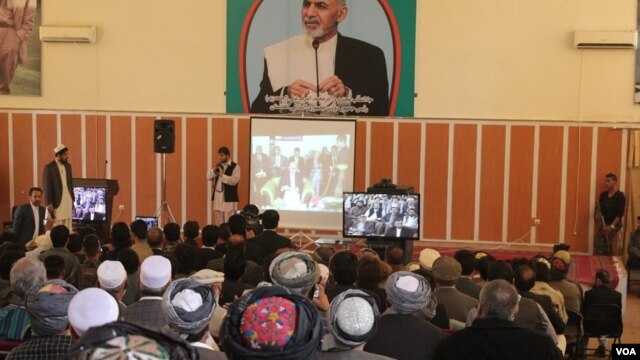
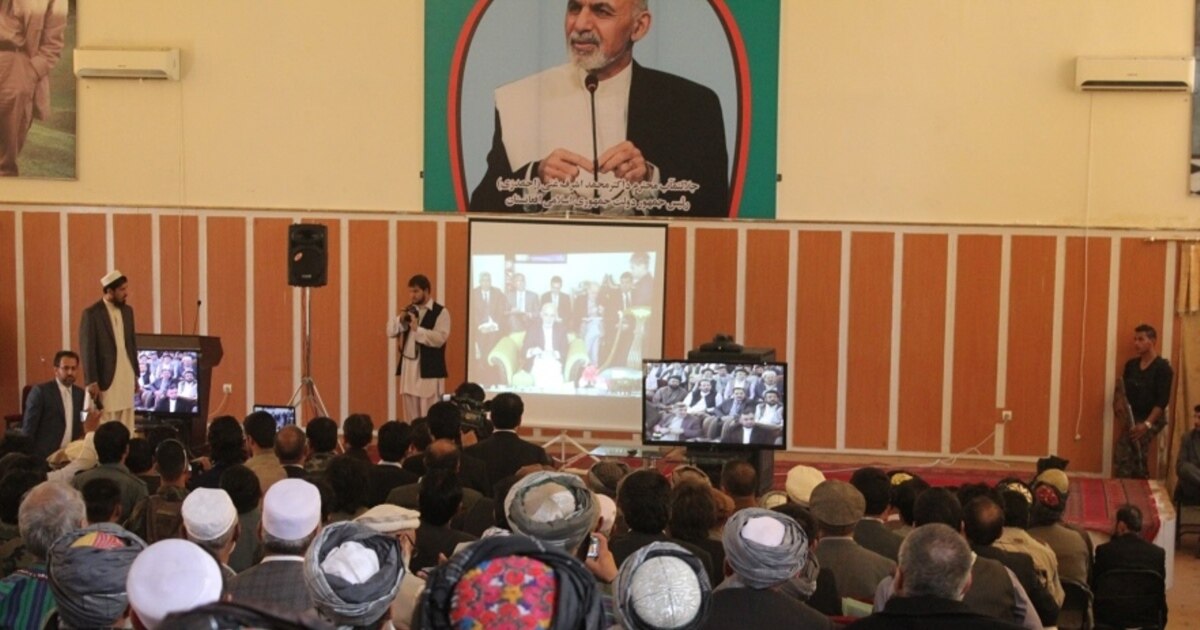
                    Afghan President Ashraf Ghani has uses Skype, Google Hangout to chair "town hall"-style meeting, Kunduz, October 2014 (Ibrahim Rahimi for VOA).


                    November 03, 2014 3:50 PM

                    Prior to assuming Afghanistan's top political office, President Ashraf Ghani, as an academic and World Bank expert on state building, wrote about how technology could help weak states cost-effectively improve governance.

                    “The advent of new information technology has overcome one of the greatest constraints in human history — the ability to process large amounts of information and identify patterns ... technology has become a mediator for a huge range of human relationships by creating new forms of organization for security and businesses,” Ghani wrote in Fixing Failed States: A Framework for Rebuilding a Fractured World, a 2008 book he co-authored with Clare Lockhart.

                    Now he's attempting to put some of these ideas into action. Over the past few weeks, for example, Ghani has used Skype and Google Hangout to chair "town hall"-style meetings in Herat, Kandahar, Kunduz and Khost, where, via large monitors, he virtually engaged dozens of citizens.

                    Not without its technical flaws, Ghani's video conferencing sessions represent a kind of communications benchmark that facilitates direct dialogue between the Afghan leader in his high-walled, high-security palace, and citizens in far-flung areas.

                    According to Ghani administration officials, the president plans to extend the practice to 33 provinces across Afghanistan.

                    In an informal talk with journalists in Kabul last month, Ghani said the use of free communications technology would not only streamline meeting schedules, but save the national treasury over US$2.5 million in presidential travel expenses alone. Security requirements make presidential travel within Afghanistan extremely expensive.

                    “It was an interesting experience,” said Ahmad Shah Ataal, who attended a video conference in Kandahar city on October 16.

                    “Although it was not anything near to a real meeting, a lot of people spoke to the president and he also talked and issued some orders,” he added, referring to a presidential directive to the governor of Kandahar, in which Ghani, via Skype, called for the re-arrest of a powerful drug trafficker who was set free extrajudicially.

                    Traditional interaction

                    The video-call technology was first brought to the Afghan Presidential Palace, the Arg, in 2002 by former Afghan President Hamid Karzai who used it primarily to communicate with the George W. Bush White House. Karzai, who stepped down in September, video-chatted less frequently with President Barack Obama. Ghani and his Chief Executive Officer Dr. Abdullah had their first video-call with President Obama on October 22.

                    Ghani has also used a secure video conference line to communicate with commanders of the Afghan National Army units in different parts of the country.

                    “Most of President Ghani’s exchange with provincial authorities via Skype and Google is available on public records so there is little concern about its security from hacking and surveillance,” said Mohammad H. Qayoumi, the Afghan-born president of San José State University.

                    “I’m sure national security and other confidential issues are not discussed on these free technology channels,” he added.

                    Despite Ghani's history of advocating online communications technology, his office made an effort to emphasize the value he still places on face-to-face interaction, release footage of more than 20 meetings with delegates from around the country over the past month.

                    He also barged into a military hospital in Kabul a late evening and fired several doctors who were not on duty.

                    As Qayoumi put it, principal aspects of Afghan politics will always be the product of lengthy tea-drinking sessions that online communications platforms, no matter how sophisticated, cannot entirely replace.

                    Rapid development

                    In 2001, most Afghans had to travel to Pakistan to place international phone calls because the service was not available at home. In the past decade, more than $2 billion has been invested in Afghanistan’s telecommunication infrastructure and more than 90 percent of Afghans have access to mobile phones and some 30 percent have access to the internet, according to the Afghan Ministry of Telecommunication & Information Technology

                    Even Taliban insurgents, despite their utmost efforts to block development projects, benefit from the advancements, frequently communicating via mobile phones and online platforms such as Facebook and Twitter.

                    Ashraf Ghani, who wrote about harnessing technology to remedy state failures as a World Bank development expert, is now implementing ideas he championed


                    [MENTION=2]Admin Khan[/MENTION] [MENTION=4551]hamid954[/MENTION]
                    * * * * * * * * * * * * * * * * * * * * * * *

                    Comment


                    • #40
                      Copper and lithium may be the keys to Afghanistan’s economic future

                      AUTHOR

                      Ali Reza Sarwar

                      Graduate Fulbright Fellow pursuing Masters of International Affairs with track in National Security and Diplomacy at Texas A&M University


                      Hajigak, one of the main routes from Kabul to Bamiyan in central Afghanistan, may contain one of the largest deposits of iron ore in the world.


                      On October 27, the last international troops closed their military camp in Southern Helmand Province and left Afghanistan, officially ending their combat role after 13 years of fighting. By the end of 2014, it’s expected that only 9,800 American troops will be left in the country.

                      Although Afghanistan continues to face security challenges, the completion of the planned transition imparts hope that the country has achieved enough political and military stability to move forward on its own. The most pressing question now is how Afghanistan will finance its still-fledgling armed forces, its state institutions and the revival of its beleaguered economy while preventing the return of the Taliban and Al-Qaida.

                      Billions of dollars in pledged international assistance have been pledged, but this is only a fleeting solution. Afghanistan needs a sustainable source of income to retake control of its destiny and reclaim its ancient role as one of Asia’s most important trade routes.

                      The answer lies in the mineral deposits spread across the country that are overflowing with copper, iron, lithium and other metals and minerals. How much lies in Afghanistan’s hills and mountains is still unknown, but they may be worth trillions of dollars.

                      Three decades of war

                      Since the fall of the monarchy in 1973, Afghanistan has never had a chance to take advantage of the richness of its land. The subsequent three decades have been marked by protracted turbulence, including the Soviet invasion of 1979, uprisings, civil wars and finally the rise of the Taliban and invasion by US-led forces. The continual struggles eliminated any opportunity to design and implement an economic strategy to discover let alone excavate and use its vast natural resources.

                      The limited work that has been done in this area was first conducted by Soviet geologists in the 1970s and 1980s. They identified abundant natural deposits that included iron, high grade chrome ore, uranium, lead, zinc, bauxite, lithium, emeralds, gold, silver and the “largest amount of copper.”

                      The World Bank says Afghanistan’s copper deposits in the Eastern Logar and the Central Bamiyan provinces are the largest in Asia and second-largest in the world, at over 1.2 billion tons. Additionally, the Afghan government confirms there are “extensive deposits of coal, marble, precious metal, game stones, gas and hydrocarbons.”

                      Perhaps the most up-to-date and intriguing claim about the country’s hidden wealth emerged in 2010 when The New York Times reported on a leaked internal memo prepared by US geologists and Pentagon officials. It said Afghanistan’s mineral deposits could fundamentally alter the country’s struggling economy.

                      The report helps confirm that Afghanistan could soon become a very wealthy country. Its lithium deposits alone are estimated to be worth as much as US$3 trillion, according to the Ministry of Mines and Petroleum.

                      Foreign investors wanted

                      The Afghan government in 2008 passed a law intended to open up its economy and spur foreign investment in the country’s key sectors. Because of the ongoing security and political challenges, the level of foreign investment remains limited.

                      Thus far China remains the single largest foreign investor. The Metallurgical Corporation of China and Jiangxi Copper Corporation are the two biggest companies contracted to invest US$4.4 billion in Aynak copper deposits. Chinese National Petroleum Corporation won the contract for Afghanistan’s gas in the northern provinces of Sari-pul and Jowzjan with an annual US$400 million investment. And last week, Afghanistan’s new President, Ashraf Ghani, paid his first official visit to China and signed a number of trade agreements, signifying the role of China in Afghanistan’s economy.

                      A wise and sustainable approach to Afghanistan’s natural resources, however, requires a strategy that involves many countries in the region and around the world, not just China. In particular, the countries in the coalition that ousted the Taliban and have been involved in Afghanistan for a decade now – whether fighting or building infrastructure – should be a part of that strategy.

                      The time is ripe for such a strategy, and it should be included in the upcoming London Conference in December. Afghanistan’s unity government will present its top economic policies and donors will unveil their post-withdrawal plans. The summit may be the last gathering of its kind, concluding one of the century’s longest wars – though NATO and the US plan to maintain an advisory role through 2025.

                      The ability to discover, extract and effectively manage Afghanistan’s natural resources will help guarantee the ultimate success of the transition to complete independence – along with the security agreement with the US and President Ghani’s fight against corruption. In the end, it could finally connect Afghanistan to its region and the world, turning the country once again into the region’s most valued trade route.

                      On October 27, the last international troops closed their military camp in Southern Helmand Province and left Afghanistan, officially ending their combat role after 13 years of fighting. By the end of…
                      * * * * * * * * * * * * * * * * * * * * * * *

                      Comment


                      • #41
                        Afghan commandos respond to call of duty


                        By KHAAMA PRESS - Fri Nov 14 2014, 2:53 pm

                        The Afghan commandos based in Helmand Province have been fighting heavily in northern districts, including Sangin over the past year. As US forces leave Camp Leatherneck and British forces leave Camp Bastion, the Afghan 7th Commando Battalion at adjacent Camp Shorabak will remain, along with the regular Afghan National Army, running operations by road and by air (when helicopters are available).


                        As US and NATO troops depart Camp Bastion and Camp Leatherneck in Helmand, Afghan commandos garrisoned at adjacent Camp Shorabak continue operations to push back insurgents in the province.
                        Colonel Zabiullah Momand, Commander, 7th Special Operations Kandak, Helmand said “If we come under ambush we have to keep moving, and if one of us is injured or our vehicle is damaged, then we will stop and establish security, but if not, we have to continue to our destination.”

                        This Afghan Special Forces convoy is preparing to travel east to Gereshk, where two days earlier a suicide bomber attacked an Afghan army convoy on its way to Sangin in the north, killing two policemen and injuring several Afghan army members.
                        Commander Zabiullah says “Gunners have to be alert.”
                        Gunners keep an eye on roadside tree lines or compounds for enemy shooters throughout the 40-minute drive, but the primary threat is suicide bombers. During the same week a vehicle-borne IED or VBIED, a truck packed with explosives and driven by a suicide bomber, injured several policemen in Lashkar Gah, the provincial capital.

                        The commandos are here to meet with the Gereshk police chief and District Governor about an upcoming operation. But today’s mission is also a show of force. A display of solidarity with the police will have meaning for the locals and potential adversaries.
                        Mohammad Fahim Mosazoy, District Governor, Nahri Saraj said “As you know, the Taliban attacked Helmand’s northern districts of Sangin, Musa Qala and Nowzad with large forces. Fortunately the Taliban have failed in their many attempts to attack Gereshk.”
                        Security is good in Gereshk, Helmand at the moment. This could change. The District Governor says that without the help of the military, the security could turn.

                        This commando battalion has been operating in Helmand for the past five years. They serve as a quick-reaction force as well as perform night operations targeting insurgents and high-level criminals.


                        However, no Afghan helicopters are dedicated exclusively to this battalion, so the commandos must often get rides from US Special Operations helicopters, or travel by road, risking IEDs and ambush.
                        By road they lose the advantage of surprise and they lose men who die from lack of air medevacs.

                        At a recent ceremony the commander remembers eight fallen commandos -calling them martyrs – and tells the men their sacrifice is not in vain.
                        Commander Zabiullah said “The day will come when the people of Afghanistan will understand and will hug you and thank you for your sacrifices. I am sure we are not far from that day.”
                        Many of the battalion’s casualties are due to fighting in Sangin and the other northern districts.

                        “In Sangin District, in Showzada village, we lost six people, but in the end we killed the Taliban,” said a service memebr of the Afghan commando.
                        Most likely Sangin will continue to be a contested area. Even in the possible case of broad political peace settlements with the Taliban and other major insurgent groups, those involved in the local illicit narcotics economy will still fight to control Sangin in order to maintain poppy growth, supply routes and opium production.
                        Commander Zabiullah said “Sangin has a very strategic location. The enemies were thinking “if they take Sangin, they take Kajaki and Musa Qala as well.”

                        The enlisted commandos are paid the equivalent of 300 US dollars a month. Some get leave every three months, but others in specialised units work for longer stretches. They define their high-risk occupation as a duty to country.
                        An Afghan commando service member said “The only thing that I have in my mind is that this country definitely needs us. And when a bridge or a road is being blown up by the enemies, or the enemies harass or oppress the people, it is our responsibility to bring the area security in the best possible way. “

                        The psychological impact of the heavy fighting has been considerable. Our team witnessed commandos in the barracks suffering from chronic nightmares, reliving traumatic moments in their sleep, and we were told of one commando who had taken his own life.
                        “It saddens me that one day my comrade is alive and fighting beside me and then he is dead. But my hope is that we can have a peaceful country for our people,” an Afghan commando service member said.
                        Another service member of the commando forces said “The country needs to be protected. Yes definitely people die, people get injured, and people become sad, but still, the country has the right to be served.”

                        The Afghan commandos based in Helmand Province have been fighting heavily in northern districts, including Sangin over the past year. As US forces leave
                        * * * * * * * * * * * * * * * * * * * * * * *

                        Comment


                        • #42
                          How the Taliban and a cow prove Afghanistan loves social media

                          Jean MacKenzie, Global Post 1:05 p.m. EST November 17, 2014


                          KABUL — It all started with a short article on a popular Afghan news website.

                          Khaama Press reported that two members of the Taliban had been caught in a rather compromising position in the northern province of Badakhshan.

                          According to the account this month, the suspects were found in flagrante delicto with a cow. The alleged offenders were soundly beaten by local villagers and then fled.

                          That might — and probably should — have been the end of it.

                          But social media had other ideas. For a solid 48 hours, Twitter and Facebook crowds were consumed with tasteless jokes and semi-offensive cartoons at the expense of the Taliban and the unfortunate bovine.

                          One tweeter put this armed bull into the fray, apparently to avenge the honor of its womenfolk.

                          The Khaama website is known to alternate serious news with some of the more arcane tidbits floating in the ether. GlobalPost, regrettably, could not independently verify the cow sex report. But in the cyber-tsunami that followed, the story became true almost by default.

                          The incident was a testament to the growing power of social media in an environment where few of the conditions for a vibrant digital universe exist.

                          This is a country with one of the world's lowest literacy rates, where more than half of the people live below the poverty line. It has also been at war for almost four decades.

                          And yet today, Afghans of all sorts, from educated city youths to rural mullahs to opium poppy farmers to the Taliban, are hitting social media with a vengeance.

                          Sure, there are cow-rape jokes. There are also porn clips and a fair amount of pranks. But there's a vibrant political discourse, in a place where reasoned debate sometimes seems to take a back seat to violent conflict.

                          "Facebook really shapes public perception these days," said Abaceen Nasimi, the 32-year-old head of Duran Research and Analysis, a Kabul-based consulting company. "People of my age and in my circles use it for political debates, for discussion of issues."

                          The effects reach far beyond Kabul.

                          "After the mudslides in Badakhshan this spring we used social media to raise money for the victims. We use it for advocacy. It is an extremely important force," Nasimi added.

                          They're even catching the social craze in southern Helmand province, a world opium-poppy hub and a powerful center of the Taliban insurgency.

                          "We depend a lot on social media," said Zainullah Stanekzai, head of the Helmand Independent Journalists Association. "Journalists get many leads from Facebook, for example."

                          An official hoping to expose corruption can create a fake account and post an entry about wrongdoing in a government department, he added.

                          "It is usually enough for journalists to catch the scent and find the story. We've had a lot of success with this," Stanekzai said.

                          Journalists in the south also use social media to keep in touch with the insurgency. Many of the Taliban are avid Facebook users, and Taliban spokesman Zabiullah Mujahed has his own Twitter account, with 6,850 followers.

                          This got him in hot water last month, when he accidentally geotagged his location in Pakistan. Given he's supposed to be in hiding, this caused a stir, and prompted the angry Talib to insist the tag was an enemy plot and, in fact, he'd been in Afghanistan all along.


                          Helmand's Stanekzai grumbles that social media has a dark side.

                          "A lot of people use it in a bad way," he said. "They backbite and stir things up. Sometimes I think the negative outweighs the positive."

                          Stanekzai is not alone.

                          During Afghanistan's messy presidential election campaign this spring, Facebook and Twitter users were spreading a level of vitriol that many found alarming. Some Afghan parliamentarians called for a temporary ban on social media, but none was enacted.

                          "Social media can be a negative phenomenon anywhere in the world. In Afghanistan it is a reflection of the society."

                          "Banning Facebook is not the solution," said Ahmad Shuja, co-founder of Impassion Afghanistan, the country's first digital media agency. "Social media can be a negative phenomenon anywhere in the world. In Afghanistan it is a reflection of the society, a mirror image of what is happening in Kabul and Kandahar."

                          Only 5.9% of the population uses the Internet, which is fewer than 2 million people, according to United Nations data, although other studies estimate a higher rate. Of those, the vast majority are in the cities, where fiber optics have made cyberspace fairly affordable. Three years ago, an acceptable rate of Internet speed in Kabul would run close to $700 per month; now, consumers can obtain the same connection quality for about $50.

                          But almost everyone has a cellphone: According to the Information and Culture Ministry, more than 90% of Afghans have access to telecoms services, with 20 million of them mobile users.

                          The United States has tried to capitalize on this. In 2011, the State Department awarded a contract ultimately totaling some $5.7 million to UStronics, a US-based company, that used the startup funding to develop Paywast, the country's first social media network. Based on mobile messaging (SMS), Paywast gives those without internet a way to stay in touch.

                          "It was a way to leverage basic technology to reach out to the masses," Jes Kaliebe Petersen, co-founder of Paywast, told GlobalPost.

                          In April, Petersen told The New York Times Paywast had no political agenda: no connection to the U.S. development agency's reported "Cuban Twitter" fiasco.

                          The U.S. government paid for a huge chunk of message time, and for about a year young Afghans were texting each other like crazy. "At one point we had close to 30% of all SMS traffic in the country," Petersen said. But when the money ran out, so did many subscribers.

                          Paywast still boasts 1.6 million users, but most of them are not engaging in SMS group chats, as had been the original vision.

                          Now Paywast markets itself to TV and radio, NGOs and Afghan government ministries seeking to get into "mobile governance." People now use it for things like voting for their favorite singer on Afghan Star, renewing identity cards or getting help to internally displaced people.

                          Now smartphones are all the rage here, too. Voters busted them out with glee, especially during the elections to choose President Hamid Karzai's successor.

                          "There is little doubt that social media contributed to the euphoria during the first round of the elections," Impassion's Shuja said. "All of these selfies of people with ink-stained fingers encouraged others to go out and vote."

                          Impassion organized Afghanistan's first social media summit last year; it was such a success that it was expanded for 2014, with sponsorship from a variety of groups, including the U.S. Embassy.

                          Shuja, who himself is gaining a pretty solid Twitter following, acknowledges that the digital world is not without its drawbacks.

                          "Social media is a particularly easy way to be more bigoted, due to the anonymity of the Internet," he said.

                          The answer, he insisted, is a legal framework to punish bullying and harassment online.

                          "The best way to combat the situation is to institute cyberlaws," Shuja said.

                          Social media here is still in its infancy, but it is growing up fast. Shuja maintains that the formal statistics are misleading.

                          "In five years the numbers will be exponentially higher, due to the increasing urbanization of the society," he said. "There will be a big boom. We should look to the future, look at where we are headed."

                          Social media can harness and channel the frustrations of Afghans who have been nursing grievances for generations.

                          "The development of the media in Afghanistan has been fantastic, but it has been one-sided," Shuja said. "There has been no cross-talk, no echo in the society. Social media can allow this to happen. Afghans can become a part of this great, boisterous debate."


                          [MENTION=2]Admin Khan[/MENTION] [MENTION=4551]hamid954[/MENTION]
                          * * * * * * * * * * * * * * * * * * * * * * *

                          Comment


                          • #43
                            Taliban suffer heavy casualties in clearing operations


                            By KHAAMA PRESS - Wed Nov 19 2014, 10:51 am

                            At least 91 Taliban militants were killed and 70 others were injured following military operations by Afghan national security forces in various provinces of the country.

                            The Ministry of Interior (MoI) following a statement said, Afghan National Police conducted several anti-terrorism joint operations with Afghan National Army and NDS to clean some of the areas from terrorists and enemies of peace and stability of Afghanistan.
                            The statement further added that the operations were conducted in Kunar, Nangarhar, Parwan, Takhar, Kandahar, Uruzgan, Ghazni, Khost, Paktika and Helmand provinces.

                            As a result of the operations at least 35 armed Taliban members were killed, 70 wounded and 13 others were arrested by Afghan National Security Forces, the statement said.

                            Also, during these operations, Afghan National Police discovered and confiscated light and heavy rounds ammunition, the statement added.
                            Afghan National Police discovered and defused four different types of IEDs placed by enemies of Afghanistan for destructive activities in Chahar Dara district of Kunduz province.
                            The anti-government armed militant groups have not commented regarding the report so far.

                            At least 91 Taliban militants were killed and 70 others were injured following military operations by Afghan national security forces in various provinces


                            Afghan Security Forces.
                            * * * * * * * * * * * * * * * * * * * * * * *

                            Comment


                            • #44
                              Afghans more confident in national army


                              November 18, 2014, 7:17 pm

                              For much of Australia's time in Afghanistan, Australian troops devoted their time to training, advising and mentoring Afghan soldiers and that appears to be paying off.

                              Afghans are increasingly confident in the ability of the Afghan National Army, with 57 per cent saying it will help improve security and 63 per cent believing it's honest and fair.

                              A survey by international think tank the Asia Foundation found 86.5 per cent of respondents expressed confidence in the ANA and 73.2 per cent in the Afghan National Police.

                              But more than half (55.7 per cent) think Afghan security forces will still need foreign support to do their job properly.

                              That's most pronounced in southern provinces where insurgents have been most active including Oruzgan, where Australian troops operated until the end of last year.

                              About 400 troops remain in Afghanistan in a variety of advisory and mentoring roles in Kabul and Kandahar.

                              The poll interviewed more than 9000 Afghans, half men and half women, from the country's 34 provinces after the June presidential run-off vote.

                              This national attitude survey has been conducted every year since 2004.

                              Despite the ongoing insurgency, Afghans are optimistic about the future with more than 75 per cent saying the government is doing a good job.

                              Thirty-seven per cent say unemployment and the poor economy is the nation's biggest problem, followed by insecurity (34 per cent) and corruption (28 per cent).

                              At the local level, unemployment is seen as the biggest problem (33 per cent), followed by electricity (23 per cent), roads (18 per cent) and drinking water (16 per cent.

                              The latest news and headlines from Yahoo! News. Get breaking news stories and in-depth coverage with videos and photos.
                              * * * * * * * * * * * * * * * * * * * * * * *

                              Comment


                              • #45
                                Afghans Aren't Giving Up

                                By THEODORE L. ELIOT Jr. and KARL F. INDERFURTHNOV. 17, 2014

                                Afghanistan’s newly inaugurated president, Ashraf Ghani, appears to be off to a good start with the Afghan people. He has announced a series of new initiatives and adopted a hands-on style of governing, including surprise visits to military posts, police stations and hospitals. A recent survey by Afghan pollsters found that more than 8 out of 10 Afghans approve of his performance in his first month in office.

                                But Mr. Ghani and his partner and chief executive in the new unity government, Abdullah Abdullah, will have their work cut out for them in maintaining high approval ratings given the severity of the problems confronting the Afghan people, as identified in a survey directed by the Asia Foundation in Kabul that is to be released Tuesday. The complete survey will be available at the foundation’s Web site, asiafoundation.org.

                                This is the 10th year that this survey has been undertaken. More than 900 experienced Afghan interviewers polled some 9,300 Afghans, half of them men, half women, across all of the country’s 34 provinces. The polling took place following the presidential runoff election in June and before the new unity government took office on Sept. 29th. The survey’s margin of error is miniscule, less than 2 percent.

                                The No. 1 concern of Afghans is their personal security, which is not surprising given the withdrawal of much of the United States and NATO security forces and intensified Taliban attacks across the country. In the latest survey, 65 percent of respondents said they fear for their own and their family’s safety some or all the time, a significant jump from 59 percent in 2013.

                                One encouraging note is a rising level of trust in Afghan security forces — 86 percent of those polled expressed confidence in the army. Still, over half the Afghan people (56 percent) say they think their country’s security forces will continue to need foreign support. One of Mr. Ghani’s first acts as president, to sign longer-term bilateral security agreements with both the United States and NATO, was a popular move.

                                Nearly three-quarters of Afghans (73 percent) say that reconciliation with the Taliban and other armed opposition groups like the Pakistan-based Haqqani network and Hezb-i-Islami militants in the northeast could help stabilize the country. Mr. Ghani has already visited Saudi Arabia, China and Pakistan, seeking support for his efforts to end the conflict. His willingness to go the extra mile by offering to include the Taliban in an inter-Afghan dialogue, however unlikely the outcome, is of some comfort to the war-weary Afghans.

                                The second biggest concern of the Afghans, as reflected in the survey, is corruption — especially with the bribes, gifts and favors required in dealing with the judicial system and municipal or district authorities. The perception of corruption as a major problem in daily life rose significantly from 56 percent in 2013 to 62 percent this year.

                                Mr. Ghani has acknowledged that corruption has had a corrosive effect on people’s confidence in all governing institutions. He has made combating it a major priority. His efforts to re-open a prominent case involving fraud at Kabul Bank is getting results — both the former chairman and the chief executive of the bank have just received 15-year prison sentences for their involvement in the $900 million embezzlement scandal. And just over a week ago Kabul announced that a new central procurement office will be created to help combat corruption, with all major projects passing through the president’s office for review.


                                Unemployment is the third major concern cited by the Afghan people. In 2009, around a quarter of those polled put it at the top of their local concerns; now it’s cited by one third of the respondents. Women say the lack of job opportunities is one of the biggest problems they face. Mr. Ghani’s Ministry of Women’s Affairs has welcomed a new $216 million program financed by U.S.A.I.D. to help train women in the fields of management, governance and leadership.

                                The combination of these Afghan concerns — insecurity, corruption and unemployment — add up to a daunting challenge for the new government. But one finding of this year’s survey is encouraging: Despite all the difficulties and hardships the country’s new leaders are facing, 55 percent of Afghans say they believe their country is moving in the right direction.

                                Afghans are not giving up on their country; nor should the international community.

                                Theodore L. Eliot Jr., U.S. ambassador to Afghanistan from 1973 to 1978, is dean emeritus of the Fletcher School of Law and Diplomacy at Tufts University. Karl F. Inderfurth, assistant U.S. secretary of state for South Asian affairs from 1997 to 2001, is a senior adviser at the Center for Strategic and International Studies. Both have served as trustees of the Asia Foundation.

                                * * * * * * * * * * * * * * * * * * * * * * *

                                Comment

                                Working...
                                X