Announcement

Collapse
No announcement yet.

Pashto Focus

Collapse
X
 
  • Filter
  • Time
  • Show
Clear All
new posts

  • #31
    Honorary PhD degree sought for octogenarian Pashto writer

    By Bureau Report


    PESHAWAR: Prominent writers of Pashto language and intellectuals on Sunday eulogised the literary achievements of Hamesh Khalil as a writer, poet, researcher, critic, political activist, fiction-writer and columnist.

    Hamesh Khalil, 84, was the name of a great era stretching from his first book written in 1948 till today, said Dr Hanif Khalil in a reception hosted in the honour of Hamesh Khalil at Saleem Raz Lecture Hall of Research Library Peshawar.

    Hanif Khalil said that Hamesh Khalil had more than 66 scholarly books to his credit in his 66 years of active service to literature and it was time that he should be given an honorary PhD degree by universities of Peshawar and Balochistan.

    “Hamesh Khalil is one of the pioneer builders of Pashto literature and Pashto journalism as evident from his initial journals of Dawraan (time), Jamhoriat (Democracy) and Bagaram newspapers,” the scholar said.

    Hanif Khalil said that Hamesh Khalil was associated with the political philosophy of Bacha Khan; however, when the nationalist parties deviated from the simple teachings of Bacha Khan and got indulged in worldly corrupt practices, he left the party openly and devoted his full energies to scholarly research despite the fact that he spent about 10 years in prison for his political thoughts. Most of his creative work was completed in those days of prison in 1950s and 60s, he added.

    World Pashto Conference chairman Saleem Raz talked about his 50-year association with Hamesh Khalil. “Despite being a strict critic and impartial researcher, Hamesh Khalil is a noble, humble and friendly man, and is free of all prejudices and biases,” he said.

    He said that Mr Khalil had not only discovered, edited and compiled the works of 12 classic poets and brought to light the unpublished works of Khushal Khan Khattak, but also wrote excellent critical reviews and biographical sketches of modern poets and writers.

    “It is a pity that the senior most Pashto scholar has been ignored by Pashto media and coloumnists,” Mr Raz said.

    Dr Perveiz Mahjoor said that Hamesh Khalil’s works should be compiled into different volumes. He requested Hamesh Khalil to write his autobiography which would be a fair account of the political and literary history of Pashto and the Pakhtuns of 20th Century.

    Dr Fasihuddin, the founder of the library, said that Hamesh Khalil’s work needed to be translated into Urdu as it was full of creative thinking and trend-setting examples. He praised the recently published ‘Pashto-Writers Directory’ by Hamesh Khalil introducing the Pashto poets from 1800 to 1975.

    Shahab Aziz Arman said that the recently completed PhD thesis on Hamesh Khalil by Dr Javed Iqbal of Balochistan University should be published

    * * * * * * * * * * * * * * * * * * * * * * *

    Shukran ya Masr!!!

    Thanks to Egypt for supporting Bangladesh against Pakistani harassment and support for terrorists and war criminals!!

    Comment


    • #32
      Folk singer launches academy to revive traditional Pashto music

      By Sher Alam Shinwari


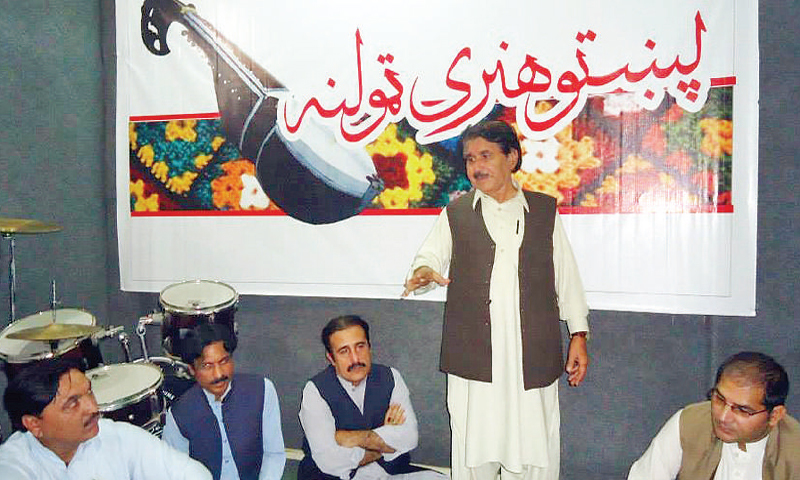
      Eminent Pashto poet Rehmat Shah Sail addresses participants at the launching ceremony of Awaz Training Academy in Peshawar on Tuesday. — Dawn

      PESHAWAR: Popular Pashto folk singer Gulzar Alam launched his own academy and audio studio named ‘Awaz’ in Khyber Super Market, Saddar, here on Tuesday. Mr Alam also launched an organisation ‘Pakhto Hunaree Tolana’ (PHT) for the welfare of artists and singers.

      Speaking as chief guest at the launching ceremony, noted Pashto poet Rahmat Shah Sail said that the need for an art academy was long felt in Peshawar. He said that opening an academy and audio studio would prove a milestone towards protecting and preserving the traditional Pashto music. He said that upcoming young artists would greatly benefit from the project.

      Gulzar Alam said that opening an academy was his great desire so that the young singers could know about the real Pashto music. “I was fed up with substandard music. My aim is to protect and revive traditional Pashto music and raise a strong voice for the genuine rights of my artists community. Abdullah, a resident of Taru Jaba village near Peshawar, is my first student; he is also studying at the University of Peshawar,” Mr Alam said.

      He said that CD culture had destroyed the Pashto music in the name modernity. He said that it not only harmed quality music, but also the quality of Pashto poetry suffered. “Now I want to save artists and art as both were suffering. I would launch a private endowment fund to help senior artists and singers,” he said.

      Gulzar Alam says his aim is to preserve music, raise voice for the artists’ rights
      Mr Abdullah told Dawn that he was in search of a perfect ‘ustad’ (teacher). He said that he was proud to be the first student at the academy where he would learn about history and art of singing. “Like me there are many young students who want to learn singing and playing traditional instruments like rabab, tabla, flute and harmonium, but they were not finding a place where training programme could be arranged,” he said.

      Mr Alam announced that regular classes for young artists would be started after 10th of Muharram. Young and educated people would be encouraged to take music classes, he said. Instrumentalists and vocalists would be taught Pashto music, the folk singer explained. “I am not against modern music, but I want to save the original Pashto music because it is the symbol of my Pakhtun identity,” he argued.

      “Launching such a project should be the responsibility of provincial culture department. Both art and artists have suffered a lot at the hands of militancy. I appreciate the efforts of Gulzar Alam who has always tried to save original Pashto music and raised voice for the welfare of artists,” Mr Sail maintained.

      Young singer Karan Khan said that Pashto music was being ruined in the name of modernity. He pointed out that artistes and singers had no voice to secure their genuine rights. The ‘Awaz’ academy, he said, would become a real voice of the art and artists in Khyber Pakhtunkhwa.

      Music director AR Anwar said that he had been running a studio in Karachi since 1980 to revive the traditional Pashto music. He said artists and singers could do so if they became serious about it.

      Octogenarian Pashto singer Ahmad Gul Ustad said that he would impart training to the young learners whenever they required, adding that Pashto music needed perfect ‘ustads’ to preserve and revive it in its original form.

      He said that serious poets and writers turned away from Pashto music industry due to its stress on too much commercialism. He said that most Pakhtuns knew that traditional music was an art, but only few knew about its basic science.

      Young researcher Noorul Amin Yousafzai regretted that serious efforts were not made for preservation of traditional Pashto music.

      He said that the art academy coupled with audio studio would definitely improve the situation. He asked the Khyber Pakhtunkhwa government to extend help to the private venture of the artists. The singers and poets who spoke on the occasion included Sarfaraz, Khalid Malik, Anwar Khial, Maaz Khan Wisal, Kamal Khan, Afsar Afghan and Israr Atal.

      Published in Dawn, October 29th , 2014


      [MENTION=1020]Feroz Afridi[/MENTION] [MENTION=1028]Yousafzai Pakhtun[/MENTION] [MENTION=1068]gadoonwal[/MENTION] [MENTION=1350]Gohar Nangyal[/MENTION]
      * * * * * * * * * * * * * * * * * * * * * * *

      Shukran ya Masr!!!

      Thanks to Egypt for supporting Bangladesh against Pakistani harassment and support for terrorists and war criminals!!

      Comment


      • #33
        Pashto-speaking Chinese welcome Afghan President's invitation

        (Xinhua) 13:17, November 02, 2014


        KABUL, Nov. 2 -- Chinese media practitioners, teachers and students, who have learned or are studying Pashto, Afghanistan's main language, welcomed the invitation extended by Afghan President Ashraf Ghani Ahmadzai to Pashto-speaking Chinese to spend a part of their careers in the country.
        During a recent interview with Xinhua, President Ghani expressed the hope that young Chinese learning Pashto and Dari will spend part of their career in Afghanistan and Afghans learning Chinese will become bridges with China and have part of their careers in China.

        "We will be delighted that Chinese youth are learning Pashto and Dari," he said, adding that he himself has spent part of his career in China, referring to his experience of serving as a World Bank official to visit China several times.
        President Ghani has just concluded a successful four-day state visit to China, the first country he visited since he took office in September.
        Director Xi Meng of the Pashto Section of China Radio International told Xinhua that he was glad that President Ghani has extended the invitation.
        "This will give me the chance to improve on my Pashto and my ability to understand Afghanistan and its people. Pashto has been playing a key role in my daily work ever since I graduated from the university around 10 years ago," Xi said.

        Although China and Afghanistan are neighboring countries, majority of the Chinese people only know Afghanistan as a country plagued by the Taliban-induced violence and terrorism, with a slim understanding of the rich Afghan culture and language.

        "But despite conflicts and violence, there is now more hope for peace and stability in this war-torn country. I am happy that Chinese and Afghan colleges have set up educational programs on each other's language," Xi said.

        Xi said that in subways in Beijing he often heard Afghan students speaking Pashto
        , adding that it is a pity that Chinese students are unable to travel to Afghanistan for studies due to security reasons.

        "I sincerely hope the country could achieve peace and national reconciliation so that Chinese students and investors could come to Afghanistan, which would definitely benefit both countries," Xi said.
        The Pashto Class of Communication University of China (CUC), from which Xi Meng has learned the language, enrolls only about a dozen students once in every four years.

        Shan Dan, a lecturer in Pashto at CUC, stressed the importance of education and people-to-people contact. "Education is always the driving force behind the development of a nation. As a scholar in Pashto language in China, I would like to contribute to the interaction between the two countries," Shan said.
        Students and faculty members at the CUC have expressed great expectations of spending part of their academic life in Kabul to further improve their command of Pashto.

        Jiang Zimin, the 20-year-old student in the CUC Pashto Class, told Xinhua that as one of the 13 students in the class, he was happy that President Ghani has realized the need to encourage the interest of Chinese youths to learn the Afghan language. "I am looking forward to exchange programs or job opportunities for Pashto-speaking Chinese in Afghanistan," Jiang said.
        Liu Jingbo, Jiang's classmate, said that he hoped he and his classmates in the Pashto class could help bridge the language and cultural barrier between the two countries and contribute to a more harmonious relationship between the Chinese and Afghan people.
        Two CUC Pashto class alumni, Wang Heng, a former Chinese diplomat, and Lin Jing, former correspondent in Xinhua's Kabul Bureau, have both worked more than a year in Kabul.
        Both Wang and Lin have expressed hope that under the stewardship of President Ghani and Chief Executive Abdullah Abdullah, Afghanistan will be able to overcome its security and economic problems and finally achieve peace and prosperity.


        [MENTION=1020]Feroz Afridi[/MENTION] [MENTION=1350]Gohar Nangyal[/MENTION]
        Last edited by Bengal_Tiger; 11-02-2014, 08:05 AM.
        * * * * * * * * * * * * * * * * * * * * * * *

        Shukran ya Masr!!!

        Thanks to Egypt for supporting Bangladesh against Pakistani harassment and support for terrorists and war criminals!!

        Comment


        • #34
          Related to the topic above:

          Pashto China Animation.mp4 - YouTube
          * * * * * * * * * * * * * * * * * * * * * * *

          Shukran ya Masr!!!

          Thanks to Egypt for supporting Bangladesh against Pakistani harassment and support for terrorists and war criminals!!

          Comment


          • #35
            LEMAR News 01 November 2014/ ۱۰ د لمر خبرونه ۱۳۹۳ لړم - YouTube


            Lemar news video from yesterday. Shows President Ashraf Ghani from 2.00 mins onwards.
            * * * * * * * * * * * * * * * * * * * * * * *

            Shukran ya Masr!!!

            Thanks to Egypt for supporting Bangladesh against Pakistani harassment and support for terrorists and war criminals!!

            Comment


            • #36
              Bengal-tiger
              many thanks.
              We are thankfull to you for your interest and contribution to pashtuns.
              This forum is yours.Pls feel free to speak your mind.


              Support pashto language and greater pukhtoonkhwa.

              pa prady jaba khabarai pakhtun naka
              be laila bala soda kho majnon naka
              gero jabo kre lahoo pa khpal tahzeeb ki
              be pakhtu ba de bal hestsok rastoon naka
              hamza baba
              پَښتو کښې اُولېکئ
              Pashto Keyboard Online (Afghan) LEXILOGOS >>

              Comment


              • #37
                Originally posted by gadoonwal View Post
                Bengal-tiger
                many thanks.
                We are thankfull to you for your interest and contribution to pashtuns.
                This forum is yours.Pls feel free to speak your mind.
                Manana gadoonwala wrora.
                * * * * * * * * * * * * * * * * * * * * * * *

                Shukran ya Masr!!!

                Thanks to Egypt for supporting Bangladesh against Pakistani harassment and support for terrorists and war criminals!!

                Comment


                • #38
                  Dr Sher Zaman Taizi (1931 to 2009): A quiet revolution in ink


                  By Hidayat Khan / Our CorrespondentPublished: November 4, 2014


                  Dr Sher Zaman Taizi. PHOTO COURTESY: DAMON LYNCH
                  PESHAWAR / KARACHI:


                  Writer, intellectual and researcher, Dr Sher Zaman Taizi was known not just for his penmanship, but also for the prolific nature of his work and his love for the Pashto language. The Pabbi born writer’s novels, blank verse, rhymed verse, short stories and academic documents come together in the published form under 32 titles in Pashto and English. Other work took the less formal arrangement of literary reviews and articles, published in both languages.
                  Born on November 3, 1931, Taizi was respected and lauded for his work during his lifetime, but after his death on December 22, 2009, the writer faces the threat of being pushed into literary oblivion by mere neglect and passage of time. He was even awarded a Tamgha-e-Imtiaz in the April of the year in which he died. Since then, not much ado has been made about the Pukhtun poet even though he fought hard with his pen to promote the language and the people it takes life from. The adabi jirga (literary society) which he presided over, the Kamil Pakhto Adabi Jirga, and the provincial government were unable commemorate his birthday with a single event.
                  The long and short of it
                  Many consider Taizi or Ghumjan—the nom de plume he used in the earlier days—to be among the first Pashto novelists. “When he began writing novels, the form was just an emerging trend in Pashto literature,” said the late Dr Muhammad Azam Azam about Taizi. Azam was quoted by Khurshid Iqbal Khattak in Dr Sher Zaman Taizi, a biography. Azam had said Taizi’s name was third on the list of great Pashto novelists, Shahibzada Idrees and Syed Rasul Rasa.
                  Taizi’s first novel, Gul Khan was well-received and is still taught in bachelor’s courses in Khyber-Pakhtunkhwa (K-P). In the preface he wrote for Gul Khan, his contemporary Professor Pareshan Khattak compared the novel with the work of Leo Tolstoy and Charles Dickens. The fictional work was not just lauded for its emphatic resonance with the highs and lows of Pukhtun culture but also for the beauty in its form.
                  “Gul Khan effectively highlights the truth of Pakhtunkhwali, its beauty and its wrongs, and draws a clear line between educated and illiterate Pukhtuns,” said Khurshid Iqbal in one of his works, which focused on the life and work of Taizi.
                  His second novel also gained almost immediate recognition, rated as a masterpiece by those who appreciated his leftist ideology. According to Khurshid Iqbal, Amanat speaks of building a revolutionary society where peace and prosperity prevail, in both social and political spectrums, without classism. Other famous novels include Rahman Korona, which weaves a tale from tribal feudalism, however, the plot transplants the story to the more urban bourgeoisie. Rahman Korona weaves a thrilling story, full of dramatic elements.
                  Not limited to overtly leftist or bright and shiny suspense novels, Taizi’s books also cover some satire and darker issues. Especially considering Ghunday and Wadah o Nasho or The marriage that did not take place.
                  The shortest short
                  Taizi’s short stories were published in different periodicals and dailies and were compiled in Sheplai. The book is considered to showcase one of the shortest stories recorded in Pashto literature, a three-sentence long story called The field.
                  “Sultana Bacha was killed. Mir Bacha was sentenced for life. And the field over which the two brothers were fighting over was usurped by others.”
                  The field might be the shortest and briefest of stories but it succinctly puts down one of the longest-running tragedies repeated in every second Pukhtun household.
                  When prose comes to verse, Taizi’s Warsho (1981) and Soma (1984) encapsulate his more personal side but is not tied down by direct reflections. His verses touch on the tragedy of Karbala, social inequity, the beauty of spring and romance.
                  His poem 1857, Taizi lies open the War of Independence with his progressive scalpel. Sala (counsel) chews out Pukhtuns who do not love their language or culture.
                  The former chair of the Pashto Academy in the city, Professor Mohammad Tair, said in an earlier interview with Radio Pakistan, “He is not only a good poet and of the conventional nazam; his blank verse is forceful, worthwhile and almost tasty, thanks to his choice of subject matter and depth of thinking. He added, “Taizi is inclined towards reformation and mysticism; his every nazam has a particular objective.”
                  “Taizi contended only a literate society can be peaceful and prosperous because such people could understand each other, their mutual problems and would be able to devise solutions,” said Khurshid Iqbal.
                  The writer’s focus on the Pukhtun intellect and culture was not appreciated by just his local peers. He made an impact which crossed continents. Damon Lynch, a cultural anthropologist and photographer from New Zealand found more in common in the scholar from Pabbi than many who surrounded him on a daily basis. Lynch told The Express Tribune via email, “I first met Dr Sher Zaman Taizi through our shared admiration of the great Bacha Khan. We soon formed a bond because of our love of intellectual and cultural life.”
                  Lynch, whose website also talks about his being inspired by Khan Abdul Ghaffar Khan, added, “[Taizi] candidly shared his insights with me. When I wrote a small essay in which I contrasted a section of his views on morality with those of Samar Minallah Khan, he immediately agreed to having it published, despite the fact that he knew my sympathies were more aligned with Samar’s views in this instance. I always admired his fearless and generous spirit. He remains an inspiration to me to this day.”
                  Taizi completed his PhD from University of Peshawar’s Area Study Centre, writing his thesis on the Saur Revolution of 1978.

                  Published in The Express Tribune, November 4th, 2014.

                  * * * * * * * * * * * * * * * * * * * * * * *

                  Shukran ya Masr!!!

                  Thanks to Egypt for supporting Bangladesh against Pakistani harassment and support for terrorists and war criminals!!

                  Comment


                  • #39
                    Students urged to respect poets as custodians of values

                    Sher Alam Shinwari

                    Published about 8 hours ago

                    PESHAWAR: The poets and writers are the protectors of social and cultural values, said Dr Rasul Jan, the vice-chancellor of University of Peshawar, here on Tuesday.

                    He was addressing as chief guest a bilingual -- Urdu and Pashto -- poetry recitation session organised by Peshawar University Teachers Association (Puta) at Agha Khan Auditorium.

                    Dr Rasul Jan said that young students should learn from the vision and imaginative flight of the poets. He urged students to respect and appreciate poets and writers. Poets recited poems depicting variety of emotions from romantic, serious, satiric to humorous.

                    About 40 Pashto and Urdu poets from Malakand, Dir, Swat, Charsadda, Mardan Swabi, Peshawar, Bannu and Fata participated in the annual event. Most poets depicted sufferings of people and political and social turmoil prevailing in the country in their poetic pieces.

                    Shazia Sadaf, a student, told Dawn that such events should be held frequently so that students could relieve themselves from tension and hectic study sessions. “I enjoyed this event very much along with my classmates. I suggest that female poets should also be given a chance to express themselves,” she said.

                    A large number of girl students living in various university hostels also attended the event.

                    “When I was president of Puta, I had launched this bilingual event way back in 1985 in which great literary giants like Ahmed Faraz, Ghani Khan and Amir Hamza Khan Shinwari were to be the chief guests. I want this event to be held twice a year as it triggers creative talent of the young poets,” said Dr Rasul Jan.

                    He recalled that earlier students had no taste for poetry and most often would hoot. “Once I threw a challenge to students if they would hoot and then invited a poet who recited a poem. The poet was Rahmat Shah Sail,” he said, adding the poem was about bomb blasts in Peshawar. There was a pin drop silence in the hall, he said.

                    Dr Fazl Nasir Qazi, the president of Puta, on the occasion said that Peshawar University would continue to provide such opportunities to students where they could hone their hidden talent. He said that keeping the worst situation in the country as well in the province in view, it became responsibility of the teachers to provide some moments of entertainment to young students.

                    Prof Abaseen Yousafzai, who presided over the function, recited an inspiring Pashto poem Ehtijaaj (protest) for which he received great applause from the participants.

                    Anwar Shadab, a young Pashto poet, too mesmerised the audience when he recited his poem, regretting that rest of the world preferred pens and books for advancement while Pakhtun nation was still craving for guns and bullets.

                    The lone woman poet Bushra Farrukh read out her beautiful Urdu poems.

                    Sajjad Juandoon, a young student, however, stole the show by reciting his poem. He expressed that young people should know their history, culture and national heroes.

                    Senior poets Dr Nazir Tabassum, Aziz Ejaz, Mushtaq Shabab, Sajjad Babar, Ghazi Sial, Abdur Rahim Roghani and Noorul Amin Yousafzai also participated in the event.


                    [MENTION=1020]Feroz Afridi[/MENTION] [MENTION=1028]Yousafzai Pakhtun[/MENTION]
                    * * * * * * * * * * * * * * * * * * * * * * *

                    Shukran ya Masr!!!

                    Thanks to Egypt for supporting Bangladesh against Pakistani harassment and support for terrorists and war criminals!!

                    Comment


                    • #40
                      I will recommend that Bengal Tiger may receive some especial appreciation thread or letter or medal from PF for his valuable contribution.

                      Comment


                      • #41
                        Jum'ah Mubarak!


                        [MENTION=1753]Manzareh[/MENTION] [MENTION=17579]Loy Afghanistan[/MENTION] [MENTION=4551]hamid954[/MENTION]

                        * * * * * * * * * * * * * * * * * * * * * * *

                        Shukran ya Masr!!!

                        Thanks to Egypt for supporting Bangladesh against Pakistani harassment and support for terrorists and war criminals!!

                        Comment


                        • #42
                          The art of peace ANP stalwart launches anti-war book


                          By Our CorrespondentPublished: November 15, 2014


                          The book is based on the proceedings of a two-day event held in April 2012. The talks held during the event were then compiled in written form by Lala.


                          PESHAWAR: Veteran politician of the Awami National Party, Afzal Khan Lala, launched his book ‘Da Pukhtano Pa Khawra Praday Jhagarha’ (Ghost war on Pakhtun soil) at a ceremony held at Peshawar Press Club on Saturday.

                          “Pukhtuns have not stood united as a nation since 1893,” said Lala while speaking on the occasion, referring to the year the Durand Line was drawn. “People cannot win without unity and Pukhtuns can never become a great nation unless they exhibit unity among them.”
                          Lala said Pakistan, Afghanistan and India should work towards bringing peace to their respective countries.

                          Pashto scholars and intellectuals can play an active role in bringing peace by using the power of their pens, but unfortunately, they are not writing anything positive in this regard, he lamented.
                          The book is based on the proceedings of a two-day event held in April 2012. The talks held during the event were then compiled in written form by Lala.
                          The event was an international one with participants from Afghanistan also in attendance. Speakers stressed on how peace could be restored in Pakistan and its western neighbour.

                          Published in The Express Tribune, November 16th, 2014.

                          * * * * * * * * * * * * * * * * * * * * * * *

                          Shukran ya Masr!!!

                          Thanks to Egypt for supporting Bangladesh against Pakistani harassment and support for terrorists and war criminals!!

                          Comment


                          • #43
                            Researcher praised for services to Pashto literature


                            Bureau report
                            Monday, November 17, 2014


                            PESHAWAR: Speakers at a function arranged on Sunday praised Prof Dawar Khan Dawood as a multi-dimensional researcher who served the Pashto language by contributing several books to its literature.

                            “He studied and taught English literature, but contributed 17 remarkable and research-based books and dozens of articles to Pashto and Urdu literature,” said Shah Aziz Mulazai at a gathering on Dawar Khan’s life and services arranged at the Research Library Peshawar.

                            “Dawar Khan has been granted a number of literary awards, including Presidential Pride of Performance in 2004, however, his greatest award is his work on Pashto folklore, Pashto dictionary, Pashto idioms and proverbs, Pashto riddles and Pashto grammar, etc, which are equally used by locals and foreigners,” he said.

                            Prof Dr Yar Muhammad Maghmoom talked about Dawar Khan’s work in different fields of literature. He said Dawar Khan had contributed a lot to biographies, criticism, book reviews, translation from English literature into Pashto and vice versa, travelogue, and much of his work has now attained the level of classics.

                            Pashto World Congress Chairman, Saleem Raz, said Dawar Khan remained a devoted and selfless researcher. He recalled his contributions as a senior researcher of Pashto Adabi Board, President of Rahman Adabi Jirga and editor of Pashto Monthly Tatara. He said Dawar Khan is a guiding example for the so-called Pashtoon leaders who never contributed to Pashto language during their rule and authority.

                            Prof Dawar Khan Dawood said he spent much time in writing for school and college teachers on educational methodologies. The audience asked him questions about his achievements.A former minister and poet, Abdul Subhan Khan, speaking as a chief guest, praised Dawar Khan for promotion of the Pashto literature.

                            * * * * * * * * * * * * * * * * * * * * * * *

                            Shukran ya Masr!!!

                            Thanks to Egypt for supporting Bangladesh against Pakistani harassment and support for terrorists and war criminals!!

                            Comment


                            • #44
                              Prof Dawar’s literary services eulogised

                              Bureau Report

                              Published about 16 hours ago

                              PESHAWAR: Speakers at a seminar paid tribute to prominent researcher and writer Prof Dawar Khan Dawood, saying that his contribution to promotion of Pashto was unmatched.

                              “Prof Dawar has contributed a lot to biographies, criticism, book reviews, and translations from English literature to Pashto and vice versa and travelogue, and much of his work has now attained the level of classics,” said prominent educationist and writer Prof Yar Mohammad Maghmoom while addressing a seminar on Prof Dawar’s life and services here at Research Library Peshawar.

                              He highlighted Prof Dawar’s work in different fi elds of literature. He said that his critical and comprehensive book on Pashto Tapa (genre of folk poetry) had been published for 18 editions and due to the intrinsic value of his books most of these were included in curriculum of various universities.

                              “In addition to his contribution to Pashto transliteration, folklore, history and dictionary, he is a poet of sweet taste and many of his songs and Na’ats are famous in public,” he said.

                              “Prof Dawar, 75, is a multi- dimensional researcher, who studied and taught English literature, and contributed 17 research-based books and dozens of articles to Pashto and Urdu literature,” said writer Shah Aziz Mulazai. He said that Prof Dawar had won several literary awards, including the Presidential Pride of Performance in 2004, but his greatest award was his work on Pashto folklore, Pashto dictionary, Pashto idioms and proverbs, Pasto riddles and Pashto grammar, etc, which were being used by locals and foreigners.

                              Speakers term his contribution to promotion of Pashto unmatched.
                              Pashto World Congress chairman Saleem Raz narrated his 50-year association with Prof Dawar and said that his contributions as a senior researcher of Pashto Adabi Board, as president of Rahman Adabi Jirga, and as an editor of Pashto monthly ‘Tatara’ would always be remembered.

                              He said: “Prof Dawar is an example for the so-called Pakhtun leadership who never contributed to Pashto language during their rule and authority.”

                              Prof Dawar told the participants that he had spent much of his time on writing for school and college teachers on educational methodologies. “I think that is the excellent time I invested on my nation and language,” he said.

                              Former provincial minister and poet, Abdul Subhan Khan was the chief guest who appreciated the role of Research Library Peshawar in promoting peace through education and research. He paid tribute to the outstanding services of Prof Dawar for over 50 years.

                              Published in Dawn, November 17th, 2014

                              * * * * * * * * * * * * * * * * * * * * * * *

                              Shukran ya Masr!!!

                              Thanks to Egypt for supporting Bangladesh against Pakistani harassment and support for terrorists and war criminals!!

                              Comment


                              • #45
                                Peshawar event celebrates Malala’s Nobel award


                                By Hidayat Khan / Photo: Muhammad IqbalPublished: November 19, 2014


                                Students, poets and singers perform at event organised by Mian Rashid Husain Shaheed Foundation.

                                PESHAWAR: Hundreds of school students gathered at the Nishtar Hall on Tuesday to celebrate the Nobel peace prize win of Malala Yousufzai organised by Mian Rashid Husain Shaheed Foundation – made after the name of Mian Iftikhar Hussain’s son, who was gunned down by suspected militants in 2010.
                                Tributes were paid to Malala for her courage to stand against militancy and to raise voice for children’s right to education. Speeches, poems and songs by young students, poets and singers were the highlights of the event where participants resolved to fight against forces of darkness and condemned those who deface Malala.

                                “Even today the girls are deprived of their basic rights not only in Pakistan but also in developed countries,” told Malala Yousufzai in a speech specially recorded for the event in Pashto. She gave a strong encouragement to women to do struggle for their rights.

                                “I want to see [every] girl of the country to have books and pen in her hands and going to school,” Malala said. She said that the change in our society can come only if we continuously struggle for it.

                                She said that not only in Pakistan but in developed countries women’s rights are being ignored and if we want to get proper opportunities for all, honour and equal rights, we have to continue our struggle for it.
                                Malala added no ‘cruel’ force or hurdle can stand in our way if we stand firm in securing our rights. “It is time that the woman becomes doctor, engineer and even the prime minister of the country,” she concluded, emphasising on the constructive roles which women can play.

                                Children from Meritorious Central College, Bacha Khan School, Jinnah Public School, Forward Public School, Khpal Kor School and Ghazali Model School attended the gathering.

                                Rahim Khan Rahim, a senior Pashto poet in his poem condemned all those who doubted the achievements of Malala and maligned her name on different pretexts and did not even celebrate the Nobel Prize she won for the country.
                                Rahim in his poem also asked the audience about unity. “If the Pakhtun were united today, they would never be in such situation,” he said in one of his verse in Pashto.

                                Children of one of the schools also explained through skits how girl schools were destroyed by militants in Khyber Pakhtunkhwa and Federally Administered Tribal Areas (FATA).

                                Bakhtiar Khattak performed his song ‘Toba da tooray, toba la janga’ while young singer Ali Baba Khan sang his debut song Khudaya sanga zindagi da pa de Khawra which was well appreciated by the young gathered at hall.
                                “Malala is not an individual but a mindset,” said Mian Iftikhar Husain, general secretary Awami National Party (ANP).

                                He criticised the K-P government for not taking a concrete stand against militancy. “They don’t even have courage to make the militant angry,” said Iftikhar.

                                * * * * * * * * * * * * * * * * * * * * * * *

                                Shukran ya Masr!!!

                                Thanks to Egypt for supporting Bangladesh against Pakistani harassment and support for terrorists and war criminals!!

                                Comment

                                Working...
                                X