Announcement

Collapse
No announcement yet.

Pashto Focus

Collapse
X
 
  • Filter
  • Time
  • Show
Clear All
new posts

  • #16


    An Eid greeting in Pashto. Eid is approaching soon and Pashtuns, who are pious Muslims, are getting ready to celebrate this holy occasion.


    Pashtuns in Junoobi Pakhtunkhwa, Quetta during an Eid prayer.
    * * * * * * * * * * * * * * * * * * * * * * *

    Comment


    • #17
      Will change in medium of instruction improve education in KP?


      By Bushra Rahim
      Published Sep 28, 2014 06:43am

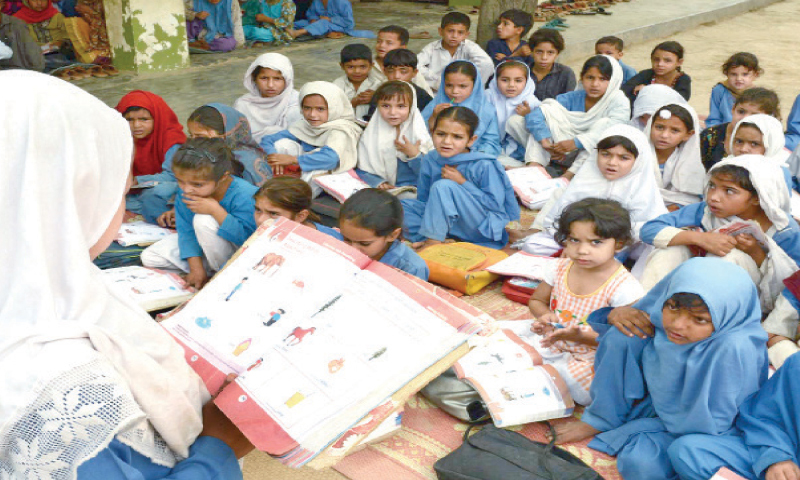
      ‹ › Students study in the open at a school in Peshawar. — Dawn


      The Khyber Pakhtunkhwa government, led by Pakistan Tehreek-i-Insaf, has changed the medium of instruction in public schools from Urdu to English from April 2014. The arguments put forward for this change in the medium of instruction were to bring public schools at par with private schools in the province and provide uniform education to all the children.
      However, its seems that before introducing the drastic step the KP government did not refer to any research or study on the subject to find answers to some key questions like; What is the preferred medium of instruction by parents, students and teachers? What is the impact of change in medium of instruction on educational outcomes e.g. completion of primary education cycle? What does international research on the subject tell us about?
      In order to understand the perceptions of stakeholders about their preferred medium of instruction we need to know first about the most commonly spoken languages in KP. According to 1998 Census, 74 per cent population of KP speaks Pashto whereas 3.9 per cent Seraiki, 1 per cent Punjabi, 0.8 per cent Urdu and 20.4 per cent speak other languages. A more recent household survey by Annual Status of Education Report (ASER) 2012 shows that the four commonly used languages in the province are: Pashto (77 per cent), Hindko (11 per cent), Seraiki (3.5 per cent), Chitrali (3 per cent) and others (5.5 per cent).
      Now do parents prefer mother tongue as the medium of instruction in schools? Research conducted on the subject in Pakistan and especially in KP shows that parents want their children to be educated in their mother tongue. For instance, one of the recommendations of a British Council Report, 2012, which was based on a case study in KP as well as consultations and policy dialogues at national level, was: “There is evidence that many people are strongly attached to their languages and wish to educate their children through those languages”. Another study by the ASER, 2012, which was based on a survey involving 13,702 households in 23 districts of Khyber Pakhtunkhwa, showed that 45 per cent households in KP preferred Pashto as medium of instruction whereas 39 per cent preferred Urdu as the medium of instruction in schools. These surveys indicate that the decision of the KP government to change the medium of instruction to English is not aligned with the demands of the parents and other stakeholders in the province.
      Even the primary school students and teachers are opposed to the idea of the government. During a visit to a girls’ primary school in Peshawar last year, while collecting research data, it was revealed that a certain school had two female teachers teaching six grade levels (from katchi/pre-primary to grade 5). The only language the teacher could speak was Urdu whereas the students could not understand Urdu as their mother tongue was Pashto. The students of grade 4 and 5, who were sharing the same classroom and being taught by one of the Urdu speaking teachers, complained that due to the language barrier between them their precious learning time is being wasted.
      This means that even if the children are in school they are not learning much that is of value. So if the students have problems in understanding a teacher speaking Urdu, one can imagine how difficult it would be for students to understand their teachers when they are speaking English while everyone is aware that most of the primary school teachers are hardly able to speak a sentence in English.
      The second question, which is usually ignored in policy discourse, is about the impact of medium of instruction on children’s educational outcomes e.g. their ability to complete primary education cycle (katchi/pre-primary to grade 5). Research on the subject revealed that medium of instruction (Urdu) was negatively associated with primary completion rate during the primary school academic cycle 2007-12 which means that the completion rate decreased by 0.7 per cent during the period as compared to the academic cycle 2002-07. The shift in the policies of the successive governments from Urdu to mother tongue (Pashto) and from mother tongue to Urdu during the two academic cycles is one of the factors in the declining educational outcomes. The decision of the political governments is also manifested in EMIS statistics, for example, the ratio of Urdu versus Pashto medium schools in 2005 was 52:46 which increased to nearly 60:40 after 2007. Hence, the ill-planned policy of the government is increasing the number of out of school children in the province.
      Researchers argue that the best medium for early education is the language a child already knows and to which a child is naturally exposed in his/her social environment. Besides, studies also indicate that children, who learn in native languages stay in school longer, do better on tests, and repeat grades less often than students who do not get instruction in familiar language. English is not the medium of instruction even in developed countries like China, Germany, Japan, South Korea, France, etc.
      Finally, the government’s argument for the change in medium of instruction, that is, to bring public schools at par with private schools in the province, is also shaky and baseless. It is a misconception that just changing the medium of instruction in public schools from Urdu to English will bring them at par with private schools. Many factors such as school resources, curriculum, teachers’ motivation, training and accountability, parents’ education and socioeconomic status contribute to improving educational outcomes. Simply changing the medium of instruction will achieve nothing unless all these other variables are addressed as well.
      The Khyber Pakhtunkhwa government needs to reconsider its decision and take steps for implementation of the decision of the previous government to embed mother tongue as medium of instruction in primary schools.


      Published in Dawn, September 28th, 2014

      http://www.dawn.com/news/1134809/wil...ducation-in-kp
      * * * * * * * * * * * * * * * * * * * * * * *

      Comment


      • #18
        Imran Khan and his genius party does not know that in Europe the medium of education is their mother tongue. English is just an optional language.
        Ufffffffffffff...... These idiots will destroy everything.

        Comment


        • #19


          [MENTION=1020]Feroz Afridi[/MENTION] [MENTION=1028]Yousafzai Pakhtun[/MENTION]
          Last edited by Bengal_Tiger; 09-28-2014, 10:04 PM.
          * * * * * * * * * * * * * * * * * * * * * * *

          Comment


          • #20
            Originally posted by Bengal_Tiger View Post
            A different lens: The scientific roots of classical Pashto poetry

            Dr Qazi Hanifu*llah Hanif explai*ns how there is more to our lyrica*l verses than love and war.
            By Hidayat Khan
            Published: September 1, 2014


            Share this article Print this page Email

            Dr Qazi Hanifullah Hanif explains how there is more to our lyrical verses than love and war.


            PESHAWAR: Pashto poetry is popularly known as relating to either love or war. Modern scholars, however, are starting to dig deeper to the ‘scientific core’ of Pukhtun verses.
            “This region’s classical poetry contains many unnoticed scientific underpinnings,” Dr Qazi Hanifullah Hanif tells The Express Tribune. Hanif, 56, has recently completed his doctorate from the Pashto Academy at the University of Peshawar—with which he has been affiliated since 1986—on a previously-untouched topic: Scientific thoughts in Pashto poetry. His six years of research was supervised by senior Pashto academician Pervaiz Mahjoor and former chairman of the chemical science department at UoP, Imdadullah Khan.
            Hanif tells us there might be a much deeper meaning to Pashto poetry than what meets the eye, but the poets have gotten little credit in this regard. Poetry has long been used as a voice for philosophical and scientific thought in many parts of the world. Amongst Pukhtuns, however, writing is usually categorised into love, war, or in certain cases, Sufi mysticism. Hanif claims in his thesis many brilliant thoughts have thus gone unobserved.
            “There are still people who believe poetry is (only) about feelings and emotions, while science is about facts,” said Hanif. “Nothing could be further from the truth.”
            He added the classical poetry of Mirza Khan Ansari, Kazim Khan Sheda, Rahman Baba, Khushal Khan Khattak and modern poets like Hamza Baba, Shamsul Qamar Shams and Dr Muhammad Azam, contain knowledge of physics, astronomy, chemistry, biology, mathematics, medicine and botany. These are also the seven fields into which the doctor’s thesis is divided.
            The famous verse of Khushal Khan Khattak ‘Dur au gohar’ explains the creation of human beings. The verses of Kazim Khan Sheda discuss mercury and its use to measure temperature.
            On the other hand, Hamza Baba and Rahman Baba talk about how everything in the universe has been created in pairs and use that to explain Creation—a notion many classical western intellectuals would agree with. A verse written by the great Sufi Rahman Baba:
            Also in Hamza Baba’s poetry can be found a reflection on the creation of different metals and precious stones inside the earth.
            “He speaks of the centuries of chemical reactions it takes for such rare minerals and stones to form,” said Hanif. “Whether our poets have reached these profound meditations consciously or unconsciously, their work is a tribute to the superiority of their thoughts.”
            Mirza Khan Ansari, a famous classical Pashto poet, has discussed the reduction of oxygen and intensity of fires as one goes uphill.
            Another verse of his talks of budding and grafting techniques – a process whereby tissues from two different plants are merged to create a new one. These horticultural techniques have now become a popular method of breeding new fruits and plants, especially roses.
            The researcher said although he is proud of classical Pashto poets, he is not content with the quality of work produced by contemporary writers. Only a few of them are committed enough to lead our nation to a brighter future, he adds.

            Published in The Express Tribune, September 1st, 2014.

            http://tribune.com.pk/story/756304/a...pashto-poetry/
            Great work by the author and Pashto academy but I love art for art sake not for other things. Poets are not scientists. Wordsworth was not a botanist when he wrote his Daffodils.

            Comment


            • #21
              [QUOTE=Bengal_Tiger;750557]Out of print, out of mind: A great Pashto poet slips through the pages

              Khyber Afridi’s work remain*s unpubl*ished due to lack of financ*es, offici*al patron*age.
              By Hidayat Khan / Creative: Munira Abbas
              Published: September 9, 2014


              Share this article Print this page Email

              Khyber Afridi’s work remains unpublished due to lack of finances, official patronage. DESIGN: MUNIRA ABBAS

              PESHAWAR: He may be one of the most respected poets of his generation, but most of Khyber Afridi’s poetry remains unpublished. Enthusiasts would be hard pressed to find any printed works today as these are quite rare.

              From Said to Khyber
              The poet was born as Said Ahmed Jan in Jamrud in 1962, later taking Khyber as his pen name. He became one of the most renowned poets from Khyber Agency and was one of the contemporaries of rhymesters Lal Zada Nazir Shinwari, Ameer Hamza Khan Shinwari and Khatir Afridi.
              A naturally gifted poet, Khyber Afridi sought the advice of peers such as Amir Zada Nazir and Hamza Baba when writing. It is said Afridi and Nazir would correspondent frequently through letters. Other renowned poets who influenced Khyber’s work were Murad Shinwari, Farooq and Saghir Afridi.
              He would often write about social ills plaguing the agency for centuries. One of his famous ghazals, Da Torkham de, da Torkham de, delta har gadam nakaam de’ (This is Torkham, this is Torkham, where there is suffering at every step), was performed by a number of singers.
              Erasure
              As focus remains on just a handful of poets, many of the greats who contributed to Pashto literature are being forgotten.
              “People are forgetting his poetry,” said Adil Reshtan, one of his sons. “The books on his work which were published in his lifetime are also rare and not available to the public.”
              Reshtan said locals have shown much love and respect for Khyber, but officials such as the political agent have to ensure that his work is published for the benefit of the readers.
              During his lifetime, Khyber published five books, including his prose Garzinda and poetry books Ranra, Pechomi and Drand.
              Two works of prose Darugar and Pukhtana Nomuna remain unpublished along with one body of poetry Shaan.
              Family love
              His unpublished work has been meticulously gathered by his family but they lack the finances to get it printed. Reshtan claims the political agent has promised time and again to help put his father’s poetry into print, but has never delivered.
              His son recalled Khyber had a tremendous sense of humour; audiences would be in stitches during his comedy show Jawab Rasan for Radio Pakistan in 1988. Reshtan remembered his father and Khatir Afridi would recite comic verses and each would try to outdo the other while Murad and Nazir Shinwari would egg them on.
              Reshtan urged the Khyber-Pakhtunkhwa governor and the political agent to help publish the great poet’s work before it completely slips through the cracks of time.
              Khyber was also the head of the Khyber Qaumi Pashto Adabi jirga and would moderate poetry sessions at the gathering.
              Muqadar Shah Muqadar, a researcher who published a book on the poetry of Khyber Agency, said the poet held a prominent position among Pukhtun writers. He added although Khyber was influenced by classic Pashto literature, he also adopted modern techniques.
              “Khyber fulfilled the role of a poet, of someone who guides society,” said Muqadar.
              Published in The Express Tribune, September 9th, 2014.


              @Feroz Afridi[/QUO
              Who will spend money on Pashto works as Pashtuns themselves hate reading Pashto.

              Comment


              • #22
                Originally posted by Bengal_Tiger View Post
                What a news! This is my life long wish that Indian Pashtuns and tribes like nyazis,muhammadzai,jadoons,tareens,lodhis etc learn Pashto.

                Comment


                • #23
                  * * * * * * * * * * * * * * * * * * * * * * *

                  Comment


                  • #24
                    Last edited by Bengal_Tiger; 10-05-2014, 09:31 AM.
                    * * * * * * * * * * * * * * * * * * * * * * *

                    Comment


                    • #25


                      Eid Mubarak!
                      * * * * * * * * * * * * * * * * * * * * * * *

                      Comment


                      • #26
                        Rabia Anum congratulates Malala in ‘Pashto’

                        E-Choice Pakistan

                        3 hours ago


                        KARACHI: Pakistan’s renown news caster Rabi Anum has surprised everyone as she congratulated Malala Yousafzai in ‘Pashto’ language.

                        The news caster congratulated Malala over winning the Nobel Prize for the country in the different language you don’t see her speaking.

                        Rabia presented this unique congratulation to Malala after few hours of the announcement in news bulletin.

                        Malala who is also a Pashto speaker belonged to Swat valley, where she was attacked by the terrorists.


                        * * * * * * * * * * * * * * * * * * * * * * *

                        Comment


                        • #27
                          * * * * * * * * * * * * * * * * * * * * * * *

                          Comment


                          • #28
                            Da pakhto fitrat me dumra islami de

                            che islam na vy,bya hm muslman vy.
                            Last edited by ghumbasa; 10-19-2014, 03:40 AM.
                            sigpic"When it is said to them: "Make not mischief on the earth," they say: "Why, we only Want to make peace!" (2.11)

                            And when it is said to them (hypocrites): "Believe as the people (followers of Muhammad Peace be upon him , Al-Ansar and Al-Muhajirun) have believed," they say: "Shall we believe as the fools have believed?" Verily, they are the fools, but they know not."(2.13)

                            Comment


                            • #29
                              Pohantoon Adabi Stori holds literary session

                              By Bureau Report
                              Published a day ago


                              PESHAWAR: Pohantoon Adabi Stori (PAS) comprising young poets and writers held its weekly literary critical appreciation session at the Faqir of Ipi Park, University of Peshawar, on Friday.

                              Asfar Afghan, a young poet from Shangla, presided over the session while noted poet and critic Abaseen Yousafzai conducted the function.

                              Mobeen Ihsas Afridi, a young poet from Bara, Khyber Agency, presented his poetic piece (ghazal) for critical appreciation.

                              The participants critically evaluated and mentioned the merits and demerits of the literary piece.

                              This was followed by a Pashto ‘mushaira’ in which Shahid Ali Shahid, Sikandar Khan Hayat, Rashid Khan Rashid, Fitrat Buneri, Shoaib Khan, Wisal Khattak, Talash Afridi, Asghar Ali Shabnam , Saeed Anwar Azad, Ameenullah, Yasir Bacha, Ayanullah Ajiz, Sirajul Haq, Qari Atiq Jan, Mohammad Khan Naseeb, Nadeem Khattak, Mohammad Shahid Taheri, Mullah Jan Mansha, Akhtar Nagiyal, Sajjad Ihsas, Hikmatullah, Sawar Shah Benawa and Shakil Hazrat recited their poetic pieces.

                              A local poet, Azeem Shah Azeem, said that Pashto language needed experts on prose and fiction more than just poets.

                              “I remember last year Sajjad Juandoon presented a beautiful pen-portrait titled ‘Full Professor’ which was a good beginning,” he observed.

                              Abaseen Yousafzai told Dawn that young poets and writers needing literary grooming had no proper place for literary debate anywhere on the campus.

                              He said that with the help of his colleagues he founded PAS last year to provide young literati with a platform where they could openly speak out their hearts and minds.

                              “Such productive sessions for grooming young people will inculcate a sense of confidence among them and inspire them to float creative ideas,” Mr Yousafzai argued.

                              PAS was formed a year ago to groom the budding Pashto poets and writers studying in different departments of Islamia College Peshawar and UoP.

                              The number of its members has swelled from just a few at its launch to 60 as the association would celebrate its founding day on coming Friday.

                              Published in Dawn, October 18th, 2014


                              [MENTION=1020]Feroz Afridi[/MENTION] [MENTION=1068]gadoonwal[/MENTION] [MENTION=1028]Yousafzai Pakhtun[/MENTION]
                              * * * * * * * * * * * * * * * * * * * * * * *

                              Comment


                              • #30
                                Originally posted by Badlun View Post
                                Che warta zrha wayee bas hagha kawi
                                Kani zamong war poray khulay starhi di

                                True nature of Pashtuns beautifully explained in this verse. Pashtuns follow their hearts not their minds and do not heed to advices .

                                Also Baheer, the tradition of collecting wood is a proof that Pashtun women without Islamism are free to move and engage in economic activity but this is Islamism which stop them doing so and compel them to stay in the 4 walls of their houses like prisoners.
                                Pashtuns women still work ..with or without so called word islamism you are reffering to islam by degrading it.Muslim women are not stopped or prohobited by islam not to go out in economic fields.Khadija ra was a businesswoman.Khola ra was a warrior even.Many sahabia ra used to provide medical aids of their time to injured during wars.
                                Many sahabia ra used to go out for different jobs...

                                situation today is different.Pashtun women now need pen rather than woods in their hands to pick up from hills.Survival doesnt come without awareness.
                                sigpic"When it is said to them: "Make not mischief on the earth," they say: "Why, we only Want to make peace!" (2.11)

                                And when it is said to them (hypocrites): "Believe as the people (followers of Muhammad Peace be upon him , Al-Ansar and Al-Muhajirun) have believed," they say: "Shall we believe as the fools have believed?" Verily, they are the fools, but they know not."(2.13)

                                Comment

                                Working...
                                X