Announcement

Collapse
No announcement yet.

Yemen watch

Collapse
X
 
  • Filter
  • Time
  • Show
Clear All
new posts

  • #31
    SAUDI LAUNCHES MILITARY ACTION!


    Saudi Arabia launches military operations in Yemen

    By Steve Almasy, Hakim Almasmari and Jason Hanna, CNN
    Updated 8:25 PM ET, Wed March 25, 2015


    (CNN)Saudi Arabia has launched military operations in Yemen, the Saudi ambassador to the United States told reporters in Washington on Wednesday.

    Adel al-Jubeir said the operation consisted of airstrikes on more than one city.

    "We are determined to protect the legitimate government of Yemen," he said.

    A senior Arab diplomat told CNN that the Gulf Cooperation Council soon will issue a statement that the Yemenis have asked for military assistance and the GCC is prepared to step in. It will be signed by all GCC countries except for Oman. Not all countries will contribute military forces, the source said.

    Arab and senior administration officials from the United States told CNN that an interagency U.S. coordination team is in Saudi Arabia. The sources said the Saudis have not specified what they want yet, but will likely ask for American air support, satellite imagery, and other intelligence.

    Al-Jubeir said the United States is not involved in the airstrikes....
    Saudi Arabia has launched military operations in Yemen, the Saudi ambassador to the United States, Adel Al-Jubeir, said in Washington on Wednesday.


    The Saudis start their military campaign in Yemen!

    The volatile middle east sees more conflict!
    Last edited by Bengal_Tiger; 03-25-2015, 09:39 PM.
    * * * * * * * * * * * * * * * * * * * * * * *

    Comment


    • #32
      SAUDI HAS DECLARED CONTROL OF YEMENI AIR SPACE

      - Also naval blockade of Yemen is reported to be expected.

      i.e. Saudi will take control of Yemeni sea and air.

      The land however is not in their hands and the two big cities are in the hands of the Houthi militia.


      Personally I expect a Syrian style take over of Lebanon as in the 1980s when the Syrian army went in to Lebanon and became the ultimate power in the country though Lebanon was still independent.

      Saudi did the same with Bahrain a few years back which is now unofficially the 14th province of Saudi Arabia.


      Saudis during their invasion of Bahrain.


      Saudi may even consider a de facto (but not de jure) annexation of Yemen e.g. the Yemeni "government" officially "requests" Saudi forces to "help" "protect" their country's borders.
      * * * * * * * * * * * * * * * * * * * * * * *

      Comment


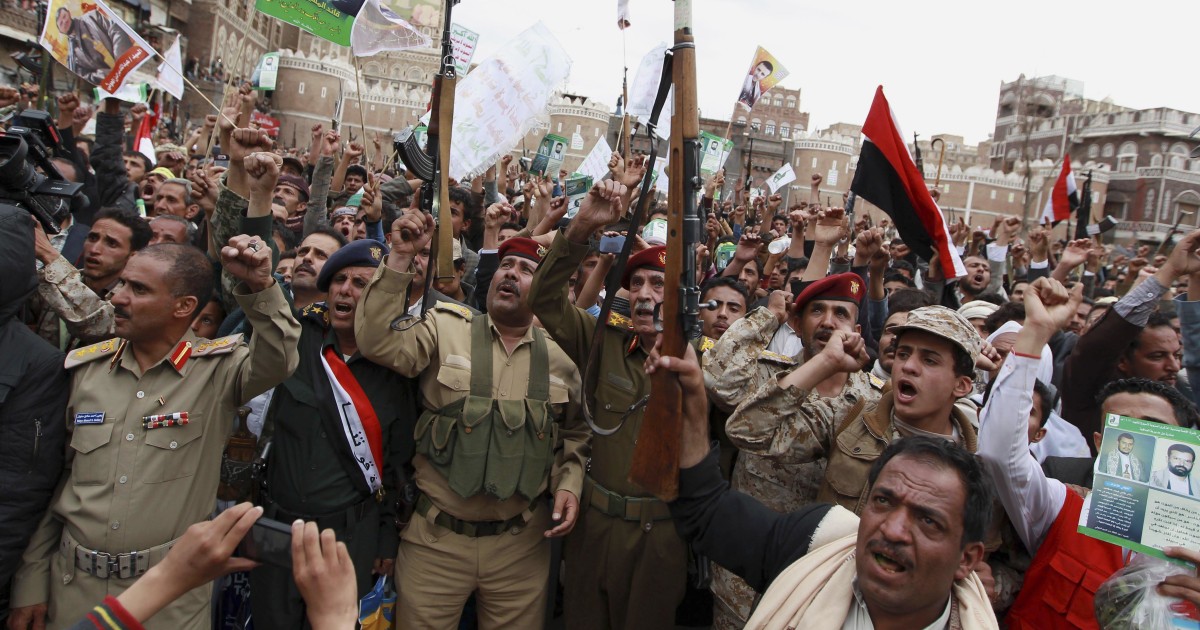
      • #33
        EGYPTIAN NAVAL FORCES REPORTED TO BE NEXT TO THE YEMENI COAST.


        - Saudi is reported to have sent 100 fighter planes to bombard Houthi positions.

        This is a massive attack!


        - Egypt is said to be readying possible deployment of army, naval and air forces to help with this Saudi-led pan-Arab operation.


        Egyptian soldiers.


        A pan-Arab "peace keeping" force may occupy the country at the "request" of the Hadi government, in other words Arab states may take control of Yemen, with Saudi leading.
        * * * * * * * * * * * * * * * * * * * * * * *

        Comment


        • #34
          Originally posted by Brown Skinned Savage View Post
          You weren't born in the 90's. What does aligning yourself with an ideology have to do with when you were born? Nothing at all.

          You have some weird fetish for urine drinking it seems. You must have learned it from Banghwali_Thormukh Who has n inferiority complex and wants to be Pashtun.
          Its has everything to do with my age, becuase you dum camel claim that I am a runaway communist.
          By your imbecil logic I was a baby communist who was the head of Khad and killed and turtured people with my toys, and I had to flee the country.
          DUM ASS

          Comment


          • #35
            No it has nothing to do with it .That's like saying someone can't be a Radicalized Taliban supporter because they're 25, you're definitely not 25, you're probably older than I am, especially considering you regurgitate the same commie rhetoric of the past.

            Baby Communist; please you aren't fooling anyone.

            Comment


            • #36
              Update:


              - TURKEY SUPPORTS SAUDI CAMPAIGN.

              Turkey has called for Iran and the Houthi militia "Ansarullah" .

              Erdogan said the conflict has evolved into a sectarian one and urged Iran to withdraw. "Iran has to change its view. It has to withdraw any forces, whatever it has in Yemen, as well as Syria and Iraq and respect their territorial integrity."


              - PAKISTAN SUPPORTS SAUDI


              SAUDI & EGYPTIAN ARMIES TO LAUNCH A GROUND OFFENSIVE (INVASION) OF YEMEN


              The GCC (excluding Oman which neighbours Yemen and is ruled by non-Sunni Ibadis), Jordan, Morocco, Egypt, Sudan, Turkey and Pakistan (albeit not openly or officially being their typical two-faced deceitful selves) all support Saudi in this.


              The big Muslim countries which have said nothing and probably want nothing to do with this are:

              - Indonesia

              - Malaysia

              - Algeria


              Commentary:

              So the Saudis and the Egyptians who they are bankroll and are dependent on Saudi largesse for survival will be sending their armies in to Yemen.

              The problem is Yemenis are a tribal society where small arms e.g. kalashnikovs are plentiful and abundant.

              Yemeni society is independent and nationalistic (Yemeni civilization is far older and superior to the Arabs of the interior of the peninsula) and Yemenis would dislike foreigners coming in.

              Will Yemen become a quagmire for Saudi Arabia?

              On the Pakistani hate-site, defence.pk, there has been nonsense written about Saudi "annexing" Yemen. Saudi is struggling to feed and meet the needs of its current population of 28 million so why not add another 24 million Yemenis whom the Saudis have to feed, clothe, provide jobs for or make equal to Saudis.

              This is just another reflection of the low quality drivel one can find on that site heavily infested as it is with racists, trolls and chest-beating nationalists.

              If the Saudis find that Yemen is a quagmire and that Yemeni guerillas carry out a long war of attrition against them financially damaging them and killing their soldiers then the Saudis will suffer.

              We will have to wait and see what happens.


              PUTIN HAS CALLED FOR PEACE IN YEMEN AND A CEASE-FIRE.


              Russia's President Vladimir Putin called for an "immediate cessation of military activities" in Yemen in phone conversations with Iran's President Hassan Rouhani, the Kremlin said in a statement on Thursday.
              MOSCOW (Reuters) - Russia's President Vladimir Putin called for an "immediate cessation of military activities" in Yemen in phone conversations with Iran's President Hassan Rouhani, the Kremlin said i...


              * * * * * * * * * * * * * * * * * * * * * * *

              Comment


              • #37
                Speaking of the defence.pk, Pakistani hate site here is an example of the daily nonsense you get in that forum:


                An Indian quotes a Saudi troll who says: "What, do you deny that you are sucking this filthy Iranian's c*ck in this thread by licking his posts?"

                The Saudi troll who wrote that used to be a "moderator" on the forum.

                This is the same website where Bangladeshi Jamaatis come online and lament the existence of an independent Bangladesh and conspiracy theories of how 60-70% of Bangladeshis are Turkic-Arabic blood etc (nonsense) and that Bangladesh is ruled by India (nonsense).

                Arab and Iranian trolls exchange insults and abuse on a daily level in that forum and there used to be open ISIS supporters there.

                These are Mahmood Al-Yemeni type trolls and the best thing to do them is simply to ignore them and not go down to their (low) level.
                * * * * * * * * * * * * * * * * * * * * * * *

                Comment


                • #38
                  Originally posted by Brown Skinned Savage View Post
                  No it has nothing to do with it .That's like saying someone can't be a Radicalized Taliban supporter because they're 25, you're definitely not 25, you're probably older than I am, especially considering you regurgitate the same commie rhetoric of the past.

                  Baby Communist; please you aren't fooling anyone.
                  You are a dum camel.

                  Comment


                  • #39


                    Yemenis apparently shot down a Sudanese plane (some say Saudi).

                    The funny thing is how relaxed these Yemeni fighters are whilst chewing their qat.

                    Yemen is a tribal society where everyone has guns. Fighting and blood feuds are common.

                    Even if 1/3 of Yemen's 24 million people fight against the Saudis that's 8 million, the Saudis will have no chance of conquering Yemen.

                    Even if they did conquer it, they wouldn't be able to handle the subsequent guerilla war of attrition.
                    Last edited by Bengal_Tiger; 03-27-2015, 08:15 PM.
                    * * * * * * * * * * * * * * * * * * * * * * *

                    Comment


                    • #40
                      U.S. Rescues Two Saudi Fighter Pilots After Splashdown Near Yemen


                      The U.S. Air Force and Navy rescued two Saudi pilots Friday after they ejected from their F-15 fighter over the Gulf of Aden during combat operations against Houthi rebels in Yemen.

                      The Saudi jet apparently suffered some mechanical problem forcing the pilots to eject. A U.S. Air Force Pave Hawk special operations helicopter and crew were dispatched from Djibouti to rescue the Saudi pilots.

                      Although their conditions are unknown, they were reported to be ambulatory. The Saudi jet and the two pilots went down in international waters. The rescue operation was coordinated by the USS Sterett, a guided-missile destroyer.

                      The entire operation took two hours. Saudi Arabia Thursday announced it bombed military installations in Yemen to weaken the Shiite rebels who chased the president out of the country.

                      The two pilots bailed out and splashed down in the Gulf of Aden after their F-15 had mechanical problems during combat operations in Yemen.


                      Between £35-50 million (price of the plane) gone down the drain as the F-15 falls in to the sea!
                      * * * * * * * * * * * * * * * * * * * * * * *

                      Comment


                      • #41
                        So far two planes of the anti-Houthi coalition have been destroyed.

                        - An American made F-15 used by the Saudis allegedly due to mechanical failure.

                        - A Sudanese plane.

                        This was in the first two days of the operation.

                        That rate means 1 plane a day.

                        So by 1 month - at this rate (which I think is unlikely) - 30 planes would be destroyed.

                        If each plane is worth a minimum average of $30 million that would be $900 million lost.

                        By 6 months all of the 170 planes (Saudi's 100 + 70 from allies) would be destroyed.

                        However I doubt that it would be at this rate and possibly far less e.g. several a week.


                        The Iranians are making Arabs kill Arabs.

                        The Iranians are stretching Saudi Arabia financially, militarily and politically in a country which has hardly any proper (i.e. twelver, Jafari) Shias in it.


                        Akbar Ali Velayati, a senior Iranian regime official.
                        * * * * * * * * * * * * * * * * * * * * * * *

                        Comment


                        • #42
                          Riyadh's war on Yemen stokes Saudi nationalism


                          The Saudi war on the Shiite Houthis in Yemen and deposed President Ali Abdullah Saleh united both a competitive royal family, plagued by hidden rivalries, and a divided nation. On March 26, Saudi launched airstrikes on Yemen after obtaining the support of all Gulf Cooperation Council (GCC) countries, with the exception of Oman, to back military action. Hours after the strikes, the Saudis announced that other Arab countries, including Egypt and Morocco, and Pakistan would join the military effort to halt the Houthi expansion toward Aden and return elected Yemeni President Abed Rabbo Mansour Hadi to his seat in Sanaa, now under the control of the Houthis. Washington gave its blessing and the Saudis announced that a joint operations room was set up to oversee airstrikes.

                          Summary: Print Saudi Arabia's war on Houthis in Yemen is key to rallying the domestic Saudi populace after the regime's repeated failures to obtain a victory over Iran.

                          Author Madawi Al-RasheedPosted March 27, 2015


                          Saudi Arabia is pursuing an aggressive military interventionist policy in the Arabian Peninsula. Its first attempt was in 2011, when about 1,000 troops moved into Bahrain under the umbrella of the GCC Desert Shield to support the Al-Khalifa rulers against a peaceful uprising, inspired by the wave of protests in the Arab world.

                          In 2009, Saudi jets participated in Saleh’s war against the Houthis, one of the six wars the deposed president started against his rivals in the north of the country. The Houthis retaliated and crossed Saudi borders, where they held a small village for several days. They later retreated to the safety of their mountain villages around Saada. At the time, the episode was celebrated as a victory for Saleh and his backers, Saudi King Abdullah and his minister of defense, Prince Khalid bin Sultan.

                          There is more to the Saudi military intervention than halting Iranian expansion at its southern border, blocking Shiite Houthi empowerment or obtaining revenge against Saleh, who had been guaranteed immunity under the GCC Yemeni Accord but turned against his patrons in Riyadh and allied himself with their archenemy in his own country to regain power in Sanaa.

                          King Salman bin Abdul-Aziz Al Saud Salman is in charge, and his defense minister and head of the royal court, his young son Muhammad, is determined to establish Saudi Arabia as the policing agency of the Arabian Peninsula. His son, an inexperienced graduate of the local King Saud University in Riyadh, is overseeing the operations. His mother is from the strong Ajman tribe. He's a true local, untarnished by outside corrupting influences, and is presented as the new bridge with traditional constituencies in Saudi Arabia. His youth must have endeared him to his father, as the elderly tend to have a certain affinity toward their youngest child. Perhaps such fathers see in these latecomers a reminder of their virility and potency, which have gradually eroded with old age. This is not to mention the development of a special trust and affinity toward a young man, who may not be seen as being in competition with the father. Such sentiments may not be easily maintained with an eldest hawkish son with ambitions of his own. Muhammad’s credentials are yet to be established in an external war that is still ambiguous, dangerous and perhaps catastrophic for both Yemen and Riyadh.

                          Muhammad is determined to achieve military success to stand on equal footing with his uncle, Prince Muhammad bin Naif, who established his credentials as the security man of Riyadh by fighting local terrorism and expelling terrorists to Yemen, where al-Qaeda in the Arabian Peninsula had established its headquarters. Salman promoted his young son at the expense of more experienced individuals. For example, Oxford graduate Faisal was sent to Medina to serve as governor, while other sons were placed in charge of tourism, oil and other less spectacular government bureaus.

                          Like his cousin Khalid bin Sultan, who earned the title "Desert Warrior" for his participation in the 1991 Gulf War to liberate Kuwait, Muhammad needs to earn a military title, perhaps "Destroyer of Shiite Rejectionists and their Persian Backers in Yemen," to remain relevant among more experienced and aspiring siblings and disgruntled royal cousins. Notable among this group are his older, more credentialed half-brothers. Faisal could have been appointed foreign minister, given his education in international relations and his knowledge of Saudi-Iranian relations. Yet Salman is still holding on to Saud al-Faisal, who has been foreign minister since 1975.

                          Perhaps Muhammad bin Salman is expected to deliver the heads of several Houthis, notably the sons of the scholar Badr al-Din al-Houthi, who are now in charge of the rebellion. It was reported that a young Houthi son named Abdullah had already been killed during the first hours of the Saudi airstrikes. The Houthi sons are not new to assassinations, as several of their ancestors have been targeted in the past. Yet the rebellion continued, and this armed Shiite-Zaydi clan did not give up its quest for power-sharing and equitable distribution of economic sources from the central Yemeni government. Their northern province remains one of the most destitute regions in a poor country. Previous Saudi airstrikes further contributed to the impoverishment of the region, and they are bound to aggravate the situation now.

                          Besides settling the rivalry between various royal figures with a military victory over the Houthis, the Saudi military intervention promises to unite a divided and apprehensive nation. Saudis are ideologically divided on domestic affairs and their government’s counter-revolutionary tactics in the past five years. So-called liberal Saudis want the government to control conservative religious constituencies and grant them more personal freedoms, from lifting the ban on women’s driving to abolishing the religious police. At the other end of the spectrum, the majority of Islamists want more Islamization, under the quest to remain faithful to the Saudi-Wahhabi pact of the 18th century, in which the Al Saud clan swore to keep the flames of Islam ignited inside Saudi Arabia and beyond its borders.

                          The Islamists, who have demanded more civil and political rights, an elected government in a constitutional monarchy and accountability, have been put behind bars. There is no sign that they will be released under the Saudi monarch. Such internal divisions have persisted and even became more obvious with the mass protests sweeping the Arab world. They all, however, aspired toward defeating Iran and thwarting its expansion toward Arab lands. They were all disappointed with the unsuccessful efforts of the Saudi regime to depose Bashar al-Assad of Syria. The Saudi regime’s failure to score a victory over Iran, coupled with the US-Iranian rapprochement over the Iran’s nuclear program, is interpreted as a serious Saudi defeat. Hence, the war on Yemen promises to nourish an aggressive and unifying hyper-nationalism, at least in the short term.

                          Within minutes of the Saudi airstrikes, Saudis began their usual hashtag activism under the moniker Asifat al-Hazm (Operation Decisive Storm). Social media users expressed their support of the new young defense minister by posting photos of him conducting war efforts like a NATO general from the high-tech military operations room. This was a celebration of the new king and his son, both of whom are required to persist in their unwavering efforts to thwart the Shiite and Iranian expansion on the southern edge of the Arabian Peninsula.

                          The war is seen as a revival of the Muslim duty — in particular, the Saudi duty — to purify religion from the "Majus" (a pejorative term for Persians), the Safavids and the heretic Shiites. Less racist and religiously bigoted opinions invoked Arab nationalism to defend the Arab identity of Yemen. There is no room for dissenting opinions, as opponents of the war, or even those who question the war's logic, are labeled traitors against the nation and religion. Suddenly, Saudis were able to unite over a controversial intervention in a domestic Yemeni conflict. Saudis seemed desperate for a war with Iran, albeit through a Houthi proxy. As long as this war remains confined to Yemen's rugged mountains and destitute cities, and so long as it does not spill over to southern Saudi Arabia, Saudis are happy to witness the destruction on their screens and Twitter accounts.

                          The war on Yemen may well be what Saudis — both commoners and royalty — have wanted for a long time. A victory over the Houthis is important for domestic reasons, not least to mend internal Saudi divides, but also to save the Saudi leadership from embarrassment over its complete failure to score victory over Iran in Syria and Iraq, and over Washington’s new policy to mend its ties with Iran and possibly lift sanctions.

                          The orchestra is beating the drums of war but whether this war is in the interest of the warring Yemeni factions or is going to deliver peace in Yemen remains to be seen.


                          Dr. Madawi Al-Rasheed is a columnist for Al-Monitor and a visiting professor at the Middle East Centre at the London School of Economics and Political Science. She has written extensively about the Arabian Peninsula, Arab migration, globalization, religious trans-nationalism and gender. On Twitter: @MadawiDr


                          Read more: http://www.al-monitor.com/pulse/orig...#ixzz3Vg8SEUq8


                          1. The author is a Saudi academic based in London. She is originally a senior female of an important tribe in Saudi Arabia.


                          2. I don't know how true her thesis that the Saudi king wants a war to raise the prestige of his youngest and favourite son is.

                          Nor if it is to give the Saudi population a war which they can unite behind.

                          To be honest, I might be wrong but I think this is secondary.


                          Saudis do not believe in subtlety when dealing with these things.

                          Being bedouin Arabs they come from a world where things are viewed in a more simplistic monochrome manner and they use hard, brute, force to deal with opposition.

                          Hence them going beserk (probably with strong hidden Pakistani advice e.g. the Pakistanis went beserk in 1971 on a rampage in east Pakistan, which they then lost) in this latest Yemen adventure.


                          3. Saudi Arabia needs to be very careful.

                          Yemen was a country divided in to two and then two decades back they of their own accord chose to re-unify, signifying a deep loyalty to a pan-Yemeni identity which transcends region and sect.

                          They can never annex Yemen despite what their Pakistani friends might have told them.

                          They can try to impose a proxy or pro-Saudi leader, but if he then cannot govern the country then Yemen will revert to this sort of situation again.

                          How many times can the Saudis then carry out operations like this?

                          The Saudi political-diplomatic elite are generally idiots and simpletons unlike the far cleverer and savvier Iranians, so let's see how the Saudis handle this.
                          * * * * * * * * * * * * * * * * * * * * * * *

                          Comment


                          • #43
                            Iran's ambassador to Kuwait slams Saudi-led operation in Yemen

                            Friday, 27 March 2015 14:16


                            Iran's ambassador to Kuwait has condemned the Saudi-led military operation codenamed "Decisive Storm" against Shia Houthi rebels in Yemen. Ali Reza Enayati said that the operation will create more complications in the region instead of solving the conflict, Anadolu has reported.

                            Speaking to reporters on the sidelines of a ceremony held at the Embassy of Bangladesh to celebrate Bangladesh National Day, Enayati said that his country totally rejects the operation because of its "negative impact" on the region.

                            Early on Thursday, Saudi Arabia and a coalition of regional allies launched a military assault in Yemen against forces loyal to deposed President Ali Abdullah Saleh and Houthi militants. According to a statement from Riyadh, the operation was carried out at the request of Yemeni President Abd Rabbo Mansour Hadi, who asked for military intervention to "protect the Yemeni people from the Houthi militias' aggression".

                            Ambassador Enayati said that he wished the operation had not taken place. "We were engaged in a process of dialogue, which is more decisive, more effective and useful for the region," he explained. "We hoped that the dialogue would continue, especially because all military operations and terrorist operations have not lead to a result." He added his belief that the Saudi operation will also be futile.

                            The Iranian ambassador noted that parties in conflict were able to reach common ground for dialogue in Libya and Syria and that everyone is now talking about its importance. Asked about the Houthis rejection of dialogue, Enayati stressed that he does not represent the group. "However, you should not blame one side or another, because dialogue is important and the best way to reach a solution, either in Syria or Yemen."


                            1. How will the Saudis gain control of the capital, Sana'a to put their man, Hadi back in power?

                            Will they send their soldiers in to Sana'a with its 2 million population full of Yemenis with AK-47s?

                            Will they delegate that to pro-Hadi Yemeni fighters?

                            What will happen if these pro-Hadi Yemenis are defeated by the Houthis, what will the Saudis do?

                            If they can't put Hadi back in power in Sana'a they look like clowns and there was nothing "decisive" about "Decisive Storm"


                            2. The Saudis need to stop listening to these Pakistani morons advising them as Pakistan is a failed terrorist state with 41 million people without toilets (link) and 2 million slaves (link).


                            Saudi is a very important country for Bangladesh as we have 2 million Bangladeshis are there and we want it to remain peaceful and prosperous and if the security of Saudi Arabia was threatened we should move our army to help them and mobilize some of our 5 million VDP reservists to volunteer for the defence of Saudi.

                            However Saudis are listening to Pakistani goons and idiots who are leading them to a huge embarassment if not disaster.


                            3. The Saudis should contact Saleh directly and arrange for him to talk with Hadi and arrange an intra-Arab solution.

                            Perhaps they should make an Afghan style solution where Hadi is the president and Saleh is the chief executive (or whatever term Abdullah Abdullah has given himself), so both can share power.

                            A political solution is the only solution!


                            The Hadi/Saleh government would then organize an interim government until fresh elections happen.

                            Saudi should never fall for the Iranian bait and get suckered in to the Yemeni quagmire.
                            * * * * * * * * * * * * * * * * * * * * * * *

                            Comment


                            • #44
                              Help! Trapped in Yemen, 2 Bangladeshis appeal


                              Star Online Report

                              Two Bangladesh nationals, who have been trapped in two hotels in Yemen due to allied strikes on Houthi rebels, have appealed for immediate rescue.

                              Trapped Golam Mostafa, 60, a civil engineer, emailed The Daily Star from Shahran Hotel in Sana’a seeking help. His passport No. is AF 3896977.

                              “I am a Bangladeshi citizen, Civil Engineer in profession. Due to war in Yemen I am in danger. I request Government of Bangladesh to rescue me from here,” he wrote in the email.

                              He identified the other Bangladeshi as Mohammad Sirajul Haque, whose passport No. is AC2545774.

                              While talking to The Daily Star, Mizanur Rahman, an official at Bangladesh embassy in Kuwait, said they will extend necessary assistance to bring back Golam Mostafa.

                              “Our ambassador Maj Gen Mohammad Ashab Uddin directly talked to Mostafa and offered the required help for his safety,” Mizanur said.

                              He, however, said they don’t have information about the news of the other Bangladeshis trapped in Yemen.


                              Meanwhile, a relative of Mostafa said the engineer went to Yemen on March 10 for his consultancy job.

                              Contacted, Golam Mostafa’s wife Tahmina Sultana told The Daily Star over phone,“We urge the government to take initiatives to bring back my husband. If necessary, it can also seek UN assistant in this regard.”

                              As there is no Bangladesh embassy in Yemen, the government can seek help from nearby countries where it has diplomatic offices, Tahmina said adding that she and her two sons are now passing miserable life.

                              Golam Mostafa left for the war-torn Middle East country with a job under a World Bank project (RMF Road Maintenance), the family mentioned.

                              The engineer, who stays at Eid city, some kilometres away from Sana, has been working there as a team leader under the project there, Tahmina said.

                              He received his engineering degree from Buet.

                              “He wanted to return Bangladesh on Friday night as the situation in Yemen is worsening. And that’s why he went to Sana to take a flight from the local airport. But he did not come out of the hotel on security grounds.”

                              The Saudi-led coalition has been carrying out military action in Yemen for the last few days, to combat Shia Houthi rebels.

                              Two Bangladesh nationals, who are trapped in two hotels in Yemen due to allied strikes against Houthi rebels, have appealed for immediate rescue
                              * * * * * * * * * * * * * * * * * * * * * * *

                              Comment

                              Working...
                              X