
 Tweet
The Doctor,the depleted uranium and the dying children.
-
sigpic"When it is said to them: "Make not mischief on the earth," they say: "Why, we only Want to make peace!" (2.11)
And when it is said to them (hypocrites): "Believe as the people (followers of Muhammad Peace be upon him , Al-Ansar and Al-Muhajirun) have believed," they say: "Shall we believe as the fools have believed?" Verily, they are the fools, but they know not."(2.13) -
Now coming to the miseries of usa and Nato soldiers that were involved in this bloodshed.sigpic"When it is said to them: "Make not mischief on the earth," they say: "Why, we only Want to make peace!" (2.11)
And when it is said to them (hypocrites): "Believe as the people (followers of Muhammad Peace be upon him , Al-Ansar and Al-Muhajirun) have believed," they say: "Shall we believe as the fools have believed?" Verily, they are the fools, but they know not."(2.13)Comment
-
Invisible epidemic rape with in US millitary.

In his documentary The Invisible War, Oscar-nominated director Kirby exposes an epidemic of rape within the US military, with some 22,800 violent sex crimes alleged in 2011 alone. The harrowing testimony of the victims contrasts with the systemic cover-up of these crimes by military authorities and a long-standing refusal to take decisive action. The extracts here show victims suffering twice: at the hands of both the attacker and the military justice system. Authorities insist they take this seriously.
For more on the film and campaign visit invisiblewarmovie.comLast edited by ghumbasa; 12-31-2014, 10:06 AM.sigpic"When it is said to them: "Make not mischief on the earth," they say: "Why, we only Want to make peace!" (2.11)
And when it is said to them (hypocrites): "Believe as the people (followers of Muhammad Peace be upon him , Al-Ansar and Al-Muhajirun) have believed," they say: "Shall we believe as the fools have believed?" Verily, they are the fools, but they know not."(2.13)Comment
-
Babylon And Beyond.
by Alexandera Sandels
·Here’s an eye-popping number:
A blogger and writer claims American military casualties in Iraq and Afghanistan now exceed 500,000.
That’s if you count certain injuries and diseases including mental illness that he alleges the Department of Defense doesn’t include in its official combat-related casualty toll in an effort to soften U.S. military losses in the wars and win funding for them from the Congress.
For example, cases of traumatic brain injury and Post-Traumatic Stress Disorder, or PTSD, as a result of serving in Iraq and Afghanistan are excluded from the official list of casualties.
“Under this scheme, chronic injuries and many acute internal injuries such as hearing impairment, back injuries, mild traumatic brain injuries, mental health problems and a host of diseases suffered by personnel in Iraq and Afghanistan are usually not counted as being war-related regardless of how debilitating they are,” writes Matthew Nasuti in an*articlepublished on the Afghan news site*and media organization*Kabul Press. “They are either generally lumped into the category of ‘non-hostile wounded’ or simply not counted at all.”
Masuti is a former*Air Force captain*and Los Angeles deputy city attorney*who worked for the State Department in Iraq for a spell. He’s now a critic of the U.S. efforts in Iraq and Afghanistan.
The writer claims that 95% of injured soldiers, sailors, Marines and airmen were not reported as casualties due to what he refers to as the Pentagon’s “fudging the numbers” in a bid to win funding from American lawmakers to finance the wars.
“Wounded in action is narrowly defined to essentially be an injury directly caused by an adversary,”*he writes.*“So called ‘friendly fire’ injuries and deaths would apparently not be counted. The emphasis is on acute injuries caused by enemy munitions which pierce or penetrate.”
He cites sources such as the Department of Veterans Affairs, the New England Journal of Medicine and the Navy to conclude that the more than 170,000 U.S. soldiers suffer from hearing damage, the 130,000 or more cases of milder brain injuries, and the 200,000 troops suffering from mental problems are left out of the casualty count.
If they were to be included in the Pentagon’s official numbers of 5,500 troop deaths and 38,000 injuries, the total American military casualty toll in Iraq and Afghanistan would amount to well over 500,000.
And it doesn’t end there. The 500,000 tally would increase significantly if one also added to the count what Nasuti claims are around 30,000 cases of serious disease and hundreds of accident injuries and suicides, among many other types of disease and injury-related military casualties.
Skeptics would maybe argue that a soldier suffering from a gastrointestinal disease from having eaten bad meals in Iraq and Afghanistan and minor roadway accident injuries do not belong in the tally along with troops who have been killed in ambushes with insurgents.
But Natusi writes that it’s important not to leave these types of injuries out in order to show the real image of the war and its effects on U.S. troops.
Not only do the aforementioned injuries deserve to be formally recognized as casualties as a sign of respect for the soldiers serving in the battlefield, but leaving them out of the count distorts the overall toll, the writer concludes.
“These casualties are real and are a direct result of fighting two wars,” he writes. “The soldiers, sailors, marines and airmen who have suffered these combat injuries deserve to be recognized and the American people deserve a proper accounting of the mounting costs of their two seemingly endless wars. That accounting begins with an honest casualty count.”
sigpic"When it is said to them: "Make not mischief on the earth," they say: "Why, we only Want to make peace!" (2.11)
And when it is said to them (hypocrites): "Believe as the people (followers of Muhammad Peace be upon him , Al-Ansar and Al-Muhajirun) have believed," they say: "Shall we believe as the fools have believed?" Verily, they are the fools, but they know not."(2.13)Comment
-
Breaking the Silence.
Brian Lewis figures he could have dealt with the rape.
It's the Navy's response to the attack that still haunts the Baltimore native.
Lewis, the son of a Defense Department civilian who commanded his JROTC battalion in high school, sailed through three years in the Navy and three months aboard the submarine tender USS Frank Cable.
Then, one night on shore in Guam, he was taken out to dinner by a higher-ranking shipmate, a man who had a wife and children. After the meal, he says, his dinner partner pulled out a knife, threatened his life, and sodomized him.
A friend reported the attack, and Lewis was visited by a senior officer on the Cable. He says the officer ordered him not to cooperate with Navy investigators.
Lewis says he did as he was told. The investigation stopped dead. There was no court-martial. His attacker was never punished.
That outcome is typical for male victims of military sexual assault, a Baltimore Sun analysis of hundreds of cases found.
The outrage over sexual assault in the military has focused largely on female service members, and with reason: A woman in uniform is much likelier to be targeted than a man, Pentagon surveys indicate. But because male service members greatly outnumber females, officials believe the majority of sexual assault victims — 53 percent in 2012 — are men.
These men — an estimated 13,900 last year alone — are far less likely than women to report an attack. Only 13 percent of reports last year were filed by men, military data show.
But the disparities do not end there. The Sun found that when men do report a sexual assault, military authorities are less likely to identify a suspect, to refer charges to court-martial or to discharge the perpetrator than in cases in which the victim is a woman.
Critics blame those differences on a military culture they say has been slow to recognize the possibility that men can be raped — and that remains hostile to the victims.
“For young men, the military justice system is the last place they would seek remedy,” says Nancy J. Parrish, president of Protect Our Defenders, a Washington-based advocacy group for sexual assault victims of both genders. “Male victims face more obstacles, more prejudice against them, more disbelief, more efforts to silence and humiliate them.”
Military leaders, under pressure from Congress and the White House to eliminate rape from the ranks, acknowledge that there have been shortcomings in the handling of sexual assault cases over the years. But they say they are doing better. A special Pentagon office has been training troops and commanders in rape prevention, working with prosecutors and encouraging victims to come forward.
Creating conditions in which victims feel confident reporting assaults is key, they say, to punishing more perpetrators. But getting male victims to cooperate with investigators presents a particular challenge.
“You have an environment that values strength and values the warrior ethos,” says Nate Galbreath, the top civilian adviser to the Pentagon's Sexual Assault Prevention and Response Office. “And, of course, when any man is sexually assaulted, they really wonder whether or not they fit into this warrior culture. But what we're trying to get across to men is that warriors not only know how to fight, they also know how to ask for help.”
Continue...sigpic"When it is said to them: "Make not mischief on the earth," they say: "Why, we only Want to make peace!" (2.11)
And when it is said to them (hypocrites): "Believe as the people (followers of Muhammad Peace be upon him , Al-Ansar and Al-Muhajirun) have believed," they say: "Shall we believe as the fools have believed?" Verily, they are the fools, but they know not."(2.13)Comment
-
sigpic"When it is said to them: "Make not mischief on the earth," they say: "Why, we only Want to make peace!" (2.11)
And when it is said to them (hypocrites): "Believe as the people (followers of Muhammad Peace be upon him , Al-Ansar and Al-Muhajirun) have believed," they say: "Shall we believe as the fools have believed?" Verily, they are the fools, but they know not."(2.13)Comment
-
The Sun spoke with seven former service members who say they were sexually assaulted while in uniform. Those attacks date from the 1970s to as recently as 2009. All described long-lasting impacts, including depression, anxiety, flashbacks, substance abuse and difficulty maintaining employment and relationships. Five said they had attempted suicide — some several times.
“It makes you do a complete about-face in the way that you view the world,” says Lewis, who was 20 when he was assaulted in 2000. “Really, it's a day-to-night experience.”
Now 34, the large-framed Lewis still carries himself with the bearing of a sailor. He wears his dark hair closely cropped, and speaks in direct and precisely crafted sentences. He lives in Anne Arundel County with Andrew, his partner of five years.
In March, he became the first man to testify before Congress about being sexually assaulted in the military. He is one of a small group of male victims now breaking a decades-long silence.
Speaking out in documentaries, at news conferences and on Capitol Hill, the men say they want the same things that female survivors want: better services for victims, justice for perpetrators, and, ultimately, the elimination of rape from the ranks.
Many want to remove prosecutions for sexual assault from the chain of command — taking the authority to send suspects to court-martial away from commanders and giving it to trained lawyers.
But they also want something more: A change in the way sexual assault is viewed, both inside the military and out. It isn't a women's issue, the men say, but a problem that can affect anyone.
That shift in perspective, they say, would benefit male and female service members alike.
Michael F. Matthews, a 20-year veteran of the Air Force, says people have become “complacent” with the idea of a woman being raped. “A lot of times, they blow it off. They say, ‘Yeah, she might be lying, she might have changed her mind afterwards, was she drinking, what was she wearing?'”
Matthews, a victim of sexual assault, adds, “All those things get thrown out the window when you start talking about a heterosexual man. I'm not looking to have sex with a guy. It doesn't matter what I was wearing.
“The public needs to know that. If people understand that this can happen to a guy, then we can dispel some of the myths about what rape is, for men and for women.”
‘Everybody’s vulnerable’
Matthews was walking back from the chow hall at Whiteman Air Force Base in Missouri one evening in 1974, he says, when someone slipped behind him and knocked him unconscious. When he came to, he says, two airmen were holding him down. A third was sodomizing him.
If it could happen to him, the plain-spoken New Yorker says, it could happen to anyone.
Michael F. Matthews kept his 1974 assault to himself for more than 25 years.
Lloyd Fox/Baltimore Sun Photo
“I did taekwondo and I boxed,” says Matthews, now 59, married and living in New Mexico. “And guess what? Everybody's vulnerable. … They can slip something in your drink. They can knock you out from behind. They can jump you from in front — depends on how many guys they got. You can't fend off three people.”
The accounts of Matthews, Lewis and the other men in this article could not be independently verified. Military officials said they could not comment on the individual allegations but acknowledge that such assaults have occurred. The military justice system has convicted perpetrators in similar attacks.
Greg Jeloudov's mistake was being different. Born and raised in Russia, he lived for years in Ireland, which gave his English a distinctive hybrid accent. Before he joined the Army, he worked as an actor (he had a small role in the Mel Gibson film “Braveheart”). By the time he enlisted in 2009, he was older than many of his fellow recruits.
When Jeloudov arrived for basic training at Fort Benning, Ga., he says, the taunting began immediately: “You commie fag, you Russian fag. You actors, you're all faggots.”
And then, the chilling warning: “We're going to teach you a lesson.”
Two weeks into basic training, Jeloudov says, he was gang-raped.
“I go and try to explain it to one of the commanders. He just said, ‘Why did you tell them about the acting? Why did you tell them anything about Russia? This would never have happened if you had kept your mouth shut.' So I'm to blame.”
Jeloudov was asked if he knew the names of his attackers. He didn't.
He says he was told the assault must not have happened.
“From that point on,” says Jeloudov, 39, now homeless in San Francisco, “there was no point in saying anything.”
Military authorities completed more than 1,200 sexual assault investigations during 2012. To see how outcomes differed for male and female victims, enter basic details below.
Accuser's gender:
Male
Female
Allegation type:
All cases
Wrongful sexual contact
Forcible Sodomy
28%
of cases were referred to court-martial
57%
of courts-martial resulted in a conviction
When a man alleged a sexual assault, wrongful sexual contact and forcible sodomy were the charges most frequently investigated.
SOURCE:*Baltimore Sun review of Department of Defense Annual Report on Sexual Assault in the Military, Fiscal Year 2012
Military data show that the typical perpetrator is a man who has served longer in the military than his victim and holds a higher rank. In most cases, the assailant identifies as heterosexual.
Roger Canaff, who has trained Army lawyers in prosecuting sexual assault cases, says many attacks amount to a particularly violent form of hazing.
It “isn't necessarily seen as a sexual act,” says Canaff, a former prosecutor in New York and Virginia. “It's seen as a humiliating act. It's the ultimate act of emasculation.
“You see that in fraternity life, sometimes. You see that in the civilian world. The military has it also.”
Heath Phillips endured months of such harassment. Seventeen when he entered the Navy from a small town in upstate New York, he was everyone's little brother at boot camp in the Orlando Naval Training Center in Florida and at advanced training in Meridian, Miss.
But when he went to the ammunition ship USS Butte at Naval Weapons Station Earle in New Jersey in 1988, he drew a different kind of attention.
“My first night, there's a group of men — ‘Hey, why don't you come hang out with us?' you know? And I thought, ‘Cool.'”
He says he went with them to a hotel in New York City. Phillips had two drinks — “I really wasn't much of a drinker” — and passed out.
“I woke up with my clothes pulled down, guys doing stuff to me, guys masturbating on my face. Instant terror.”
Crying, he locked himself in the bathroom. His shipmates told him they were only kidding, it was an initiation, they all went through it.
Phillips says reporting the assault only brought more assaults. After returning to the Butte, he told a senior leader what had happened — and was told he was lying.
“Everything escalated from there,” he says. “It turned to ‘game on,' you know? ‘Oh, look, we didn't get in trouble, they didn't believe him.'
“It was a constant harassment. These guys would terrorize me daily,” including pulling him out of bed and rubbing their genitals in his face. “And I was always called liar.”
‘Different for men’
Phillips, Jeloudov and Lewis were unusual in at least trying to report their assaults. Matthews, like most, didn't bother.
“I knew nothing good was going to come of it,” he says. “I wanted to spend 20 years in the Air Force. I wasn't going to be able to make a career out of it if I came forward.”
Men in the military outnumber women by more than 5 to 1. The Pentagon estimates that thousands of men experience unwanted sexual contact each year, but only 380 reported an assault in 2012.
Of those, just 247 sought a criminal investigation.
When there is an investigation, cases with male victims are less likely to be sent to court-martial, The Sun found. Of investigations completed in 2012 into assaults on men, 28 percent resulted in sex offense charges being sent to a court-martial. For women, the figure was 42 percent.
One reason for that disparity is the greater reluctance of male victims to cooperate with investigators, the data show.
Sexual assault survivors, advocates and military officials say victims of both genders confront several barriers to reporting and assisting with an investigation: embarrassment or shame, skepticism about whether their attackers will be punished, and concern about the impact on their own careers.
Terri Spahr Nelson, author of “For Love of Country: Confronting Rape and Sexual Harassment in the U.S. Military,” says male victims face an additional obstacle: gender expectations in a culture that celebrates the strong, stoic warrior.
“It's definitely different for men,” says Nelson, a social worker and sometime Pentagon consultant who served in the Army during the early 1980s. “For men coming forward in the military and being able to report a sexual assault, they're really having to cross that pretty heavy barrier of not being seen as weak — or even, in some cases, being accused of being homosexual.”
After Lewis was attacked, he returned to work on the Frank Cable. But everything had changed. Word of the incident had spread, he says, and he “quickly became the social outcast.”
Heath Phillips says he was repeatedly sexually assaulted while assigned to an ammunition ship.
Bob Ellis/For The Baltimore Sun
“It's almost like a virus people are afraid they'll catch,” he says. “And they want to avoid it, because they see what's happening to you.”
Lewis became paranoid. He took to carrying a knife. Commanders noted a decline in his performance and stripped him of the technical qualifications he needed to continue working on the ship.
Lewis likens sexual assault in the military to incest. In the early days, he had to continue seeing his perpetrator — “there's only so many places to run inside a 600-foot ship” — as fellow sailors took sides.
“There were even some isolated pockets of ‘This guy has a family — why are you trying to wreck his life?'”
Eventually, Lewis was removed from the ship for medical treatment. A Navy psychiatrist in San Diego decided he was lying about the assault, he says, and sent him back to work on limited duty.
“I began a long downward spiral,” Lewis says. “I was walking the piers and looking at ships all day and wondering where the next attack would come from.”
Finally, the psychiatrist diagnosed him with a personality disorder. On the first anniversary of the attack, he was given a general discharge — a less-than-honorable designation that meant he could not receive tuition aid and other G.I. benefits.
Canaff says a commander confronted with allegations of an attack within his or her unit can face a conflict of interest.
The accused is often a higher-ranking, longer-serving, more experienced member with significant responsibilities within the command. The victim is often a newer, younger member with less training and less responsibility.
“You end up getting victims that are often perceived to be of less value to the military,” Canaff says.sigpic"When it is said to them: "Make not mischief on the earth," they say: "Why, we only Want to make peace!" (2.11)
And when it is said to them (hypocrites): "Believe as the people (followers of Muhammad Peace be upon him , Al-Ansar and Al-Muhajirun) have believed," they say: "Shall we believe as the fools have believed?" Verily, they are the fools, but they know not."(2.13)Comment
-
Addressing the problem
Defense Secretary Chuck Hagel has called sexual assault “a threat to the discipline and the cohesion of our force” that “must be stamped out.”
Hagel meets weekly with the Sexual Assault Prevention and Response Office, which officials say is working to prevent attacks on both men and women and to ensure that assailants are punished.
Galbreath, who joined the office in 2007, describes a sea change in the military's efforts since then — particularly during the past two years under Hagel and his predecessor, Leon Panetta.
“I've heard Brian Lewis' account and what he had to go through, and it just breaks my heart that in the years that he served, there just wasn't this kind of program available for him,” says Galbreath, a criminal investigator turned clinical psychologist. “I would offer that if Brian had experienced sexual assault in the military today, his experience would be fundamentally different.”
Today, Galbreath says, a service member who is assaulted is assigned a victim advocate to guide him or her through the system, and, beginning this year, a special victims' counsel — a trained attorney to represent him or her in any legal proceedings.
The Pentagon office is training enlisted personnel on recognizing and stopping rape, and teaching commanders how to respond to allegations. The office also has worked with prosecutors and stepped up outreach to victims.
Another key development: The 2011 repeal of Don't Ask, Don't Tell. Officials and advocates believe the ban on openly gay service members chilled reporting by male victims, gay and straight alike.
Galbreath says the Pentagon's efforts have led to an increase in reports. More than 3,550 sexual assaults were reported during the first three quarters of the 2013 fiscal year, the Pentagon said last month, a jump of nearly 50 percent. Galbreath expects further gains from the special victims' counsel program.
Victims and their advocates say that program and other steps are positive, but don't go far enough. They say the small percentages of victims who report and convictions that result argue for comprehensive change.
“Things remain very bad,” says Baltimore attorney Susan Burke, who represents dozens of sexual assault victims, male and female, in actions against the military. “Until you create an impartial judicial system, you continue to empower the wrong people. The biases and corruption persist.”
Burke and others want Congress to take prosecutions out of the chain of command — where a commander has the sole authority to refer charges to court-martial or not, and to uphold the jury's findings or ignore them.
“The system is rigged in favor of the assailant,” says Rep. Jackie Speier, a California Democrat. “So much so that you have the vast majority, a supermajority of the victims not reporting it, which means the assailants, sexual predators, continue to operate on other people.”
Speier has championed legislation that would give trained attorneys — not commanders — the authority to investigate alleged sexual assaults, pursue charges and order sanctions.
“Because the system is closed, commanders make the rules,” she says. “And men are supposed to be tough and suck it up, and there's even less interest to provide services or take their cases seriously.”
The effort has run into opposition from military leaders and their supporters in Congress. The Democratic-controlled Senate declined to take up the issue last week. Speier describes her campaign in the
Republican-controlled House as “a marathon, not a sprint.” Military leaders say the authority to send troops under their command to court-martial is an essential tool for maintaining good order and discipline.
“We should try to fix this through the commander, and not around them,” Gen. Martin Dempsey, chairman of the Joint Chiefs of Staff, told the Senate Armed Services Committee in June.
Wasting a life away
After his discharge, Lewis returned home to Brooklyn Park and, in his words, “wasted my life away.” He let his hair grow, gained weight, cut himself.
“I just generally didn't care whether I lived from one moment to the next,” he says.
Such feelings are common among sexual assault survivors of both genders, says Sara Nett, the military sexual trauma coordinator at Baltimore VA Medical Center. Male victims also struggle with questions about their strength, their control, their sexuality.
“Suddenly, they have this big conflict on their hands,” she says. “And they start to question their masculinity, the way they were presenting to other people, if people got the wrong impression.”
Nett, a clinical psychologist, started a group at the Baltimore VA this year for male sexual assault victims. Four or five participants meet twice a month. She sees patients suffering from anxiety, fear of being in unfamiliar places or around unfamiliar people, difficulties with relationships, substance abuse, thoughts of suicide.
“The lasting impacts can be really broad,” she says.
Peter J. Vouaux sees his assault as the hinge on which his life turned. The son of an Air Force officer, he joined the service in 1974 with a knack for working with his hands and a dream of becoming an engineer.
Peter J. Vouaux says he was gang-raped while serving in the Air Force in the 1970s. He still suffers flashbacks.
Algerina Perna/Baltimore Sun Photo
But at Edwards Air Force Base in California, he says, he ran afoul of a senior leader, and the trouble began. Fellow airmen harassed him; he found urine and feces in his belongings.
One night, he says, a group of airmen pulled him from a movie theater off base, dragged him out to the desert and raped him.
He says he spent the next 15 years drunk and high. He bounced from job to job. He suffered flashbacks from the attack. He abused cocaine, LSD, heroin.
Vouaux, now 57, eventually got help through the VA, he says, and has been sober since 1991. But he still struggles with post-traumatic stress disorder. He suffers flashbacks; he feels anxious in crowds.
He has worked intermittently, most recently cleaning the jetways at BWI-Thurgood Marshall Airport. He has a room in a boarding house near Mondawmin Mall in Baltimore.
There was a time, he says, when he believed he had control over his life. The assault put an end to that.
“It's like, instead of running on all four cylinders, I'm running on one,” he says. “My family can't figure it out. They see who I am, which is this talented, intelligent person, but they can't put the two together. ‘Why does he end up in a homeless shelter? He can't keep a job. He can't do this. He can't do that.'
“I'm not able to be the person I want to be.”
From Brooklyn Park, Lewis has emerged as a leading national voice on the sexual assault of men in the military.
Lewis was one of several former service members who testified before the Senate Armed Services subcommittee on personnel in support of taking prosecutions out of the chain of command.
He appeared in the Oscar-nominated documentary “The Invisible War,” about assaults of men and women, and “Justice Denied,” co-produced by Matthews' wife, which focuses on men.
Lewis also serves as an advisory board member for Protect Our Defenders. This year he co-founded Men Recovering from Military Sexual Trauma, or Mr. MST — the first support and advocacy group specifically for male survivors.
And he has returned to school. He earned a master's degree in forensic studies from Stevenson University this month and is set to begin law school next fall. Upon graduation, he says, he wants to work on behalf of service members and veterans.
“From 2001 to the beginning of 2008, I just wasted my life away because I just couldn't get it through my head that there had to be something better waiting,” he says.
“This is better. Advocating is better.”sigpic"When it is said to them: "Make not mischief on the earth," they say: "Why, we only Want to make peace!" (2.11)
And when it is said to them (hypocrites): "Believe as the people (followers of Muhammad Peace be upon him , Al-Ansar and Al-Muhajirun) have believed," they say: "Shall we believe as the fools have believed?" Verily, they are the fools, but they know not."(2.13)Comment
-
Classified Evidence: US Soldiers Raped Boys In Front Of Their Mothers
Home*»*Foreign Policy*» Classified Evidence: US Soldiers Raped Boys In Front Of Their Mothers*
John Vibes
December 17, 2014
(TheAntiMedia)*According to a number of*global mainstream media sources, the Pentagon is covering up a disturbing video that was never made public with the rest of the recent torture report.
According to various well respected journalists, including Seymour Hersh, the appalling video was recorded at Abu Ghraib, the notorious US torture dungeon in Iraq that made headlines roughly a decade ago, when the inhumane tactics being used at the prison were exposed.
Sadly, it seems that the evidence released years ago was only scratching the surface.
While the video has remained under wraps thus far, Hersh says it is only a matter of time before it comes out.
Giving a speech at the ACLU last week after the senate torture report was initially released, Hersh gave some insight into what was on the Pentagon’s secret tape.
In the most revealing portion of his speech he said that:
“Debating about it, ummm … Some of the worst things that happened you don’t know about, okay? Videos, um, there are women there. Some of you may have read that they were passing letters out, communications out to their men. This is at Abu Ghraib … The women were passing messages out saying ‘Please come and kill me, because of what’s happened’ and basically what happened is that those women who were arrested with young boys, children in cases that have been recorded. The boys were sodomized with the cameras rolling. And the worst above all of that is the soundtrack of the boys shrieking that your government has. They are in total terror. It’s going to come out.”
“It’s impossible to say to yourself how did we get there? Who are we? Who are these people that sent us there? When I did My Lai I was very troubled like anybody in his right mind would be about what happened. I ended up in something I wrote saying in the end I said that the people who did the killing were as much victims as the people they killed because of the scars they had, I can tell you some of the personal stories by some of the people who were in these units witnessed this. I can also tell you written complaints were made to the highest officers and so we’re dealing with a enormous massive amount of criminal wrongdoing that was covered up at the highest command out there and higher, and we have to get to it and we will. We will. You know there’s enough out there, they can’t (Applause). …. So it’s going to be an interesting election year.”
Put into context with another speech that Hersh gave earlier this year, it becomes clear that the women who witnessed these young boys being raped were actually their mothers.
At a speech in Chicago this past June Hersh*was quoted as saying:
“You haven’t begun to see evil… horrible things done to children of women prisoners, as the cameras run.”
Other stories at the London Guardian also talked of young Iraqi detainees getting violently raped by US soldiers.
Ten years ago when the initial Abu Ghraib scandal was in the news, the Guardian published the testimony of an Abu Ghraib detainee who allegedly witnessed one of these brutal attacks.
Former detainee Kasim Hilas said in their testimony that:
“I saw [name blacked out] ****ing a kid, his age would be about 15-18 years. The kid was hurting very bad and they covered all the doors with sheets. Then when I heard the screaming I climbed the door because on top it wasn’t covered and I saw [blacked out], who was wearing the military uniform putting his **** in the little kid’s ass, I couldn’t see the face of the kid because his face wasn’t in front of the door. And the female soldier was taking pictures.”
Now, over a decade later the evidence of these events are beginning to surface, but the Department of Defense is still doing their best to keep it under the radar. That is why now more than ever, it is important to keep the pressure on and force the release of this evidence, while the torture report is fresh in the minds of the general population.
This article is free and open source. You have permission to republish this article under a*Creative Commons*license with attribution to the author and*TheAntiMedia.org.*Follow us on*Facebook*and*Twitter*to receive our latest articles.
John Vibes*is an author, researcher and investigative journalist who takes a special interest in the counter culture and the drug war. In addition to his writing and activist work he is also the owner of a successful music promotion company. In 2013, he became one of the organizers of the*Free Your Mind Conference, which features top caliber speakers and whistle-blowers from all over the world. You can contact him and stay connected to his work at hisFacebook page.*You can find his 65 chapter Book entitled*“Alchemy of the Timeless Renaissance”*at bookpatch.com.sigpic"When it is said to them: "Make not mischief on the earth," they say: "Why, we only Want to make peace!" (2.11)
And when it is said to them (hypocrites): "Believe as the people (followers of Muhammad Peace be upon him , Al-Ansar and Al-Muhajirun) have believed," they say: "Shall we believe as the fools have believed?" Verily, they are the fools, but they know not."(2.13)Comment
-
sigpic"When it is said to them: "Make not mischief on the earth," they say: "Why, we only Want to make peace!" (2.11)
And when it is said to them (hypocrites): "Believe as the people (followers of Muhammad Peace be upon him , Al-Ansar and Al-Muhajirun) have believed," they say: "Shall we believe as the fools have believed?" Verily, they are the fools, but they know not."(2.13)Comment
-
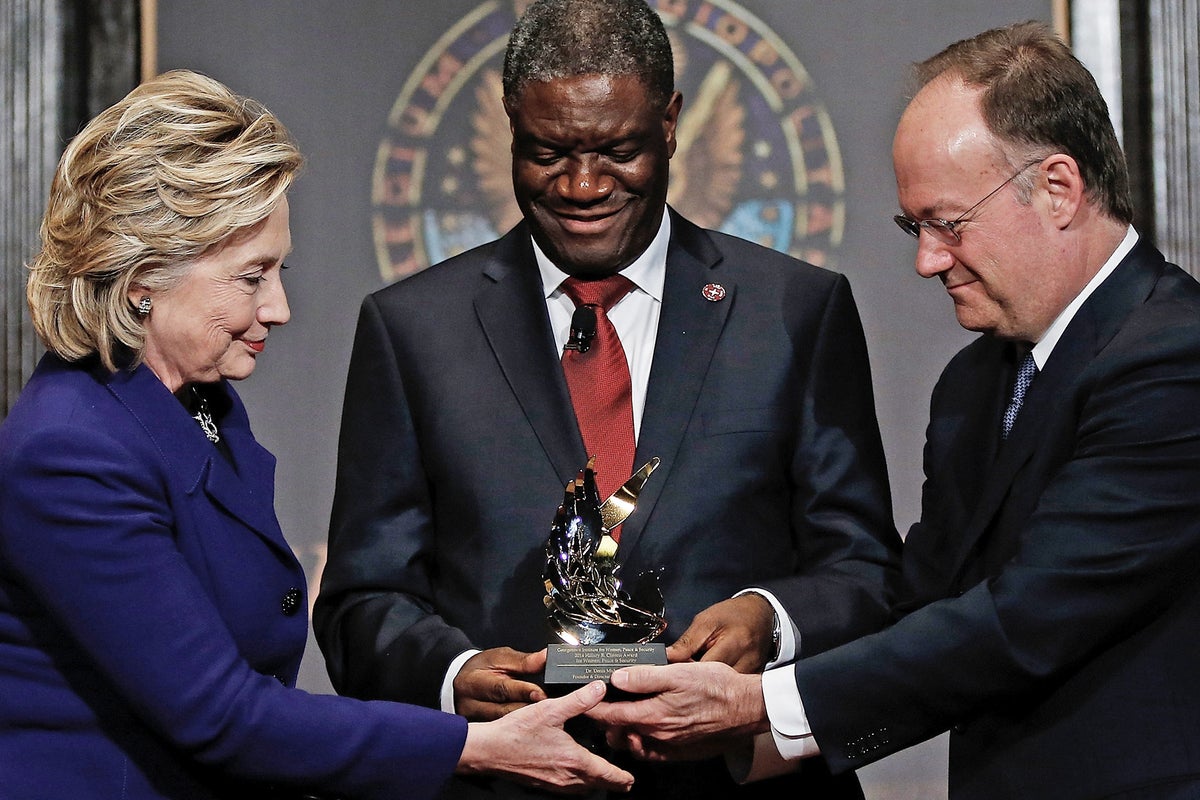
Congo genocide and torture.
Why rape is as deadly a threat as the world has faced: Congo's cheap weapon of mass destruction
Each day at the Panzi hospital in eastern Congo, Dr Denis Mukwege is trying to consign a devastating weapon of mass destruction to the past. The gynaecologist, who has been awarded the European Parliament's highest human-rights honour, talks to Patrick Strudwick*
By*PATRICK STRUDWICK
Tuesday 30 December 2014
Some of the women arrive naked. Some are only just alive, with knife or gunshot wounds to the thighs, genitals or pelvis. Many have been raped repeatedly by multiple attackers, tied up and brutalised in front of their husbands, parents and children. Sticks are used on some. Chemicals on others, doused after the rape to burn and scar, to ensure ruination. It works. Internal injuries can be so extensive as to defy medical solution.
Dr Denis Mukwege tries to help all who arrive at Panzi Hospital, the clinic he set up 15 years ago in the hills above Bukavu, eastern Congo. After training in France to become a gynaecologist, he was hoping to devote his career to treating women in pregnancy and labour. Instead, the results of the Second Congo War arrived – wave after wave, girls as young as two, women in their eighties. Entire villages of women come, dozens clutching each other, silenced and bound by trauma's grip.
The war, which has claimed more than five million lives since 1998, officially ended in 2003 but continues in the east of the country. And so, children appear at Parzi's reception who are themselves the product of conflict rape, their mothers also used as a weapon of war. Rape, in the Democratic Republic of Congo, like many war-ravaged countries, is strategy, an implement to seize power – control, not only over entire communities and regions but, crucially, in this immense country, over the great mineral wealth. The trauma – physical, psychological – disables. And it is free. The cheapest weapon of mass destruction.
Today, 4,000 miles away, Mukwege sits on a stool in a lobby next to the plenary chamber in Strasbourg's European Parliament – a vast glass cylinder abuzz with technocrats, MEPs and media. Mukwege is here because he is the recipient of the Sakharov Prize For Freedom of Thought, the highest human-rights award bestowed by the European Parliament. Last year it honoured Malala Yousafzai. Many believe that Mukwege will, like Yousafzai, be decorated by the Nobel committee.
Posters bearing his face adorn each wall and corridor; an inapt iconography for a man wishing that the spotlight was not on him but the women he treats. Against the din of bustling officials and TV crews, Mukwege smiles and locks eyes with me. "This prize is not really for me," he says softly. "It belongs to the women who have been fighting for 15 years for their rights, for their dignity, for their freedom."
"But I am very happy this prize came now because the world does not understand what it means to be raped with extreme violence. We need to highlight what is going on in this region. It is a terrible disease, women destroyed in a way that denies their humanity."
Mukwege, 59, treats 10 women a day in theatre. He has, in total, tended to more than 30,000 survivors. In what psychological state are patients when they arrive?
"They are dehumanised," he says. "Most are shamed by what happened to them. Most are excluded from their own community. They feel life has no sense." He cites the plentiful research into the psychological trauma that survivors carry, often forever.
Dr Mukwege and his team do what they can. Soon after treating his first few patients in 1999, the doctor, whose father was a pastor, realised that medicine alone was insufficient. He describes the "four pillars" of his approach.
"We treat them medically – surgically; psychologically – the trauma; legally – to teach them their rights and help them go to court, if they want to," he says. "The fourth way is to support them economically so they can be strong and fight for their own rights."
Some, however, are too damaged for treatment. Dr Mukwege specialises in repairing vaginal fistulas – holes created either between the vagina and rectum, or vagina and bladder – a common occurrence after violent rape. "Women who have been severely violated are completely destroyed – some we simply cannot cure," he says. "And unfortunately, these are often young girls aged 14, 15, 16, 17. They have to wear a colostomy bag for the rest of their lives."
*Women recovering from surgery at Panzi hospital in the Congo (Getty)
Without medical intervention, urine, blood and faeces trickle down, causing burns, infections, ulcerations, abscesses and dehydration. The smell from infections ensures everyone in the village knows what has happened. Many are shunned. Isolation engulfs. Fistulas can also lead to nerve damage called "foot drop" in which the lower limbs become paralysed. Women are left unable to walk.
"The situation is absolutely awful," says Mukwege, slowly, his French Congolese accent resonating around every syllable. He enunciates "rape" quite unlike anyone I have heard – the "r" is hard, like a German "r", the "a" is elongated; the effect is a snarl, an alarm, a pronunciation to denote the grotesque profundity of the crime.
"We are working with doctors and universities to get more technology into our hospital to improve the lives of those women, but unfortunately we still have to deal with failure."
He changes tack. "It's not the number [of women] that's important, it's the individual stories, it's the person sat opposite you who says, 'Doctor, I'm sorry, every time I come to see you people turn their heads away from me. They won't look'." Some of the patients return several times. A community might ignore her after being attacked but rapists do not, with some women being raped again and again.
By the time women are in Mukwege's care, the trauma has fanned out in all directions. "If a child has seen his mother being raped he will never be the same again," he says. "And if husbands stood by [during attacks], unable to help their wife, it completely changes their relationship. This problem destroys families as a whole."
There is another important consequence, which, for Mukwege is a "time bomb": the babies. "They are often not loved when they arrive because they are the result of rape. People sometimes blame the children. Often families say, 'This is a horrible child; he does not belong to us.' We are raising a crisis."
Among the thousands that he has treated – a fraction of the estimated millions of women raped amid this conflict – I wonder whether one patient stands out. "Yes," he says, exhaling slowly. "There is one lady. She was raped and taken into the bush and kept as a slave for three years. She was also, as a result of the rapes, contaminated with Aids. When she came home she found that while she was gone all her family – her husband, father, mother and four children – were killed." The woman eventually returned to her village but with a baby, born from the innumerable rapes she endured.
"It was very hard for her…" says Mukwege, his voice unsteady "to keep this child, to know, 'She is the child of the one who raped me, killed all my family and contaminated me with Aids'."
He stops again, frowning, wincing. "How can all this happen in the life of someone?"
*Dr Mukwege on his ward rounds in Bukavu (Getty)
We do not speak because he knows the answer. It is no secret why and how this happens. Rape emblemises Congo's history – an area brutalised for 500 years by leaders and nations crazed with greed in a rush for natural resources: rubber, oil, diamonds, copper, uranium, cobalt and coltan. The last of these is used liberally in mobile phones, cameras, printers and laptops. First came the Portuguese, in the 1480s, enslaving and destablising as British ships arrived taking captives. In the late 19th century, as demand for rubber spiked, Belgium's King Leopold II claimed the country, ordering further gargantuan enslavements, commanding torture and murder on an unfathomable scale: more than 10 million died.
By 1960, when independence was declared, the traumatised nation was ripped asunder, fractured, drained not only of minerals but of human resources: an insufficiently educated nation left to stagger on unaided. The former army officer and police sergeant Joseph-Desire Mobutu exploited the power vacuum, seized control and bled the resources further.
When Rwanda invaded in 1996 (the First Congo War), helping other neighbouring countries topple Mobutu – who had been backed by Western governments – little improved. A year later, when the Second Congo War erupted, drawing in nine nations, the turmoil was anarchic, dozens of rival militia groups, rebels and army factions killing and enslaving to gain control of the mines – a dire cacophony of child soldiers and mass starvation, collapsing infrastructure and, all along, rape.
This is why the women still come to the Panzi hospital, because a solution to the crisis does not. No one stops this.
In 2011, Mukwege compared the international reaction to that of Bosnia in the 1990s. "Since Bosnia was on Europe's doorstep, and Europe was ashamed, it didn't last so long," he said. "When it happens in Africa, people say, 'It's cultural. It's African. It's far away'." A year later, in an address at the UN he spoke of the "deafening silence and the lack of courage of the international community".
Some see such silence as deliberate, in order that the coltan keeps coming, regardless. It is possible, although lengthy and expensive, for companies to ascertain the provenance of most samples. However, all countries through which the metal passes would need to be signed up to ethical-sourcing policies and so far, although the United States has imposed restrictions on imports, the EU has not. "The West has a responsibility because it knows how coltan is produced," says Mukwege. "They can get this without destroying women." We, as Westerners, he adds, should stop buying the devices and buy instead products "without blood".
Meanwhile, the Panzi hospital is left with the wreckage. Its four pillars of care prove transformative for many. Mukwege returns to the woman who was enslaved. "Today she not only supports her child but also other patients living with Aids," he says. "She's really strong. She built her own house. She built her own business. She is a leader in her community."
Mukwege has admitted that after several years treating the severely traumatised every day he eventually had to stop listening to their accounts, encouraging the psychologists to step in. But, he added: "One does not get used to the suffering." Now, however, the mental battle for him is even tougher.
In 2012, not long after his UN speech – and many believe in response to it – five armed men went to Dr Mukwege's house, rounded up his two daughters, trained guns at their heads and waited for the doctor to come home.
*Dr Mukwege addresses a rally against sexual violence in Bukavu (Reuters)
When Mukwege got out of his car, the men pointed their AK47s at him. As his security guard attempted to save him, the hitmen shot the guard dead. Mukwege fell to the ground narrowly missing the bullets aimed at him. The attackers fled. They have never been caught.
In fear, Mukwege took his family to Sweden and then Brussels, living in exile for three months, until the women of Bukavu not only pleaded for him to return, but sold onions and pineapples to pay for his flight. On average women in the region earn less than $1 a day.
When he returned, in January 2013, they lined the streets, thousands cheering his homecoming. Reports described banners reading, "We are behind you", T-shirts saying, "Welcome our Superman", and a chorus of women singing in praise and thanks. Mukwege addressed the crowd: "The power of darkness will be defeated," he said.
But darkness lingers. How has he coped with the rumbling threat of murder? "It was very hard," he says. "Because I just thought, 'Why does this have to happen to me? What am I doing that's bad? I'm just trying to help people.' But if you say violence is not a good thing, you become a dissident. This is terrible. People have to hide because they say violence is not acceptable."
Mukwege has to hide, too. No longer safe at his home, he moved in to the hospital. One well-wisher told him, "We women will protect you." And now they do – a doctor buffered by his patients. "I don't have any social life," he says. "But I'm not complaining, I'm happy to be doing what I'm doing because when I can see how strong women are, all my strength, all my inspiration comes from them."
Even though carrying on could put his family in danger? "I think my family supports me," he says. Does he ever think about stopping? "Never. If I give up, it would be to accept that all the perpetrators are right. So I will not give up. It is perpetrators who will give up."
As I get up to leave one final question blurts out. Do you believe in God? "Yes," he says.
Even after everything you have seen?
"For me, God gave us a choice to do bad or good. We are free. It is our choice. "
The next morning, at a press conference, he calls on reporters and politicians to intervene. "What is being done to protect these women?" he asks. "We need a justice in which victims have the opportunity to confront their attackers. This will never happen unless there is a political change.
"We need your voices – if the media decided that a situation has to change you have the power. You can give the information to 500 million people so that they know that when they use their telephone, [they are aware of] the victims. You can ensure the people send that message to politicians. What we're missing today is the political will to change – so that the minerals can be mined cleanly. There are multi-nationals in Europe, who are transparent and can give us all a good conscience."
He turns to the men. "If men can stand up and say 'this is not acceptable' then our world can change. Otherwise our silence says, 'this is a woman's problem'. Those who commit these acts dirty our image as men."
As Mukwege speaks his hands form points, cones, gavels, punching through each phrase, his body and voice united in urgency. It is not enough to listen to me, his presence cries.
The chairperson tries to draw the session to a close, but Mukwege leans in to the microphone. "We have an opportunity to draw a line under using rape as a weapon of war," he cries. "To say no, to say this is not acceptable. We've done this with chemical and biological arms and we can do the same thing for sexual crimes."
His eyes – yellowed, wide – emit a plea too, beseeching, bellowing out beyond the parliament, beyond the EU, begging the world to listen to a message sent from hundreds of thousands of women, butchered and shunned and broken: do something.sigpic"When it is said to them: "Make not mischief on the earth," they say: "Why, we only Want to make peace!" (2.11)
And when it is said to them (hypocrites): "Believe as the people (followers of Muhammad Peace be upon him , Al-Ansar and Al-Muhajirun) have believed," they say: "Shall we believe as the fools have believed?" Verily, they are the fools, but they know not."(2.13)Comment
-
In hospital.sigpic"When it is said to them: "Make not mischief on the earth," they say: "Why, we only Want to make peace!" (2.11)
And when it is said to them (hypocrites): "Believe as the people (followers of Muhammad Peace be upon him , Al-Ansar and Al-Muhajirun) have believed," they say: "Shall we believe as the fools have believed?" Verily, they are the fools, but they know not."(2.13)Comment


Comment