Announcement

Collapse
No announcement yet.

Concentration camps,slavery and torture cells of past and present.

Collapse
X
 
  • Filter
  • Time
  • Show
Clear All
new posts

  • Concentration camps,slavery and torture cells of past and present.

    Concentration camps:

    Concentration camps gained notoriety after the World War II. After the allied forces marched into Nazi-held territories, many such camps were discovered. The horror seen in these camps was unspeakable. Although there were a lot of deaths in Nazi camps, a concentration camp is different from an extermination camp. There is a very thin line separating the two. An extermination camp is a place where prisoners are brought in with the sole reason of execution. There is no time wasted, and all the manpower and logistics are dedicated towards the methods of efficient killing and disposal of the dead bodies.


    DEFINITIONS:

    A concentration camp is different. It is built to efficiently torture prisoners. This torture can be in terms of real torture and forced inhumane labor. They are different from normal prisons in the sense that in a normal prison, the prisoners are looked at as humans. In a concentration camp, the prisoners are usually political rivals, sects and groups of people deemed inferior by the ruling entity of the land, and citizens of a country towards which a very pure form of hatred is directed at.

    In the following paragraphs we will try to understand this disgusting concept of a prison better. Why? Because we have to know what people have gone through in these hellish places, we have to know to what depths human empathy can fall, we have to know to what heights human cruelty can soar, and we have to know so that this may not happen again. We have to know so that we can empathize with the sadistic things that are done in these places. They should be studied just as a disease is studied by a doctor. The disease itself is bad, but it has to be studied so that mechanisms can be developed to prevent its reoccurrence.
    Read more at Buzzle:*http://www.buzzle.com/articles/life-...ion-camps.html
    sigpic"When it is said to them: "Make not mischief on the earth," they say: "Why, we only Want to make peace!" (2.11)

    And when it is said to them (hypocrites): "Believe as the people (followers of Muhammad Peace be upon him , Al-Ansar and Al-Muhajirun) have believed," they say: "Shall we believe as the fools have believed?" Verily, they are the fools, but they know not."(2.13)

  • #2
    A Brief History of Concentration Camps..continue

    Concentration camps have existed since the Roman times. The Romans built camps for Goths who were moving into Roman territory peacefully, afraid of the Hun invasion. Not able to handle such a large number, and fearing that all their food stockpile and resources might get depleted feeding them, the Romans put around 100,000 Goths in a restricted area. This restricted area was too cramped for such a large contingency of Goths. Hence, the word "concentration" camp.
    Food in the camp was heavily rationed. When shortages occurred, natural system prevailed―the stronger preyed on the weaker, stealing food and the weaker perished. Around 30,000 women and children died. The Goths did exact their revenge, but the damage was done.
    Invaders erected "Indian camps" when the Colonists took over a territory from the Native Americans. They were starved to death.
    Camps were erected for the Confederate soldiers during the American Civil War. Many soldiers were forced to live in cramped conditions with little food, water, or warmth. As a result, many of them starved or died from the cold.
    Concentration camps were also used by the British during their invasion of South Africa, where they imprisoned politically sensitive people to prevent them from instigating or supporting the people resisting the invasion.
    These camps were extensively used in Nazi Germany where Himmler came up with an idea for the final solution of ethnic cleansing of their Fatherland of impure blood. They set up around 1,200 such camps, with many more sub-camps attached to them. These camps were ultra-efficient in one thing―getting the prisoners there, making their life as hellish as possible, killing them, and getting more prisoners there. The prisoners mainly consisted of the Jews, although a significant number of Polish, Slavic, and other unwanted pollutants of their race were present.
    Many of these Nazi camps were liberated by Soviet forces. It is very ironic because the same government that directed its army to liberate these camps would then put up and operate their own concentration camps. Just like the Nazi propaganda, the Soviets were very passionate about their brand of Communism that was just born. Stalin had taken control―total control to be specific―so that he was almost ruling single-handedly as a dictator. Just like Hitler was. And understandably, the same trends started showing. Concentration camps were erected for political dissidents. These camps were called Gulags. Anyone who was deemed to be even slightly liberal was imprisoned. Artists, musicians, businessmen, traders, builders, shopkeepers―all were imprisoned.
    The living conditions in these Gulags were similar that in Nazi camps. Around 1.3 million people died in these Gulags.

    Living Conditions

    Common factors of the examples mentioned above include cramped living spaces, food scarcity, water scarcity, non-existent hygiene and hard labor. Soldiers were meant to fight a war, and hence during wartime, they were given a lot of respect by their respective countries. They were not subjected to labor in invaded land. Hence, the taken prisoners were made to do it. The conditions were hard, and labor, in most cases, was manual.
    Food was heavily rationed and unappetizing. What was unappetizing in the start became the only means of survival when things got ugly. The food was far lesser than what was required by the body to do the hard work. And since the body was using more energy than it was generating, large amounts of muscle wasting was seen. Fat was not existent, and bodies are emaciated beyond recognition. Soldiers who liberated Nazi camps recall the prisoners appearing as ghosts of just skin and bones, walking listlessly, unaware of their surroundings.
    Minimal clothing was provided. The provided clothes were not even remotely sufficient to shield the inmates from the elements, be it heat, cold, rain, or frost. Even if the prisoner somehow evened out with his grossly insufficient diet plan, the cold and frost would assault his extremities, resulting in frostbites. When the survivors recalled their stories, they say that they were subjected to hard labor even in the cold rain. In their living quarters, they were not given sufficient bedding and no blankets. The designers of such camps had in mind that if the food did not take them out, one of the elements will.
    Hygiene was non-existent too. Medicine in those times, especially antibiotics, was expensive. Mass production of drugs was happening in selected factories, and that too was diverted to the front lines for the soldiers. It was deemed a waste to waste such precious resources on these prisoners. In such abject living conditions, where there was an average of one lavatory for 400 men and women, conditions got worse. Diseases such as typhus and tuberculosis were rampant. With such a high density of people compressed together, the spread of such diseases could not be controlled. Thus, disease was the third to exterminate prisoners.
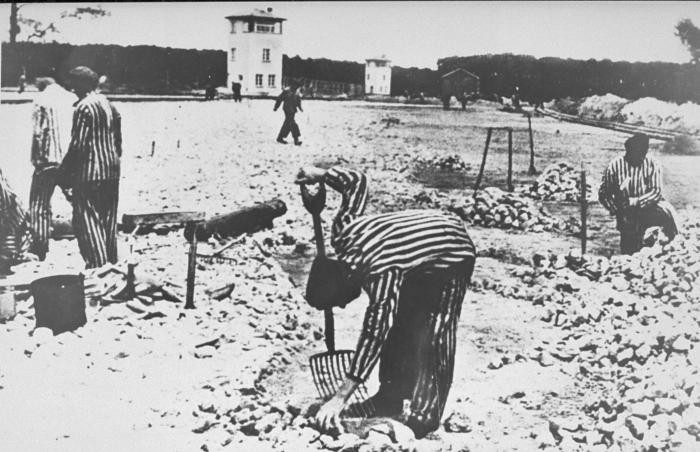
    As mentioned before, labor was hard and manual. Average working hours were 12 to 14. Working conditions were brutal too. Prisoners were punished if found even pausing to catch their breath. They were flogged publicly as an example for the rest. Usually, in such depravity, the inmates died in the flogging, and this was considered an easy way to dispose of excess. Hence, flogging got more frequent if the number of inmates increased.

    Read more at Buzzle:*http://www.buzzle.com/articles/life-...ion-camps.html
    sigpic"When it is said to them: "Make not mischief on the earth," they say: "Why, we only Want to make peace!" (2.11)

    And when it is said to them (hypocrites): "Believe as the people (followers of Muhammad Peace be upon him , Al-Ansar and Al-Muhajirun) have believed," they say: "Shall we believe as the fools have believed?" Verily, they are the fools, but they know not."(2.13)

    Comment


    • #3
      A Typical Day in a Nazi Concentration Camp

      5.30 am - Wake-up call. Usually a gong or a horn is used. The wake-up call is preponed to 4.30 am in summers. The inmates are ushered to their wash areas and given a couple of minutes to wash and relieve themselves. Relieving themselves other than this time could lead to death. They are supposed to gather outside for a roll call. If a person is missing, the whole group is punished by skipping breakfast. Sometimes, they will be made to stand in the sun or cold the whole day without food.
      6.00 am - Breakfast is served. It consists of a mug full of coffee, which is brown-flavored water. If the inmates are lucky, the water is warm. They also get a piece of bread. The bread is saved for the rest of the day, as it is the only piece of solid food they will get in the whole day.
      6.30 am - The inmates are marched to their respective places to work. Sometimes they are made to march long distances before they even start working. No water is given. The work is brutal, and floggings are common. Inmates are not supposed to help each other. Everyone is on his own. Their work is scrutinized closely. Any inefficiency is met with cruel punishment.
      12.00 pm - Lunch is served. Usually, it is lentil soup. Which means it is green-colored water. Earlier, when the camps were established, the soup contained lentils, potato, and some flour to thicken it, but by the end of the war, a piece of vegetable was rare.
      12.30 pm - The workers are ushered to work again until nightfall.
      8.00 pm - There is dinner served which consists of soup and a piece of cheese or marmalade. The piece of saved bread is also eaten now. Some save the piece for the next day. Rumors of inmates eating rats is also common.
      9.00 pm - The evening roll call is observed. Latecomers are made to stand in the open and not allowed to sleep for the whole night.
      9.30 pm - The inmates are expected to retire to their respective quarters. Sleep is a luxury.

      Concentration Camps: The Present Scenario

      The present perception of the people is that the horrors of concentration camps is past. But it is not so. Even with the acceptance of Geneva war conventions and vigilant human rights bodies, there are concentration camps present even today. Most of them are present in North Korea. Although prisons with extremely poor human rights records exist in many countries, mass punishments are very rare. And hence, these prisons cannot be called concentration camps.
      However in North Korea, such camps exist and parallels between it and the Nazi regime are hard to ignore. The inmates are usually political dissidents. They are a bit more vocal in showing displeasure of the current government of the country. These camps are known as "internment" or "re-education" camps where people with liberal views are brought and "cleansed".
      Some of the inmates, after being released, somehow managed to escape to South Korea, where they narrated their stories. These stories contain graphic content and almost inhuman conditions. Their ordeal spelled torture, starvation, cannibalism, sodomy, and murder.
      It might surprise many of us to see that working models of concentration camps still exist. In fact, they not only exist, but even thrive with efficiency. Human rights watch groups are working hard to bring awareness among such perpetrating countries. If they do have some empathy, they might just listen. If they do not, use of force to bring them to justice is debatable.
      Read more at Buzzle:*http://www.buzzle.com/articles/life-...ion-camps.html
      sigpic"When it is said to them: "Make not mischief on the earth," they say: "Why, we only Want to make peace!" (2.11)

      And when it is said to them (hypocrites): "Believe as the people (followers of Muhammad Peace be upon him , Al-Ansar and Al-Muhajirun) have believed," they say: "Shall we believe as the fools have believed?" Verily, they are the fools, but they know not."(2.13)

      Comment


      • #4
        Learn about early concentration camps the Nazi regime established in Germany, and the expansion of the camp system during the Holocaust and World War II.


        CONCENTRATION CAMPS, 1933–1939

        Related ArticlesComments

        Arrival of political prisoners at the Oranienburg concentration camp. Oranienburg, Germany, 1933.

        — DIZ Muenchen GMBH, Sueddeutscher Verlag Bilderdienst

        VIEW PHOTOGRAPHSVIEW PERSONAL HISTORIESVIEW MAPSVIEW HISTORICAL FILM FOOTAGE

        The term*concentration camp*refers to a camp in which people are detained or confined, usually under harsh conditions and without regard to legal norms of arrest and imprisonment that are acceptable in a constitutional democracy. In Nazi Germany between 1933 and 1945, concentration camps (Konzentrationslager; KL or KZ) were an integral feature of the regime.

        The first concentration camps in Germany were established soon after Hitler's appointment as chancellor in January 1933. In the weeks after the Nazis came to power, The SA (Sturmabteilungen; commonly known as Storm Troopers), the*SS; Protection Squadrons—the elite guard of the Nazi party), the police, and local civilian authorities organized numerous detention camps to incarcerate real and perceived political opponents of Nazi policy.

        German authorities established camps all over Germany on an ad hoc basis to handle the masses of people arrested as alleged subversives. The SS established larger camps in Oranienburg, north of Berlin; Esterwegen, near Hamburg;*Dachau, northwest of Munich; and Lichtenburg, in Saxony. In Berlin itself, the Columbia Haus facility held prisoners under investigation by the Gestapo (the German secret state police) until 1936.

        After the SS gained its independence from the SA in July 1934, in the wake of the Röhm purge, Hitler authorized the Reich SS leader, Heinrich Himmler, to centralize the administration of the concentration camps and formalize them into a system. Himmler chose SS Lieutenant General Theodor Eicke for this task. Eicke had been the commandant of the SS concentration camp at Dachau since June 1933. Himmler appointed him Inspector of Concentration Camps, a new section of the SS subordinate to the SS Main Office.

        After December 1934, the SS became the only agency authorized to establish and manage facilities that were formally called concentration camps, though local civilian authorities continued to establish and manage forced-labor camps and detention camps throughout Germany. In 1937, only four concentration camps were left:*Dachau, near Munich;*Sachsenhausen*near Berlin;*Buchenwaldnear Weimar; and Lichtenburg near Merseburg in Saxony for female prisoners.

        Already as commandant of Dachau in 1933, Eicke developed an organization and procedures to administer and guard a concentration camp. He issued regulations both for the duties of the perimeter guards and for treatment of the prisoners. The organization, structure, and practice developed at Dachau in 1933-1934 became the model for the Nazi concentration camp system as it expanded. Among Eicke's early trainees at Dachau was Rudolf Höss, who later commanded the*Auschwitz*concentration camp.

        Special “political units on alert” (Politische Bereitschaften), originall guarded the SS concentration camps. They were renamed “SS Guard Units” (SS-Wachverbände*in 1935 and “SS Death's-Head Units” (SS-Totenkopfverbände) in April 1936. One SS Death's-Head Unit was assigned to each concentration camp. After 1936, the camp administration, including the commandant, was also a part of the SS Death's-Head Unit. Although*all*SS units wore the Death's-Head symbol (skull and crossbones) on their caps, only the SS Death's-Head Units were authorized to wear the Death's Head Symbol on their lapels. After the creation of the “SS Death's-Head Division” of the Waffen SS in 1940, whose officers had been recruited from concentration camp service, members of this division also wore the Death's-Head symbol on their lapel.

        The SS Death's-Head Unit at each camp was divided into two groups. The first was the camp staff, which encompassed: 1) the commandant and his personal staff; 2) a Security Police officer and an assistant to maintain and update prisoner records; 3) the commandant of the so-called protective detention camp (Schutzhaftlagerführer*which housed the prisoners, and his staff (including the labor allocation officer, the roll call officer, and the Blockführer, who were responsible for the individual prisoner barracks); 4) an administrative staff responsible for the fiscal and supply administration of the camp; and 5) an infirmary run by an SS physician, who was assisted by one or two SS sanitation officers and/or medical orderlies. The second group constituted the guard detachment (SS-Wachbataillion), which prior to 1939 was at battalion strength.

        After 1938, authority to incarcerate persons in a concentration camp formallly rested exclusively with the German Security Police (made up of the Gestapo and the Criminal Police), which held this exclusive authority de facto since 1936. The “legal” instrument of incarceration was either the “protective detention” (Schutzhaft) order (which the Gestapo could issue for persons considered a political danger after 1933) and the “preventative detention” (Vorbeugungshaft) order, which the Criminal Police could issue after December 1937 for persons considered to be habitual and professional criminals, or to be engaging in what the regime defined as “asocial” behavior. Neither order was subject to judicial review, or any review by any German agency outside of the German Security Police.

        The model thus established by Eicke in the mid-1930s characterized the concentration camp system until the collapse of the Nazi regime in the spring of 1945. The daily routine at Dachau, the methods of punishment, and the duties of the SS staff and guards became the norm, with some variation, at all German concentration camps.

        EXPANSION OF THE CAMP SYSTEM 1939*
        *
        As Nazi Germany expanded by bloodless conquest between 1938 and 1939, the numbers of those labeled as political opponents and social deviants increased, requiring the establishment of new concentration camps. By the time the Germans*invaded Poland*in September 1939, unleashing*World War II, there were six concentration camps in the so-called Greater German Reich:*Dachau(founded 1933),*Sachsenhausen*(1936),*Buchenwald*(1937),Flo ssenbürg*in northeastern Bavaria near the 1937 Czech border (1938),*Mauthausen, near Linz, Austria (1938), and*Ravensbrück, the women's camp, established in Brandenburg Province, southeast of Berlin (1939), after the dissolution of Lichtenburg.

        From as early as early as 1934, concentration camp commandants deployed prisoners as forced laborers for the benefit of SS construction projects, including the construction or expansion of the camps themselves. By 1938, SS leaders envisioned using the reservoirs of forced laborers incarcerated in the camps for a variety of SS-commissioned construction projects. To mobilize and finance such projects, Himmler revamped and expanded the administrative offices of the SS and created a new SS office for business operations. Both agencies were led by SS Major General Oswald Pohl, who would take over the Inspectorate of Concentration Camps in 1942.

        Beginning a pattern that would become typical after the war began, economic considerations had an increasing impact on the selection of sites for concentration camps after 1937. For instance, Mauthausen and Flossenbürg were located near large stone quarries. Likewise, concentration camp authorities increasingly diverted prisoners from meaningless, backbreaking labor to more goal-oriented if still backbreaking and dangerous labor in extractive industries, such as stone quarries and coal mines, and construction labor.

        After Nazi Germany unleashed World War II in September 1939, vast new territorial conquests and larger groups of potential prisoners inspired the rapid expansion of the concentration camp system to the east. The war did not change the original function of the concentration camps as detention sites for the incarceration of political enemies. The climate of national emergency that the conflict granted to the Nazi leaders, however, permitted the SS to expand the functions of the camps.

        The concentration camps increasingly became sites where the SS authorities could kill targeted groups of real or perceived enemies of Nazi Germany. They also came to serve as holding centers for a rapidly expanding pool of forced laborers deployed on SS construction projects, SS-commissioned extractive industrial sites, and, by 1942, in the production of armaments, weapons, and related goods for the German war effort.

        Despite the chronic need for forced labor, the SS authorities continued to deliberately undernourish and mistreat prisoners incarcerated in the concentration camps, deploying them so ruthlessly and without regard to safety at forced labor, with such rates of mortality that many prisoners believed that they were in effect being "annihilated through work."
        sigpic"When it is said to them: "Make not mischief on the earth," they say: "Why, we only Want to make peace!" (2.11)

        And when it is said to them (hypocrites): "Believe as the people (followers of Muhammad Peace be upon him , Al-Ansar and Al-Muhajirun) have believed," they say: "Shall we believe as the fools have believed?" Verily, they are the fools, but they know not."(2.13)

        Comment


        • #5


          http://www.jewishvirtuallibrary.org/...jor_camps.html more about nazi camps.
          sigpic"When it is said to them: "Make not mischief on the earth," they say: "Why, we only Want to make peace!" (2.11)

          And when it is said to them (hypocrites): "Believe as the people (followers of Muhammad Peace be upon him , Al-Ansar and Al-Muhajirun) have believed," they say: "Shall we believe as the fools have believed?" Verily, they are the fools, but they know not."(2.13)

          Comment


          • #6
            A view.
            Attached Files
            sigpic"When it is said to them: "Make not mischief on the earth," they say: "Why, we only Want to make peace!" (2.11)

            And when it is said to them (hypocrites): "Believe as the people (followers of Muhammad Peace be upon him , Al-Ansar and Al-Muhajirun) have believed," they say: "Shall we believe as the fools have believed?" Verily, they are the fools, but they know not."(2.13)

            Comment


            • #7

              Afghan concentration camps:

              Troops had marched male villagers out of their homes, near a place in Panjwaii district called Mushan. The women and children were segregated in another part of the village. The men were lined up against a wall and made to sit in the blinding sun. An Afghan intelligence officer in a black leather jacket and with his face obscured by sweat cloth went along and picked those he deemed suspicious. There was no rhyme or reason to the choices, at least none that I could see. The soldiers with the test kits dutifully swiped the hands of the chosen, looking for gunshot residue. A small Afghan boy, in a compound that had yet to be searched, yanked aside a worn woolen blanked that served as a door. He looked around with a fierce expression that belonged to a much older face. He moulded his forefinger and thumb into the shape of a gun, aimed it at us and pretended to shoot. One of the soldiers made as though he was going after him and the boy bolted back into the compound with the flourish of a startled bird. The other guys laughed.”

              ************************************************** ************************************************** *********** Murray Brewster,*The Savage War

              This is but one of the numerous graphic scenes which fill the pages of Murray Brewster’s first-hand account of the incredibly inhumane and utterly degrading treatment Afghans receive on a daily basis. But it is not the line of men standing under the blinding sun that deserves a comment; it is the small Afghan boy, whose childhood has been snatched away, who is important in this real scene. The boy’s attempt to show his fierce reaction against the foreign soldiers says it all: after more than a decade of occupation, millions of dollars spent on propaganda announcing the arrival of freedom, and untold deaths, the Afghan boy is still fiercely independent: he wants the foreigners to be annihilated. His soul remains unshackled. He is witnessing the barbarity of the foreign soldiers, who have rounded up his father, uncles, and relatives and for him there exists only one reality: these soldiers have no place in his land.

              In the NATO countries, the Afghan war is now no more than a forgotten episode; most people have only a dim realization that their troops are still out there, but now even the returning dead bodies do not raise much concern. This is not accidental: there has been a systematic effort to wipe out Afghan war from public conscience. In Canada, flags are no more lowered on the Parliament Hill, pictures of coffins do not flash on TV screens, the conservative prime minister has banned all of this. The situation is not very different in USA and other NATO countries.

              Canadian Broadcasting Corporation (CBC) has been continuously glorifying Canada’s “heroic” role in the Afghan war ever since 2001. Its radio show, “Afcan” is a sickening effort to construct a glorified role of Canada’s involvement in this brutal and ruthless effort to make US occupation of Afghanistan a noble venture.

              Since Afghanistan does not make headlines anymore, the* public is utterly indifferent. No one actually knows how to handle this interminable war. The public callousness is simply mindboggling. When the Washington Post published the news on December 7, 2011 that the US Air Force has dumped the incinerated partial remains of at least 274 American troops in a Virginia landfill, far more than the military had acknowledged before, there was but only a subdued reaction. Such is the inhumanity of this war that it has numbed all.

              The United States army had even concealed the landfill dumping from families, but the families had, nevertheless, authorized the military to dispose of the remains in a “dignified and respectful manner.” This is their existential need. They have to do something with the remains of their kin, and more than anything, it is the cost of disposing the remains that becomes a deciding factor.

              The callousness of US officials can be gauged from the fact that US Air Force and Pentagon officials said last month that determining how many remains went to the landfill would require searching through the records of more than 6,300 troops whose remains have passed through the mortuary since 2001. “It would require a massive effort and time to recall records and research individually,” Jo Ann Rooney, the Pentagon’s acting undersecretary for personnel, wrote in a Nov. 22 letter to Rep. Rush D. Holt (D-N.J.). Holt, who has pressed the Pentagon for answers on behalf of a constituent whose husband was killed in Iraq, accused the Air Force and Defense Department of hiding the truth. “What the hell?” Holt said in a phone interview. “We spent millions, tens of millions, to find any trace of soldiers killed, and they’re concerned about a ‘massive’ effort to go back and pull out the files and find out how many soldiers were disrespected this way?” He added: “They just don’t want to ask questions or look very hard.”

              For the veteran families, the tragedy of a son, daughter, husband, wife, or uncle dying in a faraway land is a personal tragedy of great importance, and their only solace is to embrace the official lie which has two facets: our troops are dying to protect us from terrorists; they are dying for the noble cause of bringing freedom and prosperity to the Afghans. Both lies are repeated ad nauseam; both are fake, utterly false pretenses for an otherwise indefensible war.

              Everyone knows that there is absolutely no threat to any of the NATO countries from the ragtag Taliban and the notion of freedom to Afghans is equally fake, as anyone stepping into the slaughterhouse that is now Afghanistan can see.

              Afghanistan has been turned into a huge concentration camp; anyone can be rounded up any time of the day or night. The fortunes of warlords keep shifting but raw violence determines the fate of all: from the half-brother of the lord mayor of Kabul to the most wretched gun totter on the street, all are vulnerable to a donkey carrying explosives and no one has a way to stop this barbarity.
              Attached Files
              sigpic"When it is said to them: "Make not mischief on the earth," they say: "Why, we only Want to make peace!" (2.11)

              And when it is said to them (hypocrites): "Believe as the people (followers of Muhammad Peace be upon him , Al-Ansar and Al-Muhajirun) have believed," they say: "Shall we believe as the fools have believed?" Verily, they are the fools, but they know not."(2.13)

              Comment


              • #8
                TOTO5000 menghadirkan gerbang premium menuju beragam permainan Toto Slot dan Slot777 populer melalui tampilan yang modern navigasi praktis serta informasi permainan yang tersusun rapi. Jelajahi pilihan hiburan digital dengan akses yang mudah melalui unepinceedeprovence.


                WHEN YOU KILL TEN MILLION AFRICANS YOU AREN’T CALLED ‘HITLER’


                Take a look at this picture. Do you know who it is?

                Most people haven’t heard of him.

                But you should have. When you see his face or hear his name you should get as sick in your stomach as when you read about Mussolini or Hitler or see one of their pictures. You see, he killed over 10 million people in the Congo.

                His name is*King Leopold II of Belgium.

                He “owned” the Congo during his reign as the constitutional monarch of Belgium. After several failed colonial attempts in Asia and Africa, he settled on the Congo. He “bought” it and enslaved its people, turning the entire country into his own personal slave plantation. He disguised his business transactions as “philanthropic” and “scientific” efforts under the banner of the*International African Society. He used their enslaved labor to extract Congolese resources and services. His reign was enforced through work camps, body mutilations, torture, executions, and his own private army.

                Most of us aren’t taught about him in school. We don’t hear about him in the media. He’s not part of the widely-repeated narrative of oppression (which includes things like the Holocaust during World War II). He’s part of a long history of colonialism, imperialism, slavery, and genocide in Africa that would clash with the social construction of a white supremacist narrative in our schools. It doesn’t fit neatly into school curriculums in a capitalist society. Making overtly racist remarks is (sometimes) frowned upon in ‘polite’ society; but it’s quite fine not to talk about genocide in Africa perpetrated by European capitalist monarchs.1

                Mark Twain wrote a satire about Leopold called “King Leopold’s Soliloquy; A Defense of His Congo Rule”, where he mocked the King’s defense of his reign of terror, largely through Leopold’s own words. It’s an easy read at 49 pages and Mark Twain is a popular author in American public schools. But like most political authors, we will often read some of their least political writings or read them without learning why the author wrote them in the first place. Orwell’s*Animal Farm, for example, serves to reinforce American anti-socialist propaganda about how egalitarian societies are doomed to turn into their dystopian opposites. But Orwell was an anti-capitalist revolutionary of a different kind—a supporter of working class democracy from below—and that is never pointed out. We can read about Huck Finn and Tom Sawyer, but “King Leopold’s Soliloquy”*isn’t on the reading list. This isn’t by accident. Reading lists are created by boards of education in order to prepare students to follow orders and endure boredom. From the point of view of the Department of Education, Africans have no history.

                When we learn about Africa, we learn about a caricatured Egypt, about the HIV epidemic (but never its causes), about the surface level effects of the slave trade, and maybe about South African Apartheid (the effects of which, we are taught, are now long, long over). We also see lots of pictures of starving children on Christian Ministry commercials, we see safaris on animal shows, and we see pictures of deserts in films and movies. But we don’t learn about the Great African War or Leopold’s Reign of Terror during the Congolese Genocide. Nor do we learn about what the United States has done in Iraq and Afghanistan, killing millions of people through bombs, sanctions, disease, and starvation. Body counts are important. And the United States Government doesn’t count Afghan, Iraqi, or Congolese people.

                Though the Congolese Genocide isn’t included on Wikipedia’s “Genocides in History” page, it does mention the Congo. What’s now called the Democratic Republic of the Congo is listed in reference to the Second Congo War (also called Africa’s World War and the Great War of Africa), where both sides of the regional conflict hunted down Bambenga people—a regional ethnic group—and enslaved and cannibalized them. Cannibalism and slavery are horrendous evils which must be entered into history for sure, but I couldn’t help thinking whose interests were served when the only mention of the Congo on the page was in reference to regional incidents where a tiny minority of people in Africa were eating each other (completely devoid of the conditions which created the conflict, and the people and institutions who are responsible for those conditions). Stories which support the white supremacist narrative about the subhumanness of people in Africa are allowed to enter the records of history. The white guy who turned the Congo into his own personal part-plantation, part-concentration camp, part-Christian ministry—and killed 10 to 15 million Congolese people in the process—doesn’t make the cut.2

                You see, when you kill ten million Africans, you aren’t called ‘Hitler’. That is, your name doesn’t come to symbolize the living incarnation of evil. Your name and your picture don’t produce fear, hatred, and sorrow. Your victims aren’t talked about and your name isn’t remembered.

                Leopold*was just one of thousands of things that helped construct white supremacy as both an ideological narrative and material reality. I don’t pretend that he was the source of all evil in the Congo. He had generals, and foot soldiers, and managers who did his bidding and enforced his laws. He was at the head of a system. But that doesn’t negate the need to talk about the individuals who are symbolic of the system. But we don’t even get that. And since it isn’t talked about, what capitalism did to Africa, all the privileges that rich white people gained from the Congolese genocide, remain hidden. The victims of imperialism are made, like they usually are, invisible.

                - *- *-

                * * If you liked this post, please consider visiting our*Facebook page*and ‘liking’ it, and following*@iamwalking*on Twitter. Thank you! Please visit again soon! * *

                For a modern day example of the callousness of Western imperialism, read my post about the famine in Somalia “20,000 billion dollars for banks, 1 billion for millions of Africans suffering from capitalist famine“, also on this website.
                Attached Files
                sigpic"When it is said to them: "Make not mischief on the earth," they say: "Why, we only Want to make peace!" (2.11)

                And when it is said to them (hypocrites): "Believe as the people (followers of Muhammad Peace be upon him , Al-Ansar and Al-Muhajirun) have believed," they say: "Shall we believe as the fools have believed?" Verily, they are the fools, but they know not."(2.13)

                Comment


                • #9
                  Free work force to build bright futureGULAG is the Russian acronym for The Chief Administration of Corrective Labor Camps and Colonies of the Soviet Secret Police and is nowadays a vivid symbol of the lawlessness, slave labor and tyranny of the Stalin era.


                  Of Russian origin:*The GULAG


                  GULAG*is the Russian acronym for The Chief Administration of Corrective Labor Camps and Colonies of the Soviet Secret Police and is nowadays a vivid symbol of the lawlessness, slave labor and tyranny of the*Stalin*era.*

                  However, the system was first established earlier - under*Vladimir Lenin*- as a progressive alternative to prison during the years immediately following the Bolshevik Revolution. Although it functioned from 1919 to 1960, the*Gulaggenerally denoted the entire penal labor system in the USSR.

                  Vast chains of camps of all forms and varieties (labor camps, punishment camps, criminal and political camps, women's camps, children's camps, transit camps) were located mainly in the remote regions of Siberia and the Far North. They made significant contributions to the Soviet economy in the*Stalin*period and served as a source of free labour for the great economic projects.*

                  Gulag*prisoners constructed the White Sea-Baltic Canal, the Moscow-Volga Canal, the Baikal-Amur main railroad line, numerous hydroelectric stations, and strategic roads and industrial enterprises in many remote regions.

                  The enemies of the state and the criminals

                  The*Gulag*reached its peak after 1929 during the rule of*Joseph Stalin*, who used it to maintain the Soviet state by keeping its populace in a constant state of terror. By 1934 theGulag*had several million inmates. People would spend their sentences here, instead of ordinary prisons. Among the camp population were felons, such as robbers, rapists, thieves, and murderers. If one was to so much as steal a pound of potatoes, he or she could be sentenced to up to ten years in the*Gulag.*

                  In addition the*Gulag*also held political prisoners, those who were considered enemies of the Soviet regime; anyone who stood out as a small threat was sent to a penal camp. Many innocent people were sentenced to the*Gulag*for minor “crimes” such as coming to work late three times (considered sabotage) or telling a small joke about a government official (punishable by up to 25 years).*

                  The majority of the prisoners were the victims of severe legal campaigns where simple rule breaking could mean a sentence of over five years. Majority of the political prisoners who were sent to*Gulag*prison camps were innocent and weren't given as much as a trial.

                  Transportation of prisoners

                  The transportation methods to the*Gulags*were often even more disturbing and painful than the camps themselves. Most long journeys began at the railroad station. However, prisoners were not loaded onto trains at the station in full public view; they were loaded at sidings down the track, away from public glare. It was done secretively - just as the process of arrest late at night.*

                  It was usual for up to sixty or more people to be crammed into one carriage, which was constructed from wooden planks and had a few rows of horizontal boards to sleep on. There was no illumination, and rats and vermin abounded. No matter the weather, the captives were only allowed to wear the clothes they were arrested in.

                  The grinding machine of slave labour

                  Conditions in the camps, for those who survived the trip, were extremely harsh. Prisoners received insufficient clothing and inadequate food rations which made it difficult to endure the severe weather and the long working hours. As a result, the death rate from exhaustion and disease in the camps was enormously high.

                  But, to fulfill the camps' economic goals, more and more prisoners were required, which accounts for the rapid increase in camp populations in the 1930s. Eventually, every Soviet Secret Policeman was assigned a certain arrest quota in order to ensure a large enough labor force in the*Gulags.

                  In order to achieve this quota, the Secret Police simply fabricated cases against ordinary, innocent people (vividly described in*Aleksandr Solzhenitsyn’s short story “One Day in the Life of Ivan Denisovich”).

                  From camps to the war front

                  During World War II,*Gulag*populations declined sharply, owing to the mass release of hundreds of thousands of prisoners who were conscripted and sent directly to the front lines (often into penal battalions, who were thrown into the most dangerous battles and experienced high casualty rates).

                  After World War 2

                  After the war, the number of inmates in prison camps and colonies again rose sharply, reaching approximately 2.5 million people by the early 1950s. The main reason for the post-war increase in the number of prisoners was the tightening of legislation on property offenses in the summer of 1947. The result was hundreds of thousands of convictions to lengthy prison terms, often on the basis of petty theft or embezzlement.*

                  A significant minority of the inmates were Balts and Ukrainians from lands newly incorporated into the USSR, as well as Finns, Poles, Romanians and others. Prisoners of war, in contrast, were kept in a separate camp system.

                  Gulag*statistics

                  Economically, camp output almost never compensated for the cost of running the Gulags. Most of the felled trees rotted and never reached the lumber mills; many of the railroad lines and canals the prisoners built were never used; and most of the construction was hopelessly shoddy. The prisoners’ work was typically unskilled, manual, and economically inefficient.*

                  People worked up to 14 hours a day cutting trees, mining, and performing other physically exhausting activities. When they were not working up to scratch, they would be called to line up in the forest and then shot down by machine guns. This cruel camp life lingered on until eventually, the entire*Gulag*system was deemed inefficient and abandoned.

                  Not only had the USSR not gained anything economically from the camps, they were also responsible for the deaths of millions of prisoners (estimates vary from 1.6 million deaths, officially documented by the Soviet Secret Police -*NKVD*- to 15 million people, depending on the source).

                  The Great Thaw

                  After*Stalin*died in 1953, the*Gulag*population was reduced significantly. The release of political prisoners started in 1954 and became widespread. It coupled with mass rehabilitations after*Nikita Khrushchev'*s denunciation of Stalinism in his Secret Speech at the 20th Congress of the Communist Party in February 1956. By the end of the 1950s, virtually all "corrective labor camps" had been dissolved. Officially, the*Gulag*was liquidated by the*MVD*(Soviet Internal Affairs Ministry) Order 20 of 25 January 1960.

                  Still, forced labor camps continued to exist on a small scale right up to the*Gorbachevperiod, when the government opened some camps to scrutiny by journalists and human rights activists. With the advancement of democratization, political prisoners and prisoners of conscience all but disappeared from the camps.

                  Disclosing the truth

                  Aleksandr Solzhenitsyn* (Photo from http://federacia.ru/)

                  Though very well known inside the Soviet Union, the very name*Gulag*became familiar in the West only after the publication of*Aleksandr Solzhenitsyn's Nobel prize winning novel*The Gulag Archipelago*(1973) which compared the scattered camps to a chain of islands.

                  His previous book on the subject,*One Day in the Life of Ivan Denisovich, about a typical day of a*Gulag*inmate, was originally published in the most prestigious Soviet monthly,*Novyi Mir*(New World) in November 1962, but was soon banned and withdrawn from all libraries. It was the first work to describe the*Gulag*as an instrument of governmental repression against its own citizens on such a massive scale.

                  The*Gulag*subculture

                  Having affected millions of people in the USSR, it’s not surprising that the*Gulag*has had a major impact on contemporary Russian thinking. Obviously, when millions of people get through the camps and then rejoin society, the latter can’t avoid being influenced by that “other” subculture – its mentality, way of thinking, habits and language.

                  Language

                  Hundreds of prison words and expressions nowadays have become an inseparable part of everyday speech. For instance, today people in modern Russia often say “Zvat’ NIKTO, familiya – NIKAK” (“My name is NOTHING, my family name is NOBODY”), something prisoners said about themselves when being taken to the Gulag.*

                  Another example – the expression*gnut’ paltsy*or*paltsy veerom*(to “spread” the fingers of one’s hand) – prisoners literally used this special finger sign to show protest in resisting various works in prison. Today people use this expression, and even sometimes ironically show this sign, to describe somebody who doesn’t want to do something or wants to position oneself as being “special” and “above” everyone else.

                  Music

                  The*Gulag*experience also became an important part of modern Russian folklore. Many songs by the authors-performers known as the "bards," most notably Vladimir Vysotsky and Alexander Galich, neither of whom ever served time in the camps, described life inside the Gulag and glorified the life of the so-called*zeks*(slang word for “prisoners”). Words and phrases that originated in the labor camps gradually became part of the Soviet/Russian vernacular in the 1960s and 1970s.

                  In contemporary Russian art one can often come across the “cultural heritage” of theGulag*while listening to the so-called “Russian chanson” - the genre, which was born in the early 1930s when the*Gulag*became a significant part of Soviet life. However, even today it is still one of the most popular trends in Russian pop-culture.*

                  Gulag inmates at Belomorkanal construction site

                  Such musicians as Mikhail Shufutinsky, Mikhail Krug, Aleksander Novikov, Arkady Severny and others whose songs can be heard not only in restaurants and pubs, but also in public transport, shops and simply on the streets all over Russia, also tackle the miserable life of prisoners and injustice of their fate. However, they are not easy to understand for a non-native listener due to the vast use of specific prison slang and images.

                  Art

                  The*Gulag*also greatly influenced Russian painting (for example, Oscar Rabin, often called the “Solzhenitsyn of painting” and works by Evgeny Krapovnitsky and Boris Sveshnikov or drawings by Eufrosinia Kersnovskaya) and fiction, especially works of such writers and poets as*Aleksandr Solzhenitsyn,*Varlam Shalamov, Vasily Grossman,*Vasily Shukshin, Iror Holin, Genrih Sapgir,*Eduard Limonov and many others.

                  The writers either describe the life of the prisoners in the Gulag or portray those who came out of prison and tried to adapt to everyday civilian life (there is even a special Russian word for that –*grazhdanka), massively using prison words, images and expressions.

                  Literature

                  The memoirs of*Solzhenitsyn*, Alexander Dolgun,*Varlam Shalamov*and Yevgenia Ginzburg, among others, became a symbol of defiance in Soviet society. These writings harshly chastised the Soviet people for their tolerance and apathy regarding the*Gulag*while providing a testament to the courage and resolve of those who were imprisoned.
                  sigpic"When it is said to them: "Make not mischief on the earth," they say: "Why, we only Want to make peace!" (2.11)

                  And when it is said to them (hypocrites): "Believe as the people (followers of Muhammad Peace be upon him , Al-Ansar and Al-Muhajirun) have believed," they say: "Shall we believe as the fools have believed?" Verily, they are the fools, but they know not."(2.13)

                  Comment


                  • #10
                    A glimpse of israel s one concentration camp:


                    By Saed Bannoura

                    *

                    IMEMC News: A report published by the Palestinian Detainees Committee on Sunday revealed that 17 Palestinian female detainees, held by Israel, are facing very harsh conditions, harassment and are denied the right to medical treatment.

                    The Committee said Israel is currently holding captive 17 Palestinians women; the oldest is Lina al-Jarbouni, 40 years of age, from ‘Arraba al-Batouf in Akka, who has been imprisoned since more than 13 years, and the youngest is Dima Sawahra, 16 years of age, from occupied Jerusalem.

                    It said all female detainees, held in the HaSharon Israel prison, and are facing very difficult living conditions, medical neglect, constant harassment and violations.

                    On Sunday, lawyer Heba Masalha of the Palestinian Detainees Committee, managed to visit four female detainees, held in the HaSharon Israeli prison, who informed her of constant harassment and violations, including soldiers repeatedly breaking into their rooms to search, and ransack them.

                    The detainees Masalha managed to visit are:

                    1. Lina al-Jarbouni, from ‘Arraba in the occupied Galilee, sentenced to a 17-year term.
                    2. Nahil Abu ‘Aisha, from Hebron, sentenced to 33 months.
                    3. Boshra Tawil, from al-Biereh near Ramallah, currently under interrogation, and was one of the detainees released under the Shalit prisoner swap deal.
                    4. Mona Qa’dan, from Jenin, currently under interrogation, and was one of the detainees released under the Shalit prisoner swap deal.

                    The female detainees, currently held by Israel, are:
                    1. Lina al-Jarbouni.
                    2. Mona Qa’dan.
                    3. Nahil Abu ‘Aisha.
                    4. Samaher Zein ed-deen.
                    5. Rasmiyya Balawna.
                    6. Boshra Tawil.
                    7. Fida’ Shabana.
                    8. Dina Waked.
                    9. Falasteen Najm.
                    10. Dima Sawahra.
                    11. We’am ‘Asseeda.
                    12. Sherin al-‘Eesawy.
                    13. Thorayya Taha.
                    14. Fida’ Suleiman.
                    15. Ehsan Dababsa.
                    16. Yathreb Rayyan.
                    17. Hala Musallam.

                    On November 10, head of the Census Department of the Palestinian Detainees’ Committee, Abdul-Nasser Ferwana, said Israeli soldiers have kidnapped more than 3000 Palestinians in five months, with a ratio of around 20 Palestinians each day.

                    Ferwana said 13000 (43%) of the kidnapped Palestinians are from occupied East Jerusalem, and that nearly 30% of them are children.

                    The former political prisoner also stated that all of the kidnapped Palestinians have been tortured during interrogation, and during their arrest, and that the torture was psychical and psychological, adding that they are held under very difficult, inhumane conditions, in direct violation of all related international agreements and conventions.

                    He said that there are currently more than 7000 Palestinians, including 280 children, held by Israel in various prisons, detention camps and interrogation centers, and that the number of Administrative Detainees, held without charges or trial is around 550.

                    In addition, the army kidnapped around 85 former political prisoners, who were previously released under the Shalit swap agreement, while four of them from the West Bank, were sent to Gaza as Israel refused to allow them back home.
                    Attached Files
                    sigpic"When it is said to them: "Make not mischief on the earth," they say: "Why, we only Want to make peace!" (2.11)

                    And when it is said to them (hypocrites): "Believe as the people (followers of Muhammad Peace be upon him , Al-Ansar and Al-Muhajirun) have believed," they say: "Shall we believe as the fools have believed?" Verily, they are the fools, but they know not."(2.13)

                    Comment


                    • #11
                      Rest Guantanamombay,Abu gharib jail,bagram and parwan camps later.There was a concentration camp in afg made my russians but i couldnt find it anymore.
                      sigpic"When it is said to them: "Make not mischief on the earth," they say: "Why, we only Want to make peace!" (2.11)

                      And when it is said to them (hypocrites): "Believe as the people (followers of Muhammad Peace be upon him , Al-Ansar and Al-Muhajirun) have believed," they say: "Shall we believe as the fools have believed?" Verily, they are the fools, but they know not."(2.13)

                      Comment


                      • #12
                        Indian Army in action in Kashmir BURIED EVIDENCE: Unknown, Unmarked, and Mass Graves in Indian-administered Kashmir International People’s Tribunal on Human Rights and Justice in Kashmir (IPTK) ann…

                        Buried Evidence: Evidence of Indian Army War Crimes in*Kashmir


                        BURIED EVIDENCE: Unknown, Unmarked, and Mass Graves in Indian-administered Kashmir

                        International People’s Tribunal on Human Rights and Justice in Kashmir (IPTK) announces the release of its report at a press conference on Wednesday, December 02, 2009, in Srinagar, Kashmir.

                        BURIED EVIDENCE documents 2,700 unknown, unmarked, and mass graves, containing 2,943+ bodies, across 55 villages in Bandipora, Baramulla, and Kupwara districts of Kashmir, based on applied research conducted between November 2006-November 2009.

                        The graveyards investigated by IPTK entomb bodies of those murdered in encounter and fake encounter killings between 1990-2009. These graves include bodies of extrajudicial, summary, and arbitrary executions, as well as massacres committed by the Indian military and paramilitary forces.*Of these graves, 2,373 (87.9 percent) were unnamed. Of these graves, 154 contained two bodies each and 23 contained more than two cadavers. Within these 23 graves, the number of bodies ranged from 3 to 17.

                        A mass grave may be identified as containing more than one, and usually unidentified, human cadaver. Scholars refer to mass graves as resulting from crimes against humanity, war crimes, or genocide. If the intent of a mass grave is to execute death with impunity, with intent to kill more than one, and to forge an unremitting representation of death, then, to that extent, the graves in Bandipora, Baramulla, and Kupwara are part of a collective burial by India’s military and paramilitary, creating a landscape of “mass burial.”

                        Post-death, the bodies of the victims were routinely handled by military and paramilitary personnel, including the local police. The bodies were then brought to the “secret graveyards” primarily by personnel of the Jammu and Kashmir Police. The graves were constructed by local gravediggers and caretakers, buried individually when possible, and specifically not en mass, in keeping with Islamic religious sensibilities.

                        The graves, with few exceptions, hold bodies of men. Violence against civilian men has expanded spaces for enacting violence against women. Women have been forced to disproportionately assume the task of caregiving to disintegrated families and undertake the work of seeking justice following disappearances and deaths. These graveyards have been placed next to fields, schools, and homes, largely on community land, and their affect on the local community is daunting.

                        The Indian Armed Forces and the Jammu and Kashmir Police routinely claim the dead buried in unknown and unmarked graves to be “foreign militants/terrorists.” They claim that the dead were unidentified foreign or Kashmiri militants killed while infiltrating across the border areas into Kashmir or travelling from Kashmir into Pakistan to seek arms training. Official state discourse conflates cross-border militancy with present nonviolent struggles by local Kashmiri groups for political and territorial self-determination, portraying local resistance as “terrorist” activity.

                        Exhumation and identification have not occurred in sizeable cases. Where they have been undertaken, in various instances, “encounter” killings across Kashmir have, in fact, been authenticated as “fake encounter” killings. In instances where, post-burial, bodies have been identified, two methods have been used prevalently. These are 1. Exhumation; and 2. Identification through the use of photographs.

                        The report also examines 50 alleged “encounter” killings by Indian security forces in numerous districts in Kashmir. Of these persons, 39 were of Muslim descent; 4 were of Hindu descent; 7 were not determined. Of these cases, 49 were labelled militants/foreign insurgents by security forces and one body that was drowned. Of these, following investigations, 47 were found killed in fake encounters and one was identifiable as a local militant.

                        IPTK has been able to study only partial areas within 3 of 10 districts in Kashmir, and our findings and very preliminary evidence point to the severity of existing conditions. If independent investigations were to be undertaken in all 10 districts, it is reasonable to assume that the 8,000+ enforced disappearances since 1989 would correlate with the number of bodies in unknown, unmarked, and mass graves.

                        Allegations

                        The methodical and planned use of killing and violence in Indian-administered Kashmir constitutes crimes against humanity in the context of an ongoing conflict. The Indian state’s governance of Indian-administered Kashmir requires the use of discipline and death as techniques of social control. Discipline is affected through military presence, surveillance, punishment, and fear. Death is disbursed through “extrajudicial” means and those authorized by law. These techniques of rule are used to kill, and create fear of not just death but of murder.

                        Mass and intensified extrajudicial killings have been part of a sustained and widespread offensive by the military and paramilitary institutions of the Indian state against civilians of Jammu and Kashmir. IPTK asks that the evidence put forward in this report be examined, verified, and reframed as relevant by credible, independent, and international bodies, and that international institutions ask that the Government of India comply with such investigations.

                        We note that the international community and institutions have not examined the supposition of crimes against humanity in Indian-administered Jammu and Kashmir. We note that the United Nations and its member states have remained ineffective in containing and halting the adverse consequences of the Indians state’s militarization in Kashmir.

                        We ask that evidence from unknown, unmarked, and mass graves in Indian-administered Jammu and Kashmir be used to seek justice, through the sentencing of criminals and other judicial and social processes. As well, the existence of these graves, and how they came to be, may be understood as indicative of the effects and issue of militarization, and the issues pertaining to militarization itself must be addressed seriously and expeditiously.

                        The violences of militarization in Indian-administered Kashmir, between 1989-2009, have resulted in 70,000+ deaths, including through extrajudicial or “fake encounter” executions, custodial brutality, and other means. In the enduring conflict, 6, 67,000 military and paramilitary personnel continue to act with impunity to regulate movement, law, and order across Kashmir. The Indian state itself, through its legal, political, and military actions, has demonstrated the existence of a state of continuing conflict within Indian-administered Jammu and Kashmir.

                        BURIED EVIDENCE is authored by Angana P. Chatterji, Parvez Imroz, Gautam Navlakha, Zahir-Ud-Din, Mihir Desai, and Khurram Parvez.

                        Dr. Angana P. Chatterji is Convener IPTK and Professor, Anthropology, California Institute of Integral Studies.*Advocate Parvez Imroz is Convener IPTK and Founder, Jammu and Kashmir Coalition of Civil Society.*Gautam Navlakha is Convener IPTK and Editorial Consultant, Economic and Political Weekly.

                        Zahir-Ud-Din is Convener IPTK and Vice-President, Jammu and Kashmir Coalition of Civil Society.*Mihir Desai is Legal Counsel IPTK and Lawyer, Mumbai High Court and Supreme Court of India.*Khurram Parvez is Liaison IPTK and Programme Coordinator, Jammu and Kashmir Coalition of Civil Society.

                        Report, photographs, video clips available at:*www.kashmirprocess.org

                        Queries may be directed to: *kparvez@kashmirprocess. org
                        sigpic"When it is said to them: "Make not mischief on the earth," they say: "Why, we only Want to make peace!" (2.11)

                        And when it is said to them (hypocrites): "Believe as the people (followers of Muhammad Peace be upon him , Al-Ansar and Al-Muhajirun) have believed," they say: "Shall we believe as the fools have believed?" Verily, they are the fools, but they know not."(2.13)

                        Comment


                        • #13


                          Bangladesh Genocide Archive:


                          It all started with*Operation Searchlight, a planned military pacification carried out by the Pakistan Army started on 25 March, 1971 to curb the Bengali nationalist movement by taking control of the major cities on March 26, and then eliminating all opposition, political or military, within one month. Before the beginning of the operation, all foreign journalists were systematically deported from Bangladesh. The main phase of Operation Searchlight ended with the fall of the last major town in Bengali hands in mid May.

                          According to New York Times (3/28/71) 10,000 people were killed; New York Times (3/29/71) 5,000-7,000 people were killed in Dhaka; The Sydney Morning Herald (3/29/71) 10,000 – 100,000 were killed; New York Times (4/1/71) 35,000 were killed in Dhaka during operation searchlight.

                          The operation also began the 1971 Bangladesh atrocities. These systematic killings served only to enrage the Bengalis, which ultimately resulted in the secession of East Pakistan later in December, 1971. The international media and reference books in English have published casualty figures which vary greatly; 200,000–3,000,000 for Bangladesh as a whole.

                          There is only one word for this:*Genocide.

                          Genocide in Bangladesh, 1971

                          The mass killings in Bangladesh (then East Pakistan) in 1971 vie with the annihilation of the*Soviet POWs, the*holocaust against the Jews, and the*genocide in Rwanda*as the most concentrated act of genocide in the twentieth century. In an attempt to crush forces seeking independence for East Pakistan, the West Pakistani military regime unleashed a systematic campaign of mass murder which aimed at killing millions of Bengalis, and likely succeeded in doing so.

                          In national elections held in December 1970, the Awami League won an overwhelming victory across Bengali territory. On February 22, 1971 the generals in West Pakistan took a decision to crush the Awami League and its supporters. It was recognized from the first that a campaign of genocide would be necessary to eradicate the threat: “Kill three million of them,” said President Yahya Khan at the February conference, “and the rest will eat out of our hands.” (Robert Payne,Massacre*[1972], p. 50.) On March 25 the genocide was launched. The university in Dacca (Dhaka) was attacked and students exterminated in their hundreds. Death squads roamed the streets of Dacca, killing some 7,000 people in a single night. It was only the beginning. “Within a week, half the population of Dacca had fled, and at least 30,000 people had been killed. Chittagong, too, had lost half its population. All over East Pakistan people were taking flight, and it was estimated that in April some thirty million people [!] were wandering helplessly across East Pakistan to escape the grasp of the military.” (Payne,*Massacre, p. 48.) Ten million refugees fled to India, overwhelming that country’s resources and spurring the eventual Indian military intervention. (The population of Bangladesh/East Pakistan at the outbreak of the genocide was about 75 million.)

                          The Guinness Book of Records lists the Bangladesh Genocide as one of the top 5 genocides in the 20th century.

                          The gendercide against Bengali men

                          The war against the Bengali population proceeded in classic gendercidal fashion. According to Anthony Mascarenhas:

                          There is no doubt whatsoever about the targets of the genocide. They were: (1) The Bengali militarymen of the East Bengal Regiment, the East Pakistan Rifles, police and para-military Ansars and Mujahids. (2) The Hindus — “We are only killing the men; the women and children go free. We are soldiers not cowards to kill them …” I was to hear in Comilla [site of a major military base] [Comments R.J. Rummel: “One would think that murdering an unarmed man was a heroic act” (Death By Government, p. 323)] (3) The Awami Leaguers — all office bearers and volunteers down to the lowest link in the chain of command. (4) The students — college and university boys and some of the more militant girls. (5) Bengali intellectuals such as professors and teachers whenever damned by the army as “militant.” (Anthony Mascarenhas,*The Rape of Bangla Desh*[Delhi: Vikas Publications, 1972(?)], pp. 116-17.)

                          Mascarenhas’s summary makes clear the linkages between gender and social class (the “intellectuals,” “professors,” “teachers,” “office bearers,” and — obviously — “militarymen” can all be expected to be overwhelmingly if not exclusively male, although in many cases their families died or fell victim to other atrocities alongside them). In this respect, the Bangladesh events can be classed as a combined gendercide and*elitocide, with both strategies overwhelmingly targeting males for the most annihilatory excesses.

                          London, 6/13/71). The Sunday Times…..”The Government’s policy for East Bengal was spelled out to me in the Eastern Command headquarters at Dacca. It has three elements:

                          1. The Bengalis have proved themselves unreliable and must be ruled by West Pakistanis;
                          2. The Bengalis will have to be re-educated along proper Islamic lines. The – Islamization of the masses – this is the official jargon – is intended to eliminate secessionist tendencies and provide a strong religious bond with West Pakistan;
                          3. When the Hindus have been eliminated by death and fight, their property will be used as a golden carrot to win over the under privileged Muslim middle-class. This will provide the base for erecting administrative and political structures in the future.”

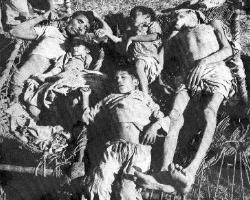
                          Bengali man and boys massacred by the West Pakistani regime.

                          Younger men and adolescent boys, of whatever social class, were equally targets. According to Rounaq Jahan, “All through the liberation war, able-bodied young men were suspected of being actual or potential freedom fighters. Thousands were arrested, tortured, and killed. Eventually cities and towns became bereft of young males who either took refuge in India or joined the liberation war.” Especially “during the first phase” of the genocide, he writes, “young able-bodied males were the victims of indiscriminate killings.” (“Genocide in Bangladesh,” in Totten*et al.,*Century of Genocide, p. 298.) R.J. Rummel likewise writes that “the Pakistan army [sought] out those especially likely to join the resistance — young boys. Sweeps were conducted of young men who were never seen again. Bodies of youths would be found in fields, floating down rivers, or near army camps. As can be imagined, this terrorized all young men and their families within reach of the army. Most between the ages of fifteen and twenty-five began to flee from one village to another and toward India. Many of those reluctant to leave their homes were forced to flee by mothers and sisters concerned for their safety.” (Death By Government, p. 329.) Rummel describes (p. 323) a chilling gendercidal ritual, reminiscent of Nazi procedure towards*Jewish males: “In what became province-wide acts of genocide, Hindus were sought out and killed on the spot. As a matter of course, soldiers would check males for the obligated circumcision among Moslems. If circumcised, they might live; if not, sure death.”

                          Robert Payne describes scenes of systematic mass slaughter around Dacca (Dhaka) that, while not explicitly “gendered” in his account, bear every hallmark of classic gender-selective roundups and gendercidal slaughters of non-combatant men:

                          In the dead region surrounding Dacca, the military authorities conducted experiments in mass extermination in places unlikely to be seen by journalists. At Hariharpara, a once thriving village on the banks of the Buriganga River near Dacca, they found the three elements necessary for killing people in large numbers: a prison in which to hold the victims, a place for executing the prisoners, and a method for disposing of the bodies. The prison was a large riverside warehouse, or godown, belonging to the Pakistan National Oil Company, the place of execution was the river edge, or the shallows near the shore, and the bodies were disposed of by the simple means of permitting them to float downstream. The killing took place night after night. Usually the prisoners were roped together and made to wade out into the river. They were in batches of six or eight, and in the light of a powerful electric arc lamp, they were easy targets, black against the silvery water. The executioners stood on the pier, shooting down at the compact bunches of prisoners wading in the water. There were screams in the hot night air, and then silence. The prisoners fell on their sides and their bodies lapped against the shore. Then a new bunch of prisoners was brought out, and the process was repeated. In the morning the village boatmen hauled the bodies into midstream and the ropes binding the bodies were cut so that each body drifted separately downstream. (Payne,*Massacre*[Macmillan, 1973], p. 55.)

                          Strikingly similar and equally hellish scenes are described in the case-studies ofgenocide in Armenia*and*the Nanjing Massacre*of 1937.
                          sigpic"When it is said to them: "Make not mischief on the earth," they say: "Why, we only Want to make peace!" (2.11)

                          And when it is said to them (hypocrites): "Believe as the people (followers of Muhammad Peace be upon him , Al-Ansar and Al-Muhajirun) have believed," they say: "Shall we believe as the fools have believed?" Verily, they are the fools, but they know not."(2.13)

                          Comment


                          • #14


                            View of genocide...
                            sigpic"When it is said to them: "Make not mischief on the earth," they say: "Why, we only Want to make peace!" (2.11)

                            And when it is said to them (hypocrites): "Believe as the people (followers of Muhammad Peace be upon him , Al-Ansar and Al-Muhajirun) have believed," they say: "Shall we believe as the fools have believed?" Verily, they are the fools, but they know not."(2.13)

                            Comment


                            • #15


                              White Economic dominition ...
                              sigpic"When it is said to them: "Make not mischief on the earth," they say: "Why, we only Want to make peace!" (2.11)

                              And when it is said to them (hypocrites): "Believe as the people (followers of Muhammad Peace be upon him , Al-Ansar and Al-Muhajirun) have believed," they say: "Shall we believe as the fools have believed?" Verily, they are the fools, but they know not."(2.13)

                              Comment

                              Working...
                              X