Announcement

Collapse
No announcement yet.

War in north waziristan

Collapse
X
 
  • Filter
  • Time
  • Show
Clear All
new posts

  • #61
    Govt warns of military operation in North Waziristan

    * Defence minister says action to take course if miscreants not expelled within deadline

    By Sardar Sikander Shaheen
    June 08, 2014


    ISLAMABAD: Military action would take its course immediately after the expiry of the deadline given by the government to the tribesmen in North Waziristan Agency (NWA) if adequate steps are not taken to ensure peace in the area, Defence Minister Khawaja Asif said on Saturday.

    “The ball is now in the court of the Taliban and tribesmen,” Asif said in a conversation with Daily Times on Saturday. He was referring to the deadline given by the ruling civilian leadership and the army command to the tribal elders of the NWA on Friday. “Our soldiers are getting martyred and blood of the innocent is being spilled. We can’t let the things go on like that. If the deadline gets past and there are no concrete measures for peace, there will be action,” the minister warned.

    A 64-member tribal jirga (delegation) comprising of the elders from Wazir and Dawar tribes separately met Peshawar Corps Commander Lieutenant General Khalid Rabbani and Khyber Pakhtunkhwa Governor Sardar Mehtab Abbasi in Peshawar on Friday. The tribesmen were told that they needed to play their role to bring peace in NWA by means of getting the foreign militants expelled from the NWA, asking them to return to the countries they came from.
    “The tribal people are best accustomed to the tribal practices, norms and traditions. It’s now up to them how they manage to get the militants ousted from the NWA. We have tried our best to restore peace through dialogue. But the peace process has not been working which is making it necessary that the force has to be exercised against the terrorists for the restoration of peace.”

    To a query, the defence minister said Prime Minister Nawaz Sharif has given the military complete authority to take decisions for the restoration of the writ of the state in FATA (Federally Administered Tribal Areas). “The PM is completely in the loop and fully aware of the situation. The military authorities brief him on a regular basis. What measures the security forces take to eliminate terrorism is something that completely rests with them. It’s part of the operational secrecy. The armed forces have the complete backing of the government.”

    Sources in the FATA Secretariat said the security forces were not restricting the people from moving across the border from NWA in order to allow the miscreants to leave the tribal agency. “There have been reports that the troublemakers are moving across the border in the garb of civilians to avoid an imminent military action. This omens well for us. We want the terrorists to return where they came from,” said a senior official at the Secretariat.
    NWA Political Agent Siraj Ahmad Khan, when approached, said that the displacements from NWA to the Afghan side of the border was underway mainly because hundreds of families in the tribal agency had their relatives across the border. “This is a closely knitted tribal society and people have family connections stretching across the border which is why people from the NWA are moving to the bordering area of Khost in Afghanistan. The displaced tribal people prefer living with their kith and kin and not in the camps, so they move to alternate areas wherein their relatives are based,” he said.
    To a question, Khan said the security forces were keeping a strict check at the Pak-Afghan border to stop any movement from Afghanistan to Pakistan. “We are not stopping anyone to move across the border but certainly we have to keep a check on movement from Afghanistan into our area because we have credible information that militants are trying to sneak into Pakistani areas to unleash violence.

    “The people who have left the NWA and went across the border moved out of their free will. But their return to Pakistan would not be without proper check and scrutiny.” Amid continuing militant violence by the Tehreek-e-Taliban Pakistan (TTP), several Pakistan Army men, including two lieutenant colonels, have lost their lives in terror attacks in the recent days.


    *Pakistani regime to Pakistani civilians of Waziristan, "even though you are just ordinary Pakistani civilians we - a nuclear armed state - expect you simple villagers and tribesmen to stop the Taliban hosting foreigners, otherwise we are going to bomb and kill you."


    - The most fundamental purpose of a state is to provide security for its citizens, not for the citizens to provide security for the state.

    - It is not the job of these simple village folk to try and dissuade the Taliban from hosting foreigners, but the job of the Pakistani state which constantly boasts of its nuclear bomb to do that and also to ensure the safety of these Pakistani civilians, rather than threaten to bomb them and destroy their villages.

    Anyway it's obvious the Punjabi-controlled Pakistan government and military view Pashtun tribesmen as not true Pakistanis (only Punjabis are that) so are expendable and can be killed if needs be.
    * * * * * * * * * * * * * * * * * * * * * * *

    Comment


    • #62
      ISI,s strategy is to continue this war in n-waziristan untill clear the area from local tribesmen.The southren waziristan is already cleard.
      Over 90% of mehsud tribe moved from waziristan to tank and di khan.
      They are pushing pashtun papulation from tribal area to continue their war on afghanistan untill they get control over pashtun dominated areas of afghanistan.
      They sarounded the pashtun dominated areas.
      Their men are already operating in noristan and kunar.
      The world must stop pakis from the genocides of pashtuns.
      The west support paki agenda and their war on pashtuns and afg.


      Support pashto language and greater pukhtoonkhwa.

      pa prady jaba khabarai pakhtun naka
      be laila bala soda kho majnon naka
      gero jabo kre lahoo pa khpal tahzeeb ki
      be pakhtu ba de bal hestsok rastoon naka
      hamza baba
      پَښتو کښې اُولېکئ
      Pashto Keyboard Online (Afghan) LEXILOGOS >>

      Comment


      • #63
        Originally posted by gadoonwal View Post
        ISI,s strategy is to continue this war in n-waziristan untill clear the area from local tribesmen.The southren waziristan is already cleard.
        Over 90% of mehsud tribe moved from waziristan to tank and di khan.
        They are pushing pashtun papulation from tribal area to continue their war on afghanistan untill they get control over pashtun dominated areas of afghanistan.
        They sarounded the pashtun dominated areas.
        Their men are already operating in noristan and kunar.
        The world must stop pakis from the genocides of pashtuns.
        The west support paki agenda and their war on pashtuns and afg.

        1. Yes the US supports the Pakistani war on Pashtuns.

        A few days ago on the forum someone posted this: http://www.pashtunforums.com/showthread.php?t=43997

        An American academic criticizing the Pakistani military and saying it has a destabilizing role in Afghanistan.

        The fact is this is a joke. The Americans know exactly what the Pakistan army is like, seeing as they essentially have control over it. The Pakistan army and state is in real terms very weak and dependent on US handouts for survival, otherwise it will collapse. If the US really wanted to, they could stop the Pakistan army from doing all this.

        However as in 1971 when America supported the Pakistani genocide of Bengalis, they now support the Pakistani war against Pashtuns.


        2. Everyone knows these Waziri tribals will not be able to convince the Taliban to remove these foreigners, if the Taliban don't listen to the 0.5 million strong nuclear armed Pakistan army then I doubt the pleas of a few Waziri villagers will have an impact.

        Unless something else happens - which is highly possible - we may see some sort of operation in north Waziristan.

        However it looks like the Pakistan army will not just be against Hafiz Gul Bahadur but also against

        - The TTP (led by Fazlullah).
        - Taliban fighters from Afghanistan.
        - Fighters from Uzbekistan.
        - Fighters from the Arab world ("Al-Qaeda").

        This will be a very bloody war if it does happen, which it may not yet.
        * * * * * * * * * * * * * * * * * * * * * * *

        Comment


        • #64
          With Obama's decision for a complete US withdrawal from Afghanistan in 2016, Pakistan's position has/is weakening financially and militarily. Pakistan's importance to the US will dwindle as US exits.

          Karzai's refusal to sign the BSA played into Obama's decision for a full withdrawal. With regards to one of the prisoners released, Khairkhwa, he was previously sought out by Hekmat Karzai. He lobbied for his release to help the peace efforts a few years ago. Khairkhwa was arrested by Pakistan in 2002, and handed over to the US.

          http://www.longwarjournal.org/archiv..._court_de.php#

          Comment


          • #65

            TTP announces to use force in response to govt attacks


            Friday, June 06, 2014
            From Print Edition


            ISLAMABAD: Banned Tehrik-e-Taliban Pakistan (TTP) has said that they will now use force to reciprocate any attack launched by the government.

            Talking to BBC on phone from an undisclosed location on Thursday, a senior TTP leader said that the outfit was interested in carrying the peace talks forward. “If the government wants to negotiate with seriousness, sincerity and will, we’re still ready for talks. But, we will respond to attacks with further attacks,” he remarked.

            On the other hand, the government has made it clear that if the extremists attack governmental installations and those in the tribal areas are found to be behind the assaults, the government will also resort to limited offensive.

            The possibilities of progress in the talks seem to be little. The new statements clarify that the two parties are going to be at loggerheads again.As he talked to BBC a few days back, TTP Spokesman Shahidullah Shahid had complained that the government which said that it would have talks with the negotiators and fight with those who wanted to indulge in war, was both negotiating and fighting with banned TTP.

            * * * * * * * * * * * * * * * * * * * * * * *

            Comment


            • #66
              ***** BREAKING NEWS ******

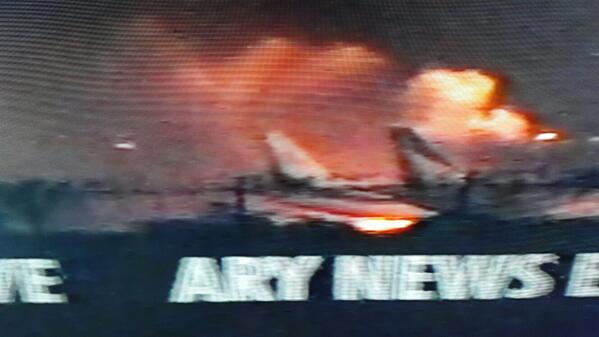
              - The airport of the biggest city and main economic centre of Pakistan, Karachi, has been attacked.

              - This airport is an important gateway for Pakistan's access to the outside world.


              Last edited by Bengal_Tiger; 06-08-2014, 04:57 PM.
              * * * * * * * * * * * * * * * * * * * * * * *

              Comment


              • #67
                Also today, 22 people have been reported to have been killed in western Pakistan.

                At least 22 people killed in suicide attack near Pak-Iran border

                By Syed Ali Shah
                Published 27 minutes ago
                -
                QUETTA: At least 22 people were killed and several others injured in two coordinated suicide blasts near the Pak-Iran border, Taftan late on Sunday night an high level official confirmed.

                Balochistan's Home Secretary Akbar Hussain Durrani told Dawn.com that 10 buses carrying Shia pilgrims had entered Pakistan from Iran.


                This maybe the work of the Punjabi Taliban, who are known for their hatred of Shias.
                * * * * * * * * * * * * * * * * * * * * * * *

                Comment


                • #68
                  There are terrorists hiding in Karachi Airport right now. Pakistan Air Force is watching the airport through surveillance drones. The same PAF often bombs residential areas in Mir Ali stating that terrorist hide among the population. Since terrorists are hiding inside Karachi airport now, the PAF can have the honors please. Do the same to Karachi airport as you do to towns and villages in Waziristan. Patriotic Pakistanis will support this strategy in Karachi too. If civilians are killed, we will remain silent. We will just say that there were terrorist in there. If anyone shows us pictures of innocent women and children killed in bombing by F-16s, we will just say, "This is propaganda against Pak forces. Pakistan Zindabad. Death to all traitors. Death to all agents of India. No innocent people died in Karachi airport and no innocent people died in Mir Ali"


                  Response:

                  Asdaq Pathan:

                  You have a point admin but people wont see your post from this point of view. They have been indoctrinated from a young age never to question the army, but to always worship them. It seems it is only legitimate to bomb one specific area. As sickening as this sounds, if terrorists were to be hiding inside a hospital full of people in the tribal area, it would have been raised to the ground. People will always be selective, and the people of Pakistan in particular will criticize whatever suits them


                  In other words Pashtuns, especially tribals, are a conquered race whose life has no value and can be killed, but the real Pakistan is Punjab and mainly Lahore and also to a lesser extent Karachi.
                  * * * * * * * * * * * * * * * * * * * * * * *

                  Comment


                  • #69
                    Atleast two of the soldiers in the video are pashtuns.
                    [URL="http://historyofpashtuns.blogspot.com.au/2014/07/afghan-sikh-wars.html"][SIZE=5][COLOR=Green]History of Pashtuns[/COLOR][/SIZE][/URL]

                    Comment


                    • #70
                      I will comment on this in more detail later, but for the time being.

                      1. The focus is on Hafiz Gul Bahadur but the TTP are a separate army and are the ones who carried out the Karachi attack.

                      So even if the Pakistan army attacks North Waziristan, they have a separate war with the TTP.

                      2. I mentioned in one of my posts above yesterday that the Pakistan army would be fighting TTP, Hafiz Gul Bahadur's army, Uzbeks and Arabs (amongst others).

                      A few hours later Uzbek fighters attacked the airport of Pakistan's biggest city.


                      3. Imran Khan knows what he is talking about when he says the secession of Waziristan is a possibility.

                      If the Pakistan army goes in hard in Waziristan they - as the Karachi attack has shown - will be provoking a huge escalation in the conflict and the surival of Pakistan itself is under threat.
                      * * * * * * * * * * * * * * * * * * * * * * *

                      Comment


                      • #71
                        What exactly are Uzbeks doing in pakistan anyways? are they trying to make a name for themselves? Also the prepartors were reported to have been speaking pashto. I think Geo is just blaming and outside force like uzbeks so the name of pakistan doesn't sink more.
                        "Revenge is a dish best served cold".

                        -Old Pashtun proverb


                        "My Pashtun Pride i will not hide!"

                        Comment


                        • #72
                          - The Uzbek militants (Uzbeks from Uzbekistan and not Afghanistan) have been in northern Pakistan for quite a while now along with other Arab militants and are hosted by the TTP.

                          - The Pakistani military has insisted on their removal from north Waziristan and the recent jirga there a day or two ago reiterated that demand i.e. their departure/expulsion from north Waziristan.

                          - The TTP is not a Pashtun nationalist movement but anti-Pashtun and kills Pashtun nationalists. The TTP is an Al-Qaeda aligned group which has Pashtuns, Punjabis, Balochis, Mohajirs, Arabs and other ethnic groups in it.

                          The Pakistanis like to portray it as being some sort of Pashtun nationalist movement. It is far from that and many of their leaders studied in madrassas in the Punjab following the Deobandi ideology originating from central India.
                          * * * * * * * * * * * * * * * * * * * * * * *

                          Comment


                          • #73
                            Before the airport attack yesterday Foreign Policy magazine warned about the Taliban threat in Karachi.

                            Here is the article:


                            Will Karachi Become the Next Waziristan?


                            BY MICHAEL KUGELMAN JUNE 5, 2014


                            This article is part of a monthly series by the author that highlights possible post-2014 scenarios for Afghanistan.
                            ***

                            On May 5, an American FBI agent named Joel Cox was arrested in the Pakistani megacity of Karachi. The charge? Attempting to board a flight to Islamabad with ammunition and knives in his carry-on baggage. The Pakistani media immediately drew comparisons between Cox's case and that of Raymond Davis -- the CIA spy jailed in 2011 after gunning down two Pakistanis in Lahore.
                            However, Cox's legal travails, unlike those of Davis, didn't last long. He was granted bail on May 8, and his case was dismissed on May 19. Cox's lawyer contended that his client was in Karachi on a "special mission" that allowed him to carry weapons -- and a judge concurred.
                            So what exactly was this "special mission"? According to U.S. officials and Cox's legal team, he was simply providing training to local law enforcement.
                            If this is true, then Cox was in Pakistan for a very good reason.
                            Pakistan's cities are suffering from relentless, and in some cases unprecedented, levels of violence. In 2013, Karachi's terrorist violence increased by 90 percent. The city's 2,700 casualties from violence that year represented a new record. Meanwhile, some of the deadliest sectarian attacks in the country over the last year have occurred in Peshawar and Quetta. Furthermore, many Pakistani cities are convulsed by bloodshed stemming from ethnic conflict and organized crime. These alone are daunting challenges for law enforcement.
                            And yet with most international troops withdrawing from neighboring Afghanistan, the difficult job of Pakistani city police officers is bound to become even tougher. The drawdown is likely to deepen instability not only in Afghanistan and Pakistan's tribal belt, but also -- thanks to the dynamics of Pakistan's rapid urbanization -- in Pakistan's teeming cities.

                            Consider that Pakistan is urbanizing at an annual rate of 3 percent -- the fastest pace in South Asia. Karachi's population grew 80 percent between 2000 and 2010 -- the biggest increase of any city in the world. According to U.N. estimates, roughly a third of Pakistan's population is currently urban-based, yet in about 10 years, that figure is expected to be nearly 50 percent (using strictly density-based definitions of urban space, Pakistan is already 60 to 65 percent urban today).
                            This urbanization can be attributed to various factors, from a natural increase in the overall population (which is rising at a nearly 2 percent annual clip) to rural residents seeking better economic opportunities and fleeing natural disasters. However, as I explain in Pakistan's Runaway Urbanization, a new Wilson Center report, there are two other chief -- yet less acknowledged -- drivers: war and conflict. Simply put, regional unrest tends to trigger mass migrations to Pakistani cities.

                            This is a long-standing dynamic. Six to eight million Indian Muslims entered Pakistan at partition, with many settling in the urban areas of Sindh and Punjab provinces. Similar influxes occurred during wars with India in 1965 and 1971. Then, in the 1980s, amid the anti-Soviet insurgency in Afghanistan, several million Afghans flowed into western Pakistan, with many ending up in Quetta and Peshawar. Finally, more recently, military offensives in Pakistan's tribal areas have triggered an exodus of people to Peshawar, Quetta, and Karachi.
                            What sets these latest rural-to-urban refugee flows apart from earlier ones is that militants are increasingly migrating along with civilians. Hundreds -- maybe thousands -- have been converging on Karachi alone over the last few years. According to some estimates, 8,000 Pakistani Taliban (TTP) fighters were there by 2012. They use the city as a fundraising and recruitment center, and, increasingly, as a base for attacks.
                            Pakistan's urban spaces offer incoming TTP forces a welcome and enabling environment. Urban society is rapidly radicalizing -- thanks in part to a young and growing, yet largely conservative middle class, and to the hardline messages of wildly popular, urban-based, private television channels. Not surprisingly, militant organizations are extending their reach across Pakistani cities. Dawn, a Pakistani newspaper, reported in March that the TTP wields some form of influence over most ethnic Pashtun-populated parts of Karachi (several million of Karachi's 18 million people are Pashtuns). And according to the Wall Street Journal, the TTP "controls or dominates" nearly a third of the city altogether
                            . Predictably, numerous extremist organizations -- including al Qaeda -- are actively recruiting from within Pakistan's urban middle class. In sum, militancy has become entrenched in Pakistani cities, and is no longer a strictly tribal-belt affair.
                            And yet soon, this could all get much worse. Next year, Afghanistan's fate will be left in the hands of fragile Afghan security forces. They will face emboldened enemies in the Afghan Taliban and Haqqani Network, which continue to enjoy sanctuaries in North Waziristan. And if the statements of militant commanders and South Asian government officials are to be believed, these enemies will receive operational support from the Pakistani Taliban, Punjab-based sectarian militants, and even Indian jihadists.
                            We now know that if Washington concludes a bilateral security agreement with Kabul, President Obama will leave nearly 10,000 troops in Afghanistan next year, before withdrawing them in 2016. While certainly helpful, this residual presence would ultimately amount to a modest, non-combat, temporary force lacking the capacity and mandate to stabilize Afghanistan in a major way. For all these reasons, we can expect Afghanistan's security situation to worsen after this year.
                            Given the large, porous Afghanistan-Pakistan frontier, we can also expect that this increased unrest will spill into Pakistan and displace communities on both sides of the border. And based on past history, we can assume that many of these refugees will migrate to Pakistani cities.
                            Admittedly, Afghan refugees may have more trouble doing so this time around as the Pakistani government is implementing new measures to reduce Afghan migration into the country. New border screening rules are going into effect, and housing acquisition procedures are becoming stricter. Already, in Karachi, officials are tracking down illegal Afghan immigrants. And in Islamabad, bulldozers have dismantled Afghan settlements.
                            Whether these measures achieve their objective remains to be seen. Yet even if they do, we can still expect scores of tribal-area Pakistanis -- displaced by intensified cross-border attacks and other fighting that spills over the border -- to converge on cities. Many would be Pashtuns, and those ending up in Karachi could further aggravate the city's volatile ethnic mix, which has already spawned violent competition (much of it fought over precious land) between the Muttahida Qaumi Movement, a political party that is dominated by Mohajirs, and the Awami National Party, which is mainly made up of Pashtuns.

                            Tribal area inhabitants could also pour into urban areas to escape from Pakistani military offensives, which are bound to pick up now that Islamabad's peace overtures to the TTP have ceased, and from vicious intra-TTP fighting -- which also stands to intensify given the organization's increasingly fractured state.

                            Meanwhile, militants, particularly those gunning for new targets as U.S. forces leave Afghanistan, could be preparing for future assaults on cities in Pakistan's populous eastern and southern regions. A recent Pakistani intelligence report claims that al Qaeda and the TTP are planning to use the Indus River to transfer arms and ammunition from Khyber-Pakhtunkhwa province to Sindh and Punjab. And the TTP is relocating large numbers of forces not only to Karachi, but also to southern Punjab -- a hotbed of sectarian and anti-India militancy.

                            As underscored in Pakistan's Runaway Urbanization, new arrivals in Pakistani cities will further tax the ability of municipal authorities to provide basic services and natural resources. Even now, some of Pakistan's urban poor can only access enough water to meet one-fifth of daily human drinking water requirements. City power shortages are incessant. Nearly 50 percent of city residents live in slums. Six percent of urban Pakistanis have no latrines, and 95 percent do not have their garbage collected. And masses of young urbanites -- in a country of 180 million, where two-thirds are under the age of 30 -- face a national labor market that creates less than 700,000 new jobs a year. The upshot? Pakistani cities could soon be awash with unemployed youth facing acute privation, a demographic primed for radicalization.
                            This all places a tremendous burden on Pakistani police forces, which have a checkered record. On the one hand, they boast efficient officers and fearless terrorist-hunting commanders such as the late Chaudhry Aslam, who was killed in a Karachi bomb attack in January. For this reason, Pakistani activists and international analysts alike have called for a more decentralized Pakistani policing model that gives officers more autonomy to do their jobs. Yet on the other hand, the police are undeniably corrupt and given to idly standing by while the vulnerable citizens they are meant to protect -- from women and schoolgirls to religious minorities -- are mercilessly attacked.
                            According to Ahsan Iqbal, Pakistan's minister for planning, development, and reform, the government is addressing policing issues, including "smart policing," community policing, and citizen-police liaison committees. This is a start. Yet much more needs to done.
                            As for FBI agent Joel Cox and his "special mission" to train police? He was doing his small part to help Pakistani law enforcement prepare for a looming and formidable challenge -- one that promises to come into sharp focus next year.

                            Michael Kugelman is the senior associate for South Asia at the Woodrow Wilson International Center for Scholars in Washington, D.C. He can be reached at michael.kugelman@wilsoncenter.org or on Twitter: @michaelkugelman.


                            * This sort of article would have been rejected or even ridiculed by Pakistani nationalists a week ago, perhaps as "over-imaginative".

                            3 days after the article was published the TTP carried out an attack in Karachi, and on the airport there.
                            * * * * * * * * * * * * * * * * * * * * * * *

                            Comment


                            • #74
                              Originally posted by Bengal_Tiger View Post
                              - The Uzbek militants (Uzbeks from Uzbekistan and not Afghanistan) have been in northern Pakistan for quite a while now along with other Arab militants and are hosted by the TTP.

                              - The Pakistani military has insisted on their removal from north Waziristan and the recent jirga there a day or two ago reiterated that demand i.e. their departure/expulsion from north Waziristan.

                              - The TTP is not a Pashtun nationalist movement but anti-Pashtun and kills Pashtun nationalists. The TTP is an Al-Qaeda aligned group which has Pashtuns, Punjabis, Balochis, Mohajirs, Arabs and other ethnic groups in it.

                              The Pakistanis like to portray it as being some sort of Pashtun nationalist movement. It is far from that and many of their leaders studied in madrassas in the Punjab following the Deobandi ideology originating from central India.
                              The Afghan Taliban also had minor non Pashtun militias like Chechens, Arabs, Egyptians etc. but they are predominantly Pashtun.

                              This is what the wikipeida article says about the TTP and the ethnic groups;

                              The TTP is not directly affiliated with the Afghan Taliban movement led by Mullah Omar, with both groups differing greatly in their histories, strategic goals and interests although they are both predominantly Pashtun


                              Correct me if i am wrong though.
                              "Revenge is a dish best served cold".

                              -Old Pashtun proverb


                              "My Pashtun Pride i will not hide!"

                              Comment


                              • #75
                                - 3 killed including a child, along with 2 Pakistani soldiers.


                                Inna lillahi wa inna ilaihi raaji'oon.


                                2 soldiers killed elsewhere.


                                http://www.dawn.com/news/1111585/roa...aran-officials.


                                4 killed in another place, Boya.


                                This means

                                - 8 soldiers dead today in 3 locations.

                                - 23 dead in south-west Pakistan (maybe the work of the Punjabi Taliban).

                                - 28 dead yesterday in Karachi.

                                That's 59 people killed in the past 2 days and Pakistan being on the front page of world's newspapers and webpages.

                                Possibly billions of dollars lost in potential investment and business which will now not be invested in the country due to security scares.
                                * * * * * * * * * * * * * * * * * * * * * * *

                                Comment

                                Working...
                                X