
 Tweet
In this thread I will monitor the notorious "Jamaat e Islami" political party which operates in Pakistan and Bangladesh.
Jamaat e Islami are considered enemies of Pashtuns by Pashtun nationalists and enemies of Bangladesh by Bangladeshi nationalists.
INTRODUCTION AND BACKGROUND
Jamaat e Islami is an organization founded by controversial Indian writer, Maudoodi. Maudoodi was from Hyderabad and was originally vehemently against the creation of Pakistan whilst someone for example Mujibur Rahman (the head of the Awami League in Bangladesh that gained independence for the country) was a supporter of the Pakistan project.
Maudoodi is rejected by:
- Deobandi
- Salafi / Ahlul Hadith
- Barelvi
and other scholars, and fatawa (legal verdicts) have been issued against him.
The party in the past was the main party for Pakistan's "Mohajirs" (Indian-origin migrants) who not having their own indigenous land/province in Pakistan and thus regional nationalism, believed in a pan-Muslim nationalism to solidify the Pakistan project and to direct people's support from regional nationalism to a common pan-Pakistani nationalism.
If Sindhis for example became nationalistic this posed a threat to Mohajirs who were migrants to their land, Sindh.
JI (Jamaat e Islami) in Bangladesh
Jamaat e Islami was heavily involved in the war crimes, rape and genocide in east Pakistan in 1971 for which the Bangladeshi wing of the party refuses to apologize.
The Bangladeshi wing, is very influential in the middle east where it lobbied for many years after 1971 for gulf countries not to recognize Bangladesh peddling lies such as Bangladesh was run by Hindus, mosques were being destroyed etc.
Such wild lies ironically coming from an "Islamic" party are characteristic of the party's modus operandi. The party in Bangladesh is also violent and has a "student" wing which engages in urban terrorism i.e. rioting.
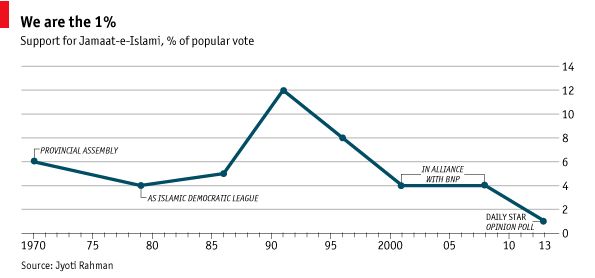
However a recent Economist article stated that Jamaat's level of support in Bangladesh is now around 1% .
Bangladesh's politics: Dispensable allies | The Economist
Though the Jamaat (which in secret still opposes the creation and existence of Bangladesh and wants it to be part of Pakistan again) enjoys very little support it is a threat to Bangladesh for two reasons.
1. It is supported by Pakistan and Saudi Arabia, both of whom fundamentally do not believe in the existence of an independent and successful Bangladesh.
Saudi Arabia will use its influence e.g. 2 million workers in Saudi sending much-needed money back to Bangladesh, a poor country to threaten, intimidate and bully Bangladesh.
2. The Jamaat has an organized network of street thugs which some say is the "muscle" for their bigger coalition partner, the BNP (Bangladesh's 2nd biggest party, now in opposition). Individuals loyal to the Jamaat are for example active in the controversial defence.pk forum where they peddle lies and also promote a heavy anti-India and anti-Hindu agenda.
Though Jamaat's appeal will decrease with an improving economy, more female empowerment it is the Pak-Saudi axis which supports them that is probably the biggest threat to the Bangladeshi people.

Abdullah Al-Saud, the dictator who rules Saudi Arabia and whose regime is a major sponsor of extremism across the globe including the controversial Jamaat e Islami in Bangladesh.

Jamaati thugs in Bangladesh.

Jamaatis burn a coach in Bangladesh, in a country where both Jamaatis and their enemies, the Awami League engage in frequent rioting and criminality.

Jamaatis beat a Bangladeshi policeman.
Jamaat in Bangladesh are also backed by the Americans which want to use them as the Bangladeshi link in their chain of brotherhood (Ikhwani) style parties across the Muslim world (as Washington DC uses radical Islam to destabilize rivals such as Russia, China and the EU).

The US' top man in Bangladesh, Dan Mozena, the US ambassador. His regime are well-known supporters of Jamaat e Islami and America supported the 1971 genocide.
The problem however for the American-Pakistani-Saudi axis is that Jamaat Islami in Bangladesh are hated by most of the country's Islamic scholars who view them as heretics and who hate Maudoodi. Also Bangladeshis in general are of a far more moderate and milder temperament than Pakistanis and are not inclined to extremism or terrorism. Thus in the long run the bad news for the American regime is that Jamaat will not be able to achieve much in Bangladesh, a country whose very existence they sought to unsuccessfully crush.
Jamaat e Islami are considered enemies of Pashtuns by Pashtun nationalists and enemies of Bangladesh by Bangladeshi nationalists.
INTRODUCTION AND BACKGROUND
Jamaat e Islami is an organization founded by controversial Indian writer, Maudoodi. Maudoodi was from Hyderabad and was originally vehemently against the creation of Pakistan whilst someone for example Mujibur Rahman (the head of the Awami League in Bangladesh that gained independence for the country) was a supporter of the Pakistan project.
Maudoodi is rejected by:
- Deobandi
- Salafi / Ahlul Hadith
- Barelvi
and other scholars, and fatawa (legal verdicts) have been issued against him.
The party in the past was the main party for Pakistan's "Mohajirs" (Indian-origin migrants) who not having their own indigenous land/province in Pakistan and thus regional nationalism, believed in a pan-Muslim nationalism to solidify the Pakistan project and to direct people's support from regional nationalism to a common pan-Pakistani nationalism.
If Sindhis for example became nationalistic this posed a threat to Mohajirs who were migrants to their land, Sindh.
JI (Jamaat e Islami) in Bangladesh
Jamaat e Islami was heavily involved in the war crimes, rape and genocide in east Pakistan in 1971 for which the Bangladeshi wing of the party refuses to apologize.
The Bangladeshi wing, is very influential in the middle east where it lobbied for many years after 1971 for gulf countries not to recognize Bangladesh peddling lies such as Bangladesh was run by Hindus, mosques were being destroyed etc.
Such wild lies ironically coming from an "Islamic" party are characteristic of the party's modus operandi. The party in Bangladesh is also violent and has a "student" wing which engages in urban terrorism i.e. rioting.
However a recent Economist article stated that Jamaat's level of support in Bangladesh is now around 1% .
In a recent opinion poll, only 1% of respondents said they would vote for Jamaat. This compares with an actual 4% share of the popular vote in the 2008 general election
Though the Jamaat (which in secret still opposes the creation and existence of Bangladesh and wants it to be part of Pakistan again) enjoys very little support it is a threat to Bangladesh for two reasons.
1. It is supported by Pakistan and Saudi Arabia, both of whom fundamentally do not believe in the existence of an independent and successful Bangladesh.
Saudi Arabia will use its influence e.g. 2 million workers in Saudi sending much-needed money back to Bangladesh, a poor country to threaten, intimidate and bully Bangladesh.
2. The Jamaat has an organized network of street thugs which some say is the "muscle" for their bigger coalition partner, the BNP (Bangladesh's 2nd biggest party, now in opposition). Individuals loyal to the Jamaat are for example active in the controversial defence.pk forum where they peddle lies and also promote a heavy anti-India and anti-Hindu agenda.
Though Jamaat's appeal will decrease with an improving economy, more female empowerment it is the Pak-Saudi axis which supports them that is probably the biggest threat to the Bangladeshi people.
Abdullah Al-Saud, the dictator who rules Saudi Arabia and whose regime is a major sponsor of extremism across the globe including the controversial Jamaat e Islami in Bangladesh.
Jamaati thugs in Bangladesh.
Jamaatis burn a coach in Bangladesh, in a country where both Jamaatis and their enemies, the Awami League engage in frequent rioting and criminality.
Jamaatis beat a Bangladeshi policeman.
Jamaat in Bangladesh are also backed by the Americans which want to use them as the Bangladeshi link in their chain of brotherhood (Ikhwani) style parties across the Muslim world (as Washington DC uses radical Islam to destabilize rivals such as Russia, China and the EU).
The US' top man in Bangladesh, Dan Mozena, the US ambassador. His regime are well-known supporters of Jamaat e Islami and America supported the 1971 genocide.
The problem however for the American-Pakistani-Saudi axis is that Jamaat Islami in Bangladesh are hated by most of the country's Islamic scholars who view them as heretics and who hate Maudoodi. Also Bangladeshis in general are of a far more moderate and milder temperament than Pakistanis and are not inclined to extremism or terrorism. Thus in the long run the bad news for the American regime is that Jamaat will not be able to achieve much in Bangladesh, a country whose very existence they sought to unsuccessfully crush.


Comment