
-
Originally posted by Firdousi -
I agree. But what about Caliphate???? The Ummah chooses the Caliphate. Hence Democracy????Originally posted by Shamlawar Khurasani View Post
If you have an Islamic Country. How do you elect Caliphate or president???? I told you about Abu Balar (r.a) he was elected by the masess my bro.جی وا ترا بلوچ ، ذندان بلوچ ، کلو واتنییے
G wa tra Baloch , Balochistan Zindabad
Comment
-
I will explain this in a seperate message. I have to sleep now. I am very tired of working today.Originally posted by FirdousiComment
-
What is this nonsense? All I hear from these idiot Salafis is how democracy is haram, not any alternatives to it.
What do they propose for a selection of a government/leader who's duty it is to uphold shariah, whoever raises their hand first? The political ascension of leaders during the days of the Salaf after the Prophet was a bloody mess, so that is not exactly an example to follow. These fools sound more like Anarchists than Muslims.
Haram haram haram, no solutions no solutions no solutions. When will these Salafis start preaching against the shirk of the kingdoms they receive their salaries from?There are people today who think that admitting God’s absolute greatness decreases the value and importance of humans in the creation, as if God and mankind are rivals competing in greatness and power. Meanwhile I feel that whenever our perception of God’s greatness increases, with it we become greater, because we are the creation of a great God.
Sayyid QutbComment
-
According to your signature, your signature makes a "cross" just like that tomato. it's christian please remove it. if you dont remove it your a devil and you will be cursed. Thank you!Originally posted by randolph85 View Postجی وا ترا بلوچ ، ذندان بلوچ ، کلو واتنییے
G wa tra Baloch , Balochistan Zindabad
Comment
-
Hukm means command and it means that God commands the universe. It is because of his order that the universe is functioning. This is the ontological and cosmological command not legislative or judgements in courts.Originally posted by Shamlawar Khurasani View Post
If you take it legislation or court rules then God should come down to the earth, establish a big parliament and a court of law and may judge on each and every affair of the billions of individuals in this world. Then all these judges are also mushriks as they are passing judgements while judgment is only for Allah!
Shirk is when you say there are two or more Gods who have to be worshiped. You cannot worship more than one God in Islam but you can legislate, judge and execute as it is a norm in democracy. There is no theocracy in Islam. If you do not have democracy then what will be the form of government in a state where Muslims live?Comment
-
Originally posted by M17ArnoBaloch View Post
Democracy gives the power that is Allah, i.e legislation to the people. that is where the shirk comes from.
If democracy is used to vote for other than Allah's legislation than that is shirk.
Its like how hindus give the power of Allah such as intercession, the weather or forgiveness to their idols when it belongs to Allah alone. Its shirk.
stop playing with the book of Allah, anyone who has respect for the book of Allah wouldn't change the words to what it doesn't meanOriginally posted by Badlun View Post
the word Hukm does NOT mean command, it means legislation.
The dictionary Hans-wher explains hukm means legislation

if you go on the second column and third column you can see hukm means legislation. Furthermore the ayaat that mentions that the hukm is only for Allah can only be for judicial matters.
Let me show you all the examples (this also answers the stupidity you mentioned with regards to hukm only means the ibadaat and not the judicial matters Allah mentions in the Quran)
First case: Surah Maidah ayaat 44-50
Indeed, We sent down the Torah, in which was guidance and light. The prophets who submitted [to Allah] judged by it for the Jews, as did the rabbis and scholars by that with which they were entrusted of the Scripture of Allah, and they were witnesses thereto. So do not fear the people but fear Me, and do not exchange My verses for a small price. And whoever does not judge by what Allah has revealed - then it is those who are the disbelievers. (44)
This ayah states that whoever does not judge by what Allah has sent down than he is a kafir. We have to look at the context of the verse to understand who Allah is talking about. Allah is talking about the whole book, the whole sharia which is what the torah was and what the Quran abrogated. The Quran has many judicial and penal laws such as cutting the hand of the thief (which is stated in the same surah), fighting the disbelievers in defense and in offense (Surah tawbah in the end its mentioned) how to divorce a women, how to take care of debts, business transactions, disciplining your wife, how a women should dress, how are renegades treated, and how is retribution treated. This, plus the spiritual matters such as prayer and the other social matters such as how should one be with their brothers are all included in the the whole of the sharia and the sunnah explains the sharia.
Whoever discards the whole of the basis. i.e the Quran and sunnah is a kafir. This is indicated by seeing that Allah mentions that the prophets, the yahud as a whole, the monks and the scholars ruled by the book indicating a communal rule. So whoever discards the whole book (in our case the Quran) is a KAFFIRRR.
And We ordained for them therein a life for a life, an eye for an eye, a nose for a nose, an ear for an ear, a tooth for a tooth, and for wounds is legal retribution. But whoever gives [up his right as] charity, it is an expiation for him. And whoever does not judge by what Allah has revealed - then it is those who are the wrongdoers. (45)
In this case, it shows whoever does not rule by one rule but accepts the whole book in a single situation is a thalim. This ayah also shows that hukm means legislation because this ayah is talking about the law of retribution.
And We sent, following in their footsteps, Jesus, the son of Mary, confirming that which came before him in the Torah; and We gave him the Gospel, in which was guidance and light and confirming that which preceded it of the Torah as guidance and instruction for the righteous. (46)
And let the People of the Gospel judge by what Allah has revealed therein. And whoever does not judge by what Allah has revealed - then it is those who are the defiantly disobedient. (47)
The injeel was a mainly spiritual book, containing no new laws, therefore whoever does not rule by those spiritual laws (such as doing dhikr, having khushu in salah, being truthful, not lying against the book like you are doing and much more) is a fasiq.
And We have revealed to you, [O Muhammad], the Book in truth, confirming that which preceded it of the Scripture and as a criterion over it. So judge between them by what Allah has revealed and do not follow their inclinations away from what has come to you of the truth. To each of you We prescribed a law and a method. Had Allah willed, He would have made you one nation [united in religion], but [He intended] to test you in what He has given you; so race to [all that is] good. To Allah is your return all together, and He will [then] inform you concerning that over which you used to differ. (48)
And judge, [O Muhammad], between them by what Allah has revealed and do not follow their inclinations and beware of them, lest they tempt you away from some of what Allah has revealed to you. And if they turn away - then know that Allah only intends to afflict them with some of their [own] sins. And indeed, many among the people are defiantly disobedient. (49)
If anyone says that this is referring to the torah, these two ayaat show that NOW we have to rule by what was revealed to the Prophet Muhammad peace be upon him.
Then is it the judgement of [the time of] ignorance they desire? But who is better than Allah in judgement for a people who are certain [in faith]. (50)
and this ayah is for you, do you want the hukm of the people of ignorance who rules by their own desires? Whats wrong with you? Whats wrong with you is you don't have yaqeen.
More ayaat coming.Last edited by Khorosani; 09-07-2013, 06:05 AM.Comment
-
[MENTION=16001]Khorosani[/MENTION]
As it is apparent from their hostility, these people hate the book of Allah, they hate his religion and thus they hate the message.
Therefore their reaction is a true reflection of their state of mind.Originally posted by FirdousiComment
-
Ruling by other than the rule of Allah
by Shaykh Muhammad bin Saalih al-Uthaymeen
Taken from ‘al-Qawl al-Mufeed `alaa
Kitaab at-Tawheed’ [2/263-269]
Translation by Abu Rumaysah [Triod Publications]
The following is taken from the Shaykh’s concluding remarks to the hadeeth of `Adee bin Haatim that he heard the Messenger of Allaah (SAW) reciting the verse,
"They (the Jews and Christians) took their rabbis and monks to be their lords besides Allaah."
[at-Tawbah (9): 31]
Upon which I said, "indeed we did not worship them." [The Prophet (SAW)] said, "did they not make unlawful that which Allaah made lawful and so you too did the same? [Did they not] make lawful what Allaah made unlawful and so you too did the same?" I replied, "verily." He said, "this then was the worship of them." Reported by Ahmad and at-Tirmidhee who declared it hasan.
[The following points] are derived from the hadeeth:
That obedience with the meaning of worship is a specific type of uboodiyyah.
Obedience in that which contradicts the Law of Allaah constitutes worship of the one obeyed. As for [obedience] in the worship of Allaah then this is [truly] worship of Allaah.
That following the scholars and servants in that which contradicts the Law of Allaah constitutes taking them as lords [besides Allaah].
Know that following the scholars or leaders in their making lawful what Allaah has made unlawful or the opposite [causes that person] to fall into one of three categories:
That he follows them while being pleased with their opinion and giving it precedence and being displeased with the ruling of Allaah - such a person is a kaafir because he has disliked what Allaah has revealed and as a result Allaah made his actions to be of no avail. No one but a kaafir has his actions rendered futile.
That he follows them while being pleased with the ruling of Allaah, knowing that it is the most ideal and best suited for the servants and the lands. However due to his following his desires he chooses this [other ruling] for example due to his [being offered] a position of responsibility. Such a person is not declared to be a kaafir, rather he is a faasiq.
That he does not know and neither is it possible for him to learn, so he blindly follows them thinking [that what he follows] is the truth. Such a person incurs no blame for he merely follows what he has been commanded and he is excused for this. This is why there occurs from the Messenger of Allaah (SAW) that he said, "indeed whosoever is given a verdict not based upon knowledge then his sin is upon the one who gave him the verdict." If we were to say that this person is sinful due to the error of someone else then this necessarily leads to oppression and difficulty, and no person would trust any other due to the possibility of bearing responsibility for that persons error.
{The hadeeth is reported by Ahmad (2/321, 365), Abu Daawood (4/66), ibn Maajah (1/20), ad-Daarimee (1/53) and al-Haakim (1/126) who said, "saheeh, meeting the conditions of the Two Shaykhs, I know of no defect [in it]." Adh-Dhahabee agreed.}
If it is asked: why are not the second category [of people] declared to be kaafir? I would reply: if we were to say that they are kaafir then this would necessitate the disbelief of every person who commits a sin while knowing that he has disobeyed Allaah and knows that [what he has contradicted] is the ruling of Allaah.
A Benefit:
Allaah has described those who do not rule by what Allaah has revealed with three descriptions:
"Whosoever does not rule by what Allaah has revealed then they are the disbelievers [kaafiroon]."
"Whosoever does not rule by what Allaah has revealed then they are the oppressors [dhaalimoon]"
"Whosoever does not rule by what Allaah has revealed then they are the sinners [faasiqoon]."
The People of Knowledge have differed concerning this. So it is opined that these descriptions in fact describe one and the same thing because the kaafir is a dhaalim due to the saying of Allaah,
"And the disbelievers are the oppressors." [al-Baqarah (2): 254]
[Similarly the kaafir] is a faasiq due to the saying of Allaah,
"As for the sinners then their abode will be the Fire…" [as-Sajdah (32): 20]
It is also opined that these are distinct descriptions and that they are [applied] in accordance to the situation:
So [one] becomes a kaafir in three circumstances
When he believes that it is permissible to rule by other than what Allaah has revealed. The evidence for this lies in the saying of Allaah,
"So is it the rule of Jaahiliyyah (ignorance) that they seek?" [al-Maa`idah 5: 50]
Everything that opposes the rule of Allaah constitutes the rule of Jaahiliyyah. [Also the evidence for this] is the definitive consensus that it is not allowed to rule by other then what Allaah has revealed. Therefore the one who considers it lawful and permissible to rule by other then what Allaah has revealed has contradicted this definitive consensus and such a person is a kaafir and an apostate. This [is similar to the case of one] who considers fornication or alcohol to be permissible or considers bread or milk to be unlawful.
When he believes that ruling by other then what Allaah revealed is equivalent to ruling by the rule of Allaah.
When he believes that ruling by other then what Allaah revealed is better than ruling by what Allaah has revealed. The evidence for this lies in the saying of Allaah,
"And who is better than Allaah in judgement for a people who have certainty?" [al-Maa`idah 5: 50]
So this verse states that the ruling of Allaah is the best of rulings as is further proven by the saying of Allaah, endorsing this,
"Is Allaah not the best of judges?" [at-Teen 95: 8]
So when Allaah is the best of the judges in ruling and He is the most just of the rulers then whosoever claims that the rule of other than Allaah is equivalent or better than the rule of Allaah is a kaafir because he has denied the Qur`aan.
[One] becomes a dhaalim
When he believes that ruling by what Allaah has revealed is the best of judgements and the most beneficial for the servants and the lands and that it is obligatory to apply it. However hatred and jealousy lead him to rule by other than what Allaah revealed over his subjects - such a person is a dhaalim.
[One] becomes a faasiq
When he follows his own desires. For example he rules in favour of a person due to being bribed by him, or due to his being a close relative or friend, or [because the ruler] seeks the fulfillment of a need from his comrades or the likes. This along with the belief that the rule of Allaah is the ideal and it is obligatory to follow it - such a person is a faasiq. Even though he is also a dhaalim, describing him as a faasiq is more befitting.
The strongest opinion is the second that these descriptions are distinct and that they are [applied] in accordance to the situation.
As regards the one who lays down legislative laws, despite his knowing the judgement of Allaah and that these laws are contrary to Allaah’s judgement - then this person has substituted these laws in place of the Sharee`ah. Therefore he is a kaafir - this because he does not choose these laws and turn away from Allaah’s Sharee`ah except due to his belief that they are better for the people and the land than the law of Allaah. But when we say that he is a kaafir, then the meaning of this is that this action leads to disbelief.
However the one who [legislates these rules] may have an excuse - for example he may be one who has been deluded: such that it has been said to him that this does not conflict with Islaam, or that it is something allowable as a case of benefiting the people (masaalih al-mursala), or that it is something that Islaam has left up to the [custom of] the people.
So there are some scholars - even though they are in error - who say that social transaction (mu`aamalaat) is something not dealt with by Islaam, and that rather it is referred to whatever is found to benefit the economy in each particular time. So if the situation requires us to establish usury banks or to tax the people then there is no problem with this.
There is no doubt concerning the error of [such a claim]. So if these people performed ijtihaad then may Allaah forgive them. Otherwise they are in a situation of very great danger and it is befitting that they are entitled ‘scholars of the state’ and not ‘scholars of the Religion.’…Originally posted by FirdousiComment
-
Ruling By Other Than What Allaah Has Revealed
A Treatise on Ruling by Other than What Allaah has Revealed
Author: Shaikh `Abdus-Salam al-Burjis
Source: Cassette Lecture (Translation and Additions by `Abu Iyaad as-Salafi)
Article ID : MNJ050003
Introduction
This article contains a transcript of a lecture by Shaikh `Abdu-Salam Burjis on the understanding of the ayahs in Surah Ma’idah related to Ruling by other than what Allah has revealed. Before we begin the lecture, a number of fatawaa from the Ulamaa of the Salaf of contemporary times have been included:
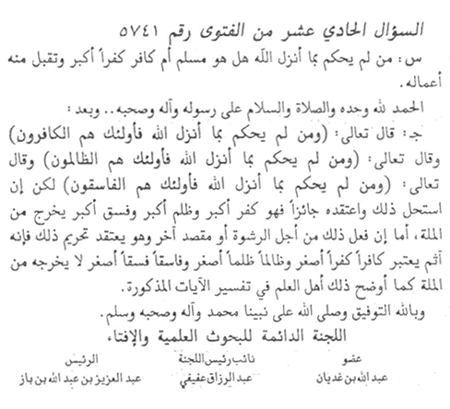
Fataawaa of the Permanent Committee for Research and Verdicts, compiled by Shaikh Ahmad bin `Abdur-Razzaq ad-Duwaish, Volume 1 (Aqidah).
Question No. 11 of Fatwa No.5741
Q. The one who does not judge by what Allaah has revealed, is he a Muslim or a Kafir [guilty of] the major kufr and are his actions accepted?
A. All Praise is due to Allaah and prayers and peace upon the His Messenger, his family and his companions. To proceed:
Allaah the Most High said: "And whosoever does not judge by what Allâh has revealed, such are the Kâfirûn" (5:44), and He the Most High said, "And whosoever does not judge by that which Allâh has revealed, such are the Zâlimûn" (5:45) and He the Most High said, "And whosoever does not judge by what Allâh has revealed (then) such (people) are the Fâsiqûn" (5:47).
However if he declares that to be lawful (istahalla dhalik) and believes it to be permissible (i’taqadahu jaa’izan), then this is the major kufr, the major fisq and the major dhulm which expels him from the religion. However, if he did this due to a bribe or some other motive while believing in the forbiddance [of this act], then he is considered a disbeliever with the minor kufr, a dhalim with the minor dhulm and a fasiq with the minor fisq which does not expel him from the religion – as the people of knowledge have explained in the exegesis (tafsir) of the aforementioned verses.
The Permanent Committee for Research and Verdicts
Member
Abdullah bin Ghudayan
Deputy Head
`Abdur-Razzaq `Afifi
Head
`Abdul-`Aziz bin Baz
END
Shaikh Muhammad bin Ibrahim said: "The actualisation of the meaning of 'Muhammad is the Messenger (sallallaahu alayhi wasallam) is from judging to his sharee'ah and confining oneself to that - and rejecting whatever is in opposition to that from amongst the rules (qawaaneen) and regulations and all those things for which Allaah has not revealed any authority. ""And the one who judges by them (hakama bihaa) or refers to them (haakama ilaihaa) - for judgement whilst believing in the correctness (sihhah) of that or the permissibility (to judge by them) (jawaaz), then he is a kaafir with the kufr that ejects from the religion. And if he does that without belief (I'tiqaad) in their correctness and (regarding it) permissible to judge by them (jawaaz), then he is a kaafir with the kufr in action, which does not eject from the religion." [Fataawaa Shaikh Ibrahim 10/9]
Imaam Ibn Baz said regarding Imaam al-Albani’s discourse on Ruling by Other than What Allaah has revealed: "I came across the beneficial, valuable reply which was given by the Eminent Shaikh Muhammad Naasir ud-Deen al-Albaanee - out of his graciousness - may Allaah grant him success in the publication: "Ash-Sharq al-Awsat" and the Magazine "al-Muslimoon" - the one in which he replied to the one who asked him about "performing takfeer of the one who judged by other than what Allaah has revealed without elaborating (upon the matter more fully)" So he replied to it with a word of truth, and has arrived at the truth in it, and has travelled upon the path of the believers by it and has made manifestly clear - may Allaah grant him success - that it is not permissible for anyone amongst the people to declare the one who judged by other than what Allaah has revealed - a disbeliever - merely on account of an action, without his knowledge that this person declared such an act to be permissible with his heart (istihalla dhaalik biqalbihi). And he used evidence for that what has come from Ibn Abbaas (ra) and others from among the Salaf.
And there is no doubt that the what he has mentioned in his reply regarding the tafseer of the saying of the Exalted - "And whoever does not judge by what Allaah has revealed, they are the kaafiroon", "And whoever does not judge by what Allaah has revealed, they are the dhaalimoon", "And whoever does not judge by what Allaah has revealed, they are the faasiqoon" - that it is the truth. And he has made manifestly clear - may Allaah grant him success - that kufr is of two types - kufr akbar and kufr asghar - just as dhulm is of two types and likes fisq is of two types - akbar and asghar. So whoever declares lawful (istahalla) judgement by other than what Allaah has revealed, or declares lawful zinaa, or usury, or other than them from the prohibited things whose prohibition is agreed upon then he has disbelieved with major kufr, and major dhulm and major fisq. And whoever does that without declaring them permissible - then his kufr is kufr asghar and his dhulm is dhulm asghar and likewise with his fisq...." [Ash-Sharq al-Awsat 12/5/1416]
And also the saying of Shaikh bin Baaz, in his comments upon the saying of Shaikh Muhammad bin Abdul Wahhaab - in his Nawaaqid ul-Islaam 'whoever believes that other than the guidance of the Prophet (sallallaahu alayhi wasallam) is more perfect than his guidance....:' So he said:
"Whoever holds the belief (I'taqada) that the systems and laws which people have prescribed are better than the Sharee'ah of Islaam, or that they are equal to it, or that it is permissible (yajooz) to refer to them for judgement...."
... "and entering into this is everyone who holds the belief (I'taqada) that it is permissible (yajooz) to judge by other than the Sharee'ah of Allaah..." [Majmoo' Fataawa wa Maqaalaat Mutanawwa'ah [2/326-330]
The Lecture
… And as for the second matter under discussion, and that is ruling by other than what Allah has revealed, before we go onto speak about it and clarify the ruling about it, we say that ruling by other than what Allah has revealed is an evil crime. Many Muslims have been put to trial by it in the present times, both rulers and those who are ruled over.
It is obligatory for the one who has fallen into this sin to refrain from it and to seek forgiveness from Allah, the Sublime and Almighty.
For it is not lawful for him to remain upon this big sin which is [in reality] a challenge to the Shari’ah of Allah, and which consists of overstepping the bounds of what Allah, the Sublime and Almighty has revealed. It also consists of putting an end to the sanctities of Allah, the Lofty and Sublime.
And the true Muslim, my dear brothers, shudders out of despair and sorrow at what he observes of this great and apparent danger and other things like it. And also at the manner in which it is rapidly spreading in many different facets of the life of the Muslims today.
Therefore, there is no other option for him, when the situation is as it is, but to offer advice, and may Allah strengthen him in every moment to rectify the situation of the Muslims and may Allah guide those amongst them who have strayed, certainly He is the All-Hearer who responds.
And this sin unlike all the other sins. In fact this is a wicked and repugnant sin on account of what it contains of opposition to the command of Allah, the Sublime and Almighty and of what it contains of departing from that which Allah obligated upon his servants.
And we, just like those besides us from amongst the Muslims, reject it clearly and in the most severe of manners and we call upon Allah that He guides the one who has fallen into it and directs him to what is correct and that He returns him to the truth and what is correct, such that he refrains from this great sin and repents to Allah, the Sublime and Almighty.
This is one matter. As for the other, which is clarifying the ruling on this issue from the Islamic Shari’ah, then its ruling is absolutely clear and evident from the Book of Allah the Most High and Sublime.
He, the Lofty and Sublime said in three places in Surah al-Mai’idah:
And whosoever does not judge by what Allâh has revealed, such are the Kâfirûn (5:44)
And whosoever does not judge by that which Allâh has revealed, such are the Zâlimûn (5:45)
And whosoever does not judge by what Allâh has revealed (then) such (people) are the Fâsiqûn (5:47)
So the one who reflects on these great verses and looks at them in light of what the language of the Arabs and the language of the Qur’an necessitate and require, he will find that they are general in their application to two entities.
The first: that they are general for all of the Muslims, regardless of whether they are rulers or those who are ruled over. So these verses include the overall ruler, the qadi (judge), the teacher, the owner of a house, the wife and so on.
The evidence of this generality is taken from the verse itself and also from the narrations that have been reported from the Salaf may Allah be pleased with them all in explanation of this verse. For the statement of the saying of Allah, the Sublime and the Most High:
"And whoever…"
gives evidence to the generality (i.e. includes everybody). And this particle "man" is one of the words which indicates generality in the view of the People of Knowledge, since it is one of the nouns of condition (‘ism ush-shart’) and so therefore it refers to all of those being addressed.
And whoever restricts it to the ruler only then he has fallen into a very big error.
As for the generality of its application to the second entity, then that is its application to all of the rules and laws of Allah, the Most High and Sublime. Therefore, every ruling, whether it is small or large, is for Allah and is included in this verse, due to its generality.
Taking interest for example, or drinking alcohol, or eating with the left hand, and letting the lower garment hang below the ankles, or having intercourse with ones wife during her menses, the laws of Allah have come for all of these matters and all of the laws of Allah regardless of whatever they may be, whether those that we have just mentioned as examples or those that have not been mentioned, come under this verse.
And the evidence for the generality here is the saying of Allah:
And whoever does not judge by WHATEVER Allah has revealed…
The word ‘ma’ again has the meaning of generality in view of the People of Knowledge. Therefore the statement of Allah, "… by whatever Allah has revealed…" includes all of the laws and rules of Allah, the Sublime and Almighty, regardless of whether it is his ruling concerning adultery, or for the one who drinks with his left hand.
And the Salaf, when they understood the meaning of this verse, in the manner described above, since it is from the language of Arabs with which they actually spoke and in which the Book of Allah was revealed, when they understood this from the verse, they said concerning the statement of Allah in the verse, "… then they are the disbelievers":
"Kufr less than kufr, that which does not eject a person from the religion".
This then is the asl (foundational pillar) concerning ruling by other than what Allah has revealed. And it is reported with an authentic chain of narration which has no defect in the view of the People of Knowledge, from Ibn ‘Abbas, may Allah be pleased with him, that he said,
"It is kufr in the [particular] rule itself and is not kufr in Allah, His Angels, Books or Messengers."
This narration has been reported by at-Tabari from Ibn Sari’ who said, "Waki’ ibn al-Jarrah" narrated to us, "my father narrated to me from Sufyan from Amr bin Rashid from Ibn Tawus from his father from Ibn Abbas.." and this isnad reaches perfect authenticity.
And at-Tabari also reported that a man said concerning this verse, "So whoever does that has he disbelieved?" so Ibn ‘Abbaas replied to him, "When he does that it is kufr only in that action of his, and he is not like the one who disbelieves in Allah and the Last Day."
And in the Mustadrak of al-Hakim from Ibn ‘Abbas also that he said, "Verily it is not the kufr which you tend to, it is not the kufr which ejects a person from the religion, "and whoever does not rule by whatever Allah has revealed" then this is kufr less than kufr."
So these are authentic and very explicit narrations from the explainer of the Qur’an and the erudite scholar of the ummah, Ibn ‘Abbas, may Allah be pleased with him.
And what has come from Ibn ‘Abbaas has also come from others besides him, from the Salaf of this Ummah and from its scholars. To give examples, what has been reported by at-Tabari in his tafsir, that a group of the Ibadi’ah sat with Abu Mijliz and they said to him, Allah says, "whoever does not judge by what Allah has revealed, they are the disbelievers, they are the oppressors, they are the rebellious" Abu Mijliz replied, "Certainly they do what they do and they know that it is a sin. And this verse was revealed concerning the Jews and the Christians." They replied, By Allah you do not know what we know but you only fear them." He replied, You have more reason to do that than we do, as for us we do not know what you know but you know it."
The chain of narration is authentic also and its meaning that those Ibadis, who were one of the groups of the Khawarij, came to Abu Mijlaz and sought to use this verse to do to takfir of the rulers of that time and he replied to them with a reply of the People of Knowledge, the reply of Ahl us-Sunnah, he said, "those rulers whom you do takfir of on account of his verse do what they do of sins and evils such as oppression, tyranny etc. they do these things and they know that they are sinful. So they do not make lawful their actions which they have fallen into from amongst those things that are in opposition to the rule of Allah, the Sublime the Most High.
So their affair is just like the affair of all the other Muslims, those who commit sins but without declaring them to be lawful for themselves.
So those Ibadis said to him, "you know that what we say is the truth, but you fear them," meaning wish to compromise with them and their actions etc.
And this is one of the mechanisms of the People of Desires that comes at the end of the narration, and this is that when the people of knowledge argue against them and refute their falsehood, they resort to the likes of these machinations, so they said to this scholar, you compromise, that you fear them etc. They said this when he replied to them whilst depending upon the Book of Allah and the Sunnah of the Messenger of Allah (sallallaahu alayhi wasallam) .
However, the one who is firmly grounded in his knowledge is never shaken by these kind of ploys, but it only makes him firm upon what is evident to him that it is the truth from the Book of Allah and the Sunnah of the Messenger (sallallaahu alayhi wasallam) and he does not pay attention to the mischief of the troublemakers and those who cause agitation and sedition in the land.
When what has been stated by the Companions and the Salaf, may Allah be pleased with them and have mercy upon them concerning this verse has become clear and evident, then it is not permissible for a Muslim who believes in Allah and the Last day that he should adopt a saying that they never said and for which there is no proof, neither from the Book nor from the Sunnah.
For they, may Allah shower mercy upon them, are more knowledgeable than us about the Book of Allah the Lofty and Sublime and are more knowledgeable than us of the intent behind the [statements] in the Book of Allah the Lofty and Sublime.
And the one who uses the verses in Surah al-Ma’idah in order to perform takfir of the rulers of the Muslims, those who have fallen into things that oppose the Shari’ah such as working with interest and other similar things, then the one who uses these verses in order to perform takfir of them, then there is no doubt that he has adopted a root of the roots of the Khawarij and may Allah protect us and you from that.
And the Salaf, may Allah have mercy upon them, also agree that the Khawarij used to use these verses and others similar to them, in order to show the disbelief of the rulers on account of what occurred from them of sins, disobedience, ruling out of their desires and other such things.
Al-Ajurree reports from Sa’id bin Jubair that he said, "Of that which the Harooris follow from the mutashabih, is the saying of Allah, the Sublime and Lofty, "and whoever does not judge by what Allah has revealed they are the disbelievers…" and they read along with this verse ".. then those who disbelieve in their Lord turn away (ya’diloon)". So when they see a ruler who has ruled by other than the truth, they say ‘He has disbelieved. And whoever disbelieves has turned away from his Lord and whoever turns away from his Lord has committed shirk, therefore those leaders are Mushriks’, and so they revolt and so they do what you can see because they make ta’weel of this verse."
Therefore using this verse in order to perform takfir of the rulers is not a new thing, it is a very ancient thing, which emerged at the time of the Khawarij and their appearance.
Shaikh ul-Islam in Minhaj us-Sunnah said about some of the verses of Allah and amongst them, " By your Lord they cannot be real believers until they make you judge in what disputes occur amongst them…." he said, "And this verse is amongst those that the khawarij use in order to perform takfir of wullat ul-amr (those in authority over the Muslims), those who do not judge by what Allah has revealed and then they claim/think that this belief of theirs is the rule of Allah itself."
And he mentioned this in the fifth volume on page 131.
The Salaf from all parts and time of the ummah know that the one who uses such verse to perform takfir of the rulers, then he is amongst the Khawarij. Every other group besides the Khawarij knows that the one who uses these verses to perform takfir of one rulers of the Muslims on account of the sins and disobedience he commits, then they know that he is one of the Khawarij.
And for this reason, Ibn al-Jawzee included at the beginning of al-Muntazam (and this is also mentioned by others aswell such as al-Khatib al-Baghdadi) that a man from the Khawarij entered upon Ma’mun. Ma’mun said, on account of what do you declare us to be disbelievers? He replied, due to a verse from the Book of Allah. Ma’mun said, What is it? He replied, "The saying of Allah, and whoever does not judge by what Allaah has revealed…" . So Ma’mun said, to him what is your proof that this is a verse from the book of Allah? The Khariji replied, "the concensus of the Muslims upon this issue" (meaning that it is a verse from the Book of Allah). So Ma’mun replied, "Then just as you are pleased with their concensus about the revelation of this verse, then be pleased with their ta’wil (explanation) of this verse."
Then Ma’mun and the rulers besides him, are those who put the Muslims to trial on account of desires and innovations or with fisq (open sinfulness) or tyranny, as occurred from Yazid and others, yet none of the Salaf judged them to be disbelievers and did not take them outside the fold of Islam.
Ma’mun, entered into the fold of Islam a great innovation, but the scholars up until the time of Ahmad, did not speak of his kufr (i.e. that he was a kafir) and this is because he came with this innovation without declaring it to be lawful.
And this issue of istihlal, is necessary, i.e. it must be present when performing takfir of the one who rules by other than what Allah has revealed. The Ahl us-Sunnah wal-Jama’ah, it is not possible in any situation for them to use this verse as evidence for the takfeer of the rulers of the Muslims, and this because if they had done this, then it would have been binding upon them to perform takfir of everyone who commits a major sin.
This is because the one who rules by other than what Allah has revealed has ruled by other than what Allah has revealed, and the one who eats with his left hand, on purpose, then he has ruled by other than what Allah has revealed, and the one who has intercourse with a woman who is menstruating, then he has ruled by other than what Allah has revealed, and likewise for everyone who commits such sins, so can it be said that he has disbelieved on account of that? The Ahl us-Sunnah do not say this, may Allah have mercy upon them. But the Khawarij say this.
And the various narrations from the Salaf concerning the tafsir of this verse are very many and I will suffice here with a quote from Imam ash-Shanqiti may Allah have mercy upon him, from his tafsir Adwa al-Bayan, in explanation of this verse, (vol 2 p.120), he says, "The verse is general in this regard, Ibn Mas’ud and al-Hasan said, "This is general for everyone who does not judge by what Allah has revealed from among the Muslims, the Jews, and the Disbelievers, while he holds belief in (the correctness of his action) and declares it to be permissible (mu’taqidan dhalik wa mustahillan lahu). And as for the one who did that whilst believing that he is committing something that is forbidden, then he is from the rebellious amongst the Muslims, and his affair is with Allah, if He wills He will punish him and if He wills and He will forgive him. And similar to this is the saying of Allah, "But no by your Lord .. complete the verse. Disputes amongst them." End of his words!
And the People of Knowledge from Ahl us-Sunnah – may Allah have mercy upon them, give an illustration of a situation (of many situations) in which ruling by other than what Allah has revealed is major kufr, which ejects from the religion. So the basis in this matter is that it is kufr less than kufr, except that in a certain situation it makes the person guilty of it fall into the greater kufr and removes him from the confines of Islam.
Before mentioning this situation, I say that the ruling of major kufr is not restricted to this issue of ruling by other than what Allah has revealed alone. It is general for all issues.
The specific situation I am talking about is when a person rules by other than what Allah has revealed, declaring his action to be lawful (istihlaal), or doing it out of deliberate opposition (juhood).
And this is when a person deliberately opposes and rejects the punishment for adultery or who falls into adultery whilst declaring it permissible for himself (in terms of belief) to do that, (mustahillan lahu) or making it permissible for others. So he says that it is halal and it is not haram.
And also for example, he says likewise for usury and drinking alcohol or for everything that it is known in the religion by necessity or for everything that has been established in the Shari’ah in the most clearest of ways and about which there is no doubt (that it is from the Shari’ah) or misconception. [So all of this is major disbelief which ejects from the religion].
And Ibn Jarir – may Allah have mercy upon him has explained in his tafsir this meaning. He said, "And likewise is the saying regarding everyone who does not judge by what Allah has revealed, deliberately opposing it (jahidan bihi), then he is a disbeliever in Allah, as Ibn Abbas has said and this is because his opposition to the rule of Allah, after having the knowledge that He revealed it in his Book, is equal to the one who opposed the Prophethood of our Prophet after his knowledge that he is the Prophet."
And Shaikh ul-Islam Ibn Taymiyyah says as occurs in al-Fatawa (vol 3/267-268), "And when a person declares to be lawful something that is haram and is unanimously agreed upon that it is haram, or who declared to be haram something that is unanimously agreed to be halal, or who replaced the legislation (baddal ash-Shar’), which is unanimously agreed upon, he is a disbeliever, apostate by the unanimous agreement of the jurists. And it is with regards to the likes of this, that the following was revealed, according to one of two opinions, "And whoever does not rule by what Allah has revealed then they are the disbelievers", meaning that he declares it to be permissible to rule by other than what Allah has revealed (huwal mustahillu lilhukm bighairi maa anzalallaahu)." End of his words.
And there are many other parts where he writes about istihlal and juhood and other such things.
And I will make clear the previous words through the words of Ibn al-Qayyim – may Allah have mercy upon him, in Madarij us-Salikin, he says in the first volume, page 163, said, "And it is correct that ruling by other than what Allah has revealed, can be both types of kufr, the minor and the major, so if he considers it to be obligatory to rule by what Allah has revealed in this instance and did not do it out of disobedience whilst acknowledging that he is deserving of punishment, then this is minor disbelief, and if he believed that it is not obligatory upon him and that he has a choice in the matter whilst having certainty that it is the ruling of Allah, then this is major disbelief. And if was ignorant of the matter and erred, then he is an errant one and his ruling is that of those who err."
And the narrations of the Salaf in this regard are very many, but we shall restrict ourselves to what has been mentioned.
Therefore do not be affected, O Sunni by what you hear of the application of the word al-Murji’ah to the one who speaks with all of the above, for that is the saying of the Ahl us-Sunnah – may Allah have mercy upon them, absolutely, [without exception].
So they say that ruling by other than what Allah has revealed can be both types of kufr, the minor disbelief and the major disbelief and this depends on the state and condition of the ruler. So if he rules by other than what Allah has revealed and acknowledges that he is sinful, that he is in error and he seeks forgiveness from Allah. And as for the one who resists and opposes the obligation to judge by what Allah has revealed and other such things then he has fallen into the major disbelief, may Allah protect us and you from this.
So this is just a small sample to illustrate the position of Ahl us-Sunnah, may Allah have mercy upon them in this issue.
What remains are some of the doubts that arise concerning this issue and we will deal with them next.
Amongst them are:
Some of the people use as proof the words of Imam Ishaq ibn Rahawaihah which are quoted by Ibn Abdul –Barr in at-Tamheed, and also Shaikh ul-Islam Ibn Taymiyyah, in as-Sarim al-Maslul. Ishaq Ibn Rahawaih said, "The muslims are agreed that the one who reviled Allah, or His Messenger or repelled anything that Allah revealed that he is a disbeliever on account of that, even if he affirms (muqirran) everything that Allah revealed."
These words from Ishaq are true, there is no doubt in these words and none from the Scholars of Ahl us-Sunnah differ with him regarding this.
However, the one who used this as proof to perform takfeer of the one who ruled by other than what Allah revealed has erred and has not understood the words of Ishaq bin Rahawaih. And these words have been explained by Shaikh Abdullah, the son of Shaikh Muhammad bin Abdul Wahhab, mayAllah reward them both, in some beneficial words of his,
"And the meaning of the statement of Ishaq, may Allah have mercy upon him, "or repels anything that Allah has revealed…" is that he repels and rejects something from the Book of Allah or something that has proceeded from the tongue of the Messenger (sallallaahu alayhi wasallam) from amongst the obligatory matters, those which are from the non-obligatory sunnah, the recommended things, after he knows that Allah has revealed it in his book or that the Messenger (sallallaahu alayhi wasallam) commanded it or forbade it, [so after this] if he repels it then he is a kafir and apostate, even if he affirms everything that Allaah revealed of legislation, unless he repelled or rejected it because it opposed his desire, or his habit, or the custom and habit of his people. And this is the meaning of the saying of the scholars, ‘Whoever rejected a subsidiary matter of the religion, which is unanimously agreed upon, then he has disbelieved’. Thus whoever rejected the forbiddance of eating with the left hand or the forbiddance or trailing the lower garment, after knowing that the messenger (sallallaahu alayhi wasallam) forbade it, then he is a disbeliever, an apostate even if he was the most devout of people, so how then will it be for the one who rejects Allah’s right to sincere worship, and his sole right to be called upon and be asked for help in times of difficulty, and making an oath, and placing reliance and so on for the other types of worship and that none of these acts should be directed to a near angel and messenger that has been sent… " to the end of his words. May Allah have mercy upon him.
So the meaning of his words, is the meaning of the saying of the people of knowledge, "Whoever rejected something which is unanimously agreed upon, then he has disbelieved." And his words cover everything from the legislation of Allah Azzawajall, even the non-obligatory matter and the recommended matters.
And there is another doubt:
The separation between ruling by other than what Allah has revealed in a single matter or two or three matters and between, ruling by other than what Allah has revealed in a hundred matters, two hundred matters or more than that or less than that.
So what is the correctness of this separation. This separation has no sound basis upon knowledge. Also the general meaning of the verse rejects this separation, since it did not specify a single ruling, two, or a hundred or two hundred. But it has been left general and unrestricted and thus it is obligatory to leave it as general or unrestricted.
And whoever made such a specification or made separation in such a manner, then it is obligatory upon him to establish a clear proof, unequivocal and sound to show such as specification for this verse.
And the one who made a specification or separation merely on account of his own opinion and what he deems to be correct (istihsan) then no consideration is to be given to it at all.
And I shall give an example to you which will make clear the falsehood of this doubt.
Example a man who has taken the position of a judge whose age is 30 or says he was in this position for forty years, for example. He spent all these years in judging between two disputants based on the bribes that he received from one of the two, or that he made his judgement based on his love of one of the two disputants, or because he is a near relative, or because he hates the one who is under judgement – so he rules by his desire and not by what Allah has revealed. So is the likes of man, about whom we know has passed in this Ummah many a time, so can it be said that he has disbelieved in Allah the Most High, and that he is an apostate and that he should not be given the treatment that a Muslim is due? The Ahl us-Sunnah do not say this, nor do they hold it as their belief and nor do they accept it from the one who says it, rather the one who says it is from the Khawarij, those who perform takfeer on account of sins and evil deeds.
Therefore know this well and reflect upon it carefully. The truth will become clear to you insha’allah in matters such as these.
And we shall make sufficient with these words on this topic….
We ask Allah that he shows us the truth as truth and grants us the ability to follow it and that he shows us the falsehood as falsehood and grants us the ability to avoid it and that we ask Him that he does not make it confusing for us so that we go astray and Allah the Most High knows best. With Allah is all success and may Allah send prayers and peace and blessings upon our Prophet Muhammad.Originally posted by FirdousiComment
-
Originally posted by FirdousiComment
-
Ruling on promulgating manmade laws and Shaykh Ibn ‘Uthaymeen’s view on that
Is the promulgation of man-made laws and drawing up a constitution for ruling by them instead of the laws of Allah a matter concerning which the scholars differed and both opinions are views of Ahl al-Sunnah? There is a discussion among some brothers as to whether this action is kufr that puts one beyond the pale of Islam or is a sin. Please explain and clarify.
Is the muqallid entitled to follow either of the two views or not?
Did Shaykh Ibn ‘Uthaymeen say at the end of his life that promulgating man-made laws is a sin, which contradicted his earlier view that it was major kufr?.
Praise be to Allaah.
Firstly:
Promulgating man-made laws that are contrary to the rulings of Allah and His Messenger concerning matters of blood, honour and wealth, is an act of major kufr which puts one beyond the pale of Islam. There is no doubt whatsoever concerning that, and there is no difference of opinion concerning it among the Muslim scholars. Promulgating such laws is competing with Allah, may He be exalted, in His rule and is going against Him in His laws. Allah says (interpretation of the meaning): “Or have they partners with Allaah (false gods) who have instituted for them a religion which Allaah has not ordained?” [al-Shoora 42:21].
And Allah says concerning obedience to one who permits dead meat (interpretation of the meaning):
“Eat not (O believers) of that (meat) on which Allaah’s Name has not been pronounced (at the time of the slaughtering of the animal), for sure it is Fisq (a sin and disobedience of Allaah). And certainly, the Shayaateen (devils) do inspire their friends (from mankind) to dispute with you, and if you obey them [by making Al‑Maytah (a dead animal) legal by eating it], then you would indeed be Mushrikoon (polytheists); [because they (devils and their friends) made lawful to you to eat that which Allaah has made unlawful to eat and you obeyed them by considering it lawful to eat, and by doing so you worshipped them; and to worship others besides Allaah is polytheism]”
[al-An‘aam 6:121].
And Allah says (interpretation of the meaning):
“Have you not seen those (hypocrites) who claim that they believe in that which has been sent down to you, and that which was sent down before you, and they wish to go for judgement (in their disputes) to the Taaghoot (false judges) while they have been ordered to reject them. But Shaytaan (Satan) wishes to lead them far astray.
61. And when it is said to them: ‘Come to what Allaah has sent down and to the Messenger (Muhammad صلى الله عليه وسلم),’ you (Muhammad صلى الله عليه وسلم) see the hypocrites turn away from you (Muhammad صلى الله عليه وسلم) with aversion”
[al-Nisa’ 4:60-61].
If this is the ruling of Allah concerning the one who wants to refer for judgement to false judges, then how about the false judge himself who promulgates laws instead of Allah.
How can legislation that is contrary to the laws of Allah not be kufr, when it inevitably implies permitting that which is forbidden and forbidding that which is permitted, or giving the legislators the right to do that, so they have the right to permit whatever they want and to forbid whatever they want; whatever the majority agrees upon must be carried out and the one who goes against it is punished and criminalised. This is the ultimate kufr.
Shaykh al-Islam Ibn Taymiyah (may Allah have mercy on him) said: If a person regards as permissible that on which there is scholarly consensus that it is forbidden, or regards as forbidden that on which there is scholarly consensus that it is permitted, or he alters a law on which there is consensus, then he is a kaafir and apostate, according to the consensus of the fuqaha’.
End quote from Majmoo‘ al-Fataawa, 3/267
Ibn Katheer (may Allah have mercy on him) said: The one who forsakes the law that was revealed to Muhammad ibn ‘Abd-Allah, the Seal of the Prophets (blessings and peace of Allah be upon him) and refers for judgement to any other law that has been abrogated, has committed an act of kufr, so how about the one who refers for judgement to al-Yaasa and gives it precedence? The one who does that is a kaafir according to the consensus of the Muslims.
End quote from al-Bidaayah wa’l-Nihaayah, 13/139.
Al-Yaasa (also known as al-Yaasiq) refers to the laws of the Tatar Genghis Khan, who forced the people to refer to them for judgement.
Undoubtedly the one who promulgates laws himself commits a greater act of kufr and is more misguided than one who refers to them for judgement.
Al-‘Allaamah Muhammad al-Ameen al-Shanqeeti (may Allah have mercy on him) said: From verses such as that in which Allah says (interpretation of the meaning) “and He makes none to share in His Decision and His Rule” [al-Kahf 18:26], it may be understood that the followers of those who promulgate laws other than those which Allah has ordained are associating others with Allah (shirk). This understanding is explained clearly in other verses, such as the verse which speaks of those who follow the laws of the Shaytaan in permitting dead meat, claiming that it has been killed by Allah [and thus should be permitted]:
“Eat not (O believers) of that (meat) on which Allaah’s Name has not been pronounced (at the time of the slaughtering of the animal), for sure it is Fisq (a sin and disobedience of Allaah). And certainly, the Shayaateen (devils) do inspire their friends (from mankind) to dispute with you, and if you obey them [by making Al‑Maytah (a dead animal) legal by eating it], then you would indeed be Mushrikoon (polytheists)”
[al-An‘aam 6:121].
Here Allah clearly states that they would be mushrikoon by obeying them. This is associating others with Allah in terms of obedience and following laws that are contrary to that which Allah has ordained -- which is what is meant by worshipping the Shaytaan in the verse in which Allah says (interpretation of the meaning):
“Did I not command you, O Children of Adam, that you should not worship Shaytaan (Satan). Verily, he is a plain enemy to you.
61. And that you should worship Me [Alone Islamic Monotheism, and set up not rivals, associate‑gods with Me]. That is the Straight Path”
[Ya-Seen 36:60-61].
And Allah tells us that His Prophet Ibraaheem said (interpretation of the meaning):
“ ‘O my father! Worship not Shaitân (Satan). Verily, Shaitân (Satan) has been a rebel against the Most Gracious (Allaah)’”
[Maryam 19:44].
And Allah says (interpretation of the meaning):
“They (all those who worship others than Allaah) invoke nothing but female deities besides Him (Allaah), and they invoke nothing but Shaytaan (Satan), a persistent rebel!”
[al-Nisa’ 4:117], i.e., they do not worship anything but a devil, i.e., by following his laws. Hence Allah calls those whom they obey in the sins that they made attractive to them “partners”, as in the verse (interpretation of the meaning) “And so to many of the Mushrikoon (polytheists) their (Allaah’s so‑called) ‘partners’ have made fair-seeming the killing of their children, in order to lead them to their own destruction and cause confusion in their religion” [al-An ‘am 6:137]. The Prophet (blessings and peace of Allah be upon him) explained this to ‘Adiyy ibn Haatim (may Allah be pleased with him) when he asked him about the verse in which Allah says (interpretation of the meaning): “They (Jews and Christians) took their rabbis and their monks to be their lords besides Allaah” [al-Tawbah 9:31]. He explained that they permitted to them that which Allah has forbidden and they forbade to them that which Allah has permitted, and they [the people] followed them in that; that is how they took them as lords.
One of the clearest proofs concerning that is the fact that in Soorat al-Nisa’, Allah, may He be glorified and exalted, mentioned those who want to refer for judgement to something other than the laws prescribed by Him and wonders at their claim to be believers, because their claim to be believers even though they want to refer for judgement to false judges shows that they have reached a level of lying which is astounding. That is what Allah says (interpretation of the meaning):
“Have you not seen those (hypocrites) who claim that they believe in that which has been sent down to you, and that which was sent down before you, and they wish to go for judgement (in their disputes) to the Taaghoot (false judges) while they have been ordered to reject them. But Shaytaan (Satan) wishes to lead them far astray”
[al-Nisa’ 4:60].
From the divinely revealed texts that we have quoted, it becomes very clear to everyone that with regard to those who follow man-made laws promulgated by the Shaytaan on the lips of his supporters which are contrary to that which Allah has prescribed on the lips of His Messengers (blessings and peace of Allah be upon them), there is no doubt that they are kaafirs and mushriks, except for the one whom Allah has blinded to the light of Revelation and left to go astray.
And he said:
As for the legal system that is contrary to the laws prescribed by the Creator of heaven and earth, ruling according to it constitutes disbelief in the Creator of heaven and earth, such as the claim that giving precedence to the male over the female in inheritance is not fair and it is necessary to make them equal in inheritance, and the claim that plural marriage is unjust, or that divorce is unfair to the woman, and that stoning, cutting off the hand and so on are barbaric acts that should not be done to people, and so on.
Making this kind of system rule the lives of people in society and their wealth, honour, lineage, reason and religion, is disbelief in the Creator of heaven and earth and a transgression against the divine system prescribed by the One Who created all things and Who knows best what is in their best interests; may He be glorified and exalted far above having any lawgiver besides Him.
“Or have they partners with Allaah (false gods) who have instituted for them a religion which Allaah has not ordained?”
[al-Shoora 42:21]
“Say (O Muhammad to these polytheists): ‘Tell me, what provision Allaah has sent down to you! And you have made of it lawful and unlawful.’ Say (O Muhammad): ‘Has Allaah permitted you (to do so), or do you invent a lie against Allaah?’”
[Yoonus 10:59]
“Say: ‘Verily, those who invent a lie against Allaah will never be successful’”
[Yoonus 10:69].
End quote from Adwa’ al-Bayaan, commentary on the verse (interpretation of the meaning): “and He makes none to share in His Decision and His Rule” [al-Kahf 18:26].
See also the answer to question no. 11309 and 974.
Secondly:
What is well established and known of the view of Shaykh Ibn ‘Uthaymeen (may Allah have mercy on him) is that he clearly stated that promulgating laws that are contrary to what Allah has revealed constitutes major kufr. He mentioned that in several places in his books, such as Sharh Kitaab al-Tawheed, Sharh al-Usool al-Thalaathah, Sharh al-Siyaasah al-Shara‘iyyah, and his fatwas which have been published in al-‘Aqeedah and Liqaa’aat al-Baab al-Maftooh. All his comments on these subjects are consistent and point to the same conclusion, which is that legislating and promulgating laws that are contrary to the sharee‘ah of Allah constitutes major kufr. As for the one who rules according to something other than that which Allah has revealed, he may be a disbeliever or a wrongdoer or an evildoer according to the crime that he has committed. We do not know of any opinion of the Shaykh concerning this matter, in which he suggested that this promulgation of laws is minor kufr. If the Shaykh had any other opinion, it would have widely known, and the Shaykh would have clearly recanted his first opinion, and striven to prevent it being published. Whoever thinks that any of the scholars would recant something that it became clear to him was wrong, then would continue to publicise the mistaken opinion until he died, without denouncing it or instructing that it be erased, has thought badly of him and has impugned his religious commitment and honesty, because it is not permissible to publicise a false opinion or to keep quiet about it, especially if it has to do with an important matter such as this.
Among the things that he (may Allah have mercy on him) said concerning this matter is what appears in Sharh al-Usool al-Thalaathah, where he said: Whoever does not rule in accordance with that which Allah has revealed because he thinks little of it or looks down on it or believes that something else is better than it and more beneficial to people or is equal to it, is a kaafir whose kufr puts him beyond the pale of Islam. That includes those who promulgate laws for people that are contrary to Islamic laws, to be a system that the people follow. They only promulgate those laws that are contrary to Islamic laws because they believe that they are better and more beneficial for people, because it is known on the basis of reason and sound human nature that no one turns away from one path to a different path unless he believes that what he has turned to is better and what he has turned away from is lacking.
End quote from Majma‘ al-Fatawa wa Rasaa’il al-Shaykh Ibn ‘Uthaymeen, 6/161.
And Allah knows best.
Islam Q&AOriginally posted by FirdousiComment
-
I was asking about how Abu Bakar (r.a) was elected THROUGH Democracy. I never said we should make our own laws and discard the Islamic ones. I was talking about Abu Bakar (r.a) and his election. How the ummah VOTED for him and elected him their caliph after the death of the Prophet (saw).
that's Democracy!جی وا ترا بلوچ ، ذندان بلوچ ، کلو واتنییے
G wa tra Baloch , Balochistan Zindabad
Comment
-
I forgot to answer answer you question.Originally posted by M17ArnoBaloch View Post
in democracy unqualified people seeking wealth and power make false promises to tempt people into voting for them.
An amir is appointed without campaigning like democrats. A shura of knowledgeable people consult one another to appoint the most qualified person for the job.
Also in Islam the criterion for leadership and authority is piety and qualification.
Abu Bakar siddiq ra was not democratically elected. Please read his biography
Originally posted by FirdousiComment
-
Originally posted by Shamlawar Khurasani View Post
Thank you.جی وا ترا بلوچ ، ذندان بلوچ ، کلو واتنییے
G wa tra Baloch , Balochistan Zindabad
Comment
 Tweet


Comment