Announcement

Collapse
No announcement yet.

SAYING OF BELOVED PROPHET MUHAMMAD (Salllahu Allaihi Wassallam)

Collapse
X
 
  • Filter
  • Time
  • Show
Clear All
new posts

  • #16
    Originally posted by Afghanistan2010 View Post
    Where do we know from this ?
    The Koran tells us that there was battles fought and believers lost their lives. It also tells us that when Moses confronted the Pharoah, a believer who hid his faith spoke and told Pharoah to have a competition between him and Moses. We also know when Moses turned the rod to a snake, the magicians bowed down to him in faith. They believed while the Pharoah and many Egyptians did not. Scriptures are a sign from God but not the only sign. The sun and moon and creation and our human bodies are all signs.

    And from among His signs are the night and the day, and the sun and the moon.)

    And among His Signs is this, that He created for you wives from among yourselves, that you may find repose in them, and He has put between you affection and mercy. Verily, in that are indeed signs for a people who refle

    And among His signs is that He created you from dust, and therefore you are human beings spread in the earth. And among His signs is that He created spouses for you from yourselves for you gain rest from them, and kept love and mercy between yourselves; indeed in this are signs for the people who ponder. And among His signs is the creation of the heavens and the earth, and the differences in your languages and colours; indeed in this are signs for people who know. And among His signs is your sleeping during the night and day, and your seeking His munificence; indeed in this are signs for people who heed. And among His signs is that He shows you the lightning, instilling fear and hope, and sends down water from the sky, so revives the earth after its death; indeed in this are signs for people of intellect. And among His signs is that the heavens and the earth remain established by His command; then when He calls you - from the earth – you will thereupon emerge.And to Him only belong all those who are in the heavens and the earth; all are

    Comment


    • #17
      Why you two (badmash and alchemist) jumped in and interfer to this slow discussion,i wanted it slowly,hold on,when i give up the rope on him,i will give you the chance.
      High achievement always takes place in the framework of high expectation.

      Comment


      • #18
        Originally posted by Bigmo View Post
        The verses about obey God and obey His messenger also outlines the prophet's responsibility and limited authority. Most of those verses have been abrogated by the Sunni/Shia sects. If the prophet had limited authority than the ruler also will have limited authority. The Meccan dynasties (Ummayids and Abbasids) wanted their rulers to enjoy absolute authority. So they elevated the prophet's authority and the 4 Caliph's authority and then transferred that authority to the Muslim ruler. They abrogated many of the verses you mentioned. The Mullahs are not honest as I said. They hide many things from the masses.

        Look at the verses carefully:

        And obey God and obey the messenger and be cautious; but if you turn back, then know that the sole duty of the messenger is the deliverance (of the message)" 5:92

        And obey God and obey the messenger, but if you turn back, then upon Our messenger is the sole duty of the clear delivery (of the message)"64:12

        So you can see that the verses you talked about actually shows us that the whole Shariah law violated the Koran. Because these verses make clear that the prophet's job was to deliver the message. However both the Suniis and Shias have a very different Islam. They have conques, they have floggings for alcohol and not wearing hijab, they have apostasy law, they have conquest and imposing taxes (jizya).

        Whoever obeys the Messenger has indeed obeyed Allah; and whoever turns away, so We have not sent you as a keeper over them. (4:80)

        Freedom is the biggest difference between the Koran and the Sunni/Shia sects. Because the prophetic responsibility in the Koran is very different that how the Sunnis and Shias understand it.

        The tax on the disbelievers is indeed mentioned in the Quran,oh pardon,let me guess also have been abrogated


        Fight those who do not believe in Allah or in the Last Day and who do not consider unlawful what Allah and His Messenger have made unlawful and who do not adopt the religion of truth from those who were given the Scripture - [fight] until they give the jizyah willingly while they are humbled

        Ibn ‘Umar related that the Messenger of Allah, upon whom be peace, said, “I have been ordered to kill the people until they testify that there is no god except Allah, and that Muhammad is the Messenger of Allah, and they establish prayer and pay the zakah. If they do that, their blood and wealth are protected from me save by the rights of Islam. Their reckoning will be with Allah.” (Related by al-Bukhari and Muslim.)”
        Mentioned also in the Quran :


        And fight them until there is no fitnah and [until] the religion, all of it, is for Allah . And if they cease - then indeed, Allah is Seeing of what they do.


        Who gave the prophet that order when we know the Koran already outlined what order God gave him?

        Allah the most high gave him these very orderes in the Quran :


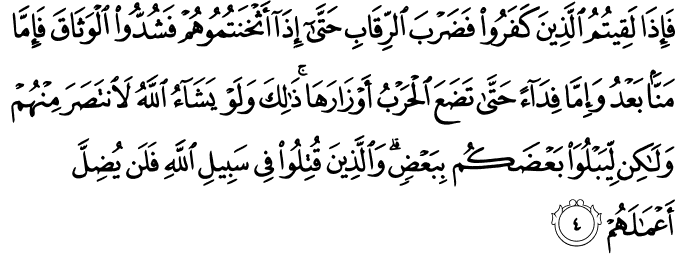
        So when you meet those who disbelieve [in battle], strike [their] necks until, when you have inflicted slaughter upon them, then secure their bonds, and either [confer] favor afterwards or ransom [them] until the war lays down its burdens. That [is the command]. And if Allah had willed, He could have taken vengeance upon them [Himself], but [He ordered armed struggle] to test some of you by means of others. And those who are killed in the cause of Allah - never will He waste their deeds.


        We also know that the Koran said as I showed in the previous post in this thread that guidance is from God. So how can the prophet fight the people till they acknowledge the Koran and him? He couldn't even convince his own peiople, so he know will have to fight them to make them acknowledge? This is terror. Not Islam.
        Why did not Allah then reveal the Quran to the whole world at once or to a shepherd,instead senting it upon the Messenger (pbuh),if he had no other job to share it with others and close his beloved mouth ? wa nauzubillah.


        But later Muslim authoritoies wanted conquest and occupying lands and taking over wealth of other nations. So they came up with this hadith. Everyone can see how this hadith violated what the Koran tells us the prophet was ordered to do. He as specifically told in the Koran repeatedly that you can not enforce or coerce or force people to have faith. That even if you tried, it will not work because olnly God has the keys to faith. But now these sects tell us that God changed his orders and ordered him to go and fight and force the poeople to believe in him whether tney like it or not.
        Was Makkah also not captured ?


        He held their hands back from you, and your hands from them in the valley of Makkah, after giving you the upper hand over them. Allah sees what you do. (Qur'an, 48:24)

        Truly We have granted you a clear victory, so that Allah may forgive you your earlier errors and any later ones, complete His blessing upon you, and guide you on a Straight Path. And so that Allah may help you with a mighty help. (Qur'an, 48:1-3)

        That is why they abrogated the verses in the Koran that outlines the prophet's responsibility. The sects claimed that verse 9-29 and verse 9-5 (sword verses) abrogated those verses.
        But i thought you do not believe in the sects,how can you follow their teaching of abrogation,when ever verse that don't suite you is according to you abrogated.
        High achievement always takes place in the framework of high expectation.

        Comment


        • #19
          Originally posted by Bigmo View Post
          The Koran tells us that there was battles fought and believers lost their lives. It also tells us that when Moses confronted the Pharoah, a believer who hid his faith spoke and told Pharoah to have a competition between him and Moses. We also know when Moses turned the rod to a snake, the magicians bowed down to him in faith. They believed while the Pharoah and many Egyptians did not. Scriptures are a sign from God but not the only sign. The sun and moon and creation and our human bodies are all signs.

          And from among His signs are the night and the day, and the sun and the moon.)

          And among His Signs is this, that He created for you wives from among yourselves, that you may find repose in them, and He has put between you affection and mercy. Verily, in that are indeed signs for a people who refle

          And among His signs is that He created you from dust, and therefore you are human beings spread in the earth. And among His signs is that He created spouses for you from yourselves for you gain rest from them, and kept love and mercy between yourselves; indeed in this are signs for the people who ponder. And among His signs is the creation of the heavens and the earth, and the differences in your languages and colours; indeed in this are signs for people who know. And among His signs is your sleeping during the night and day, and your seeking His munificence; indeed in this are signs for people who heed. And among His signs is that He shows you the lightning, instilling fear and hope, and sends down water from the sky, so revives the earth after its death; indeed in this are signs for people of intellect. And among His signs is that the heavens and the earth remain established by His command; then when He calls you - from the earth – you will thereupon emerge.And to Him only belong all those who are in the heavens and the earth; all are
          Do you pray the prayers mentioned in the Quran more than once ?
          High achievement always takes place in the framework of high expectation.

          Comment


          • #20
            Originally posted by Afghanistan2010 View Post
            The tax on the disbelievers is indeed mentioned in the Quran,oh pardon,let me guess also have been abrogated


            Fight those who do not believe in Allah or in the Last Day and who do not consider unlawful what Allah and His Messenger have made unlawful and who do not adopt the religion of truth from those who were given the Scripture - [fight] until they give the jizyah willingly while they are humbled


            Mentioned also in the Quran :


            And fight them until there is no fitnah and [until] the religion, all of it, is for Allah . And if they cease - then indeed, Allah is Seeing of what they do.


            Allah the most high gave him these very orderes in the Quran :


            So when you meet those who disbelieve [in battle], strike [their] necks until, when you have inflicted slaughter upon them, then secure their bonds, and either [confer] favor afterwards or ransom [them] until the war lays down its burdens. That [is the command]. And if Allah had willed, He could have taken vengeance upon them [Himself], but [He ordered armed struggle] to test some of you by means of others. And those who are killed in the cause of Allah - never will He waste their deeds.


            Why did not Allah then reveal the Quran to the whole world at once or to a shepherd,instead senting it upon the Messenger (pbuh),if he had no other job to share it with others and close his beloved mouth ? wa nauzubillah.


            Was Makkah also not captured ?


            He held their hands back from you, and your hands from them in the valley of Makkah, after giving you the upper hand over them. Allah sees what you do. (Qur'an, 48:24)

            Truly We have granted you a clear victory, so that Allah may forgive you your earlier errors and any later ones, complete His blessing upon you, and guide you on a Straight Path. And so that Allah may help you with a mighty help. (Qur'an, 48:1-3)


            But i thought you do not believe in the sects,how can you follow their teaching of abrogation,when ever verse that don't suite you is according to you abrogated.
            The verses you quoted are all defensive war.

            2.193. And fight them on until there is no more Tumult or oppression, and there prevail justice and faith in God, but if they cease, Let there be no hostility except to those who practise oppression

            9.13. Will ye not fight people who violated their oaths, plotted to expel the Messenger, and took the aggressive by being the first (to assault) you? Do ye fear them? Nay, it is Allah Whom ye should more justly fear, if ye believe!

            The Quran established the criteria when believers are allowed to fight.

            As for such who do not fight you on account of faith, or drive you forth from your homelands, God does not forbid you to show them kindness and to deal with them with equity, for God loves those who act equitably. God only forbids you to turn in friendship towards such as fight against you because of faith and drive you forth from your homelands or aid in driving you forth. As for those from among you who turn towards them for alliance, it is they who are wrongdoers. 60:8-9

            Permission (to fight) is given to those against whom war is being wrongfully waged, and verily, God has indeed the power to aid them. Those who have been driven from their homelands in defiance of right for no other reason than their saying, �Our Lord is God.� 22:39-40

            Only defensive war is allowed. Mecca was not a conquest since the believers were expelled from there where they lost their homes and property and livelihoods. That is when Jizya came in the Koran, not in Medina but when they were entering Mecca. The Jizya is a compensation for their losses they suffered when the Meccans expelled the propeht and his followers from there. The only time Jizya was ever mentioned in the Koran was concerning the Meccans when the believers was returning to Mecca.

            Finally, this is not a competition. We are all trying to learn and follow the Islam that God wants us to follow. You seem to think I am an enemy ro something. I am just trying to understand islam from the Koran. What is wrong with that?

            The Meccans who were the enemies of the propheta nd the Koran came to power after Ali was killed. They ruled the Muslim world for centuries, almost 700 years. The Sects in Islam all emerged during their reign. I do not trust them precisely because of these verses and the fact that 3 of the 4 Caliphs were assasinated. I believe they were assasinated by the Meccans and their allies because they would not alter the teachings of the Koran.
            Last edited by Bigmo; 05-19-2012, 06:37 AM.

            Comment


            • #21
              Originally posted by Bigmo View Post
              The verses you quoted are all defensive war.

              2.193. And fight them on until there is no more Tumult or oppression, and there prevail justice and faith in God, but if they cease, Let there be no hostility except to those who practise oppression

              9.13. Will ye not fight people who violated their oaths, plotted to expel the Messenger, and took the aggressive by being the first (to assault) you? Do ye fear them? Nay, it is Allah Whom ye should more justly fear, if ye believe!

              The Quran established the criteria when believers are allowed to fight.

              As for such who do not fight you on account of faith, or drive you forth from your homelands, God does not forbid you to show them kindness and to deal with them with equity, for God loves those who act equitably. God only forbids you to turn in friendship towards such as fight against you because of faith and drive you forth from your homelands or aid in driving you forth. As for those from among you who turn towards them for alliance, it is they who are wrongdoers. 60:8-9

              Permission (to fight) is given to those against whom war is being wrongfully waged, and verily, God has indeed the power to aid them. Those who have been driven from their homelands in defiance of right for no other reason than their saying, �Our Lord is God.� 22:39-40

              Only defensive war is allowed. Mecca was not a conquest since the believers were expelled from there where they lost their homes and property and livelihoods. That is when Jizya came in the Koran, not in Medina but when they were entering Mecca. The Jizya is a compensation for their losses they suffered when the Meccans expelled the propeht and his followers from there. The only time Jizya was ever mentioned in the Koran was concerning the Meccans when the believers was returning to Mecca.

              Finally, this is not a competition. We are all trying to learn and follow the Islam that God wants us to follow. You seem to think I am an enemy ro something. I am just trying to understand islam from the Koran. What is wrong with that?

              The Meccans who were the enemies of the propheta nd the Koran came to power after Ali was killed. They ruled the Muslim world for centuries, almost 700 years. The Sects in Islam all emerged during their reign. I do not trust them precisely because of these verses and the fact that 3 of the 4 Caliphs were assasinated. I believe they were assasinated by the Meccans and their allies because they would not alter the teachings of the Koran.


              You are swimming the wrong direction.

              Explain to me how you pray,because prayer is that what connects a believer to the Ruler of the Worlds and there is no God beside him.
              High achievement always takes place in the framework of high expectation.

              Comment


              • #22
                is this a hadith?
                'a day and a night of fighting on the frontier is better than a month of fasting and prayer'
                also i read that the seeking of knowledge was of high value to allah.

                Comment


                • #23
                  Originally posted by faye View Post
                  is this a hadith?
                  'a day and a night of fighting on the frontier is better than a month of fasting and prayer'
                  also i read that the seeking of knowledge was of high value to allah.

                  Yes,it is recorded in Sahih Bukhari,but it goes different on,it is related to Ar Ribat,which is the defending of the muslim land,property and so on,and this is better than all that is on the surface of the world.

                  Yes,second is also among the hadiths,

                  The Prophet Muhammad (peace be upon him) said: “One who treads a path in search of knowledge has his path to Paradise made easy by God…” - Riyadh us-Saleheen, 245


                  http://www.islamawareness.net/Knowle...ticle0001.html
                  High achievement always takes place in the framework of high expectation.

                  Comment


                  • #24
                    Originally posted by Afghanistan2010 View Post
                    You are swimming the wrong direction.

                    Explain to me how you pray,because prayer is that what connects a believer to the Ruler of the Worlds and there is no God beside him.
                    I pray the way all humans pray except I pray to God and nothing else.


                    All human civilizations have prayers.They all bow, stand, prostrate or kneel. The difference here is who you pray to.


                    Muhammad is the Messenger of God. Those who are with him are hard against the unbelievers merciful one to another. You see them bowing, prostrating, seeking blessing, bounty and good pleasure (of God). Their mark is on their faces, the trace of prostration. That is their likeness in the Torah, and their likeness in the Gospel: as a seed that puts forth its shoot, and strengthens it, and it grows strong and rises straight upon its stalk, pleasing the sowers, that through them it may enrage the unbelievers. God has promised those of them who believe and do deeds of righteousness forgiveness and a mighty wage(48:29)


                    Genesis 17:1-4 And when Abram was ninety years old and nine, the Lord appeared to Abram, and said unto him, I am the Almighty God; walk before me and be thou perfect. 2 And I will make my covenant between me and thee, and will multiply thee exceedingly. 3 And Abram fell on his face: and God talked with him, saying, 4 As for Me, behold, My covenant is with thee, and thou shalt be a father of many nations.

                    Deuteronomy 5:6-9 I am the Lord thy God, which brought thee out of Egypt, from the house of bondage. 7 Thou shalt have none other gods before Me. 8 Thou shalt not make thee any graven image, or any likeness of any thing that is in heaven above, or that is in the earth beneath, or that is in the waters beneath the earth: 9 Thou shalt not bow down thyself unto them nor serve them...

                    Psalm 95:6 O come, let us worship and bow down: let us kneel before the Lord our Maker.

                    Revelations 7:11-12 And all the angels stood round about the throne, and about the elders and the four beasts, and fell before the throne on their faces, and worshipped God, 12 Saying, Amen: Blessing, and glory, and wisdom, and thanksgiving, and honour, and power, and might, be unto our God for ever and ever. Amen.

                    Joshua 7:6-7 And Joshua rent his clothes, and fell to the earth upon his face before the ark of the Lord until eventide, he and the elders of Israel, and put dust upon their heads. 7 And Joshua said, Alas, O Lord God, wherefore hast Thou at all brought this people over Jordan, to deliver us into the hand of the Amorites, to destroy us? Would to God we had been content, and dwelt on the other side of the Jordan!

                    Numbers 16:20-22 And the Lord spake unto Moses and Aaron, saying, 21 Separate yourselves from among this congregation, that I may consume them in a moment. 22 And they fell upon their faces, and said, O God, the God of spirits of all flesh, shall one man sin, and wilt Thou be wroth with the all of the congregation?

                    Numbers 20:6 And Moses and Aaron went from the presence of the assembly unto the door of the tabernacle of the congregation, and they fell upon their faces: and the glory of the Lord appeared unto them.


                    Matthew 26:36-39 Then cometh Jesus with them unto a place called Gesthemane, and saith unto his disciples, Sit ye here, while I go and pray yonder. 37 And he took with him Peter and the two sons of Zebedee, and began to be very sorrowful and heavy. 38 Then saith he unto them, my soul is exceeding sorrowful, even unto death; tarry ye here, and watch with me. 39 And he went a little farther, and fell on his face, and prayed, saying, O my Father, if it be possible, let this cup pass from me: nevertheless not as I will, but as Thou Wilt.

                    Then the man bowed down and worshipped the Lord. (Genesis, 24:26)

                    ...So they sang praises with gladness and bowed their heads and worshipped. (2 Chronicles, 29:30)

                    and I bowed down and worshiped the Lord. I praised the Lord…(Genesis, 24:48)


                    .... Then the people bowed down and worshipped...did just what the Lord commanded Moses and Aaron. (Exodus, 12:27-28)

                    and they believed. And when they heard that the Lord was concerned about them and had seen their misery, they bowed down and worshipped. (Exodus, 4:31)

                    and bowed down...three times, with his face to the ground. (1 Samuel, 20:41)

                    Ezra praised the Lord, the great God; and all the people lifted their hands and responded, "Amen! Amen!" Then they bowed down and worshipped the Lord with their faces to the ground. (Nehemiah, 8:6)

                    Abram bowed with his face touching the ground...(Genesis, 17:3)

                    When Abraham's servant heard what they said, he bowed down to the ground before the Lord. (Genesis, 24:52)

                    Moses bowed to the ground at once and worshipped. (Exodus, 34:

                    When Moses heard this, he fell facedown. (Numbers, 16:4)

                    the oracle of one who hears the words of God, who sees a vision from the Almighty, who falls prostrate, and whose eyes are opened. (Numbers, 24:4)

                    Then Joshua bowed to the ground in reverence...(Joshua, 5:14)

                    When all the people saw this, they fell prostrate and cried, "The Lord—He is God! The Lord—He is God!"(1 Kings, 18:39)

                    when I bow down in the temple...may the Lord forgive your servant for this. (2 Kings, 5:18)

                    they bowed low and fell prostrate before the Lord. (1 Chronicles, 29:20)

                    they knelt on the pavement with their faces to the ground, and they worshipped and gave thanks to the Lord...(2 Chronicles, 7:3)

                    ... the king and everyone present with him knelt down and worshipped... ordered... to praise the Lord. So they sang praises with gladness and bowed their heads and worshipped. (2 Chronicles, 29:29-30)

                    Then he fell to the ground in worship and said: “Naked I came from my mother's womb, and naked I will depart. The Lord gave and the Lord has taken away; may the name of the Lord be praised.” (Job, 1:20-21)


                    This is how the prophets and their followers prayed and this is how the Koran tells us that the messenger of the Koran prayed and so were his followers. They prayed exactly the same way the rest of mankind prayed, except they prayed to God only.

                    Comment


                    • #25
                      Originally posted by Bigmo View Post

                      The prophet was the best Koranist. He would never violate the laws and verses of the Koran as they claim. He would never allow what it disallowed and he will never abrogate its laws and replace them with other laws and he will never ignore its verses.

                      The Koran will save Islam.

                      how would you know that though without hagiography contained in the ahadith?
                      [QUOTE=Afghanistan2010;658085][B]He is no different [COLOR="Red"]than us[/COLOR][/B],[B]he[COLOR="Red"] blindly believes [/COLOR]in the words [COLOR="Red"]of other men[/COLOR][/B],:[/QUOTE]

                      2010 Admitting he's a blind believer not in God, but what other men says.

                      Comment


                      • #26
                        bigmo, don't most religions pray to the creator? if there is only one god/creator, then they must all be praying to the same one. different names though.
                        even pagans and certain religions, that i have learned about have an overlord god who created the minor gods.

                        Comment


                        • #27
                          Originally posted by Bigmo View Post
                          There is nothing called proof in religion. Its a matter of faith. What is the proof that there is a God?
                          i didnt read your whole post because tbh i dont really care what you said, but i saw this line & no one answered.

                          as a muslim you should be able to answer that question yourself. There is so much proof in the quran

                          Comment


                          • #28
                            Originally posted by Bigmo View Post
                            I pray the way all humans pray except I pray to God and nothing else.


                            All human civilizations have prayers.They all bow, stand, prostrate or kneel. The difference here is who you pray to.


                            Muhammad is the Messenger of God. Those who are with him are hard against the unbelievers merciful one to another. You see them bowing, prostrating, seeking blessing, bounty and good pleasure (of God). Their mark is on their faces, the trace of prostration. That is their likeness in the Torah, and their likeness in the Gospel: as a seed that puts forth its shoot, and strengthens it, and it grows strong and rises straight upon its stalk, pleasing the sowers, that through them it may enrage the unbelievers. God has promised those of them who believe and do deeds of righteousness forgiveness and a mighty wage(48:29)


                            Genesis 17:1-4 And when Abram was ninety years old and nine, the Lord appeared to Abram, and said unto him, I am the Almighty God; walk before me and be thou perfect. 2 And I will make my covenant between me and thee, and will multiply thee exceedingly. 3 And Abram fell on his face: and God talked with him, saying, 4 As for Me, behold, My covenant is with thee, and thou shalt be a father of many nations.

                            Deuteronomy 5:6-9 I am the Lord thy God, which brought thee out of Egypt, from the house of bondage. 7 Thou shalt have none other gods before Me. 8 Thou shalt not make thee any graven image, or any likeness of any thing that is in heaven above, or that is in the earth beneath, or that is in the waters beneath the earth: 9 Thou shalt not bow down thyself unto them nor serve them...

                            Psalm 95:6 O come, let us worship and bow down: let us kneel before the Lord our Maker.

                            Revelations 7:11-12 And all the angels stood round about the throne, and about the elders and the four beasts, and fell before the throne on their faces, and worshipped God, 12 Saying, Amen: Blessing, and glory, and wisdom, and thanksgiving, and honour, and power, and might, be unto our God for ever and ever. Amen.

                            Joshua 7:6-7 And Joshua rent his clothes, and fell to the earth upon his face before the ark of the Lord until eventide, he and the elders of Israel, and put dust upon their heads. 7 And Joshua said, Alas, O Lord God, wherefore hast Thou at all brought this people over Jordan, to deliver us into the hand of the Amorites, to destroy us? Would to God we had been content, and dwelt on the other side of the Jordan!

                            Numbers 16:20-22 And the Lord spake unto Moses and Aaron, saying, 21 Separate yourselves from among this congregation, that I may consume them in a moment. 22 And they fell upon their faces, and said, O God, the God of spirits of all flesh, shall one man sin, and wilt Thou be wroth with the all of the congregation?

                            Numbers 20:6 And Moses and Aaron went from the presence of the assembly unto the door of the tabernacle of the congregation, and they fell upon their faces: and the glory of the Lord appeared unto them.


                            Matthew 26:36-39 Then cometh Jesus with them unto a place called Gesthemane, and saith unto his disciples, Sit ye here, while I go and pray yonder. 37 And he took with him Peter and the two sons of Zebedee, and began to be very sorrowful and heavy. 38 Then saith he unto them, my soul is exceeding sorrowful, even unto death; tarry ye here, and watch with me. 39 And he went a little farther, and fell on his face, and prayed, saying, O my Father, if it be possible, let this cup pass from me: nevertheless not as I will, but as Thou Wilt.

                            Then the man bowed down and worshipped the Lord. (Genesis, 24:26)

                            ...So they sang praises with gladness and bowed their heads and worshipped. (2 Chronicles, 29:30)

                            and I bowed down and worshiped the Lord. I praised the Lord…(Genesis, 24:48)


                            .... Then the people bowed down and worshipped...did just what the Lord commanded Moses and Aaron. (Exodus, 12:27-28)

                            and they believed. And when they heard that the Lord was concerned about them and had seen their misery, they bowed down and worshipped. (Exodus, 4:31)

                            and bowed down...three times, with his face to the ground. (1 Samuel, 20:41)

                            Ezra praised the Lord, the great God; and all the people lifted their hands and responded, "Amen! Amen!" Then they bowed down and worshipped the Lord with their faces to the ground. (Nehemiah, 8:6)

                            Abram bowed with his face touching the ground...(Genesis, 17:3)

                            When Abraham's servant heard what they said, he bowed down to the ground before the Lord. (Genesis, 24:52)

                            Moses bowed to the ground at once and worshipped. (Exodus, 34:

                            When Moses heard this, he fell facedown. (Numbers, 16:4)

                            the oracle of one who hears the words of God, who sees a vision from the Almighty, who falls prostrate, and whose eyes are opened. (Numbers, 24:4)

                            Then Joshua bowed to the ground in reverence...(Joshua, 5:14)

                            When all the people saw this, they fell prostrate and cried, "The Lord—He is God! The Lord—He is God!"(1 Kings, 18:39)

                            when I bow down in the temple...may the Lord forgive your servant for this. (2 Kings, 5:18)

                            they bowed low and fell prostrate before the Lord. (1 Chronicles, 29:20)

                            they knelt on the pavement with their faces to the ground, and they worshipped and gave thanks to the Lord...(2 Chronicles, 7:3)

                            ... the king and everyone present with him knelt down and worshipped... ordered... to praise the Lord. So they sang praises with gladness and bowed their heads and worshipped. (2 Chronicles, 29:29-30)

                            Then he fell to the ground in worship and said: “Naked I came from my mother's womb, and naked I will depart. The Lord gave and the Lord has taken away; may the name of the Lord be praised.” (Job, 1:20-21)


                            This is how the prophets and their followers prayed and this is how the Koran tells us that the messenger of the Koran prayed and so were his followers. They prayed exactly the same way the rest of mankind prayed, except they prayed to God only.

                            How many times a day you do such rituals ?

                            Is there not a prescribed way,as the jews have theirs,the christians have theirs,those monks have theirs,and the muslims do random ?

                            So you follow other religions aswell at the same time ?
                            High achievement always takes place in the framework of high expectation.

                            Comment


                            • #29
                              Currently, as I am reading several books on the Caliphs after the Prophet, I do not know if I can 100% trust the hadiths. Most of the authentic hadiths came from Aisha, and reading about Aisha inconsistencies after the Prophet died makes me suspicious. Aisha started to act like a Demagogue during and after Caliph Uthman was killed, than hyped up the Muslims against Ali whom she propagated as the perpetrator (even though her brother Muhammad Ibn Abu Bakr was the one). She was publicly against Uthman Ibn Affan's leadership, but became his biggest supporter after? Aisha then did the unthinkable and rose an army to fight Ali and his supporters in Iraq (http://en.wikipedia.org/wiki/Battle_of_Bassorah). 18,000 Muslims died in the battle that she started, and this was the start of the destruction of the ummah which continues till today.

                              Comment


                              • #30
                                Brother seriously,you should not waste reading the stories of the honourable people on a rubbish site,you should rather look for a site which is trustworthy and you can rely on .....


                                as for the above,this story is made up by the disbelieving people.


                                Question

                                Can a woman be the leader according to Islam? Cite references from the quran and hadith on this matter. I read a book in which a hadith was quoted from the sahih al-bukhari narrated by abi bakr that during the battle of camel he benefited from hadith in which the prophet Muhammad(pbuh) said that a nation will never prosper whose leader is a woman. The author of the book further said that this Hadith contradicts the actions of the sahabi Abu Bakr because he did participate in the battle of the camel, so it must be rejected. Moreover he writes that if a woman's leadership was not accepted in Islam then why would have Hazrat Zubair and Talha take part in the battle under the leadership of Hazrat Ayesha, r.a. Could you please enlighten me with the teachings of Islam on this matter?


                                Answer


                                Praise be to Allah, the Lord of the Worlds; and blessings and peace be upon our Prophet Muhammad and upon all his Family and Companions. A woman should not take the position of the Khalifa or the president or head of State because of the common agreement among all the scholars of Islam, who established that manhood is a pre-condition for any person who would be in charge of such very difficult and sensitive positions. The woman is not, most of the time, prepared to take such roles. This is due to the state in which Allah has created her. This doesn’t lessen in any way her role. In fact, she is supposed to do what fits her nature, otherwise, things will fall apart because of her neglecting what she would do and failing to carry out what she can not properly do. As for the Hadith you mentioned, it is a sound Hadith narrated by al-Bukhari and it says that “Abu Bakrata () returned after having gone to fight backing up al- Zubair (may Allah be pleased with him) and Talhah () who left Madina in search for those who killed Uthman bin Affan (May Allah be pleased upon him) to kill them (to revenge him). The reason why Abu Bakrata returned back was that Umm al-Mu‘minun (mother of the believers) Aisha () the honest woman and the daughter of the honest man Abu Bakr () was among the army. But she was not their leader neither was she the decision-maker. But she was prominent. So, Abu Bakrata remembered the Prophet’s Hadith: “A nation which gives its leadership to a woman will not prosper”. Abu Bakrata had understood this Hadith as a general rule concerning any nation and any woman even if that woman was Aisha () the mother of the believers. All the scholars of Islam and Muslim leaders who believe that the woman should not be posted as the general leader of all the Muslims everywhere in the world or even the leader of a portion of the Muslims, have taken this Hadith as their evidence. Only a few groups deviated from this point of view viz. (the Khawarij), and their opinion is of no weight. And Allah knows best.


                                Here it is in full

                                The battle of the Camel (Al-Jamal)
                                'Ali headed to Koofah from Al-Madeenah, when he heard that fighting broke out between 'Uthmaan Ibn Hunayf, his governor in Basrah, and the army of Talhah and Az-Zubayr . 'Ali organized a ten thousand-man army to fight them.
                                Al-Miqdaad Ibn Al-Aswad and Al-Qa'qaa' Ibn 'Amr were both sent by 'Ali to negotiate with Talhah and Az-Zubayr . The four agreed to refrain from fighting, after each party explained its point of view.
                                Talhah and Az-Zubayr were of the opinion that the killers of 'Uthmaan should not be left at large. 'Ali thought that the matter should be postponed until things were settled. Therefore, punishment of the killers of 'Uthmaan had already been agreed upon. The difference of opinion between the two sides was only regarding the timing of it.
                                Following that agreement, the two armies, being relieved, were at rest. However, the followers of 'Abdullaah Ibn Saba', i.e. killers of 'Uthmaan, were not at ease at all because that agreement was against them, as mentioned by At-Tabari, Ibn Katheer, Ibn Al-Atheer, Ibn Hazm and others .
                                The Saba' sect, therefore, decided to challenge that agreement. Before dawn and while all were sleeping, a group of them attacked the army of Talhah and Az-Zubayr, killed some of its soldiers, and fled. The army of Talhah and Az-Zubayr thought that the army of 'Ali took them by surprise, so they started skirmishes with the army of 'Ali in the morning. Loud cries of war made Talhah and Az-Zubayr come out of their tents. On inquiry they were told that 'Ali's troops had attacked their army. The hue and cry of fighting drew 'Ali out of his tent and the followers of 'Abdullaah Ibn Saba' told him that Talhah and Az-Zubayr had attacked his army all of a sudden and forced his men to fight back. The army of 'Ali thought that the army of Talhah and Az-Zubayr had tricked them and by noon skirmishes erupted into full battle! Leaders from the two armies tried to stop the fighting but in vain.
                                Ka'b Ibn Sur went to 'Aa'ishah and said, "The battle has begun. It is better for you to mount on a camel and go to the battlefield. Maybe your presence holds them back from fighting and paves the way for peace efforts to begin." But things went contrary to this plan and the flames of war leapt higher and higher.
                                Fighters from her camp were filled with great fervor when they saw her on the battlefield as if she had come to increase the enthusiasm of her troops.
                                Talhah and Az-Zubayr kept themselves apart right from the beginning of the battle. But small chieftains of various clans were firm in their resolve to fight on behalf of 'Aa'ishah . But she also, on the other hand, was in favor of peace and agreement.
                                Ka'b was holding the halter of 'Aa'ishah's camel and it was he who had escorted the Mother of the believers to battlefield hoping for peace. The swordsmen of Basrah clustered around 'Aa'ishah's camel to save it at the cost of their lives with the result the battle took a very serious turn.
                                'Aa'ishah asked Ka'b to leave the halter and advance raising the Quran and calling the people to follow the dictates of the Book of Allaah. Ka'b did accordingly. But the followers of 'Abdullaah Ibn Saba' showered arrows on him and he was honored with martyrdom. This tragic event filled the people of Basrah with zeal and fervor and in a short while there was a heap of dead bodies around the camel of 'Aa'ishah. The people of Basrah were laying down their lives to save the camel of 'Aa'ishah . It became clear to 'Ali that the presence of 'Aa'ishah in the battlefield would never allow the situation to cool, for her mount had become the center of killing and bloodshed.
                                'Ali ordered his men to target the camel, for its fall would bring the battle to its end. After a number of attacks and counterattacks someone got an opportunity to strike the legs of the camel, which made it sit down with a shriek. With the fall of the camel, the supporters of 'Aa'ishah dispersed. Al-Qa'qaa' Ibn 'Amr hurried to the spot and asked 'Ali's men to surround the camel on all sides. 'Ali asked Muhammad Ibn Abu Bakr to take care of his sister and see that she suffered no harm.
                                When her litter was taken out of the heap of the dead bodies and put at a distance, 'Ali reached there and sent his greetings and compliments to her and said, "Dear mother! How are you? May Allaah forgive all your sins." 'Aa'ishah replied, "May Allaah forgive your sins too!" Following this, commanders of various columns appeared to greet the Mother of the believers. 'Aa'ishah then said to Al-Qa'qaa': "I wish I had died twenty years before the event of this day." At the end of the battle, 'Ali made his way among the dead. There, he found Talhah Ibn 'Ubaydillaah who was killed soon after the beginning of the battle by an arrow that opened an old wound. After removing dust from Talhah's face and making his body upright, 'Ali said: "I am sorry to see you this way, dead and unsheltered, O Abu Muhammad!" He wept and said: "I wish I would have died, twenty years before this."
                                This battle became known as the battle of the Camel (Al-Jamal) because the camel 'Aa'ishah was riding, had become the center of fighting. 'Ali led the funeral prayers of all the slain and had them buried.
                                The martyrdom of Az- Zubayr
                                When the battle broke out, Az-Zubayr Ibn Al-'Awwaam who had already decided not to fight, held himself back. Al-Ahnaf Ibn Qays from Basrah was lying with a large number of men encamped separately as a neutral force. When Az-Zubayr passed by his camp, 'Amr Ibn Jurmuz, a man from the army of Al-Ahnaf Ibn Qays, followed him. He went near to him and began to move along with him. In order to dispel any doubt, he asked Az-Zubayr to give his opinion on some issue. Arriving at As-Saba' Valley, Az-Zubayr stood in prayer. And as he lay prostrate, 'Amr Ibn Al-Jurmuz struck him with his weapon and went straight to 'Ali. Ibn Jurmuz entered 'Ali's place carrying Az-Zubayr's sword. He was repeating the words: "I killed Az-Zubayr, I killed Az-Zubayr!" When 'Ali heard him, he said: "Give bad tidings of hell to the killer of the son of Safiyyah (Az-Zubayr). He did not permit his entry to see him." (This was narrated by Ibn Sa'ad.)
                                Koofah becomes the capital
                                The most important task before 'Ali following the battle of Al-Jamal was to subdue Syria and force Mu'aawiyah to take Bay'ah. So, he considered it necessary to make Koofah his capital. The Koofis happened to be the main strength of 'Ali's army. There was another reason behind making Koofah the capital and military center of Islam because Koofah was nearer to Damascus than Al-Madeenah. Kufah spreads its shadow of influence up to the Persian provinces.
                                To be continued


                                Explore the historical context of the Battle of the Camel (AlJamal) during the caliphate of Ali, may Allah be pleased with him. As tensions escalated between his governor and the armies of Talhah and AzZubayr, negotiations initially seemed to offer hope for peace. However, external provocations led to an inevitable clash. The battles dynamics shifted significantly with the presence of Aisha, who sought peace but inadvertently became a focal point of the conflict. Chaos ensued, resulting in heavy casualties, including notable figures like Talhah and AzZubayr. In the aftermath, Ali moved the capital to Kufa, a strategic decision aimed at consolidating power and addressing upcoming challenges in Syria. This pivotal battle not only illustrates the complexities of early Islamic leadership but also highlights the tensions that shaped the nascent community. Discover more about this defining moment in Islamic history and its implications for future governance.
                                Last edited by Afghanistan2010; 05-21-2012, 12:30 PM.
                                High achievement always takes place in the framework of high expectation.

                                Comment

                                Working...
                                X