Announcement

Collapse
No announcement yet.

Pakistanis will be on the moon in 2013 - pakistani patriot

Collapse
X
 
  • Filter
  • Time
  • Show
Clear All
new posts


  • 0.40 secs onwards....(parts in English too).

    LOL!


    RAW = Research and Analysis Wing i.e Indian secret service.


    Picture being kissed by Pakistanis.


    Now in Saudi. Pakistani officials have dismissed earlier reports the Saudis will whip him.


    "aRAWbia" = RAW Indian secret service has influence on Saudi Arabia.


    Pakistanis demonstrate for the release of Zaid Hamid.


    * * * * * * * * * * * * * * * * * * * * * * *

    Comment


    • India is way ahead, there is no comparison today, maybe in 60s there was but not today.

      The biggest difference in the countries is the level of education. Paindo pakistanis decided not to educate their population, instead pushed them towards extremism and jihad. This was their downfall. While in India, Bangladesh, Sri Lanka, most people are educated

      Comment


      • It reminds me of all those funny "greater Pakistan" videos on youtube.


        Although its interesting to see a country who's army seems to not do so well against other conventional armies still hold so much pride in it.
        Originally posted by Elite Pakhtun
        I still remember those pieces of garbage asking US presidents, when they visit, stuff like "why can't we (India) teach them (Pakistan) a lesson?". Morr kus de ughaym.. f*cking indiot garbage. I f*cking hate them so f*cking much. Afkoonis jumping on indiot d*ck is f*cking annoying too.

        Comment


        • Originally posted by Adam View Post
          It reminds me of all those funny "greater Pakistan" videos on youtube.


          Although its interesting to see a country who's army seems to not do so well against other conventional armies still hold so much pride in it.
          Greater Pakistani videos are harmless cuz most Pakistanis nor govt believes in it but Loya Afghanistan is dangerous because millions of afghans and large number of Pashtun in Pak are brainwash with this plan

          Pakistan army only fought one conventional army in history & we initiated all wars but our army like other modern country army is designed n trained for defence not invasion. Invasion never gos well, ask Americans and Russians or even Iraqis.

          However Pak army is more than capable of defending Pakistan from an invasion. But thing is. We r mostly on offense, but if someday some country like India or Afghanistan or whoever invade Pakistan then the army is more then capable of defending in a conventional war on home soil, of course provided there are no 5th columnists within
          "I bow to no one, except ALLAH. I dont bow to punjabay, do not bow to kabulay and afghanay, do not bow to faujay and mullay, do not bow to asfandyarwalay and petty khanays...i am traitor to all of them." - Smartay

          Comment


          • Originally posted by Adam View Post
            It reminds me of all those funny "greater Pakistan" videos on youtube.

            https://www.youtube.com/watch?v=f13DINzvXSE

            Although its interesting to see a country who's army seems to not do so well against other conventional armies still hold so much pride in it.
            AHAHAAAAAAAAAAAAAAAAHAHAHAHAHAHAHAHAH!

            Porkis have lost all the wars they started and yet they think they are something special. North Korea 2.0 Israel 2.0 = PORKIStAN!
            To Paradise, with Pakhto, I will go.

            Comment


            • We have a SLV program in development,most likely our Remote sensing satellite will be launched from our own SLV.

              if it wasn't for the ppp govt,we were all set to launch satellite with our own SLV in 2011(although initially 2007 was planned year to demonstrate the SLV for satellite launch when the project was launched in 1999-2000)
              "[B][SIZE="3"]Seer Speen Wazeer[/SIZE][/B]"

              Comment


              • Pictures of Mars from India's space exploration in a recently published article.


                India's first mission to the Red Planet, called the Mars Orbiter mission, is slated to launch from Satish Dhawan Space Center on Oct. 28, 2013. See photos from the mission's preparation here.


                Indian space program buoyed by back-to-back GSLV successes

                Posted on August 27, 2015 by Stephen Clark


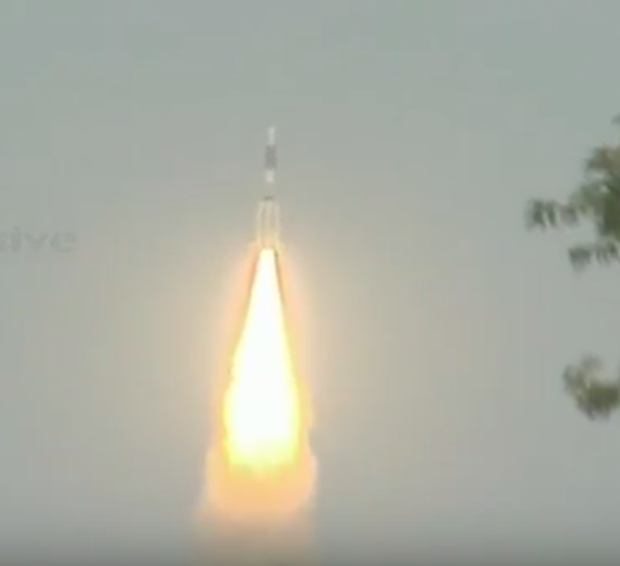
                The GSLV lifted off at 1122 GMT (7:22 a.m. EDT) Thursday from the Satish Dhawan Space Center on India's east coast about 50 miles north of Chennai.

                India’s Geosynchronous Satellite Launch Vehicle soared into space Thursday and deployed a 2.3-ton communications payload into an on-target orbit, tallying its second consecutive success with an Indian cryogenic upper stage as officials prepare to declare the once-troubled launcher operational.

                The 161-foot-tall rocket launched at 1122 GMT (7:22 a.m. EDT) from the Satish Dhawan Space Center on India’s east coastline, turning east over the Bay of Bengal powered by 1.7 million pounds of thrust from a core solid-fueled motor and four auxiliary boosters burning liquid hydrazine.

                With its nose cone emblazoned with the Indian flag, the GSLV flew with an Indian-built third stage fueled by super-cold liquid hydrogen and liquid oxygen.

                Thursday’s launch marked the third time a GSLV flew with a domestic third stage engine, a configuration called the GSLV Mk.2 by Indian space officials.

                The cryogenic engine apparently performed flawlessly, placing the 4,667-pound GSAT 6 spacecraft into the correct orbit about 17 minutes after liftoff.

                “This is the mission director,” radioed R. Umamaheswaran, director of Thursday’s launch, which was codenamed GSLV-D6. “Spacecraft separatio confirmed, and the GSLV-D6/GSAT 6 mission is accomplished.”

                Engineers and dignitaries gathered in the GSLV control center at the Satish Dhawan Space Center erupted in applause, celebrating India’s third successful launch of the year.

                Officials reported GSAT 6’s power-generating solar panels extended after the launch, and the satellite was generating electricity.

                The mission was the first by a GSLV since January 2014, when the Indian cryogenic upper stage completed its first successful test flight. An initial test of the new engine in 2010 ended in failure, and several other GSLV missions using a Russian-made upper stage did not succeed.

                In remarks after Thursday’s launch, officials from the Indian Space Research Organization hailed the test flight and said the GSLV was ready to become operational.

                A.S. Kiran Kumar, ISRO’s chairman, said Thursday’s success confirms the January 2014 launch “was no fluke. It was the result of a tremendous amount of hard work put in by the entire team to build an indigenous cryogenic engine, and today’s performance of the launch vehicle clearly demonstrates that all the systems have performed very normally, and the various intricacies of the cryogenic engine performance have been understood.”

                The GSAT 6 satellite entered an orbit with a high point of 22,335 miles (35,945 kilometers), a low point of 105 miles (170 kilometers) and an inclination of 19.96 degrees, according to ISRO officials. That is close to prelaunch targets.

                15solar-panel-deployment-test-under-progress
                The GSAT 6 satellite is pictured during a solar array deployment test. Credit: ISRO
                GSAT 6 will use its own engine to reach a circular orbit 22,300 miles above the equator, and it will unfurl a nearly 20-foot (6-meter) S-band antenna, the largest reflector of its kind ever flown on an Indian communications satellite.

                The spacecraft carries S-band and C-band communications payloads with five spot beams and one nationwide beam. The main user of the GSAT 6 satellite will be the Indian military.

                With Thursday’s success, the GSLV’s record stands at 5-for-9, including earlier variants with Russian hardware.

                That compares unfavorably with India’s smaller Polar Satellite Launch Vehicle, which has logged 29 straight successful launches.

                But the back-to-back performances by the GSLV give Indian officials hope the bigger rocket, which first flew in 2001, is finally over its early growing pains.

                Once nicknamed the “naughty boy” of ISRO, the GSLV’s next flight is scheduled for June or July 2016, according to Umamaheswaran.

                “Today, I’m really proud to say that this ‘naughty boy’ has been transformed to the most adored boy of ISRO,” Umamaheswaran said.

                The GSLV Mk.2 can carry up to 5,500 pounds — 2.5 metric tons — to geostationary transfer orbit, the drop-off point for most communications satellites. That is nearly twice as much as the PSLV’s lift capability.

                A smooth introduction of the GSLV into India’s launcher fleet is required to achieve ISRO’s goal of ramping up its launch rate. In the future, Indian space officials foresee up to six PSLV flights per year, plus an average of two GSLV missions annually.

                That would double India’s current launch cadence.

                “The indigenous GSLV with the indigenous cryogenic stage passed the ultimate (test) with flying colors and entered majestically into the operational phase,” said K. Sivan, director of the Vikram Sarabhai Space Center, which leads India’s launch vehicle programs. “GSLV-D6 is very important for the GSLV program. This particular (flight) essentially demonstrates the robustness of the vehicle to get to operational service flights. That we got.”

                India’s satellite production division also aims to build more satellites to keep up with ISRO’s busy launch rate by more than doubling the number of spacecraft delivered per year, said M. Annadurai, director of the ISRO Satellite Center in Bangalore.

                With GSLV operational, India can launch almost all its satellites on its own rockets. A few exceptions — satellites too big for the GSLV — are booked on international rockets such as Europe’s Ariane 5 launcher.

                India’s next launch is scheduled for Sept. 28 when a PSLV will blast off with Astrosat, the country’s first dedicated space telescope.


                * * * * * * * * * * * * * * * * * * * * * * *

                Comment


                • Indian achievement:

                  $2.4 trillion economy

                  Indian space programme to Mars.


                  Pakistani achievement:

                  Originally posted by Orakzai View Post


                  We have survived 70 years of Afghan attempts to swipe our land and bitchslapped you hard enough to make you go through time until you reached the Stone Age. When dealing with Afghans, it is hard to not brag and be proud.
                  Surving the "threat" from landlocked, 6 times smaller (by population) civil war ridden Afghanistan.


                  * * * * * * * * * * * * * * * * * * * * * * *

                  Comment


                  • Indian rocket to land on moon in 2017; to launch solar mission


                    By PTI | 16 Dec, 2015, 02.03PM IST


                    Chandrayaan II will land on moon in 2017 and the country's first solar mission Aditya L1 is likely to be launched in 2019, Lok Sabha was informed today.


                    NEW DELHI: India's second lunar probe Chandrayaan II will land on moon in 2017 and the country's first solar mission Aditya L1 is likely to be launched in 2019, Lok Sabha was informed today.

                    Chandrayaan II will land on the surface of moon in 2017 and this second lunar mission will help explore the possibilities of signs of extra-terrestrial life, Minister of State in Prime Minister's Office Jitendra Singh said during Question Hour responding to supplementaries.

                    The Aditya L1 mission "is aimed at studying the sun from an orbit around the sun-earth lagrangian point (L-1) which is about 1.5 million km from earth. It will carry seven payloads including a coronagraph to observe the outermost layers of the sun, the corona. Aditya L1 will be launched during 2019-20 timeframe," he said in his written response.

                    The "approved cost" of the solar mission is 378.53 crore.

                    Responding to another question, Singh said India has entered the era of "space marketing" and the launch of six Singapore satellites today will earn India 26 million euros.

                    So far, India has earned 15 million USD and 80 million euros by launching satellites of other countries, he said, adding that $5 million and 65 million euros are in the "pipeline", while apparently referring to the launches proposed in the future.

                    The minister said a budget of Rs 1420 crore has been approved by the government for realisation of Indian Regional Navigation Satellite (IRNSS) programme, including satellites and associated ground segment.


                    * * * * * * * * * * * * * * * * * * * * * * *

                    Comment

                    Working...
                    X