
 Tweet
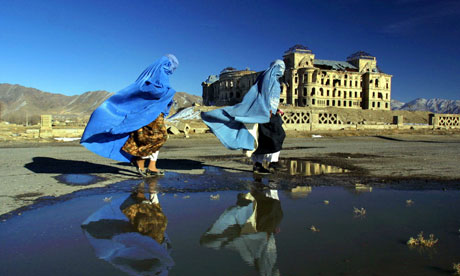
Afghanistan's myth of independence legitimised rebellion against King Amanullah, whose Darulaman palace now lies in ruins. Photograph: Paula Bronstein/Getty Images
In an interview with the Guardian, Afghan human rights activist Orzala
Asharf-Nemat said it was the responsibility of the Afghan people to create
their own national identity. Her point is absolutely valid. But since
transnational concepts such as socialism (1980s), Islam (1990s) and
democracy (2000s) have all failed to create a stable nation, we need to
ask ourselves what is the single idea that resonates with all Afghans?
Unfortunately for Afghans, the idea that makes them feel that they are
part of a distinct nation is the myth of their independence. This myth was
the narrative upon which the Afghan state was founded in the late 19th
century. Since then, it has continued to serve as the key story for
political legitimacy and nation-building.
But the myth of independence is a double-edged sword that can be
turned against foreign invaders and legitimate local governments alike.
When turned against local governments, the myth of the Afghans' natural
right to independence turns into licence to riot and rebel but without any
sense of wrongdoing.
The myth of independence is the sole idea that resonates with all
Afghans, regardless of their age, gender and ethnicity. The jihadi leaders,
their Taliban enemies and vocal dissidents such as Malalai Joya all draw on
this myth for legitimacy and popular appeal. In the mood for rebellion,
Afghan MPs at times have threatened to "hit the mountain", a euphemism
for justified rebellion against an oppressive state.
The strong sense of independence has historically served to legitimise
many acts of anarchy and subversion which is why even the president
sometimes threatens to join the Taliban rebels.
A myth that is as old as the country itself is obviously hard to shake off.
Most Afghans are emotionally helpless against the call for independence
which is why they desert the army, rally around subversive clerics and
plant bombs that blow up their own people. The myth's power is such that
it makes the legitimate question of what will happen once independence is
achieved sound ridiculous.
Afghans should be forgiven for allowing the myth of independence to
deprive them of their only chance to rebuild their country with the help of
international allies. After all, generation after generation were raised with
the idea that what made them unique was their martial qualities, their
ability to be independent even to the point of defeating empires.
In reality, Afghans did not defeat any empire, as both the British and the
Soviet empires were already in decline and in the process of
disintegration. But Afghans could not let go of the myth and were instead
encouraged to take pride in their country as the graveyard of empires. But
Afghanistan remained a graveyard while the capitals of the former
empires, Moscow and London, thrived and flourished after their so-called
defeat by Afghans. The myth persisted even after the entire country had
turned into a giant cemetery.
Afghan jihadi leaders still talk proudly about a nation that gives birth to
independence-seeking martyrs. The myth is politically useful as it turns
subversive rebels into heroes, thieving highwaymen into politicians.
Ironically, international writers and journalists have also adopted the
myth, perpetuating it by publishing books and articles about "the
graveyard of empires".
At times, it feels as if the whole world wants Afghanistan to be just that:
a massive graveyard and symbolic two fingers to superpowers. That a
country incapable of sustaining itself is further destroyed in the process
seems to matter little. Neither does it seem to matter that those who
destroy cannot rebuild and hence expect the population to live in ruins
and feed themselves with the pride of a myth rather than actual food.
The uncomfortable truth is that Afghanistan has never been a truly
independent country and has always relied on outside resources and
expertise for survival. Historically, much of the country's limited wealth
came through control of trade routes by local tribesmen who also acted as
highwaymen, making travelling in Afghanistan a famously dangerous
endeavour.
Other sources of income included military raids into richer neighbouring
territories and foreign subsidies in return for implementing superpower
policies. The government in Kabul has always received foreign aid and
subsidies to implement modernisation projects. The border tribes have
always been hard to control and repeatedly undermined the central state,
refusing to pay tax or supply soldiers to the army, again drawing on the
unspoken right to independence.
The myth of independence also legitimised internal rebellions. Hence, in
1919, King Amanullah was declared a ghazi in recognition of his jihad
against the British which won Afghans' independence. But in 1929, new
rival strongmen had emerged, contesting Amanullah's power. They called
the amir an infidel, which amounted to a declaration of war.
That a heroic Muslim leader could willy-nilly be declared an infidel is
alarming, but not in Afghanistan where the clergy has always been
subversive, often siding with the enemies of the state. After all, the
absence of a strong state empowers both clerics and rebels, which is why
both groups traditionally join hands, appealing to the myth of
independence to mobilise the masses against the state. The recent riots
in Mazar, Kandahar and Kabul were a continuation of this historical trend.
Independence, the national narrative that binds Afghans together, is
simultaneously the force that helps mobilise rebellions, undermine the
state and destabilise the country. If there is one lesson Afghans should
learn from the past, it is that the inclusion of the myth of independence in
their national narrative has to be done with great care, or the endless
cycle of internal independence-seeking rebellions will never end.
The article was written by Nushin Arbabzadah for The Guadian.
I personally completely disagree with her. If Afghanistan had been full of people who think like this we would all have been ruled by a brutal repressive Soviet Socialist Republic. Sure we may not be much worse off than we are right now but we atleast still have the opportunity to self determine how we live.
What are your thoughts on this article?
Is our heroic military history just a myth?
Was Afghanistan never a gaveyard of empires?
Do we need to rid ourselves of this myth to build a better Afghanistan?

Comment