
 Tweet
Because of all the instability that plagued Afghanistan throughout the 19th & 20th Centuries, the country has never had a viable national or regional rail network like many other countries had. Afghanistan was also never fully incorporated or assimilated into the British Empire like modern-day Pakistan & India were so there was no legacy left behind from them. There was no transition from carriages/donkeys to trains, instead transportation in Afghanistan bypassed this evolutionary step and moved straight to cars & trucks that are still widely depended upon today.
However, Afghanistan does have its own brief history of railways & locomotives and there were various plans brought up at various points in time.
Here, i'll gather various pieces of information from the web for the benefit of those who may be interested.
Railways and the Great Game
Afghanistan’s leaders have often been concerned about the intentions of
foreigners wanting to build railways into their country – and not without
reason.
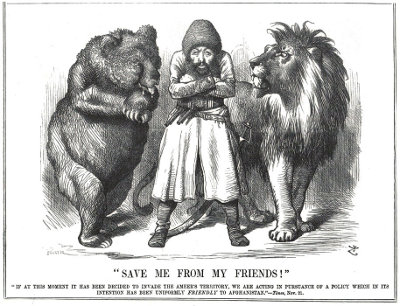
The Amir of Afghanistan sandwiched between the British lion and the Russian
bear. Punch, 30 November 1878. Source: Middle East Cartoon History
Throughout the nineteenth century the British political and military authorities
were worried that Russia might advance through Afghanistan towards India,
threatening British rule in the subcontinent. Even if a full-scale Russian
invasion and occupation of India was unlikely, any move towards India would
tie-up British resources dealing with both the Russians themselves and also
any Indian uprising which they might inspire. Britain saw defence of India’s
North West Frontier, now part of Pakistan, as essential to the ‘Great Game’ of
politics played across Central Asia by the two rivals.
In 1857 William Andrew, Chairman of the Scinde, Punjab & Delhi Railway,
suggested that railways to the Bolan and Khyber passes would have a
strategic role in responding to any Russian threat.1 No action was taken until
1876, when Britain decided to keep at least one route into Afghanistan open
all year round to permit the rapid deployment of troops from Karachi to
counter any threat to India. Orders were given that a railway should be built
to Quetta, near the Afghan border, and this developed into a scheme to reach
Kandahar.
The Second Afghan War (1878-80) broke out between Britain and Afghanistan
before work on the railway could begin. The war gave a new urgency to the
need for easier access to the frontier, and on 18 September 1879 the
Viceroy’s council decided to make do with a line through the Bolan pass usable
only in fair weather. Work began just three days later, and after four months
the first 215 km of the line was complete, opening from Ruk to Sibi in January
1880. On 27 March 1880 the Morning Post commented “after three and
twenty years of apathy the necessity has been realised and now these
railways are being constructed.” The railway was built to the 1 676 mm Indian
broad gauge.
Beyond Sibi the terrain was more difficult. Reconnaissance parties had
reached Kandahar by December 1879, but Afghanistan was enemy country,
making it difficult to find an optimal route for the line. It was realised it would
not be possible to for the railway to reach Quetta before the conclusion of
the war, and so the railway was given a lower priority. When a new cabinet
under Gladstone was formed in April 1880 the planned Kandahar extension was
put to one side.
In March 1880 Britain and Persia agreed the Herat Convention. Persia would
take control of the Afghan city of Herat subject to certain conditions,
including permitting British soldiers to be stationed there. Article seven of the
draft agreement stated that
At first the Persian foreign minister requested the removal of this article. He
eventually agreed to its inclusion, but objected to the conditions regarding
the assessment of the revenue of the city.2
In 1880 Russia began to build the Trans-Caspian railway.3 In Britain there was
concern that Russia might seize Herat, and extend their new railway to the
city.
In response to this threat Britain restarted work on the railway to
Afghanistan. To avoid alerting Russia to this work it was described as the
“Harrai road improvement project”, and camels were used for construction
traffic instead of the more usual temporary railway lines. This deception was
abandoned when Russia occupied the city of Mary in 1883, and the line was
developed as the Sind Peshin State Railway. Over 320 km long, the line
reached Quetta in March 1887, through barren mountains inhabited by armed
tribesmen.
On 30 September 1891 the Chaman Extension Railway was opened, linking
Bostan, north of Quetta, to the Afghan frontier. The buffer stop lay 5 km
beyond Chaman fort, and just 200 m short of the Durand line, the
Afghanistan-India border which was drawn around the railway when the
frontier was fixed by Sir Mortimer Durand in 1893.
A supply depot was set up at Chaman containing the rails, sleepers and bridge
parts required to extend the line the remaining 108 km to Kandahar in the
event of a military emergency. Meanwhile, across Afghanistan, the Russians
stockpiled materials at Kushka4 to allow the rapid construction of a line to
Herat.
Amir Abdul Rehman, ruler of Afghanistan between 1880 and 1901, banned
railways and the telegraph from entering Afghanistan, in case they were used
in any British or Russian invasion. Rehman commented “there will be a railway
in Afghanistan when the Afghans are able to make it themselves” and said “as
long as Afghanistan has not arms enough to fight against any great attacking
power, it would be folly to allow railways to be laid throughout the country.”
Rehman forbade his subjects from travelling on the British line to Chaman,5
which he described as “a knife pushed into my vitals.” The Afghan army
produced a manual on how to destroy railway tracks in the event of an
invasion threat.6
In 1891 Captain AC Yates wrote a booklet setting out arguments in favour of
building a railway to Seistan, rather than Kandahar, to allow the defence of
Herat against Russia.7 “The press and the public are at this moment
advocating the extension of our railways to Kandahar; but that this could be
done without precipitating a rupture of our relations with the Amir is doubtful”.
Around 1910 there was discussion8 regarding extending the Chaman line to
Kandahar, and beyond to Herat and the Russian railhead at Kushka. In the
event, the line was never extended across the border. It did however carry
traffic from Afghanistan, with a daily ice-packed train bringing fresh fruit
grown in Afghanistan to the cities of India until the 1940s.
A through railway link from Europe to India had long been contemplated, but
the schemes raised concerns for the security of the subcontinent. In 1910 a
Russian syndicate proposed a Trans-Persia railway, running from Tehran to
Yezd, Kerman, Seistan and Nushki. This raised the risk of Russian troops being
able to occupy Kandahar and Quetta, outnumbering available Indian army
forces.
In 1911 a British study looked at the implications of Russian railway
construction in the light of the successful movement of troop on the Trans
Siberian line during Russia’s war with Japan (1904-1905).9 The Trans-Persia
line faced political problems “in that it would cause alarm and suspicion in
Afghanistan, as its rails lead direct to the Afghan Frontier, which may give rise
to tribal excitements that may prove beyond the Amir’s power to control. The
measures taken to restore confidence may involve us in complications with
other European Powers.”
The study’s author commented “No connection between this line and either
Afghanistan or Northern Baluchistan should be permitted”,
Russian railways now stretched from Orenburg to Tashkent and Samarkand.
“The further extension can only be accomplished in peace, or with the
consent of the Amir, which is hardly likely to be given; or during a war with
Afghanistan. The bridging of the Oxus [Amu-Darya] is estimated to take four
months to complete”. It was estimated that after reaching the Amu-Darya it
would take the Russians 16 months to extend the railhead to Doshi. The
report also considered that an extension of the Trans-Caspian railway from
Kushka into Afghan territory would only be possible with consent or in war
time. Rails were stacked at Kushka, and it was estimated that the line could
be laid to the Helmud in 18 months.
“The extension of Russian or Persian railways through Afghanistan should be
more strongly resisted than ever” said the report. The author speculated that
the German-backed Baghdad railway could be extended to the Afghan
frontier, but handwritten annotations on the Public Record Office’s copy of
the booklet suggest officials thought this somewhat unlikely.
The author concluded that “The present attitude of the Amir concerning them
[i.e. railways] may change rapidly, as it has recently with regard to roads in
Afghanistan. Thus the construction of these two lines [Trans-Caspian from
Kushka, an extension from Samarkand] is probably only a matter of time.”
An insightful audio piece from War News Radio: Afghan Railways: From the Great Game to the Modern Silk Road
Even as railways and telegraph wires spread across the world during the
Victorian Era, Afghanistan retained its mule and dirt tracks. For, as Abdur
Rahman reasoned, "As long as Afghanistan does not have weapons to ward
off acts of aggression by the big powers [the British Empire and the tsar], it
would be crazy to allow the construction of a railway track leading into my
country."
Abdur Rahman's sons were a lot more acommodating, especially Amanullah,
who introduced Western-style schools, the emancipation of women, and a
constitution. Encouraged by these measures, the British gave Afghanistan its
independence in 1919 (since Russia was no longer a threat) and stopped the
annual subsidy. Signs of progress continued as the sales of enslaved Hazara
men, women, and children ended when the institution of slavery was abolished
in 1923, the year Afghanistan entered the Railway Age. Three steam engines
manufactured by Henschel, a German enterprise, travelled on a test track
from Kabul southwest to Darulaman Palace, seven kilometers from the city.
Whether there were plans to extend the railway farther isn't known, since the
project was short-lived and ended in 1929 when the parent German company
went bankrupt. Even today, Afghanistan remains one of the few countries in
the world without a railway system. Because of this situation, its long
distance truck drivers wield power out of all proportion, but also in the opium
trade, which is exported in the vehicles. Every Afghan politician understands
full well that the truck-driver mafia has to be courted if his government is to
remain in power long.
-Canada in Afghanistan: The War So Far, Peter Pigott
The historic plans that were drawn up but were never put into action:
'King Amanullah'
The Great Western Railway works at Swindon were visited, on Wednesday, by
the King of Afghanistan, who, with his customary keenness and untiring
energy, manifested the liveliest interest in everything he saw. It is fitting that
his first purely industrial visit should be paid to a railway works, not only
because this country is the original home of railways, but as marking the
importance of transportation in the modern state, a fact that is not likely to
have escaped the keen intelligence of the Afghan ruler. The Swindon visit is
but one of a series which he will pay to the great industrial centres of Britain
during the remainder of his stay, and these visits, like those he had already
carried out in France, Germany and Italy, are made with a definite purpose. It
is his policy to convert Afghanistan into a stable and prosperous kingdom on
modern lines, adapting the best of western practice, but cautiously, to
Afghan conditions. There are no railways at present in Afghanistan, and it is
said that there will not be until Afghanistan herself can build them; but King
Amanullah has known how to make use of European advisers in other
Departments of State, and we have no doubt that here, too, he will know
where to seek the best advice. He has an object lesson in British railway
construction on his own frontier in the Khyber railway, and in his visits he will
see something of the unexampled resources and skill of this country in the
design and manufacture of engineering and transport equipment. May the
friendship between Afghanistan and our Indian Empire, which is such an
important British and Afghan interest, be cemented in the future with bonds of
steel!
-The Railway Gazette, 23 March 1928, p. 387
'Focus: Africa & Asia'
Work on the proposed rail link between Chaman in Pakistan and Spin Baldak in
Afghanistan is to begin soon and will take about a year and a half to complete.
The link will be over seven miles long and will cost about $800,000.
Over two miles of the link will be in Pakistani territory.
-The Railway Gazette, 2 September 1966, p. 675
'Afghanistan link proposed by Iranian Railways'
Iranian State Railways has submitted to the government a proposal to build an
extension from the present railhead at Mashhad to Herat in Afghanistan.
Although Soviet and Pakistan Western lines touch the Afghanistan border, this
will be the first railway within the country.
-Railway Gazette International, March 1972, p. 85
'India surveys 1,400 km network in Afghanistan'
An initial network of 1,400 km of railway in Afghanistan connecting the
principal cities of Herat, Kandahar and Kabul is being surveyed by a team of
Indian railway consultants. Feasibility studies are being carried out following
grant of a $20m loan from Iran.
Backbone of the network would be a northwest-southeast link from Mashhad
in Iran to Herat, Kandahar, and Chaman on the Pakistan border. A direct link
from Herat would serve Kushka to the northeast on the border of the Soviet
Union, connecting there with the 1,524mm gauge Soviet Railways network.
From Kandahar a line would run northeast to serve Ghazni and the capital,
Kabul. The link with Pakistan Railways at Chaman would allow access to the
Arabian Sea at Karachi, while another sea outlet at Bandar Shapur in Iran
would be possible through Mashhad. Completion of the link form Kerman to
Zahedan and the proposed line to Bandar Abbas would enhance the value of
the proposed Afghan network by providing access to the industrial complex
planned at Iran's new port.
Preliminary surveys by Indian engineers follow on from the work of an Indo
Afghan joint commission on increased co-operation between the two
countries. Indo-Afghan co-operation already extends to consultation on
industry and power stations and the railway interest is strong enough to
justify attendance of a representative of Rail India Technical and Economic
Services at inter-governmental meetings. Estimated cost of the network in
Afghanistan is Rs8,000m to Rs9,000m.
An Afghanistan rail network would complete a further stage in a through
Europe-Asia railway, but there will certainly be some difficulty over the choice
of gauge.
-Railway Gazette International, May 1975, p. 167
'Afghan network of 1,815 km goes ahead'
The Afghanistan government has approved plans drawn up by a team of
consultants from the French firm Sofre-rail for a 1,815km network to be
constructed in the period of the seventh Afghanistan national plan (1976-80).
Similar to the proposals prepared by Indian consultants last year, the
network, which will be 1,435mm gauge, will link the Afghan capital Kabul with
the cities of Kandahar and Herat.
Other links will be with Iran at Islam Qala in the northwest and at Tarakun in
the southwest, and with Pakistan at Chaman in the southeast. From Islam
Qala an Iranian State Railways' line will run to Mashhad (-Teheran), giving
access via Tabriz or Djulfa to Western Europe. The link through Tarakun will
join the planned Kerman-Zahedan line and give access to the Iranian port of
Bandar Abbas, while the Pakistan link will allow traffic to reach the Arabian
Sea at Karachi.
About 75 per cent of the Afghan network will be laid out with a maximum
gradient of 1.0 per cent and minimum curve radius of 2,000m; the remaining
25 per cent of the network will have gradients up to 1.5 per cent allowing
speeds of 100 km/h. Initially maximum speed will be 160 km/h, but the
proposals envisage 200 km/h running with high-speed lightweight trainsets at
a later stage. Track will be continuously-laid UIC 45 kg/m rail laid on tied
block sleepers. Signalling installations will be backed by a train radio system.
At Kandahar there will be a traffic control centre, together with a motive
power depot, workshop facilities and marshalling yard. Staff requirements are
for 2,400 in 1975, rising to 3,300 with eventual expansion of the network.
Motive power will be provided initially by 40 diesel locomotives of 2,400 hp
with provision for an additional 65 units. Because of the rarified atmosphere at
high altitudes, power output losses of up to 22.5 per cent are expected.
Finance for the network is being provided by Iran, which stands to benefit
considerably from transit traffic. Initial forecasts are for 1,300 million tonne
km in 1985. Of major significance is the massive iron ore deposit at Hajigak in
the Hindu-Kouch mountain range; ore would be transported by cableway from
the deposit to a railhead 100 km away, and thence to steelworks in Iran.
-Railway Gazette International, June 1976, p. 204
'Dawn of another era'
News that Afghanistan is planning to quit that small band of nations
unfortunate enough not to have a railway has reminded a correspondent that
there was an earlier railway age in the country, albeit brief.
In the mid-1920s King Amanullah built a short line from Kabul to suburban
Darul Aman, where he planned to establish a new European-style capital.
Trains ran for two or three years until the dream ended with Amanullah's
overthrow in 1929, but two locos and several coaches still stand in a shed at
Darul Aman as relics of a bygone era and prophetic of a new one dawning for
Afghanistan.
-Railway Gazette International, August 1976, pp. 81-2
'USSR-Afghan link'
It is reported that, towards the end of May, the USSR and Afghanistan
concluded a series of agreements on the use of a bridge across the River Amu
which established a rail link to a river port just inside Afghan territory. Work
on the bridge is believed to have started shortly after Soviet intervention in
Afghanistan in the winter of 1979-80.
-From Modern Railways, August 1982, p. 342
'Kabul to be linked to Soviet Railways'
Signing of an agreement on railway development by the governments of
Afghanistan and the USSR has paved the way for construction of the first
stage of a 1,520mm gauge railway to Kabul. A combined rail and road bridge
over the River Amudarya was completed last year, allowing Soviet troops and
equipment to be railed directly into Afghanistan. Next step is construction of a
250 km line as far as Pul-i-Khumri, 150 km north of Kabul.
From Hariatan on the Afghan side of the River Amudarya the route runs
southwest to Kholm and then east towards Kunduz and Khanabad. From
Khanabad the alignment continues south, climbing through Ab Kul and Bahlan
before reaching the Surkhab river valley and Pul-i-Khumri.
Pul-I-Khumri, strategically located in the foothills of the Hindu Kush
mountains, will be the starting point for the final leg to Kabul. This would pose
tough civil engineering problems because of the exceptionally rugged terrain,
but the Soviet Ministry of Railway Construction has plenty of experience in
similar regions within the USSR. Completion of the line through Kabul would
ease considerably the USSR's supply problems in maintaining a strong military
presence in Afghanistan.
-Railway Gazette International, April 1983, p. 236
'Rail links with Pakistan and Iran'
A correspondent reports that the Soviet-backed Afghan regime is pushing
ahead with plans to establish a railway network linking Kabul, Kandahar and
Herat with a branch from Kandahar to Chaman, on the border with Pakistan,
and from Herat to Islam Qala, on the border with Iran. A Soviet-Afghan
agreement already provides for the extension of a railway spur across the
Oxus river from the Soviet military supply base of Termez, in Southern
Uzbekistan, to the Afghan town of Pul-i-Khumri, and it seems likely that, if the
mujahadeen (freedom fighters) are sufficiently subdued, this line too will be
taken through to Kabul. It was British opposition to such a rail link with Czarist
Russia in the 19th century that led to two Afghan wars. Today, neither
Pakistan nor Iran recognises the present Afghan regime and both countries
view the latest developments with extreme concern, poor communications in
the border regions ahving always been regarded as making an important
contribution to national security.
Notwithstanding continued internal unrest and lack of support from its
neighbours, the Afghan Government has been in touch with the Economic and
Social Commission for Asia and the Pacific (ESCAP) for financial and technical
assistance, presenting surveys drawn up as long ago as 1928 by a Franco
German consortium. Two ESCAP missions, including railway experts, have
visited Afghanistan.
-Modern Railways, April 1983
'USSR-Afghanistan rail project'
The Afghan Government and the USSR have signed an agreement that could
lead to construction of the first railway wholly within Afghanistan. The
Tashkent-Bukhara line of Soviet Railways (SZD) has already been extended
across the frontier to Herat, this section being completed in May 1982. Under
the new agreement the line would be continued for another 250 km (150
miles) to Pul-i-Khumri, an important strategic centre at the foot of the Hindu
Kush. The final stage would be a further 150 km (94 miles) to Kabul. The
project is important in Soviet eyes as a means of reinforcing its troops in
Afghanistan but it could not be undertaken without first bringing guerilla
activity under control.
-Modern Railways, March 1984
'Rail survey in Afghanistan'
Engineers of Pakistan Railways (PR) are to survey a possible route from the
frontier with Afghanistan via Jalalabad and Kabul to Tadzhikstan in Central
Asia. The General Manager of PR told the newspaper Dawn that it was in the
national interest to opt for establishing links with Central Asian Republics via
Afghanistan rather than Iran. The distance between Tadzhikstan and
Peshawar via Kabul is approximately 800 km (497 miles) and to Karachi about
2,400 km (1,490 miles).
-Modern Railways, November 1992
Afghan stamps depicting locomotives:

However, Afghanistan does have its own brief history of railways & locomotives and there were various plans brought up at various points in time.
Here, i'll gather various pieces of information from the web for the benefit of those who may be interested.
Railways and the Great Game
Afghanistan’s leaders have often been concerned about the intentions of
foreigners wanting to build railways into their country – and not without
reason.
The Amir of Afghanistan sandwiched between the British lion and the Russian
bear. Punch, 30 November 1878. Source: Middle East Cartoon History
Throughout the nineteenth century the British political and military authorities
were worried that Russia might advance through Afghanistan towards India,
threatening British rule in the subcontinent. Even if a full-scale Russian
invasion and occupation of India was unlikely, any move towards India would
tie-up British resources dealing with both the Russians themselves and also
any Indian uprising which they might inspire. Britain saw defence of India’s
North West Frontier, now part of Pakistan, as essential to the ‘Great Game’ of
politics played across Central Asia by the two rivals.
In 1857 William Andrew, Chairman of the Scinde, Punjab & Delhi Railway,
suggested that railways to the Bolan and Khyber passes would have a
strategic role in responding to any Russian threat.1 No action was taken until
1876, when Britain decided to keep at least one route into Afghanistan open
all year round to permit the rapid deployment of troops from Karachi to
counter any threat to India. Orders were given that a railway should be built
to Quetta, near the Afghan border, and this developed into a scheme to reach
Kandahar.
The Second Afghan War (1878-80) broke out between Britain and Afghanistan
before work on the railway could begin. The war gave a new urgency to the
need for easier access to the frontier, and on 18 September 1879 the
Viceroy’s council decided to make do with a line through the Bolan pass usable
only in fair weather. Work began just three days later, and after four months
the first 215 km of the line was complete, opening from Ruk to Sibi in January
1880. On 27 March 1880 the Morning Post commented “after three and
twenty years of apathy the necessity has been realised and now these
railways are being constructed.” The railway was built to the 1 676 mm Indian
broad gauge.
Beyond Sibi the terrain was more difficult. Reconnaissance parties had
reached Kandahar by December 1879, but Afghanistan was enemy country,
making it difficult to find an optimal route for the line. It was realised it would
not be possible to for the railway to reach Quetta before the conclusion of
the war, and so the railway was given a lower priority. When a new cabinet
under Gladstone was formed in April 1880 the planned Kandahar extension was
put to one side.
In March 1880 Britain and Persia agreed the Herat Convention. Persia would
take control of the Afghan city of Herat subject to certain conditions,
including permitting British soldiers to be stationed there. Article seven of the
draft agreement stated that
If a railway or telegraph be constructed to Kandahar the Shah [of Persia] at
the request of the Queen [Victoria] would facilitate its extension to Herat in
all ways in his power and would contribute thereto from the surplus of the
Herat revenues according to his ability.
the request of the Queen [Victoria] would facilitate its extension to Herat in
all ways in his power and would contribute thereto from the surplus of the
Herat revenues according to his ability.
At first the Persian foreign minister requested the removal of this article. He
eventually agreed to its inclusion, but objected to the conditions regarding
the assessment of the revenue of the city.2
In 1880 Russia began to build the Trans-Caspian railway.3 In Britain there was
concern that Russia might seize Herat, and extend their new railway to the
city.
In response to this threat Britain restarted work on the railway to
Afghanistan. To avoid alerting Russia to this work it was described as the
“Harrai road improvement project”, and camels were used for construction
traffic instead of the more usual temporary railway lines. This deception was
abandoned when Russia occupied the city of Mary in 1883, and the line was
developed as the Sind Peshin State Railway. Over 320 km long, the line
reached Quetta in March 1887, through barren mountains inhabited by armed
tribesmen.
On 30 September 1891 the Chaman Extension Railway was opened, linking
Bostan, north of Quetta, to the Afghan frontier. The buffer stop lay 5 km
beyond Chaman fort, and just 200 m short of the Durand line, the
Afghanistan-India border which was drawn around the railway when the
frontier was fixed by Sir Mortimer Durand in 1893.
A supply depot was set up at Chaman containing the rails, sleepers and bridge
parts required to extend the line the remaining 108 km to Kandahar in the
event of a military emergency. Meanwhile, across Afghanistan, the Russians
stockpiled materials at Kushka4 to allow the rapid construction of a line to
Herat.
Amir Abdul Rehman, ruler of Afghanistan between 1880 and 1901, banned
railways and the telegraph from entering Afghanistan, in case they were used
in any British or Russian invasion. Rehman commented “there will be a railway
in Afghanistan when the Afghans are able to make it themselves” and said “as
long as Afghanistan has not arms enough to fight against any great attacking
power, it would be folly to allow railways to be laid throughout the country.”
Rehman forbade his subjects from travelling on the British line to Chaman,5
which he described as “a knife pushed into my vitals.” The Afghan army
produced a manual on how to destroy railway tracks in the event of an
invasion threat.6
In 1891 Captain AC Yates wrote a booklet setting out arguments in favour of
building a railway to Seistan, rather than Kandahar, to allow the defence of
Herat against Russia.7 “The press and the public are at this moment
advocating the extension of our railways to Kandahar; but that this could be
done without precipitating a rupture of our relations with the Amir is doubtful”.
Around 1910 there was discussion8 regarding extending the Chaman line to
Kandahar, and beyond to Herat and the Russian railhead at Kushka. In the
event, the line was never extended across the border. It did however carry
traffic from Afghanistan, with a daily ice-packed train bringing fresh fruit
grown in Afghanistan to the cities of India until the 1940s.
A through railway link from Europe to India had long been contemplated, but
the schemes raised concerns for the security of the subcontinent. In 1910 a
Russian syndicate proposed a Trans-Persia railway, running from Tehran to
Yezd, Kerman, Seistan and Nushki. This raised the risk of Russian troops being
able to occupy Kandahar and Quetta, outnumbering available Indian army
forces.
In 1911 a British study looked at the implications of Russian railway
construction in the light of the successful movement of troop on the Trans
Siberian line during Russia’s war with Japan (1904-1905).9 The Trans-Persia
line faced political problems “in that it would cause alarm and suspicion in
Afghanistan, as its rails lead direct to the Afghan Frontier, which may give rise
to tribal excitements that may prove beyond the Amir’s power to control. The
measures taken to restore confidence may involve us in complications with
other European Powers.”
The study’s author commented “No connection between this line and either
Afghanistan or Northern Baluchistan should be permitted”,
Russian railways now stretched from Orenburg to Tashkent and Samarkand.
“The further extension can only be accomplished in peace, or with the
consent of the Amir, which is hardly likely to be given; or during a war with
Afghanistan. The bridging of the Oxus [Amu-Darya] is estimated to take four
months to complete”. It was estimated that after reaching the Amu-Darya it
would take the Russians 16 months to extend the railhead to Doshi. The
report also considered that an extension of the Trans-Caspian railway from
Kushka into Afghan territory would only be possible with consent or in war
time. Rails were stacked at Kushka, and it was estimated that the line could
be laid to the Helmud in 18 months.
“The extension of Russian or Persian railways through Afghanistan should be
more strongly resisted than ever” said the report. The author speculated that
the German-backed Baghdad railway could be extended to the Afghan
frontier, but handwritten annotations on the Public Record Office’s copy of
the booklet suggest officials thought this somewhat unlikely.
The author concluded that “The present attitude of the Amir concerning them
[i.e. railways] may change rapidly, as it has recently with regard to roads in
Afghanistan. Thus the construction of these two lines [Trans-Caspian from
Kushka, an extension from Samarkand] is probably only a matter of time.”
An insightful audio piece from War News Radio: Afghan Railways: From the Great Game to the Modern Silk Road
Even as railways and telegraph wires spread across the world during the
Victorian Era, Afghanistan retained its mule and dirt tracks. For, as Abdur
Rahman reasoned, "As long as Afghanistan does not have weapons to ward
off acts of aggression by the big powers [the British Empire and the tsar], it
would be crazy to allow the construction of a railway track leading into my
country."
Abdur Rahman's sons were a lot more acommodating, especially Amanullah,
who introduced Western-style schools, the emancipation of women, and a
constitution. Encouraged by these measures, the British gave Afghanistan its
independence in 1919 (since Russia was no longer a threat) and stopped the
annual subsidy. Signs of progress continued as the sales of enslaved Hazara
men, women, and children ended when the institution of slavery was abolished
in 1923, the year Afghanistan entered the Railway Age. Three steam engines
manufactured by Henschel, a German enterprise, travelled on a test track
from Kabul southwest to Darulaman Palace, seven kilometers from the city.
Whether there were plans to extend the railway farther isn't known, since the
project was short-lived and ended in 1929 when the parent German company
went bankrupt. Even today, Afghanistan remains one of the few countries in
the world without a railway system. Because of this situation, its long
distance truck drivers wield power out of all proportion, but also in the opium
trade, which is exported in the vehicles. Every Afghan politician understands
full well that the truck-driver mafia has to be courted if his government is to
remain in power long.
-Canada in Afghanistan: The War So Far, Peter Pigott
The historic plans that were drawn up but were never put into action:
'King Amanullah'
The Great Western Railway works at Swindon were visited, on Wednesday, by
the King of Afghanistan, who, with his customary keenness and untiring
energy, manifested the liveliest interest in everything he saw. It is fitting that
his first purely industrial visit should be paid to a railway works, not only
because this country is the original home of railways, but as marking the
importance of transportation in the modern state, a fact that is not likely to
have escaped the keen intelligence of the Afghan ruler. The Swindon visit is
but one of a series which he will pay to the great industrial centres of Britain
during the remainder of his stay, and these visits, like those he had already
carried out in France, Germany and Italy, are made with a definite purpose. It
is his policy to convert Afghanistan into a stable and prosperous kingdom on
modern lines, adapting the best of western practice, but cautiously, to
Afghan conditions. There are no railways at present in Afghanistan, and it is
said that there will not be until Afghanistan herself can build them; but King
Amanullah has known how to make use of European advisers in other
Departments of State, and we have no doubt that here, too, he will know
where to seek the best advice. He has an object lesson in British railway
construction on his own frontier in the Khyber railway, and in his visits he will
see something of the unexampled resources and skill of this country in the
design and manufacture of engineering and transport equipment. May the
friendship between Afghanistan and our Indian Empire, which is such an
important British and Afghan interest, be cemented in the future with bonds of
steel!
-The Railway Gazette, 23 March 1928, p. 387
'Focus: Africa & Asia'
Work on the proposed rail link between Chaman in Pakistan and Spin Baldak in
Afghanistan is to begin soon and will take about a year and a half to complete.
The link will be over seven miles long and will cost about $800,000.
Over two miles of the link will be in Pakistani territory.
-The Railway Gazette, 2 September 1966, p. 675
'Afghanistan link proposed by Iranian Railways'
Iranian State Railways has submitted to the government a proposal to build an
extension from the present railhead at Mashhad to Herat in Afghanistan.
Although Soviet and Pakistan Western lines touch the Afghanistan border, this
will be the first railway within the country.
-Railway Gazette International, March 1972, p. 85
'India surveys 1,400 km network in Afghanistan'
An initial network of 1,400 km of railway in Afghanistan connecting the
principal cities of Herat, Kandahar and Kabul is being surveyed by a team of
Indian railway consultants. Feasibility studies are being carried out following
grant of a $20m loan from Iran.
Backbone of the network would be a northwest-southeast link from Mashhad
in Iran to Herat, Kandahar, and Chaman on the Pakistan border. A direct link
from Herat would serve Kushka to the northeast on the border of the Soviet
Union, connecting there with the 1,524mm gauge Soviet Railways network.
From Kandahar a line would run northeast to serve Ghazni and the capital,
Kabul. The link with Pakistan Railways at Chaman would allow access to the
Arabian Sea at Karachi, while another sea outlet at Bandar Shapur in Iran
would be possible through Mashhad. Completion of the link form Kerman to
Zahedan and the proposed line to Bandar Abbas would enhance the value of
the proposed Afghan network by providing access to the industrial complex
planned at Iran's new port.
Preliminary surveys by Indian engineers follow on from the work of an Indo
Afghan joint commission on increased co-operation between the two
countries. Indo-Afghan co-operation already extends to consultation on
industry and power stations and the railway interest is strong enough to
justify attendance of a representative of Rail India Technical and Economic
Services at inter-governmental meetings. Estimated cost of the network in
Afghanistan is Rs8,000m to Rs9,000m.
An Afghanistan rail network would complete a further stage in a through
Europe-Asia railway, but there will certainly be some difficulty over the choice
of gauge.
-Railway Gazette International, May 1975, p. 167
'Afghan network of 1,815 km goes ahead'
The Afghanistan government has approved plans drawn up by a team of
consultants from the French firm Sofre-rail for a 1,815km network to be
constructed in the period of the seventh Afghanistan national plan (1976-80).
Similar to the proposals prepared by Indian consultants last year, the
network, which will be 1,435mm gauge, will link the Afghan capital Kabul with
the cities of Kandahar and Herat.
Other links will be with Iran at Islam Qala in the northwest and at Tarakun in
the southwest, and with Pakistan at Chaman in the southeast. From Islam
Qala an Iranian State Railways' line will run to Mashhad (-Teheran), giving
access via Tabriz or Djulfa to Western Europe. The link through Tarakun will
join the planned Kerman-Zahedan line and give access to the Iranian port of
Bandar Abbas, while the Pakistan link will allow traffic to reach the Arabian
Sea at Karachi.
About 75 per cent of the Afghan network will be laid out with a maximum
gradient of 1.0 per cent and minimum curve radius of 2,000m; the remaining
25 per cent of the network will have gradients up to 1.5 per cent allowing
speeds of 100 km/h. Initially maximum speed will be 160 km/h, but the
proposals envisage 200 km/h running with high-speed lightweight trainsets at
a later stage. Track will be continuously-laid UIC 45 kg/m rail laid on tied
block sleepers. Signalling installations will be backed by a train radio system.
At Kandahar there will be a traffic control centre, together with a motive
power depot, workshop facilities and marshalling yard. Staff requirements are
for 2,400 in 1975, rising to 3,300 with eventual expansion of the network.
Motive power will be provided initially by 40 diesel locomotives of 2,400 hp
with provision for an additional 65 units. Because of the rarified atmosphere at
high altitudes, power output losses of up to 22.5 per cent are expected.
Finance for the network is being provided by Iran, which stands to benefit
considerably from transit traffic. Initial forecasts are for 1,300 million tonne
km in 1985. Of major significance is the massive iron ore deposit at Hajigak in
the Hindu-Kouch mountain range; ore would be transported by cableway from
the deposit to a railhead 100 km away, and thence to steelworks in Iran.
-Railway Gazette International, June 1976, p. 204
'Dawn of another era'
News that Afghanistan is planning to quit that small band of nations
unfortunate enough not to have a railway has reminded a correspondent that
there was an earlier railway age in the country, albeit brief.
In the mid-1920s King Amanullah built a short line from Kabul to suburban
Darul Aman, where he planned to establish a new European-style capital.
Trains ran for two or three years until the dream ended with Amanullah's
overthrow in 1929, but two locos and several coaches still stand in a shed at
Darul Aman as relics of a bygone era and prophetic of a new one dawning for
Afghanistan.
-Railway Gazette International, August 1976, pp. 81-2
'USSR-Afghan link'
It is reported that, towards the end of May, the USSR and Afghanistan
concluded a series of agreements on the use of a bridge across the River Amu
which established a rail link to a river port just inside Afghan territory. Work
on the bridge is believed to have started shortly after Soviet intervention in
Afghanistan in the winter of 1979-80.
-From Modern Railways, August 1982, p. 342
'Kabul to be linked to Soviet Railways'
Signing of an agreement on railway development by the governments of
Afghanistan and the USSR has paved the way for construction of the first
stage of a 1,520mm gauge railway to Kabul. A combined rail and road bridge
over the River Amudarya was completed last year, allowing Soviet troops and
equipment to be railed directly into Afghanistan. Next step is construction of a
250 km line as far as Pul-i-Khumri, 150 km north of Kabul.
From Hariatan on the Afghan side of the River Amudarya the route runs
southwest to Kholm and then east towards Kunduz and Khanabad. From
Khanabad the alignment continues south, climbing through Ab Kul and Bahlan
before reaching the Surkhab river valley and Pul-i-Khumri.
Pul-I-Khumri, strategically located in the foothills of the Hindu Kush
mountains, will be the starting point for the final leg to Kabul. This would pose
tough civil engineering problems because of the exceptionally rugged terrain,
but the Soviet Ministry of Railway Construction has plenty of experience in
similar regions within the USSR. Completion of the line through Kabul would
ease considerably the USSR's supply problems in maintaining a strong military
presence in Afghanistan.
-Railway Gazette International, April 1983, p. 236
'Rail links with Pakistan and Iran'
A correspondent reports that the Soviet-backed Afghan regime is pushing
ahead with plans to establish a railway network linking Kabul, Kandahar and
Herat with a branch from Kandahar to Chaman, on the border with Pakistan,
and from Herat to Islam Qala, on the border with Iran. A Soviet-Afghan
agreement already provides for the extension of a railway spur across the
Oxus river from the Soviet military supply base of Termez, in Southern
Uzbekistan, to the Afghan town of Pul-i-Khumri, and it seems likely that, if the
mujahadeen (freedom fighters) are sufficiently subdued, this line too will be
taken through to Kabul. It was British opposition to such a rail link with Czarist
Russia in the 19th century that led to two Afghan wars. Today, neither
Pakistan nor Iran recognises the present Afghan regime and both countries
view the latest developments with extreme concern, poor communications in
the border regions ahving always been regarded as making an important
contribution to national security.
Notwithstanding continued internal unrest and lack of support from its
neighbours, the Afghan Government has been in touch with the Economic and
Social Commission for Asia and the Pacific (ESCAP) for financial and technical
assistance, presenting surveys drawn up as long ago as 1928 by a Franco
German consortium. Two ESCAP missions, including railway experts, have
visited Afghanistan.
-Modern Railways, April 1983
'USSR-Afghanistan rail project'
The Afghan Government and the USSR have signed an agreement that could
lead to construction of the first railway wholly within Afghanistan. The
Tashkent-Bukhara line of Soviet Railways (SZD) has already been extended
across the frontier to Herat, this section being completed in May 1982. Under
the new agreement the line would be continued for another 250 km (150
miles) to Pul-i-Khumri, an important strategic centre at the foot of the Hindu
Kush. The final stage would be a further 150 km (94 miles) to Kabul. The
project is important in Soviet eyes as a means of reinforcing its troops in
Afghanistan but it could not be undertaken without first bringing guerilla
activity under control.
-Modern Railways, March 1984
'Rail survey in Afghanistan'
Engineers of Pakistan Railways (PR) are to survey a possible route from the
frontier with Afghanistan via Jalalabad and Kabul to Tadzhikstan in Central
Asia. The General Manager of PR told the newspaper Dawn that it was in the
national interest to opt for establishing links with Central Asian Republics via
Afghanistan rather than Iran. The distance between Tadzhikstan and
Peshawar via Kabul is approximately 800 km (497 miles) and to Karachi about
2,400 km (1,490 miles).
-Modern Railways, November 1992
Afghan stamps depicting locomotives:

Comment