

 Tweet
The history of Arabs in Afghanistan spans over one millennium, from the 7th century Islamic conquest when Arab ghazis arrived with their Islamic mission[1][2] until recently when others from the Arab world arrived to defend fellow Muslims from the Soviet followed by NATO forces. Most of the early Arabs gradually lost their Arabic hegemony and ultimately mixed with the local population, though they are still considered a cognizably distinct ethnic group according to the Constitution of Afghanistan and the Afghan National Anthem. Afghans who carry Sayyid or Quraishi in their names usually claim Arab ancestry.


Mausoleum of an unknown Arab who was martyred during the Islamic conquest of Afghanistan in Kabul.
First wave
Further information: Islamic conquest of Afghanistan, Siege of Herat (643 CE), and Battle of Oxus River
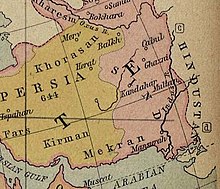
Names of territories during the Caliphate

The Shah-Do Shamshira Mosque in Kabul
At the end of the 7th century, the Umayyad Arabs entered into the area now known as Afghanistan after decisively defeating the Sassanid Empire in Nihawand. Following this colossal defeat, the last Sassanid Emperor, Yazdegerd III, who became a hunted fugitive, fled eastward deep into Central Asia. In pursuing Yazdegerd, the route the Arabs selected to enter the area was from north-eastern Iran (Khorasan) and thereafter into Herat where they stationed a large portion of their army before advancing toward eastern Afghanistan.[2] Some Arabs settled in these new areas and married locals while adopting new customs. Other groups and contingents who elected not to settle gradually pushed eastwards but encountered resistance in areas surrounding Bamiyan.[3] When ultimately arriving at Kabul, the Arabs confronted the Kabul Shahan who had built a long defensive wall around the city, part of which still remains today. The historical details of this battle remains largely unknown, though the Arabs were nonetheless victorious.
Despite maintaining some clothing customs and attire,[5] most the early Afghan-Arabs (or Arab-Afghans) gradually lost their original tongue of Arabic. This is confirmed in the 15th century work, Baburnama, which notes that the Arabs of Afghanistan have virtually lost the Arabic language and instead speak Persian and Pashto language.[2] Although the exact number of Arab-Afghans remains unknown, mostly due to ambiguous claims of descent, an 18th century academic estimated that they number at approximately 60,000 families.[2]
Second wave
Further information: Arab diaspora and Persecution of Muslims
After the Bolshevik Revolution, many Sunni Arabs residing in Bukhara and other areas of Central Asia ruled by Russians migrated to Afghanistan where they were better able to practice their religion without fear of religious persecution or discrimination.[6] One estimate indicated that approximately 30,000 Arabs lived in Bukhara during the mid-nineteenth century.[7] The Arabs who entered into Afghanistan during this time still retained some Arabic[8] in contrast to the Afghan Arabs who came during the first wave.
The Arabic spoken is mixed with Persian and Uzbeki words. Some Arabs from the second wave intermarried with the local population as they adopted the languages of northern Afghanistan, namely Uzbek, Turkmen, and Persian language.[9] Many settled in Kunduz, Takhar and Sar-e Pol provinces. Currently, while they still view themselves as Arab, almost all the Arabs from the second wave have lost their language of Arabic.[6]
Although some tribal names, including Qureshi and Shaiboni are still remembered,[10] most of the Arabs view genealogies as unimportant.[11] Many of these Afghan Arabs work in the agricultural industry, often growing cotton and wheat while others raise karakul sheep.[6] According to an academic, the Central Asian Arabs have not had any contact with Middle Eastern Arabs since the time of Tamerlane (circa 1400).[11]
Third wave
Further information: Afghan Arabs
During the 1980s Soviet war in Afghanistan, many Arab Muslims arrived and volunteered to help Afghans fight Soviet Union. Some of these remained after the Soviets withdrew from the country and were granted citizenship. Others intermarried with local Afghans while some arrived with their families to Afghanistan. Kandahar is home to a small Arab cemetery where over 70 graves belong to Arab victims of the U.S. War on Terror. These Arabs are revered by many as shahid (martyrs) and their graves are believed to possess miraculous powers.
source:wikipedia

Mausoleum of an unknown Arab who was martyred during the Islamic conquest of Afghanistan in Kabul.
First wave
Further information: Islamic conquest of Afghanistan, Siege of Herat (643 CE), and Battle of Oxus River

Names of territories during the Caliphate

The Shah-Do Shamshira Mosque in Kabul
At the end of the 7th century, the Umayyad Arabs entered into the area now known as Afghanistan after decisively defeating the Sassanid Empire in Nihawand. Following this colossal defeat, the last Sassanid Emperor, Yazdegerd III, who became a hunted fugitive, fled eastward deep into Central Asia. In pursuing Yazdegerd, the route the Arabs selected to enter the area was from north-eastern Iran (Khorasan) and thereafter into Herat where they stationed a large portion of their army before advancing toward eastern Afghanistan.[2] Some Arabs settled in these new areas and married locals while adopting new customs. Other groups and contingents who elected not to settle gradually pushed eastwards but encountered resistance in areas surrounding Bamiyan.[3] When ultimately arriving at Kabul, the Arabs confronted the Kabul Shahan who had built a long defensive wall around the city, part of which still remains today. The historical details of this battle remains largely unknown, though the Arabs were nonetheless victorious.
In the year 44 (664 AD), the Caliph Moavia Bin Aby Soofian nominated Zeead, the son of Oomya, to the government of Bussora, Seestan, and Khorassan. In the same year also Abdool Ruhman Bin Shimur, another Arab Ameer of distinction, marched from Murv to Kabul, where he made converts of upwards of twelve thousand persons... Saad was recalled in the year 59, and Abdool Ruhman, the son of Zeead, who formerly invaded Kabul, was nominated ruler of Khorassan... Shortly after his arrival in Khorassan, Sulim deputed his brother, Yezeed Bin Zeead, to Seestan. Not long after, Yezeed, having learned that the Prince of Kabul, throwing off his allegiance, had attacked and taken prisoner Aby Oobeyda, the son of Zeead, the late governor of Seestan, he marched with a force to recover that province, but was defeated in a pitched battle. When Sulim heard this news, he sent Tilla Bin Abdoolla, an officer of his court, as envoy to the court of Kabul, to ransom Aby Oobeyda; to obtain which object he paid 500,000 dirhems. Tilla afterwards received the govern*ment of Seestan as a reward for his services on this occasion, where, having collected a large force, he subdued Kabul, and Khalid Bin Abdoolla (said by some to be the son of Khalid Bin Wuleed, and by others the son of Aboo Jehl) was nominated to its government.[1]
—Muhammad Qasim Hindu Shah, (1560-1620)
Despite the lack of much written accounts, another famous archaeological legacy of this battle remains standing in Kabul, notably the tomb of the Shah-e Do Shamshira (translated into, The leader with the Two Swords in Persian) next to the Shah-Do Shamshira Mosque. The site, located near Kabul's market district, was built near the area where an Arab commander died.—Muhammad Qasim Hindu Shah, (1560-1620)
Despite fighting heroically with a sword in each hand, one of the Muslim head commanders fell in battle. It is his memory that is honored by the mosque today. The two-story edifice was built in the 1920s on the order of King Amanullah's mother on the site of one of Kabul's first mosques.
Following the Arab confrontation, the region was made part of Khorasan with its seat of power in Herat in the west. The Arabs later partially relinquished some of their territorial control though reasserted its authority approximately 50 years later in 750 when the Abbasid caliphs replaced the Ummayads.[4] By then, many Arabs increasingly blended with locals as the Arabic identity in the region began to undergo a significant change. Arab contingents settled throughout various parts of present day Afghanistan including the Wardak, Logar, Kabul, Balkh and in the Sulaiman Mountains. Over time they adopted local customs and languages, some became Persianized while others became Afghanized who followed Pashtunwali. Khalid being sub*sequently superseded, became apprehensive of returning to Arabia by the route of Persia, on account of the enemies he had in that country, and equally so of remaining in Kabul, under his suc*cessor. He retired, therefore, with his family, and a number of Arab retainers, into the Sooli-many mountains, situated between Mooltan and Pishawur, where he took up his residence, and gave his daughter in marriage to one of the Afghan chiefs, who had become a proselyte to Maho-medism. From this marriage many children were born, among whom were two sons famous in his*tory. The one Lody, the other Soor; who each, subsequently, became head of the tribes which to this day bear their name.[1]
—Muhammad Qasim Hindu Shah, (1560-1620)
It was during the reign of the Ya'qub Saffari that Arabic began losing its influence in the region. Nevertheless, the Arabs attempted to re-exert their influence in the area by supporting the Samanid rulers of Balkh who in return, assisted the Abbasid Arabs against the defiant Saffarid dynasty.—Muhammad Qasim Hindu Shah, (1560-1620)
Despite maintaining some clothing customs and attire,[5] most the early Afghan-Arabs (or Arab-Afghans) gradually lost their original tongue of Arabic. This is confirmed in the 15th century work, Baburnama, which notes that the Arabs of Afghanistan have virtually lost the Arabic language and instead speak Persian and Pashto language.[2] Although the exact number of Arab-Afghans remains unknown, mostly due to ambiguous claims of descent, an 18th century academic estimated that they number at approximately 60,000 families.[2]
Second wave
Further information: Arab diaspora and Persecution of Muslims
After the Bolshevik Revolution, many Sunni Arabs residing in Bukhara and other areas of Central Asia ruled by Russians migrated to Afghanistan where they were better able to practice their religion without fear of religious persecution or discrimination.[6] One estimate indicated that approximately 30,000 Arabs lived in Bukhara during the mid-nineteenth century.[7] The Arabs who entered into Afghanistan during this time still retained some Arabic[8] in contrast to the Afghan Arabs who came during the first wave.
The Arabic spoken is mixed with Persian and Uzbeki words. Some Arabs from the second wave intermarried with the local population as they adopted the languages of northern Afghanistan, namely Uzbek, Turkmen, and Persian language.[9] Many settled in Kunduz, Takhar and Sar-e Pol provinces. Currently, while they still view themselves as Arab, almost all the Arabs from the second wave have lost their language of Arabic.[6]
Although some tribal names, including Qureshi and Shaiboni are still remembered,[10] most of the Arabs view genealogies as unimportant.[11] Many of these Afghan Arabs work in the agricultural industry, often growing cotton and wheat while others raise karakul sheep.[6] According to an academic, the Central Asian Arabs have not had any contact with Middle Eastern Arabs since the time of Tamerlane (circa 1400).[11]
Third wave
Further information: Afghan Arabs
During the 1980s Soviet war in Afghanistan, many Arab Muslims arrived and volunteered to help Afghans fight Soviet Union. Some of these remained after the Soviets withdrew from the country and were granted citizenship. Others intermarried with local Afghans while some arrived with their families to Afghanistan. Kandahar is home to a small Arab cemetery where over 70 graves belong to Arab victims of the U.S. War on Terror. These Arabs are revered by many as shahid (martyrs) and their graves are believed to possess miraculous powers.
source:wikipedia


Comment