

 Tweet
I'm pasting the article below from SAHAR magazine (Dec. 2009 issue, starting on p. 39). It's written by Azra Nafees, the editor of the magazine, and she personally gave me her permission to post it here.
NOTE: Due to technical difficulties, I have replaced some of the images of the instruments with those that I found online (still the same instrument, though).
PASHTUN'S RICH MUSICAL HISTORY
by Azra Nafees
Classical Pashto music weaves together the past and present of diverse
ethnic groups, resulting in a pulsating expression of emotion across Pashtun society. Songs of love, longing, and celebration are prevalent in societal events, particularly during the major rites of passage. Throughout their history, Pashtuns have been seated at the crossroads between influential cultures. Exposed to the world's musical forms from as far west as Greece to the eastern edges of China, Afghanistan developed a dynamic music culture.

As early as the mid-1800s, Kabul, the capital of Afghanistan, had established itself as a center for classically trained professionals. Over the generations, these professional musicians evolved from exclusively entertaining royalty to playing at tribal and family celebrations, regardless of the pedigree of the group,and music began to permeate all of society. The legendary Kharabat Street in Kabul, a place where musicians flourished in a mysterious and joyful gypsy culture, allowed for free expression and enjoyment of Pashto music. Exotic and rapturous sounds emanated at all times from this musical ghetto at the base of the nearby silent mountains. Passersby would be treated to different styles of music at each home they passed. The more adventurous would arrive early in the evening and stay until early in the morning. Sadly, uninterrupted war has nearly destroyed this living musical heritage site.
Decades of war and the Taliban's prolonged ban on music took their toll on Pashto classical music. Musicians have been trying to resuscitate the art since the end of Taliban rule. But they face serious economic and artistic challenges. Life today remains difficult and dangerous for Pashtun musicians. This piece is aimed at discussing the most popular musical instruments used by Pashtuns all over the region for the benefit of our readers far and wide.
Rabab: The rabab is known as "the lion of instruments" and is considered the national instrument of Afghanistan.

The rabab was the lute of the ancient royal courts and is as much popular in modern day art and entertainment music the rubab is a short-necked lute like instrument, whose body is carved out of a single piece of mulberry wood. A tiny ivory or camel bone bridge rests on the face of the instrument,. It is adorned with richly inlaid ornamentation, which is covered with the skin of a goat covering the hollow bowl of the sound chamber, upon which the bridge is positioned. It has three melody strings, two drone strings, and fifteen sympathetic strings. These are variably tuned to the ragas, or musical modes, allowing for a deeply resonant timbre and subtle alterations in tone.
Rababs come in different sizes depending on the region they are found in. The Afghan rabab is also found in northern India, probably due to the Afghan rule in those regions in the 18th Century.
Sitar: Sitar is one of the most popular stringed instruments and has been in use for about 700 years. It is fashioned from a seasoned gourd and teakwood and has twenty metal frets with six or seven playing strings and nineteen sympathetic strings below. It is played with a spectrum worn on the finger.

The instrument should be balanced between the player's left foot and right knee. The hands should move freely without having to carry any of the instrument's weight. The player plucks the string using a metallic pick or plectrum called a mezrab. The thumb should stay anchored on the top of the fret board just above the main gourd. Generally only the index and middle fingers are used for fingering although a few players occasionally use the third.
Harmonium:

A harmonium or commonly known as baja in Pashto is an organ-type instrument. It is very popularly played in Pashto music, and is usually used by singers as an enhancement to vocal rehearsals. Its keys are played with one hand while the other hand is used to pump air into the instrument. It is a free-standing keyboardinstrument similar to a reed organ. Sound is produced by air, supplied by hand-operated bellows, being blown through sets of free reeds, resulting in a sound similar to that of an accordion. A harmonium has 7 stops, 3 extra notes, 3.1/4 Octaves, Multifold side bellows and bass-male reeds.
Shpelay:
Shpelay.JPG
A Shpelay is among the most ancient and most common musical instruments of Pashto music and is loved by almost everyone, especially when faintly heard from far away in the quiet of a moon-lit summer night. It is frequently played by sheep herders or shpunkey, just like it has been played by sheep herders through thousands of years. Shpelay, unlike woodwind instruments with reeds, is an aero phone or reed less wind instrument that produces its sound from the flow of air across an opening. Shpelay is carved from bamboo and is available in every possible size. It is usually played in a vertical position. Shpelay has six or eight finger holes and one embouchure hole.
Sarinda:

A sarinda is a stringed folk musical instrument similar to lutes or fiddles. It is an un-common stringed and bowed instrument. It has a very high pitched but enchanting sound and is commonly used in Pashto music. It is played while sitting on the ground just rabab or sitar is played. It is generally played joyously but can be played otherwise. It is played with a bow and has three strings. The bottom part of the front of its hollow wooden sound box is covered with animal skin.It is a stringed instrument, traditionally made with animal gut strings and a body carved from a single piece of teak wood. There is no fret on the neck, and the bridge is placed on a skin which is stretched over the body of the instrument. It is played while sitting on the ground in a vertical orientation. The large hollows on either side enable the player to move the bow across the strings. The sarinda is played by men to accompany singers and is also used today by street musicians.
Sorna:
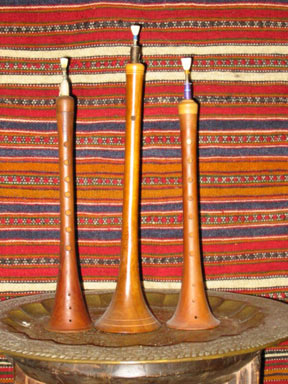
The word sorna is a compound of the words sur (strong) and nay (flute). Possibly it was called "strong flute" due to its double-reed-construction rather than usual nay, which was made of a single tube of cane. A small amount of air is forced under pressure through a small metal tube called the staple which serves to hold the reed and match it to the bore. This requires the player to make sure that one also empties the lungs of stale air when taking a new breath. Often sornas were played in pairs, with a melody and a drone player. This drone may move to different notes during a piece of music.
Sorna is commonly played almost across the Pashtun community in accompaniment to kettledrum and tambal in special traditional occasions. Often sornas are played in pairs, with a melody and a drone player. This drone may move to different notes during a piece of music, changing at prescribed places in the composition.
Dhol:

A double-headed Afghani drum, or dhol, is made from mulberry wood with goat skin stretched over both ends, tunable using a network of adjustable ropes. A dhol is a large cylindrical drum with two skin heads. It is generally struck on one side with a wooden stick bowed at the end, and with a large thin stick on the other side, though it is also played by the bare hands. It is the principal accompaniment for the Sorna or Sornay Dhol is bored out of solid wood. Its pitch is variable and is considered as an essential accompaniment for folk music especially attanr, a traditional Pashtun dance.
Dupray or dukray: Dupray or tabla, are used as an accompaniment to other musical instruments especially harmoniums. Dupray are played a little bit differently in Pashto music, since most of Pashto music has a Greek/Macedonian type beat, the musician uses the base of the palm as well as their fingers to produce great variations in sounds. Dupray maar are
observed pasting dough onto the center of the bigger dupra to improve the sound quality.
Sarangi:

It is a stringed instrument, traditionally made with animal gut strings
and a body carved from a single piece of wood. There is no fret on the neck, and the bridge is placed on a skin which is stretched over the body of the instrument. The saringda varies in form because every region has a preferred shape, tuning method, and number of strings for these instruments. The saringda is commonly thought of as the folk version of the sarangi.
Swarmandal:

It’s basically a small harp and a type of stringed instrument. It’s generally used for the drone to accompany the vocalist. It’s a traditional instrument and represents its ability to produce a large number of notes. The instrument measures from 24 to 30 inches in length and 12 to 15 inches in width. The singer may choose to employ any number of strings from 21 to 36.The strings are hooked in a nail lodged in the right edge of swarmandal and on the left, twirl around rectangular pegs which can be tightened with a special key. A sharp half inch ridge is built on both sides of the swarmandal a little apart from the nails on which the strings are tightened. This ridge functions as a bridge on both sides.
Santoor:

The santoor is basically made out of wood. The framework is generally made out of either walnut or maple wood. The santoor is a unique string instrument that is not plucked or bowed but is played with a pair of light wooden mallets or hammers. The santoor is played while sitting and placing it on top of the lap. It is a very delicate instrument and is very sensitive to such light stroke and glides. The strokes are played always on the strings either closer to the bridges or a little away from bridges. Both styles result in different tones. Sometimes strokes by one hand can be muffled by the other hand by using the face of the palm just to create a variety.
Sarod: The body of the sarod is carved from a single piece of well seasoned teakwood and the belly covered with goat skin. There are four main strings, six rhythm and drone strings and fifteen sympathetic strings, all made of metal. These are played by striking with a plectrum made of a coconut shell. Sarod has a metal fingerboard with no frets, and numerous strings. The membrane covering it provides resonance in the sound chamber. It is usually played with a coconut pick. The broad neck has a wide fretless fingerboard covered in metal to accommodate characteristic sliding pitches. The modern version has four to six main melodic strings, plus two to four others; some of the strings may be paired in double courses tuned in unison or at the octave. In addition, there are sympathetic and drone strings. The seated player holds the instrument across his lap. The strings of the sarod are plucked with a plectrum held in the right hand, while the fingernails of the left hand press the strings.
Mangay: A Mangay is a receptacle used for the storage of water, and has been used as such for thousands of years. It has a wide belly with about a four inch opening at the neck. It is used as a musical instrument only when completely dry. It is played with the flat palm of one hand, trapping and releasing air in the Mangay, producing a booming sound, and with the other hand, softly striking its outside either with a finger-ring, a coin or a pebble. To produce a greater boom, a sheet of inner auto-tyre tube rubber is tightly tied onto the neck of the Mangay and is beaten with the hand like a drum. To further enhance the sound, it is accompanied by a "Chillum" (the base of a hubble-bubble or a water pipe) into which water is poured, proportionate to sound desired, and is beaten with a soft shoe sole producing a sharper and higher pitched boom. Played together with a Chatralay Sitar is transcendental.
Druzza: This instrument is without any doubt unusual, not just because the only person (Zarnosh) that plays it, has also invented it. But the whole instrument comprises of two six-inches wheat stems not even attached to one another. Both the stems are flattened on one end, (like a reed) and a constant flow of air is blown through the flattened ends. One of the stems has just three frets and the other has none. It is played by maintaining a pocket of air in the mouth which is blown into the stems and simultaneously taking in air through the nasal passage to maintain a constant sound. It sounds like an Indian snake charmer's wind instrument (Been).
Tambal:

Tambal, also popularly known as daf, is a must for Pashtun weddings. Made of wooden ring, it is a perfect accompaniment to the dholki. The pleasant sound of tambal elevates the tempo and mood of all celebrations. Tambal is a musical instrument, which is very easy to play and doesn’t require any practice.
Others: Besides the Musical instruments mentioned above, there are many others, like Cheng, Dutara, Gungru, Naghara, dilruba, alghoza, khanak, chimta etc. that are used in Pashto Music, including most European and eastern musical instruments.
NOTE: Due to technical difficulties, I have replaced some of the images of the instruments with those that I found online (still the same instrument, though).
PASHTUN'S RICH MUSICAL HISTORY
by Azra Nafees
Classical Pashto music weaves together the past and present of diverse
ethnic groups, resulting in a pulsating expression of emotion across Pashtun society. Songs of love, longing, and celebration are prevalent in societal events, particularly during the major rites of passage. Throughout their history, Pashtuns have been seated at the crossroads between influential cultures. Exposed to the world's musical forms from as far west as Greece to the eastern edges of China, Afghanistan developed a dynamic music culture.
As early as the mid-1800s, Kabul, the capital of Afghanistan, had established itself as a center for classically trained professionals. Over the generations, these professional musicians evolved from exclusively entertaining royalty to playing at tribal and family celebrations, regardless of the pedigree of the group,and music began to permeate all of society. The legendary Kharabat Street in Kabul, a place where musicians flourished in a mysterious and joyful gypsy culture, allowed for free expression and enjoyment of Pashto music. Exotic and rapturous sounds emanated at all times from this musical ghetto at the base of the nearby silent mountains. Passersby would be treated to different styles of music at each home they passed. The more adventurous would arrive early in the evening and stay until early in the morning. Sadly, uninterrupted war has nearly destroyed this living musical heritage site.
Decades of war and the Taliban's prolonged ban on music took their toll on Pashto classical music. Musicians have been trying to resuscitate the art since the end of Taliban rule. But they face serious economic and artistic challenges. Life today remains difficult and dangerous for Pashtun musicians. This piece is aimed at discussing the most popular musical instruments used by Pashtuns all over the region for the benefit of our readers far and wide.
Rabab: The rabab is known as "the lion of instruments" and is considered the national instrument of Afghanistan.
The rabab was the lute of the ancient royal courts and is as much popular in modern day art and entertainment music the rubab is a short-necked lute like instrument, whose body is carved out of a single piece of mulberry wood. A tiny ivory or camel bone bridge rests on the face of the instrument,. It is adorned with richly inlaid ornamentation, which is covered with the skin of a goat covering the hollow bowl of the sound chamber, upon which the bridge is positioned. It has three melody strings, two drone strings, and fifteen sympathetic strings. These are variably tuned to the ragas, or musical modes, allowing for a deeply resonant timbre and subtle alterations in tone.
Rababs come in different sizes depending on the region they are found in. The Afghan rabab is also found in northern India, probably due to the Afghan rule in those regions in the 18th Century.
Sitar: Sitar is one of the most popular stringed instruments and has been in use for about 700 years. It is fashioned from a seasoned gourd and teakwood and has twenty metal frets with six or seven playing strings and nineteen sympathetic strings below. It is played with a spectrum worn on the finger.
The instrument should be balanced between the player's left foot and right knee. The hands should move freely without having to carry any of the instrument's weight. The player plucks the string using a metallic pick or plectrum called a mezrab. The thumb should stay anchored on the top of the fret board just above the main gourd. Generally only the index and middle fingers are used for fingering although a few players occasionally use the third.
Harmonium:
A harmonium or commonly known as baja in Pashto is an organ-type instrument. It is very popularly played in Pashto music, and is usually used by singers as an enhancement to vocal rehearsals. Its keys are played with one hand while the other hand is used to pump air into the instrument. It is a free-standing keyboardinstrument similar to a reed organ. Sound is produced by air, supplied by hand-operated bellows, being blown through sets of free reeds, resulting in a sound similar to that of an accordion. A harmonium has 7 stops, 3 extra notes, 3.1/4 Octaves, Multifold side bellows and bass-male reeds.
Shpelay:
Shpelay.JPG
A Shpelay is among the most ancient and most common musical instruments of Pashto music and is loved by almost everyone, especially when faintly heard from far away in the quiet of a moon-lit summer night. It is frequently played by sheep herders or shpunkey, just like it has been played by sheep herders through thousands of years. Shpelay, unlike woodwind instruments with reeds, is an aero phone or reed less wind instrument that produces its sound from the flow of air across an opening. Shpelay is carved from bamboo and is available in every possible size. It is usually played in a vertical position. Shpelay has six or eight finger holes and one embouchure hole.
Sarinda:
A sarinda is a stringed folk musical instrument similar to lutes or fiddles. It is an un-common stringed and bowed instrument. It has a very high pitched but enchanting sound and is commonly used in Pashto music. It is played while sitting on the ground just rabab or sitar is played. It is generally played joyously but can be played otherwise. It is played with a bow and has three strings. The bottom part of the front of its hollow wooden sound box is covered with animal skin.It is a stringed instrument, traditionally made with animal gut strings and a body carved from a single piece of teak wood. There is no fret on the neck, and the bridge is placed on a skin which is stretched over the body of the instrument. It is played while sitting on the ground in a vertical orientation. The large hollows on either side enable the player to move the bow across the strings. The sarinda is played by men to accompany singers and is also used today by street musicians.
Sorna:
The word sorna is a compound of the words sur (strong) and nay (flute). Possibly it was called "strong flute" due to its double-reed-construction rather than usual nay, which was made of a single tube of cane. A small amount of air is forced under pressure through a small metal tube called the staple which serves to hold the reed and match it to the bore. This requires the player to make sure that one also empties the lungs of stale air when taking a new breath. Often sornas were played in pairs, with a melody and a drone player. This drone may move to different notes during a piece of music.
Sorna is commonly played almost across the Pashtun community in accompaniment to kettledrum and tambal in special traditional occasions. Often sornas are played in pairs, with a melody and a drone player. This drone may move to different notes during a piece of music, changing at prescribed places in the composition.
Dhol:
A double-headed Afghani drum, or dhol, is made from mulberry wood with goat skin stretched over both ends, tunable using a network of adjustable ropes. A dhol is a large cylindrical drum with two skin heads. It is generally struck on one side with a wooden stick bowed at the end, and with a large thin stick on the other side, though it is also played by the bare hands. It is the principal accompaniment for the Sorna or Sornay Dhol is bored out of solid wood. Its pitch is variable and is considered as an essential accompaniment for folk music especially attanr, a traditional Pashtun dance.
Dupray or dukray: Dupray or tabla, are used as an accompaniment to other musical instruments especially harmoniums. Dupray are played a little bit differently in Pashto music, since most of Pashto music has a Greek/Macedonian type beat, the musician uses the base of the palm as well as their fingers to produce great variations in sounds. Dupray maar are
observed pasting dough onto the center of the bigger dupra to improve the sound quality.
Sarangi:
and a body carved from a single piece of wood. There is no fret on the neck, and the bridge is placed on a skin which is stretched over the body of the instrument. The saringda varies in form because every region has a preferred shape, tuning method, and number of strings for these instruments. The saringda is commonly thought of as the folk version of the sarangi.
Swarmandal:
It’s basically a small harp and a type of stringed instrument. It’s generally used for the drone to accompany the vocalist. It’s a traditional instrument and represents its ability to produce a large number of notes. The instrument measures from 24 to 30 inches in length and 12 to 15 inches in width. The singer may choose to employ any number of strings from 21 to 36.The strings are hooked in a nail lodged in the right edge of swarmandal and on the left, twirl around rectangular pegs which can be tightened with a special key. A sharp half inch ridge is built on both sides of the swarmandal a little apart from the nails on which the strings are tightened. This ridge functions as a bridge on both sides.
Santoor:
The santoor is basically made out of wood. The framework is generally made out of either walnut or maple wood. The santoor is a unique string instrument that is not plucked or bowed but is played with a pair of light wooden mallets or hammers. The santoor is played while sitting and placing it on top of the lap. It is a very delicate instrument and is very sensitive to such light stroke and glides. The strokes are played always on the strings either closer to the bridges or a little away from bridges. Both styles result in different tones. Sometimes strokes by one hand can be muffled by the other hand by using the face of the palm just to create a variety.
Sarod: The body of the sarod is carved from a single piece of well seasoned teakwood and the belly covered with goat skin. There are four main strings, six rhythm and drone strings and fifteen sympathetic strings, all made of metal. These are played by striking with a plectrum made of a coconut shell. Sarod has a metal fingerboard with no frets, and numerous strings. The membrane covering it provides resonance in the sound chamber. It is usually played with a coconut pick. The broad neck has a wide fretless fingerboard covered in metal to accommodate characteristic sliding pitches. The modern version has four to six main melodic strings, plus two to four others; some of the strings may be paired in double courses tuned in unison or at the octave. In addition, there are sympathetic and drone strings. The seated player holds the instrument across his lap. The strings of the sarod are plucked with a plectrum held in the right hand, while the fingernails of the left hand press the strings.
Mangay: A Mangay is a receptacle used for the storage of water, and has been used as such for thousands of years. It has a wide belly with about a four inch opening at the neck. It is used as a musical instrument only when completely dry. It is played with the flat palm of one hand, trapping and releasing air in the Mangay, producing a booming sound, and with the other hand, softly striking its outside either with a finger-ring, a coin or a pebble. To produce a greater boom, a sheet of inner auto-tyre tube rubber is tightly tied onto the neck of the Mangay and is beaten with the hand like a drum. To further enhance the sound, it is accompanied by a "Chillum" (the base of a hubble-bubble or a water pipe) into which water is poured, proportionate to sound desired, and is beaten with a soft shoe sole producing a sharper and higher pitched boom. Played together with a Chatralay Sitar is transcendental.
Druzza: This instrument is without any doubt unusual, not just because the only person (Zarnosh) that plays it, has also invented it. But the whole instrument comprises of two six-inches wheat stems not even attached to one another. Both the stems are flattened on one end, (like a reed) and a constant flow of air is blown through the flattened ends. One of the stems has just three frets and the other has none. It is played by maintaining a pocket of air in the mouth which is blown into the stems and simultaneously taking in air through the nasal passage to maintain a constant sound. It sounds like an Indian snake charmer's wind instrument (Been).
Tambal:
Tambal, also popularly known as daf, is a must for Pashtun weddings. Made of wooden ring, it is a perfect accompaniment to the dholki. The pleasant sound of tambal elevates the tempo and mood of all celebrations. Tambal is a musical instrument, which is very easy to play and doesn’t require any practice.
Others: Besides the Musical instruments mentioned above, there are many others, like Cheng, Dutara, Gungru, Naghara, dilruba, alghoza, khanak, chimta etc. that are used in Pashto Music, including most European and eastern musical instruments.
 Glad y'all are enjoying it!

 LOL! I'm like, sure, mom, you got yourself a pretty good deal there!

 I will try my very best to post more on similar topics, guley! Manana.
Comment