Announcement

Collapse
No announcement yet.

Secularism and Pashtuns....the panacea for all the ills of Pashtuns.

Collapse
X
 
  • Filter
  • Time
  • Show
Clear All
new posts

  • #46
    Dr Saib
    Thanks for your valuable comments. I want to see Pashtuns in a dignified place in the world so that they have respect, prosperity, development and honor in the comity of nations. This is my life dream.

    After analyzing every thing I came to the conclusion that this is mixing religion with every affair of life that Pashtuns or Muslims at large lag behind in almost every field of life and infested with evils like terrorism, sectariaism, obscurantism and violent extremism. The only panacea I found for all this is secularism where sacral affairs of religion should have its own place and secular worldly affairs its won place.

    I wish Muslims imitate the Wwest in their separation of Church from the state and science but at the same time remain attached to moral and spiritual values of Islam.

    My research and search continue towards this goal. Your comments are always taken seriously and I am learning a lot.

    I wonder why you are obsessed this much with Najib as he as a head of state never committed heinous crimes and he was also not at all a scholar on secularism or promoter of secularism ideologically. Being head of a secret service department always there are tortures . Even these except few media interview are never documented with cogent proofs.

    I will be grateful if you comment on each section of this article
    http://andromeda.rutgers.edu/~rtavak...er/secular.htm

    Comment


    • #47
      Originally posted by Badlun View Post
      Dr Saib
      Thanks for your valuable comments. I want to see Pashtuns in a dignified place in the world so that they have respect, prosperity, development and honor in the comity of nations. This is my life dream.

      We all want that, but they need to get there in their own way. The Chinese had their way, the Arabs had their way, the Turks had their way, the Americans had their way, we also are a unique people and you have to recognize this when wanting advances. We have to think even beyond ideologies and ask ourselves as scientists - why are we behind? I would posit that its not simply religion. Its geography as well. Pashtuns unfortunately or fortunately sit on a prime market land and real estate.

      Think about it Badlun, secular nationalists are obsessed with simply the Amanullah and Russian conflict periods and what they believe is the role of religion and warfare in limiting progress - this is short sighted.

      They somehow loop back to the Arab invasions and ignore everything because they have an agenda.

      Here are the people who have, without any right whatsoever invaded our lands in the last 800 years

      Ghinghaz

      Sequentially or back to back in the last 300 years
      Mughals (finally we responded in Abdali Baba's time)
      Iranians multiple times (we responded in Mir Wais time but they still came back)
      British multiple times
      Sikhs multiple times
      Russians
      and now Americans

      The last two may be controversial but they are still full blown invasions.

      There has been very few temporal pockets of peace in just the last 300 years.

      I dont think religion has much to do with it at all. I think highly of my people and think that if you have two homes:

      Home 1: Stable, economically well off, even if its evangelical christian or orthodox jew or salafi or whatever

      vs

      Home 2: Abuse going on, family members constantly bickering and fighting because they have never known peace, they are just trying to survive etc

      Of course Home 1 is going to succeed. The key to Pashtun ascendency is for them to be left alone and to take the time to find their own way.


      After analyzing every thing I came to the conclusion that this is mixing religion with every affair of life that Pashtuns or Muslims at large lag behind in almost every field of life and infested with evils like terrorism, sectariaism, obscurantism and violent extremism. The only panacea I found for all this is secularism where sacral affairs of religion should have its own place and secular worldly affairs its won place.

      This is where the author article disagrees with you though and thats why I think you actually need to read his article again. He is noting that there is a way to discuss these sensitive issues in a respectful way with Muslims. he cites the example of feminists who are now taking ownership of Islamic history and using Islam as the vehicle to talk with society about their own rights.

      He is not advocating that Al Sisi or some fool with a gun get help from caucasians to blast all devout Muslims, station spies in their mosques, forcefully remove their imams and impose a way of life on a people.

      That is the secular militant streak in you that you need to think about versus people like the author.


      I wish Muslims imitate the Wwest in their separation of Church from the state and science but at the same time remain attached to moral and spiritual values of Islam.

      I think many Muslims already do this. I do appreciate the moral and spiritual emphasis and think thats a step forward. What this means though is that in our societies things like how we dress and how we interact and what laws we have to punish crimes can come from Islamic doctrine and jurisprudence. Just as Americans for instance ban the showing of the breasts and that is their right and their penal code to punish people for indecent exposure if a woman walks down the road in Boston naked - whereas in African jungles showing the breasts is not a big deal - Muslims are entitled to disagree with Badlun's desire for them to imitate white people and Christians. Just as Americans and indigenous tribal africans disagree on whether a penalty should exist for indecent exposure - you dont have the right or the scientific mindset to tell Muslims what they should consider decent and indecent and how their law books should address this.

      My research and search continue towards this goal. Your comments are always taken seriously and I am learning a lot.

      I wonder why you are obsessed this much with Najib as he as a head of state never committed heinous crimes and he was also not at all a scholar on secularism or promoter of secularism ideologically.

      He was a communist and marxist devote which is a brand of fargone militant secularism. As we noted previously we provided Amnesty International evidences of KhAD crimes that continued on his watch when he gained the presidency. He exemplifies the psychopathic demeaner of Pashtun secularist militants and fascist who are selective when they talk about sanctity of life. The lives of the majority Pashtuns to them are expendable for their goal even if they disagree with this goal.

      Being head of a secret service department always there are tortures . Even these except few media interview are never documented with cogent proofs.

      So? If Mullah Omar gets held liable for Mazar than Najib has to be held at the same standard. Also, the various authors and interviewers who documented abuses were independent and validated these interviews with Afghans themselves who were tortured. As I noted, Karzai and his father were themselves abused by Najib's thugs and this is well documented.

      I will be grateful if you comment on each section of this article
      http://andromeda.rutgers.edu/~rtavak...er/secular.htm

      I will look at the article.
      "2 crackheads don't become any better or stronger by sharing the same crack pipe." - Greatest PF quote

      Comment


      • #48
        Originally posted by Badlun View Post
        Dr Saib
        Thanks for your valuable comments. I want to see Pashtuns in a dignified place in the world so that they have respect, prosperity, development and honor in the comity of nations. This is my life dream.

        After analyzing every thing I came to the conclusion that this is mixing religion with every affair of life that Pashtuns or Muslims at large lag behind in almost every field of life and infested with evils like terrorism, sectariaism, obscurantism and violent extremism. The only panacea I found for all this is secularism where sacral affairs of religion should have its own place and secular worldly affairs its won place.

        I wish Muslims imitate the Wwest in their separation of Church from the state and science but at the same time remain attached to moral and spiritual values of Islam.

        My research and search continue towards this goal. Your comments are always taken seriously and I am learning a lot.

        I wonder why you are obsessed this much with Najib as he as a head of state never committed heinous crimes and he was also not at all a scholar on secularism or promoter of secularism ideologically. Being head of a secret service department always there are tortures . Even these except few media interview are never documented with cogent proofs.

        I will be grateful if you comment on each section of this article
        http://andromeda.rutgers.edu/~rtavak...er/secular.htm
        Badlun your reference link is broken... the rutgers one I mean.
        "2 crackheads don't become any better or stronger by sharing the same crack pipe." - Greatest PF quote

        Comment


        • #49
          Originally posted by BarakzaiAbdali View Post
          Badlun your reference link is broken... the rutgers one I mean.
          ISLAM AND SECULARISM
          Asghar Ali Engineer
          (Secular Perspective October-1-15, 2000)
          Is Islam compatible with secularism? This question is quite important in the present context, particularly in 21st century. Both non-Muslims and orthodox Muslims feel that Islam is not compatible with secularism.

          Fundamentalist Muslims totally reject secularism as anti-Islamic and haram. Maulana Maududi, founder of Jamat-e-Islami-e-Hind had said, while leaving for Pakistan in 1948, that those who participated in secular politics were raising flag of revolt against Allah and His Messenger. The Saudi `Ulama, too, denounce secularism as strictly prohibited in Islamic tradition.

          The fundamentalist Hindus, on the other hand, say that Muslims support secularism while in minority in any country and oppose it while in majority. But this is not wholly true. Some Muslim countries like Saudi Arabia and others do reject secularism but all Muslim majority countries do not. For example, Indonesia does not reject secularism though its 85% population comprises of Muslims. However, by and large, it is true that many Muslim majority countries opt for Islamic state or at least make Islam as state religion.

          It is important to note that there is some difference between an Islamic state and Islam being a state religion. In Islamic state all laws must strictly conform to Islamic Shari`ah but if a country declares 'Islam as its religion', it means that Islam is preferred to all other religions and it enjoys itself more privilege than other religions in the country. In 1948 Islam was declared as state religion in Pakistan, but Pakistan did not become an Islamic state until Zia-ul-Haq declared it to be an Islamic state in late seventies. He then began to enforce Shari`ah laws in Pakistan.

          Islam is declared to be incompatible with secularism because in a secular state there is no place for divine laws, and secular laws are unacceptable to Islam. Also it is believed that in Islam religion and politics cannot be separated. On these grounds secularism is totally rejected by orthodox Muslims. They also think that secularism is atheistic, and atheism has no place whatsoever in Islam. Islam strongly emphasises faith in Allah. These are some of the grounds which make orthodox Muslims uneasy with the very word secularism. Islam emphasises life hereafter and secularism means only those matters which pertain to this world. There is no place for the world hereafter as far as secular philosophy is concerned.

          We would examine here whether these assertions are true and whether Islam is really incompatible with secularism. Firstly, we should make a distinction between what is theological and what is historical. The concept that religion and politics cannot be separated is more historical than theological. In fact the Holy Qur'an, as we have pointed out elsewhere too, does not give any concept of the State; it only gives the concept of the society. The Qur'an is concerned with morality rather than polity. An upright conduct, justice, truth, benevolence, compassion and human dignity are very basic to the Holy Scripture. It repeatedly asserts these values. Thus it clearly means that these values are very fundamental to an Islamic society rather than to a State.

          The view that religion cannot be separated from politics in Islam is due this primary concern with these Islamic values. It was thought by early Islamic `Ulama and jurists that if religion was separated from politics, the rulers would totally neglect these fundamental Islamic values and would behave in a manner which would only satisfy their greed for power. In fact in those days there was no concept of secularism as a philosophy of humanism. The `Ulama were afraid that if religion and politics were separated there would be absolutely no check on the conduct of the rulers. In fact, one does not find clear articulation to this effect (that religion cannot be separated from politics in Islam) in any early Islamic source. This formulation itself is of nineteenth century origin when colonial powers began to impose secular laws in Islamic countries i.e. the laws which were not basically derived from Shari`ah.

          In the early Islamic period there were no other laws than the Shari`ah laws. And since there was no such concept of the State in Qur'an, the Islamic State itself is a historical construct. The structure of Islamic State evolved over a period of time. The Qur'an and Hadith were the primary sources for the new State. It is important to note that before Islam there was no State in Mecca or Medina. There was only a senate of tribal chiefs who took collective decisions and it was tribal chiefs who enforced those decisions in their respective tribal jurisdiction. There were obviously no written laws but only tribal customs and traditions. Any decision had to be taken within the framework of these customs. There was no other source of law.

          However after Islam appeared on the social horizon of Mecca, the scenario began to change. In Medina the Prophet (PBUH) laid the framework of governance through what is known as Mithaq-e-Madina (Covenant of Medina). This Covenant also basically respects tribal customs to which adherents of Judaism, Islam and pre-Islamic idol worshippers belonged. Each tribe, along with the religious tradition it belonged to, was treated as an autonomous unit in the Covenant, which has been described in full details by Ibn Ishaque, the first biographer of the Holy Prophet. Thus the Covenant of Medina respected both the tribal as well as religious autonomy of the inhabitants of the town. It can also be said to be the first constitution of the state in making. The Covenant laid down certain principles which are valid even today in a secular state. When the covenant was drawn up by the Prophet of Islam, Shari`ah as a body of law had not evolved. In this important Medinan document what is most important is that the Prophet (PBUH) did not compel the different tribes of Jews and idol worshippers to follow the Islamic law.

          A state structure began to evolve only after the death of the Holy Prophet when vast areas of other territories were conquered and new problems began to arise. During the Prophet's time the governance was limited to almost a city. He did not live long after the conquest of Mecca. But after his death the jurisdiction of the state expanded much beyond the frontiers of Arabia. During the Prophet's time people were more concerned with day today problems of marriage, divorce, inheritance etc. on one hand, and those of problems like theft, robbery, murder and some similar problems for which the Qur'an and the Prophet were inerrant source of guidance. The people asked the Prophet for guidance and followed his pronouncements or the Qur'anic injunctions voluntarily. There was no state machinery to enforce it. There was neither any police force nor any regular military.

          There was no separate judiciary either. As far as the Prophet was concerned he was legislator, an enforcer of laws (executive) and also a judge (representing judiciary). He combined all three functions.
          Thus it will be seen that there was no regular state structure during the Prophet's own time as he was a unique personality who could combine all these functions for judicious governance, in addition to being a source of law. However, the death of the Prophet (PBUH) created a vacuum and no other person could fill it. Also, as pointed out above, the conquest of other territories created more complex problems. Now there was need for enforcement of laws as people in far off places with no commitment to

          Islam would not follow the laws voluntarily as they did in Medina in the Prophet's time. Thus a police force was needed to enforce the laws. Also, during the Prophet's time people volunteered for fighting against enemies of Islam and there was no need for a paid regular army. Now after his death need was felt for paid regular army. The border areas had to be guarded constantly. There were no such borders before.

          The corpus of Shari`ah was being evolved and for new situations guidance could no more be had from the Prophet. One either had to look for verses in the Qur'an or in Hadith which Prophet's companions remembered or one had to resort to analogy keeping analogous situations in mind. That was how the corpus of the Shari`ah law evolved slowly. The primitive Islamic state was democratic in spirit and the Caliphs often consulted their colleagues and companions of the Prophet while making any decision so as to conform to the Qur'anic values. Thus Qur'an and Hadith then were the main sources of law.

          But in secular matters like building up institutions like army or police or bureaucracy, they did not hesitate to borrow concepts from other sources like Roman or Persian. Thus Hazrat Umar borrowed the concept of Diwan (i.e. maintaining records of salaries to a paid army and bureaucracy). Similarly the Caliphs were called upon to legislate on matters like land ownership, suspension of certain punishments during times of emergency like famine etc.

          The conquests, internal strife among the Muslims, struggle for power among different tribes, groups and personalities and many other factors created strong pressures so much so that the institution of Caliphate itself did not survive. It was ultimately replaced by monarchy and dynastic rule. This was totally against the spirit of the Qur'an. These changes became inevitable under the fast developing situation. The Islamic jurists had to come to terms with these new developments and to legitimise them somehow. Once the institution of Caliphate was replaced by dynastic rule, it could never be restored throughout Islamic history. The monarchy and dynastic rule persisted until the Western colonial rule took over.

          It was under colonial rule that Muslims began to discover the virtues of democracy and saw in the Caliphate a 'golden period of Islamic democracy.' It is true that during the dynastic rule Shari`ah law could not be ignored and the rulers had to keep the `Ulama in good humour. However, they often found ways to go around and violate the spirit of the Shari`ah law. But they never ceased to pay obeisance to it. But the situation changed drastically with the onset of colonial rule during the nineteenth century in the Islamic world. Many laws were enforced by the colonial rulers which were secular in origin. The Western countries themselves were once governed by the Church and it was the Church law which was supreme.

          But the reformation changed all that and the struggle against the Church gave rise to the concept of secularism. Thus there was intense fight between the Church and the ruling princes who desired independence from the hegemony of the Church. The emerging bourgeois class too wanted to be free of the sacred rule and saw immense benefits in secularisation of politics and society. Thus it took more than three centuries in the West for secularisation of society and marginalisation of religion and religious institution. When the colonial rule was established in Asian and African countries many of which happened to be Islamic countries, the process of secularisation had traversed a great distance in the metropolitan countries.

          Thus the colonial countries posed a great challenge to Islam in the colonised countries through their technological supremacy. The religious leaders and intellectuals in these countries found refuge in the 'glory of the past' and some were overwhelmed by the supremacy of the West and began to advocate secular modernisation. Many reform movements thus were born in Islamic countries. Jamaluddin Afghani and Muhammad Abduh of Egypt were among them. Some others, however, totally rejected secularism of the West and launched intense efforts to revive the past. Revivalist and reformist movements jostled with each other for social and political space. Among those who faced the Western challenge there were those who rejected religion altogether and adopted secular humanism of the West. However, they remained in small minority.

          Islamic societies, however, found it more challenging to adopt change and adjust to it smoothly. Many sociologists ascribe this resistance to change inherent to the teachings of Islam. This, however, is not true. No religion including Islam is prone or opposed to change. The causes of resistance to change lie in the society, not in religion. In fact most of the Muslim societies were led by feudal lords and failed to produce modern bourgeois class. In these societies there was no well-entrenched mercantile or industrial class. It is as much truer of Indian Muslims as of other Muslim countries.

          The Hindus, on the other hand, had centuries old merchant class, which smoothly adjusted itself to modern industrial capitalism. Thus those who took to modern industrial capitalism felt need for secularisation and social change. The pressures for change were result of the changing ground reality for them.

          The Muslims, on the other hand, felt no such need for change, as there was no well-entrenched mercantile class to feel the need for effecting smooth change over to modernity. Also, in most of the Muslim countries, including India, Islam was embraced by weaker and poorer sections of society, for it appealed to those sections due to its emphasis on equality and justice. Those sections had no felt need for modernisation and they remained under the tight grip of traditional `Ulama who were anyway opposed to the process of secularisation.

          Also, unlike other religions, Muslims had well-developed Shari`ah law which was unanimously accepted as divine in origin. Most of the religious leaders thus rejected the very concept of secular law as unacceptable. The `Ulama, as pointed out above, had strong grip over the hearts and minds of the poor and illiterate masses and used the social base to oppose any change. The feudal lords, too, had not much use for secularism and readily struck an alliance with the `Ulama giving them full support. Thus the `Ulama strongly resisted any change in the Shari`ah laws. Not only that, they would not even admit of any reform. Those like Muhammad Abduh and others who advocated ijtihad (creative interpretation of Shari`ah laws in view of modernisation and change) were marginalised. Those important socio-economic factors cannot be ignored while discussing Islam and secularism.

          Before we proceed further I would like to throw some light on some inherent limitations of secularism also. In nineteenth century rationalism became a dogma. The rationalists and secularists almost began to worship reason and dismissed religion with contempt. In fact the rationalists have been as contemptuous of religion as the faithfuls have been of secularism. Both have refused to admit limitations of their respective positions. One can say that as there are religious fundamentalists there are rational or secular fundamentalists also. These secular fundamentalists have no respect for believers whom they consider as nothing less than 'superstitious'. Even certain cultural practices are considered as such. Some of them even refuse to admit the emotional richness of life.

          There has to be a balance between reason and faith. Faith is as important to human existence as reason is. Reason, in fact, is a tool humans use to achieve their goal. Reason can never become absolute though its usefulness as a tool cannot be minimised. Faith, on the other hand, is not tool but belief in higher values. These values are fundamental to a meaningful life on this earth. Reason at best ensures 'successful' life but not meaningful one. It is faith in values like compassion, justice, equality, non-violence etc. which make human life meaningful. Thus a creative synthesis between reason and faith is absolutely necessary for successful and meaningful life on this earth. Sacral and secular should not be treated as two poles or antagonistic contradiction. They are rather complimentary to each other.

          The faithfuls should also bear in mind that faith should not mean blind imitation of the past traditions. Faith has to be in values, not in past traditions. As absolute secularism could lead to a life devoid of meaning and responsibility towards fellow human beings absolute faith also could lead to blind surrender to an authority which leads to highly exploitative practices. One has to guard against such possibility by employing ones rational faculty. In other words while reason would not become arrogant, faith should not become blind.

          If understood in this sense one will not find any contradiction between reason and faith and between religion and secularism. Islam is also compatible with secularism, seen from this perspective. If secularism is interpreted as an atheistic philosophy, no believer in religion would accept it, let alone a believer in Islam. Islam, as pointed out above, lays strong emphasis on belief in God and unity of God. Muslims believe in divine revelation of Qur'an and in Muhammad being Messenger of Allah. One need not challenge these beliefs in the name of secularism. Secularism should be taken in political rather than philosophical sense. Secularism in political sense creates social and political space for all religious communities.

          The nineteenth century rationalism and modernism is itself under challenge today. Our period is characterised as post-modernist period in which religious pluralism rather than rejection of religion is accepted. Post-modernism recognises limitations of reason and accepts validity of religious ethos. We are now in a world which is far removed from struggle between the Church and lay people. Church has also accepted the inevitability of secularisation of society. It no longer enjoys the hegemonic position it enjoyed before reformation. It has also apologised for persecution of scientists for discovering new scientific truths. It has also accepted the concepts of democracy and human rights. There is, thus, no serious contradiction between Church and secularism.

          Islam, it must be noted, has no concept of organised church. No single religious authority is considered absolute. There has been, on the other hand, the concept of consensus (ijma`) among the `Ulama (the learned men of Islam) which is quite democratic. In fact consensus has been considered as one of the sources of Islamic law in the Sunni Islam. Also, there is concept of ijtihad which infuses the spirit of dynamism and movement, though, of late, the 'Ulama have refrained from using it for change. However, pressures are building up in Islamic societies for using the concept of ijtihad. All Islamic societies are in throes of change and modernisation. Islamic laws are no more a stagnant pool of old traditions. Changes are being effected.

          As there is no organised church in Islam the 'Ulama are divided on the issues of modernisation and change. In Iran too intense struggle is on between the conservatives and the reformists. In Saudi Arabia too the process of change is for anyone to see though the monarchy is quite cautious and wants to carry the orthodox `Ulama along. But social pressures are building up in the Saudi society in favour of change and modernisation. Even in Afghanistan the Taliban rule is more coercive than consensual. The Taliban enjoy political and not social hegemony.

          Islam admits of freedom of conscience and democratic rights and there are no two opinions about it. Islam also officially accepts religious pluralism in as much as it is Qur'anic doctrine to hold other prophets in equal esteem. The Holy Prophet provided equal social and religious space to all religions present in Medina, as pointed out above, through the Covenant of Medina. The leaders of Jami`at al-`Ulama in India rejected the concept of two nations and supported the composite nationalism on the basis of this Covenant. Religious pluralism and composite nationalism, which is the very spirit of secularism today in India, is not incompatible to Islam at all. All Islamic leaders of India have accepted Indian secularism. Even the Jama`at-e-Islami-e-Hind has not only accepted Indian democracy and secularism but has set up a democratic and secular front.

          The other characteristic of secular democracy is a respect for human dignity and human rights. The Qur'an expressly upholds both. It is true some rulers in the Islamic world reject the concept of human rights as Western in origin and not fit for their society. But it is to preserve their own absolute and unchallenged rule rather than upholding Islamic doctrinal position. It is cultural and political rather than religious problem. There are different political systems in different Islamic countries from monarchy to military dictatorship to limited democracy to democracy. But it will be naïve to blame Islam for this. One has to look into the political history of the country rather than search for its causes in to Islamic doctrines. Islamic doctrines do not nurture any concept of absolutism as perhaps no other religion does. In fact the Qur'an's emphasis is on consultation (shura), and even the Prophet used to consult his companions in secular matters.

          It will thus be seen that Islam is not incompatible to secularism if it does not mean rejection of religious faith. Throughout the world today there is increasing emphasis on harmonious coexistence of different religious faiths and Islam had inculcated this spirit from the very beginning of revelation of the Qur'an. The doctrine that religion and politics cannot be separated in Islam is a later historical construct rather than the Qur'anic doctrine. It is human construct rather than a divine revelation. One of the important aspects of modern secularism is of course separation of religion from the state. While the state should not interfere in religious autonomy, religious authorities should not poke their nose in affairs of the state. The Indian `Ulama had accepted this position with good conscience throughout freedom struggle and it was on this basis that they became allies of the Indian National Congress.

          In Muslim majority countries there is problem of autonomy of state. Again, one should not look for causes into religious teachings but in the socio-political history of those countries. These countries have hardly emerged from their feudal past. There is no history in these countries of democratic struggles of the people. Also, most of these countries have very small religious minorities and these minorities too have historically accepted religious hegemony of Islam. It will take quite sometime for this position to change as feudal past has strong presence in these countries. But there is strong pressures building up and human rights movements are emerging in all these countries.

          Globalisation may not be desirable for many other reasons but it is creating conditions for close interaction among various cultures and political systems. Information revolution also is a tide which cannot be stopped and this revolution is creating deep impact on every aspect of life. Muslim countries cannot remain aloof from this and has to open themselves to new ideas and forces.
          http://andromeda.rutgers.edu/~rtavak...er/secular.htm

          Comment


          • #50
            Originally posted by Badlun View Post
            ISLAM AND SECULARISM
            Asghar Ali Engineer

            (Secular Perspective October-1-15, 2000)
            Is Islam compatible with secularism? This question is quite important in the present context, particularly in 21st century. Both non-Muslims and orthodox Muslims feel that Islam is not compatible with secularism.

            Not necessarily - it depends on what one means by secularism. Some of these terms as defined by Americans and others and as defined by a large portion of the Muslim body politic blurs the lines. For example, there are instances where certain practices labeled secular are approaches that the Prophet would have taken (e.g. having a good time with his companions who asked him to preach and he said he did not want to make the religion overbearing)...

            but there are instances where the Quran gives a direct command and militant secularists as opposed to Americans and others seek to subvert that command on purpose - in those instances it may be hard to reconcile militant secularism with Islam

            Fundamentalist Muslims totally reject secularism as anti-Islamic and haram. Maulana Maududi, founder of Jamat-e-Islami-e-Hind had said, while leaving for Pakistan in 1948, that those who participated in secular politics were raising flag of revolt against Allah and His Messenger. The Saudi `Ulama, too, denounce secularism as strictly prohibited in Islamic tradition.

            I need to read what they wrote since as far as I knew Maududi allowed various factions to participate in democracy in Pakistan - nor do I think we should just accept such reports without reading the language of what is condemned. For instance, if Islam has banned the production and sale of Alcohol etc and militant secularists want to get drunk and sell it - just as Americans ban, burn, and illegalize marijuana - Muslims too have the right and even have a divine injunction to act accordingly.

            The fundamentalist Hindus, on the other hand, say that Muslims support secularism while in minority in any country and oppose it while in majority.

            Not true. I am in the minority but don't advocate it. He needs to reference this commentary.

            But this is not wholly true. Some Muslim countries like Saudi Arabia and others do reject secularism but all Muslim majority countries do not.

            I think one of the few points militant secularists and religionists agree is that Saudi is a hypocritical government. No need to even debate this.

            For example, Indonesia does not reject secularism though its 85% population comprises of Muslims. However, by and large, it is true that many Muslim majority countries opt for Islamic state or at least make Islam as state religion.

            It is important to note that there is some difference between an Islamic state and Islam being a state religion. In Islamic state all laws must strictly conform to Islamic Shari`ah but if a country declares 'Islam as its religion', it means that Islam is preferred to all other religions and it enjoys itself more privilege than other religions in the country. In 1948 Islam was declared as state religion in Pakistan, but Pakistan did not become an Islamic state until Zia-ul-Haq declared it to be an Islamic state in late seventies. He then began to enforce Shari`ah laws in Pakistan.

            That's a fair commentary - it is the issue with places like Pakistan. They live in this nonsensical borderzone of trying to satisfy everyone to sustain feudalism because actual Islam would erect a meritocracy.

            Islam is declared to be incompatible with secularism because in a secular state there is no place for divine laws, and secular laws are unacceptable to Islam. Also it is believed that in Islam religion and politics cannot be separated. On these grounds secularism is totally rejected by orthodox Muslims. They also think that secularism is atheistic, and atheism has no place whatsoever in Islam. Islam strongly emphasises faith in Allah. These are some of the grounds which make orthodox Muslims uneasy with the very word secularism. Islam emphasises life hereafter and secularism means only those matters which pertain to this world. There is no place for the world hereafter as far as secular philosophy is concerned.

            This is a false dichotomy Muslims are being squeezed into by militant secularists and stated sponsored religious nutcases. I think the real demarcation is provided by the Prophet himself who made it clear that wisdom and religion go hand in hand in the hadith in which a dying person freshened a wound doing wudhu because he was chasing literalism and the Prophet chided the companions for not using their common sense.

            We would examine here whether these assertions are true and whether Islam is really incompatible with secularism. Firstly, we should make a distinction between what is theological and what is historical. The concept that religion and politics cannot be separated is more historical than theological. In fact the Holy Qur'an, as we have pointed out elsewhere too, does not give any concept of the State; it only gives the concept of the society.

            Incorrect, it vested power in the Prophet as head of state and itself served as a constitution for his rule and a set of commandments on which he acted.

            The Qur'an is concerned with morality rather than polity.

            Nonsubstantiated statement. There are direct commands in business and law making this a nonsensical argument.

            An upright conduct, justice, truth, benevolence, compassion and human dignity are very basic to the Holy Scripture. It repeatedly asserts these values. Thus it clearly means that these values are very fundamental to an Islamic society rather than to a State.

            A state that runs up against the very laws that establishes such a society is what militant secularists want to establish though - basically making this a moot point.

            The view that religion cannot be separated from politics in Islam is due this primary concern with these Islamic values. It was thought by early Islamic `Ulama and jurists that if religion was separated from politics, the rulers would totally neglect these fundamental Islamic values and would behave in a manner which would only satisfy their greed for power. In fact in those days there was no concept of secularism as a philosophy of humanism. The `Ulama were afraid that if religion and politics were separated there would be absolutely no check on the conduct of the rulers. In fact, one does not find clear articulation to this effect (that religion cannot be separated from politics in Islam) in any early Islamic source. This formulation itself is of nineteenth century origin when colonial powers began to impose secular laws in Islamic countries i.e. the laws which were not basically derived from Shari`ah.

            This is a part of the essential problem. He is honest enough to admit these laws were enforced by colonial powers. He at least differentiates what might be viewed as native and not addressed by the religion and what was external. That is the crux - Pashtun militant secularists seek to do further damage and enforce such ideologies at the gun point of other super powers.

            In the early Islamic period there were no other laws than the Shari`ah laws. And since there was no such concept of the State in Qur'an, the Islamic State itself is a historical construct.

            Good admission and honest truth.

            The structure of Islamic State evolved over a period of time.

            As expected. The prophet himself conceded that there would be a time where he would leave this world and that what he left behind would serve as the rubric for future Muslims. Evolution of thought is not a bad thing, but subversion of thought as militant secularists want to do - so that they can fornicate, indebt others in perpetual interest, and drink themselves with alcohol into liver cirrhosis are not evolution but subversion.

            The Qur'an and Hadith were the primary sources for the new State. It is important to note that before Islam there was no State in Mecca or Medina. There was only a senate of tribal chiefs who took collective decisions and it was tribal chiefs who enforced those decisions in their respective tribal jurisdiction. There were obviously no written laws but only tribal customs and traditions. Any decision had to be taken within the framework of these customs. There was no other source of law.

            However after Islam appeared on the social horizon of Mecca, the scenario began to change. In Medina the Prophet (PBUH) laid the framework of governance through what is known as Mithaq-e-Madina (Covenant of Medina). This Covenant also basically respects tribal customs to which adherents of Judaism, Islam and pre-Islamic idol worshippers belonged. Each tribe, along with the religious tradition it belonged to, was treated as an autonomous unit in the Covenant, which has been described in full details by Ibn Ishaque, the first biographer of the Holy Prophet. Thus the Covenant of Medina respected both the tribal as well as religious autonomy of the inhabitants of the town. It can also be said to be the first constitution of the state in making. The Covenant laid down certain principles which are valid even today in a secular state. When the covenant was drawn up by the Prophet of Islam, Shari`ah as a body of law had not evolved. In this important Medinan document what is most important is that the Prophet (PBUH) did not compel the different tribes of Jews and idol worshippers to follow the Islamic law.

            Classic militant secularist subversive propaganda. When we actually see the text of the constitution we see what it says:

            http://www.constitution.org/cons/medina/macharter.htm

            13th amendment: No believer will help an unbeliever against a believer.

            and of course article 52:
            Article 52 Authority of Allah and the prophet Muhammad (Peace be upon them) shall be final and absolute authority in all disputes instigating any quarrel.
            And verily if any dispute arises among the parties to this document from which any quarrel may be feared, it shall be referred to God and to Muhammad (Peace be upon them), the Messenger of God , for the final and absolute decision. Verily, God is the Guarantee for the faithful observance of the contents of this constitution (which shall be enforced by the state).


            http://www.constitutionofmadina.com/...n-63-articles/

            Basically this guy thought he could make things up and that we would not read on our own. For shame.

            A state structure began to evolve only after the death of the Holy Prophet when vast areas of other territories were conquered and new problems began to arise. During the Prophet's time the governance was limited to almost a city. He did not live long after the conquest of Mecca. But after his death the jurisdiction of the state expanded much beyond the frontiers of Arabia.

            Irrelevent - he had already written his letters to the leaders of the world and had broadened the viewpoint of his community to understand that they were to one day lead the world into a new era.

            During the Prophet's time people were more concerned with day today problems of marriage, divorce, inheritance etc. on one hand, and those of problems like theft, robbery, murder and some similar problems for which the Qur'an and the Prophet were inerrant source of guidance. The people asked the Prophet for guidance and followed his pronouncements or the Qur'anic injunctions voluntarily. There was no state machinery to enforce it. There was neither any police force nor any regular military.

            There was no separate judiciary either. As far as the Prophet was concerned he was legislator, an enforcer of laws (executive) and also a judge (representing judiciary). He combined all three functions.
            Thus it will be seen that there was no regular state structure during the Prophet's own time as he was a unique personality who could combine all these functions for judicious governance, in addition to being a source of law.

            Incorrect since he gave duties to various companions and highlighted their skillsets. For instance, ibn abbas was as the constitutional scholar of his age in being able to understand the interpretation of the Quran (the constitution if Islam, Ali was a great judge and fair, the 4 great Qaris (muadh bin Jabal, Abdullah ibn Masud, Ubay ibn Kaab, Abu Musa) were highlighted by the Prophet, Zaid ibn Thabit was a record keeper for the state. The Prophet was grooming these people for the very roles that they would take on in due time.

            However, the death of the Prophet (PBUH) created a vacuum and no other person could fill it. Also, as pointed out above, the conquest of other territories created more complex problems. Now there was need for enforcement of laws as people in far off places with no commitment to

            Islam would not follow the laws voluntarily as they did in Medina in the Prophet's time. Thus a police force was needed to enforce the laws. Also, during the Prophet's time people volunteered for fighting against enemies of Islam and there was no need for a paid regular army. Now after his death need was felt for paid regular army. The border areas had to be guarded constantly. There were no such borders before.

            The corpus of Shari`ah was being evolved and for new situations guidance could no more be had from the Prophet. One either had to look for verses in the Qur'an or in Hadith which Prophet's companions remembered or one had to resort to analogy keeping analogous situations in mind. That was how the corpus of the Shari`ah law evolved slowly. The primitive Islamic state was democratic in spirit and the Caliphs often consulted their colleagues and companions of the Prophet while making any decision so as to conform to the Qur'anic values. Thus Qur'an and Hadith then were the main sources of law.

            Good admission. He at least is being honest unlike militant secularist terrorists and propagandists.

            But in secular matters like building up institutions like army or police or bureaucracy, they did not hesitate to borrow concepts from other sources like Roman or Persian. Thus Hazrat Umar borrowed the concept of Diwan (i.e. maintaining records of salaries to a paid army and bureaucracy). Similarly the Caliphs were called upon to legislate on matters like land ownership, suspension of certain punishments during times of emergency like famine etc.

            Excellent example, but the key here is that Umar based all his decisions on the Prophet's own example and he did not SUBVERT or CONTROVERT the societal laws and other prescriptions that Islam laid down.

            I will reiterate, Umar did not form a diwan to allow the sahabah to perpetually indebt others in interest, drink alcohol all the time, and fornicate like animals like the secularist nationalist militants want to do.

            Or for instance, Abdullah ibn Masud is narrated to have heard a drunk mangling the Quran and then executed Islamic law on him in the time of the caliphate- proving the key Quranic prescriptions were never to be let go.

            The conquests, internal strife among the Muslims, struggle for power among different tribes, groups and personalities and many other factors created strong pressures so much so that the institution of Caliphate itself did not survive. It was ultimately replaced by monarchy and dynastic rule. This was totally against the spirit of the Qur'an.

            Agree

            These changes became inevitable under the fast developing situation. The Islamic jurists had to come to terms with these new developments and to legitimise them somehow. Once the institution of Caliphate was replaced by dynastic rule, it could never be restored throughout Islamic history. The monarchy and dynastic rule persisted until the Western colonial rule took over.

            Agree with period of potential light like ibn Abdul Aziz etc.

            It was under colonial rule that Muslims began to discover the virtues of democracy and saw in the Caliphate a 'golden period of Islamic democracy.'

            This is incorrect since most colonized placed did not have their own parliament and could not elect into the parliament. This for instance was the very reason why Americans fought a civil war. This did not lead Americans to create a monarchy and a parliament - their derivation was all their own with some influence form Britainia.

            The concept of meritocracy, something that many democracies are now lamentingly devoid of is not inimical to Islam and never has been. Rather, one might say that Muslims recognized merit based leaders amongst other peoples that ended up benefiting them to be similar to the majlis approach of the early merit based leaders (Abu Bakr, Umar, Uthman, Ali).

            It is true that during the dynastic rule Shari`ah law could not be ignored and the rulers had to keep the `Ulama in good humour. However, they often found ways to go around and violate the spirit of the Shari`ah law.

            There is some mixing up here of indigenous ideologies and Islam versus colonial mores. The fact of the matter is that ethically, if a people want their mix of what they see as native and Islam based values versus imposed secular militant ideas echoing Caucasian western mores - then the ethical quandary is not so much whether Islam was subverted by monarchs but rather whether indigenous people have the right to autonomy versus imposed colonial mores.

            But they never ceased to pay obeisance to it. But the situation changed drastically with the onset of colonial rule during the nineteenth century in the Islamic world. Many laws were enforced by the colonial rulers which were secular in origin. The Western countries themselves were once governed by the Church and it was the Church law which was supreme.

            But the reformation changed all that and the struggle against the Church gave rise to the concept of secularism. Thus there was intense fight between the Church and the ruling princes who desired independence from the hegemony of the Church. The emerging bourgeois class too wanted to be free of the sacred rule and saw immense benefits in secularisation of politics and society. Thus it took more than three centuries in the West for secularisation of society and marginalisation of religion and religious institution. When the colonial rule was established in Asian and African countries many of which happened to be Islamic countries, the process of secularisation had traversed a great distance in the metropolitan countries.

            He is honest in that he demonstrates why militant secularism is a terroristic inhumane approach. They want to force feed a three hundred year gradual process to defeated indigenous people in the matter of 25 years. To do this they kill their enemies.

            Thus the colonial countries posed a great challenge to Islam in the colonised countries through their technological supremacy. The religious leaders and intellectuals in these countries found refuge in the 'glory of the past' and some were overwhelmed by the supremacy of the West and began to advocate secular modernisation. Many reform movements thus were born in Islamic countries. Jamaluddin Afghani and Muhammad Abduh of Egypt were among them. Some others, however, totally rejected secularism of the West and launched intense efforts to revive the past. Revivalist and reformist movements jostled with each other for social and political space. Among those who faced the Western challenge there were those who rejected religion altogether and adopted secular humanism of the West. However, they remained in small minority.

            Over complicating view of the world dynamic. Most surveys make it more simple, such as the pew data and the Maryland data - Muslims appreciate education and advancements but also find Islam to be the nurturing bedrock of their society. Plain and simple. An espresso machine in a Muslim household is not going to cause too much consternation in 99.5% of cases. He created a false dichotomy.

            Islamic societies, however, found it more challenging to adopt change and adjust to it smoothly.

            Because militant secularists enjoined it at the barrel end of a gun.

            Many sociologists ascribe this resistance to change inherent to the teachings of Islam. This, however, is not true. No religion including Islam is prone or opposed to change. The causes of resistance to change lie in the society, not in religion. In fact most of the Muslim societies were led by feudal lords and failed to produce modern bourgeois class. In these societies there was no well-entrenched mercantile or industrial class. It is as much truer of Indian Muslims as of other Muslim countries.

            The Hindus, on the other hand, had centuries old merchant class, which smoothly adjusted itself to modern industrial capitalism. Thus those who took to modern industrial capitalism felt need for secularisation and social change. The pressures for change were result of the changing ground reality for them.

            There are clear evidences in British strategy documents of the era and overt acts (e.g backing the Sikhs, Parsis, certain mercantile Hindus, ripping the gates of Somnath off Ghaznavi's tomb during the Brit invasion of Afghanistan) that show this is a historically inaccurate statement. Rather, just as the Americans empowered the Shiites and Maliki in Iraq, so too did the Brits nudge these folks along the way and subvert Muslims who were a greater threat to their intrigues.

            The Muslims, on the other hand, felt no such need for change, as there was no well-entrenched mercantile class to feel the need for effecting smooth change over to modernity. Also, in most of the Muslim countries, including India, Islam was embraced by weaker and poorer sections of society, for it appealed to those sections due to its emphasis on equality and justice. Those sections had no felt need for modernisation and they remained under the tight grip of traditional `Ulama who were anyway opposed to the process of secularisation.

            Also, unlike other religions, Muslims had well-developed Shari`ah law which was unanimously accepted as divine in origin. Most of the religious leaders thus rejected the very concept of secular law as unacceptable. The `Ulama, as pointed out above, had strong grip over the hearts and minds of the poor and illiterate masses and used the social base to oppose any change. The feudal lords, too, had not much use for secularism and readily struck an alliance with the `Ulama giving them full support.

            In certain cases they did this just as in modern cases they find their lot with PPP and other secularist manifestations.

            Besides, this phenomena occurred from Anatolia under Ataturk all the way to Afghanistan and beyond - meaning that the people themselves (the rural mass) found an imposed and alien concept contrary to their tastes and social ideologies.


            Thus the `Ulama strongly resisted any change in the Shari`ah laws. Not only that, they would not even admit of any reform. Those like Muhammad Abduh and others who advocated ijtihad (creative interpretation of Shari`ah laws in view of modernisation and change) were marginalised. Those important socio-economic factors cannot be ignored while discussing Islam and secularism.

            Rather, Islam in the true essence - i.e a meritocracy - was subverted by the feudals. This is the true nature of what happened. Its very similar to how republicans may capitalize on religion and subvert the true teachings of Christianity. That is not Christianity's fault though nor should we judge Christian law and Torah law by Lindsay Graham and other subversive figures.

            Before we proceed further I would like to throw some light on some inherent limitations of secularism also. In nineteenth century rationalism became a dogma. The rationalists and secularists almost began to worship reason and dismissed religion with contempt.

            This is how militant secularists act. I am pleased to see his honesty on this.

            In fact the rationalists have been as contemptuous of religion as the faithfuls have been of secularism. Both have refused to admit limitations of their respective positions.

            Read this part again and again and memorize it Badlun Saheb.

            One can say that as there are religious fundamentalists there are rational or secular fundamentalists also. These secular fundamentalists have no respect for believers whom they consider as nothing less than 'superstitious'. Even certain cultural practices are considered as such. Some of them even refuse to admit the emotional richness of life.

            memorize and act on this too Badlun Saheb, he is talking about militant fundamentalist secularists like Najibullah and his acolytes like you who need guidance.


            There has to be a balance between reason and faith. Faith is as important to human existence as reason is. Reason, in fact, is a tool humans use to achieve their goal. Reason can never become absolute though its usefulness as a tool cannot be minimised. Faith, on the other hand, is not tool but belief in higher values. These values are fundamental to a meaningful life on this earth. Reason at best ensures 'successful' life but not meaningful one. It is faith in values like compassion, justice, equality, non-violence etc. which make human life meaningful. Thus a creative synthesis between reason and faith is absolutely necessary for successful and meaningful life on this earth. Sacral and secular should not be treated as two poles or antagonistic contradiction. They are rather complimentary to each other.

            The faithfuls should also bear in mind that faith should not mean blind imitation of the past traditions. Faith has to be in values, not in past traditions. As absolute secularism could lead to a life devoid of meaning and responsibility towards fellow human beings absolute faith also could lead to blind surrender to an authority which leads to highly exploitative practices. One has to guard against such possibility by employing ones rational faculty. In other words while reason would not become arrogant, faith should not become blind.

            Fair comment

            If understood in this sense one will not find any contradiction between reason and faith and between religion and secularism. Islam is also compatible with secularism, seen from this perspective. If secularism is interpreted as an atheistic philosophy, no believer in religion would accept it, let alone a believer in Islam.

            Good. That is the why Muhammad Zeary Saleh and Najibullah failed in Afghanistan - they openly admitted Atheism. This the same as Soldat Amir and the other fools who think they know what is best and plan on enforcing it with violence against indigenous peoples.

            Islam, as pointed out above, lays strong emphasis on belief in God and unity of God. Muslims believe in divine revelation of Qur'an and in Muhammad being Messenger of Allah. One need not challenge these beliefs in the name of secularism. Secularism should be taken in political rather than philosophical sense. Secularism in political sense creates social and political space for all religious communities.

            The nineteenth century rationalism and modernism is itself under challenge today. Our period is characterised as post-modernist period in which religious pluralism rather than rejection of religion is accepted. Post-modernism recognises limitations of reason and accepts validity of religious ethos. We are now in a world which is far removed from struggle between the Church and lay people. Church has also accepted the inevitability of secularisation of society. It no longer enjoys the hegemonic position it enjoyed before reformation. It has also apologised for persecution of scientists for discovering new scientific truths. It has also accepted the concepts of democracy and human rights. There is, thus, no serious contradiction between Church and secularism.

            Islam, it must be noted, has no concept of organised church. No single religious authority is considered absolute. There has been, on the other hand, the concept of consensus (ijma`) among the `Ulama (the learned men of Islam) which is quite democratic. In fact consensus has been considered as one of the sources of Islamic law in the Sunni Islam. Also, there is concept of ijtihad which infuses the spirit of dynamism and movement, though, of late, the 'Ulama have refrained from using it for change. However, pressures are building up in Islamic societies for using the concept of ijtihad. All Islamic societies are in throes of change and modernisation. Islamic laws are no more a stagnant pool of old traditions. Changes are being effected.

            I do not disagree that Islam has the very tools that permit it to be appropriately dynamic. Once again though, this is dynamic as this author has defined it - not how secular Pashtun militants want to define it which is: they should be allowed to fornicate, drink alcohol, and commit treason with impugnity.

            As there is no organised church in Islam the 'Ulama are divided on the issues of modernisation and change. In Iran too intense struggle is on between the conservatives and the reformists. In Saudi Arabia too the process of change is for anyone to see though the monarchy is quite cautious and wants to carry the orthodox `Ulama along. But social pressures are building up in the Saudi society in favour of change and modernisation. Even in Afghanistan the Taliban rule is more coercive than consensual. The Taliban enjoy political and not social hegemony.

            His latter sentence is not historical based, but the general gist of what he is saying is probably true to an extent. Basically the Saudi Monarchy does want the blessings of the Ulema to do their idiothope and drinking and gambling, as well as bargaining away natural resources of the nation - but they know that they have to do this cautiously or risk reprisals.

            Islam admits of freedom of conscience and democratic rights and there are no two opinions about it. Islam also officially accepts religious pluralism in as much as it is Qur'anic doctrine to hold other prophets in equal esteem. The Holy Prophet provided equal social and religious space to all religions present in Medina, as pointed out above, through the Covenant of Medina.

            Once again, he has been selective and not quoted the key parts of the constitution that showed it to be more a document of common interests than a secular utopia.

            The leaders of Jami`at al-`Ulama in India rejected the concept of two nations and supported the composite nationalism on the basis of this Covenant. Religious pluralism and composite nationalism, which is the very spirit of secularism today in India, is not incompatible to Islam at all. All Islamic leaders of India have accepted Indian secularism. Even the Jama`at-e-Islami-e-Hind has not only accepted Indian democracy and secularism but has set up a democratic and secular front.

            No one said that Muslims should harass India over this. In fact many have said that the way India was opened to Islam through monarchial conquest and invasion was probably not conducive to Islam's taking good root there. To be honest about it, the same blowback the West receives currently, the Muslims cannot complain about that phenomena happening in India now that the Natives have the upper hand again. It was bound to happen - one cannot invade a place even if they are saint and expect indigenous groups to be happy about it.

            The other characteristic of secular democracy is a respect for human dignity and human rights. The Qur'an expressly upholds both. It is true some rulers in the Islamic world reject the concept of human rights as Western in origin and not fit for their society. But it is to preserve their own absolute and unchallenged rule rather than upholding Islamic doctrinal position. It is cultural and political rather than religious problem. There are different political systems in different Islamic countries from monarchy to military dictatorship to limited democracy to democracy. But it will be naïve to blame Islam for this. One has to look into the political history of the country rather than search for its causes in to Islamic doctrines. Islamic doctrines do not nurture any concept of absolutism as perhaps no other religion does. In fact the Qur'an's emphasis is on consultation (shura), and even the Prophet used to consult his companions in secular matters.

            It will thus be seen that Islam is not incompatible to secularism if it does not mean rejection of religious faith.

            This is the issue, the militant secularist wants to implement a "mean rejection of the faith".

            Throughout the world today there is increasing emphasis on harmonious coexistence of different religious faiths and Islam had inculcated this spirit from the very beginning of revelation of the Qur'an. The doctrine that religion and politics cannot be separated in Islam is a later historical construct rather than the Qur'anic doctrine.

            it is as he notes, dependent on the politics themselves and how contrary they run to the dictums in the Quran and hadith themselves.

            It is human construct rather than a divine revelation. One of the important aspects of modern secularism is of course separation of religion from the state. While the state should not interfere in religious autonomy, religious authorities should not poke their nose in affairs of the state. The Indian `Ulama had accepted this position with good conscience throughout freedom struggle and it was on this basis that they became allies of the Indian National Congress.

            India's example means little to me for the very reasons listed above.

            In Muslim majority countries there is problem of autonomy of state.

            An example is Hafiz Assad's idiotic Syrian regime. How can one expect common sense development when the majority will is subverted. The same goes for Egypt and that piece of rectal filth, Al Sissi.

            Again, one should not look for causes into religious teachings but in the socio-political history of those countries. These countries have hardly emerged from their feudal past. There is no history in these countries of democratic struggles of the people. Also, most of these countries have very small religious minorities and these minorities too have historically accepted religious hegemony of Islam. It will take quite sometime for this position to change as feudal past has strong presence in these countries. But there is strong pressures building up and human rights movements are emerging in all these countries.

            Globalisation may not be desirable for many other reasons but it is creating conditions for close interaction among various cultures and political systems. Information revolution also is a tide which cannot be stopped and this revolution is creating deep impact on every aspect of life. Muslim countries cannot remain aloof from this and has to open themselves to new ideas and forces.
            http://andromeda.rutgers.edu/~rtavak...er/secular.htm
            x

            On the whole, not a bad article Badlun Saheb, some disagreements, but his tone is respectful. I think these sorts of articles are helping your rehabilitation over time towards moderate secularism as opposed to militant secularism.
            "2 crackheads don't become any better or stronger by sharing the same crack pipe." - Greatest PF quote

            Comment


            • #51
              Originally posted by BarakzaiAbdali View Post
              x

              On the whole, not a bad article Badlun Saheb, some disagreements, but his tone is respectful. I think these sorts of articles are helping your rehabilitation over time towards moderate secularism as opposed to militant secularism.
              Thanks a lot for your valuable comments. I have read each and every word.

              I will say once again that I am against any violence, against any extremism, against militancy in any form. I am not communist. I am not atheist. I am not militant secularist.

              I am secular with democracy not with communism or authoritarianism or martial law or totalitarianism or fascism, or dictatorship or monarchy but secularism with moderation, democracy, human rights, development, liberalism, tolerance, spiritualism, morality, faith, religion, humanism, social justice. equality, egalitarianism, progress, prosperity, modern education, science and technology.

              I am not for taliban and at the same time I hate secular Mubarak, Asad and others of this type. I am prejudiced in liking Najib because he was Pashtun . I denounce his acts as head of Khad but his role in the post communist Afghanistan is laudable. If you read his years before his death, he was a totally changed man.

              Comment


              • #52
                Originally posted by Badlun View Post
                Thanks a lot for your valuable comments. I have read each and every word.

                I will say once again that I am against any violence, against any extremism, against militancy in any form. I am not communist. I am not atheist. I am not militant secularist.

                I am secular with democracy not with communism or authoritarianism or martial law or totalitarianism or fascism, or dictatorship or monarchy but secularism with moderation, democracy, human rights, development, liberalism, tolerance, spiritualism, morality, faith, religion, humanism, social justice. equality, egalitarianism, progress, prosperity, modern education, science and technology.

                I am not for taliban and at the same time I hate secular Mubarak, Asad and others of this type. I am prejudiced in liking Najib because he was Pashtun . I denounce his acts as head of Khad but his role in the post communist Afghanistan is laudable. If you read his years before his death, he was a totally changed man.
                What are your thoughts on militant secularist and murderer Al Sisi?
                "2 crackheads don't become any better or stronger by sharing the same crack pipe." - Greatest PF quote

                Comment


                • #53
                  Originally posted by BarakzaiAbdali View Post
                  What are your thoughts on militant secularist and murderer Al Sisi?
                  I do not know about the personality of Al Sisi but what I have read about him is that he is a nationalist, religious and I have never found him to be ideologically secular or atheist. What he is doing now is not because of his secular ideas but as his duty to restore peace , law and order in the country. He was minister with MB and may be he was one of them .

                  Since el-Sisi was appointed as Minister of Defense on 12 August 2012, there have been concerns in Egypt regarding rumors that General el-Sisi is the hand of the Muslim Brotherhood in the army,


                  He always talk of people not of secularism, or a stooge of USA or any thing against religion.


                  "But this is a military coup and America will be all over you," Morsi said, to which al-Sisi replied, "We care about the people, not about America."

                  H e also found MB to have loyalties beyond Egypt as MB has branches in other countries and Turkey sent them 20,000 pieces of arms.

                  Al-Sisi added, "I'll be honest with you – we have enough proof against you and many other government officials to convict you of compromising national defense."

                  Egyptian newspaper publishes excerpts of conversation between ousted president Morsi, General al-Sisi, hours before Morsi learns military decided to depose him, tries to close deal to leave country with family


                  The clash between him and MB is not on the basis of secularism or Islamism but MB failures, dictatorial style of government.

                  In his first comments to the public since the dispersals, General Sisi said on Sunday that the army's intervention was an obligation, not a choice, because the people's demands had gone unheeded by Morsi’s Muslim Brotherhood-backed government. "I swear to God, we were told by an official that they came to rule for 500 years. But how could they?" he said.

                  When Sisi was named the new general commander of the army and chairman of the Supreme Council of the Armed Forces, some speculated a possible alliance may have formed between the military and the new Islamist leaders, to which the army had previously been hostile.

                  Known to be religious, Sisi was accused of being too close to the Muslim Brotherhood. But like many Egyptian army officers, Sisi was also a fervent admirer of Egypt's nationalist President Gamal Abdel Nasser.

                  Sisi has come under criticism for defending “virginity tests” applied to female protesters during the revolution, which he said were conducted to “protect girls from rape as well as the army from possible allegations”. However, he later pledged to ban virginity tests.
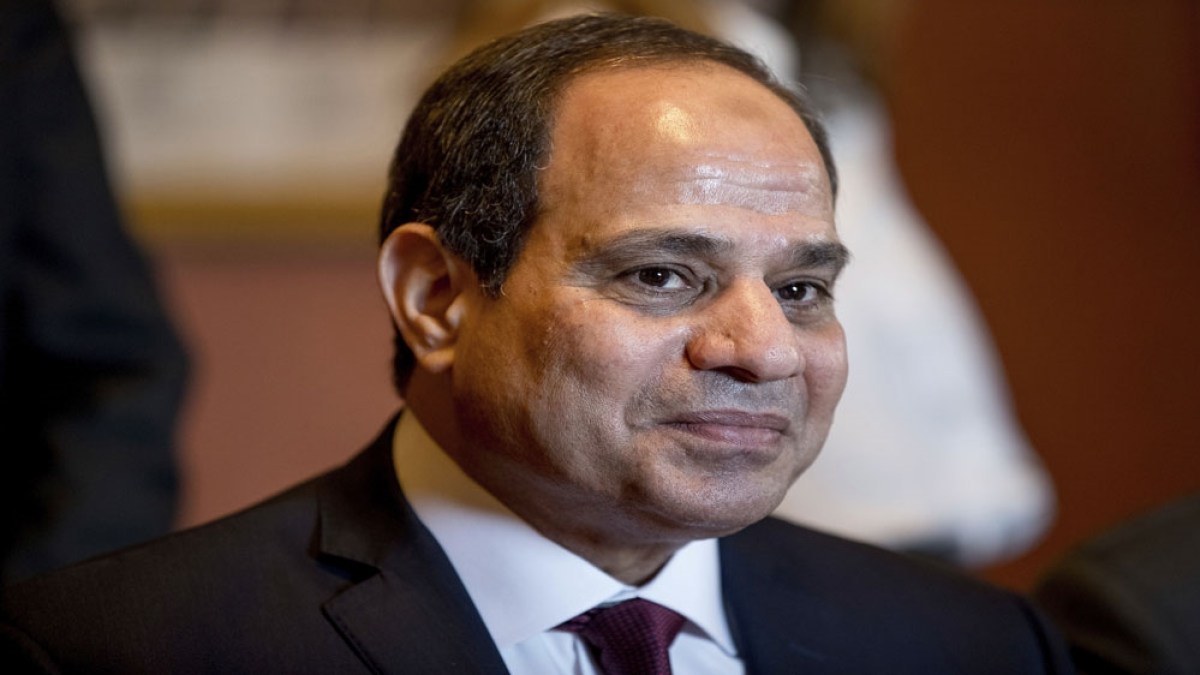
                  The Field Marshal who toppled Egypt's first democratically elected president.


                  Morsi's political ineptitude and increasingly authoritarian ruling style are largely to blame for this outcome. For example, in November 2012 Morsi effectively declared his decrees immune from judicial review after the judiciary thwarted his attempts at much needed political reform. While the judiciary was filled with appointees from the previous regime, this act was greeted with outrage in a country with a tradition of relative judicial independence.


                  Rather than using the bully pulpit to make his case, Morsi did little to win over the public, which feared this was a signal that the MB would circumvent the rule of law to achieve its goals. Had Mr. Morsi a sliver of political charisma, or surrounded himself with competent political advisors, he might have been able to confront the judiciary with more success. Instead he continued with astonishing blunders such as appointing to the governorship of Luxor a member of al-Gama'a al-Islamiyya, the militant group responsible for massacring dozens of foreign tourists there in 1997.


                  There were two areas where Morsi and the MB seemed uniquely qualified to succeed but have failed: provision of social services and security sector reform.

                  The Field Marshal who toppled Egypt's first democratically elected president.

                  Comment


                  • #54
                    Mixing politics and religion

                    One awaits the time when Narendra Modi will also join the march to reinforce the link between politics and religion — a dangerous mixture, which always results in destruction.

                    Comment

                    Working...
                    X