
 Tweet
Tweet
Scientists and engineers seek to meet three goals in the production of biofuels from non-edible sources such as microalgae: efficiency, economical production and ecological sustainability. Syracuse University's Radhakrishna Sureshkumar, professor and chair of biomedical and chemical engineering in the L.C. Smith College of Engineering and Computer Science, and SU chemical engineering Ph.D. student Satvik Wani have uncovered a process that is a promising step toward accomplishing these three goals.
Sureshkumar and Wani have discovered a method to make algae, which can be used in the production of biofuels, grow faster by manipulating light particles through the use of nanobiotechnology. By creating accelerated photosynthesis, algae will grow faster with minimal change in the ecological resources required. This method was published in Applied Physics Letters and recently highlighted in the journal Nature.
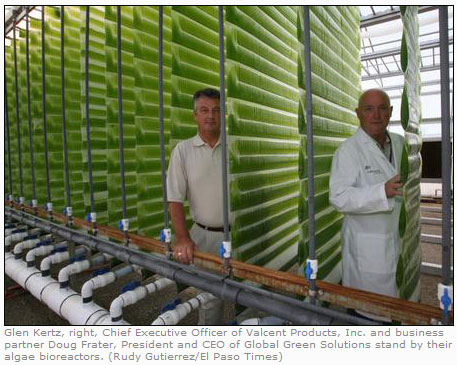
The SU team has developed a new bioreactor that can enhance algae growth. They accomplished this by utilizing nanoparticles that selectively scatter blue light, promoting algae metabolism. When the optimal combination of light and confined nanoparticle suspension configuration was used, the team was able to achieve growth enhancement of an algae sample of greater than 30 percent as compared to a control.
"Algae produce triglycerides, which consist of fatty acids and glycerin. The fatty acids can be turned into biodiesel while the glycerin is a valuable byproduct," says Sureshkumar. "Molecular biologists are actively seeking ways to engineer optimal algae strains for biofuel production. Enhancing the phototropic growth rate of such optimal organisms translates to increased productivity in harvesting the feedstock."
The process involved the creation of a miniature bioreactor that consisted of a petri dish of a strain of green algae (Chlamydomonas reinhardtii) on top of another dish containing a suspension of silver nanoparticles that served to backscatter blue light into the algae culture. Through model-guided experimentation, the team discovered that by varying the concentration and size of the nanoparticle solution they could manipulate the intensity and frequency of the light source, thereby achieving an optimal wavelength for algal growth.
"Implementation of easily tunable wavelength specific backscattering on larger scales still remains a challenge, but its realization will have a substantial impact on the efficient harvesting of phototrophic microorganisms and reducing parasitic growth," says Sureshkumar. "Devices that can convert light not utilized by the algae into the useful blue spectral regime can also be envisioned."
To date, this is one of the first explorations into utilizing nanobiotechnology to promote microalgal growth. The acceleration in the growth rate of algae also had numerous benefits outside the area of biofuel production. Sureshkumar and Wani will be looking to employ this discovery to further their research in creating environmental sensors for ecological warning systems.
http://www.sciencedaily.com/releases...0824171624.htm
Sureshkumar and Wani have discovered a method to make algae, which can be used in the production of biofuels, grow faster by manipulating light particles through the use of nanobiotechnology. By creating accelerated photosynthesis, algae will grow faster with minimal change in the ecological resources required. This method was published in Applied Physics Letters and recently highlighted in the journal Nature.
The SU team has developed a new bioreactor that can enhance algae growth. They accomplished this by utilizing nanoparticles that selectively scatter blue light, promoting algae metabolism. When the optimal combination of light and confined nanoparticle suspension configuration was used, the team was able to achieve growth enhancement of an algae sample of greater than 30 percent as compared to a control.
"Algae produce triglycerides, which consist of fatty acids and glycerin. The fatty acids can be turned into biodiesel while the glycerin is a valuable byproduct," says Sureshkumar. "Molecular biologists are actively seeking ways to engineer optimal algae strains for biofuel production. Enhancing the phototropic growth rate of such optimal organisms translates to increased productivity in harvesting the feedstock."
The process involved the creation of a miniature bioreactor that consisted of a petri dish of a strain of green algae (Chlamydomonas reinhardtii) on top of another dish containing a suspension of silver nanoparticles that served to backscatter blue light into the algae culture. Through model-guided experimentation, the team discovered that by varying the concentration and size of the nanoparticle solution they could manipulate the intensity and frequency of the light source, thereby achieving an optimal wavelength for algal growth.
"Implementation of easily tunable wavelength specific backscattering on larger scales still remains a challenge, but its realization will have a substantial impact on the efficient harvesting of phototrophic microorganisms and reducing parasitic growth," says Sureshkumar. "Devices that can convert light not utilized by the algae into the useful blue spectral regime can also be envisioned."
To date, this is one of the first explorations into utilizing nanobiotechnology to promote microalgal growth. The acceleration in the growth rate of algae also had numerous benefits outside the area of biofuel production. Sureshkumar and Wani will be looking to employ this discovery to further their research in creating environmental sensors for ecological warning systems.
http://www.sciencedaily.com/releases...0824171624.htm





Comment