Announcement

Collapse
No announcement yet.

Scientists On QURAN

Collapse
X
 
  • Filter
  • Time
  • Show
Clear All
new posts

  • Scientists On QURAN

    Think Tank of Pakistan,Pakistan's Think tank,ThinkTank of Pakistan,Voice forum of Pakistan,Pakistan's Voice forum, help us to build the biggest and independent think tank of Islamic Republic of Pakistan,History of Pakistan,Pakistan's history, informative links,Pakistan's Links, all you want to know about Pakistan all on one site


    Post date: 30/Jul/2013 Views: 75 Replies: 0 Author Page Forum Page Share with Friend Post Comment

    Scientists on the Qur'aan


    Keith L. Moore
    Professor Emeritus, Department of Anatomy and Cell Biology, University of Toronto. Distinguished embryologist and the author of several medical textbooks, including Clinically Oriented Anatomy (3rd Edition) and The Developing Human (5th Edition, with T.V.N. Persaud).

    Dr. Moore was a former President of the Canadian Association of Anatomists, and of the American Association of Clinical Anatomists. He was honoured by the Canadian Association of Anatomists with the prestigious J.C.B. Grant Award and in 1994 he received the Honoured Member Award of the American Association of Clinical Anatomists "for outstanding contributions to the field of clinical anatomy."

    "For the past three years, I have worked with the Embryology Committee of King Abdulaziz University in Jeddah, Saudi Arabia, helping them to interpret the many statements in the Qur'an and Sunnah referring to human reproduction and prenatal development. At first I was astonished by the accuracy of the statements that were recorded in the 7thcentury AD, before the science of embryology was established. Although I was aware of the glorious history of Muslim scientists in the 10th century AD, and some of their contributions to Medicine, I knew nothing about the religious facts and beliefs contained in the Qur'an and Sunnah."[2]

    At a conference in Cairo he presented a research paper and stated:

    "It has been a great pleasure for me to help clarify statements in the Qur'an about human development. It is clear to me that these statements must have come to Muhammad from God, or Allah, because most of this knowledge was not discovered until many centuries later. This proves to me that Muhammad must have been a messenger of God, or Allah." [1]

    Professor Moore also stated that:

    "...Because the staging of human embryos is complex, owing to the continuous process of change during development, it is proposed that a new system of classification could be developed using the terms mentioned in the Qur'an and Sunnah. The proposed system is simple, comprehensive, and conforms with present embryological knowledge.

    "The intensive studies of the Qur'an and Hadith in the last four years have revealed a system of classifying human embryos that is amazing since it was recorded in the seventh century A.D... the descriptions in the Qur'an cannot be based on scientific knowledge in the seventh century..."[1]


    E. Marshall Johnson

    Professor and Chairman of the Department of Anatomy and Developmental Biology, and Director of the Daniel Baugh Institute, Thomas Jefferson University, Philadelphia, Pennsylvania, USA.

    Author of over 200 publications. Former President of the Teratology Society among other accomplishments. Professor Johnson began to take an interest in the scientific signs in the Qur'an at the 7th Saudi Medical Conference (1982), when a special committee was formed to investigate scientific signs in the Qur'an and Hadith. At first, Professor Johnson refused to accept the existence of such verses in the Qur'an and Hadith. But after a dicussuion with Sheikh Zindani he took an interest and concentrated his research on the internal as well as external development of the fetus.

    "...in summary, the Qur'an describes not only the development of external form, but emphasises also the internal stages, the stages inside the embryo, of its creation and development, emphasising major events recognised by contemporary science."

    "As a scientist, I can only deal with things which I can specifically see. I can understand embryology and developmental biology. I can understand the words that are translated to me from the Qur'an. As I gave the example before, if I were to transpose myself into that era, knowing what I do today and describing things, I could not describe the things that were described...

    I see no evidence to refute the concept that this individual Muhammad had to be developing this information from some place... so I see nothing here in conflict with the concept that divine intervention was involved in what he was able to write..." [1]


    T.V.N. Persaud

    Professor of Anatomy, and Professor of Paediatrics and Child Health, University of Manitoba, Winnipeg, Manitoba, Canada.

    Author and editor of over 20 books, and has published over 181 scientific papers. Co-author of The Developing Human (5th Edition, with Keith L. Moore).He received the J.C.B. Grant Award in 1991. Professor Peraud presented several research papers.

    "It seems to me that Muhammad was a very ordinary man, he couldn't read, didn't know how to write, in fact he was an illiterate...

    We're talking about 1400 years ago, you have some illiterate person making profound statements that are amazingly accurate, of a scientific nature...

    I personally can't see how this could be mere chance, there are too many accuracies and like Dr. Moore, I have no difficulty in my mind reconciling that this is a divine inspiration or revelation which lead him to these statements." [1]


    Joe Leigh Simpson
    Professor and Chairman of the Department of Obstetrics and Gynaecology, Baylor College of Medicine, Houston, Texas, USA.

    He is the President of the American Fertility Society. He has received many awards, including theAssociation of Professors of Obstetrics and Gynaecology Public Recognition Award in 1992. Like many others, Professor Simpson was taken by surprise when he discovered that the Qur'an and Hadith contain verses related to his specialised field of study. When he met with Sheikh Abdul-Majeed A.Zindani, he insisted on verifying the text presented to him from the Qur'an and Hadith.

    "... these Hadiths (sayings of Muhammad) could not have been obtained on the basis of the scientific knowledge that was available at the time of the 'writer'... It follows that not only is there no conflict between genetics and religion (Islam) but in fact religion (Islam) may guide science by adding revelation to some of the traditional scientific approaches... There exist statements in the Qur'an shown centuries later to be valid which support knowledge in the Qur'an having been derived from God." [1]


    Gerald C. Goeringer

    Professor and Co-ordinator of Medical Embryology in the Department of Cell Biology, School of Medicine, Georgetown University, Washington DC, USA.

    Sheikh Abdul-Majeed A.Zindani met with Professor Goeringer and asked him whether in the history of embryology was there any mention of the different stages of embryonic development, or whether there existed any embryological texts at the time of the Prophet. Sheikh Zindani also asked his opinion regarding the terms the Qur'an uses to describe the different phases of fetal development. After several long discussions, he presented a study at the 8th Saudi Medical Conference:

    "...In a relatively few ayahs (Qur'anic verses) is contained a rather comprehensive description of human development from the time of commingling of the gametes through organogenesis. No such distinct and complete record of human development such as classification, terminology, and description existed previously. In most, if not all instances, this description antedates by many centuries the recording of the various stages of human embryonic and fetal development recorded in the traditional scientific literature." [1]


    Alfred Kroner

    Professor of the Department of Geosciences, University of Mainz, Germany.
    Professor Kroner is one of the world's most famous geologists, becoming well known among his colleague scientists for his criticisms against the theories of some of the major scientists in his field. Sheikh Abdul-Majeed A. Zindani met with him and presented several Qur'anic verses and Hadith which he studied and commented upon.

    "Thinking where Muhammad came from... I think it is almost impossible that he could have known about things like the common origin of the universe, because scientists have only found out within the last few years with very complicated and advanced technological methods that this is the case."

    "Somebody who did not know something about nuclear physics 1400 years ago could not, I think, be in a position to find out from his own mind for instance that the earth and the heavens had the same origin, or many others of the questions that we have discussed here...

    If you combine all these and you combine all these statements that are being made in the Qur'an in terms that relate to the earth and the formation of the earth and science in general, you can basically say that statements made there in many ways are true, they can now be confirmed by scientific methods, and in a way, you can say that the Qur'an is a simple science text book for the simple man. And that many of the statements made in there at that time could not be proven, but that modern scientific methods are now in a position to prove what Muhammad said 1400 years ago." [1]


    Yushidi Kusan

    Director of the Tokyo Observatory, Tokyo, Japan.
    Sheikh Abdul-Majeed A. Zindani presented a number of Qur'anic verses describing the beginnings of the universe and of the heavens, and the relationship of the earth to the heavens. He expressed his astonishment, saying that the Qur'an describes the universe as seen from the highest observation point, everything is distinct and clear.

    "I say, I am very much impressed by finding true astronomical facts in Qur'an, and for us modern astronomers have been studying very small piece of the universe. We have concentrated our efforts for understanding of very small part. Because by using telescopes, we can see only very few parts of the sky without thinking about the whole universe. So by reading Qur'an and by answering to the questions, I think I can find my future way for investigation of the universe." [1]


    Professor Armstrong

    Professor Armstrong works for NASA and is also Professor of Astronomy, University of Kansas, Lawrence, Kansas, USA.

    Prof. Armstrong was asked a number of questions about Qur'anic verses dealing with his field of specialisation. He was eventually asked, "You have seen and discovered for yourself the true nature of modern Astronomy by means of modern equipment, rockets, and satellites developed by man. You have also seen how the same facts were mentioned by the Qur'an fourteen centuries ago. So what is your opinion?"

    "That is a difficult question which I have been thinking about since our discussion here. I am impressed at how remarkably some of the ancient writings seem to correspond to modern and recent Astronomy. I am not a sufficient scholar of human history to project myself completely and reliably into the circumstances that 1400 years ago would have prevailed.
    Certainly, I would like to leave it at that, that what we have seen is remarkable, it may or may not admit of scientific explanation, there may well have to be something beyond what we understand as ordinary human experience to account for the writings that we have seen." [1]


    William Hay

    Professor of Oceanogprahy, University of Colorado, Boulder, Colorado, USA.
    Professor Hay is one of the best known marine scientist in the USA. Sheikh Abdul-Majeed A. Zindani met with him and asked him many questions about the marine surface, the divider between upper and lower sea, and about the ocean floor and marine geology.

    "I find it very interesting that this sort of information is in the ancient scriptures of the Holy Qur'an, and I have no way of knowing where they would have come from. But I think it is extremely interesting that they are there and this work is going on to discover it, the meaning of some of the passages."

    And when he was asked about the source of the Qur'an, he replied, "Well, I would think it must be the divine being." [1]


    Durja Rao
    Professor of Marine Geology teaching at King Abdulaziz University, Jeddah, Saudi Arabia.
    Sheikh Zindani presented to Prof. Rao many verses dealing with his area of specialisation, and asked: "What do you think of the existence of the scientific information in the Qur'an? How could Prophet Muhammad(Peace be upon him) have known about these facts fourteen centuries ago?"

    "It is difficult to imagine that this type of knowledge was existing at that time, around 1400 years back. May be some of the things they have simple idea about, but to describe those things in great detail is very difficult. So this is definitely not simple human knowledge. A normal human being cannot explain this phenomenon in that much detail. So, I thought the information must have come from a supernatural source." [1]


    Tejatat Tejasen

    Chairman of the Department of Anatomy and is the former Dean of the faculty of Medicine, University of Chiang Mai, Chiang Mai, Thailand
    Professor Tejasen studied various articles concerning the Qur'an and modern embryology. He spent four days with several scholars, Muslims and non-Muslims, discussing this phenomenon in the Qur'an and Hadith. During the 8th Saudi Medical Conference in Riyadh, Saudi Arabia he stood up and said:


    "In the last three years, I became interested in the Qur'an... From my studies and what I have learned throughout this conference, I believe that everything that has been recorded in the Qur'an fourteen hundred years ago must be the truth, that can be proved by the scientific means.

    Since the Prophet Muhammad could neither read nor write, Muhammad must be a messenger who relayed this truth which was revealed to him as an enlightenment by the one who is eligible creator. This creator must be God, or Allah.

    I think this is the time to say La ilaha illa Allah, there is no god to worship except Allah (God), Muhammad rasoolu Allah, Muhammad is Messenger of Allah...

    The most precious thing I have gained from coming to this conference is La ilaha illa Allah, and to have become Muslim." [1]


    Dr. Maurice Bucaille

    Born in 1920, former chief of the Surgical Clinic, University of Paris, has for a long time deeply interested in the correspondences between the teachings of the Holy Scriptures and modern secular knowledge.
    He is the author of a best-seller, "The Bible, The Qur'an and Science" (1976). His classical studies of the scriptural languages, including Arabic, in association with his knowledge of hieroglyphics, have allowed him to hold a multidisciplinary inquiry, in which his personal contribution as a medical doctor has produced conclusive arguments. His work, "Mummies of the Pharaohs - Modern Medical Investigations" (St. Martins Press, 1990), won a History Prize from the Académie Française and another prize from the French National Academy of Medicine.

    His other works include: "What is the Origin of Man" (Seghers, 1988), "Moses and Pharaoh, the Hebrews in Egypt", (NTT Mediascope Inc, 1994); and "Réflexions sur le Coran" (Mohamed Talbi & Maurice Bucaille, Seghers, 1989)

    After a study which lasted ten years, Dr. Maurice Bucaille addressed the French Academy of Medicine in 1976 concerning the existence in the Qur'an of certain statements concerning physiology and reproduction. His reason for doing that was that :

    "...our knowledge of these disciplines is such, that it is impossible to explain how a text produced at the time of the Qur'an could have contained ideas that have only been discovered in modern times."

    "The above observation makes the hypothesis advanced by those who see Muhammad as the author of the Qur'an untenable. How could a man, from being illiterate, become the most important author, in terms of literary merits, in the whole of Arabic literature?

    How could he then pronounce truths of a scientific nature that no other human-being could possibly have developed at that time, and all this without once making the slightest error in his pronouncement on the subject?"

  • #2
    If Scientists believe in the accuracy of scientific statements made in the Quran, why is it still so hard for Muslims to accept scientifically sound arguments for evolution?

    Comment


    • #3
      Originally posted by Midnight_Sun View Post
      If Scientists believe in the accuracy of scientific statements made in the Quran, why is it still so hard for Muslims to accept scientifically sound arguments for evolution?
      Because Muslims do not believe in science. We believe in Quran & Sunnah.

      Nobody is expected to enter Islam just because some scientists claims there are scientifically accurate things mentioned in Quran.

      Some people think that we should conform to everything scientists claim. 100 years ago, evolution theory made people think Africans are stupid and inferior to whites. Back then that was what scientists believe is accurate. Today, they no longer believe this to be true.

      Scientists claimed that homosexuality is a disease. Today they no longer say so. But rather they claim it is something that is in the genes.

      Scientists claimed so many things at one point and their claims were perceived as scientific facts. But after a while they discovered something else and suddenly they changed their views.

      Should we Muslims adjust our beliefs every time scientists come up with a new story?
      Originally posted by Firdousi
      Never talk with Afghans about politics. All their political knowledge is limited to conspiracy theories, political demonization and contradictions. No logic, no reason.

      Comment


      • #4
        science presents everything as a theory first. No matter how sure of a fact they are, they encourage and reward you to question it and come forward with evidence. That is the beauty of science. No body gets stoned for suggesting something that is not already believed. Religion forbids you from doing just that and requires blind faith.

        Science is not a religion, stop comparing it to one. Know what a ****ing "theory" means.

        "To burn always with this hard gemlike flame, to maintain this ecstasy, is success in life."


        Comment


        • #5
          1) People that have questioned science have been murdered in 10's of millions.

          2) Islam doesn't stone people for suggesting things that are not already believed, which is what you are indirectly implying.

          Cheers
          ----------

          *You cannot climb the ladder of success with your hands in your pockets*

          Originally posted by Karachi
          like I said, there was only one reason I pretended to be pathan, for a girl, who was from Afghan forums and also registered here

          Comment


          • #6
            It seems that some of the scientists above gave the statements to please Saudi Salafi dictators as they were working in their universities paid by them. How a scientist can confuse religion with science!

            The so called embryology of Qur'an is the traditional approach of creationism and genesis in a bit detail. But all this is religious and not scientific. Many scientists like Greeks and Babylons also described such kind of developments of human embryo. This is not unique of Quran.

            Religiously the information is correct but scientifically there are errors. Please see the following pages although this may be a religious propaganda but who can refute the facts given there!


            Muhammad borrowed his embryology "science" from the Babylonian Enuma Elish tablet: Enuma Elish: Babylonian pagan creation story and the Koran. What is notable is that Muhammad obviously borrowed the pagan myth that God created man from a "drop of blood" directly from the 6th tablet of the Enuma Elish creation story.

            In an effort to show the scientific accuracy of the Koran, Muslim's are quick to bring up the claim of embryology revealed in stunning accuracy, before man discovered for himself. Muslims love to tell the story of how professor Keith L. Moore, the former anatomist at the University of Toronto, was impressed with the Koran's embryological information.
            However many Muslim are completely unaware that all of the information in the Qur'an about embryology had already been revealed many different times, centuries before hand. Furthermore, some of the information is scientifically inaccurate.


            And what about professor Keith L. Moore, once at the University of Toronto, who Muslims love to quote as a scientist who saw the light of the Koran? If you buy Moore's latest sixth edition University textbook called "The developing human", he actually directs his readers to read an essay by Basim Musallam, who we just quoted. who shows that the Koran merely echoes what Greek doctor "Galen" wrote 450 years earlier. It seems Dr. Moore is not as impressed today. (B. Musallam, The human embryo in Arabic scientific and religious thought, in, G. R. Dunstan (ed.) (University of Exeter Press, 1990) The human embryo: Aristotle and the Arabic and European traditions, pp. 32-46)


            Bones Before Muscle? The Koran got it wrong!
            Keith L. Moore knows that the Koran is wrong when it says that bones are formed first, then flesh is placed upon them.
            "Look further at the bones, how We bring them together and clothe them with flesh ..." (Al-Baqara 2:259)

            Galen - On Semen
            Galen says, "The substance from which the fetus is formed is not merely menstrual blood, as Aristotle maintained, but menstrual blood plus the two semens." p 50.
            The Qur'an agrees with Galen here when it says in Sura 76:2, "We created man from a drop of mingled sperm."

            Last edited by Badlun; 08-04-2013, 02:33 AM.

            Comment


            • #7
              Can any one refute the discussion on this page? Is there any Muslim scientist inspired from Quran and got some new research and invention?

              A comparison of the early human development as stated in the Qur'an, modern science and the ancient medical works of Hippocrates, Galen, Aristotle etc.


              Embryology in the Qur'an


              In the early 1980s, Prof. Keith Moore, formerly an anatomist at the University of Toronto, Canada produced a special edition of his embryology textbook, the standard version of which has been widely used in medical schools around the world. Apparently when he first read what the Qur'an had to say about the development of the human embryo he was "astonished by the accuracy of the statements that were recorded in the 7th century AD, before the science of embryology was established"[1]. Much has subsequently been written by Muslims in an attempt to demonstrate that the Qur'an, which is claimed to be God's ultimate revelation contains statements about how humans develop inside the womb which could not possibly have been known at the time that it was revealed to Muhammed. Indeed, a recent book confirms the extent to which this has been happening:
              Dubai's medical school recently introduced a compulsory course for all students: Islamic Medicine. The program seeks to link all modern medicine, including genetics, to the Koran. Such courses have their genesis in orthodox Saudi Arabia. The Saudis have spent considerable sums on medical conferences at which leading Western scientists are asked to confirm that Koranic verses, which seem vague to the layperson, are in fact specific predictors of modern science. Videos and pamphlets from the conferences have been circulated throughout the Muslim world by the Saudis [2].
              If it is indeed true that certain verses accurately foretell modern scientific ideas which could not be tested in the seventh century, then it implies that the Qur'an must have had a divine author. It is the intention of this paper to examine what exactly was known about the human embryo at the time of Muhammed in order to see whether any of the theories expressed in the Qur'an were true or indeed well known before this time.

              The origins of life according to the Qur'an

              There are at least 60 verses which deal explicitly with human reproduction and development, but these are scattered throughout the Qur'an and many of the themes are repeated over and over again, as is common to much of the book. A useful place to begin would be the material out of which we are created. One would expect the Qur'an to be unambiguous about such an elementary matter, but the verses listed show just how much uncertainty there appears to be in our origins. Note that except where indicated the translation used is the translation of Yusuf Ali (Saudi Revised Edition).
              Could it be from earth?
              11:61 It is He Who hath produced you from the earth
              Or dry clay (Arabic Salsaal)?
              15:26,28,33 We created man from sounding clay
              17:61 ... Thou didst create from clay
              32:7 He began the creation of man from clay
              Did we come from nothing?
              19:67 We created him before out of nothing
              No, we did not!
              52:35 Were they created of nothing?
              Did we come from mud?
              23:12 We created man from a product of wet earth (loam) (Pickthall)
              23:12 Man We did create from a quintessence (of clay)
              38:71 I am about to create a mortal out of mire
              Or water?
              25:54 It is He Who has created man from water (see also 21:30, 24:45)
              Could it be dust?
              3:59 He created (Jesus) out of dust
              30:20 He created you from dust
              35:11 Allah did create you from dust ....
              Perhaps we arose from the dead or from one person?
              30:19 It is He who brings out the living from the dead
              39:6 He created you from a single Person (see also 4:1)
              To resolve the considerable ambiguity about what exactly we are made of, it has been suggested that all of the above are complimentary accounts, in the same way that a loaf of bread could be said to be made of dough, flour, carbohydrate or molecules. This evades the issue however. The metaphorical description of God making man out of the dust of the earth is ancient and predates the Qur'an by thousands of years; it is found in the Bible in Genesis 2:7. If this was literal it would be in direct scientific conflict with evolutionists who maintain that life was created out of the oceans, but Muslims maintain that we were created both from the oceans and from earth.

              The drop of fluid or semen

              In a number of places we are informed that man is created from a drop of fluid (semen, seed or sperm):
              16:4 He created man from a drop of fluid (Pickthall)
              16:4 He has created man from a sperm-drop
              32:8 He made his seed from a quintessence of despised fluid
              35:11 ... then from a little fluid (Pickthall)
              53:46 (he created) from a drop of seed when it is poured forth (Pickthall)
              53:46 From a sperm-drop when lodged (in its place)
              56:58 Have ye seen that which ye emit (Pickthall)
              56:58 Do you then see? The (human Seed) that ye emit
              75:37 Was he not a drop of fluid which gushed forth (Pickthall)
              75:37 Was he not a drop of sperm emitted (in lowly form)?
              76:2 We create man from a drop of thickened fluid (Pickthall)
              76:2 We created Man from a drop of mingled sperm
              77:20 Did We not create you from a worthless water (semen, etc.)? (Al-Hilali & Khan)
              80:19 From a sperm-drop He hath created him
              86:6-7 He is created from a drop emitted - proceeding from between the backbone and the ribs.
              Could any of this have been known to sixth-century Muslims at the time of Muhammed? Surely that procreation involves the emission of a drop of fluid has been well known from the earliest days of civilization. In Genesis 38:9 the Bible tells us that Onan "spilled his semen on the ground to keep from producing offspring for his brother". The verses which describe the origin of life as a drop of emitted fluid are therefore no more than a direct observation as to what is released during the act of sexual intercourse. We hardly need to rely upon divine inspiration to inform us of this fact.
              In the verses listed above nutfah is used when describing the fluid which gushes out during sexual intercourse and clearly this can only refer to semen. However, Prof. Moore is keen to translate nutfah in sura 76:2 as "mingled fluid" [3] and explains that this Arabic term refers to the male and female fluids which contain the gametes (male sperm and female egg). While it is true that the ancient Greeks would not have been able to see individual sperm or eggs, these only being visible through the microscope, the Qur'an emphatically does not mention sperm or eggs; it simply says nutfah. This can reasonably be translated semen, or at a push, germinal fluid - which was a term used as early as Hippocrates [4] who spoke of male and female reproductive fluids (but obviously could not have been aware of the cells contained in the fluids). If Moore wishes to translate nutfah as germinal fluid, he inadvertently reinforces that the Qur'an is borrowing this term from the Greeks.
              Sura 86:6 is interesting since it claims that during the act of sexual intercourse before which a man is created, the "gushing fluid" or semen issues from between the loins and ribs. Semen is apparently coming out of the area around the kidneys and back, which is a real problem for we know that the testicles are the sites of sperm production (although the ancient Greeks were not so convinced. Aristotle for example amusingly believed that they functioned as weights to keep the seminal passages open during sexual intercourse [5]).
              The explanation offered by Muslims [6] for the strange statement in this sura relates to the fact that the testicles originally develop from tissue in the area of the kidneys, when the man from whom sperm is gushing forth was himself an embryo. In other words, in a very convoluted fashion the sperm originates from the area between the loins and ribs because that is where the testicles which are producing the sperm originally form.
              There is a rather less complicated explanation for this verse however. The Greek physician Hippocrates and his followers taught in the fifth century BC that semen comes from all the fluid in the body, diffusing from the brain into the spinal marrow, before passing through the kidneys and via the testicles into the penis [7]. Clearly according to this view sperm originates from the region of the kidneys, and although there is obviously no substance to this teaching today, it was well-known in Muhammed's day, and shows how the Qur'an could contain such an erroneous statement.

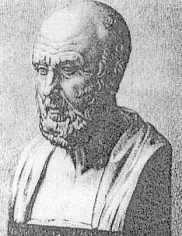
              A bust of Hippocrates
              Of course it could be argued against all this that the reference to coming from the loins is merely a metaphorical figure of speech. We can find examples of this in sura 7:172 "when thy Lord drew forth from the Children of Adam - from their loins - their descendants" or 4:23 "prohibited to you (for marriage) are ... wives of your sons proceeding from your loins". But if so then it has to be accepted that this is a common usage for Middle Eastern cultures [8]; in the Torah God promises Jacob that "kings shall come out of your loins (chalatzecha)" (Gen 35:11). Later in the Bible a promise is made to David's "son that shall come forth out of your loins" (I Kings 8:19) and in the New Testament Peter refers to the same person as "one from the fruit of his loins" (Greek osphus). However, these are examples of a metaphorical use of the word "loins" (Arabic sulb). Sura 86:6 is clearly talking about the physical act of intercourse; gushing fluid and ribs (tar a'ib) are both very physical and in the context of this verse they clearly refer to the site of semen production as wrongly taught by Hippocrates. So we have found the first example of an incorrect ancient Greek idea re-emerging in the Qur'an.

              Embryological development in the Qur'an

              Sura 22:5 says "We created you out of dust, then out of sperm, then out of a leech-like clot, then from a morsel of flesh, partly formed and partly unformed ... and We cause whom We will to rest in the wombs for an appointed term, then do We bring you out as babes." Sura 23:13-14 repeats this idea by saying God "placed him as (a drop of) sperm (nutfah) in a place of rest, firmly fixed; then We made the sperm into a clot of congealed blood (alaqa); then out of that clot We made a (foetus) lump (mudghah), then We made out of that lump bones and clothed the bones with flesh; then We developed out of it another creature." 75:38 also says man becomes an alaqa and 96:2 says we came from alaq.
              Moore however goes further and incredibly he claims in a later edition of his textbook that the Qur'an "states that the resulting organism settles in the womb like a seed, 6 days after its beginning" [9]. This really would be amazing if it was true. Actually the Qur'an says nothing of the sort.
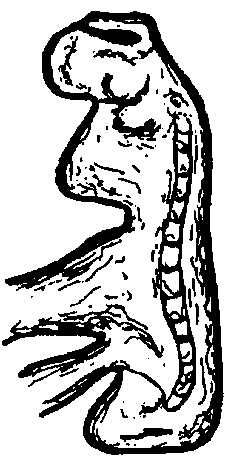
              We have to ask what the precise meaning of these words is in order to know whether the verses contain important scientific statements that have only recently been discovered, as Moore and others claim. In comparison with the meaning of nutfah, it is rather more difficult to understand what alaqa means. Many different suggestions have been made: clot (Pickthall, Maulana Muhammed Ali, Muhammed Zafrulla Khan, Hamidullah), small lump of blood (Kasimirski), leech-like clot (Yusuf Ali), and "leech, suspended thing or blood clot" (Moore, op. cit.). Moore suggests that the appearance of an embryo of 24 days' gestation resembles a leech, though this is rather debatable. In side view the developing umbilicus (genetically part of the embryo) is almost as big as the "leech-shaped" part into which a human is formed and the developing placenta (which also consists of tissue that is genetically from the embryo) is much larger than the embryo. It is claimed that the ancient sages would not have been able to see an embryo about 3mm long and describe it as leech-like, but Aristotle correctly described the function of the umbilical cord, by which the embryo "clings" to the uterus wall in the fourth century B.C. [10]. It is impossible to believe the suggestion of Bachir Torki [11] that alaq in 96:2 means links, referring to the gene code of DNA, as this makes a nonsense out of other verses where the word is used, such as 22:5 ("we made you from a drop of sperm, then from that a gene code, then from that a little lump of flesh....").

              A 24/25 day embryo at the alaqa stage, approx. 2 mm long
              To establish a definition for alaqa we might take a look at the Qamus al-Muheet, one of the most important Arabic dictionaries ever compiled, by Muhammed Ibn-Yaqub al-Firuzabadi (AD 1329-1415) [12]. He says that alaqa has the same meaning as a clot of blood. In 96:2 the word alaq is used, which is both a collective plural and a verbal noun. The latter form conveys the sense of man being created from clinging material or possibly clay, which is consistent with the creation of Adam in the Bible from the dust of the ground (Genesis 2:7) and some of the other Qur'anic verses listed above. However, the translators of the Qur'an have all translated alaq as "clot" as opposed to "clinging" in 96:2 because the use of the singular alaqa elsewhere forces them to use "clot" here too, despite the attraction for the meaning "clinging" or leech-like which is perhaps more scientifically accurate.
              Another source of information are the early Muslim commentators. Ibn Kathir wrote that when the drop of water (nutfah) settled in the womb it stayed there for forty days and then became a red clot (alaqa), staying there for another forty days before turning to mudghah, a piece of flesh without shape or form. Finally it began to take on a shape and form. Both ar-Razi and as-Suyuti [13] claimed that the dust referred both to Adam's creation and to the man's discharge; nutfah referred to the water from the male and alaqa was a solidified piece of blood clot. Ibn Qayyim al-Jawziyya (died about AD 1350) wrote that "the foetus is a living or dead babe animal which is sometimes found in the womb of a slaughtered animal, and its blood is congested" [14]. Another great physician, Ibn al-Quff wrote some 13 out of 60 chapters from "On Health Preservation" about embryology and pregnancy. He included a further stage of development one week after conception, the foam stage or raghwah. Up to 16 days the embryo was alaqa (clot) and after 27 to 30 days the clot turns into a lump of meat, mudghah [15]. These dates must be regarded as very approximate but are nevertheless a major improvement on what one of the most reliable Hadiths says about foetal development, as we shall see later.

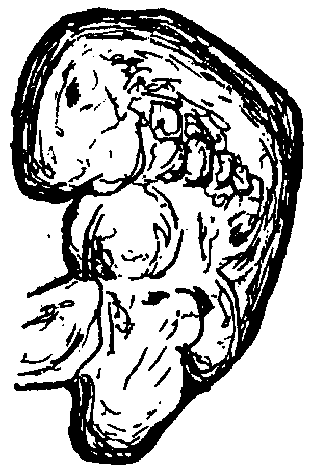
              A 26/27 day embryo, said to resemble a mouthful of flesh, but only 3 mm long
              Moving onto the next stage of development, Razi described the mudghah as being a little piece of meat the size of what a man can chew. The idea that mudghah means chewed flesh is a later, and less accurate translation of the word, but the idea has persisted because it is claimed that the somites from which the backbone and other trunk structures develop bear a passing resemblance to teeth marks implanted in plastercine. It must be said that not only is this an imaginative interpretation however, but besides, Moore cannot claim that the mudghah should occur at 26-27 days since at that point the embryo is a mere 4mm long. One would have to wait around 8 weeks before the embryo was the size of chewed flesh (if a mouthful is defined as being 20-30mm wide), which is what mudghah really means. And in the following Hadith, transmitted by Bukhari and Muslim, Muhammed claims that the mudghah stage occurs between days 80 and 120. Yet by this time the foetus is considerably larger than a lump of flesh the size of which a man can chew, and looks very human-like and totally unlike meat.

              `Abdullah (b. Mas'ud) reported that Allah's Messenger ... said: "Verily your creation is on this wise. The constituents of one of you are collected for forty days in his mother's womb in the form of blood [sperm?], after which it becomes a clot of blood in another period of forty days. Then it becomes a lump of flesh and forty days later Allah sends his angel to it ..."
              Thus according to Muhammed, the drop of sperm remains in the womb for 40 days, then becomes a clot for a further 40 days, then a lump of flesh for 40 days [16]. It has been shown that human sperm can only survive inside a woman's reproductive tract for a maximum of 7 days; at 80 days the embryo has very definitely acquired the shape of a human being and looks nothing like either a clot or a mouthful of flesh.

              An eleven week foetus, real size 7.5 cm, but according to Muhammed still at the alaqa stage, a clot of blood
              The final stage of human development which the Qur'an describes is the creation of bones, and the clothing of bones with flesh. However, according to modern embryologists including Prof. Moore, the tissue from which bone originates, known as mesoderm, is the same tissue as that from which muscle ("flesh") develops [17]. Thus bone and muscles begin to develop simultaneously, rather than sequentially. Whereas however most of the muscle tissue that we have is laid down before birth, bones continue to develop and calcify (strengthen with calcium) right into one's teenage years. So far from bones being clothed with flesh, it would be more accurate if the Qur'an had said that muscles started to develop at the same time as bones, but completed their development earlier. The idea that bones are clothed with flesh is not only scientifically completely false, but is directly copied from the ancient Greek doctor Galen, as we shall see shortly.

              Some possible explanations

              Aristotle believed that humans originated from the action of male semen upon female menstrual blood [18] which leaves us with something of a dilemma. If we translate alaqa as "clot" it means that the Qur'an is completely wrong about human development, since there is absolutely no stage during which the embryo consists of a clot. The only situation in which an embryo might appear like a clot is during a miscarriage, in which case the clotted blood which is seen to emerge (much of which comes from the mother incidentally) is solidified and by definition no longer alive. So if ever an embryo appeared to look like a clot it would never develop any further into a human; it would be a dead mass of bloody miscarrying flesh. Since Muhammed had several wives it is entirely likely that he would be very familiar with miscarriages. Alternatively it could be hinting at Aristotle's incorrect belief that the embryo originated from the combination of male sperm and female menstrual blood.
              Moore avoids this problem by translating alaqa as a leech, since he is well aware that there is no stage in development when the embryo is a clot. As we have seen however, this is only to justify his interpretation that an embryo of 24-25 days is a clinging leech-like alaqa and one at 26-27 days is a mudghah with teeth-marks. A further problem with this view is that if the alaqa is translated "leech" because it appears to be clinging to the uterus wall, does this mean that the foetus only clings to the uterus wall for a few days? Obviously it remains attached for the entire nine months of gestation.
              There are other problems with Moore's interpretation too. Not least is the claim of Muhammed that the dates of the alaqa and mudghah were 40-80 days and 80-120 days of gestation respectively, rather than 24-25 days and 26-27 days. It also begs the question as to why, if the Qur'an really is giving us a highly precise scientific account of human development, it only mentions four stages, nutfah, alaqa, mudghah, plus the clothing of bones with flesh. Between fertilization and day 28 for example Moore lists no fewer than 13 stages in his textbook. Why does the Qur'an say nothing about any of these other stages? The reality is that the more ambiguous the meaning of the Arabic terms, and the more meanings that can be attached to certain words, the less convincingly can they be said to be highly precise scientific terms.
              However, the most convincing explanation, and the most worrying for those who maintain that the Qur'an is God's eternal Word, untampered with and free from any human interference, is that the Qur'an is merely repeating the teaching of the enormously influential Greek physician Galen. If this is the case, not only is the Qur'an wrong, but it also plagiarises ancient Greek literature!

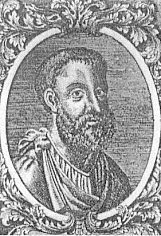
              A picture of Galen


              The Asclepion at Pergamon (modern Bergama in Turkey)
              [Click here for further pictures of this hospital]
              The account of the different stages in embryology as described by the Qur'an, ar-Razi and al-Quff is identical to that taught by Galen, writing in around AD 150 in Pergamum (Bergama in modern Turkey). Galen taught that the embryo developed in four stages as detailed below.
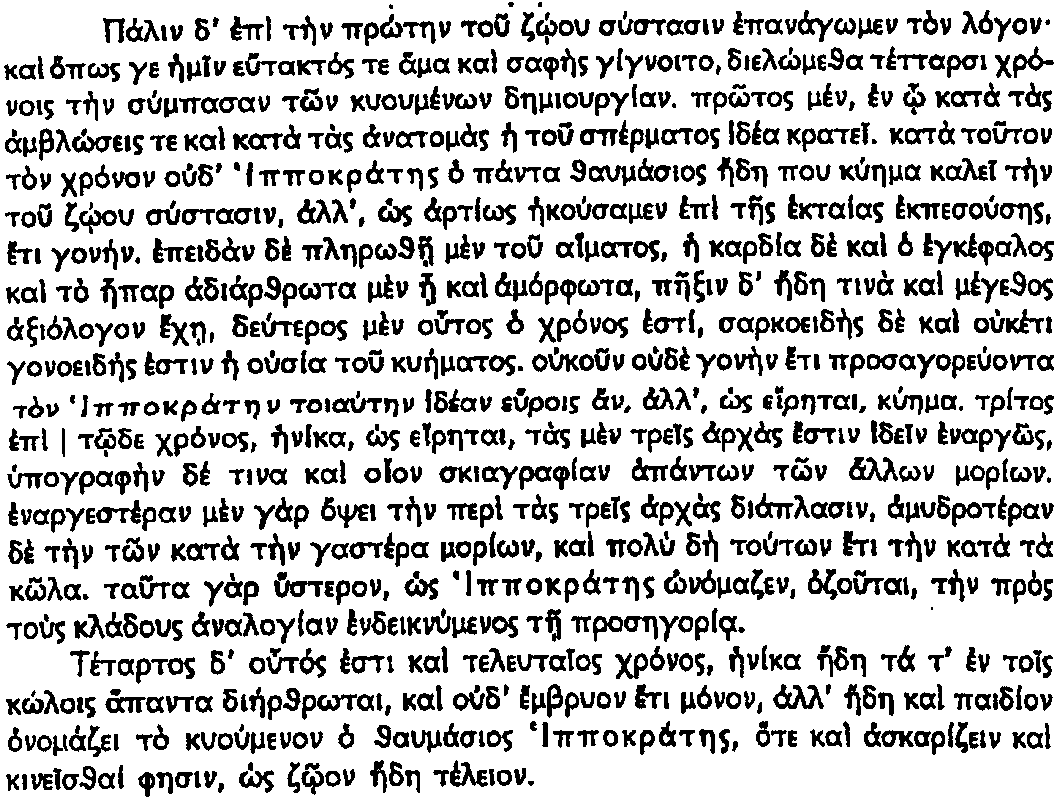
              Galen: De Semine in Greek

              English translation:
              But let us take the account back again to the first conformation of the animal, and in order to make our account orderly and clear, let us divide the creation of the foetus overall into four periods of time. The first is that in which. as is seen both in abortions and in dissection, the form of the semen prevails (Arabic nutfah). At this time, Hippocrates too, the all-marvelous, does not yet call the conformation of the animal a foetus; as we heard just now in the case of semen voided in the sixth day, he still calls it semen. But when it has been filled with blood (Arabic alaqa), and heart, brain and liver are still unarticulated and unshaped yet have by now a certain solidarity and considerable size, this is the second period; the substance of the foetus has the form of flesh and no longer the form of semen. Accordingly you would find that Hippocrates too no longer calls such a form semen but, as was said, foetus. The third period follows on this, when, as was said, it is possible to see the three ruling parts clearly and a kind of outline, a silhouette, as it were, of all the other parts (Arabic mudghah). You will see the conformation of the three ruling parts more clearly, that of the parts of the stomach more dimly, and much more still, that of the limbs. Later on they form "twigs", as Hippocrates expressed it, indicating by the term their similarity to branches. The fourth and final period is at the stage when all the parts in the limbs have been differentiated; and at this part Hippocrates the marvelous no longer calls the foetus an embryo only, but already a child, too when he says that it jerks and moves as an animal now fully formed (Arabic ‘a new creation’) ...
              ... The time has come for nature to articulate the organs precisely and to bring all the parts to completion. Thus it caused flesh to grow on and around all the bones, and at the same time ... it made at the ends of the bones ligaments that bind them to each other, and along their entire length it placed around them on all sides thin membranes, called periosteal, on which it caused flesh to grow [19].

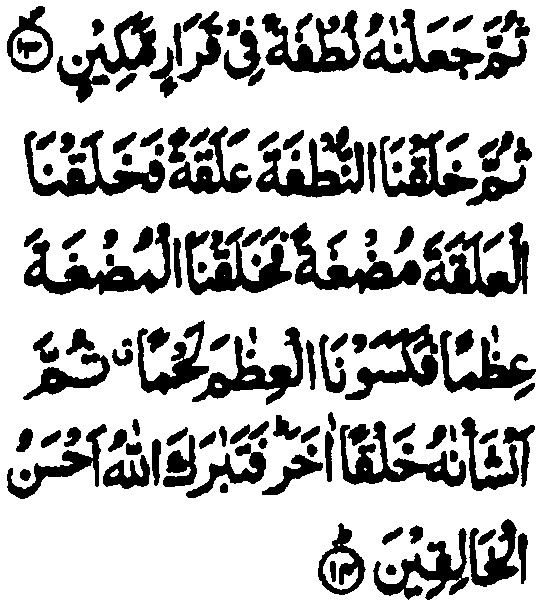
              Qur'an: Sura 23:13-14 in Arabic for comparison

              English translation:
              Thereafter We made him (the offspring of Adam) as a Nutfah (mixed drops of the male and female sexual discharge and lodged it) in a safe lodging (womb of the woman). Then We made the Nutfah into a clot (Alaqa, a piece of thick coagulated blood), then We made the clot into a little lump of flesh (Mudghah), then We made out of that little lump of flesh bones, then We clothed the bones with flesh, and then We brought it forth as another creation. So blessed be Allah, the Best of Creators!
              The first stage, geniture, corresponds to [nutfah], the drop of semen; the second stage, a bloody vascularised foetus with unshaped brain, liver and heart ("when it has been filled with blood") corresponds to [alaqa], the blood clot; the third stage "has the form of flesh" and corresponds to [mudghah], the morsel of chewed flesh. The fourth and final stage, puer, was when all the organs were well formed, joints were freely moveable, and the foetus began to move [20]. If the reader is in any doubt about the clear link being described here between the Galenic and the Qur'anic stages, it may be pointed out that it was early Muslim doctors, including Ibn-Qayyim, who first spotted the similarity. Basim Musallam, Director of the Centre of Middle Eastern Studies at the University of Cambridge concludes
              "The stages of development which the Qur'an and Hadith established for believers agreed perfectly with Galen's scientific account ... There is no doubt that medieval thought appreciated this agreement between the Qur'an and Galen, for Arabic science employed the same Qur'anic terms to describe the Galenic stages" [21].

              Stages of development - a modern idea?

              It has been said that the idea of the embryo developing through stages is a modern one, and that the Qur'an is anticipating modern embryology by depicting differing stages. However many ancient writers besides Galen taught that humans developed in different stages. For example in the Jewish Talmud we learn that the embryo has six stages of development. Samuel ha-Yehudi was a 2nd century Jewish physician, and one of many with an interest in embryology [22]. The embryo was called peri habbetten (fruit of the body) and develops as
              1. golem (formless, rolled-up thing);
              2. shefir meruqqam (embroidered foetus - shefir means amniotic sac);
              3. 'ubbar (something carried);
              4. v'alad (child);
              5. v'alad shel qayama (noble or viable child) and
              6. ben she-kallu chadashav (child whose months have been completed).

              Yet with the benefit of modern science we now know that the formation of a human being is a seamless continuation from conception to birth, hence the reason why there is so much contemporary confusion about abortion and embryo research. For if we develop as a continuous process it is impossible to draw hard-and-fast boundaries about when life starts. This makes a nonsense of the Qur'anic verse which says (71:14) "When He created you by (divers) stages".

              More examples of borrowing from ancient Greek writers

              If we look at what the ancient Greeks taught we can clearly see that all the other references to embryology in the Qur'an and Hadith can also be traced directly back to them. For example there is a Hadith in which Muhammed is questioned about why a group of red camels have a grey camel among them, and it is due to a hidden trait. But Aristotle noticed that babies who were born that looked unlike either of their parents would often take on the appearance of their grandparents [23], so that the characteristic skipped a generation, being what we now know as recessive. He also tells us of a woman from Elis who took a black husband and although their daughter was not black, their daughter's daughter was black, demonstrating a gene which skipped a generation in exactly the same way as Muhammed described [24].
              Another Hadith says "If a male's fluid prevails upon the female's substance, the child will be a male by Allah's decree, and when the substance of the female prevails upon the substance contributed by the male, a female child is formed" [25]. Surely this is not referring to dominant and recessive genes at all, as certain Muslims have claimed [26], but is simply repeating the incorrect belief of Hippocrates that both men and women produce both male and female sperm. The sex of the resulting child is determined by which sperm overwhelms the other in strength or quantity:
              "... both partners alike contain both male and female sperm (the male being stronger than the female must originate from a stronger sperm). Here is a further point: if (a) both partners produce a stronger sperm then a male is the result, whereas if (b) they produce a weak form, then a female is the result. But if (c) one partner produces one kind of sperm, and the other another then the resultant sex is determined by whichever sperm prevails in quantity. For suppose that the weak sperm is much greater in quantity than the stronger sperm: then the stronger sperm is overwhelmed and, being mixed with weak, results in a female. If on the contrary the strong sperm is greater in quantity than the weak, and the weak is overwhelmed, it results in a male" [27].
              Earlier in the Hadith, Muhammed says that the reproductive substance of men is white and that of women is yellow. This sounds very much like the content, white and yellow, that is found inside developing chick-eggs, and which Aristotle was known to dissect [28].
              Later in the same Hadith an angel is apparently sent by Allah to shape the embryo and ask what sex it is going to be. Notwithstanding that sex is actually determined at the moment of conception according to whether the fertilised egg has two X chromosomes (female) or an X and Y chromosome (male), and that there is some ambiguity about the age of the embryo when the angel appears (Hudhaifa b. Usaid reported that Muhammed said 40 or perhaps 50 days, not 42, and Abu Tufail maintains that Muhammed said to Hudhaifa b. Usaid that sperm resided in the womb for 40 days), Hippocrates taught that it took 30 days for the male genitals to form and 42 for the female embryo [29]. No wonder the angel has to wait for forty-two days before it learns the child's sex. In reality, prior to 7 weeks of gestation the ovaries and testes appear identical and the external genitalia only start to diverge around 9 weeks.
              Sura 39:6 says that God made us in stages in threefold darkness. There have been many interpretations of this verse, including that of as-Suyuti who said that there were three membranes surrounding the foetus, one to carry nutrients to it, another to absorb its urine, and the third to absorb other waste products. Elsewhere it has been suggested that they are the abdominal wall, the uterine wall and the amniotic sac in which the foetus sits. This is entirely observable to the naked eye, as Hippocrates described dissecting pregnant dogs to find puppies sitting in the amniotic sac inside the uterus [30]. A rather macabre practice of Queen Cleopatra was to rip open the wombs of her pregnant slave-girls in order to see their foetuses, according both to Rabbinic traditions and Plinius [31]. Furthermore, the Romans introduced the custom of opening the womb of a pregnant woman if she died before she had delivered her baby; the woman and her baby would be buried side-by-side, thus giving rise to the term "Caesarean section".
              It is said by Muslims that sura 80:20 describes how easy Allah has made it for delivery of the infant, but this contradicts sura 46:15 ("his mother beareth him with reluctance and bringeth him forth with reluctance"). In fact 80:19 is talking about man's origins from a drop of sperm, and 80:21 about his death and burial, so it is entirely logical that 80:20 refers not to the process of parturition (giving birth) but to the whole of man's life being made easy for him by God. In the context this makes a lot more sense, does not contradict 46:15 and does not go against the weight of obstetrical evidence that makes giving birth one of the most dangerous things a woman can do in her life. (In Mozambique, childbirth is the seventh most common cause of death in women, and worldwide a woman dies in labour every 53 seconds.) The Biblical teaching that women give birth with much pain (Genesis 3:16) is far more realistic.
              Sura 46:15 also says, "The duration of pregnancy and separation [weaning] is thirty months" and sura 31:14 informs us that "his separation is at the end of two years". This implies that the duration of a normal pregnancy is six months. Nowadays with advanced neonatal facilities it is just possible for a small proportion of babies born at 24 weeks' gestation to survive, albeit with severe disabilities in many cases. In Muhammed's day no babies could have survived at so premature an age, and the Qur'an is wildly inaccurate about the duration of a normal pregnancy.
              Sura 33:4 says that Allah has not put two hearts into any man. Yet duplication of the heart has been admitted, albeit with reluctance by Geoffrey-Saint-Hilaire and celebrated anatomists including Littre, Meckel, Colomb, Panum, Behr, Paullini, Rhodius, Winslow and Zacutus Lusitanus [32].
              In other places the Qur'an contains commands which have been claimed to be fantastically advanced and sensible, when in fact they were known and followed by far more ancient civilizations. In sura 2:222, Allah tells Muhammed that menstruation is an illness and men must not have sexual intercourse with their wives until they are cleansed from their periods. Yet 2000 years earlier Moses received the command not to have sexual intercourse during a woman's period (Torah: Leviticus 18:19) but this was very definitely not for health reasons, but for religious, ceremonial reasons. Having sex during one's period is hardly likely to cause male infertility, endometriosis and fallopian tube damage, as has been claimed by some Muslims with no scientific evidence, even if it might be unpleasant for the couple. But perhaps more importantly menstruation is not an illness; indeed the shedding of the endometrial layer of the uterus helps to prevent uterine cancer. Progesterone has to be included in hormone-replacement therapy (HRT) in post-menopausal women to induce an artificial menstruation every month to prevent a build-up of endometrium which could become cancerous!

              But how could Muhammed have known these things?

              It is one thing to find the Qur'an repeating the same embryological ideas as those described originally by the ancient Greeks, but is there any way in which we can be sure that the material was familiar to the Arabs of Muhammed's day? Given that so much of what the Qur'an says is based upon Galen's beliefs, it is particularly significant that some 26 books of his work were translated into Syriac as early as the sixth century AD by Sergius of Resh' Aina (Ra's al-Ain). Sergius was a Christian priest who studied medicine in Alexandria and worked in Mesopotania, dying in Constantinople in about AD 532 [33]. He was one of a number of Nestorian (Syriac) Christians who translated the Greek medical corpus into Syriac; others included Bishop Gregorius, al-Rahawy, al-Taybuti, the Patriarch Theodorus and al-Sabakti [34].
              The Nestorians experienced persecution from the mainstream church and fled to Persia, where they brought their completed translations of the Greek doctors' works and founded many schools of learning. The most famous of these by far was the great medical school of Jundishapur in what is now south-east Iran, founded in AD 555 by the Persian King Chosroes the Great (also known as Anusharwan or Nushirvan), whose long reign lasted from AD 531 to around 579.
              The major link between Islamic and Greek medicine must be sought in late Sasanian medicine, especially in the School of Jundishapur rather than that of Alexandria. At the time of the rise of Islam Jundishapur was at its prime. It was the most important medical centre of its time, combining the Greek, Indian and Iranian medical traditions in a cosmopolitan atmosphere which prepared the ground for Islamic medicine. The combining of different schools of medicine foreshadowed the synthesis that was to be achieved in later Islamic medicine [35].
              Arab medicine, to deal with only one side of this question, borrowed from many sources. The biggest debt was to the Greeks ... The medicine of Jundi Shapur was also mainly Greek. There must have been Syriac translations in the library of the hospital there long before the Arabs came to Persia ... According to Ibn Abi Usaybi'a the first to translate Greek works into Syriac was Sergius of Ra's-al-`Ayn [sic], who translated both medical and philosophical works. It was probably he who worked for Chosroes the Great and it was his translations in all probability which were used in Jundi Shapur [36].
              According to Muslim historians, especially Ibn Abi Usaybia and al-Qifti [37], the most celebrated early graduate of Jundishapur was a doctor named al Harith Ibn Kalada, who was an older contemporary of Muhammed. "He was born probably about the middle of the sixth century, at Ta'if, in the tribe of Banu Thaqif. He traveled through Yemen and then Persia where he received his education in the medical sciences at the great medical school of Jundi-Shapur and thus was intimately acquainted with the medical teachings of Aristotle, Hippocrates and Galen." [38]
              He became famous partly as a result of a consultation with King Chosroes [39]. Later he became a companion of the Prophet Muhammed himself, and according to the Muslim medical traditions Muhammed actually sought medical advice from him [40]. He may even have been a relative of the Prophet and his "teachings undoubtedly influenced the latter" [i.e., Muhammed] [41]. "Such medical knowledge as Muhammed possessed, he may well have acquired from Haris bin Kalda [sic], an Arab, who is said to have left the desert for a while and gone to Jundi Shapur to study medicine...On his return Haris settled in Mecca and became the foremost physician of the Arabs of the desert. Whether he ever embraced Islam is uncertain, but this did not prevent the Prophet from sending his sick friends to consult him." [42]
              Harith Ibn Kalada was unable to father any children, and it is said that he adopted Harith al-Nasar (Nadr), who was apparently a cousin of Muhammed, and also a doctor by profession [43]. Interestingly Nadr mocked Muhammed, saying that the stories in the Qur'an were far less entertaining and instructive than the old Persian legends he had grown up with. Perhaps he recognised that the Qur'an had human sources for some of its stories? As a result of this Muhammed became his sworn enemy, and the Prophet put him to death following his capture in the Battle of Badr in 624 [39].
              So we have just the link we need to show how "The translations (into Syriac) of Sergius Ras el Ain, penetrated to Jandi-Shapur. During the first years of the 7th century [more likely the end of the sixth century], Harith ben Kalada studied medicine there and Muhammad owed to Harith a part of his medical knowledge. Thus, with the one as well as the other, we easily recognize the traces of Greek (medicine)." [44] To summarise: Sergius died about the time that Chosroes the Great began his reign, and may even have been employed by Chosroes to translate Galen from Greek into Syriac. Halfway through his reign Chosroes founded Jundishapur, where Galen's manuscripts must surely have been kept in translation. Towards the end of his reign he had an audience with Harith Ibn Kalada, who later became associated with Muhammed.
              We also know that according to Muslim traditions part of at least one verse in the Qur'an that relates to the developing human came originally from human lips. While Muhammed was dictating verse 23:14 to `Abdullah Ibn Abi Sarh, the latter got carried away by the beauty of what he heard about the creation of man, and when Muhammed reached the words "another creature" his companion uttered the exclamation "Blessed be God, the best of creators!" Muhammed accepted these words as though they were the continuation of his revelation and told Ibn Abi Sarh to write them down, even though they were quite clearly his companion's words, not Muhammed's or Allah's words [45].
              This really does beg the question: since we know that at least one verse of the Qur'an contains the added words of a mere human being, how can we possibly be sure that this did not happen anywhere else in the Qur'an?
              After the fall of Alexandria in AD 642 knowledge of Greek medicine spread even more rapidly throughout the Arab world. In the 9th century Hunain Ibn Ishaq (AD 809-873) made perhaps the definitive Arabic translation of Hippocrates and Galen [46], [47], [48] and al-Kindi wrote over twenty medical treatises, including one specifically on Hippocrates.
              Indeed, the writers of the Arabic medical literature acknowledge as their sources the major Greek and Indian medical traditions. For example, one of the earliest Arabic compendiums of medicine is Ali at-Tabari's "Paradise of Wisdom" [49], [50], written by a Christian convert to Islam in about 850 at Samarra in Mesopotamia. In it he said that he was following the rules set down by Hippocrates and Aristotle regarding how to write his treatise. It contains 360 chapters, and the fourth Discourse, beginning at chapter 325 is entitled "From the Summaries of Indian Books". Chapter 330, from Sushrata, "The Genesis of the Embryo and of the Members" claims that the embryo results from mixing of sperm and menstrual blood (vis-a-vis Aristotle!) and describes various constituents of the embryo. The medical historian Arthur Meyer summed up the whole of the Arabic embryological tradition when he said that at-Tabari "depended largely upon Greek sources, which would seem to imply that he could obtain little from the Arabs. Moreover, since Aristotelian and Galenical teaching survived side by side for over a thousand years without a known Arabic counterpart, it is doubtful if the latter existed" [51].
              An extraordinary passage from the writings of the medieval philosopher Ibn Qayyim al-Jawziyya shows how heavily the later Arabic writers depended upon the Greek doctors; in one continuous discourse [52] the words of Hippocrates explain the Qur'an and Hadith, and the latter are used to explain Hippocrates. For example:
              "Hippocrates said ... 'some membranes are formed at the beginning, others after the second month, and others in the third month ...' That is why God says, 'He creates you in the wombs of your mothers, by one formation after another in three darknesses'. Since each of these membranes has its own darkness, when God mentioned the stages of creation and transformation from one state to another, He also mentioned the darknesses of the membranes. Most commentators explain: 'it is the darkness of the belly, and the darkness of the womb, and the darkness of the placenta' ... Hippocrates said, 'The ears are opened, and the eyes, which are filled with a clear liquid.' The Prophet used to say, 'I worship Him Who made my face and formed it, and opened my hearing and eyesight' etc. etc" [53].
              Here is someone writing a medical account who includes Hippocrates (bold type), the Qur'an and Hadith (bold italics), commentaries on them (italics) and his own thoughts (normal type) in one and the same paragraph. Of course the intelligentsia of Muhammed's time would have been familiar with both Greek and Indian medicine.
              Other embryologists were known but added nothing new to Galen, for example Abu Ali al-Hasan Ibn 'Abdallah Ibn Sina (AD 980-1037) who wrote a Canon Medicinae. Clement of Alexandria included familiar information and believed that the embryo was formed through the combination of semen and menstrual blood. Lactantius of Nicomedia in AD 325 opened eggs at varying stages of development.

              It seems that not even Prof. Moore is sufficiently convinced by the scientific "facts" in the Qur'an to risk his reputation as a highly respected professor of anatomy in the medical establishment. The Islamic edition of his textbook is not available even in the British Library or the US Library of Congress, let alone other medical libraries in Western countries [54], presumably because he is aware that not only do the Islamic contributions in it contradict known science, but they also contradict what he has written in the standard version of his textbook. And ironically in the bibliography for the first chapter, "A history of embryology", in both the standard and Islamic versions he refers to Needham's important work on the history of embryology [55]. Needham however is unimpressed with the Arabic claims of embryology and after writing almost 60 pages about ancient Greek, Indian and Egyptian embryology he dismisses the entire Arabic tradition in less than one page, concluding that "Arabic science, so justly famed for its successes in certain fields such as optics and astronomy, was not of great help to embryology". After listing some of the verses in the Qur'an about embryology he dismisses them as merely "a seventh-century echo of Aristotle and the Ayer-veda" [56], in other words a mixture of Greek and ancient Indian teachings. In the most recent (1998) edition of The Developing Human, Moore also directs his readers to a book which contains another essay by Basim Musallam, which again points out how similar the Qur'anic science of embryology was to that of Galen, and how this close association was never questioned by the ancient Muslim scholars [57].
              In conclusion then there is not a single statement contained in the Qur'an relating to modern embryology that was not well known through direct observation by the ancient Greek and Indian physicians many centuries before the Qur'an was written. Morever, much of what the Qur'an actually does say about embryology is scientifically inaccurate. The ancient physicians' works were translated into Syriac in the century preceeding Muhammed, and were therefore accessible to non-Greek speakers. We know that one of the Companions of the Prophet was a doctor who trained at the very same medical school that the Greek translations were kept and taught at. We even know that at least one of the verses which describes embryology, sura 23:14 contains the words of another of Muhammed's companions. We are forced to conclude that, far from proving the alleged divine credentials of the Qur'an, its embryological statements actually provide further convincing evidence for its human origins.
              References

              1. Keith L. Moore (Saunders, 1982) The Developing Human, 3rd edition with Islamic Additions, p. viiic
              2. J. Goodwin (Plume/Penguin, 1995) Price of Honor - Muslim Women Lift The Veil Of Silence On The Islamic World, p. 145
              3. Moore, op. cit., pp. 14a, 446f
              4. Hippocratic Writings (Penguin Classics, 1983) p. 320
              5. Aristotle (English trans. A. L. Peck, Heinemann, 1953) Generation of Animals, 717b
              6. Famsy Conference, 8 July 1995; a related explanation is made here.
              7. Hippocratic Writings, op. cit., pp. 317-8
              8. W. Campbell (Middle East Resources, 1986) The Qur'an and the Bible in the Light of History and Science, pp. 181-182
              9. K. L. Moore, (Saunders, 1998) The Developing Human, 6th edition, p. 10
              10. Aristotle, op. cit., 740a
              11. B. Torki (1979) L'Islam Religion de la Science, p. 178
              12. Al Munjid fil Lugha wala'aam (Dar Al Mashreq sarl, Lebanon, 1987)
              13. As-Suyuti, trans. Elgood (Ta-Ha, 1994) As-Suyuti's Medicine of the Prophet, p. 184ff
              14. Iman Ibn Qayyim al-Jawziyya (English trans. Mahammad Al-Akili, Pearl, 1993) Natural Healing with the Medicine of the Prophet, p. 284
              15. Sami K. Hamarneh (Cairo, 1974), The Physician, Therapist and Surgeon Ibn al-Quff, p. 105
              16. al-Bukhari, 8.593; Muslim Kitab an-Nikah, MCII
              17. K. L. Moore, op. cit.(1998), pp. 56, 63, chapters 15 and 16
              18. Aristotle, op. cit., 729a
              19. Corpus Medicorum Graecorum: Galeni de Semine (Galen: On Semen) (Greek text with English trans. Phillip de Lacy, Akademic Verlag, 1992) section I:9:1-10 pp. 92-95, 101
              20. A. W. Meyer (Stanford, 1939) The Rise of Embryology, p. 27
              21. B. Musallam (Cambridge, 1983) Sex and Society in Islam. p. 54
              22. J. Needham (Cambridge, 2nd edition 1959) A History of Embryology, p. 77
              23. Aristotle, op. cit., 767b, 769a
              24. Aristotle, op. cit., 722a
              25. Sahih Muslim CXXV (entitled "The characteristic of the male reproductive substance and the female reproductive substance, and that the offspring is produced by the contribution of both")
              26. Famsy Conference, op. cit.
              27. Hippocrates, op. cit., pp. 320-1
              28. J. Needham, op. cit., p. 53
              29. Hippocrates, op. cit., p. 329
              30. Hippocrates, op. cit., p. 345
              31. B. Palmer (ed.) (Paternoster Press, 1986), Medicine and the Christian Mind, p. 19
              32. G. M. Gould, W. L. Pyle (Julian Press, 1896) Anomalies and Curiosities of Medicine p. 296
              33. G. Sarton, (Williams and Wilkins, 1927) Introduction to the History of Science, vol I, pp. 423-424
              34. A. A. Khairallah (American Press, Beirut, 1946) Outline of Arabic Contributions to Medicine, p. 24
              35. H. Bailey (ed) (Cambridge University Press, 1975) Cambridge History of Iran, vol 4, p. 414
              36. C. Elgood (Camrbidge University Press, 1951) A Medical History of Persia, p. 98
              37. See for example Ibn Abi Usaybia, "Classes of Physicians" in 649 AH/1242AD; or al-Qifti, "History of the Philosophers", 624AH/1227AD.
              38. M. Z. Siddiqi (Calcutta University, 1959) Studies in Arabic and Persian Medical Literature, p. 6-7
              39. E. G. Browne (Cambridge University Press, 1962) Arabian Medicine, p. 11
              40. M. J. L. Young et al., (Cambridge University Press, 1990) Cambridge History of Arabic Literature: Religion, Learning and Science in the `Abbasid Period, p. 342
              41. A. A. Khairallah, op. cit., p. 22
              42. C. Elgood, op. cit., p. 66
              43. C. Elgood, op. cit., p. 68 (Click here for further information about this)
              44. L. LeClerc, Histoire de la M‚decine Arabe (Burt Franklin, New York; originally published in Paris, 1876) vol I, p. 123
              45. Commentary of al-Baidawi, The Lights of Revelation (Dar al Geel), p. 184 (see on sura 6:93 for an explanation of 23:14; click here for further information about this)
              46. M. Meyerhof (1926) New light on Hunain Ibn Ishaq and his period, Isis, vol 8, pp. 685-724
              47. H. Bailey, op. cit., p. 415
              48. E. G. Browne, op. cit., p. 24-26
              49. M. Meyerhof (1931) Ali at-Tabari's "Paradise of Wisdom", one of the oldest Arabic Compendiums of Medicine, Isis, vol 16, pp. 6-54
              50. Ali b. Rabban-al-Tabari, ed. M. Z. Siddiqi (Frankfurt am Main: Institute for the History of Arabic-Islamic Science, Johann Wolfgang Goethe University, 1996, originally published in 1928) Firdausu'l-Hikmat, or Paradise of Wisdom, in vol 29, "Islamic Medicine"
              51. A. W. Meyer, op. cit., p. 27
              52. Ibn Qayyin (Damascus, 1971) Tuhfat: Tuhfat al mawdud bi ahkam al-mawlud, pp. 254-291
              53. B. Musallam, op. cit., p. 56
              54. This information was accurate as of November 1996. Obviously this "oversight" could be easily rectified by Muslim efforts in reaction to this paper. But at the time of writing (the first edition of this article), more than 14 years after the publication of the "edition with Islamic additions", this special edition of the textbook was not listed in these library catalogues.
              55. K. L. Moore, op. cit.(1998), p. 15
              56. J. Needham, op. cit., p. 82
              57. B. Musallam, The human embryo in Arabic scientific and religious thought, in, G. R. Dunstan (ed.) (University of Exeter Press, 1990) The human embryo: Aristotle and the Arabic and European traditions, pp. 32-46

              Comment


              • #8
                Badlun, why whenever anything positive about Islam comes up you rush to Islamic websites like answeringIslam.com to get your info, the name says it all, it really hurts you to see anything productive being said about Islam, I can imagine you panicking when a thread comes up that is not bashing Islam, you feel suffocated and cannot breathe until you copy and paste some Islamapheobic material. I mean, why do you pose as a Muslim when anybody with an atom of judgment skills can tell you are just a troll, most of the time when you are confronted you run away, you are unable to engage in a debate because you lack free thinking, all your information is copy and pasted from google so when someone offers a rebuttal for your post you are unable to reply till you research the rebuttal the person gave you which takes a few days for you to fit into your schedule of spreading false information about Islam, you purposefully add the odd sentance here and there that are blatant lies about Islam like when you said all acts of sunnah are obligatory when infact obligatory actions in Islam are not Sunnah but called Faradh, you prey on the weak and misinformed.


                In regards to the long copy and pasted text you posted, it blabbers on a little and raises no key points apart from

                A) Allah borrowed information from the bible, Gallaleo and Greeks
                B) Dr.Moore is not credible enough (lol)
                C) The process of embryology in Quran is not the actual process

                all that is mixed and muddled up with words from Arabic like Clay and Fluid which are from transliterated sentences to confuse the reader, trouble is anybody seeking genuine knowledge and not just islampheobic ammunition will certainly know that Arabic is a rich language, and examples of clay and fluid are not direct translations but rather transliterations, the Quran has many metaphors, similes and examples.

                As for Dr.Moore, I would trust a renown scholar like him to pass a judgment on the credibility of the processes of embryology described in the Quran than some nobody like yourself copy and pasting random mumbo jumbo in desperate attempts to discredit Islam and Muslims at any given chance.

                Finally, I would like to add that it is true that some theorys mentioned by the Quran have been mentioned by greeks, ancient egyptions etc, but thats all the greeks did, think of theorys and possible philosophical justifications for scientific laws, what the Muslims did was come with the exact calculations and formuluas that actually proved these theorys true and proved many false, this is why Muslims were pioneers in mathematics and science because they took empty thoughts to a whole dofferent level, ask any of these pioneering muslims in spain, arabia, persia and they will tell youbthe foindation for their work and initial theorys are all described in the Quran. Also many non-muslim scientists have become Muslims from being astonished about the correctness of the Quran i dont like to copy and paste much but if you like i can paste multiple pages of names of renowened academics, scientists, architects and even former Islam bashers that all have been overwhelmed by the elequence of the Quran. Further to this, muslims have not claimed that the Quran is the first mention theorys from science information in all instances so I don't know why people like you get so defensive and scream and shout "it was mentioned before! It was mentioned before" do your individual unbiased research other than AnsweringIslam.com and your other Islapheobic websites before you come out with assumptions about what Muslims claim.
                ----------

                *You cannot climb the ladder of success with your hands in your pockets*

                Originally posted by Karachi
                like I said, there was only one reason I pretended to be pathan, for a girl, who was from Afghan forums and also registered here

                Comment


                • #9
                  Badlun claiming to be a Muslim yet borrowing from Answering Islam, haha what a filthy zindeeq.
                  Originally posted by Firdousi
                  Never talk with Afghans about politics. All their political knowledge is limited to conspiracy theories, political demonization and contradictions. No logic, no reason.

                  Comment


                  • #10
                    Originally posted by Manzareh View Post
                    Badlun, why whenever anything positive about Islam comes up you rush to Islamic websites like answeringIslam.com to get your info, the name says it all, it really hurts you to see anything productive being said about Islam, I can imagine you panicking when a thread comes up that is not bashing Islam, you feel suffocated and cannot breathe until you copy and paste some Islamapheobic material. I mean, why do you pose as a Muslim when anybody with an atom of judgment skills can tell you are just a troll, most of the time when you are confronted you run away, you are unable to engage in a debate because you lack free thinking, all your information is copy and pasted from google so when someone offers a rebuttal for your post you are unable to reply till you research the rebuttal the person gave you which takes a few days for you to fit into your schedule of spreading false information about Islam, you purposefully add the odd sentance here and there that are blatant lies about Islam like when you said all acts of sunnah are obligatory when infact obligatory actions in Islam are not Sunnah but called Faradh, you prey on the weak and misinformed.


                    In regards to the long copy and pasted text you posted, it blabbers on a little and raises no key points apart from

                    A) Allah borrowed information from the bible, Gallaleo and Greeks
                    B) Dr.Moore is not credible enough (lol)
                    C) The process of embryology in Quran is not the actual process

                    all that is mixed and muddled up with words from Arabic like Clay and Fluid which are from transliterated sentences to confuse the reader, trouble is anybody seeking genuine knowledge and not just islampheobic ammunition will certainly know that Arabic is a rich language, and examples of clay and fluid are not direct translations but rather transliterations, the Quran has many metaphors, similes and examples.

                    As for Dr.Moore, I would trust a renown scholar like him to pass a judgment on the credibility of the processes of embryology described in the Quran than some nobody like yourself copy and pasting random mumbo jumbo in desperate attempts to discredit Islam and Muslims at any given chance.

                    Finally, I would like to add that it is true that some theorys mentioned by the Quran have been mentioned by greeks, ancient egyptions etc, but thats all the greeks did, think of theorys and possible philosophical justifications for scientific laws, what the Muslims did was come with the exact calculations and formuluas that actually proved these theorys true and proved many false, this is why Muslims were pioneers in mathematics and science because they took empty thoughts to a whole dofferent level, ask any of these pioneering muslims in spain, arabia, persia and they will tell youbthe foindation for their work and initial theorys are all described in the Quran. Also many non-muslim scientists have become Muslims from being astonished about the correctness of the Quran i dont like to copy and paste much but if you like i can paste multiple pages of names of renowened academics, scientists, architects and even former Islam bashers that all have been overwhelmed by the elequence of the Quran. Further to this, muslims have not claimed that the Quran is the first mention theorys from science information in all instances so I don't know why people like you get so defensive and scream and shout "it was mentioned before! It was mentioned before" do your individual unbiased research other than AnsweringIslam.com and your other Islapheobic websites before you come out with assumptions about what Muslims claim.
                    Dear Manzareh

                    First of all I do appreciate the way you interact and try to convey your message. At least you write something to refute me along with bashing me and calling me a devil, an evil, an infidel and Kafir not like others who issue fatwa but with out even a try to justify the Fatwa!

                    If you think Sunna is not obligatory , just optional then our this dispute is resolved. Then Sunna being non obligatory cannot be a source of Islam and if any one is convinced may opt for it if not may leave it as it is not obligatory. Thus I can listen to music, can shave , can dance and women are not obliged to cover their whole bodies.

                    I am not at all against the religion of Islam. I believe in the five pillars of Islam. I am against mixing Islam with science, society, culture, economy, politics and education. This is not part of my belief system to believe in the stages of embryology mentioned in Quran.

                    I am Mulsim by saying shahadah , prayers, fasting, zakat and hajj. I must follow Islamic moral system as not telling lie, not murdering, no adulteration, no stealing etc. This is enough for me being a Muslim. I will not follow Arab culture or believe that sun rises in the east and sets in the west as mentioned in Qur'an to be a Muslim.

                    The sites I quoted above have some well organized stuff which have a lot of valid points. Instead of just calling it Islamophobic we may come up with some valid counter arguments.

                    My solution to all such discussion is that we may restrict Islam to be a religion and Qur'an to be a book of religion not a book of science or culture. Quran being a book of religion do mention some scientific information but those are based on 1400 years back milieu. Qur'an says sun rises and sets and we know that it is scientifically wrong but Qur'an mentions it in a common man parlance and prove the existence of God not giving some scientific data.

                    There are many other verses of Qur'an which are scientifically wrong but correct religiously, spiritually and representative of a common man thinking and approach.

                    Yes there is some contribution of Muslim scientists but they were Muslims by name and birth not that the credit goes to Islam but to Muslims. They were also not Salafi kind of Muslims and many of them were declared kafir by their Asharite kind of Muslims.

                    If religion or religious names have to do something with science then the millions of christian and Jews scientists that we have today will make Christianity or Judaism or even atheism superior to Islam.

                    Those Muslims were only in limited time(mainly 10th century) and subsequent generations ignored science and today we do not have any Muslim scientist of international refutation.

                    Comment


                    • #11
                      Originally posted by Badlun View Post
                      Can any one refute the discussion on this page? Is there any Muslim scientist inspired from Quran and got some new research and invention?

                      A comparison of the early human development as stated in the Qur'an, modern science and the ancient medical works of Hippocrates, Galen, Aristotle etc.


                      Embryology in the Qur'an


                      In the early 1980s, Prof. Keith Moore, formerly an anatomist at the University of Toronto, Canada produced a special edition of his embryology textbook, the standard version of which has been widely used in medical schools around the world. Apparently when he first read what the Qur'an had to say about the development of the human embryo he was "astonished by the accuracy of the statements that were recorded in the 7th century AD, before the science of embryology was established"[1]. Much has subsequently been written by Muslims in an attempt to demonstrate that the Qur'an, which is claimed to be God's ultimate revelation contains statements about how humans develop inside the womb which could not possibly have been known at the time that it was revealed to Muhammed. Indeed, a recent book confirms the extent to which this has been happening:
                      Dubai's medical school recently introduced a compulsory course for all students: Islamic Medicine. The program seeks to link all modern medicine, including genetics, to the Koran. Such courses have their genesis in orthodox Saudi Arabia. The Saudis have spent considerable sums on medical conferences at which leading Western scientists are asked to confirm that Koranic verses, which seem vague to the layperson, are in fact specific predictors of modern science. Videos and pamphlets from the conferences have been circulated throughout the Muslim world by the Saudis [2].
                      If it is indeed true that certain verses accurately foretell modern scientific ideas which could not be tested in the seventh century, then it implies that the Qur'an must have had a divine author. It is the intention of this paper to examine what exactly was known about the human embryo at the time of Muhammed in order to see whether any of the theories expressed in the Qur'an were true or indeed well known before this time.

                      The origins of life according to the Qur'an

                      There are at least 60 verses which deal explicitly with human reproduction and development, but these are scattered throughout the Qur'an and many of the themes are repeated over and over again, as is common to much of the book. A useful place to begin would be the material out of which we are created. One would expect the Qur'an to be unambiguous about such an elementary matter, but the verses listed show just how much uncertainty there appears to be in our origins. Note that except where indicated the translation used is the translation of Yusuf Ali (Saudi Revised Edition).
                      Could it be from earth?
                      11:61 It is He Who hath produced you from the earth
                      Or dry clay (Arabic Salsaal)?
                      15:26,28,33 We created man from sounding clay
                      17:61 ... Thou didst create from clay
                      32:7 He began the creation of man from clay
                      Did we come from nothing?
                      19:67 We created him before out of nothing
                      No, we did not!
                      52:35 Were they created of nothing?
                      Did we come from mud?
                      23:12 We created man from a product of wet earth (loam) (Pickthall)
                      23:12 Man We did create from a quintessence (of clay)
                      38:71 I am about to create a mortal out of mire
                      Or water?
                      25:54 It is He Who has created man from water (see also 21:30, 24:45)
                      Could it be dust?
                      3:59 He created (Jesus) out of dust
                      30:20 He created you from dust
                      35:11 Allah did create you from dust ....
                      Perhaps we arose from the dead or from one person?
                      30:19 It is He who brings out the living from the dead
                      39:6 He created you from a single Person (see also 4:1)
                      To resolve the considerable ambiguity about what exactly we are made of, it has been suggested that all of the above are complimentary accounts, in the same way that a loaf of bread could be said to be made of dough, flour, carbohydrate or molecules. This evades the issue however. The metaphorical description of God making man out of the dust of the earth is ancient and predates the Qur'an by thousands of years; it is found in the Bible in Genesis 2:7. If this was literal it would be in direct scientific conflict with evolutionists who maintain that life was created out of the oceans, but Muslims maintain that we were created both from the oceans and from earth.

                      The drop of fluid or semen

                      In a number of places we are informed that man is created from a drop of fluid (semen, seed or sperm):
                      16:4 He created man from a drop of fluid (Pickthall)
                      16:4 He has created man from a sperm-drop
                      32:8 He made his seed from a quintessence of despised fluid
                      35:11 ... then from a little fluid (Pickthall)
                      53:46 (he created) from a drop of seed when it is poured forth (Pickthall)
                      53:46 From a sperm-drop when lodged (in its place)
                      56:58 Have ye seen that which ye emit (Pickthall)
                      56:58 Do you then see? The (human Seed) that ye emit
                      75:37 Was he not a drop of fluid which gushed forth (Pickthall)
                      75:37 Was he not a drop of sperm emitted (in lowly form)?
                      76:2 We create man from a drop of thickened fluid (Pickthall)
                      76:2 We created Man from a drop of mingled sperm
                      77:20 Did We not create you from a worthless water (semen, etc.)? (Al-Hilali & Khan)
                      80:19 From a sperm-drop He hath created him
                      86:6-7 He is created from a drop emitted - proceeding from between the backbone and the ribs.
                      Could any of this have been known to sixth-century Muslims at the time of Muhammed? Surely that procreation involves the emission of a drop of fluid has been well known from the earliest days of civilization. In Genesis 38:9 the Bible tells us that Onan "spilled his semen on the ground to keep from producing offspring for his brother". The verses which describe the origin of life as a drop of emitted fluid are therefore no more than a direct observation as to what is released during the act of sexual intercourse. We hardly need to rely upon divine inspiration to inform us of this fact.
                      In the verses listed above nutfah is used when describing the fluid which gushes out during sexual intercourse and clearly this can only refer to semen. However, Prof. Moore is keen to translate nutfah in sura 76:2 as "mingled fluid" [3] and explains that this Arabic term refers to the male and female fluids which contain the gametes (male sperm and female egg). While it is true that the ancient Greeks would not have been able to see individual sperm or eggs, these only being visible through the microscope, the Qur'an emphatically does not mention sperm or eggs; it simply says nutfah. This can reasonably be translated semen, or at a push, germinal fluid - which was a term used as early as Hippocrates [4] who spoke of male and female reproductive fluids (but obviously could not have been aware of the cells contained in the fluids). If Moore wishes to translate nutfah as germinal fluid, he inadvertently reinforces that the Qur'an is borrowing this term from the Greeks.
                      Sura 86:6 is interesting since it claims that during the act of sexual intercourse before which a man is created, the "gushing fluid" or semen issues from between the loins and ribs. Semen is apparently coming out of the area around the kidneys and back, which is a real problem for we know that the testicles are the sites of sperm production (although the ancient Greeks were not so convinced. Aristotle for example amusingly believed that they functioned as weights to keep the seminal passages open during sexual intercourse [5]).
                      The explanation offered by Muslims [6] for the strange statement in this sura relates to the fact that the testicles originally develop from tissue in the area of the kidneys, when the man from whom sperm is gushing forth was himself an embryo. In other words, in a very convoluted fashion the sperm originates from the area between the loins and ribs because that is where the testicles which are producing the sperm originally form.
                      There is a rather less complicated explanation for this verse however. The Greek physician Hippocrates and his followers taught in the fifth century BC that semen comes from all the fluid in the body, diffusing from the brain into the spinal marrow, before passing through the kidneys and via the testicles into the penis [7]. Clearly according to this view sperm originates from the region of the kidneys, and although there is obviously no substance to this teaching today, it was well-known in Muhammed's day, and shows how the Qur'an could contain such an erroneous statement.

                      A bust of Hippocrates
                      Of course it could be argued against all this that the reference to coming from the loins is merely a metaphorical figure of speech. We can find examples of this in sura 7:172 "when thy Lord drew forth from the Children of Adam - from their loins - their descendants" or 4:23 "prohibited to you (for marriage) are ... wives of your sons proceeding from your loins". But if so then it has to be accepted that this is a common usage for Middle Eastern cultures [8]; in the Torah God promises Jacob that "kings shall come out of your loins (chalatzecha)" (Gen 35:11). Later in the Bible a promise is made to David's "son that shall come forth out of your loins" (I Kings 8:19) and in the New Testament Peter refers to the same person as "one from the fruit of his loins" (Greek osphus). However, these are examples of a metaphorical use of the word "loins" (Arabic sulb). Sura 86:6 is clearly talking about the physical act of intercourse; gushing fluid and ribs (tar a'ib) are both very physical and in the context of this verse they clearly refer to the site of semen production as wrongly taught by Hippocrates. So we have found the first example of an incorrect ancient Greek idea re-emerging in the Qur'an.

                      Embryological development in the Qur'an

                      Sura 22:5 says "We created you out of dust, then out of sperm, then out of a leech-like clot, then from a morsel of flesh, partly formed and partly unformed ... and We cause whom We will to rest in the wombs for an appointed term, then do We bring you out as babes." Sura 23:13-14 repeats this idea by saying God "placed him as (a drop of) sperm (nutfah) in a place of rest, firmly fixed; then We made the sperm into a clot of congealed blood (alaqa); then out of that clot We made a (foetus) lump (mudghah), then We made out of that lump bones and clothed the bones with flesh; then We developed out of it another creature." 75:38 also says man becomes an alaqa and 96:2 says we came from alaq.
                      Moore however goes further and incredibly he claims in a later edition of his textbook that the Qur'an "states that the resulting organism settles in the womb like a seed, 6 days after its beginning" [9]. This really would be amazing if it was true. Actually the Qur'an says nothing of the sort.
                      We have to ask what the precise meaning of these words is in order to know whether the verses contain important scientific statements that have only recently been discovered, as Moore and others claim. In comparison with the meaning of nutfah, it is rather more difficult to understand what alaqa means. Many different suggestions have been made: clot (Pickthall, Maulana Muhammed Ali, Muhammed Zafrulla Khan, Hamidullah), small lump of blood (Kasimirski), leech-like clot (Yusuf Ali), and "leech, suspended thing or blood clot" (Moore, op. cit.). Moore suggests that the appearance of an embryo of 24 days' gestation resembles a leech, though this is rather debatable. In side view the developing umbilicus (genetically part of the embryo) is almost as big as the "leech-shaped" part into which a human is formed and the developing placenta (which also consists of tissue that is genetically from the embryo) is much larger than the embryo. It is claimed that the ancient sages would not have been able to see an embryo about 3mm long and describe it as leech-like, but Aristotle correctly described the function of the umbilical cord, by which the embryo "clings" to the uterus wall in the fourth century B.C. [10]. It is impossible to believe the suggestion of Bachir Torki [11] that alaq in 96:2 means links, referring to the gene code of DNA, as this makes a nonsense out of other verses where the word is used, such as 22:5 ("we made you from a drop of sperm, then from that a gene code, then from that a little lump of flesh....").

                      A 24/25 day embryo at the alaqa stage, approx. 2 mm long
                      To establish a definition for alaqa we might take a look at the Qamus al-Muheet, one of the most important Arabic dictionaries ever compiled, by Muhammed Ibn-Yaqub al-Firuzabadi (AD 1329-1415) [12]. He says that alaqa has the same meaning as a clot of blood. In 96:2 the word alaq is used, which is both a collective plural and a verbal noun. The latter form conveys the sense of man being created from clinging material or possibly clay, which is consistent with the creation of Adam in the Bible from the dust of the ground (Genesis 2:7) and some of the other Qur'anic verses listed above. However, the translators of the Qur'an have all translated alaq as "clot" as opposed to "clinging" in 96:2 because the use of the singular alaqa elsewhere forces them to use "clot" here too, despite the attraction for the meaning "clinging" or leech-like which is perhaps more scientifically accurate.
                      Another source of information are the early Muslim commentators. Ibn Kathir wrote that when the drop of water (nutfah) settled in the womb it stayed there for forty days and then became a red clot (alaqa), staying there for another forty days before turning to mudghah, a piece of flesh without shape or form. Finally it began to take on a shape and form. Both ar-Razi and as-Suyuti [13] claimed that the dust referred both to Adam's creation and to the man's discharge; nutfah referred to the water from the male and alaqa was a solidified piece of blood clot. Ibn Qayyim al-Jawziyya (died about AD 1350) wrote that "the foetus is a living or dead babe animal which is sometimes found in the womb of a slaughtered animal, and its blood is congested" [14]. Another great physician, Ibn al-Quff wrote some 13 out of 60 chapters from "On Health Preservation" about embryology and pregnancy. He included a further stage of development one week after conception, the foam stage or raghwah. Up to 16 days the embryo was alaqa (clot) and after 27 to 30 days the clot turns into a lump of meat, mudghah [15]. These dates must be regarded as very approximate but are nevertheless a major improvement on what one of the most reliable Hadiths says about foetal development, as we shall see later.

                      A 26/27 day embryo, said to resemble a mouthful of flesh, but only 3 mm long
                      Moving onto the next stage of development, Razi described the mudghah as being a little piece of meat the size of what a man can chew. The idea that mudghah means chewed flesh is a later, and less accurate translation of the word, but the idea has persisted because it is claimed that the somites from which the backbone and other trunk structures develop bear a passing resemblance to teeth marks implanted in plastercine. It must be said that not only is this an imaginative interpretation however, but besides, Moore cannot claim that the mudghah should occur at 26-27 days since at that point the embryo is a mere 4mm long. One would have to wait around 8 weeks before the embryo was the size of chewed flesh (if a mouthful is defined as being 20-30mm wide), which is what mudghah really means. And in the following Hadith, transmitted by Bukhari and Muslim, Muhammed claims that the mudghah stage occurs between days 80 and 120. Yet by this time the foetus is considerably larger than a lump of flesh the size of which a man can chew, and looks very human-like and totally unlike meat.

                      `Abdullah (b. Mas'ud) reported that Allah's Messenger ... said: "Verily your creation is on this wise. The constituents of one of you are collected for forty days in his mother's womb in the form of blood [sperm?], after which it becomes a clot of blood in another period of forty days. Then it becomes a lump of flesh and forty days later Allah sends his angel to it ..."
                      Thus according to Muhammed, the drop of sperm remains in the womb for 40 days, then becomes a clot for a further 40 days, then a lump of flesh for 40 days [16]. It has been shown that human sperm can only survive inside a woman's reproductive tract for a maximum of 7 days; at 80 days the embryo has very definitely acquired the shape of a human being and looks nothing like either a clot or a mouthful of flesh.

                      An eleven week foetus, real size 7.5 cm, but according to Muhammed still at the alaqa stage, a clot of blood
                      The final stage of human development which the Qur'an describes is the creation of bones, and the clothing of bones with flesh. However, according to modern embryologists including Prof. Moore, the tissue from which bone originates, known as mesoderm, is the same tissue as that from which muscle ("flesh") develops [17]. Thus bone and muscles begin to develop simultaneously, rather than sequentially. Whereas however most of the muscle tissue that we have is laid down before birth, bones continue to develop and calcify (strengthen with calcium) right into one's teenage years. So far from bones being clothed with flesh, it would be more accurate if the Qur'an had said that muscles started to develop at the same time as bones, but completed their development earlier. The idea that bones are clothed with flesh is not only scientifically completely false, but is directly copied from the ancient Greek doctor Galen, as we shall see shortly.

                      Some possible explanations

                      Aristotle believed that humans originated from the action of male semen upon female menstrual blood [18] which leaves us with something of a dilemma. If we translate alaqa as "clot" it means that the Qur'an is completely wrong about human development, since there is absolutely no stage during which the embryo consists of a clot. The only situation in which an embryo might appear like a clot is during a miscarriage, in which case the clotted blood which is seen to emerge (much of which comes from the mother incidentally) is solidified and by definition no longer alive. So if ever an embryo appeared to look like a clot it would never develop any further into a human; it would be a dead mass of bloody miscarrying flesh. Since Muhammed had several wives it is entirely likely that he would be very familiar with miscarriages. Alternatively it could be hinting at Aristotle's incorrect belief that the embryo originated from the combination of male sperm and female menstrual blood.
                      Moore avoids this problem by translating alaqa as a leech, since he is well aware that there is no stage in development when the embryo is a clot. As we have seen however, this is only to justify his interpretation that an embryo of 24-25 days is a clinging leech-like alaqa and one at 26-27 days is a mudghah with teeth-marks. A further problem with this view is that if the alaqa is translated "leech" because it appears to be clinging to the uterus wall, does this mean that the foetus only clings to the uterus wall for a few days? Obviously it remains attached for the entire nine months of gestation.
                      There are other problems with Moore's interpretation too. Not least is the claim of Muhammed that the dates of the alaqa and mudghah were 40-80 days and 80-120 days of gestation respectively, rather than 24-25 days and 26-27 days. It also begs the question as to why, if the Qur'an really is giving us a highly precise scientific account of human development, it only mentions four stages, nutfah, alaqa, mudghah, plus the clothing of bones with flesh. Between fertilization and day 28 for example Moore lists no fewer than 13 stages in his textbook. Why does the Qur'an say nothing about any of these other stages? The reality is that the more ambiguous the meaning of the Arabic terms, and the more meanings that can be attached to certain words, the less convincingly can they be said to be highly precise scientific terms.
                      However, the most convincing explanation, and the most worrying for those who maintain that the Qur'an is God's eternal Word, untampered with and free from any human interference, is that the Qur'an is merely repeating the teaching of the enormously influential Greek physician Galen. If this is the case, not only is the Qur'an wrong, but it also plagiarises ancient Greek literature!

                      A picture of Galen


                      The Asclepion at Pergamon (modern Bergama in Turkey)
                      [Click here for further pictures of this hospital]
                      The account of the different stages in embryology as described by the Qur'an, ar-Razi and al-Quff is identical to that taught by Galen, writing in around AD 150 in Pergamum (Bergama in modern Turkey). Galen taught that the embryo developed in four stages as detailed below.
                      Galen: De Semine in Greek

                      English translation:
                      But let us take the account back again to the first conformation of the animal, and in order to make our account orderly and clear, let us divide the creation of the foetus overall into four periods of time. The first is that in which. as is seen both in abortions and in dissection, the form of the semen prevails (Arabic nutfah). At this time, Hippocrates too, the all-marvelous, does not yet call the conformation of the animal a foetus; as we heard just now in the case of semen voided in the sixth day, he still calls it semen. But when it has been filled with blood (Arabic alaqa), and heart, brain and liver are still unarticulated and unshaped yet have by now a certain solidarity and considerable size, this is the second period; the substance of the foetus has the form of flesh and no longer the form of semen. Accordingly you would find that Hippocrates too no longer calls such a form semen but, as was said, foetus. The third period follows on this, when, as was said, it is possible to see the three ruling parts clearly and a kind of outline, a silhouette, as it were, of all the other parts (Arabic mudghah). You will see the conformation of the three ruling parts more clearly, that of the parts of the stomach more dimly, and much more still, that of the limbs. Later on they form "twigs", as Hippocrates expressed it, indicating by the term their similarity to branches. The fourth and final period is at the stage when all the parts in the limbs have been differentiated; and at this part Hippocrates the marvelous no longer calls the foetus an embryo only, but already a child, too when he says that it jerks and moves as an animal now fully formed (Arabic ‘a new creation’) ...
                      ... The time has come for nature to articulate the organs precisely and to bring all the parts to completion. Thus it caused flesh to grow on and around all the bones, and at the same time ... it made at the ends of the bones ligaments that bind them to each other, and along their entire length it placed around them on all sides thin membranes, called periosteal, on which it caused flesh to grow [19].

                      Qur'an: Sura 23:13-14 in Arabic for comparison

                      English translation:
                      Thereafter We made him (the offspring of Adam) as a Nutfah (mixed drops of the male and female sexual discharge and lodged it) in a safe lodging (womb of the woman). Then We made the Nutfah into a clot (Alaqa, a piece of thick coagulated blood), then We made the clot into a little lump of flesh (Mudghah), then We made out of that little lump of flesh bones, then We clothed the bones with flesh, and then We brought it forth as another creation. So blessed be Allah, the Best of Creators!
                      The first stage, geniture, corresponds to [nutfah], the drop of semen; the second stage, a bloody vascularised foetus with unshaped brain, liver and heart ("when it has been filled with blood") corresponds to [alaqa], the blood clot; the third stage "has the form of flesh" and corresponds to [mudghah], the morsel of chewed flesh. The fourth and final stage, puer, was when all the organs were well formed, joints were freely moveable, and the foetus began to move [20]. If the reader is in any doubt about the clear link being described here between the Galenic and the Qur'anic stages, it may be pointed out that it was early Muslim doctors, including Ibn-Qayyim, who first spotted the similarity. Basim Musallam, Director of the Centre of Middle Eastern Studies at the University of Cambridge concludes
                      "The stages of development which the Qur'an and Hadith established for believers agreed perfectly with Galen's scientific account ... There is no doubt that medieval thought appreciated this agreement between the Qur'an and Galen, for Arabic science employed the same Qur'anic terms to describe the Galenic stages" [21].

                      Stages of development - a modern idea?

                      It has been said that the idea of the embryo developing through stages is a modern one, and that the Qur'an is anticipating modern embryology by depicting differing stages. However many ancient writers besides Galen taught that humans developed in different stages. For example in the Jewish Talmud we learn that the embryo has six stages of development. Samuel ha-Yehudi was a 2nd century Jewish physician, and one of many with an interest in embryology [22]. The embryo was called peri habbetten (fruit of the body) and develops as
                      1. golem (formless, rolled-up thing);
                      2. shefir meruqqam (embroidered foetus - shefir means amniotic sac);
                      3. 'ubbar (something carried);
                      4. v'alad (child);
                      5. v'alad shel qayama (noble or viable child) and
                      6. ben she-kallu chadashav (child whose months have been completed).

                      Yet with the benefit of modern science we now know that the formation of a human being is a seamless continuation from conception to birth, hence the reason why there is so much contemporary confusion about abortion and embryo research. For if we develop as a continuous process it is impossible to draw hard-and-fast boundaries about when life starts. This makes a nonsense of the Qur'anic verse which says (71:14) "When He created you by (divers) stages".

                      More examples of borrowing from ancient Greek writers

                      If we look at what the ancient Greeks taught we can clearly see that all the other references to embryology in the Qur'an and Hadith can also be traced directly back to them. For example there is a Hadith in which Muhammed is questioned about why a group of red camels have a grey camel among them, and it is due to a hidden trait. But Aristotle noticed that babies who were born that looked unlike either of their parents would often take on the appearance of their grandparents [23], so that the characteristic skipped a generation, being what we now know as recessive. He also tells us of a woman from Elis who took a black husband and although their daughter was not black, their daughter's daughter was black, demonstrating a gene which skipped a generation in exactly the same way as Muhammed described [24].
                      Another Hadith says "If a male's fluid prevails upon the female's substance, the child will be a male by Allah's decree, and when the substance of the female prevails upon the substance contributed by the male, a female child is formed" [25]. Surely this is not referring to dominant and recessive genes at all, as certain Muslims have claimed [26], but is simply repeating the incorrect belief of Hippocrates that both men and women produce both male and female sperm. The sex of the resulting child is determined by which sperm overwhelms the other in strength or quantity:
                      "... both partners alike contain both male and female sperm (the male being stronger than the female must originate from a stronger sperm). Here is a further point: if (a) both partners produce a stronger sperm then a male is the result, whereas if (b) they produce a weak form, then a female is the result. But if (c) one partner produces one kind of sperm, and the other another then the resultant sex is determined by whichever sperm prevails in quantity. For suppose that the weak sperm is much greater in quantity than the stronger sperm: then the stronger sperm is overwhelmed and, being mixed with weak, results in a female. If on the contrary the strong sperm is greater in quantity than the weak, and the weak is overwhelmed, it results in a male" [27].
                      Earlier in the Hadith, Muhammed says that the reproductive substance of men is white and that of women is yellow. This sounds very much like the content, white and yellow, that is found inside developing chick-eggs, and which Aristotle was known to dissect [28].
                      Later in the same Hadith an angel is apparently sent by Allah to shape the embryo and ask what sex it is going to be. Notwithstanding that sex is actually determined at the moment of conception according to whether the fertilised egg has two X chromosomes (female) or an X and Y chromosome (male), and that there is some ambiguity about the age of the embryo when the angel appears (Hudhaifa b. Usaid reported that Muhammed said 40 or perhaps 50 days, not 42, and Abu Tufail maintains that Muhammed said to Hudhaifa b. Usaid that sperm resided in the womb for 40 days), Hippocrates taught that it took 30 days for the male genitals to form and 42 for the female embryo [29]. No wonder the angel has to wait for forty-two days before it learns the child's sex. In reality, prior to 7 weeks of gestation the ovaries and testes appear identical and the external genitalia only start to diverge around 9 weeks.
                      Sura 39:6 says that God made us in stages in threefold darkness. There have been many interpretations of this verse, including that of as-Suyuti who said that there were three membranes surrounding the foetus, one to carry nutrients to it, another to absorb its urine, and the third to absorb other waste products. Elsewhere it has been suggested that they are the abdominal wall, the uterine wall and the amniotic sac in which the foetus sits. This is entirely observable to the naked eye, as Hippocrates described dissecting pregnant dogs to find puppies sitting in the amniotic sac inside the uterus [30]. A rather macabre practice of Queen Cleopatra was to rip open the wombs of her pregnant slave-girls in order to see their foetuses, according both to Rabbinic traditions and Plinius [31]. Furthermore, the Romans introduced the custom of opening the womb of a pregnant woman if she died before she had delivered her baby; the woman and her baby would be buried side-by-side, thus giving rise to the term "Caesarean section".
                      It is said by Muslims that sura 80:20 describes how easy Allah has made it for delivery of the infant, but this contradicts sura 46:15 ("his mother beareth him with reluctance and bringeth him forth with reluctance"). In fact 80:19 is talking about man's origins from a drop of sperm, and 80:21 about his death and burial, so it is entirely logical that 80:20 refers not to the process of parturition (giving birth) but to the whole of man's life being made easy for him by God. In the context this makes a lot more sense, does not contradict 46:15 and does not go against the weight of obstetrical evidence that makes giving birth one of the most dangerous things a woman can do in her life. (In Mozambique, childbirth is the seventh most common cause of death in women, and worldwide a woman dies in labour every 53 seconds.) The Biblical teaching that women give birth with much pain (Genesis 3:16) is far more realistic.
                      Sura 46:15 also says, "The duration of pregnancy and separation [weaning] is thirty months" and sura 31:14 informs us that "his separation is at the end of two years". This implies that the duration of a normal pregnancy is six months. Nowadays with advanced neonatal facilities it is just possible for a small proportion of babies born at 24 weeks' gestation to survive, albeit with severe disabilities in many cases. In Muhammed's day no babies could have survived at so premature an age, and the Qur'an is wildly inaccurate about the duration of a normal pregnancy.
                      Sura 33:4 says that Allah has not put two hearts into any man. Yet duplication of the heart has been admitted, albeit with reluctance by Geoffrey-Saint-Hilaire and celebrated anatomists including Littre, Meckel, Colomb, Panum, Behr, Paullini, Rhodius, Winslow and Zacutus Lusitanus [32].
                      In other places the Qur'an contains commands which have been claimed to be fantastically advanced and sensible, when in fact they were known and followed by far more ancient civilizations. In sura 2:222, Allah tells Muhammed that menstruation is an illness and men must not have sexual intercourse with their wives until they are cleansed from their periods. Yet 2000 years earlier Moses received the command not to have sexual intercourse during a woman's period (Torah: Leviticus 18:19) but this was very definitely not for health reasons, but for religious, ceremonial reasons. Having sex during one's period is hardly likely to cause male infertility, endometriosis and fallopian tube damage, as has been claimed by some Muslims with no scientific evidence, even if it might be unpleasant for the couple. But perhaps more importantly menstruation is not an illness; indeed the shedding of the endometrial layer of the uterus helps to prevent uterine cancer. Progesterone has to be included in hormone-replacement therapy (HRT) in post-menopausal women to induce an artificial menstruation every month to prevent a build-up of endometrium which could become cancerous!

                      But how could Muhammed have known these things?

                      It is one thing to find the Qur'an repeating the same embryological ideas as those described originally by the ancient Greeks, but is there any way in which we can be sure that the material was familiar to the Arabs of Muhammed's day? Given that so much of what the Qur'an says is based upon Galen's beliefs, it is particularly significant that some 26 books of his work were translated into Syriac as early as the sixth century AD by Sergius of Resh' Aina (Ra's al-Ain). Sergius was a Christian priest who studied medicine in Alexandria and worked in Mesopotania, dying in Constantinople in about AD 532 [33]. He was one of a number of Nestorian (Syriac) Christians who translated the Greek medical corpus into Syriac; others included Bishop Gregorius, al-Rahawy, al-Taybuti, the Patriarch Theodorus and al-Sabakti [34].
                      The Nestorians experienced persecution from the mainstream church and fled to Persia, where they brought their completed translations of the Greek doctors' works and founded many schools of learning. The most famous of these by far was the great medical school of Jundishapur in what is now south-east Iran, founded in AD 555 by the Persian King Chosroes the Great (also known as Anusharwan or Nushirvan), whose long reign lasted from AD 531 to around 579.
                      The major link between Islamic and Greek medicine must be sought in late Sasanian medicine, especially in the School of Jundishapur rather than that of Alexandria. At the time of the rise of Islam Jundishapur was at its prime. It was the most important medical centre of its time, combining the Greek, Indian and Iranian medical traditions in a cosmopolitan atmosphere which prepared the ground for Islamic medicine. The combining of different schools of medicine foreshadowed the synthesis that was to be achieved in later Islamic medicine [35].
                      Arab medicine, to deal with only one side of this question, borrowed from many sources. The biggest debt was to the Greeks ... The medicine of Jundi Shapur was also mainly Greek. There must have been Syriac translations in the library of the hospital there long before the Arabs came to Persia ... According to Ibn Abi Usaybi'a the first to translate Greek works into Syriac was Sergius of Ra's-al-`Ayn [sic], who translated both medical and philosophical works. It was probably he who worked for Chosroes the Great and it was his translations in all probability which were used in Jundi Shapur [36].
                      According to Muslim historians, especially Ibn Abi Usaybia and al-Qifti [37], the most celebrated early graduate of Jundishapur was a doctor named al Harith Ibn Kalada, who was an older contemporary of Muhammed. "He was born probably about the middle of the sixth century, at Ta'if, in the tribe of Banu Thaqif. He traveled through Yemen and then Persia where he received his education in the medical sciences at the great medical school of Jundi-Shapur and thus was intimately acquainted with the medical teachings of Aristotle, Hippocrates and Galen." [38]
                      He became famous partly as a result of a consultation with King Chosroes [39]. Later he became a companion of the Prophet Muhammed himself, and according to the Muslim medical traditions Muhammed actually sought medical advice from him [40]. He may even have been a relative of the Prophet and his "teachings undoubtedly influenced the latter" [i.e., Muhammed] [41]. "Such medical knowledge as Muhammed possessed, he may well have acquired from Haris bin Kalda [sic], an Arab, who is said to have left the desert for a while and gone to Jundi Shapur to study medicine...On his return Haris settled in Mecca and became the foremost physician of the Arabs of the desert. Whether he ever embraced Islam is uncertain, but this did not prevent the Prophet from sending his sick friends to consult him." [42]
                      Harith Ibn Kalada was unable to father any children, and it is said that he adopted Harith al-Nasar (Nadr), who was apparently a cousin of Muhammed, and also a doctor by profession [43]. Interestingly Nadr mocked Muhammed, saying that the stories in the Qur'an were far less entertaining and instructive than the old Persian legends he had grown up with. Perhaps he recognised that the Qur'an had human sources for some of its stories? As a result of this Muhammed became his sworn enemy, and the Prophet put him to death following his capture in the Battle of Badr in 624 [39].
                      So we have just the link we need to show how "The translations (into Syriac) of Sergius Ras el Ain, penetrated to Jandi-Shapur. During the first years of the 7th century [more likely the end of the sixth century], Harith ben Kalada studied medicine there and Muhammad owed to Harith a part of his medical knowledge. Thus, with the one as well as the other, we easily recognize the traces of Greek (medicine)." [44] To summarise: Sergius died about the time that Chosroes the Great began his reign, and may even have been employed by Chosroes to translate Galen from Greek into Syriac. Halfway through his reign Chosroes founded Jundishapur, where Galen's manuscripts must surely have been kept in translation. Towards the end of his reign he had an audience with Harith Ibn Kalada, who later became associated with Muhammed.
                      We also know that according to Muslim traditions part of at least one verse in the Qur'an that relates to the developing human came originally from human lips. While Muhammed was dictating verse 23:14 to `Abdullah Ibn Abi Sarh, the latter got carried away by the beauty of what he heard about the creation of man, and when Muhammed reached the words "another creature" his companion uttered the exclamation "Blessed be God, the best of creators!" Muhammed accepted these words as though they were the continuation of his revelation and told Ibn Abi Sarh to write them down, even though they were quite clearly his companion's words, not Muhammed's or Allah's words [45].
                      This really does beg the question: since we know that at least one verse of the Qur'an contains the added words of a mere human being, how can we possibly be sure that this did not happen anywhere else in the Qur'an?
                      After the fall of Alexandria in AD 642 knowledge of Greek medicine spread even more rapidly throughout the Arab world. In the 9th century Hunain Ibn Ishaq (AD 809-873) made perhaps the definitive Arabic translation of Hippocrates and Galen [46], [47], [48] and al-Kindi wrote over twenty medical treatises, including one specifically on Hippocrates.
                      Indeed, the writers of the Arabic medical literature acknowledge as their sources the major Greek and Indian medical traditions. For example, one of the earliest Arabic compendiums of medicine is Ali at-Tabari's "Paradise of Wisdom" [49], [50], written by a Christian convert to Islam in about 850 at Samarra in Mesopotamia. In it he said that he was following the rules set down by Hippocrates and Aristotle regarding how to write his treatise. It contains 360 chapters, and the fourth Discourse, beginning at chapter 325 is entitled "From the Summaries of Indian Books". Chapter 330, from Sushrata, "The Genesis of the Embryo and of the Members" claims that the embryo results from mixing of sperm and menstrual blood (vis-a-vis Aristotle!) and describes various constituents of the embryo. The medical historian Arthur Meyer summed up the whole of the Arabic embryological tradition when he said that at-Tabari "depended largely upon Greek sources, which would seem to imply that he could obtain little from the Arabs. Moreover, since Aristotelian and Galenical teaching survived side by side for over a thousand years without a known Arabic counterpart, it is doubtful if the latter existed" [51].
                      An extraordinary passage from the writings of the medieval philosopher Ibn Qayyim al-Jawziyya shows how heavily the later Arabic writers depended upon the Greek doctors; in one continuous discourse [52] the words of Hippocrates explain the Qur'an and Hadith, and the latter are used to explain Hippocrates. For example:
                      "Hippocrates said ... 'some membranes are formed at the beginning, others after the second month, and others in the third month ...' That is why God says, 'He creates you in the wombs of your mothers, by one formation after another in three darknesses'. Since each of these membranes has its own darkness, when God mentioned the stages of creation and transformation from one state to another, He also mentioned the darknesses of the membranes. Most commentators explain: 'it is the darkness of the belly, and the darkness of the womb, and the darkness of the placenta' ... Hippocrates said, 'The ears are opened, and the eyes, which are filled with a clear liquid.' The Prophet used to say, 'I worship Him Who made my face and formed it, and opened my hearing and eyesight' etc. etc" [53].
                      Here is someone writing a medical account who includes Hippocrates (bold type), the Qur'an and Hadith (bold italics), commentaries on them (italics) and his own thoughts (normal type) in one and the same paragraph. Of course the intelligentsia of Muhammed's time would have been familiar with both Greek and Indian medicine.
                      Other embryologists were known but added nothing new to Galen, for example Abu Ali al-Hasan Ibn 'Abdallah Ibn Sina (AD 980-1037) who wrote a Canon Medicinae. Clement of Alexandria included familiar information and believed that the embryo was formed through the combination of semen and menstrual blood. Lactantius of Nicomedia in AD 325 opened eggs at varying stages of development.

                      It seems that not even Prof. Moore is sufficiently convinced by the scientific "facts" in the Qur'an to risk his reputation as a highly respected professor of anatomy in the medical establishment. The Islamic edition of his textbook is not available even in the British Library or the US Library of Congress, let alone other medical libraries in Western countries [54], presumably because he is aware that not only do the Islamic contributions in it contradict known science, but they also contradict what he has written in the standard version of his textbook. And ironically in the bibliography for the first chapter, "A history of embryology", in both the standard and Islamic versions he refers to Needham's important work on the history of embryology [55]. Needham however is unimpressed with the Arabic claims of embryology and after writing almost 60 pages about ancient Greek, Indian and Egyptian embryology he dismisses the entire Arabic tradition in less than one page, concluding that "Arabic science, so justly famed for its successes in certain fields such as optics and astronomy, was not of great help to embryology". After listing some of the verses in the Qur'an about embryology he dismisses them as merely "a seventh-century echo of Aristotle and the Ayer-veda" [56], in other words a mixture of Greek and ancient Indian teachings. In the most recent (1998) edition of The Developing Human, Moore also directs his readers to a book which contains another essay by Basim Musallam, which again points out how similar the Qur'anic science of embryology was to that of Galen, and how this close association was never questioned by the ancient Muslim scholars [57].
                      In conclusion then there is not a single statement contained in the Qur'an relating to modern embryology that was not well known through direct observation by the ancient Greek and Indian physicians many centuries before the Qur'an was written. Morever, much of what the Qur'an actually does say about embryology is scientifically inaccurate. The ancient physicians' works were translated into Syriac in the century preceeding Muhammed, and were therefore accessible to non-Greek speakers. We know that one of the Companions of the Prophet was a doctor who trained at the very same medical school that the Greek translations were kept and taught at. We even know that at least one of the verses which describes embryology, sura 23:14 contains the words of another of Muhammed's companions. We are forced to conclude that, far from proving the alleged divine credentials of the Qur'an, its embryological statements actually provide further convincing evidence for its human origins.
                      References

                      1. Keith L. Moore (Saunders, 1982) The Developing Human, 3rd edition with Islamic Additions, p. viiic
                      2. J. Goodwin (Plume/Penguin, 1995) Price of Honor - Muslim Women Lift The Veil Of Silence On The Islamic World, p. 145
                      3. Moore, op. cit., pp. 14a, 446f
                      4. Hippocratic Writings (Penguin Classics, 1983) p. 320
                      5. Aristotle (English trans. A. L. Peck, Heinemann, 1953) Generation of Animals, 717b
                      6. Famsy Conference, 8 July 1995; a related explanation is made here.
                      7. Hippocratic Writings, op. cit., pp. 317-8
                      8. W. Campbell (Middle East Resources, 1986) The Qur'an and the Bible in the Light of History and Science, pp. 181-182
                      9. K. L. Moore, (Saunders, 1998) The Developing Human, 6th edition, p. 10
                      10. Aristotle, op. cit., 740a
                      11. B. Torki (1979) L'Islam Religion de la Science, p. 178
                      12. Al Munjid fil Lugha wala'aam (Dar Al Mashreq sarl, Lebanon, 1987)
                      13. As-Suyuti, trans. Elgood (Ta-Ha, 1994) As-Suyuti's Medicine of the Prophet, p. 184ff
                      14. Iman Ibn Qayyim al-Jawziyya (English trans. Mahammad Al-Akili, Pearl, 1993) Natural Healing with the Medicine of the Prophet, p. 284
                      15. Sami K. Hamarneh (Cairo, 1974), The Physician, Therapist and Surgeon Ibn al-Quff, p. 105
                      16. al-Bukhari, 8.593; Muslim Kitab an-Nikah, MCII
                      17. K. L. Moore, op. cit.(1998), pp. 56, 63, chapters 15 and 16
                      18. Aristotle, op. cit., 729a
                      19. Corpus Medicorum Graecorum: Galeni de Semine (Galen: On Semen) (Greek text with English trans. Phillip de Lacy, Akademic Verlag, 1992) section I:9:1-10 pp. 92-95, 101
                      20. A. W. Meyer (Stanford, 1939) The Rise of Embryology, p. 27
                      21. B. Musallam (Cambridge, 1983) Sex and Society in Islam. p. 54
                      22. J. Needham (Cambridge, 2nd edition 1959) A History of Embryology, p. 77
                      23. Aristotle, op. cit., 767b, 769a
                      24. Aristotle, op. cit., 722a
                      25. Sahih Muslim CXXV (entitled "The characteristic of the male reproductive substance and the female reproductive substance, and that the offspring is produced by the contribution of both")
                      26. Famsy Conference, op. cit.
                      27. Hippocrates, op. cit., pp. 320-1
                      28. J. Needham, op. cit., p. 53
                      29. Hippocrates, op. cit., p. 329
                      30. Hippocrates, op. cit., p. 345
                      31. B. Palmer (ed.) (Paternoster Press, 1986), Medicine and the Christian Mind, p. 19
                      32. G. M. Gould, W. L. Pyle (Julian Press, 1896) Anomalies and Curiosities of Medicine p. 296
                      33. G. Sarton, (Williams and Wilkins, 1927) Introduction to the History of Science, vol I, pp. 423-424
                      34. A. A. Khairallah (American Press, Beirut, 1946) Outline of Arabic Contributions to Medicine, p. 24
                      35. H. Bailey (ed) (Cambridge University Press, 1975) Cambridge History of Iran, vol 4, p. 414
                      36. C. Elgood (Camrbidge University Press, 1951) A Medical History of Persia, p. 98
                      37. See for example Ibn Abi Usaybia, "Classes of Physicians" in 649 AH/1242AD; or al-Qifti, "History of the Philosophers", 624AH/1227AD.
                      38. M. Z. Siddiqi (Calcutta University, 1959) Studies in Arabic and Persian Medical Literature, p. 6-7
                      39. E. G. Browne (Cambridge University Press, 1962) Arabian Medicine, p. 11
                      40. M. J. L. Young et al., (Cambridge University Press, 1990) Cambridge History of Arabic Literature: Religion, Learning and Science in the `Abbasid Period, p. 342
                      41. A. A. Khairallah, op. cit., p. 22
                      42. C. Elgood, op. cit., p. 66
                      43. C. Elgood, op. cit., p. 68 (Click here for further information about this)
                      44. L. LeClerc, Histoire de la M‚decine Arabe (Burt Franklin, New York; originally published in Paris, 1876) vol I, p. 123
                      45. Commentary of al-Baidawi, The Lights of Revelation (Dar al Geel), p. 184 (see on sura 6:93 for an explanation of 23:14; click here for further information about this)
                      46. M. Meyerhof (1926) New light on Hunain Ibn Ishaq and his period, Isis, vol 8, pp. 685-724
                      47. H. Bailey, op. cit., p. 415
                      48. E. G. Browne, op. cit., p. 24-26
                      49. M. Meyerhof (1931) Ali at-Tabari's "Paradise of Wisdom", one of the oldest Arabic Compendiums of Medicine, Isis, vol 16, pp. 6-54
                      50. Ali b. Rabban-al-Tabari, ed. M. Z. Siddiqi (Frankfurt am Main: Institute for the History of Arabic-Islamic Science, Johann Wolfgang Goethe University, 1996, originally published in 1928) Firdausu'l-Hikmat, or Paradise of Wisdom, in vol 29, "Islamic Medicine"
                      51. A. W. Meyer, op. cit., p. 27
                      52. Ibn Qayyin (Damascus, 1971) Tuhfat: Tuhfat al mawdud bi ahkam al-mawlud, pp. 254-291
                      53. B. Musallam, op. cit., p. 56
                      54. This information was accurate as of November 1996. Obviously this "oversight" could be easily rectified by Muslim efforts in reaction to this paper. But at the time of writing (the first edition of this article), more than 14 years after the publication of the "edition with Islamic additions", this special edition of the textbook was not listed in these library catalogues.
                      55. K. L. Moore, op. cit.(1998), p. 15
                      56. J. Needham, op. cit., p. 82
                      57. B. Musallam, The human embryo in Arabic scientific and religious thought, in, G. R. Dunstan (ed.) (University of Exeter Press, 1990) The human embryo: Aristotle and the Arabic and European traditions, pp. 32-46
                      What he writes here is really not that articulate. Pretty much this lengthy supposed rebuttal boils down to a few things:

                      1) Muhammad (S) could have borrowed from partially correct and incorrect concepts in vogue at the time
                      2) The correctness of the interpretations hinges on the word alaq meaning that which clings versus meaning clot.
                      3) The word earthen clay is used and water in other instances meaning Muhammad (S) contradicted himself.

                      First, I don't think trying to couch one's belief system in proving the Quran predicted scientific discoveries is fair either to Science or the Quran. The Quran never professes to be a book of Science.

                      These forceful verses that describe man's origin are not trying to teach contemporary sahaba or future generations of Muslims embryology - rather they are using forceful and powerful literary motifs to tell man that he needs to reflect on his constitution and nature. In some instances its God's way of telling man that he ought to look at the fact that he was created from a small infinitesimal fluid. Forgetting the odds that were working against him in his progression to manhood and power, this member of the animal kingdom feels comfortable in burying his daughters alive and depriving others of their due rights.

                      That being said, there are true scientific facts that a healthy belief system should not run up against. For example, if a religious text says that plants on Earth were created before the sun, thats a significant problem and some degree of reconciliation and reflection has to be done.

                      Lets go to 1)
                      He talks about borrowing from Galen - the onus or the burden of proof is on him. Even if we move this to a secular atheistic discussion, there would be no reason for why a 6th century Arab would not be able to independently arrive at similar conclusions as Galen had or more correct conclusions.

                      So there is simply no need to deal with this spurious discussion.

                      Lets go to 2)
                      The dictionary he quotes is actually not the most celebrated as he claims. The one that is heard about most often is Lisan Al Arab:
                      "The actual word "al-alaq" has a dual meaning in Arabic. Depending on the context it can either mean "a clump of blood" or "leech." This can be seen for example in the Arabic-English Dictionary "A Dictionary of Modern Written Arabic" by J. Milton Cowan. On page 634, this word is translated into English as "medicinal leech; leech, blood, blood clot." To find a much more comprehensive and authoritative study of this word we need to go to the 18 volume encyclopedia of Arabic language, Lisan Al-Arab. In volume 10, pages 261-270 we can find a detailed treatment of this word, its root, its derivations, its usage, its various permutations, and their meanings. In these ten pages we are presented with roughly 160 different permutations of this word. Each differing only very slightly from the others in written or pronounced form, and with all of them being united by the common theme of different ways of "clinging or hanging""

                      For that matter, his view is anchored in the notion that the understanding of prophecies or words to Moses, Jesus, or Muhammad (S) could not find enhanced meaning with time. That is, if one believes that a Supreme being revealed a text to man, then that belief in the initial is based on an understanding that the Supreme Being knows more than the Prophet or the disciples accepting that faith. In that vein then, the contemporary of the Prophet took the verse to be what it is, which is an exhortation to to do good and to remind himself of his simple nature and be thankful God raised him in stature. But that in no way negates the notion that time would allow the Supreme Being's enhanced meanings to stand out.

                      Lets go to 3)
                      This is the most simple to dismiss. We are all in a sense derived from this Earth. The very Amino Acids and other organic substrates that make us up are from this very planet.

                      The very name Adam and its origin in Adamah (of the Earth):


                      Emphasize this.

                      Basically, a doctor today saying to his patient:
                      You are derived from your mother and father's sperm and egg

                      does not contradict an equal correct statement by the same said doctor
                      Your origin owes itself to the organic substances of this world

                      This author really wasted a lot of time in that portion of the discussion.

                      ---------------------------------------------------------

                      Here is a great site that had devastated Answering Islam and Jochen Katz in recent years. They have gone so far as to become a very analytical site of Quranic history:
                      The Islamic Awareness site is dedicated to presenting the pure teachings of Islam, correcting the misconceptions and refuting the lies, distortions and false accusations of Christian missionaries and Orientalists.
                      "2 crackheads don't become any better or stronger by sharing the same crack pipe." - Greatest PF quote

                      Comment


                      • #12
                        Badlun is from munkar e hadees group.

                        Comment


                        • #13
                          Originally posted by Firdousi
                          Never talk with Afghans about politics. All their political knowledge is limited to conspiracy theories, political demonization and contradictions. No logic, no reason.

                          Comment


                          • #14
                            Originally posted by Shamlawar Khurasani View Post
                            Because Muslims do not believe in science. We believe in Quran & Sunnah.

                            Nobody is expected to enter Islam just because some scientists claims there are scientifically accurate things mentioned in Quran.

                            Some people think that we should conform to everything scientists claim. 100 years ago, evolution theory made people think Africans are stupid and inferior to whites. Back then that was what scientists believe is accurate. Today, they no longer believe this to be true.

                            Scientists claimed that homosexuality is a disease. Today they no longer say so. But rather they claim it is something that is in the genes.

                            Scientists claimed so many things at one point and their claims were perceived as scientific facts. But after a while they discovered something else and suddenly they changed their views.

                            Should we Muslims adjust our beliefs every time scientists come up with a new story?
                            We have and we always do. And Why not? Muslims adjust their beliefs when new science/technology is created. There was a time when the loud speaker and microphone were considered Haram because it was not the pure voice coming through. Now that they understand the science, they have accepted them.
                            Last edited by Midnight_Sun; 08-04-2013, 10:10 PM.

                            Comment


                            • #15
                              Dear Barakzai

                              Your these sentences are enough for me

                              I don't think trying to couch one's belief system in proving the Quran predicted scientific discoveries is fair either to Science or the Quran. The Quran never professes to be a book of Science.

                              These forceful verses that describe man's origin are not trying to teach contemporary sahaba or future generations of Muslims embryology - rather they are using forceful and powerful literary motifs to tell man that he needs to reflect on his constitution and nature. In some instances its God's way of telling man that he ought to look at the fact that he was created from a small infinitesimal fluid. Forgetting the odds that were working against him in his progression to manhood and power, this member of the animal kingdom feels comfortable in burying his daughters alive and depriving others of their due rights.

                              Comment

                              Working...
                              X