
 Tweet
I really like Kaku, he is a theoretical physicist & a futurist and discusses very interesting topics.
2109: a life of equality –
but no polar bears
It is going to take 98 years for there to be pay parity
between men and women. But what other predictions can be
made for the year 2109?
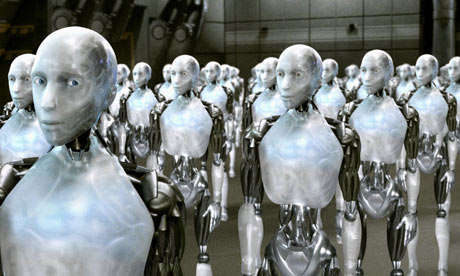
What domestic help will look like in 2109. Photograph: Allstar/20 Century Fox
What kind of world is it that ensures that women are paid the same as
men? One very different from our own, it seems. The Chartered
Management Institute reckons it will take 98 years for us to reach pay
parity – by which time our planet looks set to undergo some radical
changes.
Robots should finally be smart enough to liberate us from mundane chores –
and space tourism will be old news, as will planetary exploration. Instead
we will begin reaching out beyond our solar system to neighbouring stars,
using millions of tiny nanoships to scout for suitable planets, and giant solar
sails to carry us there. And we will use clean nuclear fusion to meet all our
energy needs. At least that's according to futurologist Michio Kaku, whose
book Physics of the Future attempts to predict what our world will look like
a century from now.
But while this may still all sound somewhat far-fetched (and a tad familiar)
we may actually find ourselves hoping he's right, not least because of how
crowded our planet will become. For, while it's still possible that our global
population level may actually have dropped by 2100, if growth continues at
current levels, there is the distinct possibility that a century from now we
could be brushing shoulders with 43.6 billion other people. Quite literally in
fact because, according to the Intergovernmental Panel on Climate Change,
if average temperatures are allowed to rise by 1-4C we could see sea levels
rising by as much as six metres, which would create even less space. Along
the way extinctions may help free up some land. It's impossible to tell which
ones, according to Jean-Christophe Vie of the International Union of the
Conservation of Nature's Red List of Endangered Species, but in the firing
line are tigers, polar bears and the Javan Rhino, he says.
But it's not all bad news. Advances in medicine should cut mortality rates in
countries such as the UK. And for women that's great news, because not
only will they get to finally enjoy equal pay but their life expectancy should
rise to 90, five years longer than their male counterparts.
2109: a life of equality
2109: a life of equality –
but no polar bears
It is going to take 98 years for there to be pay parity
between men and women. But what other predictions can be
made for the year 2109?
What domestic help will look like in 2109. Photograph: Allstar/20 Century Fox
What kind of world is it that ensures that women are paid the same as
men? One very different from our own, it seems. The Chartered
Management Institute reckons it will take 98 years for us to reach pay
parity – by which time our planet looks set to undergo some radical
changes.
Robots should finally be smart enough to liberate us from mundane chores –
and space tourism will be old news, as will planetary exploration. Instead
we will begin reaching out beyond our solar system to neighbouring stars,
using millions of tiny nanoships to scout for suitable planets, and giant solar
sails to carry us there. And we will use clean nuclear fusion to meet all our
energy needs. At least that's according to futurologist Michio Kaku, whose
book Physics of the Future attempts to predict what our world will look like
a century from now.
But while this may still all sound somewhat far-fetched (and a tad familiar)
we may actually find ourselves hoping he's right, not least because of how
crowded our planet will become. For, while it's still possible that our global
population level may actually have dropped by 2100, if growth continues at
current levels, there is the distinct possibility that a century from now we
could be brushing shoulders with 43.6 billion other people. Quite literally in
fact because, according to the Intergovernmental Panel on Climate Change,
if average temperatures are allowed to rise by 1-4C we could see sea levels
rising by as much as six metres, which would create even less space. Along
the way extinctions may help free up some land. It's impossible to tell which
ones, according to Jean-Christophe Vie of the International Union of the
Conservation of Nature's Red List of Endangered Species, but in the firing
line are tigers, polar bears and the Javan Rhino, he says.
But it's not all bad news. Advances in medicine should cut mortality rates in
countries such as the UK. And for women that's great news, because not
only will they get to finally enjoy equal pay but their life expectancy should
rise to 90, five years longer than their male counterparts.
2109: a life of equality