
 Tweet
I lied. The lasers don't actually make it rain. Not yet atleast. In the future however we may have the power to create or even prevent heavy rain helping to prevent floods or increase crop yield.
Firing laser beams into the
sky could make it rain, say
scientists
Water droplets have been created by shooting lasers into
the air. The technique might be used to create or prevent
rain
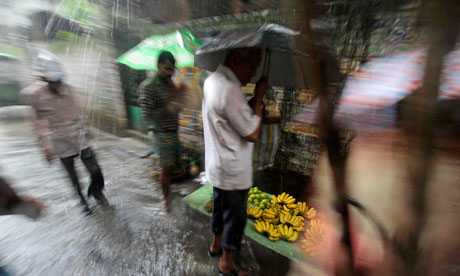
Heavy rain in Kolkata, India. Lasers could offer some control over when and where
rain falls.
Ever since ancient farmers called on the gods to send rain to save their
harvests, humans have longed to have the weather at their command.
That dream has now received a boost after researchers used a powerful
laser to produce water droplets in the air, a step that could ultimately help
trigger rainfall.
While nothing can produce a downpour from dry air, the technique, called
laser-assisted water condensation, might allow some control over where
and when rain falls if the atmosphere is sufficiently humid.
Researchers demonstrated the technique in field tests after hauling a
mobile laser laboratory the size of a small garage to the banks of the Rhône
near lake Geneva in Switzerland.
Records from 133 hours of firings revealed that intense pulses of laser light
created nitric acid particles in the air that behaved like atmospheric glue,
binding water molecules together into droplets and preventing them from
re-evaporating.
Within seconds, these grew into stable drops a few thousandths of a
millimetre in diameter: too small to fall as rain, but large enough to
encourage the scientists to press on with the work.
"We have not yet generated raindrops – they are too small and too light to
fall as rain. To get rain, we will need particles a hundred times the size, so
they are heavy enough to fall," said Jérôme Kasparian, a physicist at the
University of Geneva. A report on the tests appears in the journal Nature
Communications.
With improvements, shooting lasers into the sky could either help trigger or
prevent showers. One possibility might be to create water droplets in air
masses drifting towards mountains. The air would cool as it rose over
these, causing the water droplets to grow and eventually fall.
An alternative might be to stave off an immediate downpour by creating so
many tiny droplets in the air that none grew large enough to fall. "Maybe
one day this could be a way to attenuate the monsoon or reduce flooding
in certain areas," Kasparian said.
Efforts to bring the weather under control have become a matter of
national pride in China, where the Beijing meterological bureau has an office
devoted to weather modification. In 2009, the department claimed success
after 18 jets and 432 explosive rockets laden with chemicals were sent into
the skies to "seed" clouds. The chemicals, usually dry ice or silver iodide,
provide a surface for water vapour to condense on, and supposedly trigger
downpours from pregnant skies.
Kasparian believes laser-assisted rainmaking has advantages over blasting
chemicals into the sky. "The laser can run continuously, you can aim it
well, and you don't disperse huge amounts of silver iodide in the
atmosphere," he said.
"You can also turn the laser on and off at will, which makes it easier to
assess whether it has any effect. When the Chinese launch silver iodide
into the sky, it is very hard to know whether it would have rained anyway,"
Kasparian added.
The team's Teramobile laser can shoot beams of light several kilometres
into the sky, putting within easy reach the regions of the atmosphere
where water vapour normally condenses into raindrops.
One modification the team is considering involves sweeping the laser
across the sky to produce water droplets over a greater area. "From a
technical point of view, sweeping the laser is not an issue. They do it in
nightclubs all the time," Kasparian said.
Firing laser beams into the sky could make it rain, say scientists | Science | The Guardian
Firing laser beams into the
sky could make it rain, say
scientists
Water droplets have been created by shooting lasers into
the air. The technique might be used to create or prevent
rain
Heavy rain in Kolkata, India. Lasers could offer some control over when and where
rain falls.
Ever since ancient farmers called on the gods to send rain to save their
harvests, humans have longed to have the weather at their command.
That dream has now received a boost after researchers used a powerful
laser to produce water droplets in the air, a step that could ultimately help
trigger rainfall.
While nothing can produce a downpour from dry air, the technique, called
laser-assisted water condensation, might allow some control over where
and when rain falls if the atmosphere is sufficiently humid.
Researchers demonstrated the technique in field tests after hauling a
mobile laser laboratory the size of a small garage to the banks of the Rhône
near lake Geneva in Switzerland.
Records from 133 hours of firings revealed that intense pulses of laser light
created nitric acid particles in the air that behaved like atmospheric glue,
binding water molecules together into droplets and preventing them from
re-evaporating.
Within seconds, these grew into stable drops a few thousandths of a
millimetre in diameter: too small to fall as rain, but large enough to
encourage the scientists to press on with the work.
"We have not yet generated raindrops – they are too small and too light to
fall as rain. To get rain, we will need particles a hundred times the size, so
they are heavy enough to fall," said Jérôme Kasparian, a physicist at the
University of Geneva. A report on the tests appears in the journal Nature
Communications.
With improvements, shooting lasers into the sky could either help trigger or
prevent showers. One possibility might be to create water droplets in air
masses drifting towards mountains. The air would cool as it rose over
these, causing the water droplets to grow and eventually fall.
An alternative might be to stave off an immediate downpour by creating so
many tiny droplets in the air that none grew large enough to fall. "Maybe
one day this could be a way to attenuate the monsoon or reduce flooding
in certain areas," Kasparian said.
Efforts to bring the weather under control have become a matter of
national pride in China, where the Beijing meterological bureau has an office
devoted to weather modification. In 2009, the department claimed success
after 18 jets and 432 explosive rockets laden with chemicals were sent into
the skies to "seed" clouds. The chemicals, usually dry ice or silver iodide,
provide a surface for water vapour to condense on, and supposedly trigger
downpours from pregnant skies.
Kasparian believes laser-assisted rainmaking has advantages over blasting
chemicals into the sky. "The laser can run continuously, you can aim it
well, and you don't disperse huge amounts of silver iodide in the
atmosphere," he said.
"You can also turn the laser on and off at will, which makes it easier to
assess whether it has any effect. When the Chinese launch silver iodide
into the sky, it is very hard to know whether it would have rained anyway,"
Kasparian added.
The team's Teramobile laser can shoot beams of light several kilometres
into the sky, putting within easy reach the regions of the atmosphere
where water vapour normally condenses into raindrops.
One modification the team is considering involves sweeping the laser
across the sky to produce water droplets over a greater area. "From a
technical point of view, sweeping the laser is not an issue. They do it in
nightclubs all the time," Kasparian said.
Firing laser beams into the sky could make it rain, say scientists | Science | The Guardian
Comment