
 Tweet
Will Balochistan be free?
By Ahmar Mustikhan
Wed May 27, 2015 3:17 AM


This is a question that many inside Balochistan and outside are asking, and those asking this question are both Baloch and non-Baloch: can Balochistan be free?
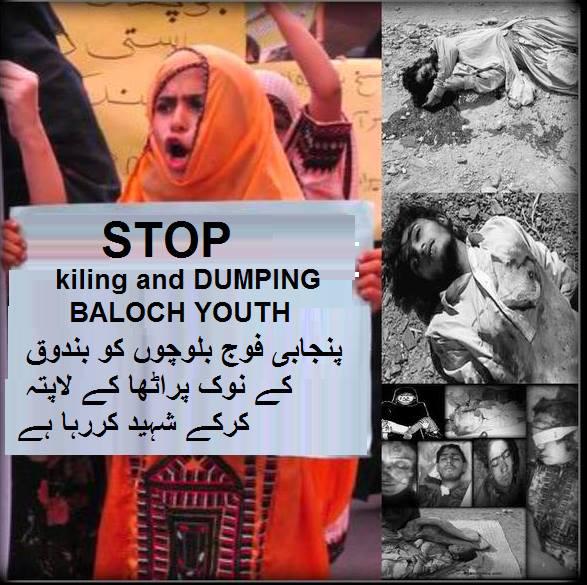
As much as the actions of the Islamic Republic of Pakistan shows, the answer is: Yes. It looks like the state of Pakistan is on its death bed or at least in a state of extreme panic when it comes to Balochistan, as if they are about to lose everything. Earlier this month, the top brass of the army at the corps commanders meeting in Rawalpindi directly pointed a finger of blame at India for terrorism in Balochistan. Just during the last two months in brutal army operations in Awaran, Mashkay, Mastung, Kalat and Panjgur more than 100 people were killed, scores abducted and dozens of homes looted and burned. Most of the deaths were custodial killings, which were shown as armed encounters. A wheel-chair bound person Hayat Bewas was dubbed as a militant commander of the Baloch Liberation Front and killed execution style before the eyes of his mother April 13 in Gebun in Kech district. On April 21, two newly wed brothers Ijaz Baloch and Aftab Baloch, sons of Fazal Baloch, and a third newlywed Shah Nawaz Baloch, son of Faiz Mohammad, were abducted from the home of a relative of Waja Akhtar Nadeem, a Baloch freedom leader. A fourth victim was Basit Baloch son of Lal Bakhsh Baloch. They were all killed execution style and their bodies bore torture marks, but Pakistani media announced the four were killed in an encounter. In yet another incident on May 18, a teenager Mairaj Baloch, a student of Grade 10 was abducted from his home and later that day his body was dumped. He was an orphan whose father Ramzan Baloch was killed by the security forces on January 24.
The extreme atrocities being committed by Pakistan army is forcing even those who are in Islamabad camp to speak out. Last week, member of Pakistan national assembly Sardar Kamal Khan Bangulzai, who belongs to army-allied National Party, accused the security forces of conducting extrajudicial killings of his constituents in Kalat and Mastung. “From one home three brothers were abducted and within two hours their bodies were found,” Bangulzai said. “If they are killed in this manner what else can their other family members do but pick up arms against the state,” he added.
In these actions, there is a degree of desperation that is quite visible. In Baloch tribal societies, if you kill one person from a village the entire village turns against you. In Balochistan today there is not a single small town or village that does not have its list of martyrs, which means the Baloch people are totally against the state of Pakistan, even though Pakistan has tried to promote death squads and Islamist militant outfits to counter the freedom fighters or sarmachars. The situation on the ground appears to be horrible. “There has been a regular, planned and systemic campaign against Baloch people in terms of summary executions, liquidation, persecution, sexual violence, sodomy, torture, maiming and enforced disappearances, custodial killing, displacement and kill and dump. These (actions) amount to crimes against humanity under Article 7 of the Rome Statute, which set up the International Criminal Court,” Kachkol Ali, a former fisheries minister who now lives in exile in Oslo, Norway, said in a letter to the United Nations. Ali added, “Regrettably, the state`s failure to hold even a single perpetrator of enforced disappearance to account perpetuates the culture of impunity in Pakistan.” The discovery of mass graves in Tootak, Khuzdar, with 169 bodies was an eye opener for the world, Ali wrote.
However, to counter the movement Islamabad last month deputed its most trusted politician Senator Hasil Bizenjo to the US where he said in a newspaper interview Baloch militancy does not make any difference for the state of Pakistan. Bizenjo’s father Mir Ghous Bakhsh Bizenjo was ranked among the founders of Baloch nationalism and widely respected for his speech against accession to Pakistan and for spending years behind the bars, while his son is despised by the nationalist youths as an agent of Islamabad, keen to play second fiddle to Premier Nawaz Sharif and impressed by his riches. In an interview with Dawn newspaper, whose owners always enjoyed good ties with successive military dictators, Bizenjo said, “The militants cannot defeat the military. They can only create disturbance and instability.” The report cited Pakistan’s favorite Baloch politician as saying if a referendum were held in Balochistan today, the militants would win. “But there will be no referendum. There will be elections and they cannot win elections.” The kind of logic advanced by the senator shows why the Bizenjos who were once equal in respect to the Bugtis, Marris and Mengals are today the butt of ridicule and have zero support among the freedom loving camp. Bizenjo has also refused to take action against his party's chief financier Imam Bheel, who was declared a drug kingpin by President Obama, even after he killed a government official.
Notwithstanding Bizenjo’s task handed to him by Islamabad, even a cursory look at Balochistan history will show a story of Pakistani deception mixed with barbarism. From the arrest and sentencing of both the first and second leaders of Baloch uprising against the state, Prince Aga Abdul Karim in 1948 and Nawab Nauroz Khan Zarakzai, in 1960s to the killing of Nawab Akbar Khan Bugti in 2006 and Mir Balach Marri in 2007 and the earlier enforced disappearance of Mir Asadullah Mengal in 1974 and killing and dumping him, to the assassination of Zamur Domki and Janaan Domki, wife and daughter of Mir Bakhtiar Domki, Pakistan state has not spared the highest among high in Balochistan. Even though not as rich, all these personalities are more or less of the same stature as the late Shaikh Zayed bin Sultan Al-Nahiyan or the late Sheikh Rashid bin Maktoum right across the Straits of Hormuz in the UAE.
Nawab Bugti's killing on August 26, 2006 was a watershed. "If it awakened the Baloch consciousness its a small price our family had to pay," says Washane Bugti, a grand nephew of Nawab Bugti. Until the killing of Nawab Bugti, the struggle was mostly in the hands of the Baloch elites but his sacrifice for his land and people diffused the militant movement to almost all strata of Baloch political society. Since then Pakistan army, ISI and Military Intelligence has desperately tried to crush the whole political leadership which has spread far and wide, away from the traditional bastions of tribal power such as Kohlu, Dera Bugti and Wadh.
A more resilient and battle-hardened leadership has emerged which includes educated youths who are not averse to defend their motherland with guns, rockets and missiles. This is best illustrated by the rise of gold medalist gynecologist Dr Allah Nazar, chief of the Baloch Liberation Front. According to Wahab Baloch, an aide to the late Nawab Khair Bakhsh Marri, the icon of the freedom movement had willed that he has full faith and trust in Dr Allah Nazar’s political leadership. However, given the peculiar tribal setup of Balochistan other militant organizations such as the Baloch Republican Army, United Baloch Army, Lashkar-i-Balochistan and Baloch Liberation Army are also very important, even though no tribal leader is willing to own these organizations. Leaders with a tribal background do have a big role to play, both inside and outside Balochistan. Their position and status cannot be wished away, especially at this crucial juncture when all hands are required on the deck. However, the greatest weakness among these personalities is feudal egotism and a tendency to immaturely approach the Pakistan Press, infested with ISI agents, to air their views.
Almost all of these militant organizations have at one point or the other made mistakes and even blunders. But then even the best armies in the world do make serious blunders. However, there is a growing realization among the Baloch militant camp that the Laws of War have to be respected, despite serious provocations by Islamabad.
On the other hand, young and energetic leaders of different Baloch political parties are demonstrating almost every month and sometimes every week in Western cities from Dusseldorf and Berlin in Germany to Barnaby in Canada. It is true there is a need for them to show greater unity and organize in four critical areas, in addition to activism. These areas include lobbying in parliaments, working with think-tanks and policy makers, outreach to civil society and human rights organizations and lastly, but most importantly, the Western media. It is naïve to think Pakistan media will ever do justice with the Balochstan issue if the past record of Pakistan media is kept in mind. Until the very final day of the 1971 war, December 16, Pakistani media was feeding the public wrong and totally erroneous information about the ground situation in Bangladesh as if the army was winning against the Bengalis. The same narrative that Baloch are Indian agents is once again being repeated.
Of course, at least one significant state entity has to solidly and openly support the freedom movement in Balochistan. In the regional context India with BJP in power is the best bet for Balochistan. As the BJP seeks to correct the wrongs of the Nehruvian era, Balochistan was one area that suffered immensely due to the mistakes of the founding fathers of India. Many young Hindu nationalists agree the state of Pakistan in its present form will never allow peace in Kashmir, or for that matter rest of India. Indian National Security adviser Ajit Doval has very clearly said if Pakistan commits one more terror attack like what it did November 26, 2008, in Mumbai, India will separate Balochistan. Friends of Balochistan and India like Canadian intellectual of Indian descent Tarek Fatah says there is no need for India to wait for another Mumbai style attack.
Pakistan has been playing with Baloch lives and honor for almost seventy years now since the forced accession of Balochistan at the point of gun March 27, 1948. Much blood has flowed down the Bolan River since then. As they bury their dead, the Baloch from all strata of society are teary-eyed, tired, insulted and wounded by Pakistan's daily war crimes and crimes against humanity. The anger of the masses witnessed during the burial of these martyrs shows Pakistan and its many stooges like Bizenjo or Chief Minister Abdul Malik have no role to play in Balochistan's future. Neither is the presence of Pakistan military boots on their homeland tolerable for the Baloch people nor is defeat an option for them. The Baloch youths are willing to die but not willing to surrender. This will to do or die is a harbinger that Balochistan will be free, no doubts.
1. As an outside observer if anything it seems that the Baloch insurgency is getting weaker, not stronger.
So I am not sure if the writer is correct.
2. Pakistani nationalists worship their army, and either refuse to accept its crimes or when proven of its crimes say "it was necessary".
3. Pakistani nationalists worship of their army is that they unquestioningly believe anything that these people say. The Pakistan army can never lie.
So when the Pakistani army was losing the war in east Pakistan, till the last day they were telling Pakistanis on radio about how victorious they were.
So on 16th December when they surrendered, Pakistanis were stunned.
4. For a Pakistani nationalist anyone who complains of army brutality is not a fellow Pakistani, a citizen of Pakistan who must be loved and respected and his grievances looked at and tried to be resolved.
No, he is a "traitor".
A traitor who dares refuse to worship the Pakistani army.
A traitor who dares try to sully the image of the glorious, always truthful, always honourable Pakistani army.
He must be silenced, arrested, tortured and if required killed.
By Ahmar Mustikhan
Wed May 27, 2015 3:17 AM
This is a question that many inside Balochistan and outside are asking, and those asking this question are both Baloch and non-Baloch: can Balochistan be free?
As much as the actions of the Islamic Republic of Pakistan shows, the answer is: Yes. It looks like the state of Pakistan is on its death bed or at least in a state of extreme panic when it comes to Balochistan, as if they are about to lose everything. Earlier this month, the top brass of the army at the corps commanders meeting in Rawalpindi directly pointed a finger of blame at India for terrorism in Balochistan. Just during the last two months in brutal army operations in Awaran, Mashkay, Mastung, Kalat and Panjgur more than 100 people were killed, scores abducted and dozens of homes looted and burned. Most of the deaths were custodial killings, which were shown as armed encounters. A wheel-chair bound person Hayat Bewas was dubbed as a militant commander of the Baloch Liberation Front and killed execution style before the eyes of his mother April 13 in Gebun in Kech district. On April 21, two newly wed brothers Ijaz Baloch and Aftab Baloch, sons of Fazal Baloch, and a third newlywed Shah Nawaz Baloch, son of Faiz Mohammad, were abducted from the home of a relative of Waja Akhtar Nadeem, a Baloch freedom leader. A fourth victim was Basit Baloch son of Lal Bakhsh Baloch. They were all killed execution style and their bodies bore torture marks, but Pakistani media announced the four were killed in an encounter. In yet another incident on May 18, a teenager Mairaj Baloch, a student of Grade 10 was abducted from his home and later that day his body was dumped. He was an orphan whose father Ramzan Baloch was killed by the security forces on January 24.
The extreme atrocities being committed by Pakistan army is forcing even those who are in Islamabad camp to speak out. Last week, member of Pakistan national assembly Sardar Kamal Khan Bangulzai, who belongs to army-allied National Party, accused the security forces of conducting extrajudicial killings of his constituents in Kalat and Mastung. “From one home three brothers were abducted and within two hours their bodies were found,” Bangulzai said. “If they are killed in this manner what else can their other family members do but pick up arms against the state,” he added.
In these actions, there is a degree of desperation that is quite visible. In Baloch tribal societies, if you kill one person from a village the entire village turns against you. In Balochistan today there is not a single small town or village that does not have its list of martyrs, which means the Baloch people are totally against the state of Pakistan, even though Pakistan has tried to promote death squads and Islamist militant outfits to counter the freedom fighters or sarmachars. The situation on the ground appears to be horrible. “There has been a regular, planned and systemic campaign against Baloch people in terms of summary executions, liquidation, persecution, sexual violence, sodomy, torture, maiming and enforced disappearances, custodial killing, displacement and kill and dump. These (actions) amount to crimes against humanity under Article 7 of the Rome Statute, which set up the International Criminal Court,” Kachkol Ali, a former fisheries minister who now lives in exile in Oslo, Norway, said in a letter to the United Nations. Ali added, “Regrettably, the state`s failure to hold even a single perpetrator of enforced disappearance to account perpetuates the culture of impunity in Pakistan.” The discovery of mass graves in Tootak, Khuzdar, with 169 bodies was an eye opener for the world, Ali wrote.
However, to counter the movement Islamabad last month deputed its most trusted politician Senator Hasil Bizenjo to the US where he said in a newspaper interview Baloch militancy does not make any difference for the state of Pakistan. Bizenjo’s father Mir Ghous Bakhsh Bizenjo was ranked among the founders of Baloch nationalism and widely respected for his speech against accession to Pakistan and for spending years behind the bars, while his son is despised by the nationalist youths as an agent of Islamabad, keen to play second fiddle to Premier Nawaz Sharif and impressed by his riches. In an interview with Dawn newspaper, whose owners always enjoyed good ties with successive military dictators, Bizenjo said, “The militants cannot defeat the military. They can only create disturbance and instability.” The report cited Pakistan’s favorite Baloch politician as saying if a referendum were held in Balochistan today, the militants would win. “But there will be no referendum. There will be elections and they cannot win elections.” The kind of logic advanced by the senator shows why the Bizenjos who were once equal in respect to the Bugtis, Marris and Mengals are today the butt of ridicule and have zero support among the freedom loving camp. Bizenjo has also refused to take action against his party's chief financier Imam Bheel, who was declared a drug kingpin by President Obama, even after he killed a government official.
Notwithstanding Bizenjo’s task handed to him by Islamabad, even a cursory look at Balochistan history will show a story of Pakistani deception mixed with barbarism. From the arrest and sentencing of both the first and second leaders of Baloch uprising against the state, Prince Aga Abdul Karim in 1948 and Nawab Nauroz Khan Zarakzai, in 1960s to the killing of Nawab Akbar Khan Bugti in 2006 and Mir Balach Marri in 2007 and the earlier enforced disappearance of Mir Asadullah Mengal in 1974 and killing and dumping him, to the assassination of Zamur Domki and Janaan Domki, wife and daughter of Mir Bakhtiar Domki, Pakistan state has not spared the highest among high in Balochistan. Even though not as rich, all these personalities are more or less of the same stature as the late Shaikh Zayed bin Sultan Al-Nahiyan or the late Sheikh Rashid bin Maktoum right across the Straits of Hormuz in the UAE.
Nawab Bugti's killing on August 26, 2006 was a watershed. "If it awakened the Baloch consciousness its a small price our family had to pay," says Washane Bugti, a grand nephew of Nawab Bugti. Until the killing of Nawab Bugti, the struggle was mostly in the hands of the Baloch elites but his sacrifice for his land and people diffused the militant movement to almost all strata of Baloch political society. Since then Pakistan army, ISI and Military Intelligence has desperately tried to crush the whole political leadership which has spread far and wide, away from the traditional bastions of tribal power such as Kohlu, Dera Bugti and Wadh.
A more resilient and battle-hardened leadership has emerged which includes educated youths who are not averse to defend their motherland with guns, rockets and missiles. This is best illustrated by the rise of gold medalist gynecologist Dr Allah Nazar, chief of the Baloch Liberation Front. According to Wahab Baloch, an aide to the late Nawab Khair Bakhsh Marri, the icon of the freedom movement had willed that he has full faith and trust in Dr Allah Nazar’s political leadership. However, given the peculiar tribal setup of Balochistan other militant organizations such as the Baloch Republican Army, United Baloch Army, Lashkar-i-Balochistan and Baloch Liberation Army are also very important, even though no tribal leader is willing to own these organizations. Leaders with a tribal background do have a big role to play, both inside and outside Balochistan. Their position and status cannot be wished away, especially at this crucial juncture when all hands are required on the deck. However, the greatest weakness among these personalities is feudal egotism and a tendency to immaturely approach the Pakistan Press, infested with ISI agents, to air their views.
Almost all of these militant organizations have at one point or the other made mistakes and even blunders. But then even the best armies in the world do make serious blunders. However, there is a growing realization among the Baloch militant camp that the Laws of War have to be respected, despite serious provocations by Islamabad.
On the other hand, young and energetic leaders of different Baloch political parties are demonstrating almost every month and sometimes every week in Western cities from Dusseldorf and Berlin in Germany to Barnaby in Canada. It is true there is a need for them to show greater unity and organize in four critical areas, in addition to activism. These areas include lobbying in parliaments, working with think-tanks and policy makers, outreach to civil society and human rights organizations and lastly, but most importantly, the Western media. It is naïve to think Pakistan media will ever do justice with the Balochstan issue if the past record of Pakistan media is kept in mind. Until the very final day of the 1971 war, December 16, Pakistani media was feeding the public wrong and totally erroneous information about the ground situation in Bangladesh as if the army was winning against the Bengalis. The same narrative that Baloch are Indian agents is once again being repeated.
Of course, at least one significant state entity has to solidly and openly support the freedom movement in Balochistan. In the regional context India with BJP in power is the best bet for Balochistan. As the BJP seeks to correct the wrongs of the Nehruvian era, Balochistan was one area that suffered immensely due to the mistakes of the founding fathers of India. Many young Hindu nationalists agree the state of Pakistan in its present form will never allow peace in Kashmir, or for that matter rest of India. Indian National Security adviser Ajit Doval has very clearly said if Pakistan commits one more terror attack like what it did November 26, 2008, in Mumbai, India will separate Balochistan. Friends of Balochistan and India like Canadian intellectual of Indian descent Tarek Fatah says there is no need for India to wait for another Mumbai style attack.
Pakistan has been playing with Baloch lives and honor for almost seventy years now since the forced accession of Balochistan at the point of gun March 27, 1948. Much blood has flowed down the Bolan River since then. As they bury their dead, the Baloch from all strata of society are teary-eyed, tired, insulted and wounded by Pakistan's daily war crimes and crimes against humanity. The anger of the masses witnessed during the burial of these martyrs shows Pakistan and its many stooges like Bizenjo or Chief Minister Abdul Malik have no role to play in Balochistan's future. Neither is the presence of Pakistan military boots on their homeland tolerable for the Baloch people nor is defeat an option for them. The Baloch youths are willing to die but not willing to surrender. This will to do or die is a harbinger that Balochistan will be free, no doubts.

1. As an outside observer if anything it seems that the Baloch insurgency is getting weaker, not stronger.
So I am not sure if the writer is correct.
2. Pakistani nationalists worship their army, and either refuse to accept its crimes or when proven of its crimes say "it was necessary".
3. Pakistani nationalists worship of their army is that they unquestioningly believe anything that these people say. The Pakistan army can never lie.
So when the Pakistani army was losing the war in east Pakistan, till the last day they were telling Pakistanis on radio about how victorious they were.
So on 16th December when they surrendered, Pakistanis were stunned.
4. For a Pakistani nationalist anyone who complains of army brutality is not a fellow Pakistani, a citizen of Pakistan who must be loved and respected and his grievances looked at and tried to be resolved.
No, he is a "traitor".
A traitor who dares refuse to worship the Pakistani army.
A traitor who dares try to sully the image of the glorious, always truthful, always honourable Pakistani army.
He must be silenced, arrested, tortured and if required killed.


 every BLA member will be buried, and soon their sardars will be killed.




Comment