Announcement

Collapse
No announcement yet.

Bengali rebellions against the British

Collapse
X
 
  • Filter
  • Time
  • Show
Clear All
new posts

  • Bengali rebellions against the British

    Some one in another thread commented on this issue so I am addressing it in this thread.

    Titu Mir


    Mir Nisar Ali (Titu Mir) was one of the greatest freedom fighters of Bangladesh. He sparked the flame of liberation in the hearts of Bangladeshis which is continuous leading them in their struggle for political, cultural and economic independence.

    Titu Mir was born on 14 Magh 1188 (Bangla calendar), 27 January 1782 at a village named Chandpur under Bashirhat Thana of Chabbish Parguna District. His father was Mir Hassan Ali and mother was Abeeda Rukaya Khatun.

    He received his primary education from his own village. Then he studied in a local Madrassa where he came into contact of an Alim and Hafiz teacher. Titu Mir become a Hafiz of Quran there. He also became scholar in Hadith. He completed his Madrassa education at the age of 18 years. He had good command on Arabic, Persian and Bangla.

    Titu Mir was a renowned wrestler of his time. He defeated many of his contemporary boxers.

    He went to Mecca in 1822 to perform Haj. There he met Saiyeed Ahmad Shaheed. He became greatly influenced by Saiyeed Ahmad Shaheed who inspired him to preach the true teachings of Islam and fight for the freedom of Muslims.

    Upon returning home, he started his struggle against Bidaat. He united Hindu peasants against the Zaminders and the British occupiers and inspired them to fight for liberation of Bangladesh. He used to say that Muslims must be fully Muslim in their words, deeds and behaviours, and should help the oppressed irrespective of their religion.

    Titu Mir protested levying tax on beard, mustache, mosque and Islamic name of Muslims by local Hindu Zaminder Krishna Dev Roy. It resulted in a conflict between Titu Mir and the Zaminder. The Zaminder tried to create division among Titu Mir's followers by labeling him as a Wahabi. However, the Muslims did not pay any heed to his tricks. As a result, he intensified torture on the Muslims.

    Zaminder Krishna Dev Roy took help of the British occupiers to oppress the followers of Titu Mir. Some of his followers were martyred at one stage. The Muslims became more united and formed a Mujahid freedom fighter force in the leadership of Ghulam Masum. They built a bamboo castle at Narikelbaria. Titu Mir declared liberation from the British and re-establishment of Muslim rule. The whole area of Chabbish Parguna, Nadia and Faridpur districts were under his control. He had around five thousands Mujahid freedom fighters with him. The soldiers of the Zaminder and of occupier British were being repeatedly defeated by the Mujahids.

    At last, on 14 November 1831, the British force armed modern arms attacked the Muslim Mujahids. They could not withstand the attack of the British force with modern arms with their shields and spears. The bamboo castle was destroyed. Titu Mir was martyred along with many of his fellow freedom fighters.

    Titu Mir and his bamboo castle are still sources of inspiration of liberation for the people of Bangladesh.



    *There was no "Bangladesh" at the time so that is the only problem with that article, he did however struggle against British colonial rule and had the support of both Muslim and Hindu Bengalis.

    In other words he is just one example of Bengali rebellion against the British.

    There are others who I will post more details of later.
    * * * * * * * * * * * * * * * * * * * * * * *

    Shukran ya Masr!!!

    Thanks to Egypt for supporting Bangladesh against Pakistani harassment and support for terrorists and war criminals!!

  • #2
    From Wikipedia.

    Confrontations with the British

    The followers of Titu Mir, believed to have grown to 15,000 by that time, readied themselves for armed conflict, and they built a fort of bamboo at Narikelbaria, near the town of Barasat. This was surrounded by a high double curtain wall of bamboo stakes filled in with mud cladding and sun-baked.
    Titu Mir declared independence from the British, and regions comprising the current districts of 24 Parganas, Nadia and Faridpur came under his control. The private armies of the Zamindars and the forces of the British met with a series of defeats at the hands of his men as a result of his strike-and-retreat guerrilla tactics.

    Finally, the British forces, led by Lieutenant Colonel Stewart consisting of 100 cavalry, 300 native infantry and artillery with two cannons, mounted a concerted attacks on 14 November 1831, on Titu Mir and his followers. Armed with nothing more than the bamboo quarterstaff and Lathi and a few swords and spears, Titu Mir and his forces could not withstand the might of modern weapons, and were overwhelmed. The bamboo castle was destroyed, and Titu Mir was killed along with several of his followers. The commanding officer of the British forces noted his opponent's bravery in dispatches, and also commented on the strength and resilience of bamboo as a material for fortification, since he had had to pound it with artillery for a surprisingly long time before it gave way.

    After a long-drawn trial, Golam Rasul, Titumir's nephew and second in command was hanged and some 350 others were sentenced to transportation for life.

    Titu Mir has been a source of inspiration in the liberation for the people of Bangladesh.

    In 2004, listeners of the BBC's Bengali service voted Titu Mir 11 on a list of 20 "Greatest Bengalis." The survey produced well over 100 names, and the top 20 was compiled on points awarded according to listeners' order of preference.

    In Dhaka, Jinnah College was renamed to Titumir College in 1971. Titumir Hall is also a dormitory of Dhakas Bangladesh University of Engineering and Technology.

    Bangladesh Navy has its principal base in Khulna named after him as 'BNS Titumir'.

    On 19 November 1992, the Government of Bangladesh issued a commemorative stamp honoring Titumir on the 161st anniversary of his death.
    * * * * * * * * * * * * * * * * * * * * * * *

    Shukran ya Masr!!!

    Thanks to Egypt for supporting Bangladesh against Pakistani harassment and support for terrorists and war criminals!!

    Comment


    • #3
      Khudiram

      This thread is about "Bengali" rebellion and not just Muslim Bengali rebellion. It is about the ethnic group and not exclusive to the Muslim Bengali section of it.


      Wikipedia


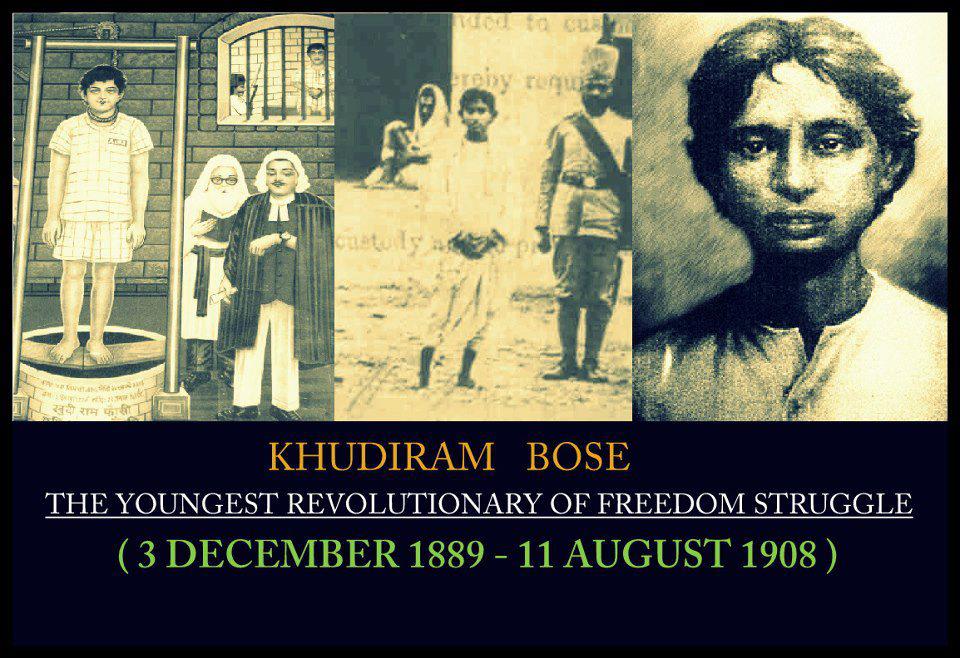
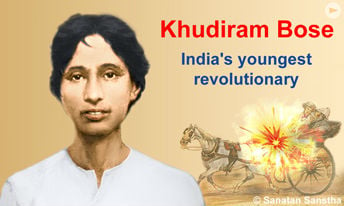
      Khudiram Bose (Bengali: ক্ষুদিরাম বসু Khudiram Boshu) (3 December 1889 – 11 August 1908) was a Bengali revolutionary, one of the youngest revolutionaries early in the Indian independence movement. At the time of his hanging, he was 18 years, 8 months 8 days old....

      On 11 August, the region around the prison became packed with a swelling crowd before it was 6 am—the scheduled time. People holding flower garlands filled up the front rows of the crowd. Upendranath Sen, the lawyer-journalist of the Bengali news daily "Bengali", who was close to Khudiram, reports having reached the venue by 5 am, in a car with all the necessary funerary arrangements and clothes. After the hanging, the funeral procession went through Kolkata, with police guards holding back the crowd all along the central artery street. The people kept throwing their flowers on the body as the carriage passed by.

      The Amrita Bazar Patrika, one of the prominent dailies of that era, carried the story of the hanging the next day, on 12 August. Under the headline "Khudiram's End: Died cheerful and smiling" the newspaper wrote: "Khudiram's execution took place at 6 a.m. this morning. He walked to the gallows firmly and cheerfully and even smiled when the cap was drawn over his head." An established British newspaper, The Empire, wrote: "Khudiram Bose was executed this morning...It is alleged that he mounted the scaffold with his body erect. He was cheerful and smiling."


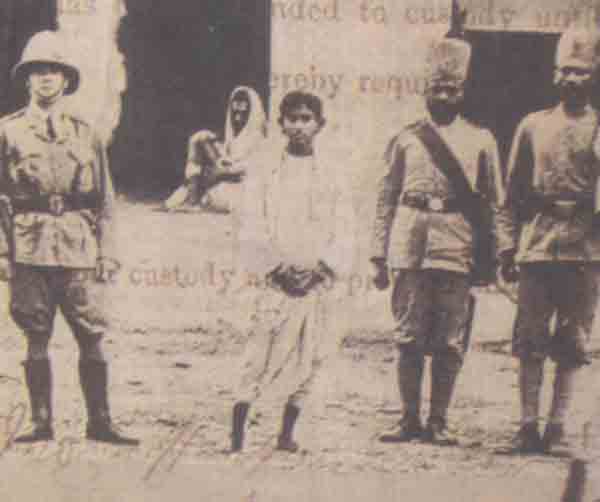
      Khudiram arrested by the British.
      * * * * * * * * * * * * * * * * * * * * * * *

      Shukran ya Masr!!!

      Thanks to Egypt for supporting Bangladesh against Pakistani harassment and support for terrorists and war criminals!!

      Comment


      • #4
        Khudiram Bose


        Born In: Tamluk, Midnapore, Bengal
        Died On: August 11, 1908
        Career: Freedom fighter
        Nationality: Indian

        Khudiram Bose, a young political activist from Bengal, was not only one of the most prominent figures in India's fight for freedom from British rule, but also the youngest revolutionary that the Indian independence movement had witnessed. Khudiram Bose led a life of risk and adventure, never for once flinching from his goal of acquiring freedom for his country. Apart from possessing the spirit of a fighter, Khudiram Bose was also known for his leadership qualities and his services to the society. However, the revolutionary died an unfortunate early death, leaving India bereft of one of the greatest freedom strugglers that the country had ever seen. Khudiram Bose will always be remembered in the history of Indian independence as the proponent of the 'Agni Yuga' or the fiery age, an era which was characterized by young people getting involved in the fight against the British without thinking twice about their own lives. Khudiram Bose was the first martyr of the early twentieth century.
        Read more at http://www.iloveindia.com/indian-her...PKjeEOlpsuF.99
        * * * * * * * * * * * * * * * * * * * * * * *

        Shukran ya Masr!!!

        Thanks to Egypt for supporting Bangladesh against Pakistani harassment and support for terrorists and war criminals!!

        Comment


        • #5
          In the past the Sylhet region of modern day Bangladesh was called "Jalalabad" (after Shah Jalal, the saint who established Islam in the region) and Sylheti scholars would be called "so-and-so Jalalabadee" in the wider Islamic community.

          The city of Chittagong was in the past called "Islamabad", way before the current federal capital of Pakistan was even conceived of let alone created.

          So Monir ur Zaman Islamabadi was from Islamabad i.e. Chittagong.


          Monir uz Zaman Islamabadi


          Maulana Maniruzzaman Islamabadi (1875-1950), was an Islamic philosopher, nationalist activist and journalist from Chittagong, Bengal, British India (present Bangladesh). He assumed the surname "Islamabadi" because "Islamabad" was the official name for Chittagong during the Muslim period. It has no relation to Pakistan's capital Islamabad...

          Islamabadi's activism started in 1904 with the "Islam Mission Samity" which had undertaken a course of action to preach awareness among Bengali Muslims of their cultural heritage. Referring to the uneducated mullahs’ reservation about learning geography on the baseless ground that the subject was created by the "Kafir English,"

          Islamabadi wrote:

          "We wouldn’t be able to change our conditions, let alone make progress, until we would take the trouble to review out history and acquire essential knowledge about geography, science, industry, commerce and agriculture, et cetera."

          Islamabadi supported the Indian National Congress and took an active part in the movement for the annulment of the Partition of Bengal. He also participated actively in the Non-cooperation Movement and Khilafat Movement and was the President of the provincial Congress Committee. He, along with Mohammad Akram Khan toured throughout Bengal and organized Khilafat meetings, particularly in Dhaka and Chittagong. In an article titled Asahojogita-o-Amader Kartbya, Islamabadi declared that to protect Khilafat and to acquire Swaraj were the twin aims of the Khilafat movement.

          He was one of the architects of the Bengal Pact of 1923. He left Congress politics in the 1930s and joined the Krishak Praja Party and was elected to the Bengal Legislative Assembly in 1937 from this party.

          Anjuman-i-Ulama-i-Bangala

          In 1913, Moniruzzaman Islamabadi along with Maulana Abul Kalam Azad, Mohammad Akram Khan, Maulana Abdullahil Baqi and Dr Muhammad Shahidullah led the organizing of the Anjuman-i-Ulama-i-Bangala with headquarters based in Kolkata. One of the objectives of this organization was popularizing Bengali language among the Muslim middle class. When the Anjuman-i-Ulama-i-Bangala merged into Jamiat Ulema-e-Hind, in 1921, he became the founder of its branch in Bengal, the Jamiat-i-Ulama-i-Bangalah. He founded the Chittagong branch of the organization and himself became its president.

          Through the Anjuman, Islamabadi addressed social ills that plagued the Muslim society like dowry, excessive mahr and young child marriage, without registering the age of consent. Due to its involvement Islamabadi's involvement with the Krishak Praja Party, the Anjuman viewed the Muslim League as repugnant, lacking religiosity and "not being true Muslims."

          Islamabadi was a preacher who wanted to give Bengali Muslims a new identity by purifying the modern and invoking universal morality.[7]
          Islamabadi wanted to establish an Islamic university in Chittagong but the lack of funds and circumstances of the time did not favor his efforts.[1]
          Works[edit]
          Islamabadi's main objective to project the past glory of Islam, its contributions to the progress of human civilization and thus inspiring the Bengali Muslims to change their conditions manifested in publications such as:

          Bhugol Shastre Musalman (Muslim contributions in geographical science)
          Khagol Shastre Musalman (Muslim contributions in astronomy)
          Korane Swadhinatar Bani (Messages of freedom in the Qur’an)
          Bharate Islam Prachar (Spreading of Islam in India)
          Musalman Amale Hindur Adhikar (Rights of the Hindus in Muslim Rule)
          Moslem Birangana (Heroic Muslim women)
          Turashker Sultan (Sultan of Turkey)
          Aurangzeb
          Nejamuddin Aulia
          * * * * * * * * * * * * * * * * * * * * * * *

          Shukran ya Masr!!!

          Thanks to Egypt for supporting Bangladesh against Pakistani harassment and support for terrorists and war criminals!!

          Comment


          • #6
            A couple of important points.


            1. Monir uz Zaman Islamabadi was a Maulana who respected Hindus as human beings.

            This is in contrast to the anti-Hindu racism of Pakistani nationalists such as Zaid Hamid, the Pakistan military and right wing and the pro-Pakistan, Jamaat e Islami operating in Bangladesh.


            2. Monir uz Zaman was a "Bengali nationalist".

            He tried to revive the Bengali language and promote the rights of Bengali Muslims (as well as Hindus).

            Due to the monopolization of history by northern Indian and now Pakistani Muslims, Bengali is vilified as a "Hindu" language.

            This propaganda of Bengali being a "Hindu" language is also promoted by the Jamaat e Islami terrorist organization in Bangladesh supported by Arab fundamentalists including the Saudi-controlled "Muslim World League".

            In the Arakan region occupied by Burma next to Bangladesh, the Muslims there who speak the Chittagongi dialect of Bengali are discouraged to speak Bengali by these fundamentalists as it is a "Hindu" language.

            This propaganda is also being currently disseminated on the Pakistani propaganda site defence.pk by supporters of Jamaat e "Islami", who have also advocated terrorism against the Bangladeshi army and state on that site.


            3. Monir uz Zaman was a proto-Bangladeshi nationalist.

            A terrorist organization like the pro-Pakistani Jamaat e "Islami" can not claim him as he believed in the importance of the Bengali language something which the Jamaat works against.

            The Jamaat though not saying this overtly is a pro-Pakistani Urdu-philiac organization which reveres the Urdu language and detests Bengali (though they deny this in public).

            Also the Jamaat is an anti-Hindu organization whereas Monir uz Zaman respected Hindus.


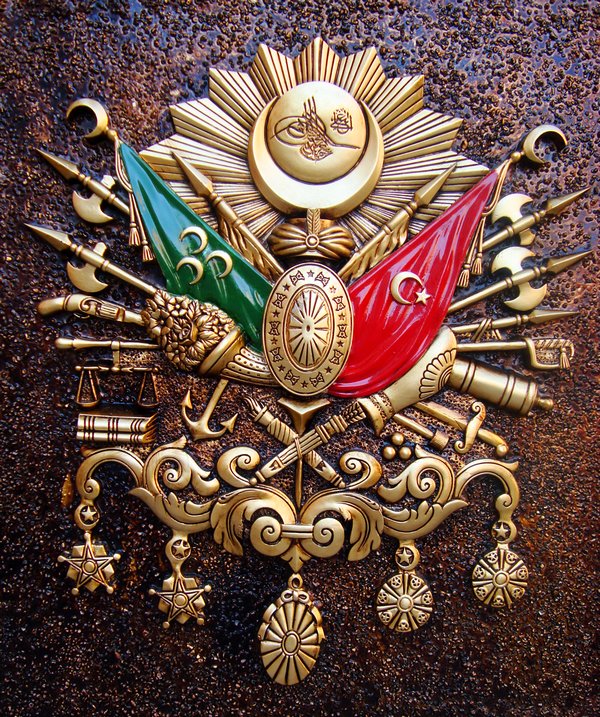
            4. Monir uz Zaman was pro-Turkish, pro-Osmanli.


            The main support for Turkey/the Ottomans from India's Muslims came from northern India and Bengal.

            Today's modern day Pakistan (i.e. Punjab) did not do much and in fact saw Punjabi Muslim soldiers killing Turkish Muslims for the sake of the British in both Gallipoli and Mecca.

            Despite this the modern state of Turkey and its indoctrinated public prefer the state of Pakistan to Bangladesh believing that Pakistan is the state which supported Turkey despite it not existing and despite the area which it now occupies playing no major role in the pro-Turkey Khilafah movement and Bengali Muslims playing a greater role.

            Thus a hero such as Monir-uz-Zaman, who would clearly be against the racist anti-Hindu and anti-Bengali nature of an organization like Jamaat e "Islami" would also condemn the Erdogan regime, Milli Gorus/ Saadet and Adnan Otkar as traitors.


            TRAITOR: Erdogan who spat at the sacrifices of the Muslim Bengalis who supported the Ottoman Caliphate (Osmanli Hilafet) by supporting terrorists and militants in Bangladesh rejected by the vast majority of the Bangladeshi nation and whose racist ideology is in conflict with that of the Muslim Bengalis of the early 20th century who supported Turkey.


            TRAITOR: Davutoglu, who was part of the AKP regime's anti-Bangladeshi policies of supporting anti-Bangladeshi militants of the Jamaat e "Islami" terrorist organization, an organization whose views go completely against that of those Muslim Bengalis who supported Turkey's war of independence in the 1920s.


            TRAITOR: Bekir Bozdag, AKP regime thug and minister who insulted and abused Bangladesh when it took legal action against militants and leaders of the Jamaat e "Islami" terrorist organization for war crimes. The Jamaat has an ideology which goes against the principles of those Muslim Bengalis who supported the Ottoman Caliphate in the 1920s (Osmanli Hilafet).


            TRAITOR: Adnan Otkar a supporter of militants and terrorists in Bangladesh who mobilized Muslim public opinion in Turkey across the world for anti-Bangladeshi militants. Otkar is a traitor who has betrayed all those Muslim Bengalis who supported the Ottoman Caliphate in the 1920s including Monir uz Zaman (rahmatullahi 'alaih).
            * * * * * * * * * * * * * * * * * * * * * * *

            Shukran ya Masr!!!

            Thanks to Egypt for supporting Bangladesh against Pakistani harassment and support for terrorists and war criminals!!

            Comment

            Working...
            X