
 Tweet
Tweet
** In this thread I will compile all news related to the Bangladeshi economy. **
BANGLADESHI ECONOMIC NEWS
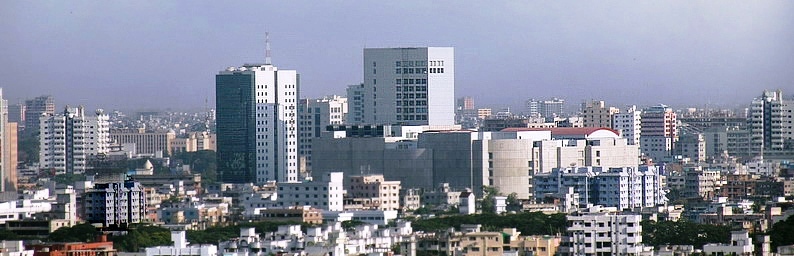
Dhaka, capital of Bangladesh.
"Bangladesh impresses investors"
http://www.thedailystar.net/banglade...nvestors-44260
The above is important to mention because the very fundamental economic need that a state must provide for its populace is food security. Bangladesh as "east Pakistan", did not have this and its population used to go hungry under west Pakistani mismanagement. Now it has a food surplus.
Such things are important to point out because there is a propaganda campaign of Pakistani hate-sites such as defence.pk to invalidate the concept of an independent Bangladesh and to paint Bangladesh as a failure which should never have won its freedom from Pakistan.

Defence.pk, is an anti-Bangladeshi propaganda site with personnel connected to the Pakistani military and the Pakistani-backed Jamaat e Islami terrorist organization operating in Bangladesh engaged in a campaign of propaganda against Bangladesh.
There are 15 million Bangladeshis who earn $10,000 a year that is more than the average GDP per capita of people in Romania or Bulgaria (both EU states).
Bulgaria has 10 million people (approx.) with an average GDP per capita of $7,004 while Bangladesh has 15 million people at least on $10,000.
In other words there is a very big market and emerging middle class with disposable income to purchase products and services from major multi-national companies.
This level of economic growth would not have been possible if Bangladesh had not won its freedom in 1971, despite what Pakistanis, Saudis and AKP Turks may think.

Saudi regime. The Saudi regime is ideologically opposed to the existence of an independent Bangladesh and opposes Bangladesh's war of liberation. It supports anti-Bangladeshi terrorist groups and has carried out a diplomatic and economic war against Bangladesh. However despite this Saudi war against Bangladesh, Bangladesh is progressing.
BANGLADESHI ECONOMIC NEWS
Dhaka, capital of Bangladesh.
"Bangladesh impresses investors"
http://www.thedailystar.net/banglade...nvestors-44260
In 1971, Bangladesh had a population of 70 million and was perennially short of food, according to the historian. “Our agriculture could not cope with 70 million people.”
Four decades later, with the population scaling 160 million, there is no shortage of food. Not only that, this fiscal year the country is set to make its maiden large-scale food export -- some 50,000 tonnes of rice to Sri Lanka.
Four decades later, with the population scaling 160 million, there is no shortage of food. Not only that, this fiscal year the country is set to make its maiden large-scale food export -- some 50,000 tonnes of rice to Sri Lanka.
Such things are important to point out because there is a propaganda campaign of Pakistani hate-sites such as defence.pk to invalidate the concept of an independent Bangladesh and to paint Bangladesh as a failure which should never have won its freedom from Pakistan.
Defence.pk, is an anti-Bangladeshi propaganda site with personnel connected to the Pakistani military and the Pakistani-backed Jamaat e Islami terrorist organization operating in Bangladesh engaged in a campaign of propaganda against Bangladesh.
Growth has averaged 6.2 percent the past five years, which Radhika Kak, South Asia economist at Standard Chartered Bank, said is high compared to the average of South Asian economies and other low-income economies.
“So, broadly speaking, it is fair to say that Bangladesh has been a relative outperformer in terms of growth.”
But to talk about economics only misses the real progress the country has made -- and that lies in the social sector. “If you look at the social indicators, in every respect Bangladesh has done well,” Rizvi said.
This proclamation was corroborated by Johannes Zutt, country director of World Bank, who went on to add that the country has overtaken India “by a considerable margin” in many key development indicators since 1971 despite the fact that its income level is significantly lower than India's.
“If we had been sitting in a meeting like this around independence and looking forward to 2014, would we have dared to predict that Bangladesh would do as well as it has done? My supposition is that we probably would not have.”
He particularly highlighted the pace of GDP growth in the past three decades, which is about 1 percentage point per decade. “It's something very few countries have managed that's a remarkable achievement.”
Remarkable, he said, as the country faced serious economic challenges and complications during the period -- that one would have expected to knock back GDP quite badly or at least make it volatile.
“But what we see instead is a very strong and steady improvement in GDP year over year,” he said, while particularly praising the macroeconomic management, across both the BNP and Awami League governments.
This strong GDP growth has had two by-products: an equally consistent reduction in poverty rate and a rising middle and affluent class.
Today, there are 15 million or more Bangladeshis who earn $10,000 a year, which is twice the number as in Malaysia, according to Zarif Munir, a partner at Boston Consulting Group.
“So, broadly speaking, it is fair to say that Bangladesh has been a relative outperformer in terms of growth.”
But to talk about economics only misses the real progress the country has made -- and that lies in the social sector. “If you look at the social indicators, in every respect Bangladesh has done well,” Rizvi said.
This proclamation was corroborated by Johannes Zutt, country director of World Bank, who went on to add that the country has overtaken India “by a considerable margin” in many key development indicators since 1971 despite the fact that its income level is significantly lower than India's.
“If we had been sitting in a meeting like this around independence and looking forward to 2014, would we have dared to predict that Bangladesh would do as well as it has done? My supposition is that we probably would not have.”
He particularly highlighted the pace of GDP growth in the past three decades, which is about 1 percentage point per decade. “It's something very few countries have managed that's a remarkable achievement.”
Remarkable, he said, as the country faced serious economic challenges and complications during the period -- that one would have expected to knock back GDP quite badly or at least make it volatile.
“But what we see instead is a very strong and steady improvement in GDP year over year,” he said, while particularly praising the macroeconomic management, across both the BNP and Awami League governments.
This strong GDP growth has had two by-products: an equally consistent reduction in poverty rate and a rising middle and affluent class.
Today, there are 15 million or more Bangladeshis who earn $10,000 a year, which is twice the number as in Malaysia, according to Zarif Munir, a partner at Boston Consulting Group.
There are 15 million Bangladeshis who earn $10,000 a year that is more than the average GDP per capita of people in Romania or Bulgaria (both EU states).
Bulgaria has 10 million people (approx.) with an average GDP per capita of $7,004 while Bangladesh has 15 million people at least on $10,000.
In other words there is a very big market and emerging middle class with disposable income to purchase products and services from major multi-national companies.
This level of economic growth would not have been possible if Bangladesh had not won its freedom in 1971, despite what Pakistanis, Saudis and AKP Turks may think.
Saudi regime. The Saudi regime is ideologically opposed to the existence of an independent Bangladesh and opposes Bangladesh's war of liberation. It supports anti-Bangladeshi terrorist groups and has carried out a diplomatic and economic war against Bangladesh. However despite this Saudi war against Bangladesh, Bangladesh is progressing.














Comment