Announcement

Collapse
No announcement yet.

Raheel Sharif watch

Collapse
X
 
  • Filter
  • Time
  • Show
Clear All
new posts

  • Raheel Sharif watch

    *** RAHEEL SHARIF WATCH ***


    War criminal and murderer, Raheel Sharif.

    Raheel Sharif is the current head of the Pakistan army and thus most likely the most powerful man in Pakistan with its 180+ million people.

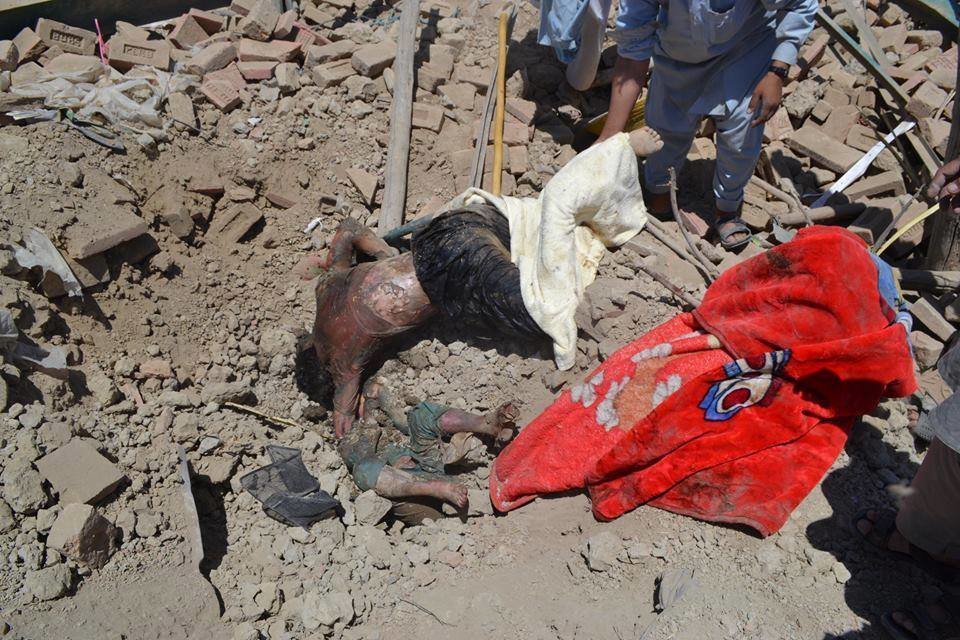
    His forces have recently killed civilians including women and children in northern Pakistan.

    He has also blocked civilians in north Waziristan from fleeing their homes in an area under military bombardment. In other words these civilians have to stay and die. This constitutes a war crime.

    Sharif as part of the Pakistan army is part of an organization with a brutal and murderous history of genocide, massacres and rapes.

    Hopefully one day he will be tried in the Hague or somewhere for war crimes.
    * * * * * * * * * * * * * * * * * * * * * * *

  • #2
    North Waziristan: Curfew imposed in Mir Ali

    May 22, 2014, 12:52 pm ONLINE


    North Waziristan: Curfew imposed in Mir Ali

    Miranshah- Pakistani air force jets continued to pound militants’ targets in a restive tribal area near the Afghan border today before clashes broke out between the military and insurgents, leaving dozens dead.
    At least 11 militants were killed in the early morning airstrikes, officials sources said, while four soldiers were also martyred in fighting near the town of Mir Ali in the North Waziristan region.
    The political administration has sealed the entry/exit points while curfew has been imposed in the region. There have been a number of insurgent attacks on the security forces in recent weeks and the air raids fit a familiar pattern of the armed forces responding by hitting the insurgents’ bases in the tribal areas.

    Miranshah- Pakistani air force jets continued to pound militants’ targets in a restive tribal area near the Afghan border today before clashes broke out


    1. Pakistani media write claims such as "X number of militants killed", but

    a: They have no way of knowing exactly how many "militants" died. None of their reporters are on the ground to walk around and count.

    b: It is claimed civilians are killed and then the Pakistani army claims it is "militants" who have been killed.


    Raheel Sharif is blocking Pakistani civilians (Pashtuns) from fleeing from a war zone being bombed.

    Sharif is caging them so they can be bombed and killed.


    Sharif is a war criminal and terrorist.
    * * * * * * * * * * * * * * * * * * * * * * *

    Comment


    • #3
      International Criminal Court

      The International Criminal Court (ICC or ICCt) is a permanent international tribunal to prosecute individuals for genocide, crimes against humanity, war crimes, and the crime of aggression (although jurisdiction for the crime of aggression will not be active until 2017 at the earliest).

      The ICC was created by the Rome Statute which came into force on 1 July 2002. The Court has established itself in The Hague, Netherlands, but its proceedings may take place anywhere. It is intended to complement existing national judicial systems, and may only exercise its jurisdiction when national courts are unwilling or unable to investigate or prosecute such crimes.


      Other war criminals captured and imprisoned before.


      Mladic.


      Milosevic.


      One day, Sharif must be tried for war crimes. It may be very unlikely that this happens because the Pakistani army is protected by America but we must at least have the hope that this war criminal is tried.
      * * * * * * * * * * * * * * * * * * * * * * *

      Comment


      • #4
        Pakistani government feels weight of army's heavy hand

        ReutersBy By Mehreen Zahra-Malik | Reuters – Fri, May 23, 2014


        By Mehreen Zahra-Malik

        ISLAMABAD (Reuters) - At Pakistani Prime Minister Nawaz Sharif's palatial offices in Islamabad this week, the army chief sat down to deliver the head of government a message he did not want to hear: The time for talks with the troublesome Pakistani Taliban was over.
        Sharif came to power a year ago promising to find a peaceful settlement with the Islamist militant group, but as round after round of talks failed, the powerful armed forces favoured a military solution.
        Their patience finally ran out and, late on Tuesday afternoon, during a tense meeting, the army effectively declared it would override a crucial plank of the government's strategy and take matters into its own hands.
        "The army chief and other military officers in the room were clear on the military's policy: the last man, the last bullet," a government insider with first-hand knowledge of the meeting told Reuters.

        Asked to sum up the message General Raheel Sharif wanted to convey at the gathering, he added: "The time for talk is over."
        The next day, Pakistani forces launched rare air strikes against militants holed up in the remote, lawless tribal belt near the Afghan border. It is not clear whether Sharif authorised the operation.
        On Thursday, they backed that up with the first major ground offensive against the Taliban there, undermining Sharif's year-long attempt to end a bloody insurgency across his country through peaceful means.
        Disagreement over the militant threat is the latest row to flare up between the government and military, and relations between the two branches of power are at their lowest ebb for years, according to government officials.
        The government did say talks with the Taliban would go on.
        "We will talk with those who are ready for it and the (military) operation is being launched against those who are not ready to come to the negotiating table," spokesman Pervez Rashid told local media on Thursday.
        But the operations put the military, which has a long record of intervening in civilian rule through plots and coups, firmly back at the centre of Pakistan's security policy.
        The balance of power is shifting at a time when foreign troops are preparing to withdraw from Afghanistan, and arch-rival India has just elected a Hindu nationalist leader promising to be more assertive on the international stage.
        "This is the clearest signal yet that the army will dictate its terms now," a member of Sharif's cabinet said.

        TALIBAN ON THE OFFENSIVE

        The Pakistani Taliban, as distinct from the Afghan Taliban which is actively targeting NATO forces in Afghanistan, is believed to be behind attacks on Pakistani soldiers and civilians that have killed thousands in recent years.
        The Pakistan army has distinguished between "good" Taliban like the feared Haqqani network - who do not attack Pakistani security forces but fight in Afghanistan - and "bad" Taliban, indigenous Pakistani militants who are seeking to create an Islamic state.

        While Pakistan's military wants to go after the "bad" Taliban, it has, despite pressure from Washington, largely avoided taking on groups who launch attacks against coalition forces in Afghanistan from Pakistan's North Waziristan region.

        Prompting the latest intervention, the Pakistani Taliban have become increasingly bold, striking the army in tribal areas including a recent battle in which an army major died. Earlier this month, nine soldiers were killed in an explosion near the Afghan border.

        "We will avenge the blood of every last soldier. Talks or no talks, the army will retaliate," said one military official, who, like most others interviewed for this article, spoke on condition of anonymity due to the sensitivity of the subject.
        The army has ruled Pakistan for more than half of its history. Sharif himself was toppled by the army in 1999 during his previous tenure as prime minister.
        But, humiliated after a secret 2011 U.S. raid that killed Osama bin Laden on Pakistani soil, the army stood back from politics and supported last year's first democratic transition of power which brought Sharif back to office.
        Sharif manoeuvred carefully, hand picking a new army chief and trying to forge a partnership with the military in the early days of his tenure, but the overtures had little lasting impact.

        TRADE, DIPLOMACY

        There are other signs of civil-military discord.
        Sharif came to power promising to rebuild relations with India, but has been under pressure to toughen his stance from hardliners at home, particularly within the army.
        The nuclear-armed neighbours have fought three wars since independence from Britain in 1947, two of them over the still-disputed Himalayan territory of Kashmir.
        Sharif's policies towards India have been heavily scrutinised; some in the army justify its hefty budget by pointing to - and, critics say, playing up - the potential threat from India.
        And despite signs the military has become more amenable to overtures from its old foe than in the past, a trade deal pushed by the prime minister and aimed at improving ties with India was cancelled at the last minute after pressure from the army, top government officials said.
        Sharif now faces a dilemma over whether to accept an invitation by Indian Prime Minister-designate Narendra Modi to attend his inauguration next week.
        The army is also bitter about the trial of former military ruler Pervez Musharraf, who ousted Sharif from power in 1999 and was arrested after he returned to Pakistan to take part in last year's election.
        Ties with Afghanistan have never been easy, but some officials believe the army wants to torpedo the government's relationship with a future Kabul administration, risking a deterioration in regional security as NATO troops prepare to leave this year.
        Generals have jealously guarded the right to dictate policy on Afghanistan, seeing friendly guerrilla groups as "assets" to blunt the influence of India there.

        TENSIONS COME TO SURFACE

        Though simmering under the surface, tensions between the government and the army spilled into the open last month when a popular journalist was shot by unknown gunmen, and his channel, Geo News, blamed the army's powerful spy agency, the Directorate of Inter-Services Intelligence (ISI).
        Public criticism of the shadowy ISI is almost unheard of in Pakistan. In a rare public response, the army demanded that Geo News, the country's most-watched news channel, be shut down.
        The government's media regulator has since resisted the army's demands to cancel the channel's license, which the military sees as a direct sign of defiance.
        "Everyone was looking out to see how the government would treat the army in this crisis -- as a friend or foe?" said a senior military official. "But the government allowed this to become a free-for-all, army-hunting season."
        For Sharif, buckling under military pressure is a major risk. "This is not about one TV channel but about freedom of expression and about living in a democracy," Rashid said. "We should live and let live."
        But despite putting on a brave front, officials say the government is feeling under siege.
        "Never in the last year has the government felt weaker or more vulnerable," one of Sharif's key economic advisers said. "Now every time we have to take a major decision, on India, on Afghanistan, we will have to think 'How will the army react?'"
        A serving general said the army chief would always pick the "institution over the constitution if push comes to shove," adding: "As a society and a state, we have to avoid a context in which the army is pushed to do something it doesn't want to."

        (Editing by Mike Collett-White and Maria Golovnina)

        By Mehreen Zahra-Malik ISLAMABAD (Reuters) - At Pakistani Prime Minister Nawaz Sharif's palatial offices in Islamabad this week, the army chief sat down to deliver the head of government a message he ...


        1. This article is claiming that war criminal, Raheel Sharif, has told the current Pakistani prime minister, the corrupt, Nawaz Sharif that the army will be adopting a tough policy against the Taliban. The army will be running the show.


        2. The Pakistan army is a failed institution with a history of humiliation and failure.

        a: In 1971 it launched a bloodbath against Pakistani citizens slaughtering hundreds of thousands of Pakistani citizens in the eastern wing before it was defeated and expelled.

        The Pakistan army lost half of the country, not the MQM, the ANP, but the traitors of the Pakistan army.


        b: It ruled Pakistan for 9 years from 1999-2008 in the form of military dictator Pervez Musharraf. The military government achieved the following:

        - It re-ignited the Baloch insurgency through its killing of Baloch leader Akbar Bugti.

        - It massacred Pakistani civilians in a mosque in the federal capital, Islamabad, the Lal Masjid scandal.

        - Ignited the Pakistan (mainly Punjab) lawyers movement against him over the sacking of the chief justice.

        By the 2007 military rule in Pakistan had caused the country to be suffering from a massive terrorist campaign, a Baloch insurgency, a struggling economy and socio-political crisis.

        Musharraf handed over power to a civilian government in 2008 after elections.

        The military ruined Pakistan in their 9 year rule.


        The military has already lost east Pakistan, reignited the Baloch insurgency, massacred Pakistani civilians in the capital and if its aggressive policies cause more trouble in FATA and the possible break up of Pakistan itself, it will have no one to blame but themselves.

        If Pakistan breaks up then the independent Punjab should try Raheel Sharif as a war criminal, similar to the way Pervez Musharraf, the former military dictator is now being tried in court.


        Pervez Musharraf, the former military dictator of Pakistan who is now being tried in Pakistani courts. He was the former head of the Pakistan army, a failed institution with a long list of humiliations, defeats and failures including losing half of the country in 1971, massacring Pakistani civilians and ruining the country and its economy as it did by 2007.
        * * * * * * * * * * * * * * * * * * * * * * *

        Comment


        • #5
          PLEASE SIGN THIS PETITION:


          Investigation of civilian killings by Pakistan Army in North Waziristan ,FATA ,Pakistan


          Petition by

          Justice For Pashtuns


          Pashtuns civilians on Afghanistan-Pakistan border particularly in Pakistan’s Federally Administered Tribal Areas (FATA) have been the worst-hurt victims of the current war involving Taliban, Pakistan Armed Forces and US/NATO ISAF since 9/11. Last week (May 21, 2014) Pakistani F-16 jet planes started bombing North Waziristan but instead of precisely targeting terrorist camps, they conducted lethal air raids on civilian populations in different villages of North Waziristan. According to the fleeing people, the bombardment has been indiscriminate in which hundreds of civilian men, women and children have been killed and injured while forcing thousands of people to scramble to safer areas such as Bannu, Pakistan and for the first time ever to Khost, Afghanistan. Based on an oppressive set of colonial laws like the Frontier Crimes Regulation and the prevailing conflict situation, the Government of Pakistan particularly the Pakistan Army keeps the FATA strictly out of bounds for the media preventing it from ascertaining the death toll in the latest aerial aggression. We demand a parliamentary inquiry into the May 21 civilian carnage in North Waziristan and strongly demand that the perpetrators be immediately brought to court and the victims’ human rights restored. Furthermore, we demand that journalists and human rights organizations be given immediate access to North Waziristan to investigate these Pakistan Air Force assaults on densely populated villages. To make matters worse for the displaced civilians, the Government of Pakistan has not even notified North Waziristan as a conflict zone and therefore the displaced persons are stranded without support from any government institution or humanitarian organization.
          * * * * * * * * * * * * * * * * * * * * * * *

          Comment


          • #6
            Will he, won't he?


            - There are reports that Shareef is being asked to get Pakistani soldiers to fight and kill Yemenis in return for money by the Saudis.

            - Will Shareef and his traitor Pakistan army kill Muslims for money?


            Yemen crisis, Saudi is bombing the country, Pakistani soldiers may go there soon for cash to kill Yemenis.


            Will the C.E.O. of the Pakistan army inc., Raheel Shareef, decide that it's a good and lucrative business project?
            * * * * * * * * * * * * * * * * * * * * * * *

            Comment

            Working...
            X