
 Tweet
Japan wants Dhaka to look east
Nurul Islam Hasib, bdnews24.com
Published: 2014-05-21 19:13:03.0 BdST Updated: 2014-05-22 02:10:07.0 BdST

Japan will try to impress Prime Minister Sheikh Hasina to take “a serious look” towards the east for expanding trade during her upcoming Tokyo visit, its ambassador in Dhaka has said.
Japanese envoy upbeat on Bangladesh
2014-05-21 14:07:29.0
Japan eyeing 'comprehensive partnership' with Bangladesh
2014-03-22 18:25:34.0
Dhaka-Tokyo ties to get a boost
2014-05-15 21:34:30.0
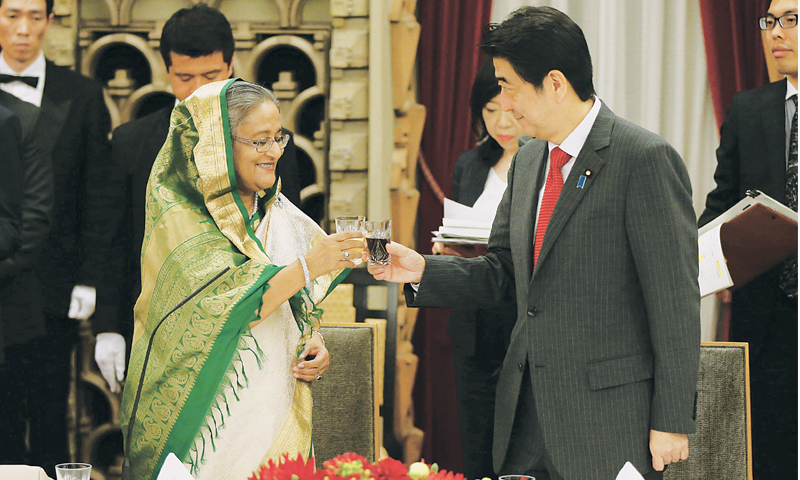
Hasina will leave Dhaka for Japan on the night of May 24 on a four-day official visit.
Aambassador Shiro Sadoshima on Wednesday said the upcoming visit proved the bilateral relations between the two countries entered “a new phase”.
Japan, which established diplomatic ties with Bangladesh in February 1972, is the largest bilateral development partner of the country.
Its assistance comes regularly as grant, aid, technical assistance and soft loan. The total grants and aid reached $11 billion last year.
The ambassador said Bangladesh had been “very successful” in connecting European and North American market and became number two ready-made clothes exporter in the world.
He said Japanese business people would be “very happy” to work with Bangladesh “to diversify your industries”.
“But at this moment this is not happening because your basic orientation is with the West, not seriously with the East yet,” he said.
The ambassador was speaking with the diplomatic correspondents in Dhaka at a talks organised by Diplomatic Correspondents Association, Bangladesh (DCAB) with its President Mainul Alam in chair.
General Secretary Angur Nahar Monty delivered the welcome speech in the talks, ahead of prime minister’s Tokyo visit.
In the last seven years the number of Japanese companies operating in Bangladesh has nearly tripled --from 61 in 2007 to 176 in 2013.
But the envoy said Japan wants to see Japanese big companies and establishments coming over to Bangladesh and set up their establishments.
He said after China became costly, Japanese businesses were looking for alternatives and Vietnam already seized the opportunity.
But still Bangladesh has potentials to attract them, he said.
He said there were huge amount of trade taking place among Japan, Korea, China and ASEAN countries.
“Bangladesh is sitting right next to this,” he said. “Bangladesh should take a very serious look at this”.
“This will also satisfy your aspiration to diversify the base of your production in coming years and future as well”.
Hasina has visited Tokyo twice in her last as many tenure.
But Tokyo lays more importance on her this visit as it has a vision for this region, which Prime Minister Shinzo Abe cleared last year.
Japan’s strategic intention was to combine two oceanic regions –Pacific Ocean and Indian Ocean – together for what the ambassador said larger space for Japan’s economic activities.
He said it looks like a “butterfly” in which Bangladesh and Myanmar occupies the “lynchpin position” to connect these oceanic regions.
“We now want to enhance the bilateral relations in political and economic areas (with Bangladesh),” he said, adding that Tokyo finds no problem in engaging with the current government, despite the Jan 5 elections were held without the participation of BNP.
“We need closer policy dialogue so that both sides would be able to efficiently translate those visions and policies into reality”.
He said the elections had been constitutional and there was no legal flaw at all in it.
The envoy said Japan strongly believes that Bangladesh is going to play “a very important role for prosperity and peace of the region”.
“And from Japan’s perspective it has also potential to provide large economic activities”.
“We find many potentials here, hard working people, good number of engineers and bankers,” he said. “We like to invite all people to come here”.
The envoy said the visit would further develop the relations through “a comprehensive partnership” that the Japanese foreign minister Fumio Kishida sought during his visit in March.
“We want to make a difference when your PM visit Japan by inviting our investment here”.
To do so, he said, “Japan is ready to do everything possible”.
He, however, would not say specifically what would be discussed during the visit as, he said, he was not in a position to say so.
“The visit will be very important particularly to promote bilateral economic relations,” he maintained.
He said Japan might find out “opportunities” to collaborate with the government and the two armed forces to learn Bangladesh’s experiences in the field of peacekeeping.
Dhaka is one of the major peacekeeper- sender countries in the world.
He said Japan would be always behind Bangladesh to help constructing facilities and pointed out that lack of energy and infrastructure were the main stumbling blocks in the way of increases trade and investment.

- Japan is considered by some Bangladeshis to be the best friend of Bangladesh (others think it is China).
- It has done more for Bangladesh than its so-called "Muslim brothers" such as Saudi Arabia and the GCC e.g. Saudi police harass Bangladeshi workers on the orders of the Saudi regime to display anger at the centre-left Bangladeshi government not being compliant to Pakistan.
- I for one am deeply grateful to Japan for its invaluable support to our nation.
- Bangladesh needs to look east i.e. to China, Japan, Malaysia, Indonesia who are our true friends.
Nurul Islam Hasib, bdnews24.com
Published: 2014-05-21 19:13:03.0 BdST Updated: 2014-05-22 02:10:07.0 BdST
Japan will try to impress Prime Minister Sheikh Hasina to take “a serious look” towards the east for expanding trade during her upcoming Tokyo visit, its ambassador in Dhaka has said.
Japanese envoy upbeat on Bangladesh
2014-05-21 14:07:29.0
Japan eyeing 'comprehensive partnership' with Bangladesh
2014-03-22 18:25:34.0
Dhaka-Tokyo ties to get a boost
2014-05-15 21:34:30.0
Hasina will leave Dhaka for Japan on the night of May 24 on a four-day official visit.
Aambassador Shiro Sadoshima on Wednesday said the upcoming visit proved the bilateral relations between the two countries entered “a new phase”.
Japan, which established diplomatic ties with Bangladesh in February 1972, is the largest bilateral development partner of the country.
Its assistance comes regularly as grant, aid, technical assistance and soft loan. The total grants and aid reached $11 billion last year.
The ambassador said Bangladesh had been “very successful” in connecting European and North American market and became number two ready-made clothes exporter in the world.
He said Japanese business people would be “very happy” to work with Bangladesh “to diversify your industries”.
“But at this moment this is not happening because your basic orientation is with the West, not seriously with the East yet,” he said.
The ambassador was speaking with the diplomatic correspondents in Dhaka at a talks organised by Diplomatic Correspondents Association, Bangladesh (DCAB) with its President Mainul Alam in chair.
General Secretary Angur Nahar Monty delivered the welcome speech in the talks, ahead of prime minister’s Tokyo visit.
In the last seven years the number of Japanese companies operating in Bangladesh has nearly tripled --from 61 in 2007 to 176 in 2013.
But the envoy said Japan wants to see Japanese big companies and establishments coming over to Bangladesh and set up their establishments.
He said after China became costly, Japanese businesses were looking for alternatives and Vietnam already seized the opportunity.
But still Bangladesh has potentials to attract them, he said.
He said there were huge amount of trade taking place among Japan, Korea, China and ASEAN countries.
“Bangladesh is sitting right next to this,” he said. “Bangladesh should take a very serious look at this”.
“This will also satisfy your aspiration to diversify the base of your production in coming years and future as well”.
Hasina has visited Tokyo twice in her last as many tenure.
But Tokyo lays more importance on her this visit as it has a vision for this region, which Prime Minister Shinzo Abe cleared last year.
Japan’s strategic intention was to combine two oceanic regions –Pacific Ocean and Indian Ocean – together for what the ambassador said larger space for Japan’s economic activities.
He said it looks like a “butterfly” in which Bangladesh and Myanmar occupies the “lynchpin position” to connect these oceanic regions.
“We now want to enhance the bilateral relations in political and economic areas (with Bangladesh),” he said, adding that Tokyo finds no problem in engaging with the current government, despite the Jan 5 elections were held without the participation of BNP.
“We need closer policy dialogue so that both sides would be able to efficiently translate those visions and policies into reality”.
He said the elections had been constitutional and there was no legal flaw at all in it.
The envoy said Japan strongly believes that Bangladesh is going to play “a very important role for prosperity and peace of the region”.
“And from Japan’s perspective it has also potential to provide large economic activities”.
“We find many potentials here, hard working people, good number of engineers and bankers,” he said. “We like to invite all people to come here”.
The envoy said the visit would further develop the relations through “a comprehensive partnership” that the Japanese foreign minister Fumio Kishida sought during his visit in March.
“We want to make a difference when your PM visit Japan by inviting our investment here”.
To do so, he said, “Japan is ready to do everything possible”.
He, however, would not say specifically what would be discussed during the visit as, he said, he was not in a position to say so.
“The visit will be very important particularly to promote bilateral economic relations,” he maintained.
He said Japan might find out “opportunities” to collaborate with the government and the two armed forces to learn Bangladesh’s experiences in the field of peacekeeping.
Dhaka is one of the major peacekeeper- sender countries in the world.
He said Japan would be always behind Bangladesh to help constructing facilities and pointed out that lack of energy and infrastructure were the main stumbling blocks in the way of increases trade and investment.
- Japan is considered by some Bangladeshis to be the best friend of Bangladesh (others think it is China).
- It has done more for Bangladesh than its so-called "Muslim brothers" such as Saudi Arabia and the GCC e.g. Saudi police harass Bangladeshi workers on the orders of the Saudi regime to display anger at the centre-left Bangladeshi government not being compliant to Pakistan.
- I for one am deeply grateful to Japan for its invaluable support to our nation.
- Bangladesh needs to look east i.e. to China, Japan, Malaysia, Indonesia who are our true friends.




Comment