

 Tweet
Tweet
Geo TV's face-off with ISI spy agency – a subplot of a larger tussle in Pakistan
For decades Pakistan's Directorate for Inter-Services Intelligence was the spy agency that could not be named, let alone publicly criticised. The media would refer only to the "agencies", the "establishment" or, even more coyly, "the angels".
But in the past week that taboo has been broken by the Independent Media Corporation, Pakistan's largest media group, which has used the two biggest newspapers in the country and by far its most popular television network to daily hammer the ISI.
The high-stakes gamble threatens to destroy the group and further sour already tense relations between the government and army.
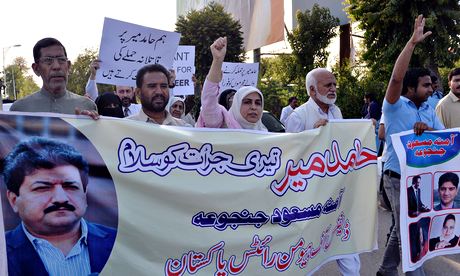
The media onslaught followed the shooting last Saturday in Karachi of Hamid Mir – the star anchor on Geo News, the channel that pioneered tabloid television news in Pakistan.
Geo editors cleared the bulletins for non-stop coverage of the attempt to kill Mir and the claims by his brother that the attack on his car had been directly ordered by the ISI's normally low profile chief, Zaheer-ul-Islam, whose picture the TV channel displayed for hours.
The agency, Mir claimed, had been infuriated by his Capital Talk programmes that criticised ISI tactics against separatists in Balochistan province, where the military is accused of kidnapping and illegally detaining suspects.
The Urdu-language Jang newspaper and its English stablemate, the News, which like Geo followed up with a daily barrage of attacks against an enormously powerful agency that has been accused of everything from rigging elections to backing Taliban insurgents in Afghanistan.
"It's unprecedented – the first time you have the ISI facing off with a media channel in such a manner," said Jugnu Mohsin, a veteran newspaper publisher who has watched the emergence of the boisterous private television business since the sector was deregulated under the former president Pervez Musharraf.
She said the firm's belligerence is a sign of power shifting in the country with the media, judiciary and politicians all becoming increasingly assertive against a once unassailable military.
"This is Pakistan's middle classes asserting their power and manifesting themselves in wanting more openness and rule of law for everybody," she said.
But plenty of other journalists, including those within the Independent Media Corporation, are deeply critical of Geo's stance.
Public opinion is also divided, with many horrified by the unheard of attacks on an institution that has cultivated an image for itself as a guardian of Pakistan's honour. There have been calls on social media for the government to ban Geo and posters have gone up in some cities declaring "We love Pakistan army and ISI".
Although international human rights groups have reported on the ISI harassing, kidnapping and even torturing journalists in the past, they say there was simply no evidence to support Mir's claims that the ISI was responsible for the attack on him.
Mir has also been threatened by the Taliban, although no militant group claimed responsibility for the Karachi shooting.
Others see the hand of Mir Shakil-ur-Rahman, in the broadsides against the ISI.
For decades Pakistan's Directorate for Inter-Services Intelligence was the spy agency that could not be named, let alone publicly criticised. The media would refer only to the "agencies", the "establishment" or, even more coyly, "the angels".
But in the past week that taboo has been broken by the Independent Media Corporation, Pakistan's largest media group, which has used the two biggest newspapers in the country and by far its most popular television network to daily hammer the ISI.
The high-stakes gamble threatens to destroy the group and further sour already tense relations between the government and army.
The media onslaught followed the shooting last Saturday in Karachi of Hamid Mir – the star anchor on Geo News, the channel that pioneered tabloid television news in Pakistan.
Geo editors cleared the bulletins for non-stop coverage of the attempt to kill Mir and the claims by his brother that the attack on his car had been directly ordered by the ISI's normally low profile chief, Zaheer-ul-Islam, whose picture the TV channel displayed for hours.
The agency, Mir claimed, had been infuriated by his Capital Talk programmes that criticised ISI tactics against separatists in Balochistan province, where the military is accused of kidnapping and illegally detaining suspects.
The Urdu-language Jang newspaper and its English stablemate, the News, which like Geo followed up with a daily barrage of attacks against an enormously powerful agency that has been accused of everything from rigging elections to backing Taliban insurgents in Afghanistan.
"It's unprecedented – the first time you have the ISI facing off with a media channel in such a manner," said Jugnu Mohsin, a veteran newspaper publisher who has watched the emergence of the boisterous private television business since the sector was deregulated under the former president Pervez Musharraf.
She said the firm's belligerence is a sign of power shifting in the country with the media, judiciary and politicians all becoming increasingly assertive against a once unassailable military.
"This is Pakistan's middle classes asserting their power and manifesting themselves in wanting more openness and rule of law for everybody," she said.
But plenty of other journalists, including those within the Independent Media Corporation, are deeply critical of Geo's stance.
Public opinion is also divided, with many horrified by the unheard of attacks on an institution that has cultivated an image for itself as a guardian of Pakistan's honour. There have been calls on social media for the government to ban Geo and posters have gone up in some cities declaring "We love Pakistan army and ISI".
Although international human rights groups have reported on the ISI harassing, kidnapping and even torturing journalists in the past, they say there was simply no evidence to support Mir's claims that the ISI was responsible for the attack on him.
Mir has also been threatened by the Taliban, although no militant group claimed responsibility for the Karachi shooting.
Others see the hand of Mir Shakil-ur-Rahman, in the broadsides against the ISI.




Comment