Announcement

Collapse
No announcement yet.

India to pay Russia for arms, ammo it sells to Afghanistan
Collapse
X
 
  • Filter
  • Time
  • Show
Clear All
new posts

  • India to pay Russia for arms, ammo it sells to Afghanistan

    India to pay Russia for arms, ammo it sells to Afghanistan


    Written by Pranab Dhal Samanta | New Delhi | April 18, 2014 2:23 am Print

    The first order under this deal, sources said, is already being executed. The first order under this deal, sources said, is already being executed.

    India, is committed to provide arms and ammunition to strengthen the Afghan National Army.

    Ahead of NATO troops downsizing their presence in Afghanistan, India has firmed up a far-reaching deal with Russia to supply arms to the troubled country under which New Delhi will pay for the military equipment that will be sourced from Moscow.

    The deal, which had been under intense negotiations for the past few months, was clinched after a high-level Indian team made a quiet trip to Moscow in February and stitched up the loose ends even as Russia was bracing for the challenge in Ukraine.

    The first order under this deal, sources said, is already being executed.
    India, through the strategic partnership with Afghanistan, is committed to provide arms and ammunition to strengthen the Afghan National Army. The arrangement with Moscow allows New Delhi to fulfill this commitment, an issue on which Kabul has been sending reminders including detailed lists of its requirements.

    The issue was debated at length on various occasions in the Cabinet Committee on Security, which eventually arrived at two conclusions — that India will have no troop presence in Afghanistan; and that India will not provide small arms even though some are manufactured domestically.
    The logic behind the second decision was to avoid a situation where any India-marked small arms make their way into Kashmir or to the hinterland through terrorist outfits.

    While Russia may separately supply its own range of Kalashnikovs, the Indian financing will largely focus on artillery guns, air support in the form of choppers and even armoured vehicles, including tanks.

    A range of non-lethal items could also make it to the list depending on the nature of the requirement. Also part of the arrangement is an exercise to refit some old Russian-made equipment lying with Afghanistan for years, sources said, adding that a survey of such equipment has been carried out.
    As of now, the ANA is a predominantly infantry force as the US, sources said, limited its access to long-range guns largely due to Pakistani concerns. But over the past of couple of years, Afghanistan has been pressuring countries such as India and Russia to properly equip the ANA if it has to repel Taliban offensives on its own.

    On the training front, the Indian position remains the same. While trying to meet Afghan demands for more seats here, the government is still against setting up any facility in Afghanistan and posting instructors there. Sources pointed out that any such move may also invite strong Pakistani protests.
    Besides, India has also held preliminary conversations with China on jointly improving the connectivity infrastructure in Afghanistan’s mining belt so that the resources can be better exploited. Both countries already have interests in specific mining projects and are looking to expand their presence, which would aid Afghanistan’s economy.


    - India and Russia are looking to ensure the continued stability of Afghanistan and national governments in Kabul.


    - The recent national elections in Afghanistan which, despite some violence, the Taliban were unable to sabotage is being cited by some as an example of the growing strength of the Kabul government, though on the other hand a minister was kidnapped this week in Kabul.


    [MENTION=4551]hamid954[/MENTION]
    * * * * * * * * * * * * * * * * * * * * * * *

    Shukran ya Masr!!!

    Thanks to Egypt for supporting Bangladesh against Pakistani harassment and support for terrorists and war criminals!!

  • #2
    Indian Army commanders to meet to discuss Afghanistan

    Friday, 18 April 2014 - 8:15am IST | Place: New Delhi | Agency: DNA

    DNA Correspondent


    Outgoing army chief General Bikram Singh will take stock of impact drawdown of Allied forces from Afghanistan and possible measures to counter threat arising from that country with his top commanders during Army Commanders Conference, scheduled to begin from next Monday in New Delhi.

    Defence minister AK Antony, who has the distinction of being the longest-serving defence minister of the country, will also address the top commanders for the last time in UPA-II government.

    According to army, the security as well as intelligence agencies are keeping a close watch on the developments in trouble-torn fragile Afghanistan. And especially after pullout of US led allied forces from there by the end of 2014.

    "Various operational and strategic issues will be discussed during the five-day-long conference. Developments in neighbouring countries especially Afghanistan will also be part of the discussion,"said an officer.

    Keeping in view of drawdown of US-led forces from Afghanistan in 2014, Indian Army is also providing training to Afghanistan National Army (ANA). According to to army, Army is targeting to train about 1100 Afghan troops by the end of 2014, as compared to 574 personnel training in last year. Though New Delhi has not decided on the request of Afghanistan government to provide them lethal weapons, but they are considering an option send first batch of Indian experts and officers to Afghanistan to give training to ANA in their backyard and their home conditions. Training in their locations and terrain would given them an edge as compared to training here in Indian conditions.

    Five day Army Commanders Conference, beginning from April 21, will also discuss security situation in Jammu and Kashmir and the issue of incursions by Chinese troops in Indian territory.

    The issue of incursion by the Chinese troops along the Line of Actual Control is expected to come up for discussion, Army officials said.

    The Indian side will also discuss the issues to be raised by the Director General of Military Operations (DGMO) during the delegation-level parleys with his Chinese counterpart starting April 23.

    The LAC has seen several incidents of face-offs between Indian and Chinese troops and the two sides have signed a border pact recently to avoid the possibility of a flare-up between their troops while carrying out patrolling.

    Meanwhile, the meeting is also expected to take up the security situation in Jammu and Kashmir and the expected rise in infiltration and activities by terrorists in the coming months.

    * * * * * * * * * * * * * * * * * * * * * * *

    Shukran ya Masr!!!

    Thanks to Egypt for supporting Bangladesh against Pakistani harassment and support for terrorists and war criminals!!

    Comment


    • #3
      India-Russia cooperation in post-2014 Afghanistan


      Discussion in 'Strategic & Geopolitical Issues' started by Gessler, Yesterday at 8:41 PM.


      With the countdown beginning for the pulling out of international forces from Afghanistan, New Delhi is left with an eerie scenario of Taliban getting back the levers of power in the war-ravaged country. For India, this represents a disturbing proposition since it was during the time the Taliban was in power in Afghanistan (in December 1999) that an Indian aircraft was hijacked to Kandahar in Afghanistan and India had to release three dreaded terrorists in return. However, after the overthrow of the Taliban regime, India has regained precious lost ground in Afghanistan and has now opened consulates in Afghan cities like Kandahar, Mazar-e-Sharif, Jalalabad and Herat. At the same time, it has paid a heavy price and has borne the brunt of terrorist attacks on the Indian Embassy in Kabul. If indeed, the Taliban takes over the reins of power in Afghanistan after international forces leave in 2014, this would mean a significant setback for India.

      India has a huge stake in Afghanistan and has committed around $2 billion in developmental assistance to that country, thus becoming one of the leading international donors in Afghanistan. Besides, a consortium of Indian companies (from both the public and private sector) has won the rights to invest in the Hajigak iron ore reserves in Afghanistan. India has also given scholarships to hundreds of Afghan students to study in Indian institutions and now is the time when New Delhi should be trying to reap the benefits of the goodwill it has generated.

      For Russia too, the return of the Taliban to Afghanistan is a dangerous proposition, since that is likely to stoke the embers of terrorism in Chechnya, Dagestan and other parts of Russia. A Taliban takeover in Afghanistan would also impact stability in Central Asia, which would ultimately impact Russian interests.


      So, in what ways can Russia and India cooperate in post-2014 Afghanistan?
      For starters, it was Russia and India (along with Iran) who played a key role in tacitly backing the anti-Taliban Northern Alliance in Afghanistan which swept away the Taliban from Kabul after the start of Operation Enduring Freedom in the aftermath of 9/11. In case the Taliban were to take over the reins of power in Afghanistan once again, Russia, India and Iran would need to revive their cooperation to back up a grouping in Afghanistan which could serve as an antidote.

      As seen from a recent agreement where India has agreed to fund the supply of Russian origin weaponry to Afghanistan, New Delhi is prepared to help strengthen the fledgling Afghan National Army (ANA). Since both domestic and foreign policy considerations prevent New Delhi from supplying weaponry to Afghanistan directly, it has chosen this route. The Strategic Partnership Agreement signed between India and Afghanistan in October 2011 during the visit of the Afghan President Hamid Karzai to India has committed New Delhi to assist Afghanistan “in the training, equipping and capacity building programmes for Afghan National Security Forces”

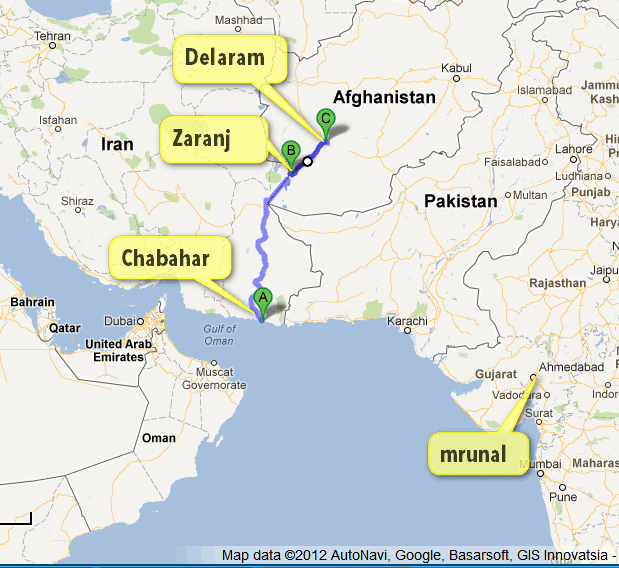
      India and Russia need to ensure the economic viability of Afghanistan. It is here that the Indian-funded and constructed roads like the Zaranj-Delaram highway would be critical since they provide an alternate access to the sea to Afghanistan. The stability of Afghanistan is also critical to the safety and security of the planned TAPI (Turkmenistan-Afghanistan-Pakistan-India) pipeline which will bring natural gas from Turkmenistan to India and is scheduled to be operational by 2017.


      The Zaranj-Delaram highway that connects Afghanistan to the Chabrahar port in Iran, which is also being funded & built by India to open up new passages & trade routes with Afghanistan & Iran.

      Moscow and New Delhi also need to pool their resources with countries which have much to lose in case the Taliban were to come back to power in Kabul, which would include the Central Asian countries and China. Indeed, the withdrawal of international forces from Afghanistan would make the Chinese province of Xinjiang, vulnerable to further attacks. Already the province has been affected by violence and the ramifications of the same can be seen in cities like Kunming where there was a deadly knife attack. China also has significant economic investments in Afghanistan and would stand to lose a lot in case the Taliban were to take over the country. Besides, Russia and India can also help engage and stabilize Afghanistan through organizations like the Shanghai Cooperation Organisation (SCO) where Russia is a member while India and Afghanistan are observers.

      There are various scenarios that are possible in Afghanistan after the western troops leave. There is a possibility that some western forces would stay back in Afghanistan even after 2014 although the present President Hamid Karzai has refused to sign a security deal that would let some US troops stay in Afghanistan after their current mission ends this year. The Taliban would most likely control the major part of the country and India has to come to terms with this fact. With the Western countries interested in keeping alive a channel of communication with the Taliban as reflected in the opening of a Taliban office in Doha, India too should take the cue and keep open its channels of communication with the Taliban.

      At the same time, it would be naïve to assume that Pakistan would not try to once again prop up the Taliban as an anti-Indian front.

      India would need to go for innovative diplomacy when it engages with Afghanistan post-2014. In the interests of its own national security, it will need to make certain concessions. New Delhi will also have a new government soon. Afghanistan is too important for India’s own national security interests and hence cooperation with Russia in stabilising Afghanistan is the best option for India at this critical juncture.


      1. China, Russia and India all want a stable Afghanistan free of terrorists, for peace in their own countries and regions.


      America wants radicalism to flourish to create problems for China and Russia.


      2. Ultimately the China, Russia, India axis is growing stronger day by day with economic growth and the US is getting weaker.

      Afghanistan too as a nation is getting stronger, with more and more education, economic growth, development of national government etc.


      In the long run the Taliban will not win in the next few decades.
      * * * * * * * * * * * * * * * * * * * * * * *

      Shukran ya Masr!!!

      Thanks to Egypt for supporting Bangladesh against Pakistani harassment and support for terrorists and war criminals!!

      Comment


      • #4
        Afghanistan bullish on military ties with India

        Faced with the prospects of a military vacuum as Western forces will soon withdraw from its territory, Afghanistan is hopeful that India, under the Modi government, will emerge as a major player in filling the security gap in the strife-torn nation.

        “Even before Prime Minister Narendra Modi had taken the oath of office, Afghanistan President Hamid Karzai had held two telephonic conversations with him, setting the tone for energising an already formidable relationship,” a diplomatic source said. The appointment of Ajit Doval as National Security Adviser also undergirds Afghan hopes. “We are aware of Mr. Doval’s security instincts when it comes to Afghanistan, and these augur well for a robust military relationship,” the source said.

        From Afghanistan’s perspective, a prominent military dimension will raise the profile of the relationship between the two SAARC countries to the next level. With the Americans expected to leave behind only 10,000 troops by 2014-end, the Afghans are looking to bolster their armed forces with big-ticket military hardware from India, including Russian-origin fighter jets and tanks that New Delhi eventually wants to discard. These include MiG-21 fighters and T-72 tanks, apart from Bofors howitzers and equipment vital for command and control. But wary of upsetting Pakistan, the UPA-II government had told the Afghans that India would not be in a position to fly this equipment over Pakistani airspace in case it required repair in Indian military establishments, sources said.

        Consequently, the Afghans approached the problem in a larger geopolitical perspective, involving a deeper and simultaneous engagement with India, Russia and China. Russia was approached to supply India-funded military hardware to Afghanistan, resulting in the establishment of a complex triangular partnership.

        Reuters had earlier quoted Indian officials as saying that New Delhi had held talks with China, Japan and Iran to find ways to fund Afghan security demands, with a price tag of around $4 billion a year.

        Seeking a special relationship with China, the Afghans want Beijing to invest heavily in their country, hoping that the Chinese will drive sufficient economic and commercial stakes in Afghanistan, persuading them to play a stabilising role in the country.

        Analysts point out that the focus of Afghanistan on India, Russia and China to fortify its strategic interests comes at a time of a sharp deterioration of ties between Washington and Moscow, and Russia’s growing relationship with China, anchored by a recent $400-billion gas deal.


        - Afghans are looking for MIG-21s


        A Russian-made MIG-21 fighter jet.


        [MENTION=223]JAMALUDEEN[/MENTION]
        * * * * * * * * * * * * * * * * * * * * * * *

        Shukran ya Masr!!!

        Thanks to Egypt for supporting Bangladesh against Pakistani harassment and support for terrorists and war criminals!!

        Comment

        Working...
        X
