Announcement

Collapse
No announcement yet.

Iran Guard Says Military Sites Not Open To Inspections

Collapse
X
 
  • Filter
  • Time
  • Show
Clear All
new posts

  • Iran Guard Says Military Sites Not Open To Inspections

    Iran Guard Says Military Sites Not Open To Inspections

    RFE Sunday 19th April, 2015

    A senior commander in Iran's Islamic Revolutionary Guards Corps (IRGC) says the country's military sites would not be open to foreign inspection under any nuclear agreement with world powers.
    Hossein Salami, the Guard's deputy leader, told state TV on April 19 that allowing the foreign inspection of military sites amounts to "selling out."
    Iran and the six world powers agreed on April 2 on a framework for a final deal that would limit Iran's nuclear program in exchange for relief from economic sanctions.
    They have set a June 30 deadline for an agreement.
    A fact sheet on the framework accord issued by the State Department said Iran would be required to grant the UN nuclear agency access to any "suspicious sites."
    Iran has repeatedly said its military sites will not be open to inspection.
    Based on reporting by AP and farsnews.com

    "The past is not my concern. The future is no longer my concern either. One minute. One minute of everything at once. And anything before is nothing. Everything after nothing. Nothing in comparison to that one minute."

  • #2
    Well, Ofcourse. They are not going to make the same mistake as Saddam. First inspect and learn their military capabilities and then attack.

    Comment


    • #3
      Originally posted by khushal View Post
      Well, Ofcourse. They are not going to make the same mistake as Saddam. First inspect and learn their military capabilities and then attack.
      I oppose Iran's nuclear program for reasons that the regime in place is currently involved in wars that are spreading sectarianism throughout the region. Put that aside though.


      The US-Iran nuclear talks can be summed up in a few points.

      1) US's main concern is to avoid a military confrontation with Iran. That is the number one objective of the talks. In the back channel talks that began in 2012, the US asked that Iran steer clear of US interests in the Gulf, and in return the US would not be involved with or support an Israeli strike on Iran. However, Iran responded by saying that they would consider an Israeli strike on Iran as the same as an American strike.

      Washington reportedly sends Tehran indirect message saying it will not back Israeli strike on nuclear facilities as long as Iran refrains from attacking American facilities in Persian Gulf


      2) the second objective (which is really an extension of the first) is to prevent Israeli military confrontation/strike on Iran. This is actually why the US is engaged in talks with Iran in the first place. US foreign policy establishment is hoping to resolve the Iranian nuclear issue in order to prevent Israel from striking Iran.

      3) Second objective is to determine if US-Iran ties can be restored under a grand deal. The hope is that US companies would reenter the Iranian economy, especially the oil sector. This is very naive as it disregards one of the founding principles of Khomeinei who ruled out any sort of diplomatic or economic relationship with the US as it is considered "the Great Satan." Even if some desire within Iranian clergy exists, it will never materialize because it would mean the end of Khomeinei's Iranian revolution. It is taboo for the regime. The WH policy paper which advises to seek out ties with Iran was authored by James Baker. In their paper, they state that US interests can be forwarded by Iran, and can be aligned. It is a very naive paper written by people considered to be "expert former state officials." You can understand the US approach to the Iran talks through this.
      Last edited by Insight; 04-20-2015, 12:50 AM.
      "The past is not my concern. The future is no longer my concern either. One minute. One minute of everything at once. And anything before is nothing. Everything after nothing. Nothing in comparison to that one minute."

      Comment


      • #4
        Is there a link to the paper?

        Comment


        • #5
          Originally posted by khushal View Post
          Is there a link to the paper?

          These two links discuss the most revealing parts of Zbigniew Brzezinski report

          The Iran Project's new report, Iran and Its Neighbors: Regional Implications for U.S. Policy of a Nuclear Agreement, examines the potential shift in Iran’s relations with other countries in the Middle East after a comprehensive nuclear agreement is reached, and the implications of these changes for US foreign policy.


          The report is here below. You will have to either download it from the website or try to zoom in.

          "The past is not my concern. The future is no longer my concern either. One minute. One minute of everything at once. And anything before is nothing. Everything after nothing. Nothing in comparison to that one minute."

          Comment


          • #6
            Why the details of the Iran deal don’t matter
            More Topics
            U.S. Foreign Policy
            Iran
            Nonproliferation
            Nuclear Weapons
            Nuclear Energy
            Middle East and North Africa
            Military Technology
            negotiation
            Share on emailShare on twitterShare on facebookShare on linkedin Share on google_plusone_shareShare on stumbleuponShare on redditShare on print
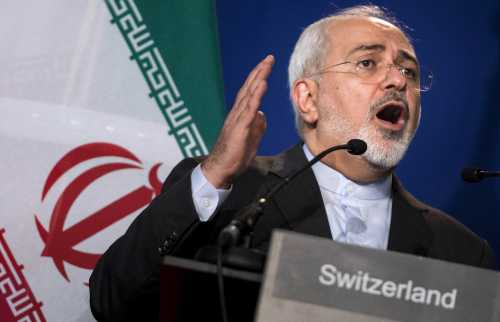
            Iran's Foreign Minister Javad Zarif gestures as he speaks during a news conference at the Swiss Federal Institute of Technology in Lausanne (REUTERS/Brendan Smialowski).
            Negotiating with Iran over its nuclear program has become something of a national pastime and a cottage industry in U.S. foreign policy circles. Since that fateful day in 2002 when it was revealed that Iran was secretly pursuing an enrichment program, we have all learned more than most of us would have cared to about advanced centrifuges, uranium enrichment, and pathways to nuclear weapons. And so naturally, with the semi-culmination of the negotiations last week, we are all picking over the minutiae, while declaring gravely that “the devil is in the details.” But while we have learned much in the last 13 years about nuclear weapons development, we have forgotten one essential fact—the details really don’t matter.

            In the first instance, they don’t matter because it is not the content of the deal that will ultimately stop the Iranian nuclear program. We should all be very impressed by the technical savvy, perseverance, and creativity brought to this issue by the negotiators on all sides. But at the end of the day, Iran is a scientifically-advanced country with good cash-flow and, if it is willing to pay the price, it can develop a nuclear weapon. Absent some program of national-scale lobotomization, there is nothing the international community can do about this. The negotiators have implicitly admitted this by focusing on limiting Iran’s breakout time to one year rather than on denying the capability altogether. But nobody can explain why one year is a magical period of time, versus, say, six months or five years. This is because there is no reason.

            But secondly, and more importantly, the details don’t matter because the Iranian nuclear program is not really what opponents and proponents of the recent deal are arguing about. Sure, the nuclear program focuses the mind and it engages the public with a clarity that only nuclear weapons possess. But it is more a symbol of the fight over Iran policy than the core of the issue. At heart, this is a fight over what to do about Iran’s challenge to U.S. leadership in the Middle East and the threat that Iranian geopolitical ambitions pose to U.S. allies, particularly Israel and Saudi Arabia.

            Proponents of the deal believe that the best way for the United States to deal with the Iranian regional challenge is to seek to integrate Iran into the regional order, even while remaining wary of its ambitions. A nuclear deal is an important first step in that regard, but its details matter little because the ultimate goal is to change Iranian intentions rather destroy Iranian capability.

            Opponents of the deal, both in the United States and abroad, believe that Iran needs to be contained and countered on every front with the all the power the West and its allies can muster. In this view, the struggle against Iranian nuclear weapons is mostly important for ensuring the engagement of the United States in the Iranian problem. A nuclear deal that reduced confrontation between the United States and Iran would carry with it the threat the United States would reduce its commitment to the broader Iran regional problem. This means that for those focused on the broader Iranian threat, like Israeli Prime Minister Netanyahu, there really is no nuclear deal, regardless of the details, that will satisfy. One could say something similar of domestic opponents in the United States, who have the additional incentive of a partisan abhorrence of any presidential policy success.

            Of course, both sides will fasten onto the details of the deal to try to convince the broader public to take their point of view. But on a subject matter as complex as nuclear weapons development, the spin doctors on both sides will always have ample material with which to work. Their talents are such that it matters very little what details they start with when they begin to spin.

            But if the details don’t matter, the deal certainly does. It is at the heart of a dispute over the nature of U.S. leadership in the Middle East. This is important because this broader implication often gets lost in the fight over centrifuge numbers and enrichment percentages.

            For President Obama, the Iranian deal is not just the centerpiece of his nuclear non-proliferation efforts, but also of his effort to pull the United States back from its involvement in the wasteful internecine struggles of the region. He seeks to re-establish the United States as a balancer in the region, rather than as a direct participant in its endless civil wars. A balancer has no friends or enemies—it is able and willing to, say, support Iranian goals in Iraq while it supports Iranian opponents in Yemen. An ongoing confrontation with Iran over nuclear weapons simply is too black and white for these purposes. Its apparent moral clarity is too easily used by U.S. allies to embroil the United States in their disputes with Iran and by domestic political opponents to attack a nuanced foreign policy.

            Opponents of the deal, in contrast, are seeking to establish unstinting U.S. support for its regional allies in a more-or-less permanent confrontation with Iran. This would have the benefit of lending greater consistency to U.S. policy in the region by focusing it firmly on one enemy. But it would have the disadvantage of locking the United States into a coalition with Arab states whose values and interests differ greatly from its own. An enduring U.S.-Iranian enmity would reduce these partners’ fears of abandonment, but it would similarly reduce their incentive to handle their problems on their own.

            All of this is nearly as complicated as the details of nuclear weapons development, even if there isn’t as much math. But I don’t claim to know where the devil actually is. The view from my hotel room in Las Vegas suggests he probably lives in Nevada. But regardless, he is definitely not in the details of the Iran deal.

            With last week's semi-culmination of international negotiations with Iran over its nuclear program, we are all picking over the minutiae, while declaring gravely that “the devil is in the details.” But, argues Jeremy Shapiro, while we have learned much in the last 13 years about nuclear weapons development, we have forgotten one essential fact—the details really don’t matter.

            Comment

            Working...
            X