Announcement

Collapse
No announcement yet.

Erdogan Watch

Collapse
X
 
  • Filter
  • Time
  • Show
Clear All
new posts

  • #31
    Clearly you seem to be in complete denial that you're propaganda ministering, so I'm not going to bother. I'm not the only one that sees what you're doing and that's enough to know your agenda is contained.

    As Mawlana Rumi once said " agar ba paras-e-sagha wa bang-e-churusha onha khush hal hastanad"

    Anyways once again Erdogan is a high quality and balanced leader, he has the best intentions in mind. If he wanted to harm any neighbor the blowback would have been considerable since extremists are ruthless and hard to contain

    Comment


    • #32
      Turkey arrests three over Erdogan Twitter insults

      ISTANBUL: Turkish police on Friday detained three people accused of insulting President Recep Tayyip Erdogan and other top officials on Twitter, after raiding their homes.

      The raids were the latest in a string of actions against critics of Erdogan on Twitter, as activists express growing alarm over the limits on freedom of expression in Turkey.

      The three people, two of them women and identified as Veli H.K., Serpil I. and Serap K., were detained at their homes and are expected to face court hearings in the coming days, the official Anatolia news agency reported.

      According to media reports, two were arrested in Istanbul and one in the resort of Fethiye in the Mugla province on the Mediterranean.

      In a separate incident, police in the central Anatolian city of Kayseri also arrested a Turkish student who had been convicted of calling Erdogan a “dictator” during the protests in the summer of 2013 against his rule, the Hurriyet daily reported.

      Aykulatap Avsar, who until now had been at large, was sent to a prison in Kayseri to begin serving a one year and two months jail sentence.

      Erdogan had in a speech earlier lashed out at the protesters involved in the 2013 demonstrations, which began as rallies over the planned development of Gezi Park in central Istanbul.

      He said in a speech in Ankara that the “youth of this country were not the vandals you saw in Gezi” nor the “provocateurs in skirts who set the streets on fire”.

      His comments appeared to reaffirm his distaste of a women’s rights march in Istanbul earlier this year where men wore skirts.

      Students, journalists and even a former Miss Turkey beauty queen are currently facing legal proceedings for insulting Erdogan on social media.

      In a case that attracted wide attention, teenage schoolboy Mehmet Emin Altunses went on trial on March 6 on charges of insulting the president in a speech in the conservative Anatolian city of Konya.

      Erdogan, who ruled Turkey from 2003-2014 as premier and since last year as president, has long been accused by critics of being increasingly authoritarian and intolerant of criticism.


      *To be honest Turkey is a freer and much better place than it was under the far more brutal Kemalists who even today would kill people if they could if they criticize Ataturk.

      However Erdogan is becoming increasingly autocratic.


      Will the above protestors campaign for people's right to criticize the dictator Ataturk? Will they protest for Kurdish rights?
      * * * * * * * * * * * * * * * * * * * * * * *

      Comment


      • #33
        'Big Brother' to move into Erdogan’s palace

        President Recep Tayyip Erdogan has an insatiable appetite for control, and is what Westerners call a "control freak." Erdogan, who gathered the Cabinet at his palace despite the perceptible discomfort of Prime Minister Ahmet Davutoglu, who is technically the head of the council of ministers, has frequently tampered with the legislative process in the parliament; targeted the independence of the central bank, which dared not to heed his demands for lower interest rates; consolidated his hold over the judiciary and the police; used his personal contacts to keep the media under his thumb and enjoyed regulating the personal lives of citizens, including how many children they should have. His latest intervention was to prevent the former undersecretary of the National Intelligence Organization (MIT), Hakan Fidan, who had resigned, from running in elections and returning to his former post.

        President Recep Tayyip Erdogan is setting up a massive electronic surveillance center in his palace to monitor the entire county.

        His newest venture is to set up a "Big Brother" system in his controversial palace. It may sound like an exaggeration, but from his control center, Erdogan will be able to keep an eye on 77 million Turkish citizens.

        According to a Taraf report by Huseyin Ozay, 143 TV monitors at Erdogan’s White Palace control center will be used to keep an eye on all the closed-circuit television systems in the streets of 81 provinces
        through Turkey’s Mobile Electronic System Integration (MOBESE) system and transmissions from unmanned aerial vehicles (UAVs).

        The technical infrastructure of this frighteningly ambitious project has been completed and is now being tested. All popular incidents, demonstrations, police and military operations will be monitored. Erdogan will thus be able to manage all the operations of the security forces from his palace.

        In addition to UAV and MOBESE data, TV and 3G transmissions can also be monitored from the center. The Gendarmerie, Disasters and Emergencies Management Directorate, the Information and Communication Technologies Authority (BTK) and MIT will be linked there as well.

        The MOBESE records of the entire country will be archived in three massive servers. The work station set up by the BTK will enable access to restricted information. In times of military operations, the data at the chief of staff's operations center will be transmitted to the White Palace control center.


        There is currently a Crisis Management Center at the Prime Ministry. The chief of staff's headquarters houses its combat operations center in a bunker. In the newly completed Foreign Ministry building, there will be a special crisis center. The Shah Euphrates operation for the evacuation of the Tomb of Suleiman Shah in Syria was monitored by Davutoglu at the military operations center. With the new integrated system, Erdogan will be able to control developments from his palace.

        Erdogan’s zeal to control all aspects of life in Turkey is surely becoming a top concern in the country. Erdogan is obsessed with maintaining control, cannot tolerate any opposition to his ambitions. For example, he targeted the Constitutional Court as “non-national” because it had ruled against his Twitter ban. Erdogan accused the central bank's governor, who refused to lower interest rates despite his persistent calls, of “selling out the country.”

        Erdogan expressed his anger with social media platforms he can’t control, saying, "Every other day I am becoming more and more against the Internet."

        Erdogan’s obsession became more pronounced after the Gezi Park protests and the December corruption investigations. Many legislative changes were introduced to appease his dislike of investigations and public pressure. The domestic security draft bill now in the parliament is the latest such attempt.

        A president may find ways to avoid being labeled a dictator, but Erdogan, with his ambition to control everything in the country, won’t find it easy to avoid accusations of personalizing the state.


        Read more: http://www.al-monitor.com/pulse/orig...#ixzz3UMATj5Ju


        Fehim Tastekin, author.


        * The lira has also fallen to another new record low against the dollar meaning prices for foreign goods go up.

        Despite all this Erdogan will most likely win the parliamentary elections in a few months and then amend the constitution to become a very powerful president who runs Turkey the way he wishes.

        I personally am not too bothered if Erdogan does this, because the positive side is:


        - He can reduce and combat the ferocious Islamophobia and secular fascism of the Turkish middle classes, who are also often very racist and anti-Kurdish.

        However he will be coming up against a brick wall if he tries to carry on his project of creating a Middle east run by "Muslim" Brotherhood type parties loyal to him as their inspiration/leader.

        He's failed in Egypt.

        Failed in Syria.

        Failing in Libya.

        Hated in Iraq.

        Tunisia has rejected their version of the Brotherhood, "An-Nahda"

        "Neo-Ottomanism" is a failed project.
        Last edited by Bengal_Tiger; 03-14-2015, 08:07 AM.
        * * * * * * * * * * * * * * * * * * * * * * *

        Comment


        • #34


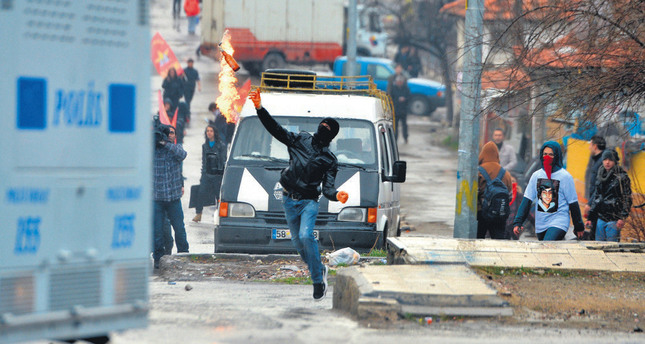
          Istanbul clashes

          A man points his gun in front of a barricade towards Turkish riot police, during clashes following a protest in memory of a teenager killed in 2013 anti-government demonstrations and whose death has become a rallying cause for opponents of the President, Istanbul, Mar. 11, 2015.

          Read more: http://www.al-monitor.com/pulse/gall...#ixzz3UMHljQ1u


          This is a leftist (dominated by the Alevi ethno-religious group in Turkey).


          A member of the police force wearing civilian clothing is seen pointing a gun at a citizen attending the commemoration ceremony of Berkin Elvan on Wednesday in İstanbul. (Photo: Cihan)

          March 11, 2015, Wednesday/ 15:22:37/ TODAY'S ZAMAN / ISTANBUL


          * * * * * * * * * * * * * * * * * * * * * * *

          Comment


          • #35
            Ankara sidelined on Syria

            As the Syrian crisis enters its fifth year, an end to one of the bloodiest conflicts the region has seen in modern times appears no nearer, leaving Turkey bearing a large share of the burden while facing serious quandaries it has found no answers to yet.

            Summary: Ankara has hardly any influence left over events in Syria and its goal of deposing President Bashar al-Assad is no closer now than four years ago, while the persisting conflict poses ever-increasing headaches for Turkey.

            Author Semih Idiz

            Posted March 17, 2015

            Having marginalized itself regionally in a series of miscalculations since the end of 2011, Ankara has hardly any influence left over events in neighboring Syria, let alone in the rest of the Middle East. Meanwhile, events continue to move in a direction that is anathema to Turkish President Recep Tayyip Erdogan and Prime Minister Ahmet Davutoglu, who still insist on the total defeat of Syria’s President Bashar al-Assad and his regime and its replacement by an elected government.

            Recent remarks by US Secretary of State John Kerry and CIA Director John Brennan suggesting that it may be necessary to cooperate with Assad not only to end the conflict, but also to roll back the Islamic State (IS) and other radical groups, have therefore been met with anger in Ankara.

            Given that the majority of Syrians are Sunni, the assumption among diplomats and Turkish experts is that what Erdogan and Davutoglu ultimately want is a Sunni-led government in Damascus with the Muslim Brotherhood at its helm. The fact that Ankara has made its sectarian leanings in the region apparent over these past four years has bolstered this belief. Erdogan and Davutoglu, both of whom have strong Islamist roots, have also felt no need to hide the strong affinity they feel for the Muslim Brotherhood.

            That affinity, however, has contributed significantly to alienating Turkey from most of the region’s regimes, which look on the Brotherhood as an existential threat. Its support for the Brotherhood has also raised questions about Ankara’s aims in Syria. There is no indication, however, that Ankara is preparing to revise its Syrian policy in an attempt to regain its lost regional influence. The Davutoglu government also remains vehemently opposed to any role for Assad or his regime in any Syrian settlement.

            This position was revealed again when Foreign Minister Mevlut Cavusoglu reacted angrily to Kerry’s suggestion in a CBS interview that it may be necessary to negotiate with Assad.

            “What is there to negotiate with Assad? What are you going to negotiate with a regime that has killed over 200,000 people and used chemical weapons?” Cavusoglu responded irately during an official visit to Phnom Penh, when asked by reporters for comment on Kerry’s remark.

            Cavusoglu’s words show that the problem for Ankara is not just Assad but his regime, too. The clarification to Kerry’s remarks by State Department spokesperson Jen Psaki is therefore unlikely to have pleased Ankara. In her statement, Psaki repeated Washington’s support for a political settlement in Syria and added, “By necessity … there always has been a need for representatives of the Assad regime to be a part of that process.”

            She said, however, “It would not be and would never be, and it wasn’t what Secretary Kerry was intending to imply, that that would be Assad himself.”

            While appearing to be in tune with Cavusoglu’s position, statements from European colleagues, such as French Foreign Minister Laurent Fabius, who also criticized Kerry, clearly don’t go far enough for Ankara.

            “The solution is a political transition that must both preserve regime institutions — not Mr. Bashar al-Assad — … and include the opposition, of course,” Fabius said in Brussels on March 16.

            Reading between the lines of such statements, it must be apparent to Assad that as long as he can hold out, his chances of being part of the solution will increase, regardless of whether it is he or a representative of his regime who is involved in any talks.

            Ankara also sees this, which only increases its displeasure. Recent remarks by Brennan are also unlikely to have gone down well in Ankara.

            “The last thing we want to do is to allow [IS, Jabhat al-Nusra and al-Qaeda] to march into Damascus,” Brennan said, suggesting that that is what would happen if the Assad regime collapsed and created a political vacuum. He added, “We need to continue to support those elements within Syria that are dedicated to moving Assad and his ilk out, but there has to be some kind of political pathway to the future.”

            Ankara’s insistence on a military defeat of the Assad regime appears to be a recipe for prolonging the Syrian civil war. Assad, who continues to get support from Moscow and Tehran, has proven his staying power. The West, meanwhile, much to Erdogan’s annoyance, has made it clear it will not put the boots on the ground that would be required to defeat Assad.

            The West has also made it clear that its first priority is to defeat IS, and not to go after Assad. The same applies with regional countries like Saudi Arabia, Jordan and Egypt, which are all part of the US-led coalition against IS. The Davutoglu government, however, continues to believe that targeting Assad should be the main priority, but has no power to bring this about.

            Ankara’s dilemma is that a prolongation of the Syrian conflict will only increase Turkey’s headaches in terms of an uncontrolled flow of refugees, a long and porous border that is hard to secure against radical elements, the emergence of an undesired autonomous Kurdish entity in northern Syria and continuing regional isolation due to disagreements with regional countries.

            Professor Ihsan Dagi of the Middle East Technical University’s Department of International Relations believes, nevertheless, that it is very unlikely that the Davutoglu government will revise its Syrian policy soon.

            “The government is trapped by its own web,” Dagi told Al-Monitor. “A pragmatic government would have used the fact that its Syrian policy is not supported by a large portion of the public and revised it. But this policy has became a question of ideological commitment for the government,” Dagi said.

            Ahmet Han, a lecturer in international politics at Istanbul’s Kadir Has University, also believes that Ankara has painted itself into a corner. “The only option Turkey has now is to move with the tide,” Han told Al-Monitor. “The government committed too many mistakes, and this makes it impossible for it to become a meaningful actor in Syria. All it can do now is to try and control the damage,” he said.

            Han added that if the United States decides Assad has to be part of the solution, Turkey will have to accept this, saying, “Turkey is a submissive, not a proactive, player today. Its only choice is to tag along or be dragged along. If its resists, it will be increasingly at odds with its allies.”

            Retired Ambassador Murat Bilhan, a deputy director of the Turkish Asian Center for Strategic Studies, believes Washington has already decided Assad should be part of a Syrian settlement. He says this will compound the collapse of Turkey’s Syria policy, which, he argues, was misguided from the start, being motivated by sectarian Sunni reflexes that produced nothing in the end.

            “Syria will stay closed to Turkey for some time, unless Ankara accepts its mistakes and revises its Syria policy fundamentally. Otherwise, its current impasse will continue,” Bilhan told Al-Monitor. He added that he does not expect a policy revision before the general elections June 7, but believes this might happen after the elections, based on the results obtained by the ruling Justice and Development Party.

            Despite nuanced differences in expert Turkish opinion, there seems to be general agreement that the government’s current Syria policy is unsustainable.


            Read more: http://www.al-monitor.com/pulse/orig...#ixzz3Um2nE5g0


            - Erdogan has failed in Syria.

            He backed extremists to overthrow the Damascus government and failed.


            - Erdogan cannot declare war against Syria because that means a war against Iran. Iran will mobilize its army and fight Turkey for Syria.

            In military terms Syria is now a de facto military zone/province of Iran which cannot be allowed to fall in the eyes of Tehran.


            - Syrian and Iranian intelligence will also use the millions of Shias (Alevis) in Turkey to destabilize Turkey as well should there be a war.


            - Turkey has lost in Syria. It is hated by Iraq. The Kurds in Syria are following the Kurds in Iraq in getting their own autonomous regions.

            "Neo-Ottomanism" and Turkish meglomania have been defeated.


            Turkey can never be the leader of the Muslim world, but should behave more like Malaysia, which does not aspire to bully other Muslim countries but rather inspires them by its success and speaks in favour of pan-Muslim issues.

            In other words Turkey should play a role as a valued but equal member of the Muslim bloc.


            Malaysia's celebrated leader, Mahatir Mohammad.
            * * * * * * * * * * * * * * * * * * * * * * *

            Comment


            • #36
              bengal cat character assassin

              Comment


              • #37
                Originally posted by jankhan View Post
                bengal cat character assassin
                Erdogan is an atomic bomb and Bengal Tiger is exposing him in a very systematic way. Muslim world needs secularism not Islamism of Erdogan.

                Comment


                • #38
                  Ten young adults on trial for calling Erdoğan 'murderer' and 'thief'


                  Ten young adults are being tried for up to 4.5 years in prison over insulting then-Prime Minister Recep Tayyip Erdoğan during last year’s presidential campaign.

                  Ten young adults on trial for calling Erdoğan 'murderer' and 'thief'


                  An indictment has been filed against 10 members of the ultra-nationalist Turkish Youth Union (TGB) over charges of ‘insulting a public official’ for shouting slogans and hanging a banner with the words “murderer” and “thief” aimed at President Recep Tayyip Erdoğan, who was then the prime minister.

                  The minor protest occurred on August 2, 2014 when Erdoğan visited Gündoğdu Square in İzmir as part of his campaign for the upcoming presidential elections on August 10. The young adults began shouting slogans against Erdoğan from the balcony of the TGB building, 20 meters from the square, and also hung up a huge banner that read, “The murderer and thief is in Gündoğdu – TGB.”

                  The police climbed the balcony and cut half of the banner down before detaining the 10 TGB members. They were released after they delivered their statements to the police.

                  Having concluded his investigation into the matter, Public Prosecutor Fehmi Aşgun filed an indictment seeking between 1.5 and 4.5 years imprisonment for the young adults over having insulted Erdoğan.

                  * * * * * * * * * * * * * * * * * * * * * * *

                  Comment


                  • #39
                    Turkish professor’s three teenage sons enter Syria and join ISIL


                    Three sons of an assistant professor at a Turkish university have joined the Islamic State of Iraq and the Levant (ISIL).
                    Turkish professor’s three teenage sons enter Syria and join ISIL


                    The assistant professor, whom daily Hürriyet identifies only as M. Şefik İ. for safety resons, has appealed to the government for help, but security forces determined that his sons had already crossed to Syria.

                    According to the investigation, 19-year-old Hacettepe University student Süleyman Bengi İ. led his 16-year-old twin brothers, Dilar and Dilşat, in their venture to join ISIL. After crossing Turkey’s border with Syria, the three teenagers continued to Iraq to join the ranks of ISIL there, Turkey’s National Intelligence Agency (MİT) revealed.

                    “We have found peace here, don’t worry about us,” Süleyman Bengi İ. sent in a message to his family after crossing the border.

                    The family, on the other hand, has called on Turkish President Tayyip Erdoğan, Prime Minister Ahmet Davutoğlu, the MİT and the police to bring their sons back to Turkey.

                    Turkish authorities continue diplomatic efforts to bring back the three brothers who are still in an ISIL-controlled area of Iraq. Meanwhile, police and intelligence officers are investigating whom Süleyman Bengi İ. contacted in Ankara to cross the border.

                    Before leaving his dorm in Ankara, Süleyman Bengi İ., a dentistry candidate, left a note for his family, urging his mother to distribute the belongings he left behind to the poor.

                    Those who know him said he was a successful student who was radicalized after he started to visit Islamist bookstores. The change in his personality became more dramatic after he read a book titled “Promised Heaven,” which he also distributed to his friends.

                    A daily Hürriyet investigation in September 2014 revealed a number of Islamic associations and bookstores which had popped up across Turkey. They are one of the main recruiting tools of ISIL in the country. Turkish intelligence recently sent a report to Turkey’s associations watchdog, determining that seven associations and foundations should be scrutinized for their suspicious activities.

                    So far 2,307 Turkish citizens have joined ISIL, according to official figures, with some 700 more linked to the group. Around 1,500 of them still live in the ISIL-controlled areas of Syria and Iraq, and most of them are fighting in the ranks of the jihadists.

                    In 2014 and the first three months of 2015, 680 families in Turkey reported their children had run away to join ISIL.

                    Officials say 11 Turks have died so far while fighting for the group.


                    - The Erdogan regime are open supporters of the "Muslim" Brotherhood and have violated all diplomatic protocol in supporting them over the government of Egypt.

                    - Erdogan's regime also supports so-called "Islamists" in Syria, Iraq, Libya, Bangladesh and elsewhere.

                    - Though some Turks deny this it is an open secret that Erdogan's regime supports ISIS in order to weaken the Assad government.


                    Turkey needs to stop sponsoring terrorists and destabilizing Syria.

                    Turkey has suffered massive international shame and humiliation and a loss of popularity evidenced by things for example such as its humiliating failure to get a UN security council seat despite lobbying vigorously.

                    The fact that middle-class Turks are joining ISIS should be a cause for concern.

                    As a Bangladeshi I personally hope our government are taking notice of the Erdogan regime and its destabilization of the Muslim world and are taking the appropriate precautions and planning, especially considering that Bangladesh became the subject of perhaps the 3rd highest twitter trend in the world a few years ago over the war crimes case of a pro-Pakistani politician, Qader Molla, primarily due to Turkish "Islamists".

                    Erdogan will win the next elections and rule for another 4-5 years, hopefully this will be enough time to significantly combat the massive Islamophobia and Kemalism and racism in Turkey.

                    After having done that Erdogan will hopefully be consigned to the dustbin of history.

                    Insha'Allah.

                    Ameen, thumma Ameen.

                    * * * * * * * * * * * * * * * * * * * * * * *

                    Comment


                    • #40
                      Whistleblower claims Erdoğan apologized to Sisi at secret meeting in Saudi Arabia


                      Turkish President Recep Tayyip Erdoğan (R) and Saudi King Salman walk past an honor guard at a welcoming ceremony on Monday in Riyadh.

                      March 20, 2015, Friday/ 22:53:32/ TODAYSZAMAN.COM / ISTANBUL

                      A government whistleblower who tweets under the pseudonym Fuat Avni has alleged that Turkish President Recep Tayyip Erdoğan apologized to Egyptian President Abdel Fattah el-Sisi during a secret meeting in Saudi Arabia earlier this month.
                      President Recep Tayyip Erdoğan' met with king Salman of Saudi Arabia in Riyadh on March 2, only one day after Sisi's visit, prompting speculation that Saudi Arabia played a mediating role between Turkey and Egypt with the aim of repairing relations between the two countries, which have been at odds for several years.
                      Erdoğan has been one of the leading critics of Sisi, Egypt's former military head, ever since he came to power after removing former President Mohamed Morsi -- the country's first democratically elected and a member of the MB -- via a military coup in July 2013. President Erdoğan has also accused the international community of hypocrisy for giving legitimacy to Sisi and not taking a stand against him after the coup in Egypt.
                      Fuat Avni tweeted on Friday night that Erdoğan had sent three mediators to Sisi to mend ties and the Egyptian president was convinced to meet with Erdoğan after new Saudi king interfered in the issue. “Yezid and Sisi met in the presence of the Saudi king in Saudi Arabia. Yezid apologized to Sisi,” the Twitter whistleblower claimed.
                      Fuat Avni refers to Erdoğan as Yezid, which is a reference to the Umayyad caliph, who according to Islamic belief allowed his opponent Imam Hussein, the grandson of the Prophet Muhammad, to die of thirst in the Battle of Karbala.
                      The whistleblower also claimed that Erdoğan “begged” Sisi and Salman not to disclose the secret meeting. He also alleged that the president told his inner circle that he would even meet with Syrian President Bashar al-Assad.


                      1. Erdogan has lost his war against Sisi and Egypt.

                      Egypt is too big, powerful and important for Turkey to do anything.

                      For example to go to Europe from Asia you have to go through Egypt in terms of trading via ships.

                      Egypt cancelled some important deals for Turkey recently which meant Turkey suffered economically, so Erdogan has had to go running to Saudi to beg for forgiveness from Sisi.


                      Sisi.


                      2. The Saudis are probably the most powerful state in the Muslim world, more powerful than Turkey as they brokered this event i.e. Erdogan's apology to Sisi.


                      3. What this means for the so-called "Muslim" Brotherhood in Egypt and elsewhere I can't say for certain.

                      However Egypt is the home of the Brotherhood and its main centre, so its allies in the rest of the Arab and Muslim world are significantly weakened with Erdogan normalizing relations with Egypt (if that is indeed true).


                      4. The Erdogan regime and its masters in America must realize that no one is interested in "Neo-Ottomanism" or Turkish dominated Muslim bloc, in particular the Arabs.

                      I think Erdogan will abandon "Neo-Ottomanism" and realize he is not and cannot be the leader of the Muslim world.


                      5. If it's true that Erdogan is willing to make up with Assad, it means another major defeat for Erdogan and for "Islamists".

                      The middle east would revert to its traditional self as it was a few years ago, with Syria however having suffered the most e.g. 1/4 of Syrians refugees.


                      Well done to Saudi Arabia and King Salman for making Erdogan smell the coffee and see sense.

                      A more stable middle east where all nations respect each other is what we all want to see.

                      [MENTION=3580]asad71[/MENTION]
                      * * * * * * * * * * * * * * * * * * * * * * *

                      Comment


                      • #41
                        University student faces 4.5 years in prison over ‘insulting’ Erdoğan


                        The Izmir public prosecutor is charging a university student with between 1.5 to 4.5 years prison over insulting President Recep Tayyip Erdoğan with a post he shared that mocked the Turkish president.
                        University student faces 4.5 years in prison over ‘insulting’ Erdoğan


                        The Cyber Crimes Unit of the Izmir Police Department launched an investigation against Ege University student Alp A. (21) over a February 6th 2014 Twitter post on charges that he had insulted then-Prime Minister Erdoğan.

                        The police then relayed their information to the Izmir Public Prosecutor’s Office, with prosecutor Ali Fuat Taşkın launching a criminal case against the student over “insulting a public official regarding the performance of their duties,” seeking a prison sentence between 1.5 to 4.5 years.

                        Ali A. is a student at the Faculty of Economic and Administrative Sciences at İzmir's Ege University. In his testimony to police, he confirmed that the account had been his since 2013 and expressed his regret over having insulted Erdoğan.

                        Dozens of people, including journalists, pop stars, high school students, activists and even beauty queens, have been prosecuted for insulting Erdoğan on social media in recent months.

                        March 22, 2015 | BGNNews.com | İstanbul

                        * * * * * * * * * * * * * * * * * * * * * * *

                        Comment


                        • #42
                          Erdogan has all but destroyed Turkish journalism


                          Yavuz Baydar

                          Journalists are being intimidated and imprisoned, while government-friendly moguls are given lucrative contracts. The free media is on the verge of extinction


                          'If alarm for the independence of the Turkish press was already high, those concerns were raised still further soon after the outbreak of the summer demonstrations in 2013 to protect Istanbul’s Gezi Park.'

                          Friday 20 March 2015 11.00 GMT Last modified on Friday 20 March 2015 12.44 GMT

                          Among journalists, the truth universally acknowledged is that bad news commands more column inches than good. In Turkey, the even more depressing truism is that much of the bad news has to do with the news industry itself.

                          Those of us trying to preserve our integrity as journalists fight a constant rearguard action – against proprietors who set little store by integrity, and against a government that tries to accrue power by restricting freedom of expression and ringfencing public debate.

                          Recent headlines have been devoted to the arrest of the journalist Mehmet Baransu. He was detained for a story he wrote in 2010, based on (literally) a suitcase of military documents, handed over to him by a whistleblowing officer, which implicated senior commanders in an attempted coup d’état, codenamed Sledgehammer.

                          The subsequent court proceedings – both in their scale and the liberal use of pre-trial detention – proved bitterly controversial. There is little doubt that the government interfered and was more interested in taming its own military than producing justice. The defence was able to cast doubt on the authenticity of some (but by no means all) of the evidence. So there is reason to believe that some of the convictions – suspended pending a retrial – were unsound.

                          Yet this is not why Baransu has been thrown in prison. He is accused not of misleading the courts but of handling state secrets, despite the fact that he had handed the leaked documents over to state prosecutors. Having got the military under its thumb, the government now requires its cooperation and has turned on the journalist who once made the government’s case.

                          Worse still, much of the government media is egging the prosecutors on. Imagine Glenn Greenwald being arrested and then the rest of the press urging the authorities to throw away the key. The current state of journalism is only a reflection of how polarised Turkish society has become under the divisive rule of President Recep Tayyip Erdoğan.


                          Self-censorship is the rule. Many Turkish newsrooms resemble an open prison rather than a creative hive and fear has gripped those of the so-called mainstream media institutions. It is not the fear of ending up in courtrooms or in jail: it is fear of being fired. There is utter professional vulnerability. According to Turkey’s journalist union, only 1.5% of our journalists belong to a union.

                          The columnist Kadri Gürsel wrote recently that the real aim is to finish off journalism as a whole, and this is a view shared by many. We are witnessing the dismantling of a profession whose independence should be guaranteed by the constitution. The very DNA of Turkey’s fourth estate is being severely tampered with. The aim of the government is to subordinate the media, as a whole if possible, to the political executive.

                          As I argue in The Newsroom as an Open Air Prison: Corruption and Self-Censorship in Turkish Journalism, a discussion paper that I prepared as Shorenstein Fellow at Harvard Kennedy School last autumn, this is the tragic story of the demise of a profession in one of the most important parts of the world.

                          This destructive pattern was accelerated by the two police operations in the last days of December 2013, massive investigations into the affairs of four ministers of the majority Justice and Development party (AKP) government. Those touched by the corruption scandals included a number of businessmen with close connections to the government, bureaucrats and bank managers, but also Bilal Erdoğan, son of the prime minister.

                          Of even greater concern is that the investigations appeared to suggest that senior government figures were engaged in sanctions-busting against Iran, and that these senior figures had links to financiers who laundered funds for al-Qaida.

                          The files compiled by law enforcement and prosecutors were a burning fuse: they claimed to expose a vast network of organised crime, with evidence of bribery, abuse of power and widespread corruption at the very highest echelons of power.Corruption of the nation’s media was at the heart of these allegations. A critical part of the investigation – backed by legal wiretappings – concerned consortiums to co-finance media entirely in favour of the AKP government. This joint effort, in which businessmen benefiting from government contracts paid into a common slush fund, gave rise to the term “pool media”.

                          A landmark in this targeting of media independence was reached with the blackout implemented by the media itself on the story of 34 Kurdish villagers killed by Turkish fighter jets in the Iraqi border village of Uludere/Roboski in late 2011. That silence became a dress rehearsal for the media surrendering its role as the watchdog of the public interest.

                          Yet if alarm for the independence of the Turkish press was already high, those concerns were raised still further soon after the outbreak of the summer demonstrations in 2013 to protect Istanbul’s Gezi Park. Protests spread to 78 of the 81 provinces in Turkey. The degree of self-censorship became so intense that the mainstream Turkish media itself became the subject of demonstration and open ridicule. Even so, Erdoğan declared that critical media – domestic and international – were part of a conspiracy to topple him and his government from power. Thereafter the demonisation of independent journalism gathered pace. Journalists who tried to defend their independence and dignity found themselves fired or dispatched to professional limbo.

                          The developing story of high-level corruption (reaching the very heights of the political establishment – a dream for any decent journalist anywhere in the world) was declared by the news management to be an area surrounded by “barbed wire.” Thus, 2014 began with a self-censorship more institutionalised and internalised than ever before. Blocked by political and institutional pressure, the core of Turkey’s dedicated and defiant journalists migrated their craft online. Social media and independent news sites began to fill a vacuum. The government’s reaction was to try to shut down YouTube and Twitter, but this proved technically difficult and legally unsuccessful.

                          Still Erdoğan is undeterred; the internet remains a target and vulnerable to government interference. Between 2013 and the end of 2014, the government imposed more than 20 news blackouts on important stories, on various grounds including national security. This was a normalisation of censorship.

                          Intimidation is normal, too. According to the latest report on 2014 by Independent Communication Network (BiA) there are currently 22 journalists in jail. More than 61 have been found guilty of defamation against Erdoğan in the past three years. On 14 December 2014 two of the remaining critical media outlets – Zaman and STV – were raided, their top managers arrested. Hidayet Karaca, the general manager of Samanyolu Media Group, has been detained for more than 80 days. His charges arise from a TV script.

                          This continuing process cannot be described as anything other than a purge. The Turkish media industry is systematically losing its qualified workforce, its remaining ethics are vanishing.

                          With the business groups on board, Erdoğan has simply raised the stakes to enforce dependence: in return for lucrative public contracts, all the media moguls in Turkey have to put their outlets in the service of power. It is a system based on corruption that also requires full complicity. If Erdoğan or his aides do not call the top managers and editors of the media to publish propaganda or censor undesirable content, the owners themselves do it.

                          The notion of journalism as a check on the irresponsible, corrupt or unfettered exercise of power is evaporating. Investigative reporting, more crucial than ever, is on the verge of extinction. Our democracy now depends on whether the Turkish media can escape the quagmire into which one man’s ambition has driven it.

                          Journalists are being intimidated and imprisoned, while government-friendly moguls are given lucrative contracts. The free media is on the verge of extinction


                          - Unlike some of the trolls on this forum e.g. Mahmood al-Yemeni (Revulsion Through Ranting a.k.a. Brown Skinned Savage) I take a more nuanced view of Erdogan, neither totally bad or totally good, something which an Erdogan fan-boy like al-Yemeni doesn't understand.

                          Overall until recently Erdogan made Turkey a freer more tolerant place especially for practising Muslims, Kurds and others.

                          He took on the might of the brainwashed Kemalist urban middle class who despite their complaints now are far from champions of democracy and freedom but believe in suppression of Kurds and Islam and are essentially fascists.

                          However imprisoning young students for e.g. 4 years and Erdogan is not the perfect symbol of purity that al-Yemeni and other Erdogan fan boys would like us to believe.

                          He has his good and bad sides.

                          * * * * * * * * * * * * * * * * * * * * * * *

                          Comment


                          • #43
                            Originally posted by Badlun View Post
                            Erdogan is an atomic bomb and Bengal Tiger is exposing him in a very systematic way. Muslim world needs secularism not Islamism of Erdogan.
                            You have a mental problem.
                            Last edited by jankhan; 03-23-2015, 05:14 PM.

                            Comment


                            • #44
                              One dead in ISIL-linked magazine bombing in Istanbul


                              ISTANBUL - Doğan News Agency


                              A blast at the office of a magazine in Istanbul’s Kağıthane district late on March 25 left one dead and three injured, according to a police report.

                              A pressure-induced bomb left at the entrance door of the office of monthly Adımlar Magazine exploded at around 7.30 p.m. as the door was opened, the Istanbul police department announced. Ünsal Zor, 45, one of the magazine’s writers, died immediately at the scene, while three others were injured and taken to a hospital.

                              “Ünsal Zor died in the attack on the scene on March 25 around 7.30 p.m. 47-year-old Ali Osman Zor, 30-year-old Cem Türkbiner and 39-year-old Cüneyt Karan were injured as a result of the attack. The investigation into the incident is ongoing,” the police statement read.

                              Adımlar Magazine, which allegedly has close ties with illegal Turkish Islamist group the Islamic Great East Raiders Front (IBDA-C), has organized campaigns demanding the release of Salih Mirzabeyoğlu, the leader of the group, and supports the Islamic State of Iraq and the Levant (ISIL).

                              A recently-founded organization named the People’s Defense Unit has claimed responsibility for the attack.

                              “Adımlar Magazine was punished for their justification of the massacres. Our actions will continue to the extent that such discourses continue. It is a crime to defend killers. No action will be left unpunished against revolutionists,” the group stated via its Twitter account.

                              The People’s Defense Unit had recently announced its foundation on Twitter on March 19.

                              Istanbul Governor Vasip Şahin was reluctant to be drawn on allegations that the bomb had exploded inside the office.

                              “There is nothing clear about the issue. I cannot confirm that this incident took place inside or outside the office. We can answer this question following the detailed technical investigations,” said Şahin, adding that the investigation into the attack is still underway.

                              The Turkish Press Council has released a statement denouncing the attack as “a crime against humanity.”

                              “It is not possible to accept the Adımlar Magazine bomb attack. It is against democratic principles and a crime against the humanity of media organs, founded for expressing ideas, to face such attack, no matter what their worldview is,” the statement read.

                              The IBDA-C is listed as a terrorist organization by the United States and the European Union. The organization claimed responsibility for the 2003 Istanbul bombings targeting two synagogues, an HSBC Bank and the British Consulate, killing 57 people. Turkish officials at the time named al-Qaeda as the perpetrators of the bombings.


                              A blast at the office of a magazine in Istanbul’s Kağıthane district has left one dead and three injured, according to a police report


                              ...


                              No one claimed responsibility for the attack, although some Turkish media outlets reported that the Revolutionary People's Liberation Party-Front (DHKP-C) claimed responsibility. There were no statements of responsibility on the websites affiliated with the terrorist organization as of press time. The İBDA-C is known for its opposition to the DHKP-C and other far-left terrorist groups, but experts point out that the militant group also suffers from infighting.


                              1. This seems to be a leftist terrorist attack against a Sunni nationalist pro-ISIS magazine.


                              2. The radical left in Turkey are mainly Alevis (heterodox non-Muslim offshoot of Shiasm).

                              In the 1970s Turkey was in a low-intensity civil war between leftists and rightists, however underneath the political labels it was also an ethno-religious war between Alevis (leftists) and Sunnis (rightists, nationalists).

                              The Alevis of Turkey have always been a marginalized minority and in the absence of any real meaningful theology many have just turned to atheism or Marxism so the Turkish left is dominated by them.

                              It was also speculated that if Turkey went too far in Syria, Iran and Syria would use Alevi leftists against Turkey.

                              This may just be a one off attack though.


                              DHKP-C in Istanbul. The heavily anti-American leftist terrorist organization had a dozen members arrested by police in Turkey yesterday and today there was a strike against a pro-ISIS magazine.
                              * * * * * * * * * * * * * * * * * * * * * * *

                              Comment


                              • #45
                                Turkish actress faces two years in jail for ‘insulting’ President Erdoğan


                                Turkish actress Gonca Vuslateri is facing a prison sentence of up to two years for posts on Twitter alleged to have insulted Turkish President Recep Tayyip Erdoğan.

                                Turkish actress faces two years in jail for ‘insulting’ President Erdoğan


                                According to the indictment prepared by Ankara Public Prosecutor Adem Can, prosecutors opened a case against the 30-year-old Vuslateri for posting comments and sharing some posts on Twitter about Erdoğan that are alleged to have insulted the Turkish president.

                                Prosecutor Can asked for a prison sentence of between one and two years for the actress in the indictment he wrote, Turkish media reported on Friday.

                                Her lawyer denied the charges on Vuslateri's behalf, underlining that Vuslateri was acting in a comedy series and said she only shared a cartoon published in a satirical magazine.

                                A number of people, including journalists, high school students and activists have been prosecuted for insulting Erdoğan on social media.

                                According to official figures by the ministry, during the seven-year tenure of the country's 11th President Abdullah Gül, a total of 1359 indictments were filed, of which only 545 lead to trial and zero arrests were made. Meanwhile in the seven-month tenure of Turkey's 12th President Recep Tayyip Erdoğan, 105 charges were accepted and 8 lead to an arrest. Of the 236 indictments, 159 were filed in 2015.

                                TRY 7,600 fine for spitting on Erdoğan’s vehicle


                                A man was fined TRY 7,600 for spitting on Turkish President Recep Tayyip Erdoğan’s car, in a case for “insulting a public official.”

                                The İstanbul Chief Public Prosecutor's Office opened a case against 28-year-old Fatih Koçkesen on charges of insulting then-Prime Minister Erdoğan by spitting on his official car on July 11, 2014. At the time the car was parked in front of Eyüp Sultan Mosque in İstanbul.

                                During his testimony at the court, Koçkesen said that he spit on a car he thought to be that of Erdoğan to protest the then-prime minister, whom he held responsible for a mine accident in Soma that left 301 workers dead, Turkish media reported.

                                The indictment prepared by the prosecutor’s office was seeking up to two years imprisonment. In the hearing held in an İstanbul courthouse on Thursday, the court fined Koçkesen TRY 7,600 on charges of “insulting a public official.”

                                236 indictments have been filed over “insulting” Erdoğan in the seven months since he took office last August, with 105 charges being accepted and 8 leading to arrest.

                                * * * * * * * * * * * * * * * * * * * * * * *

                                Comment

                                Working...
                                X