
-
"Revenge is a dish best served cold".
-Old Pashtun proverb

"My Pashtun Pride i will not hide!" -
i bet it was a jew!
now what will happen with sauds house?faye's chauffeur
Pashton's girlfriend
I'm a Pashtun Princes

-
His brother Salman will take over.Originally posted by Hallo View Post
[MENTION=1058]Bengal_Tiger[/MENTION], your thoughts brother."Revenge is a dish best served cold".
-Old Pashtun proverb
"My Pashtun Pride i will not hide!"Comment
-
sureOriginally posted by Kushan Prince View Post
i bet there will be a fight inside the house
everybody wants to rulefaye's chauffeur
Pashton's girlfriend
I'm a Pashtun Princes
Comment
-
The royal family and the Wahabhi establishment are probably the most evil people on earth, they have done the most damage to the Islamic world and muslims
On a individual level, he was slightly better then others, he did some reforms but on a very slow paceComment
-
On a personal and human level, this is a tragedy as human life is very sacrosanct and we should never gloat over its loss.Originally posted by Kushan Prince View Post
In terms of the wider implications for Saudi Arabia, there will be continuity and stability. The Saudi royal family always unite together to ensure their continued rule of the state.* * * * * * * * * * * * * * * * * * * * * * *Comment
-
Although heavily despised, i think he was a better leader than any other middle eastern leader like Assad or Saddam who plunged their country into chaos. The King may have relied on America for help, but alteast he prevented his country from getting involved in the Arab Spring unlike Syria or Libya.Originally posted by Bengal_Tiger View Post
I agree, as muslims we should never gloat a loss of another human's life."Revenge is a dish best served cold".
-Old Pashtun proverb
"My Pashtun Pride i will not hide!"Comment
-
1. The new leader, Salman is part of the Sudairi seven.
The Sudairi seven are the sons of Abdul Aziz's "favourite" (reportedly) wife.
They include some of the previous Saudi leaders.

2. The Sudairis are more conservative i.e. what in general terms would be called more "Islamic" (though I don't agree that we see today in terms of traditional Islam is the real Islam of the Quran and the prophet صلی اللہ علیہ وسلم.
This is in contrast to the late Abdullah or his brother Prince Talal or his billionaire son Prince Waleed bin Talal.
Salman has recently removed Saudi's only female minister.

Saudi's only female minister, Nora Al-Faiz removed, a few days ago.
3. The Sudairis are consolidating power in their hands and have removed the half-Yemeni crown prince Muqrin who is no longer an heir to the throne.
Instead it will be another Sudairi, the interior minister, Nayef.

Ibn Nayef, the new Saudi crown prince and current interior minister, a hardliner against anti-monarchist militants.
After Ibn Nayef, it's the current leader, Salman's youngest son, the young 35 year old defence minister who is being promoted by the Saudi media as the pin-up boy of their military campaign against Yemen.

4. Ibn Nayef has no sons so will probably continue Salman's policy of making his youngest son Mohammed as leader after Ibn Nayef's death.
5. Salman got rid of Saud bin Faisal, the man who was foreign minister for 39 years and son of former Saudi leader, Faisal.
The new foreign minister is a non-royal which is a huge and historical event in Saudi history for such an elite position to be given to a non-royal.
It was the man who until recently was the Saudi ambassador to America.
New Saudi foreign minister, Adel al-Jubeir.* * * * * * * * * * * * * * * * * * * * * * *Comment
-
What's Behind Saudi Arabia's Dramatic Palace Reshuffle
Posted: 05/02/2015 11:09 am EDT Updated: 1 hour ago
Every week, The WorldPost asks an expert to shed light on a topic driving headlines around the world. This week, we spoke with Robert Lacey about Saudi Arabia's royal reshuffle.
Saudi Arabia's King Salman reshuffled his cabinet and appointed a new line of heirs this week, in a major shake-up of the top echelons of power in the conservative kingdom.
Prince Mohammed bin Nayef, 55, became the first grandson of the country's founding monarch to be appointed crown prince, marking a historic shift of power to the next generation of Saudi royals. King Salman's son, Prince Mohammed bin Salman, believed to be in his early 30s, was named deputy crown prince, consolidating a meteoric rise to power that saw him appointed Saudi defense minister in January.
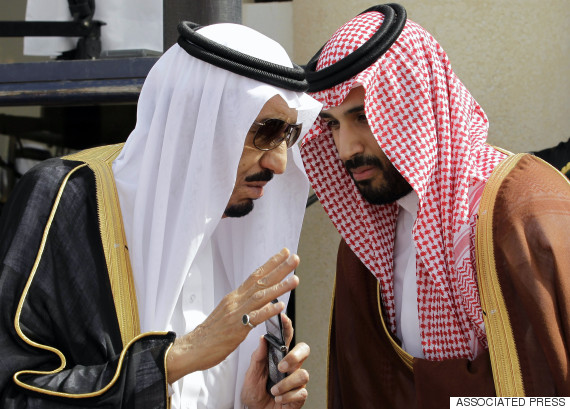
King Salman (L), then crown prince, left, speaks with his son Prince Mohammed in Riyadh, Saudi Arabia on May 14, 2012. (AP Photo/Hassan Ammar, File)
The 79-year-old king -- just three months into his reign -- also reshuffled an array of government ministers, including removing the sole female member of cabinet.
The new appointments come during tense times in the region. Saudi Arabia is leading a coalition that's bombing neighboring Yemen, hoping to dislodge Houthi rebels it accuses of being proxies of Iran. At home, Saudi Arabia is cracking down on suspected extremists, and having to draw on its financial reserves (which, granted, are large) after oil prices plummeted last year.
To understand the implications of King Salman's reshuffle, the WorldPost spoke to historian and author Robert Lacey, who has studied Saudi Arabia for decades and wrote two acclaimed books on the country, The Kingdom and Inside the Kingdom.
King Salman just replaced his half-brother as next in line for the throne, putting his nephew in his place and his son second in line. What do you think was behind this decision?
There are dynastic and family reasons, but the main reason is to finally establish the new generation in charge of the kingdom. The Saudi monarchy is seen as ancient and sclerotic, but now the next two people in line to the throne are in their 50s and 30s.
Another interesting part of this reshuffle is that neither Crown Prince Mohammed bin Nayef nor Deputy Crown Prince Mohammed bin Salman are the eldest sons of their families. It's traditional in Saudi Arabia for the eldest son to get the job, but these appointments show they are being picked based on ability.
The main reason is to finally establish the new generation in charge of the kingdom.
Do you think former Crown Prince Muqrin really stepped down voluntarily?
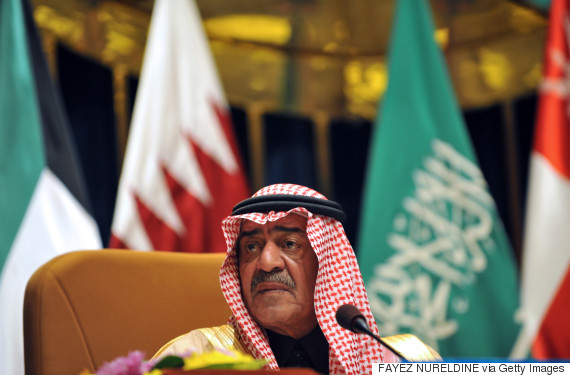
Prince Muqrin bin Abdul Aziz al-Saud pictured in Riyadh on Dec. 4, 2011.
I think he himself would agree with the main reason for the reshuffle, which is to hand power to the new generation. Muqrin is not going to go around stabbing anyone in the back.
He was always controversial in that role. When late King Abdullah made him deputy crown prince in 2013, there was some backlash. His mother was from Yemen, and to some in Saudi that meant he did not have the required royal, religious or tribal lineage.
So, who is the new crown prince? What sort of king would he make?
Mohammed bin Nayef is the most outstanding figure of the new generation. He is immensely able, hard-working and quiet. He is different in style to the current king. He is more like a university professor than a big desert Bedouin like the current king, in the mold of the kingdom’s founder.
Some people describe him as authoritarian, but he is much more liberal than people might think. He was behind the re-education program for fundamentalists in the kingdom. He will be the first to admit the project was not altogether a success, but it was a very idealistic endeavor.
Mohammed bin Nayef has something of a magical aura in Saudi Arabia, because of how he survived a 2009 assassination attempt. An al Qaeda member who pretended he had reformed blew himself up standing next to Mohammed bin Nayef, and the prince emerged virtually unscathed. There is a sense in Saudi Arabia that he was specially spared and chosen because of this incident.
What about the new deputy crown prince, Mohammed bin Salman?
He is more controversial. Nobody doubts that he has an unusually strong work ethic for a Saudi prince, but he is not that popular. As with many forceful characters, he can rub people up the wrong way.
Mohammed bin Salman has become incredibly important to his father, the current king. He has been his father’s right-hand man since the king was governor of the Saudi capital Riyadh. There are many rumors about King Salman’s health, and whatever their veracity, the king does seem to flag at the end of the day, which is not a problem for his young son.
How was this reshuffle received by the royal family in Saudi Arabia?
The official announcement of Mohammed bin Salman’s new position says he had the support of the majority of the family council. The same language was used when Muqrin was appointed with some controversy. It is striking, as normally the position should be approved by the whole council.
Some say this reshuffle confirms the dominance of one branch of the Saudi royal family, the Sudairi branch. But it is also a matter of hard work and talent rising to the top.
How is all this viewed by people in Saudi Arabia?
In general, the country just demands competence and authority. There is no real alternative to the ruling royal family in Saudi Arabia. There is no real threat of the Saudi monarchy being toppled.
That said, there is a lively debate in Saudi Arabia about the future of the country. While there is no formal democracy, people are debating and discussing these issues, especially online.
Which of the other new appointments this week should people be paying attention to?
This is an enormous reshuffle that goes right through the government. Everyone is fixated on the royal family, but one of the most important changes was that the foreign minister was replaced by a non-royal (former ambassador to the U.S. Adel al-Jubeir).
The only woman in government, Deputy Education Minister Nora al-Fayez, was removed because the fundamentalists got upset about her work with with girls’ education.
Do you expect any of these changes to impact Saudi policy, whether domestic or foreign?
The appointment of (foreign minister) al-Jubeir and (crown prince) Mohammed bin Nayef cements the Saudi-U.S. alliance during a period of uneasy relations as well as extreme volatility in the Middle East. Washington has concerns about what Saudi Arabia is trying to do in Yemen, and in Saudi Arabia there is great concern about Washington’s rapprochement with Iran.
Domestic policy is unlikely to change, but will continue in the conservative direction of King Salman. When he took the throne this January, a rift had emerged between the traditionalists and the ruling royal family. Since then, King Salman has tried to reconcile the two by removing people aligned to late King Abdullah and bringing the conservatives on board. Saudi Arabia’s biggest threat is from fundamentalists, and the king wants to re-establish an Islamic consensus to counter this.

- I agree, there is no real alternative to the Al-Saud family and the territorial integrity and stability of Saudi Arabia must be maintained.
However there must also be reforms and greater freedom.* * * * * * * * * * * * * * * * * * * * * * *Comment
-
[MENTION=1058]Bengal_Tiger[/MENTION],
I commend you for posting this news as i was also going to post it but you beat me to it. I
Its good that Salman put his son second in line, it will be good to have a young non-tryant leader (hopefully) that can lead his country and be an example to the Saudi youth. I didn't agree with Ibn Neyef putting his son as military commander for the bombing of Yemen but hopefully what he is doing can bring some kind of reform to ksa."Revenge is a dish best served cold".
-Old Pashtun proverb
"My Pashtun Pride i will not hide!"Comment
-
1. Ibn Nayef is the son of Salman's brother, Nayef who was one of the Sudairi Seven.Originally posted by Kushan Prince View Post
He is relatively young for a potential Saudi King, i.e in his 50s.
Salman isn't expected to be around for too long as he is old and ill, so in the next few years ibn Nayef will take over (as things currently stand).
2. Ibn Nayef has a good relationship with the Americans and is at the heart of efforts to protect the Saudi state and dynasty, so he probably has the support of other senior Saudi princes in that they have confidence in him to protect their interests in this time of great flux and instability.
3. Ibn Nayef could be king for 20 years like Fahd was. After that Mohammed bin Salman would take over.
However that is if the Saudi state exists by then, to be honest I doubt it will. Not just the Saudis but the entire middle east will look different in 20 years time.
4. Ibn Nayef has had a western education and will probably be less "reformist" as Abdullah but less conservative than Salman. That is if he can afford to be.
The world and Saudi society is changing, things can't continue the way they are.
Saudis want to be citizens, full and equal stakeholders of the country they live in rather than subjects, property of a family whom they are supposed to be "grateful" to for giving them inherent rights.
5. What goes on in Saudi Arabia, as the homeland of Islam and the site of the two holy cities is of concern to all of the world's 1.5 billion Muslims.* * * * * * * * * * * * * * * * * * * * * * *Comment
 Tweet


Comment