
 Tweet
New Chapter for Afghan Publishing
Booksellers report brisk trade as appetite for reading grows in country’s east.
By Hijratullah Ekhtyar - Afghanistan
29 Apr 14
Five years ago, the shops on the ground floor of the Eshaqzai Market in the eastern Afghan city of Jalalabad were full of video recorders, CDs and DVDs.
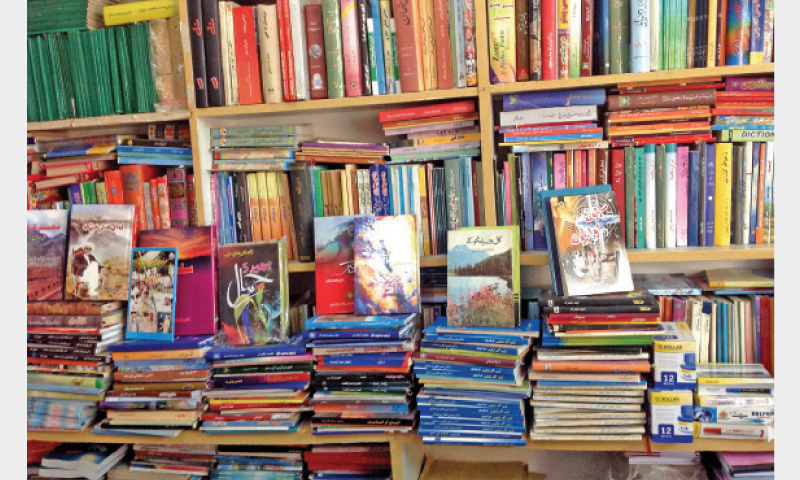
Now, instead of films and computer games, the shops are crammed with shelves of books, with students searching through them for the subjects they need.
Nasir Ahmad, 20, has just purchased three volumes from the Enayat bookstore.
“I bought a book of maths exercises, biology exercises and a guide to the university entrance test for eight dollars. I hope these books will help me get into my chosen faculty,” he said, adding, “In the past, I watched lots of movies, but then I realised that films are not only a waste of time, they are also distracting.”
Afghanistan’s publishing industry had little chance to develop during more than three decades of war which disrupted the education of millions.
Some state-owned media outlets and printing presses continued to function through the various waves of conflict, but publications were few in number and often censored. There were few local translations, and most of the books available were imports.
With the Taleban’s rise to power in the mid-1990s, film, music, satellite TV and radio were all banned.
Ahmad said that following the fall of the Taleban in 2001, young people gorged themselves on movies and music, a trend which was only now abating in favour of reading.
Even now, more than 70 per cent of the Afghan population remains illiterate. Despite that, Habibollah Rafi, a member of the country’s Academy of Sciences, said the Taleban’s collapse had ushered in a whole new era of knowledge.
“Freedom of speech came with the new government,” he said. “The media was liberated along with freedom of speech. Now Afghans have the chance to write important books and to translate books from other languages. Young people are trying to eradicate the culture of war and to replace it with knowledge.
“Previously, only books that had gone through the government’s censorship filters would be printed,” he continued. “Then, up to 50 books would be printed annually, but maybe thousands of books are now published each year.”
Social affairs expert and writer Abdol Ghafur Lewal said there was a growing awareness that high standards of literacy were vital for future careers.
“With the emergence of the private sector, the number of educational centres increased. And now young people understand that they can’t build an economic base for themselves in the free market without possessing academic skills," he said. "When academic organisations increase, the demand for books increases as well, which then leads to more publication.”
Lewal said larger numbers of books were being printed than ever before, with a growing interest in learning other languages, particularly English, seen as the lingua franca of business. Most books published in Afghanistan were now translations, he said.
“Young people are now in touch with the whole world via the internet,” he continued. “They know what the world wants and they learn from that accordingly.”
Mohammad Ibrahim Hamkar, a lecturer in education at Nangarhar university, said that teachers were motivating their students to read and write more.
“As a lecturer, I give the students lists and tell them to read those books, because they are an important factor in their studies,” he said. “The internet has informed our young people about the progress of global development. Now they can see and contact the whole world.”
Other commentators see the increased interest in reading as a side-effect of economic development.
Nangarhar university lecturer Janas Khan Zaran noted that when people’s basic needs were addressed, they had the luxury of turning to literature.
“Luckily, the economy has improved to an extent. Our young people have become interested in the cultures of the world. They buy books about them and read them,” he said. “For that reason, the work of translation and printing has improved as well. It’s good news for us.”
This phenomenon, said Nasirullah Mohmand, who heads the association of booksellers in Jalalabad, “brings both knowledge and money to Afghan homes”.
He said that up to 500 new books came out in Nangarhar every year, and sold throughout Afghanistan and even sent across the border to Quetta in Pakistan.
The head of the government’s information and culture department in Nangarhar, Aurang Samim, said the boom in printing was “all because of the blessing of freedom of speech”.
Jalalabad alone boasts more than 20 publishing companies, each printing dozens of Pashto-language books each month.
One of these outlets, the Gudar Publishing Society, was established as the Gudar bookstore in 2001 with capital of just 50 US dollars. Since it launched its printing press in 2006, it has produced hundreds of new books.
Its head, Qudratullah Nayed, said that the business was now worth 100,000 dollars.
“In the past, there wasn’t a good market for books, but that has improved in the past few years,” he said.
However, there is still a prevailing attitude that both authors and translators should provide their services for nothing.
Saifullah Gharibyar, a student at the private Spinghar Medical university, has written or translated 29 books to date.
“I have not asked for a penny for the printing of any of my books. I write or translate them because of my feelings,” he said, adding that the idea of paying authors was not yet widespread.
“The price of the writer or translator in Afghanistan is zero,” he laughed.
But that is beginning to change. Writers and translators were once expected to pay for printing out of their own pockets, but now publishers at least cover that cost.
The Momand Publishing Society is the only one in Nangarhar that actually reimburses writers. Its head, Fazel Maula, said, “We give the writer or translator 150 books or pay him an amount equal to that. We cannot pay more than that, because books don’t make much of a profit.”
But one section of Afghan society is still excluded from the publishing boom. Conservative traditions mean that women and girls cannot freely browse bookshops.
Mariam, a student at Nangarhar university, said her younger brother and father brought her textbooks from the market, because it was seen as unacceptable for women to visit bookstores.
“Sometimes I ask my father for one book and he brings back something else,” she said, adding, “If I could go myself, I would also learn about newly-published books. What can I do about it? Our hands are tied by our helplessness.”
Hijratullah Ekhtyar is an IWPR-trained reporter in Nangarhar, Afghanistan.
1.
If each of the 20 publishers prints 12 Pashto-language books each month then at the very minimum:
20 x 12 = 240 per month.
240 x 12 (months) = 2,880.
This from Jalalabad alone.
2. This will only set to increase with an expansion of population and literacy rates.
This is definitely good for the Pashto language, its survival and flourishing.
[MENTION=1201]Toramana[/MENTION] [MENTION=2]Admin Khan[/MENTION] [MENTION=1068]gadoonwal[/MENTION] [MENTION=1028]Yousafzai Pakhtun[/MENTION]
Booksellers report brisk trade as appetite for reading grows in country’s east.
By Hijratullah Ekhtyar - Afghanistan
29 Apr 14
Five years ago, the shops on the ground floor of the Eshaqzai Market in the eastern Afghan city of Jalalabad were full of video recorders, CDs and DVDs.
Now, instead of films and computer games, the shops are crammed with shelves of books, with students searching through them for the subjects they need.
Nasir Ahmad, 20, has just purchased three volumes from the Enayat bookstore.
“I bought a book of maths exercises, biology exercises and a guide to the university entrance test for eight dollars. I hope these books will help me get into my chosen faculty,” he said, adding, “In the past, I watched lots of movies, but then I realised that films are not only a waste of time, they are also distracting.”
Afghanistan’s publishing industry had little chance to develop during more than three decades of war which disrupted the education of millions.
Some state-owned media outlets and printing presses continued to function through the various waves of conflict, but publications were few in number and often censored. There were few local translations, and most of the books available were imports.
With the Taleban’s rise to power in the mid-1990s, film, music, satellite TV and radio were all banned.
Ahmad said that following the fall of the Taleban in 2001, young people gorged themselves on movies and music, a trend which was only now abating in favour of reading.
Even now, more than 70 per cent of the Afghan population remains illiterate. Despite that, Habibollah Rafi, a member of the country’s Academy of Sciences, said the Taleban’s collapse had ushered in a whole new era of knowledge.
“Freedom of speech came with the new government,” he said. “The media was liberated along with freedom of speech. Now Afghans have the chance to write important books and to translate books from other languages. Young people are trying to eradicate the culture of war and to replace it with knowledge.
“Previously, only books that had gone through the government’s censorship filters would be printed,” he continued. “Then, up to 50 books would be printed annually, but maybe thousands of books are now published each year.”
Social affairs expert and writer Abdol Ghafur Lewal said there was a growing awareness that high standards of literacy were vital for future careers.
“With the emergence of the private sector, the number of educational centres increased. And now young people understand that they can’t build an economic base for themselves in the free market without possessing academic skills," he said. "When academic organisations increase, the demand for books increases as well, which then leads to more publication.”
Lewal said larger numbers of books were being printed than ever before, with a growing interest in learning other languages, particularly English, seen as the lingua franca of business. Most books published in Afghanistan were now translations, he said.
“Young people are now in touch with the whole world via the internet,” he continued. “They know what the world wants and they learn from that accordingly.”
Mohammad Ibrahim Hamkar, a lecturer in education at Nangarhar university, said that teachers were motivating their students to read and write more.
“As a lecturer, I give the students lists and tell them to read those books, because they are an important factor in their studies,” he said. “The internet has informed our young people about the progress of global development. Now they can see and contact the whole world.”
Other commentators see the increased interest in reading as a side-effect of economic development.
Nangarhar university lecturer Janas Khan Zaran noted that when people’s basic needs were addressed, they had the luxury of turning to literature.
“Luckily, the economy has improved to an extent. Our young people have become interested in the cultures of the world. They buy books about them and read them,” he said. “For that reason, the work of translation and printing has improved as well. It’s good news for us.”
This phenomenon, said Nasirullah Mohmand, who heads the association of booksellers in Jalalabad, “brings both knowledge and money to Afghan homes”.
He said that up to 500 new books came out in Nangarhar every year, and sold throughout Afghanistan and even sent across the border to Quetta in Pakistan.
The head of the government’s information and culture department in Nangarhar, Aurang Samim, said the boom in printing was “all because of the blessing of freedom of speech”.
Jalalabad alone boasts more than 20 publishing companies, each printing dozens of Pashto-language books each month.
One of these outlets, the Gudar Publishing Society, was established as the Gudar bookstore in 2001 with capital of just 50 US dollars. Since it launched its printing press in 2006, it has produced hundreds of new books.
Its head, Qudratullah Nayed, said that the business was now worth 100,000 dollars.
“In the past, there wasn’t a good market for books, but that has improved in the past few years,” he said.
However, there is still a prevailing attitude that both authors and translators should provide their services for nothing.
Saifullah Gharibyar, a student at the private Spinghar Medical university, has written or translated 29 books to date.
“I have not asked for a penny for the printing of any of my books. I write or translate them because of my feelings,” he said, adding that the idea of paying authors was not yet widespread.
“The price of the writer or translator in Afghanistan is zero,” he laughed.
But that is beginning to change. Writers and translators were once expected to pay for printing out of their own pockets, but now publishers at least cover that cost.
The Momand Publishing Society is the only one in Nangarhar that actually reimburses writers. Its head, Fazel Maula, said, “We give the writer or translator 150 books or pay him an amount equal to that. We cannot pay more than that, because books don’t make much of a profit.”
But one section of Afghan society is still excluded from the publishing boom. Conservative traditions mean that women and girls cannot freely browse bookshops.
Mariam, a student at Nangarhar university, said her younger brother and father brought her textbooks from the market, because it was seen as unacceptable for women to visit bookstores.
“Sometimes I ask my father for one book and he brings back something else,” she said, adding, “If I could go myself, I would also learn about newly-published books. What can I do about it? Our hands are tied by our helplessness.”
Hijratullah Ekhtyar is an IWPR-trained reporter in Nangarhar, Afghanistan.

1.
Jalalabad alone boasts more than 20 publishing companies, each printing dozens of Pashto-language books each month
20 x 12 = 240 per month.
240 x 12 (months) = 2,880.
This from Jalalabad alone.
2. This will only set to increase with an expansion of population and literacy rates.
This is definitely good for the Pashto language, its survival and flourishing.
[MENTION=1201]Toramana[/MENTION] [MENTION=2]Admin Khan[/MENTION] [MENTION=1068]gadoonwal[/MENTION] [MENTION=1028]Yousafzai Pakhtun[/MENTION]



Comment