
 Tweet
Pashtun heroes deserve to be remembered
By Mureeb MohmandPublished: October 25, 2013
The ANP parliamentary leader in the K-P assembly Sardar Hussain Babak has said that the PTI-led K-P government, at the suggestion of its coalition partner JI, wants to exclude two essays from the Pashto Book of class six and seven — on Khan Abdul Ghafar Khan (commonly known as Bacha Khan), a Pashtun social reformer, and Ghani Khan, a famous Pashto poet, as the former is the grandfather of ANP leader Asfandyar Wali Khan and the latter is his uncle. Sources in the PTI have rejected the statement which was published in many Urdu papers but speculation about the issue lingers.
The two people under discussion are both famous Pashtun personalities, which is why the ANP government has added an essay on both in the local textbooks. Pashtuns have a rich history and especially so in the Pakistan movement for which they have rendered many sacrifices. Unfortunately, our textbooks say nothing about these Pashtun heroes. The local youth possesses knowledge of all those who have nothing to do with their region but are unaware of local heroes like Haji Sahib Turangzai, Sardar Ayub Khan, Umra Khan of Jandul, Faqir of Ipy, Malalai of Maiwand and many others who also sacrificed much in the struggle for independence.
There is no doubt that Sir Syed Ahmed Khan was the founder of the modern education system in India but it is also a fact that Bacha Khan and Haji Sahib Turangzai had laid down the foundation of Azad schools on Pashtun land. It is a fact that Tipu Sultan and Nawab Siraj ud Daulah were heroes, but Umra Khan and Faqir had also fought bravely against the British Empire on Pashtun land. Our youth knows about Rani of Jhansi who was an Indian, and General Bakht Khan, both heroes from the War of Independence fought in 1857, but only a few know about Sardar Ayub Khan and Malalai who defeated the British on Afghan land.
As a student of the history and politics of the Pashtun people, I am of the opinion that Pashtun history is very rich, and it is our responsibility to teach our youth about these heroes. Entering essays on Ghafar Khan and Ghani Khan was the first step in the right direction. If their names are excluded from the (Pashto) textbooks that are already not being used in K-P’s private schools, then how can one expect other Pashtun heroes to be added to our textbooks in the future? Will we not forget our own heroes like this?
Published in The Express Tribune, October 25th, 2013.
Pashtun heroes deserve to be remembered – The Express Tribune
1. Pashtuns of "Pakistan" (land of the pure) are facing linguistic genocide.
Most Pashtuns can no longer write in their mother tongue, Pashto.
2. They are facing war. They are being bombed and killed.
3. They are facing the destruction of their homes and societies.
Over 1 million Pashtuns have been made refugees, mainly from the FATA region.
4. In addition to this physical, cultural and linguistic onslaught, Pashtuns of "Pakistan" are being de-Pashtunized even more by the omission of their historical figures, many of whom are also Islamic figures.
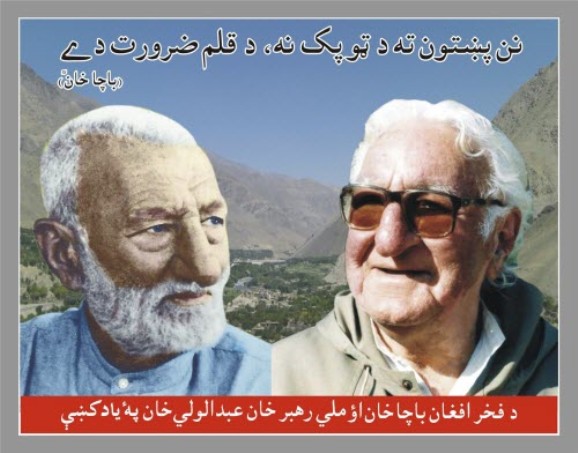
No matter what Imran Khan and others want to do, let the whole world know that Bacha Khan is a hero of Muslims and Pashtuns.
Kabul ke pa BACHA KHAN BABA PA Seminar Hamid Karzai 1 - YouTube
By Mureeb MohmandPublished: October 25, 2013
The ANP parliamentary leader in the K-P assembly Sardar Hussain Babak has said that the PTI-led K-P government, at the suggestion of its coalition partner JI, wants to exclude two essays from the Pashto Book of class six and seven — on Khan Abdul Ghafar Khan (commonly known as Bacha Khan), a Pashtun social reformer, and Ghani Khan, a famous Pashto poet, as the former is the grandfather of ANP leader Asfandyar Wali Khan and the latter is his uncle. Sources in the PTI have rejected the statement which was published in many Urdu papers but speculation about the issue lingers.
The two people under discussion are both famous Pashtun personalities, which is why the ANP government has added an essay on both in the local textbooks. Pashtuns have a rich history and especially so in the Pakistan movement for which they have rendered many sacrifices. Unfortunately, our textbooks say nothing about these Pashtun heroes. The local youth possesses knowledge of all those who have nothing to do with their region but are unaware of local heroes like Haji Sahib Turangzai, Sardar Ayub Khan, Umra Khan of Jandul, Faqir of Ipy, Malalai of Maiwand and many others who also sacrificed much in the struggle for independence.
There is no doubt that Sir Syed Ahmed Khan was the founder of the modern education system in India but it is also a fact that Bacha Khan and Haji Sahib Turangzai had laid down the foundation of Azad schools on Pashtun land. It is a fact that Tipu Sultan and Nawab Siraj ud Daulah were heroes, but Umra Khan and Faqir had also fought bravely against the British Empire on Pashtun land. Our youth knows about Rani of Jhansi who was an Indian, and General Bakht Khan, both heroes from the War of Independence fought in 1857, but only a few know about Sardar Ayub Khan and Malalai who defeated the British on Afghan land.
As a student of the history and politics of the Pashtun people, I am of the opinion that Pashtun history is very rich, and it is our responsibility to teach our youth about these heroes. Entering essays on Ghafar Khan and Ghani Khan was the first step in the right direction. If their names are excluded from the (Pashto) textbooks that are already not being used in K-P’s private schools, then how can one expect other Pashtun heroes to be added to our textbooks in the future? Will we not forget our own heroes like this?
Published in The Express Tribune, October 25th, 2013.
Pashtun heroes deserve to be remembered – The Express Tribune
1. Pashtuns of "Pakistan" (land of the pure) are facing linguistic genocide.
Most Pashtuns can no longer write in their mother tongue, Pashto.
2. They are facing war. They are being bombed and killed.
3. They are facing the destruction of their homes and societies.
Over 1 million Pashtuns have been made refugees, mainly from the FATA region.
4. In addition to this physical, cultural and linguistic onslaught, Pashtuns of "Pakistan" are being de-Pashtunized even more by the omission of their historical figures, many of whom are also Islamic figures.
No matter what Imran Khan and others want to do, let the whole world know that Bacha Khan is a hero of Muslims and Pashtuns.
Kabul ke pa BACHA KHAN BABA PA Seminar Hamid Karzai 1 - YouTube

Comment