Announcement

Collapse
No announcement yet.

Crimes

Collapse
X
 
  • Filter
  • Time
  • Show
Clear All
new posts

  • #16
    Originally posted by randolph85 View Post
    all you are doing is posting pics from anti islamic sites. this is hardly some unbiased thread about crimes around the world.
    rawa.org is anti-islamic?
    as i posted just one article in one thread no one said something hmmmmmmmmmmmm

    just look for articles about the drones in yemen and pakistan
    faye's chauffeur

    Pashton's girlfriend

    I'm a Pashtun Princes


    Comment


    • #17
      several anti islamic pictures and then one rawa picture to "balance" things out doesn't work.
      There are people today who think that admitting God’s absolute greatness decreases the value and importance of humans in the creation, as if God and mankind are rivals competing in greatness and power. Meanwhile I feel that whenever our perception of God’s greatness increases, with it we become greater, because we are the creation of a great God.

      Sayyid Qutb

      Comment


      • #18
        Originally posted by Bengal_Tiger View Post
        What is the point of this thread??

        I would expect to see this in some sort of anti-Muslim site or Islamophobic webpage trying to show how Muslims are evil, but not on a Muslim forum.

        All I see is images and articles trying to show how evil Muslims and Islam are.
        And this thread was opened by a kaffir (aka hallo) to show crimes of Muslims but not the crimes of tons of non Muslims which is commited everyday. Talk about a hidden agenda!

        Coincedence? I think not!
        "Revenge is a dish best served cold".

        -Old Pashtun proverb


        "My Pashtun Pride i will not hide!"

        Comment


        • #19
          faye's chauffeur

          Pashton's girlfriend

          I'm a Pashtun Princes


          Comment


          • #20
            faye's chauffeur

            Pashton's girlfriend

            I'm a Pashtun Princes


            Comment


            • #21
              faye's chauffeur

              Pashton's girlfriend

              I'm a Pashtun Princes


              Comment


              • #22
                A War Without End: US Atrocities in Afghanistan

                Vital homeland needs go begging. Targeted countries are ravaged and destroyed. Imperial lawlessness operates this way

                by Stephen Lendman
                US drones murder Afghan civilian men, women and children. American grounds forces do it up close and personal.
                US inflicted death, torture and other atrocities reflect daily life. Ordinary Afghans suffer most. They struggle to survive. American aggression is one of history’s greatest crimes.
                War criminals remain unpunished. Accountability is denied. Conflict persists. It’s Washington’s longest war. It’s longer than WW I and II combined. It shows no signs of ending.
                Trillions of dollars go mass slaughter and destruction. They’re spent for unchallenged global dominance.
                Vital homeland needs go begging. Targeted countries are ravaged and destroyed. Imperial lawlessness operates this way.
                Its appetite is insatiable. It ignores rule of law principles. It does whatever it wants. It does it where, when, by what means, and under whatever pretexts it contrives.
                It does so unapologetically. It targets one country at a time or in multiples. It wages direct and proxy wars. It does so without justification. It lies claiming otherwise.
                Atrocities are virtually de rigueur. All US wars are dirty. In March 2012, 20 US forces murdered 16 Afghan men, women, and nine children aged two to 12.
                Children were massacred while they slept. Two women were raped before soldiers killed them. Pentagon officials and media scoundrels whitewashed what happened.
                One soldier was blamed for crimes 20 US forces committed. Nineteen got off scot-free. Cold blooded murder and other atrocities persist. They do so with disturbing regularity.
                On November 12, Reuters headlined ” ‘Lack of US Cooperation halts Afghan probe into civilian killings,” saying:
                “Afghanistan’s intelligence service has abandoned its investigation into the murder of a group of civilians after being refused access to US special forces soldiers suspected of involvement, according to a document obtained by Reuters.”
                War crimes were committed. US forces raided Wardak province. They did so from October 2012 to February 2013.

                Cartoon: Carlos Latuff
                Seventeen Afghan men were detained. They disappeared. Residents found 10 buried in shallow graves. They were several hundred meters from where US forces are based.
                “In the report authored by Afghanistan’s National Directorate of Security (NDS) intelligence agency, investigators said they had asked the United States for access to three US Green Berets and four Afghan translators working with them but were rebuffed,” said Reuters.
                On September 23, NDS published its report. “Despite many requests (it made, America hasn’t) cooperated,” it said. “Without (its) cooperation, this process cannot be completed.”
                Pentagon officials routinely whitewash serious war crimes. So do US commanders on the ground. Doing so is longstanding US policy. Rare exceptions prove the rule.
                Under a decade long military agreement, Afghan officials can’t charge US forces with war crimes. Whatever they do, they’re immune.
                Zakeria Kandahari is an Afghan translator. He works with US Green Berets. He’s done so for nine years.
                Documents Reuters obtained explained how US interrogations are conducted. Kandahari witnessed Sayid Mohammed’s treatment.
                He was murdered. Kandahari named three US Special Forces responsible. He kicked Mohammed,” he said. He beat him. He threatened him.
                “I handed him over to Mr. Dave and Mr. Hagen, but later I saw his body in a black body bag,” he said.
                Wardak residents accuse US forces of abducting Afghan men and boys. Interrogations involving torture follows.
                Karzai is a US installed stooge. He’s done nothing to stop what’s persisted throughout his tenure. Failure to act responsibly reflects complicity.
                Russia Today interviewed journalist Matthieu Aikins. He spent five months investigating the Wardak incident.
                Local residents bore testimony. They supplied credible evidence. War crimes were committed. According to Aikins:
                “The special forces team was deployed to an isolated valley west of Kabul, where the Taliban and other insurgents groups have a very heavy presence.”
                “Over last winter, the locals started complaining that the forces team and their translators were murdering people, abducting them, trotting them, and disappearing them.”
                “Just extraordinary allegations that at the time were essentially unproven.”
                In November 2012, residents first complained about a so-called Special Forces ODA 3124 unit.
                When it withdrew in April, human remains were discovered near America’s Nerkh district base.
                Local authorities determined that ODA 3124 operations bore full responsibility.
                Survivor testimonies confirmed it. Victims described being severely beaten and tortured.
                ICRC representatives obtained more evidence. Because of an alleged US investigation, details weren’t disclosed.
                According to Aikins:
                “In the five months that I spent reporting this story, not a single one of the witnesses that I spoke to had ever been contacted by the US military investigator.”
                “So it does really beg the question whether these investigators are actually going to be able to establish any sort of accountability of what happened.”


                The Associated Press, Jul. 9, 2013: A missing-persons poster, with pictures of nine men who their relatives say were last seen being arrested by U.S. special operation forces, is held by a villager in Maidan Shahr, Afghanistan on Sunday, March 10, 2013. The posters were up for several months, but taken down after the bodies were found buried in a field near a U.S. base in Narkh district, about 15 kilometers (about 10 miles) from Maidan Shahr, capital of the Wardak province. (Photo: Anja Niedringhaus/AP)

                It bears repeating. Pentagon officials routinely whitewash serious war crimes. So do US commanders on the ground.
                Unaccountability is standard practice. US forces guilty of rape, torture and murder go unpunished.
                On November 6, Aitkins headlined his Rolling Stone article “The A-Team Killings.”
                “Last spring,” he said, “the remains of 10 missing Afghan villagers were dug up outside a US Special Forces base – was it a war crime or just another episode in a very dirty war?”
                Six months after US Special Forces arrived in Wardak province, allegations of torture and murder surfaced.
                Locals said 10 civilians were abducted. They disappeared. US Special Forces were responsible.
                They killed another eight Afghans during their operations. Perhaps more bodies remain to be discovered.
                On February 16, “a student named Nasratullah was found under a bridge with his throat slit,” said Aikins.
                Family members said US Green Berets abducted him. Other bodies were found. In July, Col. Jane Crichton lied, saying: ”After thorough investigation, there was no credible evidence to substantiate misconduct by ISAF (International Security Assistance Force) or US forces.”
                According to Aikins:
                “(O)ver the past five months, Rolling Stone has interviewed more than two dozen eyewitnesses and victims’ families who’ve provided consistent and detailed allegations of the involvement of American forces in the disappearance of the 10 men, and has talked to Afghan and Western officials who were familiar with confidential Afghan-government, UN and Red Cross investigations that found the allegations credible.”
                “In July, a UN report on civilian casualties in Afghanistan warned: ‘The reported disappearances, arbitrary killings and torture – if proven to have been committed under the auspices of a party to the armed conflict – may amount to war crimes.”
                Aikins recounted Gul Rahim’s killing. He spoke to three of his neighbors. They saw US Special Forces arrive.
                They heard gun shots. When they left. They saw Rahim’s “bullet-ridden body lying among the apple trees, his skull shattered.”
                A man identified only as Omar was targeted. He witnessed Rahim’s killing. He survived.
                He was taken to America’s Nerkh base. He was put in a plywood cell. Interrogations began the next morning.
                His hands were bound above his head. He was suspended and beaten. Afghan translator Zakeria Kandahari was involved.

                A Royal Marine was found guilty of murdering an injured Afghan insurgent by a military court. The judge released stills from the footage they inadvertantly took of the incident but not the footage itself.
                Two Americans interrogated him. He said he knew nothing about Rahim and local Taliban commanders.
                Beatings intensified. Sessions lasted for two days. “At one point,” said Aikins, “Kandahari held a pistol to Omar’s head and told him that he would kill him as easily as he had killed his friend.”
                He was certain he’d die. At night, he was shackled in his plywood cell. Americans handed him over to Afghan forces. He realized he was being freed.
                ” ‘I promised that I would kill you,’ he says Kandahari told him, ‘and I don’t know how you’re getting away alive.”
                Wardak is an intense battleground. It’s “littered with bomb craters and burned-out tanker trucks,” said Aikins.
                Many disappeared Afghans “were rounded up by the Americans in broad daylight, in front of dozens of witnesses.”
                Aikins obtained credible testimonies. Mohammad Hazrat Janan is deputy head of Wardak’s provincial council.
                US forces terrorize people, he said. They do it “because they could not defeat the insurgents.”
                People abducted weren’t Taliban, he explained. “(B)ut even if they were, no one is allowed to just kill them in this way.”
                Nerkh district feels besieged, said Aikins. It’s a “hotbed of guerrilla resistance.” It’s close to Kabul. It’s a “staging ground for suicide attacks on the capital.”
                US forces are stationed at Combat Outpost Nerkh. Green Beret units are called Operational Detachment Alpha, ODA, or A-Team. The Nerkha-based one is called ODA 3124.
                It’s involved in counterinsurgency operations. They part of what’s known as “white” Special Forces. So-called “black” ones launch night raids.
                CIA elements are involved in local operations. Insurgents control Nerkh rural areas. US forces are vulnerable to ambushes or roadside blasts.
                Nerkh incidents didn’t occur in a vacuum, said Aikins. “Over the past 10 years human rights groups, the UN and Congress have repeatedly documented the recurring abuse of detainees in the custody of the US military, the CIA and their Afghan allies.”
                According to Human Rights Watch Asia advocacy director John Sifton:
                “The US military has a poor track record of holding its forces responsible for human rights abuses and war crimes.”
                “There are some cases of detainee deaths 11 years ago that resulted in no punishments.”
                Aikins said a former ODA 3124 interpreter named Farooq said he “routinely witnessed abusive interrogations during his time with the A-Team, involving physical beatings with fists, feet, cables and the use of devices similar to Tasers.”
                When Obama begins drawing down US forces, Green Berets and CIA will remain. According to Aikins, they’ll be even less oversight than now.
                Based on what he’s seen and gotten from witnesses, “the fight in Afghanistan may get even dirtier.”
                Covert war may continue interminably. Afghans have enjoyed rare times of peace. They’ve had none for over three decades. Future prospects look grim.
                For centuries, Afghans experienced what few can imagine. Marauding armies besieged cities. They slaughtered thousands. They caused vast destruction.
                Imperial Britain and Czarist Russia vied for control. Local warlords exerted their own dominance. When Soviet Russia withdrew in 1989, a ravaged country remained.
                Living Afghans can’t remember peace, stability and tranquility. Endless conflicts persist.
                Post-9/11, America’s attack, invasion and occupation followed. Millions died. Countless others suffer horrifically.
                It bears repeating. Nothing ahead looks promising. America came to stay. Permanent occupation is planned.
                Afghanistan is strategically important. It straddles the Middle East, South and Central Asia. It’s in the heart of Eurasia.
                Occupation projects America’s military might. It targets Russia, China, Iran, and other oil-rich Middle East states.
                It furthers Washington’s imperium. It prioritizes unchallenged global dominance. It seeks control over Afghan’s untapped natural gas, oil and other mineral resources.
                In June 2010, The New York Times headlined “US Identifies Vast Mineral Riches in Afghanistan,” saying:
                They’re worth an estimated $1 trillion. Estimates are notoriously inaccurate.
                Whatever they’re worth, they include “huge veins of iron, copper, cobalt, gold and critical industrial metals like lithium – are so big and include so many minerals that are essential to modern industry that Afghanistan could eventually be transformed into one of the most important mining centers in the world, the United States officials believe.”
                An internal Pentagon memo calls Afghanistan the “Saudi Arabia of lithium.” It’s a key material needed to produce “batteries, laptops and BlackBerrys.”
                Years of development are needed. Huge potential exists. Heavy investment is likely. An economic bonanza awaits profiteers.
                Don’t expect ordinary Afghans to benefit. Surviving concerns them most. Violence continues unabated.
                Living conditions are deplorable. Vital services are lacking. Millions have little or no access to clean water.
                Many don’t get enough food. Life expectancy is one of the world’s lowest. Infant mortality is one of the highest.
                Extreme poverty, unemployment, human misery, and constant fear reflect daily life. Washington prioritizes conquest, colonization, plunder and dominance.
                War without end rages. Human needs go begging. Wherever America shows up, death and destruction follow. So does unrelieved dystopian harshness. No end in sight looms.
                Stephen Lendman lives in Chicago. He can be reached at lendmanstephen@sbcglobal.net.

                faye's chauffeur

                Pashton's girlfriend

                I'm a Pashtun Princes


                Comment


                • #23
                  The Nerkh Killings: The problem with ‘immunity’ for US soldiers


                  Author: Kate Clark Date: 14 November 2013


                  Afghans torturing an Afghan detainee - and US soldiers standing by? This video (screenshot; find link to play video in text), referenced in Matt Aikins' Rolling Stones story on the Nerkh killings indicates that Nerkh might not have been an isolated incident.

                  Revelations concerning the alleged involvement of US soldiers in the forced disappearance, murder and torture of Afghans in the Nerkh district of Wardak a year ago keep surfacing. The US insists its forces come only under US legal jurisdiction, that they are ‘immune’ from Afghan courts and that it will investigate any wrongdoing by its forces. This non-negotiable demand is due to be debated at a consultative loya jirga on the Bilateral Security Agreement in just over a week’s time. Yet the Nerkh case and others show just how poor the US military and the CIA are at investigating the crimes of their own, especially when it comes to command responsibility. To date, no officer has been prosecuted for authorising crimes or failing to stop a junior committing a crime. AAN Senior Analyst, Kate Clark, reports.
                  Villagers in Nerkh first raised the alarm over their people going missing in November 2012. Both the US military and ISAF (according to a new report by Matthieu Aikins in Rolling Stone and the government of Afghanistan (according to UNAMA) were informed, but it was months and about a dozen ‘disappearances’ later before the Afghan government forced the unit to leave. It was only after the International Committee of the Red Cross (ICRC) presented fresh evidence to ISAF command in early June that it ordered the US military to start a criminal investigation.
                  Pressure on the US military to act has come from the media – with repeated investigative reports over many months by Reuters, here, here and here, the New York Times, here, here and here and the Wall Street Journal (see here) - and from the UN, the ICRC, the government of Afghanistan and local people. The allegations are serious – disappearances, arbitrary killings and torture. Ten people are believed to have been killed and a further eight have disappeared. The question is not only who carried out the killings and other crimes, but also who may have had command responsibility. This is when a superior (civilian or military) authorises or allows a subordinate to commit a crime. (1) UNAMA, writing about the incidents in July, was blunt about their gravity: “If proven to have been committed under the auspices of a party to the armed conflict [these] may amount to war crimes.”
                  Nerkh: Investigations and denials
                  After villagers and provincial council members first complained about the disappearances, the government set up first one and then a second investigation. ISAF, which often speaks on behalf of the US ‘counter-terrorism’ mission, Operation Enduring Freedom, and US military spokesmen have repeatedly denied the involvement of US forces in any mistreatment. The first denial came in January after a video was found showing an Afghan, later named as Zikria Kandahari, whom villagers said was an interpreter on the base and ISAF said was a former interpreter, beating a detainee. (Kandaharhi was arrested by the NDS in July 2013.)
                  In February 2013, the Afghan government ordered all US Special Forces to leave the province because of the Nerkh allegations. It seems that at this point, the US military was jolted into action. It set up a joint investigation with Afghan counterparts in early March. According to UNAMA, Afghan members of the team said the US Special Forces had perpetrated the killings and US members denied this. Then, more evidence came – literally – to light after the Special Forces unit left Nerkh and villagers could finally start digging in the hope of finding bodies. They unearthed ten sets of human remains buried in six locations near the base. Aikins reports the Afghan army commander who took over the base laughing at the suggestion that anyone could bury a body 50 yards outside the perimeter without those inside being aware of it:
                  “There is no possibility,” he says, pointing out that his guard towers have clear lines of sight in all directions over the flat ground. No one could start digging outside the base without attracting immediate attention. “The Americans must have known they were there.”
                  Witnesses repeatedly placed US soldiers as involved. Aikins, for example, reported: “Many of the men who disappeared in Nerkh were rounded up by the Americans in broad daylight, in front of dozens of witnesses.” He interviewed men who alleged they were badly beaten by US soldiers as well as by Kandahari and one who said he witnessed Kandahari killing one of the victims, Gul Rahman, in front of American soldiers. Another translator with the Special Forces unit said the team routinely abused detainees. An indication that the Nerkh abuses may not have been an isolated case came with the release of a video showing a bound, blindfolded Afghan being beaten in an interrogation by Afghans with what look to be US soldiers looking.
                  Aikins said none of the witnesses or family members he had spoken to had been interviewed by the military investigators. This is a pattern AAN has found looking into other cases, for example, the (probably legal) killing of an Afghan journalist by a US soldier in Uruzgan in 2012. Reuters has also now reported new allegations, that NDS investigators said they were refused access to three US soldiers and four Afghan translators whom they wanted to interview about the killings. The soldiers are protected from Afghan criminal jurisdiction by the Status of Forces Agreement signed by the US and Afghan governments in 2003 (for more detail, see here); this is a legal protection which the Bilateral Security Agreement would re-new for any post-2014 US deployment. The translators, however, should not be protected.
                  The US record on investigating soldiers and CIA officials
                  Unfortunately, what we have seen over the Nerkh killings in the last year is a familiar pattern. As AAN said in a major report on transitional justice and reconciliation in Afghanistan:
                  The US military seldom publicizes the results of investigations into specific abuses, including torture, deaths in detention and indiscriminate or disproportionate use of force during ground operations. In the majority of cases, there is little indication that anyone has been held accountable for these abuses.
                  One could add that the few cases which have come to prosecution have predominantly been of junior soldiers and, in one case, a CIA civilian contractor. When officers have been prosecuted, it is for their direct involvement in crimes. No-one has been prosecuted for command responsibility. Yet, this is one of the key ways in ensuring systemic failures do not go unchecked. The system and culture of holding soldiers and those in command accountable is fundamental to ensuring abuses do not take place. As Human Rights Watch said in relation to Nerkh, “It is hardly a surprise that serious abuses keep occurring when the US so rarely punishes those who commit them.”
                  Two pieces of research which have sought to calculate how well the US army and CIA investigated the abuse of detainees were published in 2006. In the first, Human Rights First counted nearly 100 deaths of US ‘war on terror’ detainees (ie in Afghanistan and Iraq) since August 2002. Breaking this number down, it said, the US had classified 34 as suspected or confirmed homicides; Human Rights First judged a further 11 to have been due to physical abuse or harsh conditions; it said eight people had been tortured to death; finally, in almost half the cases, the cause of death remained undetermined or unannounced. Yet, it said, only 12 detainee deaths had resulted in punishment of any kind for a US official:
                  Of the 34 homicide cases so far identified by the military, investigators recommended criminal charges in fewer than two thirds, and charges were actually brought (based on decisions made by command) in less than half. While the CIA has been implicated in several deaths, not one CIA agent has faced a criminal charge. Crucially, among the worst cases in this list – those of detainees tortured to death – only half have resulted in punishment; the steepest sentence for anyone involved in a torture-related death: five months in jail.
                  The second report, by Human Rights Watch, which was based on joint research with a number of organisations (2) found US abuse of ‘war on terror’ detainees (in Afghanistan, Guantanamo Bay and Iraq) was “widespread”; it documented more than 330 cases in which US military and civilian personnel were “credibly alleged” to have abused or killed detainees. It said 54 military personnel out of the more than 600 implicated were convicted by courts martial, with just 40 sentenced to prison and of these, only ten to a term longer than one year.
                  Military commanders, it said, often chose to proceed with weaker non-judicial forms of disciplinary action (such as dismissal, cuts in pay and reductions in rank). No CIA officer has been put on trial. One civilian contractor working with the CIA was found guilty of assault in the beating to death of a prisoner in Kunar in 2003. Human Rights Watch found only about half the cases of alleged torture or other mistreatment appeared to have been properly investigated:
                  In numerous cases, military investigators appear to have closed investigations prematurely or to have delayed their resolution. In many cases, the military has simply failed to open investigations, even in cases where credible allegations have been made.
                  Trials and Denials
                  There have only been a few cases where US personnel have been put on trial. These include, recently, Sergeant Robert Bates who killed 16 civilians, including nine children, in Panjwayi in 2012 and members of what became known as the ‘kill team’, US soldiers who killed civilians in Kandahar in 2009 and collected body parts as trophies. “It is proper that Sergeant Bates has been held accountable,” said Human Rights Watch, “But in many respects this case is an outlier: an obvious perpetrator clearly acting on his own, outside of any military operation, allowing for the punishment of a wrongdoer without implicating others.” As for the ‘kill team’, whose murders came to light after one of their comrades ‘blew the whistle’, while the soldiers involved were convicted, with sentences ranging from several months to life, the commander who allegedly encouraged the criminal behaviour received only a letter of admonishment.
                  Against these high profile cases can be put some egregious crimes committed in Afghanistan where no-one has been prosecuted or sentences have been minimal:
                  - Two men, Dilawar and Habibullah, were tortured to death in Bagram in 2002, in separate incidents. Media investigations initially uncovered the fact that Dilawar had not died of ‘natural causes’ as the military had been claiming. At a trial in 2005, those involved in the killings received sentences ranging from three months in jail to reductions in rank and temporary reductions in pay. (See reporting here and here.
                  - Gul Rahman, the driver of Ghairat Bahir, (son-in-law of Hezb-e Islami leader, Gulbuddin Hekmatyar) was rendered by the CIA along with Bahir from Pakistan to Afghanistan in 2002. He froze to death in a CIA detention facility known as the Salt Pit after a case officer ordered guards to strip him naked and leave him chained on a concrete floor overnight. It was not until 2010 that the Associated Press uncovered the killing. As the Open Society Foundations reported earlier this year:
                  A CIA Office of Inspector General investigation “determined that the CIA’s top officer…at the prison displayed poor judgment by leaving Rahman in the cold.” The investigative report also “expressed concerns about the CIA station chief in Afghanistan, and later placed some blame on agency management at headquarters.” The inspector general referred the case to the Justice Department, but prosecutors decided not to bring charges. Although a review board comprised of senior officials subsequently recommended that the CIA’s top officer at the Salt Pit should be disciplined, CIA high-ranking official Kyle “Dusty” Foggo, determined no one would be punished. In 2011, Rahman’s case became one of two cases to be criminally investigated by the US Justice Department. In August 2012, Attorney General Holder summarily announced that the Justice Department would not pursue criminal charges in these cases.
                  Holder said “admissible evidence would not be sufficient to obtain and sustain a conviction beyond a reasonable doubt.” (See reporting here and here.)
                  - In March 2007 in Jalalabad, Afghanistan, US Marines fleeing an ambush, fired indiscriminately on people along a lengthy stretch of road, killing 19 civilians, including a 16 year old girl and a 75 year old man. Human Rights Watch said, “Although the unit was withdrawn from Afghanistan and an investigation opened, no one was ever charged.”
                  - In Khataba, Gardez, US soldiers attempted to cover up a botched night raid in 2010 where civilians, including pregnant women, were killed. The soldiers dug bullets out of the women’s bodies and claimed they had been murdered in an ‘honour killing’ (see the original US military version here and the actual story here. The military initially tried to besmirch the reputation of the reporter who had uncovered the crime – Jerome Starkey of The Times - rather than investigating it. Eventually, the US Special Forces commander came to the village to beg forgiveness. Starkey told AAN that, as far as he knows, no-one has been charged or disciplined over the incident.
                  - Ten election workers were killed in a US air strike in Takhar in 2010 after intelligence mixed up who held a telephone SIM card and failed to make even the most basic ‘human intelligence’ checks. The US air force targeted the wrong man, a civilian, Zabit Amanullah, killing him and nine of his companions. Despite being presented with overwhelming evidence (see AAN reporting here) which included an interview with the man the military claimed to have killed, the US command continued to insist they had killed a Taleban deputy governor and his Taleban fighters. Subsequently, when journalists asked the US military about the case, spokesmen deceived them as to the evidence on which they had based the targeting. As AAN said at the time:
                  The apparent inability, or unwillingness, of the ISAF command and US Special Forces to listen to alternative accounts of operations which Afghans and foreigners like ourselves believe have resulted in civilian casualties is troubling. How can mistakes and systemic failures be addressed without at least some honesty about what has gone wrong?
                  Criminal Jurisdiction and the Bilateral Security Agreement
                  The US military is not the only country with troops deployed in Afghanistan which has proved poor at investigating its own. As recent court cases in the UK (3) and Germany (4) show, failings go much wider. Yet, it is the US which is in the spotlight because of its demand that US forces fall only under US criminal jurisdiction. From the US point of view, it is unthinkable that it would allow its forces to be put in harm’s way by exposing them to the courts of any country, let alone those in Afghanistan where the justice system is deeply flawed. In the Afghan and often the international press, this demand is frequently presented as their being ‘immune’ from prosecution and US officials are keen to argue why this is not the case, for example US ambassador, James Cunningham in a recent press conference (the text was emailed by the embassy to AAN):
                  Our approach, to be clear, so there’s no misunderstanding, is not that American military personnel have immunity from punishment if they do something wrong, it’s that they will be punished, if it’s required that they will be punished, under American law by the American legal authority.
                  Yet claims by the US that it takes the crimes of its soldiers seriously are simply belied by the record. Afghanistan might still decide that, on balance, continuing to give up the right to legal jurisdiction over US forces is worth accepting for the benefits the Bilateral Security Agreement might bring. However, the way the US military has gone about addressing the serious allegations made in Nerkh gives little confidence that any crimes committed by US forces after 2014 would be properly investigated, let alone prosecuted. Moreover, indicators suggest this is likely to get worse. The international media has played a major role in uncovering crimes since 2001 and is already reducing its presence in Afghanistan. Also, after 2014, the planned US counter-terrorism force would be most probably be made up of Special Operations Forces and the CIA, who are both much more secretive than conventional forces. If the Bilateral Security Agreement is signed and US troops stay on after 2014 still under US criminal jurisdiction, it is likely to become even more difficult for Afghans to get justice.

                  (1) For a commander to be held responsible for the acts of his subordinates (according to Art. 28 of the Rome Statute of the International Criminal Court):
                  • The subordinates must be under the effective command and control, or the effective authority or control of the superior;
                  • The military commander knew or should have known that his forces were committing or about to commit such a crime;
                  • The military commander failed to take all necessary and reasonable measures to prevent the crimes or to punish them by submitting them to the competent authorities for investigation and prosecution;
                  • If the superior is a civilian, he will be responsible if he knew or consciously disregarded information which indicated that his subordinates were committing crimes.
                  (2) The Detainee Abuse and Accountability Project was a joint research effort by the Centre for Human Rights and Global Justice at New York University School of Law, Human Rights Watch and Human Rights First.
                  (3) In the last week, a British marine was found guilty of murdering a wounded Taleban detainee in Helmand. The killing came to light 12 months after it took place when civilian police arrested another marine (possibly one of those on the same patrol) during a completely different investigation and found a clip on his laptop showing members of the patrol dragging the Taleb across the field and talking about killing him. This was enough for the civilian police to get the military police involved.
                  Another clip was unearthed in the investigation showing the actual shot being fired and the marine (who has not been named) quoting Shakespeare: “Shuffle off this mortal coil, you cunt” and telling the rest of the patrol, "Obviously this doesn't go anywhere fellas. I've just broken the Geneva convention."
                  Three marines were charged with the murder and one was convicted. The two who were found not guilty, as well as other members of the patrol witnessed the killing and did not report it and some, at least, have returned to active duty. (For reporting, see here here and here.)
                  (4) A local court in Bonn (Thomas Ruttig writes) is currently examining whether relatives of the victims of an air strike ordered by the German PRT commander in Kunduz in 2009 can claim compensation from the German government. Earlier, after a preliminary investigation, the German Federal Prosecutor's Office had concluded that neither international or German law had been broken.
                  The strike killed around 90 civilians on 4 September 2009 on the border of Chahrdara and Aliabad districts of Kunduz. The PRT commander had ordered the strike on two fuel tankers which had been hijacked by Taleban. The lorries had got stuck in a riverbed and the Taleban had called locals to pump out the fuel, but the commander relied on a single local source who claimed that only Taleban were on the spot. He declared the PRT to be in ‘imminent danger’ and falsely claimed troops were ‘in contact’ (ie engaged in a firefight and needing air support). He also rejected the offer of a ‘show of force’ low-altitude over-flight to disperse the crowd by the two US jet pilots who ultimately carried out the strike. (For reporting on the strike, see here and here, and on the recent and earlier court proceedings see here.) The Laws of War stipulate that parties to a conflict cannot target civilians and must take all feasible precautions to protect them.


                  The Nerkh Killings: The problem with
                  faye's chauffeur

                  Pashton's girlfriend

                  I'm a Pashtun Princes


                  Comment


                  • #24
                    this topic is full of raccism out of context and most of the scenarios are the result of american occupation and intervention yara sry.using shiit words like wahabi or american words like islamists dont explain why .

                    Comment


                    • #25
                      US drone strikes could be classed as war crimes, says Amnesty International

                      Joint report with Human Rights Watch judges US attacks in Yemen and Pakistan to have broken international human rights law


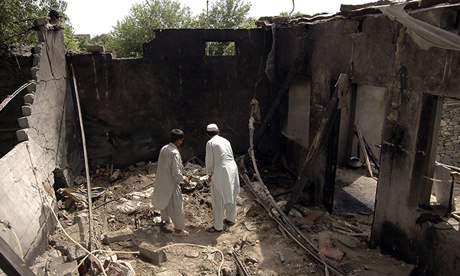
                      A house in Pakistan near the border with Afghanistan destroyed by a drone missile in 2008. Eighteen people including Islamist militants were killed. Photograph: Reuters


                      US officials responsible for the secret CIA drone campaign against suspected terrorists in Pakistan may have committed war crimes and should stand trial, a report by a leading human rights group warns. Amnesty International has highlighted the case of a grandmother who was killed while she was picking vegetables and other incidents which could have broken international laws designed to protect civilians.
                      The report is issued in conjunction with an investigation by Human Rights Watch detailing missile attacks in Yemen which the group believes could contravene the laws of armed conflict, international human rights law and Barack Obama's own guidelines on drones.
                      The reports are being published while Nawaz Sharif, Pakistan's prime minister, is in Washington. Sharif has promised to tell Obama that the drone strikes – which have caused outrage in Pakistan – must end.
                      Getting to the bottom of individual strikes is exceptionally difficult in the restive areas bordering Afghanistan, where thousands of militants have settled. People are often terrified of speaking out, fearing retribution from both militants and the state, which is widely suspected of colluding with the CIA-led campaign.
                      There is also a risk of militants attempting to skew outside research by forcing interviewees into "providing false or inaccurate information", the report said.
                      But Amnesty mounted a major effort to investigate nine of the many attacks to have struck the region over the last 18 months, including one that killed 18 labourers in North Waziristan as they waited to eat dinner in an area of heavy Taliban influence in July 2012. All those interviewed by Amnesty strongly denied any of the men had been involved in militancy. Even if they were members of a banned group, that would not be enough to justify killing them, the report said.
                      "Amnesty International has serious concerns that this attack violated the prohibition of the arbitrary deprivation of life and may constitute war crimes or extrajudicial executions," the report said. It called for those responsible to stand trial.
                      The US has repeatedly claimed very few civilians have been killed by drones. It argues its campaign is conducted "consistent with all applicable domestic and international law".
                      The Amnesty report supports media accounts from October last year that a 68-year-old woman called Mamana Bibi was killed by a missile fired from a drone while she was picking okra outside her home in North Waziristan with her grandchildren nearby. A second strike minutes later injured family members tending her.
                      If true, the case is striking failure of a technology much vaunted for its accuracy. It is claimed the remote-controlled planes are able to observe their targets for hours or even days to verify them, and that the explosive force of the missiles is designed to limit collateral damage. As with other controversial drone strikes, the US has refused to acknowledge or explain what happened.
                      Amnesty said it accepts some US drone strikes may not violate the law, "but it is impossible to reach any firm assessment without a full disclosure of the facts surrounding individual attacks and their legal basis. The USA appears to be exploiting the lawless and remote nature of the region to evade accountability for its violations," it said.
                      In Yemen, another country where US drones are active, Human Rights Watch highlighted six incidents, two of which were a "clear violation of international humanitarian law". The remaining four may have broken the laws of armed conflict because the targets were illegitimate or because not enough was done to minimise civilian harm, the report said.
                      It also argued that some of the Yemen attacks breach the guidelines announced by Obama earlier this year in his first major speech on a programme that is officially top secret. For example, the pledge to kill suspects only when it is impossible to capture them appears to have been ignored on 17 April this year when an al-Qaida leader was blown up in a township in Dhamar province in central Yemen, Human Rights Watch said.
                      An attack on a truck driving 12 miles south of the capital Sana'a reportedly killed two al-Qaida suspects but also two civilians who had been hired by the other men. That means the attack could have been illegal because it "may have caused disproportionate harm to civilians".
                      The legal arguments over drones are extremely complex, with much controversy focusing on whether or not the places where they are used amount to war zones.
                      Amnesty said some of the strikes in Pakistan might be covered by that claim, but rejected a "global war doctrine" that allows the US to attack al-Qaida anywhere in the world.
                      "To accept such a policy would be to endorse state practices that fundamentally undermine crucial human rights protections that have been painstakingly developed over more than a century of international law-making," the report said.


                      US drone strikes could be classed as war crimes, says Amnesty International | World news | The Guardian
                      faye's chauffeur

                      Pashton's girlfriend

                      I'm a Pashtun Princes


                      Comment


                      • #26
                        Originally posted by Khilji View Post
                        this topic is full of raccism out of context and most of the scenarios are the result of american occupation and intervention yara sry.using shiit words like wahabi or american words like islamists dont explain why .
                        should i open every time a new thread for every post?
                        faye's chauffeur

                        Pashton's girlfriend

                        I'm a Pashtun Princes


                        Comment


                        • #27
                          ISAF blamed for killing civilians in Batikot

                          Nangarhar Governor Attaullah Ludin said ISAF troops raided the houses of two brothers, who were labourers


                          A man who lost his children in a US bombing early during the US invasion of Afghanistan.
                          More Photos
                          International Security Assistance Forces (ISAF) soldiers killed two civilians in the Batikot district of eastern Nangarhar province, the Presidential Palace said, but the alliance insisted the dead were militants.
                          President Karzai was saddened by the killings and condemned the act, a statement from his office said, calling for an immediate end to international forces’ raids on civilian homes.
                          Nangarhar Governor Attaullah Ludin said ISAF troops raided the houses of two brothers, who were labourers, in the Shabdiani locality of Batikot. The incident resulted in the killing of both, the statement added.
                          In recent weeks, locals have been protesting increasing to the provincial governor over such raids. Residents had repeatedly asked the government to stop such incidents, the statement added.
                          But ISAF said the Batikot operation was led by Afghan forces and coalition troops were involved as advisors. The men killed were militants, not civilians, a statement from the alliance added.

                          faye's chauffeur

                          Pashton's girlfriend

                          I'm a Pashtun Princes


                          Comment


                          • #28
                            RAWA.org: Innocent civilians the main victims of the US/NATO so-called "war on terror" in Afghanistan (photos)
                            faye's chauffeur

                            Pashton's girlfriend

                            I'm a Pashtun Princes


                            Comment


                            • #29

                              what i mentioned about this video that syrian women hide their faces now hmmmmmmmmmm
                              Last edited by HalloIsBack; 12-07-2013, 04:17 PM.
                              faye's chauffeur

                              Pashton's girlfriend

                              I'm a Pashtun Princes


                              Comment


                              • #30
                                faye's chauffeur

                                Pashton's girlfriend

                                I'm a Pashtun Princes


                                Comment

                                Working...
                                X